•  
XB-1 Supersonic Prototype Makes Second Flight

XB-1 Supersonic Prototype Makes Second Flight

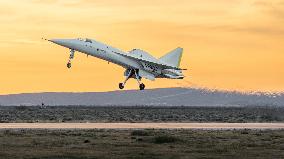
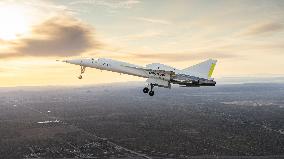
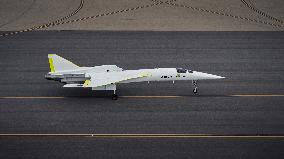
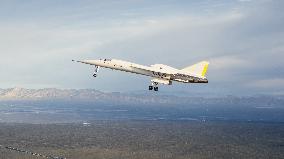
Handout photo shows Boom Supersonic’s XB-1 demonstrator aircraft completing his second test flight on August 26, 2024 in Mojave Air and Spaceport, California, USA. The flight, led by Chief Test Pilot Tristan “Geppetto” Brandenburg, focused on critical evaluations of the aircraft’s systems. This included testing the retraction and extension of the landing gear, as well as assessing a digital stability augmentation system known as a roll damper to enhance in-flight stability. Additionally, tufting, a technique used to visualize airflow, was applied to the right wing to ensure aerodynamic performance. The XB-1 took to the skies for the first time on March 22, 2024, safely achieving an altitude of 7,120 feet (2,100 meters) and speeds up to 238 knots (273 mph). The XB-1 serves as a demonstrator for Boom’s upcoming Overture airliner. The supersonic passenger jet is poised to seat between 64 and 80 passengers and fly up to 4,250 nautical miles (7,867 kilometers) at a cruising speed of Mach 1.7. The production of the

  •  
XB-1 Supersonic Prototype Makes Second Flight

XB-1 Supersonic Prototype Makes Second Flight

Handout photo shows Boom Supersonic’s XB-1 demonstrator aircraft completing his second test flight on August 26, 2024 in Mojave Air and Spaceport, California, USA. The flight, led by Chief Test Pilot Tristan “Geppetto” Brandenburg, focused on critical evaluations of the aircraft’s systems. This included testing the retraction and extension of the landing gear, as well as assessing a digital stability augmentation system known as a roll damper to enhance in-flight stability. Additionally, tufting, a technique used to visualize airflow, was applied to the right wing to ensure aerodynamic performance. The XB-1 took to the skies for the first time on March 22, 2024, safely achieving an altitude of 7,120 feet (2,100 meters) and speeds up to 238 knots (273 mph). The XB-1 serves as a demonstrator for Boom’s upcoming Overture airliner. The supersonic passenger jet is poised to seat between 64 and 80 passengers and fly up to 4,250 nautical miles (7,867 kilometers) at a cruising speed of Mach 1.7. The production of the

  •  
XB-1 Supersonic Prototype Makes Second Flight

XB-1 Supersonic Prototype Makes Second Flight

Handout photo shows Boom Supersonic’s XB-1 demonstrator aircraft completing his second test flight on August 26, 2024 in Mojave Air and Spaceport, California, USA. The flight, led by Chief Test Pilot Tristan “Geppetto” Brandenburg, focused on critical evaluations of the aircraft’s systems. This included testing the retraction and extension of the landing gear, as well as assessing a digital stability augmentation system known as a roll damper to enhance in-flight stability. Additionally, tufting, a technique used to visualize airflow, was applied to the right wing to ensure aerodynamic performance. The XB-1 took to the skies for the first time on March 22, 2024, safely achieving an altitude of 7,120 feet (2,100 meters) and speeds up to 238 knots (273 mph). The XB-1 serves as a demonstrator for Boom’s upcoming Overture airliner. The supersonic passenger jet is poised to seat between 64 and 80 passengers and fly up to 4,250 nautical miles (7,867 kilometers) at a cruising speed of Mach 1.7. The production of the

  •  
XB-1 Supersonic Prototype Makes Second Flight

XB-1 Supersonic Prototype Makes Second Flight

Handout photo shows Boom Supersonic’s XB-1 demonstrator aircraft completing his second test flight on August 26, 2024 in Mojave Air and Spaceport, California, USA. The flight, led by Chief Test Pilot Tristan “Geppetto” Brandenburg, focused on critical evaluations of the aircraft’s systems. This included testing the retraction and extension of the landing gear, as well as assessing a digital stability augmentation system known as a roll damper to enhance in-flight stability. Additionally, tufting, a technique used to visualize airflow, was applied to the right wing to ensure aerodynamic performance. The XB-1 took to the skies for the first time on March 22, 2024, safely achieving an altitude of 7,120 feet (2,100 meters) and speeds up to 238 knots (273 mph). The XB-1 serves as a demonstrator for Boom’s upcoming Overture airliner. The supersonic passenger jet is poised to seat between 64 and 80 passengers and fly up to 4,250 nautical miles (7,867 kilometers) at a cruising speed of Mach 1.7. The production of the

  •  
XB-1 Supersonic Prototype Makes Second Flight

XB-1 Supersonic Prototype Makes Second Flight

Handout photo shows Boom Supersonic’s XB-1 demonstrator aircraft completing his second test flight on August 26, 2024 in Mojave Air and Spaceport, California, USA. The flight, led by Chief Test Pilot Tristan “Geppetto” Brandenburg, focused on critical evaluations of the aircraft’s systems. This included testing the retraction and extension of the landing gear, as well as assessing a digital stability augmentation system known as a roll damper to enhance in-flight stability. Additionally, tufting, a technique used to visualize airflow, was applied to the right wing to ensure aerodynamic performance. The XB-1 took to the skies for the first time on March 22, 2024, safely achieving an altitude of 7,120 feet (2,100 meters) and speeds up to 238 knots (273 mph). The XB-1 serves as a demonstrator for Boom’s upcoming Overture airliner. The supersonic passenger jet is poised to seat between 64 and 80 passengers and fly up to 4,250 nautical miles (7,867 kilometers) at a cruising speed of Mach 1.7. The production of the

  •  
XB-1 Supersonic Prototype Makes Second Flight

XB-1 Supersonic Prototype Makes Second Flight

Handout photo shows Boom Supersonic’s XB-1 demonstrator aircraft completing his second test flight on August 26, 2024 in Mojave Air and Spaceport, California, USA. The flight, led by Chief Test Pilot Tristan “Geppetto” Brandenburg, focused on critical evaluations of the aircraft’s systems. This included testing the retraction and extension of the landing gear, as well as assessing a digital stability augmentation system known as a roll damper to enhance in-flight stability. Additionally, tufting, a technique used to visualize airflow, was applied to the right wing to ensure aerodynamic performance. The XB-1 took to the skies for the first time on March 22, 2024, safely achieving an altitude of 7,120 feet (2,100 meters) and speeds up to 238 knots (273 mph). The XB-1 serves as a demonstrator for Boom’s upcoming Overture airliner. The supersonic passenger jet is poised to seat between 64 and 80 passengers and fly up to 4,250 nautical miles (7,867 kilometers) at a cruising speed of Mach 1.7. The production of the

  •  
Toyota releases new Belta subcompact sedan

Toyota releases new Belta subcompact sedan

TOKYO, Japan - Toyota Motor Corp. on Nov. 28 released a new subcompact sedan named the Belta, powered either by a 1.0- or 1.3-liter engine, for sale in the domestic market. The car, 4.3 meters long and 1.7 meters wide, is Toyota's smallest sedan and comes in two- and four-wheel-drive models.

  •  
Toyota releases new Belta subcompact sedan

Toyota releases new Belta subcompact sedan

TOKYO, Japan - Toyota Motor Corp. on Nov. 28 released a new subcompact sedan named the Belta, powered either by a 1.0- or 1.3-liter engine, for sale in the domestic market. The car, 4.3 meters long and 1.7 meters wide, is Toyota's smallest sedan and comes in two- and four-wheel-drive models.

  •  
New Gion Festival drapery unveiled

New Gion Festival drapery unveiled

KYOTO, Japan - A newly completed 'dokake' drapery to decorate one of the 32 floats that feature the traditional Gion Festival in Kyoto is displayed for media review June 28. The silk-made fabric, 1.7 meters high and 2.6 meters wide, is designed to cover the ''Suzukayama'' float. It cost about 10 million yen to make. Festival organizers said a drapery for the ''Suzukayama'' float has been renewed for the first time in about 270 years.

  •  
Alloy Giken Automates Brazing Process Cleaning

Alloy Giken Automates Brazing Process Cleaning

Alloy Giken (Iwatsuki Ward, Saitama City) has automated the cleaning process, which is a preliminary step in the brazing process. In addition to addressing the shortage of manpower, the company aims to improve the working environment by reducing the emission of volatile organic solvents through the use of a sealed cleaning tank. Since the machine is about 2 meters square and 1.7 meters high, the space for the washing process was expanded. In anticipation of future restrictions on organic solvents and other cleaning fluids, a general-purpose cleaning tank was used. In the past, baskets containing parts were manually moved in and out of the cleaning tank, but now that the tank is sealed, "workers will not be bothered by the strong smell of volatile solvents," according to the company. The company says that this will also lead to a reduction in solvent costs. Photo taken on October 24, 2019, credit: Nikkan Kogyo Shimbun / Kyodo News Images

  •  
Toyota unveils extra-small Lexus concept car at Geneva auto show

Toyota unveils extra-small Lexus concept car at Geneva auto show

Toyota Motor Corp. of Japan displays a concept car for its extra-small model of the high-end Lexus brand at the start of the Geneva International Motor Show in the Swiss city on March 3, 2015. The car, codenamed LF-SA, is 3.45 meters long and 1.7 meters wide. (Kyodo) ==Kyodo

  •  
Toyota releases new Belta subcompact sedan

Toyota releases new Belta subcompact sedan

TOKYO, Japan - Toyota Motor Corp. on Nov. 28 released a new subcompact sedan named the Belta, powered either by a 1.0- or 1.3-liter engine, for sale in the domestic market. The car, 4.3 meters long and 1.7 meters wide, is Toyota's smallest sedan and comes in two- and four-wheel-drive models. (Kyodo)

  •  
Toyota releases new Belta subcompact sedan

Toyota releases new Belta subcompact sedan

TOKYO, Japan - Toyota Motor Corp. on Nov. 28 released a new subcompact sedan named the Belta, powered either by a 1.0- or 1.3-liter engine, for sale in the domestic market. The car, 4.3 meters long and 1.7 meters wide, is Toyota's smallest sedan and comes in two- and four-wheel-drive models. (Kyodo)

  •  
New Gion Festival drapery unveiled

New Gion Festival drapery unveiled

KYOTO, Japan - A newly completed 'dokake' drapery to decorate one of the 32 floats that feature the traditional Gion Festival in Kyoto is displayed for media review June 28. The silk-made fabric, 1.7 meters high and 2.6 meters wide, is designed to cover the ''Suzukayama'' float. It cost about 10 million yen to make. Festival organizers said a drapery for the ''Suzukayama'' float has been renewed for the first time in about 270 years.

  • Main
  • Top
  • Editorial
  • Creative
  • About Us
  • About ILG
  • Terms of use
  • Company
  • BEHIND
  • Price List
  • Single Plan
  • Monthly Plan
  • Services
  • Shooting
  • Rights Clearance
  • Support
  • FAQ
  • How To Buy
  • Contact Us
  • Become a Partner

© KYODO NEWS IMAGES INC

All Rights Reserved.

  • Editorial
  • Olympics
  • News
  • Sports
  • Japan
  • Tech
  • Royal
  • Disaster
  • NorthKorea
  • Old Japan
  • SNS
  • Creative
  • Food
  • Japan
  • Landscape
  • Animal
  • Popular
  • #Ukraine
  • #Russia
  • #coronavirus
  • #N. Korea
  • #Thailand
  • #China
  • #Ukraine
  • #Russia
  • #coronavirus
  • #N. Korea
  • #Thailand
  • #China
  • Food
  • Japan
  • Landscape
  • Animal
  • Olympics
  • News
  • Sports
  • Japan
  • Tech
  • Royal
  • Disaster
  • NorthKorea
  • Old Japan
  • SNS