•  
Scroll shows sword-wielding skill license given to historical hero

Scroll shows sword-wielding skill license given to historical hero

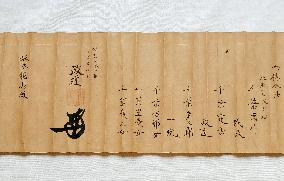
KYOTO, Nov. 12 Kyodo - Photo taken in Kyoto, western Japan, on Nov. 7, 2015, shows a scroll certifying the skill in wielding a "naginata" long-handled sword given to historical hero Sakamoto Ryoma in the waning years of the Edo period (1603-1867). The name of his lover, Chiba Sana, is among a list of names that also includes Chiba Shusaku, founder of the Hokushin Ittoryu school of swordsmanship.

  •  
Medieval folding-screen painting re-created with brocade

Medieval folding-screen painting re-created with brocade

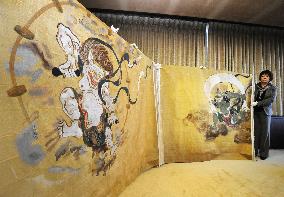
KYOTO, Japan - A "Nishijin-ori" brocade version of the "Fujin Raijin" (Wind and Thunder Gods) painting drawn on a folding screen by Tawaraya Sotatsu in the Edo period (1603-1867) is displayed in Kyoto, western Japan, on Dec. 18, 2014. Nishijin-ori craftsmen spent seven years to complete the work using traditional weaving skills.

  •  
Craftsmen re-create folding-screen painting with brocade

Craftsmen re-create folding-screen painting with brocade

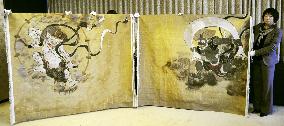
KYOTO, Japan - Two pieces of "Nishijin-ori" brocade made to re-create the "Fujin Raijin" (Wind and Thunder Gods) painting drawn on a folding screen by Tawaraya Sotatsu in the Edo period (1603-1867) are displayed in Kyoto, western Japan, on Dec. 18, 2014. Using traditional Nishijin-ori weaving skills, craftsmen spent seven years to complete the work.

  •  
Feudal-era wooden tablet depicts rare sumo technique

Feudal-era wooden tablet depicts rare sumo technique

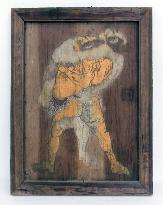
TONDABAYASHI, Japan - A wooden votive "ema" tablet from the Edo period (1603-1867) kept at a shrine in Kawachinagano, Osaka Prefecture, western Japan, is seen in the western Japanese city on Oct. 16, 2014. The tablet depicts a sumo technique known as "kawazu-gake," or a leg-entangled throw.

  •  
Cotton planting restored in western Japan

Cotton planting restored in western Japan

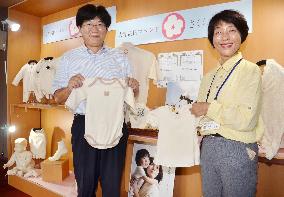
KASHIHARA, Japan - Miho Morita (R), a section chief of the Yamatotakada Chamber of Commerce and Industry, and Yoshihiro Yoshioka, a local researcher of spinning industry history, hold baby wear made of locally grown cotton in Yamatotakada, Nara Prefecture, western Japan, on Aug. 20, 2014. The chamber and local companies collaboratively grow organic cotton to bring back cotton plantation which used to be the biggest business in the region in the Edo era (1603-1867).

  •  
Cotton planting restored in western Japan

Cotton planting restored in western Japan

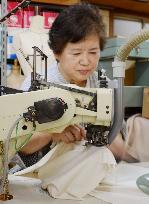
KASHIHARA, Japan - A seamstress makes a baby outfit made of locally produced cotton at a factory in Yamatotakada, Nara Prefecture, western Japan, on Sept. 28, 2014. The Yamatotakada Chamber of Commerce and Industry and local companies jointly grow organic cotton to bring back cotton plantation which used to be the biggest business in the region in the Edo era (1603-1867).

  •  
Cotton planting restored in western Japan

Cotton planting restored in western Japan

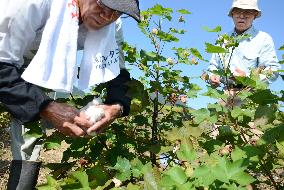
KASHIHARA, Japan - Retired businessmen pick organic cotton flowers for Sakura Cotton Co. in Katsuragi, Nara Prefecture, western Japan, on Sept. 28, 2014. The Yamatotakada Chamber of Commerce and Industry and other parties in the neighboring city of Yamatotakada has restored cotton plantation which used to be the biggest business in the region in the Edo era (1603-1867).

  •  
Huge signboard of Hokusai exhibition stands in Paris

Huge signboard of Hokusai exhibition stands in Paris

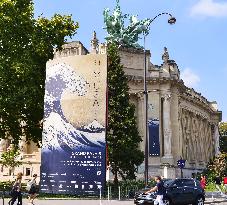
PARIS, France - A huge signboard stands in front of the Grand Palais museum in Paris on Sept. 25, 2014, to promote an exhibition featuring famed Japanese "ukiyo-e" artist Katsushika Hokusai. The exhibition, opening on Oct. 1, will display more than 700 works by the Japanese artist of the Edo period (1603-1867) under the Tokugawa shogunate.

  •  
Costume play lovers listen to guide at old residence

Costume play lovers listen to guide at old residence

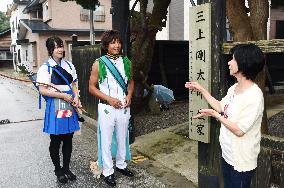
AOMORI, Japan - Young women listen to a guide in front of an old residence, reportedly built during the Edo period (1603-1867), in Sai village, Aomori Prefecture, on the northern tip of Japan's main island of Honshu on Aug. 15, 2014, during a village-wide event to welcome costume play lovers. The residence is the birthplace of Gotaro Mikami, a medical doctor who saved both Japanese and Russian soldiers during the 1904-1905 Russo-Japanese war.

  •  
'Oiran' courtesan parades in Sapporo, northern Japan

'Oiran' courtesan parades in Sapporo, northern Japan

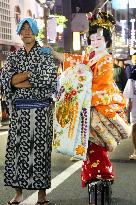
SAPPORO, Japan - Geisha entertainer Botan (R) walks down the street at a festival in Sapporo, Hokkaido Prefecture, northern Japan, on Aug. 6, 2014, performing as an "oiran" traditional courtesan of the highest rank from the Edo era (1603-1867) during an "oiran parade."

  •  
'Oiran' courtesan parades in Sapporo, northern Japan

'Oiran' courtesan parades in Sapporo, northern Japan

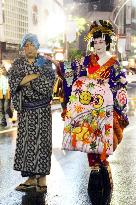
SAPPORO, Japan - Freelance anchorwoman Chikage Aoyama (R) walks down the street at a festival in Sapporo, Hokkaido Prefecture, northern Japan, on Aug. 6, 2014, performing as an "oiran" traditional courtesan of the highest rank from the Edo era (1603-1867) during an "oiran parade."

  •  
24K gold box in commemoration of shop's 80th anniversary

24K gold box in commemoration of shop's 80th anniversary

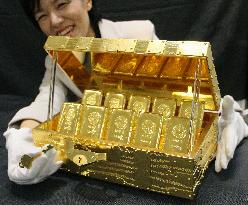
NAGOYA, Japan - Niimi, a jewelry and watch shop in Handa, Aichi Prefecture, central Japan, shows a cashbox in Edo era (1603-1867) style made of 24-carat gold, worth 300 million yen, at a press conference in Nagoya on May 15, 2014.

  •  
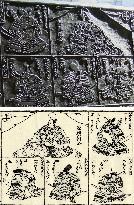
Printing block, print from late Edo period

Printing block, print from late Edo period

TOKYO, Japan - Part of a printing block (above), used as a board for a "sugoroku" game (a type of snakes and ladders) in the late Edo period (1603-1867), and its print are shown in this file photo taken on March 8, 2014. The block was discovered by a sugoroku researcher in Sendai, northeastern Japan.

  •  
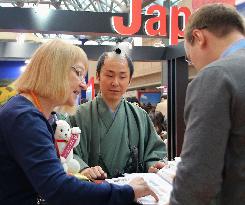
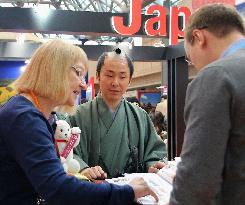
Attracting Russian tourists to Japan

Attracting Russian tourists to Japan

MOSCOW, Russia - A salesman (C), dressed as an Edo-era (1603-1867) man, from the Edo Wonderland theme park in Nikko, Tochigi Prefecture, explains about the facility at the Moscow International Exhibition Travel and Tourism on March 21, 2012.

  •  
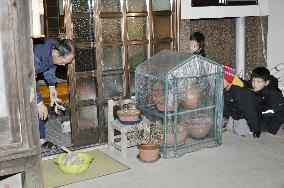
Yamaguchi's Halloween-like event

Yamaguchi's Halloween-like event

YAMAGUCHI, Japan - Children hide themselves after placing a horse doll of straw at a house and wait for a resident (L) to replace the doll with sweets during a traditional festivity in the western Japanese city of Yamaguchi on Jan. 14, 2012. The event, called ''Toitoi,'' is said to have been performed since the Edo period (1603-1867) but its origin is unknown. Some say ''Toitoi'' derives from ''Trick or Treat,'' said by children going house to house collecting candy at Halloween, since there used to be a church in the area.

  •  
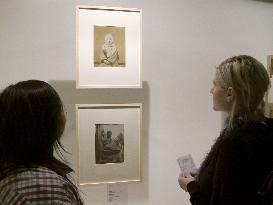
Photo exhibition on Japan in Switzerland

Photo exhibition on Japan in Switzerland

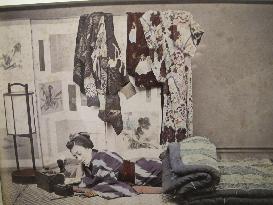
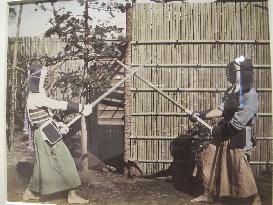
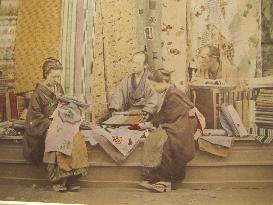
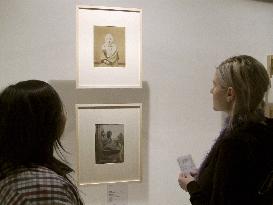
LUGANO, Switzerland - Visitors look at photos capturing life in Japan around the end of the Edo period (1603-1867) and the early Meiji period (1868-1912) at an exhibition in Lugano, southern Switzerland, on Feb. 1, 2011. Some 200 photos at the exhibition, which runs through Feb. 27, include those taken by well-known photographers Felice Beato, Kimbe Kusakabe and others. The photos, which were originally black and white, were later hand-colored.

  •  
Photo exhibition on Japan in Switzerland

Photo exhibition on Japan in Switzerland

LUGANO, Switzerland - Photo showing life in Japan around the end of the Edo period (1603-1867) and the beginning of the Meiji period (1868-1912) is one of some 200 photos, many on public display for the first time, at an exhibition in Lugano, southern Switzerland, on Feb. 1, 2011. Photos at the exhibition, which runs through Feb. 27, include those taken by well-known photographers Felice Beato, Kimbe Kusakabe and others. The photos, which were originally black and white, were later hand-colored.

  •  
Photo exhibition on Japan in Switzerland

Photo exhibition on Japan in Switzerland

LUGANO, Switzerland - Photo showing life in Japan around the end of the Edo period (1603-1867) and the beginning of the Meiji period (1868-1912) is one of some 200 photos, many on public display for the first time, at an exhibition in Lugano, southern Switzerland, on Feb. 1, 2011. Photos at the exhibition, which runs through Feb. 27, include those taken by well-known photographers Felice Beato, Kimbe Kusakabe and others. The photos, which were originally black and white, were later hand-colored.

  •  
Photo exhibition on Japan in Switzerland

Photo exhibition on Japan in Switzerland

LUGANO, Switzerland - Photo showing life in Japan around the end of the Edo period (1603-1867) and the beginning of the Meiji period (1868-1912) is one of some 200 photos, many on public display for the first time, at an exhibition in Lugano, southern Switzerland, on Feb. 1, 2011. Photos at the exhibition, which runs through Feb. 27, include those taken by well-known photographers Felice Beato, Kimbe Kusakabe and others. The photos, which were originally black and white, were later hand-colored.

  •  
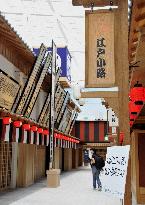
Haneda's new int'l terminal shown to media

Haneda's new int'l terminal shown to media

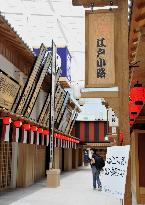
TOKYO, Japan - A commercial area with scenery recreating the Edo period (1603-1867) at the new five-story international terminal building at Tokyo's Haneda airport is shown to the media on Aug. 2, 2010, in advance of its opening in October.

  •  
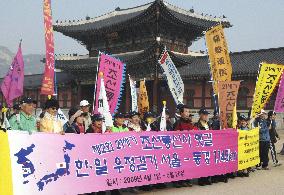
Seoul-Tokyo friendship walking event begins

Seoul-Tokyo friendship walking event begins

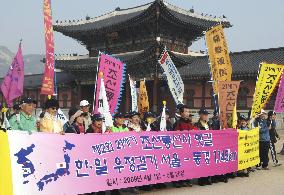
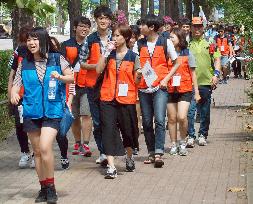
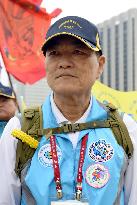
SEOUL, South Korea - People from South Korea and Japan leave Gyeongbokgung, a former royal palace in downtown Seoul, on April 1 for a 50-day friendship walk along a 2,000-kilometer route that Korean dynasty envoys to Japan took during Japan's Edo period (1603-1867). The participants aim to arrive in Tokyo on May 20.

  •  
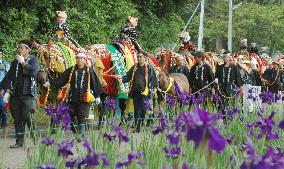
Horse festival held in northern Japan

Horse festival held in northern Japan

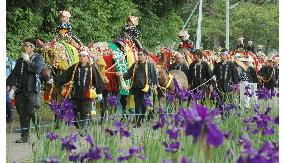
IWATE, Japan - Some 100 decorated horses are led along a road lined by irises in an annual horse festival in Iwate Prefecture on June 9. The festival, called Chagu-chagu Umakko (horses with ringing bells) originated in the Edo Period (1603-1867) as a way to express gratitude to horses used for agriculture and to pray for good health and no disasters.

  •  
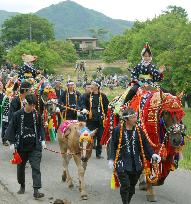
Horse festival held in northern Japan

Horse festival held in northern Japan

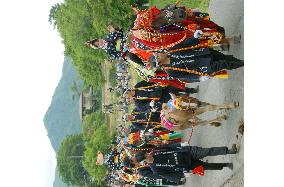
IWATE, Japan - Some 100 decorated horses take to the streets in an annual horse festival in Iwate Prefecture on June 9. The festival, called Chagu-chagu Umakko (horses with ringing bells), originated in the Edo Period (1603-1867) as a way to express gratitude to horses used for agriculture and to pray for good health and no disasters.

  •  
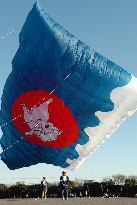
World's largest kite flown in Tokyo

World's largest kite flown in Tokyo

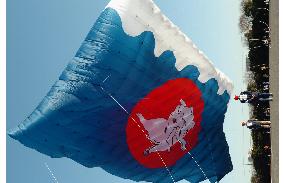
TOKYO, Japan - A huge kite is flown at Tokyo's Harumi Pier as part of an event to promote the culture of the Edo period (1603-1867) on Jan. 8. The vinyl-made kite measures 25 meters by 40 meters and is claimed by the organizers of the event to be the largest in the world.

  •  
Rakugo storyteller Katsura Bunji dies at 80

Rakugo storyteller Katsura Bunji dies at 80

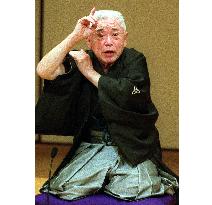
TOKYO, Japan - Popular rakugo storyteller Katsura Bunji (in photo taken in October 2001) died of kidney failure caused by acute leukemia at a Tokyo hospital on Jan. 31, his family said. He was 80. Bunji, whose real name was Tatsuo Sekiguchi, was known for his crisp and well-mannered style of delivering his stories, which conveyed the traditions of the Edo Period (1603-1867).

  •  
Miniature castle built with bill fragments worth 500 mil. yen

Miniature castle built with bill fragments worth 500 mil. yen

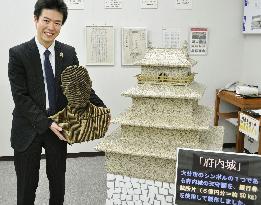
An employee at the Bank of Japan's Oita branch in the southwestern Japan city holds a cardboard bust of Fukuzawa Yukichi, whose portrait is used on the 10,000 yen note, beside a miniature of Funai Castle in the city that was lost to fire during the Edo period (1603-1867). The miniature castle, which was created by using fragments of old banknotes worth some 500 million yen ($4.46 million) will be exhibited to mark the resumption of public visits to the branch following a one-year hiatus due to disaster-preparation building works. (Kyodo) ==Kyodo

  •  
Kanazawa firefighters perform at New Year ceremony

Kanazawa firefighters perform at New Year ceremony

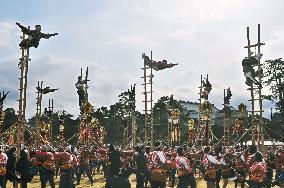
Firefighters perform "Kaga Tobi" acrobatic stunts dating from the Edo period (1603-1867) on 6-meter-high ladders during an annual New Year ceremony in Kanazawa Castle Park in Kanazawa, Ishikawa Prefecture, on Jan. 10, 2016. The role of firefighters in the Edo period was to destroy adjoining houses in order to prevent the spread of fires. (Kyodo) ==Kyodo

  •  
Great Bear star sign in swordsmanship license for historical hero

Great Bear star sign in swordsmanship license for historical hero

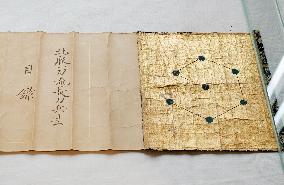
Photo taken on Nov. 7, 2015, shows a Great Bear star sign inscribed in a scroll certifying the skill in wielding a "naginata" long-handled sword given to historical hero Sakamoto Ryoma in the waning years of the Edo period (1603-1867). The scroll lists the names of several related people, including his lover Chiba Sana and Chiba Shusaku, founder of the Hokushin Ittoryu school of swordsmanship. (Kyodo) ==Kyodo

  •  
Japanese, S. Korean students retrace route of ancient Korean envoys

Japanese, S. Korean students retrace route of ancient Korean envoys

About 50 Japanese and South Korean university students start a trek from Seoul to Busan on Sept. 6, 2015, on the first leg of a journey retracing the route taken by Joseon Dynasty diplomatic envoys to Japan during the Edo period (1603-1867). They are trying to refocus on the spirit of good-neighborliness at a time bilateral diplomatic relations remain frosty. (Kyodo) ==Kyodo

  •  
Joseon missions to Japan reenacted for 1st time in 3 yrs

Joseon missions to Japan reenacted for 1st time in 3 yrs

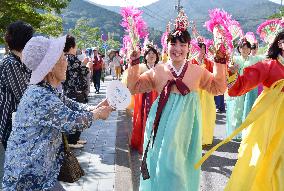
Women in ethnic costumes parade on a street in Tsushima, an island city of Nagasaki Prefecture, southwestern Japan, on Aug. 2, 2015, as part of a reenactment, held for the first time in three years, of Joseon missions to Japan in the Edo period (1603-1867) sent by the Joseon dynasty on the Korean Peninsula. Some 300 people, including about 40 South Koreans, took part in the parade. (Kyodo) ==Kyodo

  •  
Expert points to historical importance of naval dock in southern Japan

Expert points to historical importance of naval dock in southern Japan

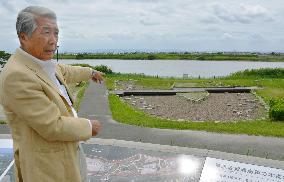
Toshitsugu Haji, head of a civilian group studying cultural heritage in Saga Prefecture, southwestern Japan, talks about the historical importance of the Mietsu Naval Dock, built by the Saga feudal domain near the end of the Edo period (1603-1867), in the prefectural capital on June 20, 2015. The facility is one of the candidate sites of the Meiji-era (1868-1911) industrial revolution Japan is seeking to have registered on the UNESCO World Heritage list. (Kyodo) ==Kyodo

  •  
"Sendai Tansu" chest of drawers to be listed as traditional artifact

"Sendai Tansu" chest of drawers to be listed as traditional artifact

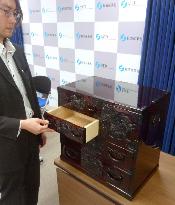
A "Sendai Tansu" chest of drawers is shown at the Ministry of Economy, Trade and Industry in Tokyo on May 11, 2015, as an example of traditional Japanese artifacts to be added to the ministry's list of such craftwork. The product, hand-made in Sendai, northeastern Japan, originated toward the end of the Edo period (1603-1867). (Kyodo) ==Kyodo

  •  
Descendent of Korean mission envoy joins Seoul-Tokyo "friendship walk"

Descendent of Korean mission envoy joins Seoul-Tokyo "friendship walk"

Yo Un Jun, the 11th generation descendent of Yo U Gil, chief delegate of a Korean diplomatic mission dispatched by the Yi dynasty to Japan in 1607, participates in a "friendship walk" from Seoul to Tokyo, started on April 1, 2015, to follow the footsteps of the missions to Japan in the Edo period (1603-1867). (Kyodo) ==Kyodo

  •  
Touch-screen system shows scroll painting at new shrine treasure house

Touch-screen system shows scroll painting at new shrine treasure house

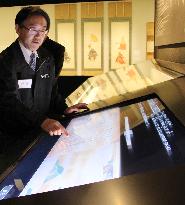
An official at the Toshogu shrine in Nikko, Tochigi Prefecture, eastern Japan, operates a touch-screen system in its new treasure house on March 5, 2015, to display the five-volume "Toshogu Engi (luck)" scroll painting. Dedicated to feudal ruler Tokugawa Ieyasu who founded the 1603-1867 Tokugawa shogunate, the Shinto shrine built the treasure house as part of a project to commemorate the 400th anniversary of his death. (Kyodo) ==Kyodo

  •  
Shrine tied to feudal ruler shows 3D image in new treasure house

Shrine tied to feudal ruler shows 3D image in new treasure house

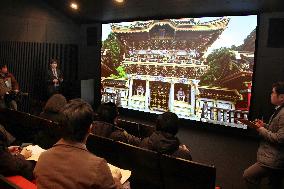
Reporters watch a three-dimensional image of the Yomeimon gate, a national treasure, at a theater of a new treasure house at the Toshogu shrine in Nikko, Tochigi Prefecture, eastern Japan, on March 5, 2015. The Shinto shrine, dedicated to feudal ruler Tokugawa Ieyasu who founded the 1603-1867 Tokugawa shogunate, built the treasure house as part of a project to commemorate the 400th anniversary of his death. (Kyodo) ==Kyodo

  •  
Ritzy pottery found from middle-class feudal warrior's house

Ritzy pottery found from middle-class feudal warrior's house

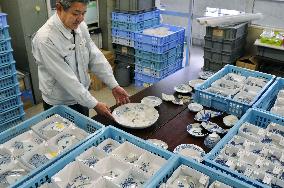
Some 1,200 pieces of pottery and porcelain, including ritzy Hizen ware in the early Edo period (1603-1867), are on display in Matsue, Shimane Prefecture, western Japan, on Jan. 6, 2015. Unearthed from the homestead of a feudal middle-class "samurai" warrior belonging to the Matsue Domain, the ceramics are baffling experts as only a warlord could afford such earthenware. (Kyodo) ==Kyodo

  •  
Woman in news: Curator sending out info on revolution hero Ryoma

Woman in news: Curator sending out info on revolution hero Ryoma

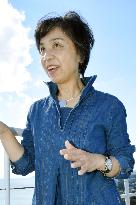
Yukie Maeda, a curator at the Sakamoto Ryoma Memorial Museum in Kochi, western Japan, talks on Nov. 10, 2015, about the prominent figure in the movement to overthrow the Tokugawa shogunate in the late Edo period (1603-1867). The 180th anniversary of Ryoma's birth was celebrated on Nov. 15. (Kyodo) ==Kyodo

  •  
Ceremony held at shrine for "hidden Christians" in southwest Japan

Ceremony held at shrine for "hidden Christians" in southwest Japan

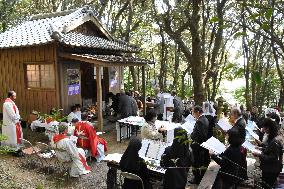
Catholics, Buddhists and others attend a ceremony at Karematsu Shrine in Nagasaki, southwestern Japan, on Nov. 3, 2015, to pray for Christians persecuted by the feudal government during the Edo period (1603-1867). The shrine stands on a location where "hidden Christians" were said to have secretly gathered to keep their faith. (Kyodo) ==Kyodo

  •  
Men in armor walk from Tokyo to shrine in Nikko

Men in armor walk from Tokyo to shrine in Nikko

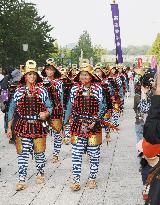
Some 100 people, including men in armored outfits of feudal samurai, leave the plaza in front of the Imperial Palace in Tokyo on Oct. 24, 2015, to set off for a 150-km walk to the Nikko Toshogu Shinto shrine in Nikko, Tochigi Prefecture, dedicated to Tokugawa Ieyasu, founder of the Tokugawa shogunate (1603-1867). The year 2015 marks the 400th anniversary of Ieyasu's death. (Kyodo) ==Kyodo

  •  
Main gate of grand shrine at Tokyo's Ueno Park glitters in gold

Main gate of grand shrine at Tokyo's Ueno Park glitters in gold

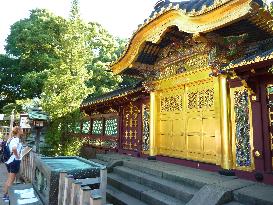
The main gate of the Ueno Toshogu shrine at Ueno Park in downtown Tokyo glitters in gold as seen in this photo taken on July 31, 2015. The shrine is dedicated to Tokugawa Ieyasu, founder of the 1603-1867 Tokugawa shogunate. (Kyodo) ==Kyodo

  •  
Old water well used by hospital remains in Tokyo botanical garden

Old water well used by hospital remains in Tokyo botanical garden

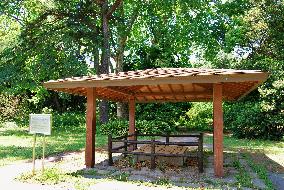
A water well used by an old medical facility dating back to the Edo feudal era (1603-1867) remains in the Koishikawa Botanical Garden in the Hakusan area of Tokyo's Bunkyo district as seen in this photo taken on May 21, 2015. (Kyodo) ==Kyodo

  •  
Tokyo's Higashi-Mukojima area: Garden in heart of metropolis

Tokyo's Higashi-Mukojima area: Garden in heart of metropolis

A volunteer guide (L) explains on May 30, 2015, about the attractiveness of the Mukojima-Hyakkaen Garden, the only surviving flower garden from the Edo period (1603-1867) in Tokyo's old downtown of Higashi-Mukojima, dubbed a land of cultural figures. (Kyodo) ==Kyodo

  •  
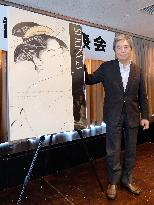
Ex-PM Hosokawa unveils plan to hold exhibition of erotic woodblock prints

Ex-PM Hosokawa unveils plan to hold exhibition of erotic woodblock prints

Former Japanese Prime Minister Morihiro Hosokawa speaks to reporters at the Foreign Correspondents' Club of Japan in Tokyo on May 21, 2015, about a plan to hold an exhibition in September to December of "shunga" erotic woodblock prints from the Edo period (1603-1867) kept by the Hosokawa family. (Kyodo) ==Kyodo

  •  
Horse festival held in northern Japan

Horse festival held in northern Japan

IWATE, Japan - Some 100 decorated horses are led along a road lined by irises in an annual horse festival in Iwate Prefecture on June 9. The festival, called Chagu-chagu Umakko (horses with ringing bells) originated in the Edo Period (1603-1867) as a way to express gratitude to horses used for agriculture and to pray for good health and no disasters. (Kyodo)

  •  
Horse festival held in northern Japan

Horse festival held in northern Japan

IWATE, Japan - Some 100 decorated horses take to the streets in an annual horse festival in Iwate Prefecture on June 9. The festival, called Chagu-chagu Umakko (horses with ringing bells), originated in the Edo Period (1603-1867) as a way to express gratitude to horses used for agriculture and to pray for good health and no disasters. (Kyodo)

  •  
Seoul-Tokyo friendship walking event begins

Seoul-Tokyo friendship walking event begins

SEOUL, South Korea - People from South Korea and Japan leave Gyeongbokgung, a former royal palace in downtown Seoul, on April 1 for a 50-day friendship walk along a 2,000-kilometer route that Korean dynasty envoys to Japan took during Japan's Edo period (1603-1867). The participants aim to arrive in Tokyo on May 20. (Kyodo)

  •  
World's largest kite flown in Tokyo

World's largest kite flown in Tokyo

TOKYO, Japan - A huge kite is flown at Tokyo's Harumi Pier as part of an event to promote the culture of the Edo period (1603-1867) on Jan. 8. The vinyl-made kite measures 25 meters by 40 meters and is claimed by the organizers of the event to be the largest in the world. (Kyodo)

  •  
Haneda's new int'l terminal shown to media

Haneda's new int'l terminal shown to media

TOKYO, Japan - A commercial area with scenery recreating the Edo period (1603-1867) at the new five-story international terminal building at Tokyo's Haneda airport is shown to the media on Aug. 2, 2010, in advance of its opening in October. (Kyodo)

  •  
Attracting Russian tourists to Japan

Attracting Russian tourists to Japan

MOSCOW, Russia - A salesman (C), dressed as an Edo-era (1603-1867) man, from the Edo Wonderland theme park in Nikko, Tochigi Prefecture, explains about the facility at the Moscow International Exhibition Travel and Tourism on March 21, 2012. (Kyodo)

  •  
Photo exhibition on Japan in Switzerland

Photo exhibition on Japan in Switzerland

LUGANO, Switzerland - Visitors look at photos capturing life in Japan around the end of the Edo period (1603-1867) and the early Meiji period (1868-1912) at an exhibition in Lugano, southern Switzerland, on Feb. 1, 2011. Some 200 photos at the exhibition, which runs through Feb. 27, include those taken by well-known photographers Felice Beato, Kimbe Kusakabe and others. The photos, which were originally black and white, were later hand-colored. (Kyodo)

  • Main
  • Top
  • Editorial
  • Creative
  • About Us
  • About ILG
  • Terms of use
  • Company
  • BEHIND
  • Price List
  • Single Plan
  • Monthly Plan
  • Services
  • Shooting
  • Rights Clearance
  • Support
  • FAQ
  • How To Buy
  • Contact Us
  • Become a Partner

© KYODO NEWS IMAGES INC

All Rights Reserved.

  • Editorial
  • Olympics
  • News
  • Sports
  • Japan
  • Tech
  • Royal
  • Disaster
  • NorthKorea
  • Old Japan
  • SNS
  • Creative
  • Food
  • Japan
  • Landscape
  • Animal
  • Popular
  • #Ukraine
  • #China
  • #coronavirus
  • #N. Korea
  • #Russia
  • #Thailand
  • #Ukraine
  • #China
  • #coronavirus
  • #N. Korea
  • #Russia
  • #Thailand
  • Food
  • Japan
  • Landscape
  • Animal
  • Olympics
  • News
  • Sports
  • Japan
  • Tech
  • Royal
  • Disaster
  • NorthKorea
  • Old Japan
  • SNS