•  
WBA undefeated champ John too much for Takemoto

WBA undefeated champ John too much for Takemoto

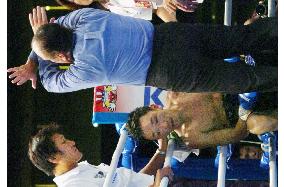
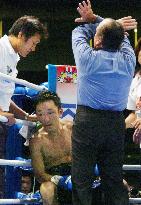
KOBE, Japan - Japanese challenger Zaiki Takemoto, badly mauled by WBA featherweight champion Chris John, fails to stand up to the gong at the start of 10th round in the world title match in Kobe on Aug. 19. The Indonesian champion successfully retained his title for the eighth consecutive time and improved his record to 40-0 with one draw and 21 knockouts. Takemoto, appearing in his first world title bout, slipped to 21-7-1 (12 KOs).

  •  
WBA undefeated champ John too much for Takemoto

WBA undefeated champ John too much for Takemoto

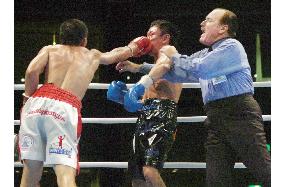
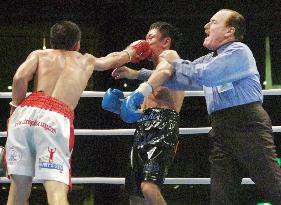
KOBE, Japan - WBA featherweight champion Chris John lands a right on Japanese challenger Zaiki Takemoto as the referee tries to stop the fight at the end of the ninth round in a world title match in Kobe on Aug. 19 to successfully retain his title for the eighth consecutive time. The Indonesian boxer improved to 40-0 with one draw and 21 knockouts after Takemoto was unable to stand for the 10th round. Takemoto, appearing in his first world title bout, slipped to 21-7-1 (12 KOs).

  •  
WBA undefeated champ John too much for Takemoto

WBA undefeated champ John too much for Takemoto

KOBE, Japan - Japanese challenger Zaiki Takemoto, badly mauled by WBA featherweight champion Chris John, fails to stand up to the gong at the start of 10th round in the world title match in Kobe on Aug. 19. The Indonesian champion successfully retained his title for the eighth consecutive time and improved his record to 40-0 with one draw and 21 knockouts. Takemoto, appearing in his first world title bout, slipped to 21-7-1 (12 KOs). (Kyodo)

  •  
WBA undefeated champ John too much for Takemoto

WBA undefeated champ John too much for Takemoto

KOBE, Japan - WBA featherweight champion Chris John lands a right on Japanese challenger Zaiki Takemoto as the referee tries to stop the fight at the end of the ninth round in a world title match in Kobe on Aug. 19 to successfully retain his title for the eighth consecutive time. The Indonesian boxer improved to 40-0 with one draw and 21 knockouts after Takemoto was unable to stand for the 10th round. Takemoto, appearing in his first world title bout, slipped to 21-7-1 (12 KOs). (Kyodo)

  •  
Japan rout Uruguay in Rugby World Cup warm-up

Japan rout Uruguay in Rugby World Cup warm-up

Ayumu Goromaru opens the scoring with a try in the first half of Japan's 40-0 win over Uruguay in Game 2 of their test match series at Prince Chichibu Memorial Rugby Ground in Tokyo on Aug. 29, 2015. The two teams will play in the Rugby World Cup in England starting Sept. 18. (Kyodo) ==Kyodo

  •  
Japan center Matsushima in action in test rugby match vs. Uruguay

Japan center Matsushima in action in test rugby match vs. Uruguay

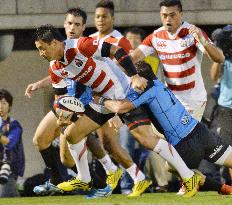
South African-born Japanese center Kotaro Matsushima (C) attempts to push into the Uruguay side in the first half of a game at Prince Chichibu Memorial Rugby Ground in Tokyo on Aug. 29, 2015. Japan shut out Uruguay 40-0 in the second in a test match series ahead of the Rugby World Cup 2015 in England starting in September. (Kyodo) ==Kyodo

  •  
Japanese rugby team joyous after 40-0 win over Uruguay

Japanese rugby team joyous after 40-0 win over Uruguay

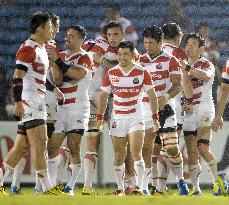
Players of Japan's national rugby team, including Fumiaki Tanaka (C, front) and Kenki Fukuoka (far R), are elated following their 40-0 win against Uruguay at Prince Chichibu Memorial Rugby Ground in Tokyo on Aug. 29, 2015. The game was the second in a test match series ahead of the Rugby World Cup 2015 in England starting in September. (Kyodo) ==Kyodo

  •  
Japan center Matsushima scores try in test rugby match vs. Uruguay

Japan center Matsushima scores try in test rugby match vs. Uruguay

South African-born Japanese center Kotaro Matsushima (bottom) scores a try in the fourth minute in the second half of a game against Uruguay at Prince Chichibu Memorial Rugby Ground in Tokyo on Aug. 29, 2015. Japan beat Uruguay 40-0 in the second in a test match series ahead of the Rugby World Cup 2015 in England starting in September. (Kyodo) ==Kyodo

  •  
Western style house in kanagawa

Western style house in kanagawa

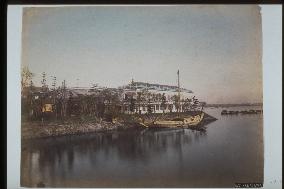
The photo is entitled Kanagawa, but the location of the place and building are unknown.==Date:unknown, Place:Kanagawa, Photo:unknown, (Credit:Nagasaki University Library/Kyodo News Images) [Cabinet Number19‐40‐0]

  •  
A large temple bell

A large temple bell

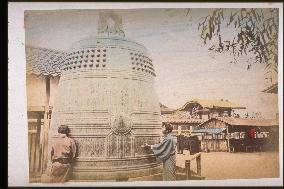
This may be the bronze bell at Jorakuji Temple (important national treasure). Jorakuji was built by Hojo Yasutoki, and a priest from china named Rankei Doryu designed the temple in Zen style, establishing Zen Buddhism in japan for the first time. The bronze bell has 1248 inscribed on it, and is said to have been made by Hojo Tokiyori in commemoration of Hojo Yasutoki.==Date:unknown, Place:Kamakura, Photo:unknown, (Credit:Nagasaki University Library/Kyodo News Images) [Cabinet Number16‐40‐0]

  •  
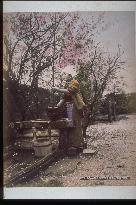
Woman drawing water from a well

Woman drawing water from a well

The English caption reads Drawing water from a well. A young woman draws water from a wooden framed well, and pours it into another wooden pail. Dramatized photo of a typical water drawing scene in Japan.==Date:unknown, Place:unknown, Photo:Ogawa Kazumasa, (Credit:Nagasaki University Library/Kyodo News Images) [Cabinet Number7‐40‐0]

  •  
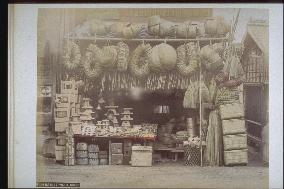
Basket shop

Basket shop

Merchandise such as baskets hang from a bamboo pole, and others are placed on the roof. The owner probably used the bamboo stick to raise and lower the pole. In this shop, bowls and sanpo (wooden stands for offerings )are on display along with bamboo products.==Date:unknown, Place:unknown, Photo:Ogawa Kazumasa, (Credit:Nagasaki University Library/Kyodo News Images) [Cabinet Number6‐40‐0]

  •  
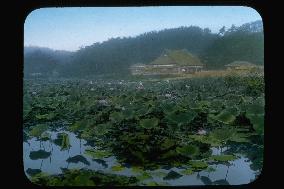
A lotus pond in Sankei-en Garden,Yokohama

A lotus pond in Sankei-en Garden,Yokohama

The Japanese garden Sankeien was built by Hara Tomisaburo, a prominent Yokohama raw silk trader. Old buildings were dismantled and relocated here from different locations. It opened to the public in 1906 and attracted many visitors. The house across the lotus pond is the Hara family villa.==Date:unknown, Place:Yokohama, Photo:unknown, (Credit:Nagasaki University Library/Kyodo News Images) [Cabinet Number98‐40‐0]

  •  
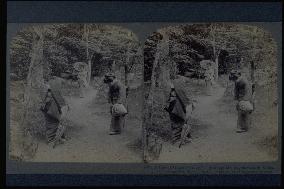
The garden of Kinkakuji Temple

The garden of Kinkakuji Temple

Stereograph depicting two women in kimono on the past to the Rokuonji temple garden. Holding closed Japanese-style parasols, they face each other and bow, exchanging morning greetings. There is another woman further back wearing kimono and holding a parasol. Taken in 1904.==Date:1904, Place:Kyoto, Photo:Underwood, (Credit:Nagasaki University Library/Kyodo News Images) [Cabinet Number97‐40‐0]

  •  
Manganji Temple,Nikko

Manganji Temple,Nikko

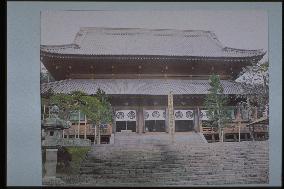
Sanbutsu-do, the main hall of Rinoji Temple, was formerly part of Nikko Futarasan Shinto Shrine. In response to the official separation of Buddhism and Shintoism in 1871, it was dissembled and rebuilt on its present site in 1881. It enshrines three Buddhist deities: Senju-kannon (1,000-hand deity of mercy), Amida-nyorai and Bato-kannon.==Date:unknown, Place:Nikko, Photo:unknown, (Credit:Nagasaki University Library/Kyodo News Images) [Cabinet Number96‐40‐0]

  •  
Cherry trees at Ueno Park

Cherry trees at Ueno Park

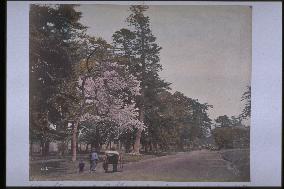
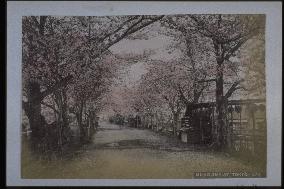
The street running between Kuromon Street in Ueno Park and present-day JR Ueno Station is viewed from the south. On the right corner is Ryoun'in, a subsidiary of Kaneiji Temple, site of present-day National Museum of Western Art. The woman holding up the bottom of her kimono may be the mother of the young child.==Date:unknown, Place:Tokyo, Photo:Usui Shuzaburo, (Credit:Nagasaki University Library/Kyodo News Images) [Cabinet Number94‐40‐0]

  •  
A lotus pond at Tsurugaoka Hachimangu Shrine

A lotus pond at Tsurugaoka Hachimangu Shrine

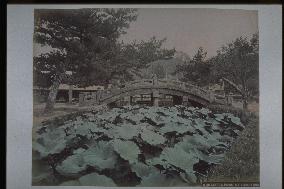
The photograph is labeled A B6 LOTUS POND AT KAMAKURA. Date unknown. View of the stone bridge from the east. The Sanno-torii (Third Gate) is visible behind the building on the left. This bridge is mentioned in books from the Edo Period. It was referred to as Akahashi (Red Bridge). There is a wooden bridge behind it. The stone bridge was destroyed by the Great Kanto Earthquake of 1923.==Date:unknown, Place:Kamakura, Photo:unknown, (Credit:Nagasaki University Library/Kyodo News Images) [Cabinet Number93‐40‐0]

  •  
Exchanging nupital cups at a wedding

Exchanging nupital cups at a wedding

The three-times-three exchange of nuptial sake cups is observed to solidify the marital bond. Originally, a small girl and boy poured the sake into the cup. The sake container was usually illustrated with male and female butterflies. The bridegroom has a topknot and wears ceremonial garments while the bride wears a wedding hood made of flattened cotton and a ceremonial dress. ==Date:unknown, Place:unknown, Photo:unknown, (Credit:Nagasaki University Library/Kyodo News Images) [Cabinet Number92‐40‐0]

  •  
Rice planting

Rice planting

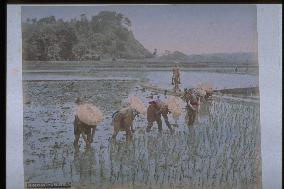
Five women with bamboo hats and one woman with a hair cover line up slightly irregularly to plant rice shoots. A man in a loincloth is carrying bundles of rice shoots.==Date:unknown, Place:unknown, Photo:unknown, (Credit:Nagasaki University Library/Kyodo News Images) [Cabinet Number88‐40‐0]

  •  
The stage of Kiyomizudera Temple,Kyoto

The stage of Kiyomizudera Temple,Kyoto

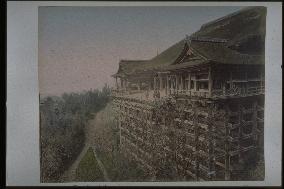
The balcony off the main hall of Kiyomizu Temple seen from Okuno-in, facing west-northwest. There are four people on the balcony. The fallen leaves in the South Garden suggest winter. The balcony was renovated in 1633. The yosemune style building is roofed entirely with hinoki tree bark. Wings flank the west side and the east and west of the south side. The wooden fencing inside the railing is to prevent people from falling. The approach stretches westward to the left through the South Garden.==Date:unknown, Place:Kyoto, Photo:unknown, (Credit:Nagasaki University Library/Kyodo News Images) [Cabinet Number87‐40‐0]

  •  
Women in Okano Garden

Women in Okano Garden

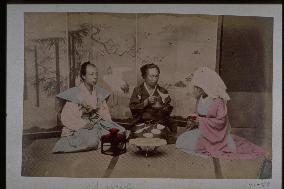
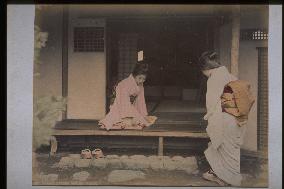
A woman lifts her kimono to go up to the tea room, and another woman welcomes her by placing her hands together in front of her knees. This may be tea service practice for geishas. A light can be seen in the window in the dark room behind. This is the kind of Japanese scene loved by foreigners.==Date:unknown, Place:Tokyo, Photo:unknown, (Credit:Nagasaki University Library/Kyodo News Images) [Cabinet Number85‐40‐0]

  •  
The honden (inner sanctuary),Toshogu Shrine,Nikko

The honden (inner sanctuary),Toshogu Shrine,Nikko

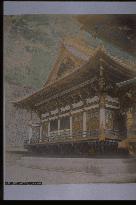
The main shrine of Nikko Toshogu is viewed from the west. The inner sanctuary is in the centre. The section one level lower is called Ishinoma. The inner shrine containing the tomb of first shogun Tokugawa Ieyasu is located in the forest above the stone embankment. Carvings of tapirs can be seen on the upper part of the shrine doors.==Date:unknown, Place:Nikko, Photo:A. Farsari, (Credit:Nagasaki University Library/Kyodo News Images) [Cabinet Number82‐40‐0]

  •  
Women washing clothes

Women washing clothes

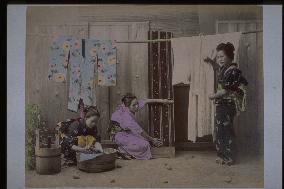
Kimono are being dried on bamboo poles. People aired clothes and books in the sun, in places where a breeze blows on a sunny non-humid day to prevent moisture, dust, and insects from damaging the items. The girl in the centre is doing araihari (explained in #2353). The girls all have their sleeves pulled up with cords.==Date:unknown, Place:unknown, Photo:A. Farsari, (Credit:Nagasaki University Library/Kyodo News Images) [Cabinet Number81‐40‐0]

  •  
The bell tower,Toshogu Shrine,Nikko

The bell tower,Toshogu Shrine,Nikko

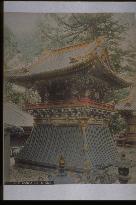
The Koro (Drum Tower), located to the left of Yomei Gate at Nikko Toshogu, is decorated with 38 carvings including depictions of tortoises, dragons and clouds. Honji-do (Yakushi-do), famous for its meiryu (crying dragon) ceiling painting is visible on the right. The dragon was painted by Kano Eishin Yasunobu, but the entire building was later destroyed by fire and rebuilt. The roof visible on the left is the Rinzo (Kyozo).==Date:unknown, Place:Nikko, Photo:unknown, (Credit:Nagasaki University Library/Kyodo News Images) [Cabinet Number80‐40‐0]

  •  
Dancing geikos

Dancing geikos

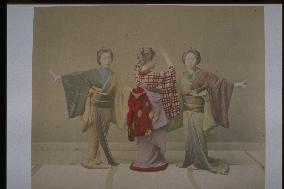
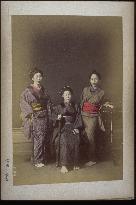
Three women are dancing together in a group. A young geiko in the centre has doffed one of the sleeves of her kimono, revealing the colourful undergarment. Two older geiko are dancing at each side in the same style.==Date:unknown, Place:unknown, Photo:unknown, (Credit:Nagasaki University Library/Kyodo News Images) [Cabinet Number79‐40‐0]

  •  
A row of Japanese cedar trees along the Nikko Road

A row of Japanese cedar trees along the Nikko Road

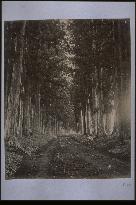
Cedar trees line the street near present-day Imaichi City. The sides of the streets and the area around the roots of the trees are surprisingly clean. Various tracks are visible on the surface of the road, perhaps reflecting the time when modes of transportation were diversifying to include rickshaws, stagecoaches and buses.==Date:unknown, Place:Nikko, Photo:R. Stillfried, (Credit:Nagasaki University Library/Kyodo News Images) [Cabinet Number78‐40‐0]

  •  
A secondhand shop

A secondhand shop

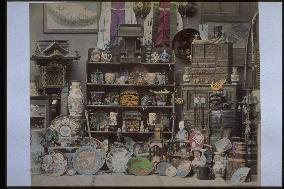
Highly valuable items like a set of armour, spears, swords, foot soldier's camp hats, battle coats, other battlefield equipment, large plates and jars are on display. Many of these articles may have been sold to the shop by impoverished samurai.==Date:unknown, Place:unknown, Photo:R. Stillfried, (Credit:Nagasaki University Library/Kyodo News Images) [Cabinet Number77‐40‐0]

  •  
Men drawing water from a well

Men drawing water from a well

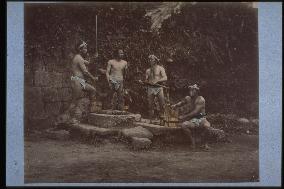
Men wearing head towels and loincloths are at a well to draw water. This is an old well built with stones. The wall behind them may be that of a former castle. The embankment continues to the foot of a mountain covered with bamboo trees. The location is unknown.==Date:unknown, Place:unknown, Photo:R. Stillfried, (Credit:Nagasaki University Library/Kyodo News Images) [Cabinet Number76‐40‐0]

  •  
The Yomeimon Gate,Toshogu Shrine,Nikko

The Yomeimon Gate,Toshogu Shrine,Nikko

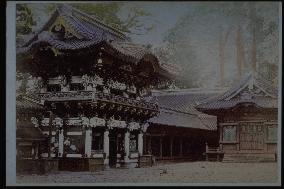
This is the rear side of Yomeimon. The symbol of Nikko Toshogu, this gate displays craftsmanship and decorative techniques representative of the early Edo Period. The carvings on the gate total 508 in number and include people, animals (real and imaginary), flowers, birds, and patterns. It is also called Higurashimon (Evening Falling Gate) because visitors can stand looking at it all day long and still not tire of its beauty. The building on the right is Shinyosha.==Date:unknown, Place:Nikko, Photo:unknown, (Credit:Nagasaki University Library/Kyodo News Images) [Cabinet Number69‐40‐0]

  •  
Men at hairdressing

Men at hairdressing

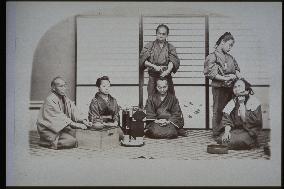
Hairdressers and their customers are depicted in a carpeted salon. The two people on the left are sitting next to a brazier with an iron pot on it. Combs and other hairdressing tools are visible in the box in the centre. The man on the far right is having facial hair shaved and his sakayaki shaped. A white cloth is placed on the shoulders to protect the kimono. Taken by Ogawa Kazumasa.==Date:unknown, Place:Kyoto, Photo:Ogawa Kazumasa, (Credit:Nagasaki University Library/Kyodo News Images) [Cabinet Number67‐40‐0]

  •  
The hundred steps of Motomachi and Maeda-bashi Bridge,Yokohama

The hundred steps of Motomachi and Maeda-bashi Bridge,Yokohama

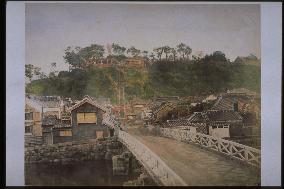
The stone steps visible in the centre are the Motomachi Hyakudan ( one hundred steps ). Sengen Shinto Shrine stands at the top of the stairs, with the border of Motomachi 2-chome and 3-chome at the bottom. The bridge in the foreground is Maedabashi, built when Horikawa Waterway was dug in 1860. Since it was replaced with an iron bridge in 1890, this photograph must have been taken prior to that date.==Date:unknown, Place:Yokohama, Photo:unknown, (Credit:Nagasaki University Library/Kyodo News Images) [Cabinet Number64‐40‐0]

  •  
A distant view of Yokohama Station

A distant view of Yokohama Station

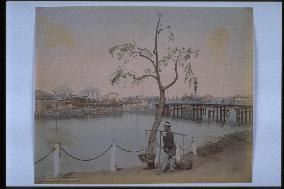
This is the original Yokohama Station designed by American architect R. P. Bridgens and built in 1871. The building is of stone and wood construction. Renamed Sakuragi-cho Station in 1915, the building was destroyed in the Great Kanto Earthquake of 1923.==Date:unknown, Place:Yokohama, Photo:unknown, (Credit:Nagasaki University Library/Kyodo News Images) [Cabinet Number55‐40‐0]

  •  
Cherry trees at Mukojima

Cherry trees at Mukojima

The area across Sumida River from Asakusa is Mukojima. There is no official boundary, but area from Mokuboji Temple to Makura Bridge is referred to as Mukojima. The banks of Sumida River at Mukojima are called Sumida-tei or Boku-tei. Cherry trees were planted here during the Kyoho Period (1716-36) by the 8th Shogun Tokugawa Yoshimune, and saplings were planted from time to time thereafter. This area thus became the most popular place to enjoy cherry blossoms in Edo. Taken around 1898.==Date:unknown, Place:Tokyo, Photo:unknown, (Credit:Nagasaki University Library/Kyodo News Images) [Cabinet Number53‐40‐0]

  •  
Enjoying a cool evening on yuka platforms along the Kamo River

Enjoying a cool evening on yuka platforms along the Kamo River

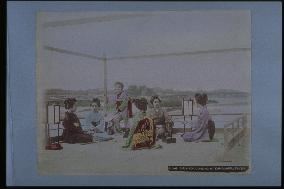
Geisha and maiko relax on a terrace at Shijo Ohashi, on the western side of Kamogawa River. The two on the left are drinking sake, while the two on the right are playing paper, scissors, rock. Lamps and cigarette trays have been placed on the floor. The houses lining the eastern side of the river and Gojo-Ohashi Bridge are visible in the background. This photograph may have been used in picture postcards for tourists. ==Date:unknown, Place:Kyoto, Photo:unknown, (Credit:Nagasaki University Library/Kyodo News Images) [Cabinet Number52‐40‐0]

  •  
The Two Venerable Images of Buddha,Sensoji Temple

The Two Venerable Images of Buddha,Sensoji Temple

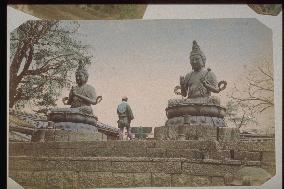
These two statues were built by Takase Zenbei of Tatebayashi by order of Ota Kyuemon Masayoshi and donated to Sensoji Temple in 1687. Standing 2.5 meters tall including the lotus base, the statues are usually referred to as Nurebotoke (Wet Buddha). They survived the Great Earthquake of 1923 and also the air raids of 1945, but the Main Hall, Niomon, and Sutra Repository were all destroyed in the latter.==Date:unknown, Place:Tokyo, Photo:unknown, (Credit:Nagasaki University Library/Kyodo News Images) [Cabinet Number51‐40‐0]

  •  
Women holding Western-style umbrellas

Women holding Western-style umbrellas

The women hold Western-style umbrellas. These were introduced to Japan in the latter half of the 19th century. They were nicknamed bat umbrellas, because they resemble the wings of a bat.==Date:unknown, Place:unknown, Photo:unknown, (Credit:Nagasaki University Library/Kyodo News Images) [Cabinet Number49‐40‐0]

  •  
Women picking up shells

Women picking up shells

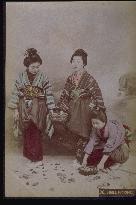
Shell gathering at low tide was a recreation. Especially at the time of spring tide (from March 3 through 7 on the lunar calendar), the gap between high and low tides is large. This outing on the beach is observed on March 3 in many areas of Japan. It is a major event of the season. This photograph must have been taken in a studio because the women are wearing socks.==Date:unknown, Place:unknown, Photo:Tamamura Kozaburo, (Credit:Nagasaki University Library/Kyodo News Images) [Cabinet Number48‐40‐0]

  •  
Rice planting

Rice planting

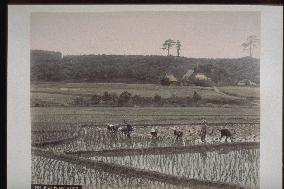
Men carry rice shoots, but men also join the five women planting the rice shoots. The rice paddies are beautifully demarcated. This is a real-life photograph.==Date:unknown, Place:unknown, Photo:unknown, (Credit:Nagasaki University Library/Kyodo News Images) [Cabinet Number47‐40‐0]

  •  
Cherry trees at Kudanzaka slope

Cherry trees at Kudanzaka slope

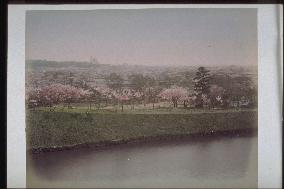
Kudanzaka is a long slope going down to the direction of Kanda from the side of Yasukuni Shrine from Ichigaya. A beautiful cherry boulevard continues. The moat to the fore is the Chidorigafuchi.==Date:unknown, Place:Tokyo, Photo:unknown, (Credit:Nagasaki University Library/Kyodo News Images) [Cabinet Number42‐40‐0]

  •  
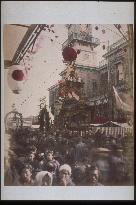
A float in a festival

A float in a festival

The dashi (large carts) had many styles such as the mountain style, stall style, boat style, and lantern style, according to each locality, and developed in line with local culture. Decoration became more magnificent as the economy developed, and the size was competed. But the spread of electric wires limited the height, and they had to be made smaller.==Date:unknown, Place:Yokohama, Photo:Suzuki Shin-ichi, (Credit:Nagasaki University Library/Kyodo News Images) [Cabinet Number41‐40‐0]

  •  
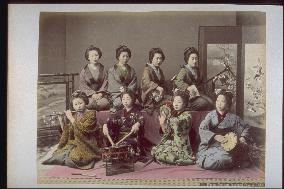
Women playing Japanese musical instraments

Women playing Japanese musical instraments

Eight women play Japanese instruments. The front row is the Ohayashi group with lutes, big and small drums, with two shamisen players and two singers in the back row.==Date:unknown, Place:unknown, Photo:Kusakabe Kinbei, (Credit:Nagasaki University Library/Kyodo News Images) [Cabinet Number40‐40‐0]

  •  
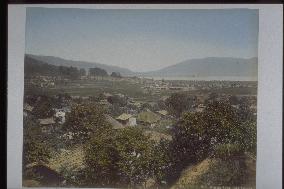
Inns at Nakasendo Shimo-no-Suwa and Suwa Lake

Inns at Nakasendo Shimo-no-Suwa and Suwa Lake

Shimosuwa village on the Nakasendo, one of the five kaidos. Shimosuwa is located to the northeast bank of Lake Suwa, and spreads with the Yashima highlands to the back. There are many spas in the juku, and was also called the city of spas. It is the terminal point of the Koshukaido.==Date:unknown, Place:Nagano, Photo:Kusakabe Kinbei, (Credit:Nagasaki University Library/Kyodo News Images) [Cabinet Number38‐40‐0]

  •  
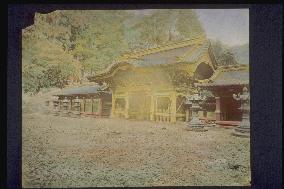
Nitenmon gate of nikko daishuin's burial ground

Nitenmon gate of nikko daishuin's burial ground

The Yashamon Gate stands in front of the Karamon Gate, the entrance to the main hall of the Taiyuan Mausoleum where Tokugawa Iemitsu was buried. There are statues of demons (yasha) on both sides of the gate covered with peony flower carvings. This photo captures the back view of the gate as seen from the worship hall.==Date:unknown, Place:Nikko, Photo:unknown, (Credit:Nagasaki University Library/Kyodo News Images) [Cabinet Number37‐40‐0]

  •  
Entire view of nikko hachi-ishi

Entire view of nikko hachi-ishi

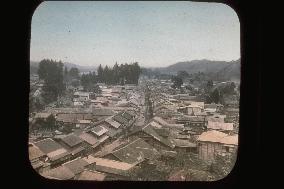
A photo of the city of Hatsuishi of Nikko from the middle of the western side of the mountain of Kannonji. Near Kannonji and the present Nikko City Office, Nikko Road took a turn leading to Kami Bridge at the entrance to Nikko Shrine.==Date:unknown, Place:Nikko, Photo:unknown, (Credit:Nagasaki University Library/Kyodo News Images) [Cabinet Number31‐40‐0]

  •  
Kiga Spa

Kiga Spa

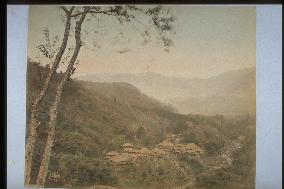
An overall view of the Kiga Spa. The river to the right is the Haya River. The mountain to the rear is Myojingadake and Usui Pass. Kiga Spa was divided by the Su River into the Miyagino side with Kameya and Yuyouin and the Miyanoshita side with the Sengokuya and Shobuyu inns. The photo is similar to the Edaori of the Seven Spas (1811) .==Date:unknown, Place:Hakone, Photo:unknown, (Credit:Nagasaki University Library/Kyodo News Images) [Cabinet Number26‐40‐0]

  •  
Women from behind

Women from behind

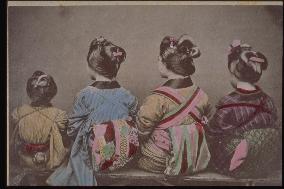
Four women (one a girl) sit with their backs toward a stand with a long side. All four have their sleeves tucked up tasukigake style, so they are probably women working in a restaurant or a teahouse. The sash, bands and hair style of the Japanese women, were probably photographed because of their interest to foreigners.==Date:unknown, Place:unknown, Photo:Ogawa Kazumasa, (Credit:Nagasaki University Library/Kyodo News Images) [Cabinet Number25‐40‐0]

  •  
Tomb of yoritomo

Tomb of yoritomo

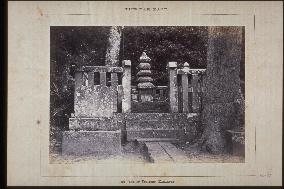
Minamoto Yoritomo died at the age of 53 in 1199, and his remains were buried in the Jibutsudo in the hills of Nishigomon in Kamakura city. The five-story stone pagoda with a stone fence marks the site. Huge trees stand in the front and back of the stone fence.==Date:unknown, Place:Kamakura, Photo:unknown, (Credit:Nagasaki University Library/Kyodo News Images) [Cabinet Number24‐40‐0]

  •  
A woman reading a book

A woman reading a book

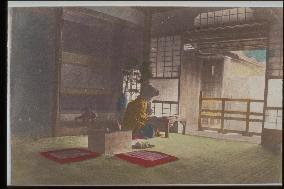
A woman sitting at a writing desk reads a book facing the garden. In the hall is a brazier with a kettle, and around that are two cushions. The alcove has a scroll, and a pine branch is arranged in the vase.==Date:unknown, Place:unknown, Photo:unknown, (Credit:Nagasaki University Library/Kyodo News Images) [Cabinet Number18‐40‐0]

  •  
Mother and a child

Mother and a child

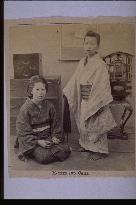
A picture from the July 1, 1872 edition of The Far East , page 67. There is no explanation in the text. The daughter is dressed up, so it looks like some celebration. The daughter holds a Japanese umbrella, and the mother holds a tobacco case.==Date:unknown, Place:unknown, Photo:unknown, (Credit:Nagasaki University Library/Kyodo News Images) [Cabinet Number17‐40‐0]

  •  
Nagasaki Kiyomizudera Temple

Nagasaki Kiyomizudera Temple

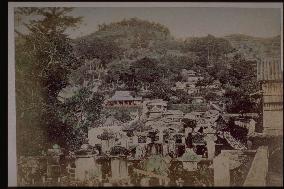
Kiyomizudera of the Shingon Sect in Nagasaki in shown in the centre. Houses line the stone steps of the main hall, but it is a cemetery at present. The temple was built in 1668 as a copy of the Kiyomizu temple in Kyoto. This photo was taken from the cemetery at Shokakuji Temple.==Date:unknown, Place:Nagasaki, Photo:unknown, (Credit:Nagasaki University Library/Kyodo News Images) [Cabinet Number15‐40‐0]

  • Main
  • Top
  • Editorial
  • Creative
  • About Us
  • About ILG
  • Terms of use
  • Company
  • BEHIND
  • Price List
  • Single Plan
  • Monthly Plan
  • Services
  • Shooting
  • Rights Clearance
  • Support
  • FAQ
  • How To Buy
  • Contact Us
  • Become a Partner

© KYODO NEWS IMAGES INC

All Rights Reserved.

  • Editorial
  • Olympics
  • News
  • Sports
  • Japan
  • Tech
  • Royal
  • Disaster
  • NorthKorea
  • Old Japan
  • SNS
  • Creative
  • Food
  • Japan
  • Landscape
  • Animal
  • Popular
  • #Ukraine
  • #Russia
  • #coronavirus
  • #N. Korea
  • #Thailand
  • #China
  • #Ukraine
  • #Russia
  • #coronavirus
  • #N. Korea
  • #Thailand
  • #China
  • Food
  • Japan
  • Landscape
  • Animal
  • Olympics
  • News
  • Sports
  • Japan
  • Tech
  • Royal
  • Disaster
  • NorthKorea
  • Old Japan
  • SNS