•  

France: Hundreds of Thousands Join Nationwide Protests Over Austerity Budget 4

On September 18, hundreds of thousands people joined over 250 demonstrations across France in response to a cross-industry union call against the austerity budget introduced by former Prime Minister François Bayrou. Unions criticized the measures as “brutal,” arguing they unfairly target workers, vulnerable groups, retirees, and the sick. Current Prime Minister Sébastien Lecornu has yet to revise the policies. Union leaders hailed the strike as a success and urged the government to ensure fiscal, social, and environmental justice in the upcoming budget.

  •  
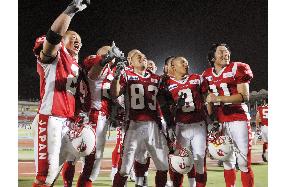
Japan whips France in American football World Cup opener

Japan whips France in American football World Cup opener

KAWASAKI, Japan - Members of Japan's American football team acknowledge their fans after beating France 48-0 on the opening day of the World Cup of American football in Kawasaki, Kanagawa Prefecture on July 7. Six nations, including the United States for the first time since the tournament began in 1999, are taking part in the competition.

  •  
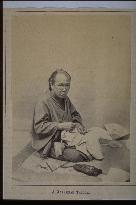
Tailor

Tailor

Carried on page 31 of the May 14, 1872 edition of The Far East. The man's face is pitted with small pox and is not at all handsome, but he is skilled in sewing. He is indispensable to the foreign women customers. His tools are rare, such as needles, scissors and a ruler.==Date:Early Meiji, Place:unknown, Photo:THE FAR EAST, (Credit:Nagasaki University Library/Kyodo News Images) [Cabinet Number17‐48‐0]

  •  
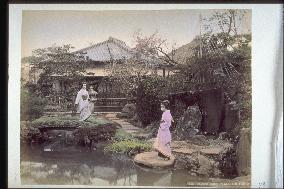
Women in Okano Garden

Women in Okano Garden

A serial of the photo numbered 9-41, from a different angle. The woman in the fore stops walking at the edge and stands there with her eyes on the surface of the lake. The woman in the rear stands half way across the bridge and looks at the camera. The same as the photo numbered 10-37.==Date:unknown, Place:Tokyo, Photo:Ogawa Kazumasa, (Credit:Nagasaki University Library/Kyodo News Images) [Cabinet Number9‐48‐0]

  •  
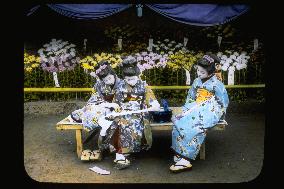
A chrysanthemem exhibition at Nozawa Garden

A chrysanthemem exhibition at Nozawa Garden

Three girls are reading a letter. Behind them, many types of chrysanthemum flowers are in full bloom in an exhibition. Their hair is in momoware style and they wear furisode kimono and bokkuri wooden clogs. This was typical attire for an outing in the Meiji and Taisho Periods.==Date:unknown, Place:unknown, Photo:unknown, (Credit:Nagasaki University Library/Kyodo News Images) [Cabinet Number98‐48‐0]

  •  
A woman in her night clothes

A woman in her night clothes

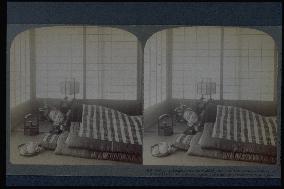
This photograph, which appeared in the album JAPAN THROUGH THE STEREOSCOPE published by Underwood & Underwood, was taken sometime between 1887 and 1907. The caption on the back reads: Girl sleeping between wadded futons with head on a wooden support - Teahouse, Hikone. The sleeping young woman, futon, wooden support for the head to protect the hairstyle, tobacco tray, tea tray, and andon light attracted the interest of Westerners.==Date:1904, Place:Hikone, Photo:Underwood, (Credit:Nagasaki University Library/Kyodo News Images) [Cabinet Number97‐48‐0]

  •  
Hairdressing

Hairdressing

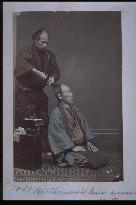
The sakayaki haircut with hair shaved in a half-circle from the forehead to the crown was popular among the common people of the Edo Period. Men went to a barber to have their sideburns and sakayaki shaved and the remaining hair arranged in a mage topknot.==Date:unknown, Place:unknown, Photo:Usui Shuzaburo, (Credit:Nagasaki University Library/Kyodo News Images) [Cabinet Number94‐48‐0]

  •  
Oblations for moon viewing

Oblations for moon viewing

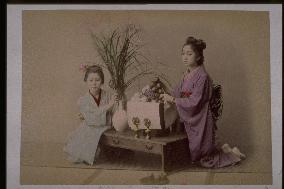
Moon viewing parties were held in Japan on the 15th of the eighth month and 13th of the ninth month on the lunar calendar. The custom originated in China and was adopted in Japan during the Heian Period. It became very popular in the Edo Period. Dumplings, chestnuts, taro, autumn flowers, and eulalia grass are offered to the full moon.==Date:unknown, Place:unknown, Photo:unknown, (Credit:Nagasaki University Library/Kyodo News Images) [Cabinet Number92‐48‐0]

  •  
A woman playing the koto

A woman playing the koto

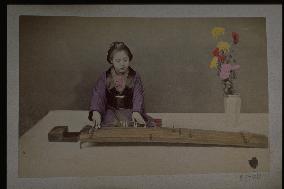
The koto is a traditional stringed instrument. It has 13 strings. The bridges place on the body under the strings determine the pitch. Fine tuning is done by adjusting the bridges. Performers wear picks on the thumb, index finger and middle finger of the right hand.==Date:unknown, Place:unknown, Photo:unknown, (Credit:Nagasaki University Library/Kyodo News Images) [Cabinet Number91‐48‐0]

  •  
Miyajima Island,Aki

Miyajima Island,Aki

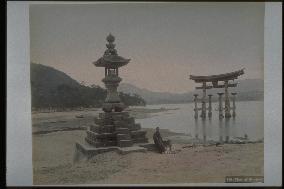
This is the view of the Grand Torii Gate from Mikasa Beach. The vista is still intact today. Nowadays people take photographs to include the red torii gate of Itsukushima Shinto Shrine in the background. To the left is the stone lantern donated by Konya Kochu of Awa (present-day Tokushima Prefecture) in 1805. This is the largest of the many stone lanterns in the shrine.==Date:unknown, Place:Miyajima, Photo:unknown, (Credit:Nagasaki University Library/Kyodo News Images) [Cabinet Number87‐48‐0]

  •  
Priests

Priests

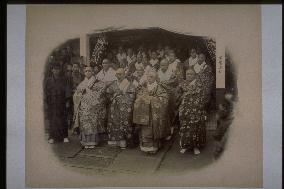
This Yokohama photograph by an anonymous photographer is the same as #2522. This may be a Buddhist service at a big temple. It shows a large number of Buddhist priests in opulent kesa robes surrounded by the faithful.==Date:unknown, Place:unknown, Photo:unknown, (Credit:Nagasaki University Library/Kyodo News Images) [Cabinet Number85‐48‐0]

  •  
A woman holding an umbrella

A woman holding an umbrella

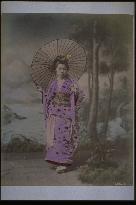
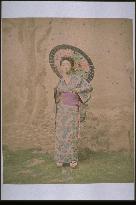
A girl is holding a plain parasol. Her hair is in momoware (split peach) style with a flower pin. The cloth hanging down is probably an obiage (cloth belt to support the sash. Mt. Fuji is visible in the background.==Date:unknown, Place:unknown, Photo:A. Farsari, (Credit:Nagasaki University Library/Kyodo News Images) [Cabinet Number81‐48‐0]

  •  
The Yashamon Gate,Taiyuin Shrine,Nikko

The Yashamon Gate,Taiyuin Shrine,Nikko

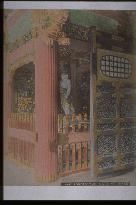
Visitors climbing the steep stairs from Nitenmon pass the mausoleum of the third shogun Tokugawa Iemitsu and come in front of Yashamon, where four yasha (female demons) are enshrined. Each yasha is painted in a different colour and represents north, south, east and west. Since the gate is decorated with peonies and arabesque patterns, it is also called the Botan-mon ( Peony Gate ).==Date:unknown, Place:Nikko, Photo:unknown, (Credit:Nagasaki University Library/Kyodo News Images) [Cabinet Number80‐48‐0]

  •  
Woman putting up a parasol

Woman putting up a parasol

A woman is holding an ehigasa (picture parasol) popular among women during the Edo Period. Prohibitions on their use were often enforced because the parasols were viewed as overly luxurious. Flowers, birds, and arabesque designs were the usual motifs.==Date:unknown, Place:unknown, Photo:unknown, (Credit:Nagasaki University Library/Kyodo News Images) [Cabinet Number79‐48‐0]

  •  
Weaving

Weaving

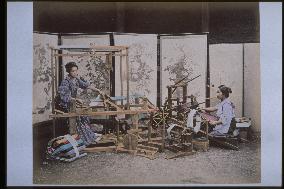
Artistic handwork is one of Japan's driving forces. A jibata handloom from the Edo Period and takahata weaving apparatus from the Meiji Period are shown on the right and left. The venue for weaving was shifting from homes to factories around this time.==Date:unknown, Place:unknown, Photo:R. Stillfried, (Credit:Nagasaki University Library/Kyodo News Images) [Cabinet Number77‐48‐0]

  •  
Tagonoura Bridge and Mt. Fuji

Tagonoura Bridge and Mt. Fuji

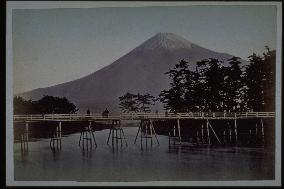
Northern view of Mt. Fuji from the mouth of Tagonoura (formerly Yoshiwara Minato) harbour in Fuji City. The reinforcements to the girders of Tagonoura Bridge (built in 1873) indicate that this photograph was taken after photograph #3146. Also, because the stone gate to block the back flow is missing in the inner part of the harbour, this photograph must have been taken before 1886. Four or five people can be seen standing on the bridge.==Date:unknown, Place:Shizuoka, Photo:unknown, (Credit:Nagasaki University Library/Kyodo News Images) [Cabinet Number69‐48‐0]

  •  
A row of pine trees along the Tokaido Road

A row of pine trees along the Tokaido Road

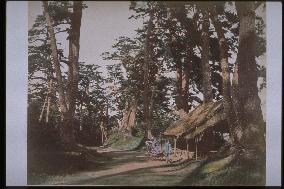
Opened in 1602, Nakasendo was the second of the five major highways in Japan. Pine and cedar trees were planted along the highway, and the cedar trees of Annaka (Gunma Prefecture) became famous. After World War II, many trees died due to pollution caused by car exhaust. Luckily, the decision to build National Route 142 parallel to the old Nakasendo Highway saved the trees at Kasatori Pass. The photograph with the rickshaw parked in front of the tea house shows how the highway had been renovated so that carriages could pass.==Date:unknown, Place:Nagano, Photo:unknown, (Credit:Nagasaki University Library/Kyodo News Images) [Cabinet Number64‐48‐0]

  •  
Mt. Fuji seen from Numakawa,Tagonoura

Mt. Fuji seen from Numakawa,Tagonoura

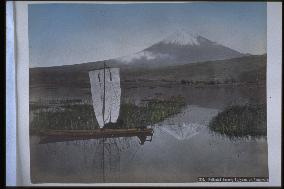
Northern view of Mt. Fuji from Ukishimanuma (Floating Island Bog) near Kashiwabara-Shinden in Fuji City. Ukishimanuma was formerly a stretch of low land between the southern foot of Mt. Fuji/Mt. Ashitaka and Suruga Bay. It flows into Numa River and Tagonoura harbour. Mt. Fuji and a sailboat are reflected on the pond. A man is on a small craft, with small islands scattered in the background.==Date:unknown, Place:Shizuoka, Photo:unknown, (Credit:Nagasaki University Library/Kyodo News Images) [Cabinet Number59‐48‐0]

  •  
Courtesans of Jimpuro brothel

Courtesans of Jimpuro brothel

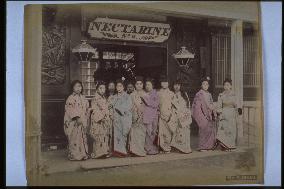
The Jimpuro brothel was called Nectarine No.9 and, together with Iwakiro, was one of the top brothels of Yokohama until the Great Kanto Earthquake of 1923. The original brothel at Miyozaki, called Isero, moved several times over the years, but this photograph seems to have been taken at the Takashima-machi location (1872-1882).==Date:unknown, Place:Yokohama, Photo:unknown, (Credit:Nagasaki University Library/Kyodo News Images) [Cabinet Number55‐48‐0]

  •  
The Hundred Stone Statues of Jizo at Ganmangahara,Nikko

The Hundred Stone Statues of Jizo at Ganmangahara,Nikko

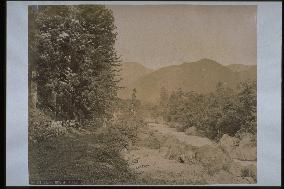
This famous sight on Daiya River is known by names such as Narabi-jizo, Bake-jizo, and Hyaku-jizo. It is also known as Kanman-ga-fuchi or Ganman-ga-fuchi. Oya-jizo, the head of which was washed away by the flood of 1902, is visible at the end of the road.==Date:unknown, Place:Nikko, Photo:unknown, (Credit:Nagasaki University Library/Kyodo News Images) [Cabinet Number54‐48‐0]

  •  
Daibutsu (the Great Buddha),Ueno

Daibutsu (the Great Buddha),Ueno

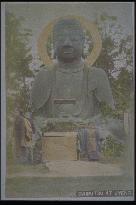
The Great Buddha was located on a hill to the left of Ueno Seiyoken Restaurant and attracted many visitors during the cherry blossom season. However, the head of the Buddha fell off in the Great Kanto Earthquake of 1923. The body was donated to the military to make (of all things) weapons during World War II. On the 50th anniversary of the earthquake, a pagoda was built at the site of the former Great Buddha, and the head of the Buddha, which had been kept at Kaneiji Temple, was installed in a monument south of the pagoda. Probably taken around 1878.==Date:unknown, Place:Tokyo, Photo:unknown, (Credit:Nagasaki University Library/Kyodo News Images) [Cabinet Number53‐48‐0]

  •  
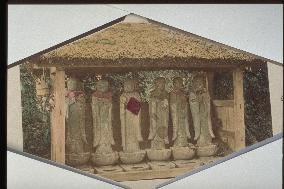
The Six Statues of Jizo

The Six Statues of Jizo

A different photograph of the Rokujizo figures was carried in the October 16, 1871 (September 3 on the lunar calendar) issue of The Far East (photograph #1082). In photographs of Kamakura taken in the early Meiji Period, however, the structure in which the jizo statues are housed and the atmosphere of the surroundings are different. This casts some doubt on whether the jizo depicted here are those in Kamakura. The exact date of the photograph is unknown.==Date:unknown, Place:Kamakura, Photo:unknown, (Credit:Nagasaki University Library/Kyodo News Images) [Cabinet Number51‐48‐0]

  •  
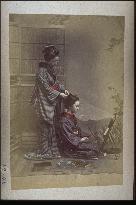
A woman putting on a comb

A woman putting on a comb

The girl in front of the mirror is having accessories applied to her hair. The striped pattern of the kimono worn by the woman on the left was popular during the Edo Period. This pattern appears frequently in ukiyoe woodblock prints.==Date:unknown, Place:unknown, Photo:unknown, (Credit:Nagasaki University Library/Kyodo News Images) [Cabinet Number49‐48‐0]

  •  
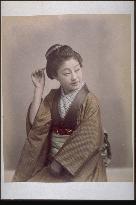
A woman putting on an ornamental hairpin

A woman putting on an ornamental hairpin

This woman, who is scratching her tilted head with a hairpin, is probably a yaritebaba, the woman who managed courtesans and supervised the business of a brothel. She certainly has the look of such a woman.==Date:unknown, Place:unknown, Photo:unknown, (Credit:Nagasaki University Library/Kyodo News Images) [Cabinet Number47‐48‐0]

  •  
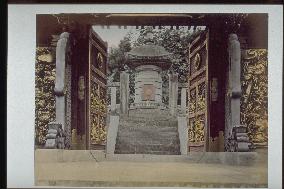
Middle gate of Shotokuin inner building and the treasure tower at Shiba Zojoji Temple

Middle gate of Shotokuin inner building and the treasure tower at Shiba Zojoji Temple

This Hoto is of the Edo era, and the tower on the canopy is called the Fukuhachi style. A sorin is built on the roof. The sorin is the metallic part built on the top of the Buddhist tower, and its foundation is called Kyurin.==Date:unknown, Place:Tokyo, Photo:unknown, (Credit:Nagasaki University Library/Kyodo News Images) [Cabinet Number42‐48‐0]

  •  
People attending an important Buddhist ceremony

People attending an important Buddhist ceremony

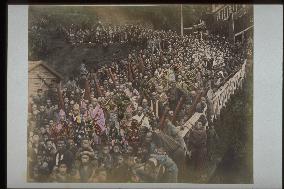
A large scale memorial ceremony. A long procession of priest in two rows follow. Many people stand to watch.==Date:unknown, Place:unknown, Photo:unknown, (Credit:Nagasaki University Library/Kyodo News Images) [Cabinet Number41‐48‐0]

  •  
Woman weaving silk

Woman weaving silk

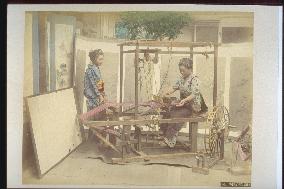
A woman weaves a silk material on a loom. To the right is a spinning wheel. Silk production prospered in Japan after import of silk thread was regulated during the Edo era by means of the thread warifu (quota) system. After that, the silk industry developed into one of the main Japanese exports.==Date:unknown, Place:unknown, Photo:Kusakabe Kinbei, (Credit:Nagasaki University Library/Kyodo News Images) [Cabinet Number40‐48‐0]

  •  
Inns at Nakasendo Iwamurata

Inns at Nakasendo Iwamurata

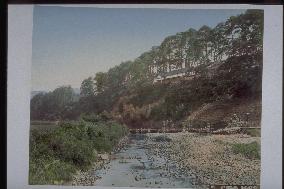
A view of the Iwata village (presently the Saku City of Nagano prefecture) on the Nakasendo. The fore could be a canal. Travelers can be seen on the path. At Iwata village, Nakasendo, Zenkojido, Koshukaido, Shimonitado met, so its was an important place for transporting commodities.==Date:unknown, Place:Nagano, Photo:Kusakabe Kinbei, (Credit:Nagasaki University Library/Kyodo News Images) [Cabinet Number38‐48‐0]

  •  
Ueno Gongen

Ueno Gongen

Ueno Gongen is also called Ueno Toshogu, and worships the Shogun Tokugawa Ieyasu. Gogen implies the Bosatsu appearing in the form of Ancient Gods or people, but Ieyasu also was given this title.==Date:unknown, Place:Tokyo, Photo:unknown, (Credit:Nagasaki University Library/Kyodo News Images) [Cabinet Number37‐48‐0]

  •  
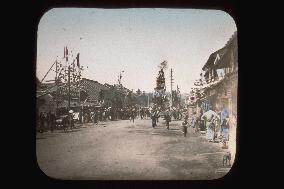
Scene of a festival

Scene of a festival

A festival scene in a city. A cart with decorations comes from the opposite direction. The cart is characteristic of festivities in the city and originates from the many festivals in Kyoto during the Heian Era. There are no electric poles, and the cart stands like a mountain.==Date:unknown, Place:unknown, Photo:unknown, (Credit:Nagasaki University Library/Kyodo News Images) [Cabinet Number31‐48‐0]

  •  
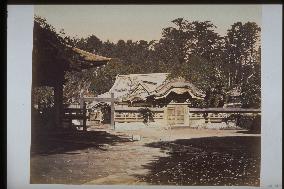
Temple in fujisawa

Temple in fujisawa

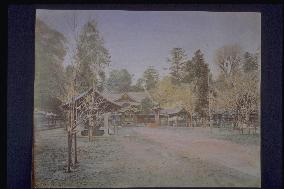
The compounds of Seijokoji in Fujisawa, the head temple of the Ji Sect. The roof of the building can be seen over the Kara Gate and fence. The background is a forest.==Date:unknown, Place:Fujisawa, Photo:unknown, (Credit:Nagasaki University Library/Kyodo News Images) [Cabinet Number26‐48‐0]

  •  
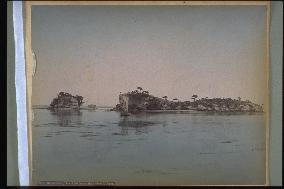
Matsushima

Matsushima

Matsushima, one of the three most scenic spots of Japan. Islands of various shapes stand in the bay, carved by the waves. In the centre a small and big island stand with a pine tree forming a pair, and show the surface of the rock carved by the waves. To the fore is a boat with a mast casting a shadow on the water.==Date:unknown, Place:Matsushima, Photo:Ogawa Kazumasa, (Credit:Nagasaki University Library/Kyodo News Images) [Cabinet Number25‐48‐0]

  •  
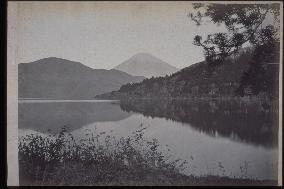
Mt. Fuji seen from Lake Ashi

Mt. Fuji seen from Lake Ashi

This is a photo of the so-called Sakasa Fuji (upside-down Fuji) . It is monochrome, but the shadows can be seen clearly. To the right in the mountains is Hakone Shinto Shrine. The same as the photo in The Far East Vol. 2-20.==Date:unknown, Place:Hakone, Photo:unknown, (Credit:Nagasaki University Library/Kyodo News Images) [Cabinet Number19‐48‐0]

  •  
Shop of hagoita,battledores

Shop of hagoita,battledores

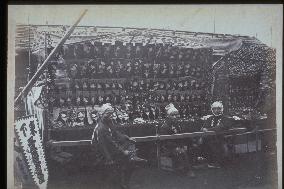
An open-air hagoita (battledore) shop. It has a large opening, and battledores are arranged in five rows for sale. Three men sit at the entrance of the shop and look in the direction of the camera. The men have towels around or over their heads and the two men to the right and left hold pipes in their hands.==Date:unknown, Place:unknown, Photo:unknown, (Credit:Nagasaki University Library/Kyodo News Images) [Cabinet Number18‐48‐0]

  •  
The stage of Kiyomizudera Temple,Kyoto

The stage of Kiyomizudera Temple,Kyoto

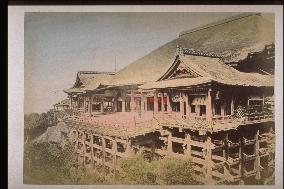
(The same as the photo numbered 5-43, but from a point nearer to the building.) There are no people seen on the stage.==Date:unknown, Place:Kyoto, Photo:unknown, (Credit:Nagasaki University Library/Kyodo News Images) [Cabinet Number16‐48‐0]

  •  
View of a small island

View of a small island

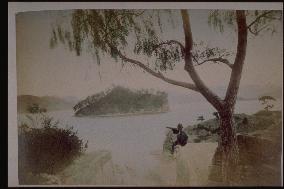
The location is unknown. A man sitting on a stone wall points to a small island in the distance. It is probably a dramatized photo. The tree placed as if to cover the upper part of the photo evokes the structure of Japanese paintings.==Date:unknown, Place:unknown, Photo:unknown, (Credit:Nagasaki University Library/Kyodo News Images) [Cabinet Number15‐48‐0]

  •  
Arashiyama

Arashiyama

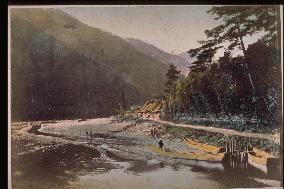
A bamboo grove grows on the right bank with Mt.Arashi to the left. Amid the bamboo trees, houses can be seen. Near the bank are many poles with boats anchored to them. ==Date:unknown, Place:Kyoto, Photo:Uchida Kuichi, (Credit:Nagasaki University Library/Kyodo News Images) [Cabinet Number14‐48‐0]

  •  
Dancing children

Dancing children

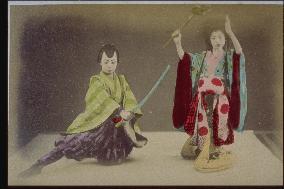
Two young women dance dressed as a woman and a man. The woman dressed as a man is a warrior with haori, hakama and a wooden sword. The other woman wears an courtesan costume and holds a stick to compete with the woman dressed as a man.==Date:unknown, Place:unknown, Photo:unknown, (Credit:Nagasaki University Library/Kyodo News Images) [Cabinet Number12‐48‐0]

  •  
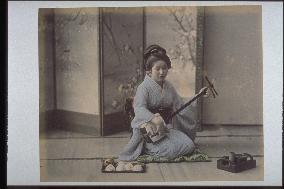
A woman playing the shamisen

A woman playing the shamisen

A woman dressed in a kimono and hair in Japanese style sits in a room playing a shamisen. A tray with a tea set and a tobacco tray are placed next to her, and a screen is placed at her back.==Date:unknown, Place:unknown, Photo:unknown, (Credit:Nagasaki University Library/Kyodo News Images) [Cabinet Number11‐48‐0]

  •  
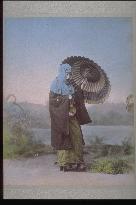
Woman dressed up to avoid rain

Woman dressed up to avoid rain

A young woman dressed in a kimono and a haori coat, wears high-heeled clogs, a scarf over her head, and poses with a Japanese umbrella avoiding the rain. Taken in a studio,this is a dramatized photo of a woman dressed for rain. A cover to protect feet from mud is seen at the toes of the clogs.==Date:unknown, Place:unknown, Photo:Ogawa Kazumasa, (Credit:Nagasaki University Library/Kyodo News Images) [Cabinet Number10‐48‐0]

  •  
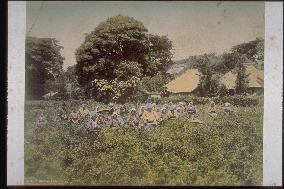
Tea picking

Tea picking

About 30 men and women look in this direction, stopping their tea-leaf picking. Most are women, but some are men and children. Most of the women wear their kimono sleeves tied up and a towel over their heads. Trees and houses can be seen in the background of the tea fields.==Date:unknown, Place:unknown, Photo:Ogawa Kazumasa, (Credit:Nagasaki University Library/Kyodo News Images) [Cabinet Number7‐48‐0]

  •  
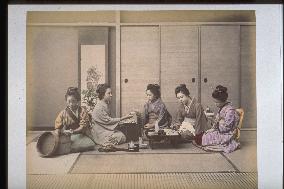
A scene of a meal

A scene of a meal

A dramatized photo of a Japanese meal with five girls. Each are posed to drink sake with a choshi (sake bottle) and sakazuki (cup), to serve rice from the rice pail and to eat the rice and food with chop-sticks. Individual meal stands are placed on the tatami, and a pot is placed on the brazier.==Date:unknown, Place:unknown, Photo:Ogawa Kazumasa, (Credit:Nagasaki University Library/Kyodo News Images) [Cabinet Number6‐48‐0]

  •  
Nunobiki Falls

Nunobiki Falls

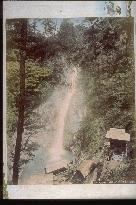
Ondaki, located in the upper part of Nunobiki Falls, has a height of 45 meters and falls in 5 sections. The photo is a part of the falls.In the lower right is a hokora (small shrine) and some people.==Date:unknown, Place:Kobe, Photo:Ogawa Kazumasa, (Credit:Nagasaki University Library/Kyodo News Images) [Cabinet Number5‐48‐0]

  •  
Nunobiki Falls

Nunobiki Falls

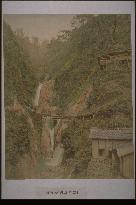
Nunobiki Falls, which run over a granite cliff with the water source from the Ikuta River, are made up of Metaki, Tsuzumigadaki, Meotodaki and Osutaki. The Metaki in the photo is located furthest downstream. Kanbo Bridge is seen in the centre of the photo.==Date:unknown, Place:Kobe, Photo:Kusakabe Kinbei, (Credit:Nagasaki University Library/Kyodo News Images) [Cabinet Number3‐48‐0]

  •  
A priest

A priest

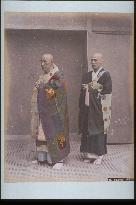
Buddhist priest and his disciple holding hands in prayer and wearing clerical vestments. 14 Buddhist Priest==Date:unknown, Place:unknown, Photo:Kusakabe Kinbei, (Credit:Nagasaki University Library/Kyodo News Images) [Cabinet Number2‐48‐0]

  •  
Middle gate of Shotokuin inner building and the treasure tower at Shiba Zojoji Temple

Middle gate of Shotokuin inner building and the treasure tower at Shiba Zojoji Temple

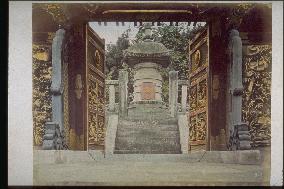
Caption reads Tomb of a shogun in Tokyo in German. This photo shows the middle gate and Hoto (treasure tower) in the tomb of Shotokuin (the 14th Shogun Iemochi) within the Zojoji Temple compound in Shiba, Tokyo. The magnificent carving on the middle gate, which was destroyed in the great Kanto Earthquake, can be observed.==Date:unknown, Place:Tokyo, Photo:Kusakabe Kinbei, (Credit:Nagasaki University Library/Kyodo News Images) [Cabinet Number1‐48‐0]

  •  
Suntory close in on Top League title

Suntory close in on Top League title

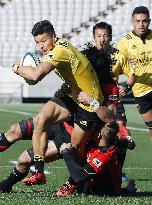
Shota Emi of Suntory Sungoliath advances with the ball during a Japan Rugby Top League match against Toshiba Brave Lupus in Tokyo on Jan. 7, 2017. Suntory won 48-0, moving ever closer to their fourth league title. (Kyodo) ==Kyodo

  • Main
  • Top
  • Editorial
  • Creative
  • About Us
  • About ILG
  • Terms of use
  • Company
  • BEHIND
  • Price List
  • Single Plan
  • Monthly Plan
  • Services
  • Shooting
  • Rights Clearance
  • Support
  • FAQ
  • How To Buy
  • Contact Us
  • Become a Partner

© KYODO NEWS IMAGES INC

All Rights Reserved.

  • Editorial
  • Olympics
  • News
  • Sports
  • Japan
  • Tech
  • Royal
  • Disaster
  • NorthKorea
  • Old Japan
  • SNS
  • Creative
  • Food
  • Japan
  • Landscape
  • Animal
  • Popular
  • #Ukraine
  • #China
  • #coronavirus
  • #N. Korea
  • #Russia
  • #Thailand
  • #Ukraine
  • #China
  • #coronavirus
  • #N. Korea
  • #Russia
  • #Thailand
  • Food
  • Japan
  • Landscape
  • Animal
  • Olympics
  • News
  • Sports
  • Japan
  • Tech
  • Royal
  • Disaster
  • NorthKorea
  • Old Japan
  • SNS