•  
Japan Mobility Show

Japan Mobility Show

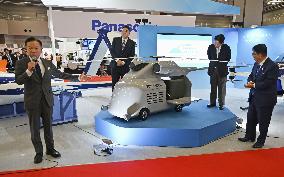
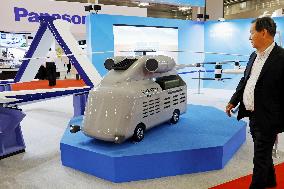
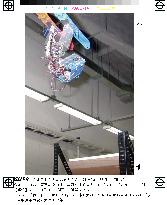
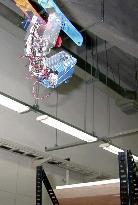
Nagoya-based Prodrone Co. displays a prototype of a drone capable of transporting cargo weighing up to 50 kilograms on the opening day of the Japan Mobility Show at Tokyo Big Sight hall in Tokyo on Oct. 26, 2023.

  •  
Japan Mobility Show

Japan Mobility Show

Nagoya-based Prodrone Co. displays a prototype of a drone capable of transporting cargo weighing up to 50 kilograms on the opening day of the Japan Mobility Show at Tokyo Big Sight hall in Tokyo on Oct. 26, 2023.

  •  

Russia launches Progress MS-24 cargo spaceship into orbit

STORY: Russia launches Progress MS-24 cargo spaceship into orbit DATELINE: Aug. 23, 2023 LENGTH: 0:00:31 LOCATION: VLADIVOSTOK, Russia CATEGORY: TECHNOLOGY SHOTLIST: 1. various of the launch of the Progress MS-24 cargo spaceship (Source: Roscosmos) STORYLINE: A Soyuz-2.1a rocket carrying the Progress MS-24 cargo spacecraft blasted off from the Baikonur Cosmodrome in Kazakhstan on Wednesday, sending it into orbit. The rocket lifted off at 4:08 a.m. Moscow time (0108 GMT) and sent the spacecraft into orbit nine minutes later, Russia's state space corporation Roscosmos said. Progress MS-24 will perform a two-day autonomous flight to the International Space Station (ISS), where it is expected to dock with the Zvezda service module of the space outpost on Friday at 6:50 a.m. Moscow time (0350 GMT). The cargo spaceship will deliver about 2.5 tons of supplies to the ISS, including more than 1.5 tons of various equipment and materials, half a ton of fuel to refuel the station, 420 kilograms of drinking

  •  
Big cabbages harvested in Hokkaido's Sapporo

Big cabbages harvested in Hokkaido's Sapporo

SAPPORO, Japan - People harvest big cabbages, measuring 50-60 centimeters in diameter and weighing 10-15 kilograms, in Sapporo, Hokkaido, Japan's northernmost main island, on Oct. 30, 2014.

  •  
Big cabbages harvested in Hokkaido's Sapporo

Big cabbages harvested in Hokkaido's Sapporo

SAPPORO, Japan - People harvest big cabbages, measuring 50-60 centimeters in diameter and weighing 10-15 kilograms, in Sapporo, Hokkaido, Japan's northernmost main island, on Oct. 30, 2014.

  •  
ChubuSat-1 satellite developed by Japanese consortium

ChubuSat-1 satellite developed by Japanese consortium

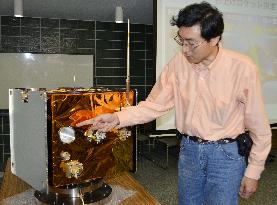
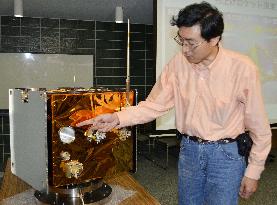
NAGOYA, Japan - Hiroyasu Tajima, professor at the Solar-Terrestrial Environment Laboratory at Nagoya University, gives a briefing about a prototype of the ChubuSat-1 satellite in Nagoya on May 16, 2012. A consortium of universities and aerospace companies in the Chubu region of central Japan that jointly developed the satellite, with sides measuring 50 centimeters and weighing 50 kilograms, said the same day it will be launched into space on a Russian rocket in December.

  •  
ChubuSat-1 satellite developed by Japanese consortium

ChubuSat-1 satellite developed by Japanese consortium

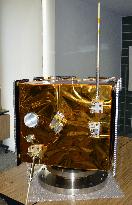
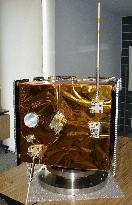
NAGOYA, Japan - Photo taken in Nagoya on May 16, 2012, shows a prototype of the ChubuSat-1 satellite. A consortium of universities and aerospace companies in the Chubu region of central Japan that jointly developed the satellite, with sides measuring 50 centimeters and weighing 50 kilograms, said the same day it will be launched into space on a Russian rocket in December.

  •  
Murata's cycling robots

Murata's cycling robots

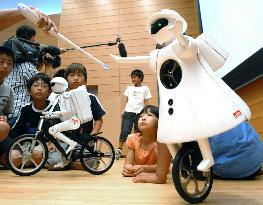
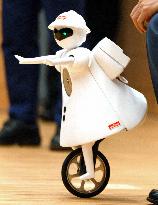
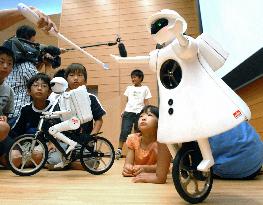
KYOTO, Japan - Murata Manufacturing Co. unveils a unicycle-riding robot at Nagaokakyo, Kyoto Prefecture on Sept. 23 along with a bicycle-riding robot the Nagaokakyo-based company had developed earlier. The company describes the two robots as ''cousins'' as they share the same weight (5 kilograms) and height (50 centimeters). According to Murata officials, the unicycle-riding robot, designed in the form of a kindergarten girl, can ride the unicycle backward and forward. The robot can also keep itself in balance without falling in a stationary pose. The two robots can be viewed by the public at the CEATEC Japan 2008 exhibition to open at Makuhari Messe in Chiba on Sept. 30.

  •  
Murata's unicycle-riding robot

Murata's unicycle-riding robot

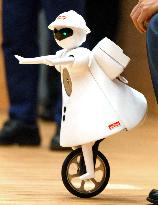
KYOTO, Japan - Murata Manufacturing Co. unveils a unicycle-riding robot (photo) at Nagaokakyo, Kyoto Prefecture on Sept. 23 along with a bicycle-riding robot the Nagaokakyo-based company had developed earlier. The company describes the two robots as ''cousins'' as they share the same weight (5 kilograms) and height (50 centimeters). According to Murata officials, the unicycle-riding robot, designed in the form of a kindergarten girl, can ride the unicycle backward and forward. The robot can also keep itself in balance without falling in a stationary pose. The two robots can be viewed by the public at the CEATEC Japan 2008 exhibition to open at Makuhari Messe in Chiba on Sept. 30.

  •  
Hitachi robot navigates its way to take images

Hitachi robot navigates its way to take images

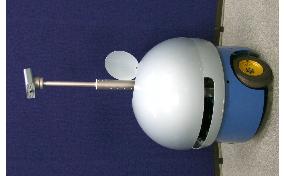
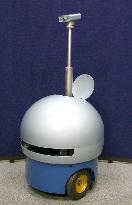
TOKYO, Japan - Hitachi Ltd. said on March 7 it has developed a robot (in handout photo) that moves indoors negotiating its way around obstacles and uses a surveillance camera to take images. The robot, which measures 57 centimeters high and 50 cm wide and weighs 33 kilograms, is powered by a battery to travel at a speed of one kilometer per hour on two tire wheels. The company said the robot can detect more things as compared with one with a surveillance camera fixed onto one spot.

  •  
10,000 tourists enjoy fire festival at Kumano-Nachi Shrine

10,000 tourists enjoy fire festival at Kumano-Nachi Shrine

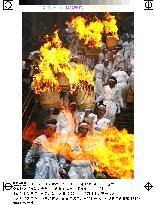
SHINGU, Japan - Local youths walked up and down steep stairs in front of Kumano-Nachi Shrine in the town of Nachi-Katsuura, Wakayama Prefecture, on July 14, carrying giant burning torches. Some 10,000 tourists gathered to view the Nachi-no-Himatsuri (Nachi Fire Festival), during which 60 local youths took turns carrying 12 burning torches. Each torch was 1.4 meter long and weighed 50 kilograms.

  •  
Freestyle skiing robot developed

Freestyle skiing robot developed

TOKYO, Japan - A robot developed by a group led by Kazuo Yoshida, a professor in the science and engineering department at Tokyo's Keio University, performs a midair somersault in a demonstration to the media at the university Aug. 23. The robot stands 50 centimeters tall and weighs 4.3 kilograms. It can travel at a speed of about 7.5 meters per second. Yoshida said the robot that moves according to a recorded program of instructions via radio transmission may be used in space.

  •  

China's Inner Mongolia reports record-high grain output

STORY: China's Inner Mongolia reports record-high grain output DATELINE: Dec. 13, 2022 LENGTH: 00:00:50 LOCATION: HOHHOT, China CATEGORY: ECONOMY SHOTLIST: 1. various of grain harvesting in Inner Mongolia STORYLINE: Official data show that north China's Inner Mongolia Autonomous Region this year reported a record-high annual grain output of over 39 billion kilograms, up 600 million kilograms from last year. According to the regional agriculture and animal husbandry department, Inner Mongolia has maintained an annual grain output of above 37.5 billion kilograms for five consecutive years. As one of China's major grain-producing regions, Inner Mongolia's output of major food crops such as corn, soybeans and potatoes ranks among the top in China. In 2022, the region saw the stable expansion of its sown grain area, which climbed to more than 104 million mu (about 6.9 million hectares), and its average crop yield per area unit also grew. Xinhua News Agency correspondents reporting from Hohhot, China. (XHTV)

  •  

India's space body says newly-launched small satellites "no longer usable"

STORY: India's space body says newly-launched small satellites "no longer usable" DATELINE: Aug. 8, 2022 LENGTH: 00:01:13 LOCATION: New Delhi CATEGORY: TECHNOLOGY SHOTLIST: 1. various of India gate 2. various of SSLV-D1/EOS-02 Mission (courtesy of Indian Space Research Organization) STORYLINE: The Indian Space Research Organization (ISRO) on Sunday said the two small satellites launched earlier in the day are "no longer usable." The Earth Observation Satellite (EOS-02) and the AzadiSAT (Independence Satellite) developed by school students, were put into orbit, but the "orbit achieved was less than expected," said the ISRO. The AzadiSAT is a CubeSat developed by 750 girl students to mark the 75th anniversary of India's independence on Aug. 15, according to media reports. "AzadiSAT is an 8U CubeSat weighing around 8 kilograms. It carried 75 different payloads each weighing around 50 grams and conducting femto-experiments. Girl students from rural regions across the country were provided guidance to build

  •  
Fully automated aseptic cell separation system from Mitsui Denki Seiki

Fully automated aseptic cell separation system from Mitsui Denki Seiki

Mitsui Denki Seiki (Noda City, Chiba Prefecture) has developed a fully automated aseptic cell separation system. It is characterized by the fact that it does not require human intervention and does not require facilities such as clean rooms. The device developed by Mitsui Denki Seiki draws blood or body fluids from an infusion bag directly into the main body using a large syringe without using test tubes, and separates it into multiple components to recover the desired components. The Niigata University School of Medicine and the Graduate School of Engineering of Chiba University cooperated in the demonstration tests and the design, respectively. It is 325 mm wide, 430 mm high, and 385 mm deep, and weighs 26.3 kilograms. The company will continue to aggressively develop and sell its own products, aiming for a 50% share of its own products in the future. July 9, 2019, credit: Nikkan Kogyo Shimbun / Kyodo News Images)

  •  
Terrafuse's own product "Yakijaga

Terrafuse's own product "Yakijaga

Terrafuse will start to expand sales of potato chips that are not fried in oil, for which it has its own manufacturing technology. In cooperation with a major trading company, the company will work on developing products for major convenience stores. In order to expand sales, the company plans to triple the production capacity of its main plant in the near future. Currently, Terrafuse produces its own potato chips product, "Yakijaga", and private brand products for distributors at the main plant. Its production capacity is about 50 kilograms per hour, which will be increased to about 150 kilograms per hour. Photo taken on May 13, 2019, location unknown, credit: Nikkan Kogyo Shimbun / Kyodo News Images

  •  
Murata's unicycle-riding robot

Murata's unicycle-riding robot

OSAKA, Japan - Murata Manufacturing Co. unveils a unicycle-riding robot (photo) at Nagaokakyo, Kyoto Prefecture on Sept. 23 along with a bicycle-riding robot the Nagaokakyo-based company had developed earlier. The company describes the two robots as ''cousins'' as they share the same weight (5 kilograms) and height (50 centimeters). According to Murata officials, the unicycle-riding robot, designed in the form of a kindergarten girl, can ride the unicycle backward and forward. The robot can also keep itself in balance without falling in a stationary pose. The two robots can be viewed by the public at the CEATEC Japan 2008 exhibition to open at Makuhari Messe in Chiba on Sept. 30. (Kyodo)

  •  
Murata's cycling robots

Murata's cycling robots

KYOTO, Japan - Murata Manufacturing Co. unveils a unicycle-riding robot at Nagaokakyo, Kyoto Prefecture on Sept. 23 along with a bicycle-riding robot the Nagaokakyo-based company had developed earlier. The company describes the two robots as ''cousins'' as they share the same weight (5 kilograms) and height (50 centimeters). According to Murata officials, the unicycle-riding robot, designed in the form of a kindergarten girl, can ride the unicycle backward and forward. The robot can also keep itself in balance without falling in a stationary pose. The two robots can be viewed by the public at the CEATEC Japan 2008 exhibition to open at Makuhari Messe in Chiba on Sept. 30. (Kyodo)

  •  
Scenes of sumo

Scenes of sumo

A sumo wrestler grabs some salt to toss into the ring at the Nagoya Grand Sumo Tournament in Nagoya, central Japan, on July 18, 2017. About 40 to 50 kilograms of salt is used per day to purify the ring and pray for the safety of the wrestlers. (Kyodo) ==Kyodo

  •  
Hitachi robot navigates its way to take images

Hitachi robot navigates its way to take images

TOKYO, Japan - Hitachi Ltd. said on March 7 it has developed a robot (in handout photo) that moves indoors negotiating its way around obstacles and uses a surveillance camera to take images. The robot, which measures 57 centimeters high and 50 cm wide and weighs 33 kilograms, is powered by a battery to travel at a speed of one kilometer per hour on two tire wheels. The company said the robot can detect more things as compared with one with a surveillance camera fixed onto one spot. (Kyodo)

  •  
ChubuSat-1 satellite developed by Japanese consortium

ChubuSat-1 satellite developed by Japanese consortium

NAGOYA, Japan - Hiroyasu Tajima, professor at the Solar-Terrestrial Environment Laboratory at Nagoya University, gives a briefing about a prototype of the ChubuSat-1 satellite in Nagoya on May 16, 2012. A consortium of universities and aerospace companies in the Chubu region of central Japan that jointly developed the satellite, with sides measuring 50 centimeters and weighing 50 kilograms, said the same day it will be launched into space on a Russian rocket in December. (Kyodo)

  •  
ChubuSat-1 satellite developed by Japanese consortium

ChubuSat-1 satellite developed by Japanese consortium

NAGOYA, Japan - Photo taken in Nagoya on May 16, 2012, shows a prototype of the ChubuSat-1 satellite. A consortium of universities and aerospace companies in the Chubu region of central Japan that jointly developed the satellite, with sides measuring 50 centimeters and weighing 50 kilograms, said the same day it will be launched into space on a Russian rocket in December. (Kyodo)

  •  
Big cabbages harvested in Hokkaido's Sapporo

Big cabbages harvested in Hokkaido's Sapporo

SAPPORO, Japan - People harvest big cabbages, measuring 50-60 centimeters in diameter and weighing 10-15 kilograms, in Sapporo, Hokkaido, Japan's northernmost main island, on Oct. 30, 2014. (Kyodo)

  •  
Chubby seal in Japan

Chubby seal in Japan

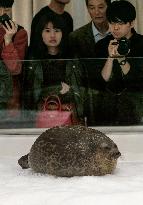
Visitors take photos of ringed seal Yuki at Osaka Aquarium Kaiyukan in western Japan on Oct. 24, 2018. Yuki, 1 meter long and weighing 50 kilograms, an average size for the animal, has attracted attention among visitors for her roly-poly figure. (Kyodo) ==Kyodo

  •  
Chubby seal in Japan

Chubby seal in Japan

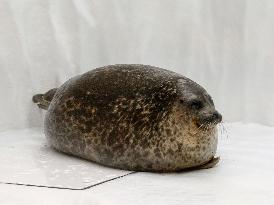
Photo taken Oct. 24, 2018, shows ringed seal Yuki at Osaka Aquarium Kaiyukan in western Japan. Yuki, 1 meter long and weighing 50 kilograms, an average size for the animal, has attracted attention among visitors for her roly-poly figure. (Kyodo) ==Kyodo

  •  
Freestyle skiing robot developed

Freestyle skiing robot developed

TOKYO, Japan - A robot developed by a group led by Kazuo Yoshida, a professor in the science and engineering department at Tokyo's Keio University, performs a midair somersault in a demonstration to the media at the university Aug. 23. The robot stands 50 centimeters tall and weighs 4.3 kilograms. It can travel at a speed of about 7.5 meters per second. Yoshida said the robot that moves according to a recorded program of instructions via radio transmission may be used in space.

  • Main
  • Top
  • Editorial
  • Creative
  • About Us
  • About ILG
  • Terms of use
  • Company
  • BEHIND
  • Price List
  • Single Plan
  • Monthly Plan
  • Services
  • Shooting
  • Rights Clearance
  • Support
  • FAQ
  • How To Buy
  • Contact Us
  • Become a Partner

© KYODO NEWS IMAGES INC

All Rights Reserved.

  • Editorial
  • Olympics
  • News
  • Sports
  • Japan
  • Tech
  • Royal
  • Disaster
  • NorthKorea
  • Old Japan
  • SNS
  • Creative
  • Food
  • Japan
  • Landscape
  • Animal
  • Popular
  • #Ukraine
  • #Thailand
  • #coronavirus
  • #N. Korea
  • #Russia
  • #China
  • #Ukraine
  • #Thailand
  • #coronavirus
  • #N. Korea
  • #Russia
  • #China
  • Food
  • Japan
  • Landscape
  • Animal
  • Olympics
  • News
  • Sports
  • Japan
  • Tech
  • Royal
  • Disaster
  • NorthKorea
  • Old Japan
  • SNS