•  
Qamdo Culture And Arts Festival - China

Qamdo Culture And Arts Festival - China

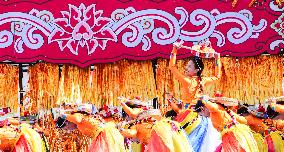
Performers dance during the opening ceremony of a culture and arts festival themed on the ancient Tea Horse Road in Qamdo, southwest China's Xizang Autonomous Region, on September 15, 2025. Qamdo used to be a key stop along the ancient Tea Horse Road, a trade route which dates back to the Tang Dynasty (618-907) and spans multiple regions. Photo by Kelsang Namgyai /Xinhua/ABACAPRESS.COM

  •  
Qamdo Culture And Arts Festival - China

Qamdo Culture And Arts Festival - China

Performers dance during the opening ceremony of a culture and arts festival themed on the ancient Tea Horse Road in Qamdo, southwest China's Xizang Autonomous Region, on September 15, 2025. Qamdo used to be a key stop along the ancient Tea Horse Road, a trade route which dates back to the Tang Dynasty (618-907) and spans multiple regions. Photo by Dang Li /Xinhua/ABACAPRESS.COM

  •  
Qamdo Culture And Arts Festival - China

Qamdo Culture And Arts Festival - China

Performers dance during the opening ceremony of a culture and arts festival themed on the ancient Tea Horse Road in Qamdo, southwest China's Xizang Autonomous Region, on September 15, 2025. Qamdo used to be a key stop along the ancient Tea Horse Road, a trade route which dates back to the Tang Dynasty (618-907) and spans multiple regions. Photo by Dang Li /Xinhua/ABACAPRESS.COM

  •  
Qamdo Culture And Arts Festival - China

Qamdo Culture And Arts Festival - China

People perform a "King Gesar" dance during the opening ceremony of a culture and arts festival themed on the ancient Tea Horse Road in Qamdo, southwest China's Xizang Autonomous Region, on September 15, 2025. Qamdo used to be a key stop along the ancient Tea Horse Road, a trade route which dates back to the Tang Dynasty (618-907) and spans multiple regions. Photo by Kelsang Namgyai /Xinhua/ABACAPRESS.COM

  •  
Qamdo Culture And Arts Festival - China

Qamdo Culture And Arts Festival - China

Performers from Riwoqe County dance during the opening ceremony of a culture and arts festival themed on the ancient Tea Horse Road in Qamdo, southwest China's Xizang Autonomous Region, on September 15, 2025. Qamdo used to be a key stop along the ancient Tea Horse Road, a trade route which dates back to the Tang Dynasty (618-907) and spans multiple regions. Photo by Kelsang Namgyai /Xinhua/ABACAPRESS.COM

  •  
Qamdo Culture And Arts Festival - China

Qamdo Culture And Arts Festival - China

A singer sings during the opening ceremony of a culture and arts festival themed on the ancient Tea Horse Road in Qamdo, southwest China's Xizang Autonomous Region, on September 15, 2025. Qamdo used to be a key stop along the ancient Tea Horse Road, a trade route which dates back to the Tang Dynasty (618-907) and spans multiple regions. Photo by Kelsang Namgyai /Xinhua/ABACAPRESS.COM

  •  
Qamdo Culture And Arts Festival - China

Qamdo Culture And Arts Festival - China

Models present traditional costumes during the opening ceremony of a culture and arts festival themed on the ancient Tea Horse Road in Qamdo, southwest China's Xizang Autonomous Region, on September 15, 2025. Qamdo used to be a key stop along the ancient Tea Horse Road, a trade route which dates back to the Tang Dynasty (618-907) and spans multiple regions. Photo by Kelsang Namgyai /Xinhua/ABACAPRESS.COM

  •  
Fujian Fortified Manors - China

Fujian Fortified Manors - China

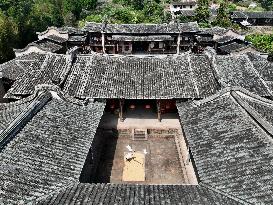
An aerial drone photo taken on May 20, 2025 shows Zhutou Manor in Yongtai County, southeast China's Fujian Province. Nestled in the Daiyun Mountain like scattered pearls, over 2,000 fortified manors in Yongtai County trace their origins to the Tang Dynasty 618-907 AD), flourishing later during the Ming 1368-1644) and Qing 1644-1911) eras. Today, increasing numbers of ancient manors and villages are being protected and revitalized. As historical heritage integrates with contemporary life and cultural landscapes merge with humanistic values, these age-old structures are radiating renewed vitality. Photo by Zhang Keren/Xinhua/ABACAPRESS.COM

  •  
Fujian Fortified Manors - China

Fujian Fortified Manors - China

An aerial drone photo taken on May 20, 2025 shows Beishan Manor in Yongtai County, southeast China's Fujian Province. Nestled in the Daiyun Mountain like scattered pearls, over 2,000 fortified manors in Yongtai County trace their origins to the Tang Dynasty 618-907 AD), flourishing later during the Ming 1368-1644) and Qing 1644-1911) eras. Today, increasing numbers of ancient manors and villages are being protected and revitalized. As historical heritage integrates with contemporary life and cultural landscapes merge with humanistic values, these age-old structures are radiating renewed vitality. Photo by Zhang Keren/Xinhua/ABACAPRESS.COM

  •  
Fujian Fortified Manors - China

Fujian Fortified Manors - China

A resident spreads out unhusked rice to dry in Zhutou Manor in Yongtai County, southeast China's Fujian Province, on Octobre 2, 2023. Nestled in the Daiyun Mountain like scattered pearls, over 2,000 fortified manors in Yongtai County trace their origins to the Tang Dynasty 618-907 AD), flourishing later during the Ming 1368-1644) and Qing 1644-1911) eras. Today, increasing numbers of ancient manors and villages are being protected and revitalized. As historical heritage integrates with contemporary life and cultural landscapes merge with humanistic values, these age-old structures are radiating renewed vitality. Photo by Jiang Kehong/Xinhua/ABACAPRESS.COM

  •  
Fujian Fortified Manors - China

Fujian Fortified Manors - China

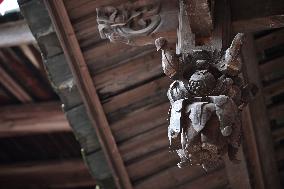
This photo taken on May 20, 2025 shows timber structural elements of a fortified manor in Yongtai County, southeast China's Fujian Province. Nestled in the Daiyun Mountain like scattered pearls, over 2,000 fortified manors in Yongtai County trace their origins to the Tang Dynasty 618-907 AD), flourishing later during the Ming 1368-1644) and Qing 1644-1911) eras. Today, increasing numbers of ancient manors and villages are being protected and revitalized. As historical heritage integrates with contemporary life and cultural landscapes merge with humanistic values, these age-old structures are radiating renewed vitality. Photo by Wang Zecong/Xinhua/ABACAPRESS.COM

  •  
Fujian Fortified Manors - China

Fujian Fortified Manors - China

An aerial drone photo taken on May 20, 2025 shows Hecheng Manor in Yongtai County, southeast China's Fujian Province. Nestled in the Daiyun Mountain like scattered pearls, over 2,000 fortified manors in Yongtai County trace their origins to the Tang Dynasty 618-907 AD), flourishing later during the Ming 1368-1644) and Qing 1644-1911) eras. Today, increasing numbers of ancient manors and villages are being protected and revitalized. As historical heritage integrates with contemporary life and cultural landscapes merge with humanistic values, these age-old structures are radiating renewed vitality. Photo by Zhang Keren/Xinhua/ABACAPRESS.COM

  •  
Fujian Fortified Manors - China

Fujian Fortified Manors - China

An aerial drone photo taken on May 20, 2025 shows Hecheng Manor in Yongtai County, southeast China's Fujian Province. Nestled in the Daiyun Mountain like scattered pearls, over 2,000 fortified manors in Yongtai County trace their origins to the Tang Dynasty 618-907 AD), flourishing later during the Ming 1368-1644) and Qing 1644-1911) eras. Today, increasing numbers of ancient manors and villages are being protected and revitalized. As historical heritage integrates with contemporary life and cultural landscapes merge with humanistic values, these age-old structures are radiating renewed vitality. Photo by Wang Zecong/Xinhua/ABACAPRESS.COM

  •  
Fujian Fortified Manors - China

Fujian Fortified Manors - China

An aerial photo taken on May 20, 2025 shows Hecheng Manor in Yongtai County, southeast China's Fujian Province. Nestled in the Daiyun Mountain like scattered pearls, over 2,000 fortified manors in Yongtai County trace their origins to the Tang Dynasty 618-907 AD), flourishing later during the Ming 1368-1644) and Qing 1644-1911) eras. Today, increasing numbers of ancient manors and villages are being protected and revitalized. As historical heritage integrates with contemporary life and cultural landscapes merge with humanistic values, these age-old structures are radiating renewed vitality. Photo by Jiang Kehong/Xinhua/ABACAPRESS.COM

  •  
Fujian Fortified Manors - China

Fujian Fortified Manors - China

An aerial photo taken on May 20, 2025 shows Zhutou Manor in Yongtai County, southeast China's Fujian Province. Nestled in the Daiyun Mountain like scattered pearls, over 2,000 fortified manors in Yongtai County trace their origins to the Tang Dynasty 618-907 AD), flourishing later during the Ming 1368-1644) and Qing 1644-1911) eras. Today, increasing numbers of ancient manors and villages are being protected and revitalized. As historical heritage integrates with contemporary life and cultural landscapes merge with humanistic values, these age-old structures are radiating renewed vitality. Photo by Jiang Kehong/Xinhua/ABACAPRESS.COM

  •  
Bookshop at Beilong Village - China

Bookshop at Beilong Village - China

People visit a bookshop at Beilong Village of Shaxi Town, Jianchuan County, southwest China's Yunnan Province, April 20, 2025. A remote town in Jianchuan County, Shaxi was once an important trading hub for tea, herbs, silks and salt on the ancient Tea Horse Road, a trade route dating back to the Tang Dynasty (618-907). However, the trading hub in the late 19th century saw a decline because it was far away from emerging modern arterial roads, and other means of transport replaced the traveling caravans. Therefore, the local government initiated a restoration project with an aim to preserve its cultural heritage and landscape by improving infrastructure and promoting economic growth in Shaxi. Years of efforts are paying off. The town saw its old buildings renovated and sceneries beautified. Currently, Shaxi has turned into a desirable destination for tourists at home and abroad. In 2024 alone, Shaxi received over 3 million tourist trips from home and abroad, along with a total revenue of 4.298 billion yuan (abo

  •  
Bookshop at Beilong Village - China

Bookshop at Beilong Village - China

People visit a bookshop at Beilong Village of Shaxi Town, Jianchuan County, southwest China's Yunnan Province, April 20, 2025. A remote town in Jianchuan County, Shaxi was once an important trading hub for tea, herbs, silks and salt on the ancient Tea Horse Road, a trade route dating back to the Tang Dynasty (618-907). However, the trading hub in the late 19th century saw a decline because it was far away from emerging modern arterial roads, and other means of transport replaced the traveling caravans. Therefore, the local government initiated a restoration project with an aim to preserve its cultural heritage and landscape by improving infrastructure and promoting economic growth in Shaxi. Years of efforts are paying off. The town saw its old buildings renovated and sceneries beautified. Currently, Shaxi has turned into a desirable destination for tourists at home and abroad. In 2024 alone, Shaxi received over 3 million tourist trips from home and abroad, along with a total revenue of 4.298 billion yuan (abo

  •  
Bookshop at Beilong Village - China

Bookshop at Beilong Village - China

This panoramic photo taken on April 20, 2025 shows a bookshop at Beilong Village of Shaxi Town, Jianchuan County, southwest China's Yunnan Province. A remote town in Jianchuan County, Shaxi was once an important trading hub for tea, herbs, silks and salt on the ancient Tea Horse Road, a trade route dating back to the Tang Dynasty (618-907). However, the trading hub in the late 19th century saw a decline because it was far away from emerging modern arterial roads, and other means of transport replaced the traveling caravans. Therefore, the local government initiated a restoration project with an aim to preserve its cultural heritage and landscape by improving infrastructure and promoting economic growth in Shaxi. Years of efforts are paying off. The town saw its old buildings renovated and sceneries beautified. Currently, Shaxi has turned into a desirable destination for tourists at home and abroad. In 2024 alone, Shaxi received over 3 million tourist trips from home and abroad, along with a total revenue of 4

  •  
Zigong International Dinosaur Lantern Show - China

Zigong International Dinosaur Lantern Show - China

A drone photo shows light installations at the 31st Zigong International Dinosaur Lantern Show in Zigong, southwest China's Sichuan Province, on January 17, 2025. The national-level intangible cultural heritage project Zigong lantern show boasts a long history, as it can be traced back to the Tang (618-907) and Song (960-1279) dynasties. In 1964, Zigong held the first lantern show celebrating the Spring Festival. So far, making colorful lanterns has become a popular industry here, with Zigong lanterns having been displayed in more than 80 countries and regions. Making a Zigong lantern involves many craftsmen, including art designers, bench workers, mechanics, electricians and paperhanging workers. The complete process can hardly be found in other places in China. Photo by Wang Xi/Xinhua/ABACAPRESS.COM

  •  
Zigong International Dinosaur Lantern Show - China

Zigong International Dinosaur Lantern Show - China

A drone photo shows light installations at the 31st Zigong International Dinosaur Lantern Show in Zigong, southwest China's Sichuan Province, on January 17, 2025. The national-level intangible cultural heritage project Zigong lantern show boasts a long history, as it can be traced back to the Tang (618-907) and Song (960-1279) dynasties. In 1964, Zigong held the first lantern show celebrating the Spring Festival. So far, making colorful lanterns has become a popular industry here, with Zigong lanterns having been displayed in more than 80 countries and regions. Making a Zigong lantern involves many craftsmen, including art designers, bench workers, mechanics, electricians and paperhanging workers. The complete process can hardly be found in other places in China. Photo by Wang Xi/Xinhua/ABACAPRESS.COM

  •  
Zigong International Dinosaur Lantern Show - China

Zigong International Dinosaur Lantern Show - China

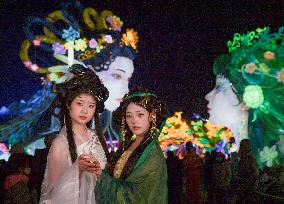
Tourists pose for photos at the 31st Zigong International Dinosaur Lantern Show in Zigong, southwest China's Sichuan Province, on January 17, 2025. The national-level intangible cultural heritage project Zigong lantern show boasts a long history, as it can be traced back to the Tang (618-907) and Song (960-1279) dynasties. In 1964, Zigong held the first lantern show celebrating the Spring Festival. So far, making colorful lanterns has become a popular industry here, with Zigong lanterns having been displayed in more than 80 countries and regions. Making a Zigong lantern involves many craftsmen, including art designers, bench workers, mechanics, electricians and paperhanging workers. The complete process can hardly be found in other places in China. Photo by Wang Xi/Xinhua/ABACAPRESS.COM

  •  
Zigong International Dinosaur Lantern Show - China

Zigong International Dinosaur Lantern Show - China

A tourist visits Colorful Lantern Museum of China in Zigong, southwest China's Sichuan Province, on January 18, 2025. The national-level intangible cultural heritage project Zigong lantern show boasts a long history, as it can be traced back to the Tang (618-907) and Song (960-1279) dynasties. In 1964, Zigong held the first lantern show celebrating the Spring Festival. So far, making colorful lanterns has become a popular industry here, with Zigong lanterns having been displayed in more than 80 countries and regions. Making a Zigong lantern involves many craftsmen, including art designers, bench workers, mechanics, electricians and paperhanging workers. The complete process can hardly be found in other places in China. Photo by Xinhua/ABACAPRESS.COM/Xu Bingjie

  •  
Zigong International Dinosaur Lantern Show - China

Zigong International Dinosaur Lantern Show - China

Light installations are seen at the 31st Zigong International Dinosaur Lantern Show in Zigong, southwest China's Sichuan Province, on January 29, 2025. The national-level intangible cultural heritage project Zigong lantern show boasts a long history, as it can be traced back to the Tang (618-907) and Song (960-1279) dynasties. In 1964, Zigong held the first lantern show celebrating the Spring Festival. So far, making colorful lanterns has become a popular industry here, with Zigong lanterns having been displayed in more than 80 countries and regions. Making a Zigong lantern involves many craftsmen, including art designers, bench workers, mechanics, electricians and paperhanging workers. The complete process can hardly be found in other places in China. Photo by Xinhua/ABACAPRESS.COM

  •  
Zigong International Dinosaur Lantern Show - China

Zigong International Dinosaur Lantern Show - China

Tourists visit the 31st Zigong International Dinosaur Lantern Show in Zigong, southwest China's Sichuan Province, on January 17, 2025. The national-level intangible cultural heritage project Zigong lantern show boasts a long history, as it can be traced back to the Tang (618-907) and Song (960-1279) dynasties. In 1964, Zigong held the first lantern show celebrating the Spring Festival. So far, making colorful lanterns has become a popular industry here, with Zigong lanterns having been displayed in more than 80 countries and regions. Making a Zigong lantern involves many craftsmen, including art designers, bench workers, mechanics, electricians and paperhanging workers. The complete process can hardly be found in other places in China. Photo by Wang Xi/Xinhua/ABACAPRESS.COM

  •  
Zigong International Dinosaur Lantern Show - China

Zigong International Dinosaur Lantern Show - China

Tourists visit the 31st Zigong International Dinosaur Lantern Show in Zigong, southwest China's Sichuan Province, on January 17, 2025. The national-level intangible cultural heritage project Zigong lantern show boasts a long history, as it can be traced back to the Tang (618-907) and Song (960-1279) dynasties. In 1964, Zigong held the first lantern show celebrating the Spring Festival. So far, making colorful lanterns has become a popular industry here, with Zigong lanterns having been displayed in more than 80 countries and regions. Making a Zigong lantern involves many craftsmen, including art designers, bench workers, mechanics, electricians and paperhanging workers. The complete process can hardly be found in other places in China. Photo by Wang Xi/Xinhua/ABACAPRESS.COM

  •  
Zigong International Dinosaur Lantern Show - China

Zigong International Dinosaur Lantern Show - China

Tourists visit the 31st Zigong International Dinosaur Lantern Show in Zigong, southwest China's Sichuan Province, on January 17, 2025. The national-level intangible cultural heritage project Zigong lantern show boasts a long history, as it can be traced back to the Tang (618-907) and Song (960-1279) dynasties. In 1964, Zigong held the first lantern show celebrating the Spring Festival. So far, making colorful lanterns has become a popular industry here, with Zigong lanterns having been displayed in more than 80 countries and regions. Making a Zigong lantern involves many craftsmen, including art designers, bench workers, mechanics, electricians and paperhanging workers. The complete process can hardly be found in other places in China. Photo by Wang Xi/Xinhua/ABACAPRESS.COM

  •  
XINHUA PHOTOS OF THE DAY

XINHUA PHOTOS OF THE DAY

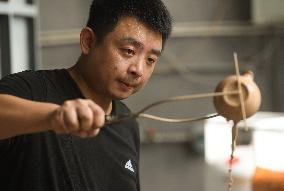
(240712) -- BEIJING, July 12, 2024 Photo by Xinhua/ABACAPRESS.COM) -- Xie Zhenwei applies glaze to a porcelain ware at a kiln in Shabu Township, Huangyan of Taizhou, east China's Zhejiang Province, July 11, 2024. Originated in the Tang Dynasty (618-907) and flourished in the Northern Song Dynasty (960-1127), the Shabu Kilns are considered as transitional kilns during the development of southern celadon industry from Yue Kilns to Longquan Kilns. Xie Zhenwei, a young porcelain artisan and a native of Shabu Township, has been making efforts to reproduce the celadon wares in the style of Shabu Kilns, which is characterized by exquisite carved patterns. To achieve his goal, Xie learned techniques from Yue Kilns and Longquan Kilns and kept using local materials. At present, Xie has successfully made celadon wares like censer, jug and powder boxes, in the style of Shabu Kilns. He also set up a workshop to display the culture of this art. Photo by Xinhua/ABACAPRESS.COM/Weng Xinyang)

  •  
(ZhejiangPictorial)CHINA-ZHEJIANG-SHABU KILNS-CELADON PORCELAIN-ARTISAN (CN)

(ZhejiangPictorial)CHINA-ZHEJIANG-SHABU KILNS-CELADON PORCELAIN-ARTISAN (CN)

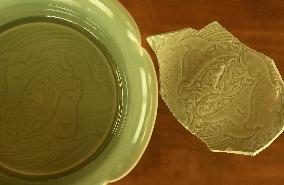
(240711) -- TAIZHOU, July 11, 2024 Photo by Xinhua/ABACAPRESS.COM) -- A piece of ancient Shabu-Kiln celadon ware (R) and a celadon ware made by Xie Zhenwei are pictured in Shabu Township, Huangyan of Taizhou, east China's Zhejiang Province, July 11, 2024. Originated in the Tang Dynasty (618-907) and flourished in the Northern Song Dynasty (960-1127), the Shabu Kilns are considered as transitional kilns during the development of southern celadon industry from Yue Kilns to Longquan Kilns. Xie Zhenwei, a young porcelain artisan and a native of Shabu Township, has been making efforts to reproduce the celadon wares in the style of Shabu Kilns, which is characterized by exquisite carved patterns. To achieve his goal, Xie learned techniques from Yue Kilns and Longquan Kilns and kept using local materials. At present, Xie has successfully made celadon wares like censer, jug and powder boxes, in the style of Shabu Kilns. He also set up a workshop to display the culture of this art. Photo by Xinhua/ABACAPRESS.COM/Weng

  •  
(ZhejiangPictorial)CHINA-ZHEJIANG-SHABU KILNS-CELADON PORCELAIN-ARTISAN (CN)

(ZhejiangPictorial)CHINA-ZHEJIANG-SHABU KILNS-CELADON PORCELAIN-ARTISAN (CN)

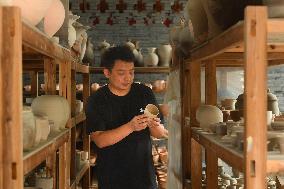
(240711) -- TAIZHOU, July 11, 2024 Photo by Xinhua/ABACAPRESS.COM) -- Xie Zhenwei arranges porcelain wares at a kiln in Shabu Township, Huangyan of Taizhou, east China's Zhejiang Province, July 11, 2024. Originated in the Tang Dynasty (618-907) and flourished in the Northern Song Dynasty (960-1127), the Shabu Kilns are considered as transitional kilns during the development of southern celadon industry from Yue Kilns to Longquan Kilns. Xie Zhenwei, a young porcelain artisan and a native of Shabu Township, has been making efforts to reproduce the celadon wares in the style of Shabu Kilns, which is characterized by exquisite carved patterns. To achieve his goal, Xie learned techniques from Yue Kilns and Longquan Kilns and kept using local materials. At present, Xie has successfully made celadon wares like censer, jug and powder boxes, in the style of Shabu Kilns. He also set up a workshop to display the culture of this art. Photo by Xinhua/ABACAPRESS.COM/Weng Xinyang)

  •  
(ZhejiangPictorial)CHINA-ZHEJIANG-SHABU KILNS-CELADON PORCELAIN-ARTISAN (CN)

(ZhejiangPictorial)CHINA-ZHEJIANG-SHABU KILNS-CELADON PORCELAIN-ARTISAN (CN)

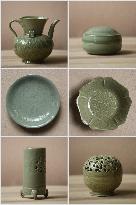
(240711) -- TAIZHOU, July 11, 2024 Photo by Xinhua/ABACAPRESS.COM) -- This combo photo taken on July 11, 2024 shows celadon wares made by Xie Zhenwei in Shabu Township, Huangyan of Taizhou, east China's Zhejiang Province. Originated in the Tang Dynasty (618-907) and flourished in the Northern Song Dynasty (960-1127), the Shabu Kilns are considered as transitional kilns during the development of southern celadon industry from Yue Kilns to Longquan Kilns. Xie Zhenwei, a young porcelain artisan and a native of Shabu Township, has been making efforts to reproduce the celadon wares in the style of Shabu Kilns, which is characterized by exquisite carved patterns. To achieve his goal, Xie learned techniques from Yue Kilns and Longquan Kilns and kept using local materials. At present, Xie has successfully made celadon wares like censer, jug and powder boxes, in the style of Shabu Kilns. He also set up a workshop to display the culture of this art. Photo by Xinhua/ABACAPRESS.COM/Weng Xinyang)

  •  
(ZhejiangPictorial)CHINA-ZHEJIANG-SHABU KILNS-CELADON PORCELAIN-ARTISAN (CN)

(ZhejiangPictorial)CHINA-ZHEJIANG-SHABU KILNS-CELADON PORCELAIN-ARTISAN (CN)

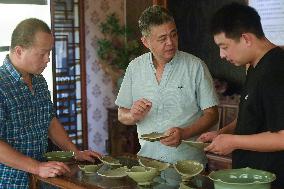
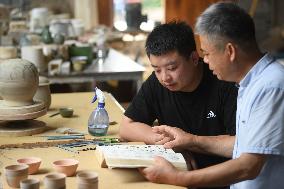
(240711) -- TAIZHOU, July 11, 2024 Photo by Xinhua/ABACAPRESS.COM) -- Luo Yonghua (C), an expert on Shabu Kilns, explains the features of the carved patterns on ancient Shabu-Kiln celadon pieces as Xie Zhenwei (R) listens in Shabu Township, Huangyan of Taizhou, east China's Zhejiang Province, July 11, 2024. Originated in the Tang Dynasty (618-907) and flourished in the Northern Song Dynasty (960-1127), the Shabu Kilns are considered as transitional kilns during the development of southern celadon industry from Yue Kilns to Longquan Kilns. Xie Zhenwei, a young porcelain artisan and a native of Shabu Township, has been making efforts to reproduce the celadon wares in the style of Shabu Kilns, which is characterized by exquisite carved patterns. To achieve his goal, Xie learned techniques from Yue Kilns and Longquan Kilns and kept using local materials. At present, Xie has successfully made celadon wares like censer, jug and powder boxes, in the style of Shabu Kilns. He also set up a workshop to display the cult

  •  
(ZhejiangPictorial)CHINA-ZHEJIANG-SHABU KILNS-CELADON PORCELAIN-ARTISAN (CN)

(ZhejiangPictorial)CHINA-ZHEJIANG-SHABU KILNS-CELADON PORCELAIN-ARTISAN (CN)

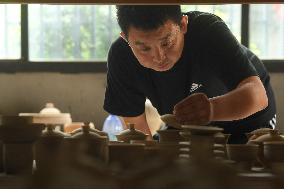
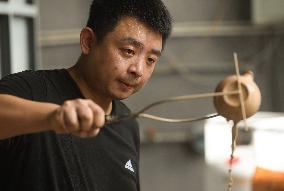
(240711) -- TAIZHOU, July 11, 2024 Photo by Xinhua/ABACAPRESS.COM) -- Xie Zhenwei works at a kiln in Shabu Township, Huangyan of Taizhou, east China's Zhejiang Province, July 11, 2024. Originated in the Tang Dynasty (618-907) and flourished in the Northern Song Dynasty (960-1127), the Shabu Kilns are considered as transitional kilns during the development of southern celadon industry from Yue Kilns to Longquan Kilns. Xie Zhenwei, a young porcelain artisan and a native of Shabu Township, has been making efforts to reproduce the celadon wares in the style of Shabu Kilns, which is characterized by exquisite carved patterns. To achieve his goal, Xie learned techniques from Yue Kilns and Longquan Kilns and kept using local materials. At present, Xie has successfully made celadon wares like censer, jug and powder boxes, in the style of Shabu Kilns. He also set up a workshop to display the culture of this art. Photo by Xinhua/ABACAPRESS.COM/Weng Xinyang)

  •  
(ZhejiangPictorial)CHINA-ZHEJIANG-SHABU KILNS-CELADON PORCELAIN-ARTISAN (CN)

(ZhejiangPictorial)CHINA-ZHEJIANG-SHABU KILNS-CELADON PORCELAIN-ARTISAN (CN)

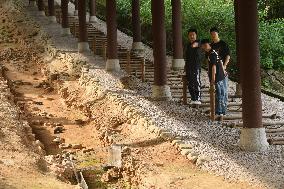
(240711) -- TAIZHOU, July 11, 2024 Photo by Xinhua/ABACAPRESS.COM) -- Xie Zhenwei (L) makes a point as students graduated from a technician college look on during a visit in a relic site of an ancient kiln in Shabu Township, Huangyan of Taizhou, east China's Zhejiang Province, July 11, 2024. Originated in the Tang Dynasty (618-907) and flourished in the Northern Song Dynasty (960-1127), the Shabu Kilns are considered as transitional kilns during the development of southern celadon industry from Yue Kilns to Longquan Kilns. Xie Zhenwei, a young porcelain artisan and a native of Shabu Township, has been making efforts to reproduce the celadon wares in the style of Shabu Kilns, which is characterized by exquisite carved patterns. To achieve his goal, Xie learned techniques from Yue Kilns and Longquan Kilns and kept using local materials. At present, Xie has successfully made celadon wares like censer, jug and powder boxes, in the style of Shabu Kilns. He also set up a workshop to display the culture of this art.

  •  
(ZhejiangPictorial)CHINA-ZHEJIANG-SHABU KILNS-CELADON PORCELAIN-ARTISAN (CN)

(ZhejiangPictorial)CHINA-ZHEJIANG-SHABU KILNS-CELADON PORCELAIN-ARTISAN (CN)

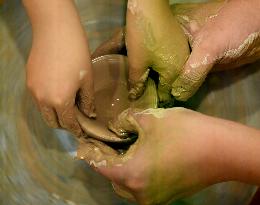
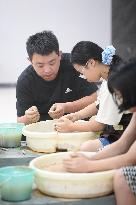
(240711) -- TAIZHOU, July 11, 2024 Photo by Xinhua/ABACAPRESS.COM) -- Xie Zhenwei helps a primary school student make a piece of porcelain in Shabu Township, Huangyan of Taizhou, east China's Zhejiang Province, July 11, 2024. Originated in the Tang Dynasty (618-907) and flourished in the Northern Song Dynasty (960-1127), the Shabu Kilns are considered as transitional kilns during the development of southern celadon industry from Yue Kilns to Longquan Kilns. Xie Zhenwei, a young porcelain artisan and a native of Shabu Township, has been making efforts to reproduce the celadon wares in the style of Shabu Kilns, which is characterized by exquisite carved patterns. To achieve his goal, Xie learned techniques from Yue Kilns and Longquan Kilns and kept using local materials. At present, Xie has successfully made celadon wares like censer, jug and powder boxes, in the style of Shabu Kilns. He also set up a workshop to display the culture of this art. Photo by Xinhua/ABACAPRESS.COM/Weng Xinyang)

  •  
(ZhejiangPictorial)CHINA-ZHEJIANG-SHABU KILNS-CELADON PORCELAIN-ARTISAN (CN)

(ZhejiangPictorial)CHINA-ZHEJIANG-SHABU KILNS-CELADON PORCELAIN-ARTISAN (CN)

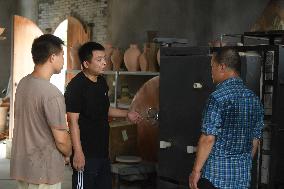
(240711) -- TAIZHOU, July 11, 2024 Photo by Xinhua/ABACAPRESS.COM) -- Xie Zhenwei (C) discusses with his fellows on porcelain-making in Shabu Township, Huangyan of Taizhou, east China's Zhejiang Province, July 11, 2024. Originated in the Tang Dynasty (618-907) and flourished in the Northern Song Dynasty (960-1127), the Shabu Kilns are considered as transitional kilns during the development of southern celadon industry from Yue Kilns to Longquan Kilns. Xie Zhenwei, a young porcelain artisan and a native of Shabu Township, has been making efforts to reproduce the celadon wares in the style of Shabu Kilns, which is characterized by exquisite carved patterns. To achieve his goal, Xie learned techniques from Yue Kilns and Longquan Kilns and kept using local materials. At present, Xie has successfully made celadon wares like censer, jug and powder boxes, in the style of Shabu Kilns. He also set up a workshop to display the culture of this art. Photo by Xinhua/ABACAPRESS.COM/Weng Xinyang)

  •  
(ZhejiangPictorial)CHINA-ZHEJIANG-SHABU KILNS-CELADON PORCELAIN-ARTISAN (CN)

(ZhejiangPictorial)CHINA-ZHEJIANG-SHABU KILNS-CELADON PORCELAIN-ARTISAN (CN)

(240711) -- TAIZHOU, July 11, 2024 Photo by Xinhua/ABACAPRESS.COM) -- Luo Yonghua (R), an expert on Shabu Kilns, shows the traditional carved patterns to Xie Zhenwei in Shabu Township, Huangyan of Taizhou, east China's Zhejiang Province, July 11, 2024. Originated in the Tang Dynasty (618-907) and flourished in the Northern Song Dynasty (960-1127), the Shabu Kilns are considered as transitional kilns during the development of southern celadon industry from Yue Kilns to Longquan Kilns. Xie Zhenwei, a young porcelain artisan and a native of Shabu Township, has been making efforts to reproduce the celadon wares in the style of Shabu Kilns, which is characterized by exquisite carved patterns. To achieve his goal, Xie learned techniques from Yue Kilns and Longquan Kilns and kept using local materials. At present, Xie has successfully made celadon wares like censer, jug and powder boxes, in the style of Shabu Kilns. He also set up a workshop to display the culture of this art. Photo by Xinhua/ABACAPRESS.COM/Weng Xin

  •  
(ZhejiangPictorial)CHINA-ZHEJIANG-SHABU KILNS-CELADON PORCELAIN-ARTISAN (CN)

(ZhejiangPictorial)CHINA-ZHEJIANG-SHABU KILNS-CELADON PORCELAIN-ARTISAN (CN)

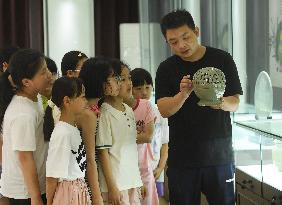
(240711) -- TAIZHOU, July 11, 2024 Photo by Xinhua/ABACAPRESS.COM) -- Xie Zhenwei explains the features of a Shabu-Kiln celadon censer as primary school students listen in Shabu Township, Huangyan of Taizhou, east China's Zhejiang Province, July 11, 2024. Originated in the Tang Dynasty (618-907) and flourished in the Northern Song Dynasty (960-1127), the Shabu Kilns are considered as transitional kilns during the development of southern celadon industry from Yue Kilns to Longquan Kilns. Xie Zhenwei, a young porcelain artisan and a native of Shabu Township, has been making efforts to reproduce the celadon wares in the style of Shabu Kilns, which is characterized by exquisite carved patterns. To achieve his goal, Xie learned techniques from Yue Kilns and Longquan Kilns and kept using local materials. At present, Xie has successfully made celadon wares like censer, jug and powder boxes, in the style of Shabu Kilns. He also set up a workshop to display the culture of this art. Photo by Xinhua/ABACAPRESS.COM/Weng

  •  
(ZhejiangPictorial)CHINA-ZHEJIANG-SHABU KILNS-CELADON PORCELAIN-ARTISAN (CN)

(ZhejiangPictorial)CHINA-ZHEJIANG-SHABU KILNS-CELADON PORCELAIN-ARTISAN (CN)

(240711) -- TAIZHOU, July 11, 2024 Photo by Xinhua/ABACAPRESS.COM) -- Xie Zhenwei gives instruction in a pottery class for primary school students at his studio in Shabu Township, Huangyan of Taizhou, east China's Zhejiang Province, July 11, 2024. Originated in the Tang Dynasty (618-907) and flourished in the Northern Song Dynasty (960-1127), the Shabu Kilns are considered as transitional kilns during the development of southern celadon industry from Yue Kilns to Longquan Kilns. Xie Zhenwei, a young porcelain artisan and a native of Shabu Township, has been making efforts to reproduce the celadon wares in the style of Shabu Kilns, which is characterized by exquisite carved patterns. To achieve his goal, Xie learned techniques from Yue Kilns and Longquan Kilns and kept using local materials. At present, Xie has successfully made celadon wares like censer, jug and powder boxes, in the style of Shabu Kilns. He also set up a workshop to display the culture of this art. Photo by Xinhua/ABACAPRESS.COM/Weng Xinyang)

  •  
(ZhejiangPictorial)CHINA-ZHEJIANG-SHABU KILNS-CELADON PORCELAIN-ARTISAN (CN)

(ZhejiangPictorial)CHINA-ZHEJIANG-SHABU KILNS-CELADON PORCELAIN-ARTISAN (CN)

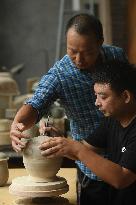
(240711) -- TAIZHOU, July 11, 2024 Photo by Xinhua/ABACAPRESS.COM) -- Longquan celadon artisan Chen Junlin (top) instructs as Xie Zhenwei makes a censer in the style of Shabu Kilns in Shabu Township, Huangyan of Taizhou, east China's Zhejiang Province, July 11, 2024. Originated in the Tang Dynasty (618-907) and flourished in the Northern Song Dynasty (960-1127), the Shabu Kilns are considered as transitional kilns during the development of southern celadon industry from Yue Kilns to Longquan Kilns. Xie Zhenwei, a young porcelain artisan and a native of Shabu Township, has been making efforts to reproduce the celadon wares in the style of Shabu Kilns, which is characterized by exquisite carved patterns. To achieve his goal, Xie learned techniques from Yue Kilns and Longquan Kilns and kept using local materials. At present, Xie has successfully made celadon wares like censer, jug and powder boxes, in the style of Shabu Kilns. He also set up a workshop to display the culture of this art. Photo by Xinhua/ABACAPRE

  •  
(ZhejiangPictorial)CHINA-ZHEJIANG-SHABU KILNS-CELADON PORCELAIN-ARTISAN (CN)

(ZhejiangPictorial)CHINA-ZHEJIANG-SHABU KILNS-CELADON PORCELAIN-ARTISAN (CN)

(240711) -- TAIZHOU, July 11, 2024 Photo by Xinhua/ABACAPRESS.COM) -- Xie Zhenwei applies glaze to a porcelain ware at a kiln in Shabu Township, Huangyan of Taizhou, east China's Zhejiang Province, July 11, 2024. Originated in the Tang Dynasty (618-907) and flourished in the Northern Song Dynasty (960-1127), the Shabu Kilns are considered as transitional kilns during the development of southern celadon industry from Yue Kilns to Longquan Kilns. Xie Zhenwei, a young porcelain artisan and a native of Shabu Township, has been making efforts to reproduce the celadon wares in the style of Shabu Kilns, which is characterized by exquisite carved patterns. To achieve his goal, Xie learned techniques from Yue Kilns and Longquan Kilns and kept using local materials. At present, Xie has successfully made celadon wares like censer, jug and powder boxes, in the style of Shabu Kilns. He also set up a workshop to display the culture of this art. Photo by Xinhua/ABACAPRESS.COM/Weng Xinyang)

  •  
(ZhejiangPictorial)CHINA-ZHEJIANG-SHABU KILNS-CELADON PORCELAIN-ARTISAN (CN)

(ZhejiangPictorial)CHINA-ZHEJIANG-SHABU KILNS-CELADON PORCELAIN-ARTISAN (CN)

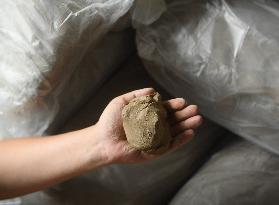
(240711) -- TAIZHOU, July 11, 2024 Photo by Xinhua/ABACAPRESS.COM) -- Xie Zhenwei shows the clay made from local materials for porcelain-making in Shabu Township, Huangyan of Taizhou, east China's Zhejiang Province, July 11, 2024. Originated in the Tang Dynasty (618-907) and flourished in the Northern Song Dynasty (960-1127), the Shabu Kilns are considered as transitional kilns during the development of southern celadon industry from Yue Kilns to Longquan Kilns. Xie Zhenwei, a young porcelain artisan and a native of Shabu Township, has been making efforts to reproduce the celadon wares in the style of Shabu Kilns, which is characterized by exquisite carved patterns. To achieve his goal, Xie learned techniques from Yue Kilns and Longquan Kilns and kept using local materials. At present, Xie has successfully made celadon wares like censer, jug and powder boxes, in the style of Shabu Kilns. He also set up a workshop to display the culture of this art. Photo by Xinhua/ABACAPRESS.COM/Weng Xinyang)

  •  
(ZhejiangPictorial)CHINA-ZHEJIANG-SHABU KILNS-CELADON PORCELAIN-ARTISAN (CN)

(ZhejiangPictorial)CHINA-ZHEJIANG-SHABU KILNS-CELADON PORCELAIN-ARTISAN (CN)

(240711) -- TAIZHOU, July 11, 2024 Photo by Xinhua/ABACAPRESS.COM) -- Xie Zhenwei arranges porcelain wares at a kiln in Shabu Township, Huangyan of Taizhou, east China's Zhejiang Province, July 11, 2024. Originated in the Tang Dynasty (618-907) and flourished in the Northern Song Dynasty (960-1127), the Shabu Kilns are considered as transitional kilns during the development of southern celadon industry from Yue Kilns to Longquan Kilns. Xie Zhenwei, a young porcelain artisan and a native of Shabu Township, has been making efforts to reproduce the celadon wares in the style of Shabu Kilns, which is characterized by exquisite carved patterns. To achieve his goal, Xie learned techniques from Yue Kilns and Longquan Kilns and kept using local materials. At present, Xie has successfully made celadon wares like censer, jug and powder boxes, in the style of Shabu Kilns. He also set up a workshop to display the culture of this art. Photo by Xinhua/ABACAPRESS.COM/Weng Xinyang)

  •  
(MASTER OF CRAFTS)CHINA-CARVED LACQUER-INHERITOR-STUDIO (CN)

(MASTER OF CRAFTS)CHINA-CARVED LACQUER-INHERITOR-STUDIO (CN)

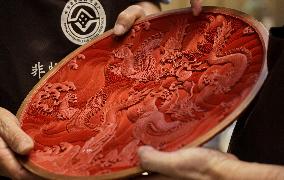
(240607) -- BEIJING, June 7, 2024 Photo by Xinhua/ABACAPRESS.COM) -- Zhu Jiang (L) and his father carry semi-finished carved lacquer wares for drying at his studio in Gu'an, north China's Hebei Province, May 30, 2024. Carved lacquer, dating back to the Tang Dynasty (618-907), greeted its peak time in Ming and Qing dynasties (1368-1911). Since the founding of the People's Republic of China in 1949, Beijing and Yangzhou have become the two centers for the craft of carved lacquer, which was listed as a national-level intangible cultural heritage in 2006. Carved lacquer differs in its colors, namely red, black or multiple colors. Its making procedures include designing, body shaping, lacquer making, coating, drawing, carving and grinding. The craftsman needs to smoothly use various kinds of knives to carve patterns on the ware, and even a little miss can destroy the whole artwork. The craft can only be grasped through three to five years of practice. Therefore, it is also called "the art of time." Born in 1976, Z

  •  
(MASTER OF CRAFTS)CHINA-CARVED LACQUER-INHERITOR-STUDIO (CN)

(MASTER OF CRAFTS)CHINA-CARVED LACQUER-INHERITOR-STUDIO (CN)

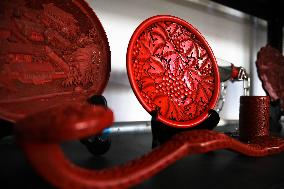
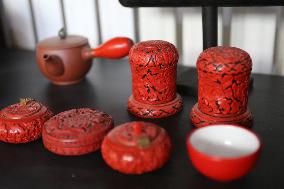
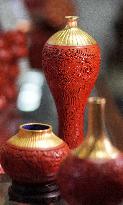
(240607) -- BEIJING, June 7, 2024 Photo by Xinhua/ABACAPRESS.COM) -- Carved lacquer artworks are displayed at Zhu Jiang's studio in Gu'an, north China's Hebei Province, May 30, 2024. Carved lacquer, dating back to the Tang Dynasty (618-907), greeted its peak time in Ming and Qing dynasties (1368-1911). Since the founding of the People's Republic of China in 1949, Beijing and Yangzhou have become the two centers for the craft of carved lacquer, which was listed as a national-level intangible cultural heritage in 2006. Carved lacquer differs in its colors, namely red, black or multiple colors. Its making procedures include designing, body shaping, lacquer making, coating, drawing, carving and grinding. The craftsman needs to smoothly use various kinds of knives to carve patterns on the ware, and even a little miss can destroy the whole artwork. The craft can only be grasped through three to five years of practice. Therefore, it is also called "the art of time." Born in 1976, Zhu Jiang, an inheritor of the craft

  •  
(MASTER OF CRAFTS)CHINA-CARVED LACQUER-INHERITOR-STUDIO (CN)

(MASTER OF CRAFTS)CHINA-CARVED LACQUER-INHERITOR-STUDIO (CN)

(240607) -- BEIJING, June 7, 2024 Photo by Xinhua/ABACAPRESS.COM) -- Carved lacquer artworks are displayed at Zhu Jiang's studio in Gu'an, north China's Hebei Province, May 30, 2024. Carved lacquer, dating back to the Tang Dynasty (618-907), greeted its peak time in Ming and Qing dynasties (1368-1911). Since the founding of the People's Republic of China in 1949, Beijing and Yangzhou have become the two centers for the craft of carved lacquer, which was listed as a national-level intangible cultural heritage in 2006. Carved lacquer differs in its colors, namely red, black or multiple colors. Its making procedures include designing, body shaping, lacquer making, coating, drawing, carving and grinding. The craftsman needs to smoothly use various kinds of knives to carve patterns on the ware, and even a little miss can destroy the whole artwork. The craft can only be grasped through three to five years of practice. Therefore, it is also called "the art of time." Born in 1976, Zhu Jiang, an inheritor of the craft

  •  
(MASTER OF CRAFTS)CHINA-CARVED LACQUER-INHERITOR-STUDIO (CN)

(MASTER OF CRAFTS)CHINA-CARVED LACQUER-INHERITOR-STUDIO (CN)

(240607) -- BEIJING, June 7, 2024 Photo by Xinhua/ABACAPRESS.COM) -- Carved lacquer artworks are displayed at Zhu Jiang's studio in Gu'an, north China's Hebei Province, May 30, 2024. Carved lacquer, dating back to the Tang Dynasty (618-907), greeted its peak time in Ming and Qing dynasties (1368-1911). Since the founding of the People's Republic of China in 1949, Beijing and Yangzhou have become the two centers for the craft of carved lacquer, which was listed as a national-level intangible cultural heritage in 2006. Carved lacquer differs in its colors, namely red, black or multiple colors. Its making procedures include designing, body shaping, lacquer making, coating, drawing, carving and grinding. The craftsman needs to smoothly use various kinds of knives to carve patterns on the ware, and even a little miss can destroy the whole artwork. The craft can only be grasped through three to five years of practice. Therefore, it is also called "the art of time." Born in 1976, Zhu Jiang, an inheritor of the craft

  •  
(MASTER OF CRAFTS)CHINA-CARVED LACQUER-INHERITOR-STUDIO (CN)

(MASTER OF CRAFTS)CHINA-CARVED LACQUER-INHERITOR-STUDIO (CN)

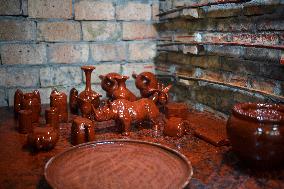
(240607) -- BEIJING, June 7, 2024 Photo by Xinhua/ABACAPRESS.COM) -- A piece of carved lacquer artwork on drying is displayed at Zhu Jiang's studio in Gu'an, north China's Hebei Province, May 30, 2024. Carved lacquer, dating back to the Tang Dynasty (618-907), greeted its peak time in Ming and Qing dynasties (1368-1911). Since the founding of the People's Republic of China in 1949, Beijing and Yangzhou have become the two centers for the craft of carved lacquer, which was listed as a national-level intangible cultural heritage in 2006. Carved lacquer differs in its colors, namely red, black or multiple colors. Its making procedures include designing, body shaping, lacquer making, coating, drawing, carving and grinding. The craftsman needs to smoothly use various kinds of knives to carve patterns on the ware, and even a little miss can destroy the whole artwork. The craft can only be grasped through three to five years of practice. Therefore, it is also called "the art of time." Born in 1976, Zhu Jiang, an inh

  •  
(MASTER OF CRAFTS)CHINA-CARVED LACQUER-INHERITOR-STUDIO (CN)

(MASTER OF CRAFTS)CHINA-CARVED LACQUER-INHERITOR-STUDIO (CN)

(240607) -- BEIJING, June 7, 2024 Photo by Xinhua/ABACAPRESS.COM) -- Carved lacquer artworks are displayed at Zhu Jiang's studio in Gu'an, north China's Hebei Province, May 30, 2024. Carved lacquer, dating back to the Tang Dynasty (618-907), greeted its peak time in Ming and Qing dynasties (1368-1911). Since the founding of the People's Republic of China in 1949, Beijing and Yangzhou have become the two centers for the craft of carved lacquer, which was listed as a national-level intangible cultural heritage in 2006. Carved lacquer differs in its colors, namely red, black or multiple colors. Its making procedures include designing, body shaping, lacquer making, coating, drawing, carving and grinding. The craftsman needs to smoothly use various kinds of knives to carve patterns on the ware, and even a little miss can destroy the whole artwork. The craft can only be grasped through three to five years of practice. Therefore, it is also called "the art of time." Born in 1976, Zhu Jiang, an inheritor of the craft

  •  
(MASTER OF CRAFTS)CHINA-CARVED LACQUER-INHERITOR-STUDIO (CN)

(MASTER OF CRAFTS)CHINA-CARVED LACQUER-INHERITOR-STUDIO (CN)

(240607) -- BEIJING, June 7, 2024 Photo by Xinhua/ABACAPRESS.COM) -- Semi-finished carved lacquer artworks are seen on drying at Zhu Jiang's studio in Gu'an, north China's Hebei Province, May 30, 2024. Carved lacquer, dating back to the Tang Dynasty (618-907), greeted its peak time in Ming and Qing dynasties (1368-1911). Since the founding of the People's Republic of China in 1949, Beijing and Yangzhou have become the two centers for the craft of carved lacquer, which was listed as a national-level intangible cultural heritage in 2006. Carved lacquer differs in its colors, namely red, black or multiple colors. Its making procedures include designing, body shaping, lacquer making, coating, drawing, carving and grinding. The craftsman needs to smoothly use various kinds of knives to carve patterns on the ware, and even a little miss can destroy the whole artwork. The craft can only be grasped through three to five years of practice. Therefore, it is also called "the art of time." Born in 1976, Zhu Jiang, an inh

  •  
(MASTER OF CRAFTS)CHINA-CARVED LACQUER-INHERITOR-STUDIO (CN)

(MASTER OF CRAFTS)CHINA-CARVED LACQUER-INHERITOR-STUDIO (CN)

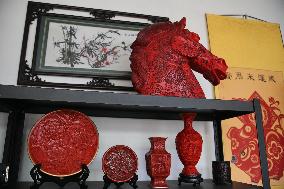
(240607) -- BEIJING, June 7, 2024 Photo by Xinhua/ABACAPRESS.COM) -- Carved lacquer artworks are displayed at Zhu Jiang's studio in Beijing, capital of China, June 5, 2024. Carved lacquer, dating back to the Tang Dynasty (618-907), greeted its peak time in Ming and Qing dynasties (1368-1911). Since the founding of the People's Republic of China in 1949, Beijing and Yangzhou have become the two centers for the craft of carved lacquer, which was listed as a national-level intangible cultural heritage in 2006. Carved lacquer differs in its colors, namely red, black or multiple colors. Its making procedures include designing, body shaping, lacquer making, coating, drawing, carving and grinding. The craftsman needs to smoothly use various kinds of knives to carve patterns on the ware, and even a little miss can destroy the whole artwork. The craft can only be grasped through three to five years of practice. Therefore, it is also called "the art of time." Born in 1976, Zhu Jiang, an inheritor of the craft of carved

  • Main
  • Top
  • Editorial
  • Creative
  • About Us
  • About ILG
  • Terms of use
  • Company
  • BEHIND
  • Price List
  • Single Plan
  • Monthly Plan
  • Services
  • Shooting
  • Rights Clearance
  • Support
  • FAQ
  • How To Buy
  • Contact Us
  • Become a Partner

© KYODO NEWS IMAGES INC

All Rights Reserved.

  • Editorial
  • Olympics
  • News
  • Sports
  • Japan
  • Tech
  • Royal
  • Disaster
  • NorthKorea
  • Old Japan
  • SNS
  • Creative
  • Food
  • Japan
  • Landscape
  • Animal
  • Popular
  • #Ukraine
  • #China
  • #coronavirus
  • #N. Korea
  • #Russia
  • #Thailand
  • #Ukraine
  • #China
  • #coronavirus
  • #N. Korea
  • #Russia
  • #Thailand
  • Food
  • Japan
  • Landscape
  • Animal
  • Olympics
  • News
  • Sports
  • Japan
  • Tech
  • Royal
  • Disaster
  • NorthKorea
  • Old Japan
  • SNS