•  
Japan Princess Kako at greenery event

Japan Princess Kako at greenery event

Japanese Princess Kako attends an award ceremony for companies and organizations that contributed to urban afforestation on Dec. 15, 2025, in Tokyo.

  •  
Japan Princess Kako at greenery event

Japan Princess Kako at greenery event

Japanese Princess Kako addresses an award ceremony for companies and organizations that contributed to urban afforestation on Dec. 15, 2025, in Tokyo. (Pool photo)

  •  
Japan Princess Kako at greenery event

Japan Princess Kako at greenery event

Japanese Princess Kako attends an award ceremony for companies and organizations that contributed to urban afforestation on Dec. 15, 2025, in Tokyo.

  •  
Japan Princess Kako at greenery event

Japan Princess Kako at greenery event

Japanese Princess Kako addresses an award ceremony for companies and organizations that contributed to urban afforestation on Dec. 15, 2025, in Tokyo.

  •  
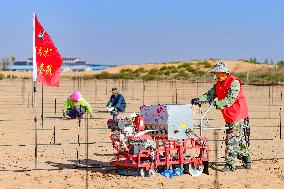
Caragana Ecological Economic Industrial Chain in Ordos

Caragana Ecological Economic Industrial Chain in Ordos

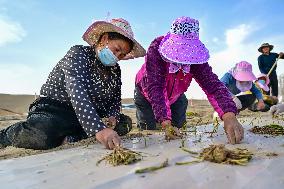
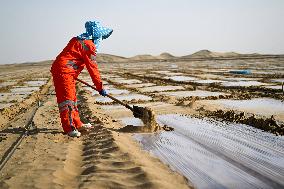
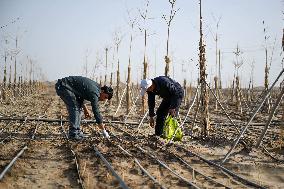
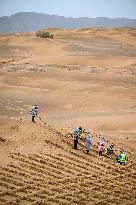
ORDOS, CHINA - MAY 27, 2025 - Technicians use the technique of infiltrating and irrigating lemon strips to plant seeds for desert afforestation in Ordos, Inner Mongolia, China on May 27, 2025.

  •  
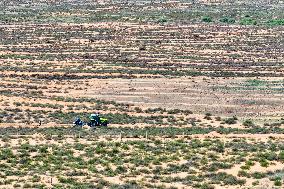
Caragana Ecological Economic Industrial Chain in Ordos

Caragana Ecological Economic Industrial Chain in Ordos

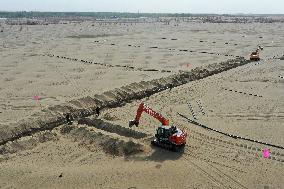
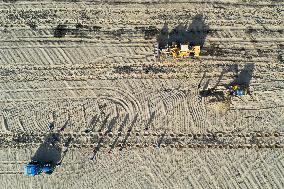
ORDOS, CHINA - MAY 27, 2025 - The desert afforestation technology of dense planting of caragana by seepage irrigation was used by sand control machinery to sow caragana in Ordos City, Inner Mongolia Autonomous Region, China on May 27, 2025.

  •  
Taklimakan Desert Control Afforestation - China

Taklimakan Desert Control Afforestation - China

An aerial drone photo taken on April 8, 2025 shows people planting coix at a sand industry experimental base in Yutian County of Hotan Prefecture, northwest China's Xinjiang Uygur Autonomous Region. The Taklimakan Desert in northwest China's Xinjiang Uygur Autonomous Region covers 337,600 square kilometers and its circumference measures 3,046 kilometers, making it the largest desert in China and the second-largest drifting desert in the world. Thanks to decades-long sand prevention and control efforts, the Taklimakan Desert was completely encircled with a sand-blocking green belt on Nov. 28, 2024. In 2025, Xinjiang aims to afforest a land area of about 796,000 hectares, including 562,666 hectares for frontline control in the Taklimakan Desert. These afforestations form a part of the Three-North Shelterbelt Forest Program, the world's largest afforestation program, which tackles desertification in northwest, north and northeast China. Meanwhile, Xinjiang will further widen the sand-blocking green belt and enha

  •  
Taklimakan Desert Control Afforestation - China

Taklimakan Desert Control Afforestation - China

An aerial drone photo taken on April 7, 2025 shows oleaster saplings in Hotan County of Hotan Prefecture, northwest China's Xinjiang Uygur Autonomous Region. The Taklimakan Desert in northwest China's Xinjiang Uygur Autonomous Region covers 337,600 square kilometers and its circumference measures 3,046 kilometers, making it the largest desert in China and the second-largest drifting desert in the world. Thanks to decades-long sand prevention and control efforts, the Taklimakan Desert was completely encircled with a sand-blocking green belt on Nov. 28, 2024. In 2025, Xinjiang aims to afforest a land area of about 796,000 hectares, including 562,666 hectares for frontline control in the Taklimakan Desert. These afforestations form a part of the Three-North Shelterbelt Forest Program, the world's largest afforestation program, which tackles desertification in northwest, north and northeast China. Meanwhile, Xinjiang will further widen the sand-blocking green belt and enhance desert-locking efforts to achieve sus

  •  
Taklimakan Desert Control Afforestation - China

Taklimakan Desert Control Afforestation - China

Staff members plant onions in sandy land at a sand-control experimental station in Minfeng County of Hotan Prefecture, northwest China's Xinjiang Uygur Autonomous Region on April 8, 2025. The Taklimakan Desert in northwest China's Xinjiang Uygur Autonomous Region covers 337,600 square kilometers and its circumference measures 3,046 kilometers, making it the largest desert in China and the second-largest drifting desert in the world. Thanks to decades-long sand prevention and control efforts, the Taklimakan Desert was completely encircled with a sand-blocking green belt on Nov. 28, 2024. In 2025, Xinjiang aims to afforest a land area of about 796,000 hectares, including 562,666 hectares for frontline control in the Taklimakan Desert. These afforestations form a part of the Three-North Shelterbelt Forest Program, the world's largest afforestation program, which tackles desertification in northwest, north and northeast China. Meanwhile, Xinjiang will further widen the sand-blocking green belt and enhance desert-

  •  
Taklimakan Desert Control Afforestation - China

Taklimakan Desert Control Afforestation - China

An aerial drone photo taken on April 8, 2025 shows staff members embedding water pipelines in Minfeng County of Hotan Prefecture, northwest China's Xinjiang Uygur Autonomous Region. The Taklimakan Desert in northwest China's Xinjiang Uygur Autonomous Region covers 337,600 square kilometers and its circumference measures 3,046 kilometers, making it the largest desert in China and the second-largest drifting desert in the world. Thanks to decades-long sand prevention and control efforts, the Taklimakan Desert was completely encircled with a sand-blocking green belt on Nov. 28, 2024. In 2025, Xinjiang aims to afforest a land area of about 796,000 hectares, including 562,666 hectares for frontline control in the Taklimakan Desert. These afforestations form a part of the Three-North Shelterbelt Forest Program, the world's largest afforestation program, which tackles desertification in northwest, north and northeast China. Meanwhile, Xinjiang will further widen the sand-blocking green belt and enhance desert-lockin

  •  
Taklimakan Desert Control Afforestation - China

Taklimakan Desert Control Afforestation - China

An aerial drone photo taken on April 9, 2025 shows staff members planting seedlings at a sand-control base in Qiemo County, the Mongolian Autonomous Prefecture of Bayingolin, northwest China's Xinjiang Uygur Autonomous Region. The Taklimakan Desert in northwest China's Xinjiang Uygur Autonomous Region covers 337,600 square kilometers and its circumference measures 3,046 kilometers, making it the largest desert in China and the second-largest drifting desert in the world. Thanks to decades-long sand prevention and control efforts, the Taklimakan Desert was completely encircled with a sand-blocking green belt on Nov. 28, 2024. In 2025, Xinjiang aims to afforest a land area of about 796,000 hectares, including 562,666 hectares for frontline control in the Taklimakan Desert. These afforestations form a part of the Three-North Shelterbelt Forest Program, the world's largest afforestation program, which tackles desertification in northwest, north and northeast China. Meanwhile, Xinjiang will further widen the sand-

  •  
Taklimakan Desert Control Afforestation - China

Taklimakan Desert Control Afforestation - China

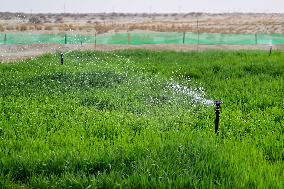
This photo taken on April 13, 2025 shows a wheat field irrigated by desalinated water in Xayar County, Aksu Prefecture, northwest China's Xinjiang Uygur Autonomous Region. The Taklimakan Desert in northwest China's Xinjiang Uygur Autonomous Region covers 337,600 square kilometers and its circumference measures 3,046 kilometers, making it the largest desert in China and the second-largest drifting desert in the world. Thanks to decades-long sand prevention and control efforts, the Taklimakan Desert was completely encircled with a sand-blocking green belt on Nov. 28, 2024. In 2025, Xinjiang aims to afforest a land area of about 796,000 hectares, including 562,666 hectares for frontline control in the Taklimakan Desert. These afforestations form a part of the Three-North Shelterbelt Forest Program, the world's largest afforestation program, which tackles desertification in northwest, north and northeast China. Meanwhile, Xinjiang will further widen the sand-blocking green belt and enhance desert-locking efforts

  •  
Taklimakan Desert Control Afforestation - China

Taklimakan Desert Control Afforestation - China

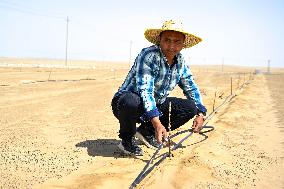
A villager arranges a drip irrigation pipe at a desert-control model zone in Yutian County of Hotan Prefecture, northwest China's Xinjiang Uygur Autonomous Region, April 8, 2025. The Taklimakan Desert in northwest China's Xinjiang Uygur Autonomous Region covers 337,600 square kilometers and its circumference measures 3,046 kilometers, making it the largest desert in China and the second-largest drifting desert in the world. Thanks to decades-long sand prevention and control efforts, the Taklimakan Desert was completely encircled with a sand-blocking green belt on Nov. 28, 2024. In 2025, Xinjiang aims to afforest a land area of about 796,000 hectares, including 562,666 hectares for frontline control in the Taklimakan Desert. These afforestations form a part of the Three-North Shelterbelt Forest Program, the world's largest afforestation program, which tackles desertification in northwest, north and northeast China. Meanwhile, Xinjiang will further widen the sand-blocking green belt and enhance desert-locking e

  •  
Taklimakan Desert Control Afforestation - China

Taklimakan Desert Control Afforestation - China

A villager plants coix at a sand industry experimental base in Yutian County of Hotan Prefecture, northwest China's Xinjiang Uygur Autonomous Region on April 8, 2025. The Taklimakan Desert in northwest China's Xinjiang Uygur Autonomous Region covers 337,600 square kilometers and its circumference measures 3,046 kilometers, making it the largest desert in China and the second-largest drifting desert in the world. Thanks to decades-long sand prevention and control efforts, the Taklimakan Desert was completely encircled with a sand-blocking green belt on Nov. 28, 2024. In 2025, Xinjiang aims to afforest a land area of about 796,000 hectares, including 562,666 hectares for frontline control in the Taklimakan Desert. These afforestations form a part of the Three-North Shelterbelt Forest Program, the world's largest afforestation program, which tackles desertification in northwest, north and northeast China. Meanwhile, Xinjiang will further widen the sand-blocking green belt and enhance desert-locking efforts to ac

  •  
Taklimakan Desert Control Afforestation - China

Taklimakan Desert Control Afforestation - China

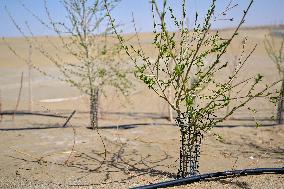
Protective nets are attached to seedlings to prevent animals from eating them at a sand-control base in Qiemo County, the Mongolian Autonomous Prefecture of Bayingolin, northwest China's Xinjiang Uygur Autonomous Region, April 9, 2025. The Taklimakan Desert in northwest China's Xinjiang Uygur Autonomous Region covers 337,600 square kilometers and its circumference measures 3,046 kilometers, making it the largest desert in China and the second-largest drifting desert in the world. Thanks to decades-long sand prevention and control efforts, the Taklimakan Desert was completely encircled with a sand-blocking green belt on Nov. 28, 2024. In 2025, Xinjiang aims to afforest a land area of about 796,000 hectares, including 562,666 hectares for frontline control in the Taklimakan Desert. These afforestations form a part of the Three-North Shelterbelt Forest Program, the world's largest afforestation program, which tackles desertification in northwest, north and northeast China. Meanwhile, Xinjiang will further widen

  •  
Taklimakan Desert Control Afforestation - China

Taklimakan Desert Control Afforestation - China

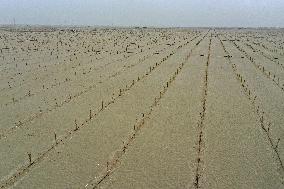
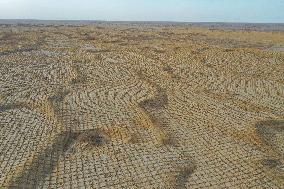
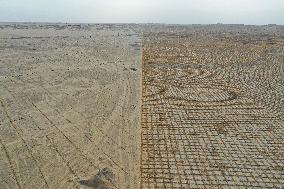
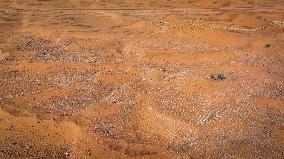
An aerial drone photo taken on April 8, 2025 shows checkerboard sand barriers in Minfeng County of Hotan Prefecture, northwest China's Xinjiang Uygur Autonomous Region. The Taklimakan Desert in northwest China's Xinjiang Uygur Autonomous Region covers 337,600 square kilometers and its circumference measures 3,046 kilometers, making it the largest desert in China and the second-largest drifting desert in the world. Thanks to decades-long sand prevention and control efforts, the Taklimakan Desert was completely encircled with a sand-blocking green belt on Nov. 28, 2024. In 2025, Xinjiang aims to afforest a land area of about 796,000 hectares, including 562,666 hectares for frontline control in the Taklimakan Desert. These afforestations form a part of the Three-North Shelterbelt Forest Program, the world's largest afforestation program, which tackles desertification in northwest, north and northeast China. Meanwhile, Xinjiang will further widen the sand-blocking green belt and enhance desert-locking efforts to

  •  
Taklimakan Desert Control Afforestation - China

Taklimakan Desert Control Afforestation - China

People arrange drip irrigation pipes at a sand-control experimental base in Yutian County of Hotan Prefecture, northwest China's Xinjiang Uygur Autonomous Region, April 8, 2025. The Taklimakan Desert in northwest China's Xinjiang Uygur Autonomous Region covers 337,600 square kilometers and its circumference measures 3,046 kilometers, making it the largest desert in China and the second-largest drifting desert in the world. Thanks to decades-long sand prevention and control efforts, the Taklimakan Desert was completely encircled with a sand-blocking green belt on Nov. 28, 2024. In 2025, Xinjiang aims to afforest a land area of about 796,000 hectares, including 562,666 hectares for frontline control in the Taklimakan Desert. These afforestations form a part of the Three-North Shelterbelt Forest Program, the world's largest afforestation program, which tackles desertification in northwest, north and northeast China. Meanwhile, Xinjiang will further widen the sand-blocking green belt and enhance desert-locking ef

  •  
Taklimakan Desert Control Afforestation - China

Taklimakan Desert Control Afforestation - China

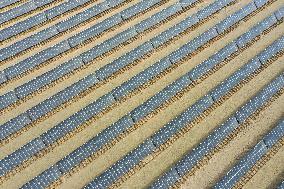
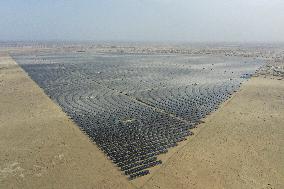
An aerial drone photo taken on April 13, 2025 shows a photovoltaic power project in Xayar County, Aksu Prefecture, northwest China's Xinjiang Uygur Autonomous Region. The Taklimakan Desert in northwest China's Xinjiang Uygur Autonomous Region covers 337,600 square kilometers and its circumference measures 3,046 kilometers, making it the largest desert in China and the second-largest drifting desert in the world. Thanks to decades-long sand prevention and control efforts, the Taklimakan Desert was completely encircled with a sand-blocking green belt on Nov. 28, 2024. In 2025, Xinjiang aims to afforest a land area of about 796,000 hectares, including 562,666 hectares for frontline control in the Taklimakan Desert. These afforestations form a part of the Three-North Shelterbelt Forest Program, the world's largest afforestation program, which tackles desertification in northwest, north and northeast China. Meanwhile, Xinjiang will further widen the sand-blocking green belt and enhance desert-locking efforts to ac

  •  
Taklimakan Desert Control Afforestation - China

Taklimakan Desert Control Afforestation - China

An aerial drone photo taken on April 8, 2025 shows checkerboard sand barriers at a sand-control zone in Minfeng County of Hotan Prefecture, northwest China's Xinjiang Uygur Autonomous Region. The Taklimakan Desert in northwest China's Xinjiang Uygur Autonomous Region covers 337,600 square kilometers and its circumference measures 3,046 kilometers, making it the largest desert in China and the second-largest drifting desert in the world. Thanks to decades-long sand prevention and control efforts, the Taklimakan Desert was completely encircled with a sand-blocking green belt on Nov. 28, 2024. In 2025, Xinjiang aims to afforest a land area of about 796,000 hectares, including 562,666 hectares for frontline control in the Taklimakan Desert. These afforestations form a part of the Three-North Shelterbelt Forest Program, the world's largest afforestation program, which tackles desertification in northwest, north and northeast China. Meanwhile, Xinjiang will further widen the sand-blocking green belt and enhance des

  •  
Taklimakan Desert Control Afforestation - China

Taklimakan Desert Control Afforestation - China

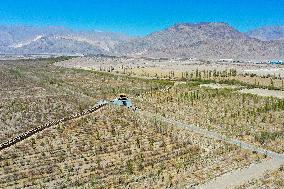
An aerial drone photo taken on April 11, 2025 shows a forest park in Hejing County, the Mongolian Autonomous Prefecture of Bayingolin, northwest China's Xinjiang Uygur Autonomous Region. The Taklimakan Desert in northwest China's Xinjiang Uygur Autonomous Region covers 337,600 square kilometers and its circumference measures 3,046 kilometers, making it the largest desert in China and the second-largest drifting desert in the world. Thanks to decades-long sand prevention and control efforts, the Taklimakan Desert was completely encircled with a sand-blocking green belt on Nov. 28, 2024. In 2025, Xinjiang aims to afforest a land area of about 796,000 hectares, including 562,666 hectares for frontline control in the Taklimakan Desert. These afforestations form a part of the Three-North Shelterbelt Forest Program, the world's largest afforestation program, which tackles desertification in northwest, north and northeast China. Meanwhile, Xinjiang will further widen the sand-blocking green belt and enhance desert-l

  •  
Taklimakan Desert Control Afforestation - China

Taklimakan Desert Control Afforestation - China

An aerial drone photo taken on April 13, 2025 shows a photovoltaic power project in Xayar County, Aksu Prefecture, northwest China's Xinjiang Uygur Autonomous Region. The Taklimakan Desert in northwest China's Xinjiang Uygur Autonomous Region covers 337,600 square kilometers and its circumference measures 3,046 kilometers, making it the largest desert in China and the second-largest drifting desert in the world. Thanks to decades-long sand prevention and control efforts, the Taklimakan Desert was completely encircled with a sand-blocking green belt on Nov. 28, 2024. In 2025, Xinjiang aims to afforest a land area of about 796,000 hectares, including 562,666 hectares for frontline control in the Taklimakan Desert. These afforestations form a part of the Three-North Shelterbelt Forest Program, the world's largest afforestation program, which tackles desertification in northwest, north and northeast China. Meanwhile, Xinjiang will further widen the sand-blocking green belt and enhance desert-locking efforts to ac

  •  
Taklimakan Desert Control Afforestation - China

Taklimakan Desert Control Afforestation - China

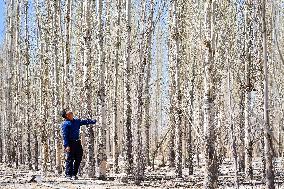
Fu Guoxi checks the trees at a green belt built by his father Fu Zhizhou in Hejing County, the Mongolian Autonomous Prefecture of Bayingolin, northwest China's Xinjiang Uygur Autonomous Region, April 11, 2025. Over the past four decades, Fu Zhizhou had planted more than 800,000 trees and his son Fu Guoxi took over the cause after his father passed away in 2024. The Taklimakan Desert in northwest China's Xinjiang Uygur Autonomous Region covers 337,600 square kilometers and its circumference measures 3,046 kilometers, making it the largest desert in China and the second-largest drifting desert in the world. Thanks to decades-long sand prevention and control efforts, the Taklimakan Desert was completely encircled with a sand-blocking green belt on Nov. 28, 2024. In 2025, Xinjiang aims to afforest a land area of about 796,000 hectares, including 562,666 hectares for frontline control in the Taklimakan Desert. These afforestations form a part of the Three-North Shelterbelt Forest Program, the world's largest affor

  •  
Taklimakan Desert Control Afforestation - China

Taklimakan Desert Control Afforestation - China

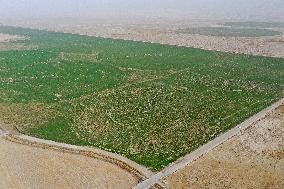
An aerial drone photo taken on April 12, 2025 shows a grassland in Baicheng County, Aksu Prefecture, northwest China's Xinjiang Uygur Autonomous Region. The Taklimakan Desert in northwest China's Xinjiang Uygur Autonomous Region covers 337,600 square kilometers and its circumference measures 3,046 kilometers, making it the largest desert in China and the second-largest drifting desert in the world. Thanks to decades-long sand prevention and control efforts, the Taklimakan Desert was completely encircled with a sand-blocking green belt on Nov. 28, 2024. In 2025, Xinjiang aims to afforest a land area of about 796,000 hectares, including 562,666 hectares for frontline control in the Taklimakan Desert. These afforestations form a part of the Three-North Shelterbelt Forest Program, the world's largest afforestation program, which tackles desertification in northwest, north and northeast China. Meanwhile, Xinjiang will further widen the sand-blocking green belt and enhance desert-locking efforts to achieve sustaina

  •  
Japanese Princess Kako at award ceremony

Japanese Princess Kako at award ceremony

Japanese Princess Kako attends an award ceremony for companies and other organizations that contributed to urban afforestation on Dec. 16, 2024, in Tokyo.

  •  
Japanese Princess Kako at award ceremony

Japanese Princess Kako at award ceremony

Japanese Princess Kako addresses an award ceremony for companies and other organizations that contributed to urban afforestation on Dec. 16, 2024, in Tokyo.

  •  
Japanese Princess Kako at award ceremony

Japanese Princess Kako at award ceremony

Japanese Princess Kako addresses an award ceremony for companies and other organizations that contributed to urban afforestation on Dec. 16, 2024, in Tokyo.

  •  

China's anti-desertification practice amazes international students

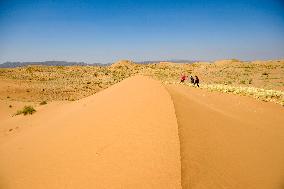
STORY: China's anti-desertification practice amazes international students SHOOTING TIME: June 14, 2024 DATELINE: June 17, 2024 LENGTH: 00:00:57 LOCATION: LINGWU, China CATEGORY: ENVIRONMENT SHOTLIST: 1. various of international students visiting the Baijitan national nature reserve 2. SOUNDBITE (English): RICHARD DJURIST NGENZI, Tanzanian student, Ningxia Medical University STORYLINE: A group of 25 students from over 10 countries visited the Baijitan national nature reserve in northwest China's Ningxia on Friday, marveling at China's efforts in combating desertification. Ningxia is surrounded by desert on three sides. Baijitan, edged by Maowusu, one of China's major deserts, is one of the hardest-hit place, highly vulnerable to sandstorm catastrophes. Over the past 70 years, with the unremitting efforts by local people and volunteers, 680,000 mu (45,333 hectares) of trees have been planted, raising the local forest coverage rate to 41 percent. The afforestation has curbed the expansion of the desert.

  •  
Chinese Experience in Desert Controi

Chinese Experience in Desert Controi

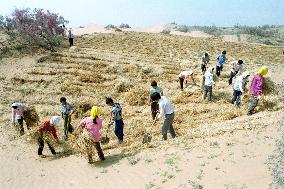
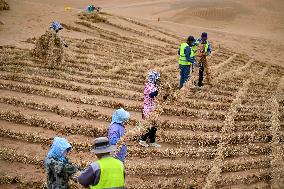
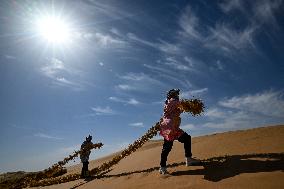
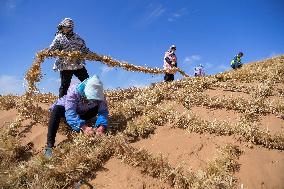
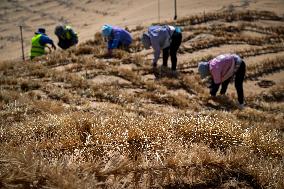
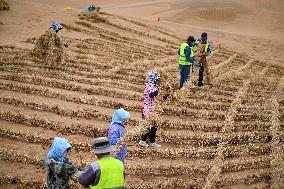
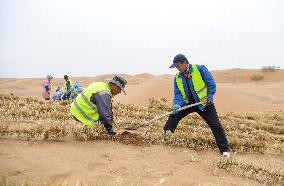
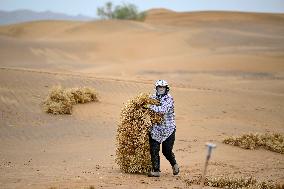
Workers set up straw checkerboards in Zhongwei, northwest China's Ningxia Hui Autonomous Region, Sept. 24, 1994. In the 1950s, to protect China's first railway that runs through a desert, the city of Zhongwei embarked on a journey of desert mitigation. Scientists at the Shapotou Desert Research and Experiment Station, part of the Northwest Institute of Eco-Environment and Resources of the Chinese Academy of Sciences, along with local residents, developed straw checkerboards to stabilize the sand and prevent dunes from shifting. Tang Ximing, a senior engineer at a state-owned forestry farm in Zhongwei, crafted a steel tool that differs from regular shovels by featuring two horizontal bars at the front tip. This innovative tool enables the planting of seedling roots 50 centimeters deep into the moist sand layer. This simple tool increases the survival rate of afforestation by 25 percent to over 85 percent. It has been widely promoted and used in afforestation projects across other regions in northern China. In

  •  
Chinese Experience in Desert Controi

Chinese Experience in Desert Controi

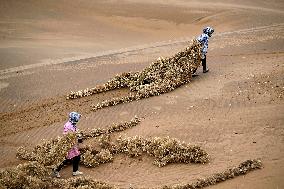
Workers pave straw checkerboards in the Tengger Desert, in Zhongwei of northwest China's Ningxia Hui Autonomous Region, May 29, 2024. In the 1950s, to protect China's first railway that runs through a desert, the city of Zhongwei embarked on a journey of desert mitigation. Scientists at the Shapotou Desert Research and Experiment Station, part of the Northwest Institute of Eco-Environment and Resources of the Chinese Academy of Sciences, along with local residents, developed straw checkerboards to stabilize the sand and prevent dunes from shifting. Tang Ximing, a senior engineer at a state-owned forestry farm in Zhongwei, crafted a steel tool that differs from regular shovels by featuring two horizontal bars at the front tip. This innovative tool enables the planting of seedling roots 50 centimeters deep into the moist sand layer. This simple tool increases the survival rate of afforestation by 25 percent to over 85 percent. It has been widely promoted and used in afforestation projects across other regions i

  •  
Chinese Experience in Desert Controi

Chinese Experience in Desert Controi

Workers pave straw checkerboards in the Tengger Desert, in Zhongwei of northwest China's Ningxia Hui Autonomous Region, May 30, 2024. In the 1950s, to protect China's first railway that runs through a desert, the city of Zhongwei embarked on a journey of desert mitigation. Scientists at the Shapotou Desert Research and Experiment Station, part of the Northwest Institute of Eco-Environment and Resources of the Chinese Academy of Sciences, along with local residents, developed straw checkerboards to stabilize the sand and prevent dunes from shifting. Tang Ximing, a senior engineer at a state-owned forestry farm in Zhongwei, crafted a steel tool that differs from regular shovels by featuring two horizontal bars at the front tip. This innovative tool enables the planting of seedling roots 50 centimeters deep into the moist sand layer. This simple tool increases the survival rate of afforestation by 25 percent to over 85 percent. It has been widely promoted and used in afforestation projects across other regions i

  •  
Chinese Experience in Desert Controi

Chinese Experience in Desert Controi

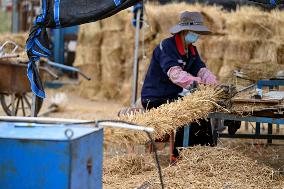
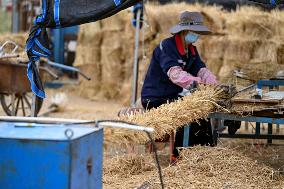
Workers produce straw checkerboard materials in Zhongwei of northwest China's Ningxia Hui Autonomous Region, May 29, 2024. In the 1950s, to protect China's first railway that runs through a desert, the city of Zhongwei embarked on a journey of desert mitigation. Scientists at the Shapotou Desert Research and Experiment Station, part of the Northwest Institute of Eco-Environment and Resources of the Chinese Academy of Sciences, along with local residents, developed straw checkerboards to stabilize the sand and prevent dunes from shifting. Tang Ximing, a senior engineer at a state-owned forestry farm in Zhongwei, crafted a steel tool that differs from regular shovels by featuring two horizontal bars at the front tip. This innovative tool enables the planting of seedling roots 50 centimeters deep into the moist sand layer. This simple tool increases the survival rate of afforestation by 25 percent to over 85 percent. It has been widely promoted and used in afforestation projects across other regions in northern

  •  
Chinese Experience in Desert Controi

Chinese Experience in Desert Controi

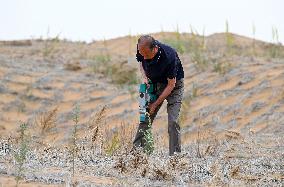
Tang Ximing, a senior engineer at a state-owned forestry farm in Zhongwei, demonstrates an upgraded electric seedling planter invented by himself in northwest China's Ningxia Hui Autonomous Region, June 1, 2024. In the 1950s, to protect China's first railway that runs through a desert, the city of Zhongwei embarked on a journey of desert mitigation. Scientists at the Shapotou Desert Research and Experiment Station, part of the Northwest Institute of Eco-Environment and Resources of the Chinese Academy of Sciences, along with local residents, developed straw checkerboards to stabilize the sand and prevent dunes from shifting. Tang Ximing, a senior engineer at a state-owned forestry farm in Zhongwei, crafted a steel tool that differs from regular shovels by featuring two horizontal bars at the front tip. This innovative tool enables the planting of seedling roots 50 centimeters deep into the moist sand layer. This simple tool increases the survival rate of afforestation by 25 percent to over 85 percent. It has

  •  
Chinese Experience in Desert Controi

Chinese Experience in Desert Controi

Workers set up straw checkerboards in Zhongwei, northwest China's Ningxia Hui Autonomous Region, June 13, 2019. In the 1950s, to protect China's first railway that runs through a desert, the city of Zhongwei embarked on a journey of desert mitigation. Scientists at the Shapotou Desert Research and Experiment Station, part of the Northwest Institute of Eco-Environment and Resources of the Chinese Academy of Sciences, along with local residents, developed straw checkerboards to stabilize the sand and prevent dunes from shifting. Tang Ximing, a senior engineer at a state-owned forestry farm in Zhongwei, crafted a steel tool that differs from regular shovels by featuring two horizontal bars at the front tip. This innovative tool enables the planting of seedling roots 50 centimeters deep into the moist sand layer. This simple tool increases the survival rate of afforestation by 25 percent to over 85 percent. It has been widely promoted and used in afforestation projects across other regions in northern China. In 2

  •  
Chinese Experience in Desert Controi

Chinese Experience in Desert Controi

An aerial drone photo taken on Sept. 7, 2020 shows workers paving straw checkerboards near a section of an express way in the Tengger Desert, northwest China's Ningxia Hui Autonomous Region. In the 1950s, to protect China's first railway that runs through a desert, the city of Zhongwei embarked on a journey of desert mitigation. Scientists at the Shapotou Desert Research and Experiment Station, part of the Northwest Institute of Eco-Environment and Resources of the Chinese Academy of Sciences, along with local residents, developed straw checkerboards to stabilize the sand and prevent dunes from shifting. Tang Ximing, a senior engineer at a state-owned forestry farm in Zhongwei, crafted a steel tool that differs from regular shovels by featuring two horizontal bars at the front tip. This innovative tool enables the planting of seedling roots 50 centimeters deep into the moist sand layer. This simple tool increases the survival rate of afforestation by 25 percent to over 85 percent. It has been widely promoted

  •  
Chinese Experience in Desert Controi

Chinese Experience in Desert Controi

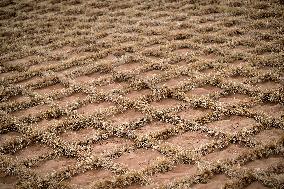
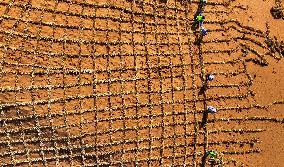
An aerial drone photo taken on May 30, 2024 shows workers paving straw checkerboards in the Tengger Desert, in Zhongwei of northwest China's Ningxia Hui Autonomous Region. In the 1950s, to protect China's first railway that runs through a desert, the city of Zhongwei embarked on a journey of desert mitigation. Scientists at the Shapotou Desert Research and Experiment Station, part of the Northwest Institute of Eco-Environment and Resources of the Chinese Academy of Sciences, along with local residents, developed straw checkerboards to stabilize the sand and prevent dunes from shifting. Tang Ximing, a senior engineer at a state-owned forestry farm in Zhongwei, crafted a steel tool that differs from regular shovels by featuring two horizontal bars at the front tip. This innovative tool enables the planting of seedling roots 50 centimeters deep into the moist sand layer. This simple tool increases the survival rate of afforestation by 25 percent to over 85 percent. It has been widely promoted and used in affores

  •  
Chinese Experience in Desert Controi

Chinese Experience in Desert Controi

An aerial drone photo taken on May 30, 2024 shows workers paving straw checkerboards in the Tengger Desert, in Zhongwei of northwest China's Ningxia Hui Autonomous Region. In the 1950s, to protect China's first railway that runs through a desert, the city of Zhongwei embarked on a journey of desert mitigation. Scientists at the Shapotou Desert Research and Experiment Station, part of the Northwest Institute of Eco-Environment and Resources of the Chinese Academy of Sciences, along with local residents, developed straw checkerboards to stabilize the sand and prevent dunes from shifting. Tang Ximing, a senior engineer at a state-owned forestry farm in Zhongwei, crafted a steel tool that differs from regular shovels by featuring two horizontal bars at the front tip. This innovative tool enables the planting of seedling roots 50 centimeters deep into the moist sand layer. This simple tool increases the survival rate of afforestation by 25 percent to over 85 percent. It has been widely promoted and used in affores

  •  
Chinese Experience in Desert Controi

Chinese Experience in Desert Controi

Workers pave straw checkerboards in the Tengger Desert, in Zhongwei of northwest China's Ningxia Hui Autonomous Region, May 29, 2024. In the 1950s, to protect China's first railway that runs through a desert, the city of Zhongwei embarked on a journey of desert mitigation. Scientists at the Shapotou Desert Research and Experiment Station, part of the Northwest Institute of Eco-Environment and Resources of the Chinese Academy of Sciences, along with local residents, developed straw checkerboards to stabilize the sand and prevent dunes from shifting. Tang Ximing, a senior engineer at a state-owned forestry farm in Zhongwei, crafted a steel tool that differs from regular shovels by featuring two horizontal bars at the front tip. This innovative tool enables the planting of seedling roots 50 centimeters deep into the moist sand layer. This simple tool increases the survival rate of afforestation by 25 percent to over 85 percent. It has been widely promoted and used in afforestation projects across other regions i

  •  
Chinese Experience in Desert Controi

Chinese Experience in Desert Controi

Workers pave straw checkerboards in the Tengger Desert, in Zhongwei of northwest China's Ningxia Hui Autonomous Region, May 30, 2024. In the 1950s, to protect China's first railway that runs through a desert, the city of Zhongwei embarked on a journey of desert mitigation. Scientists at the Shapotou Desert Research and Experiment Station, part of the Northwest Institute of Eco-Environment and Resources of the Chinese Academy of Sciences, along with local residents, developed straw checkerboards to stabilize the sand and prevent dunes from shifting. Tang Ximing, a senior engineer at a state-owned forestry farm in Zhongwei, crafted a steel tool that differs from regular shovels by featuring two horizontal bars at the front tip. This innovative tool enables the planting of seedling roots 50 centimeters deep into the moist sand layer. This simple tool increases the survival rate of afforestation by 25 percent to over 85 percent. It has been widely promoted and used in afforestation projects across other regions i

  •  
Chinese Experience in Desert Controi

Chinese Experience in Desert Controi

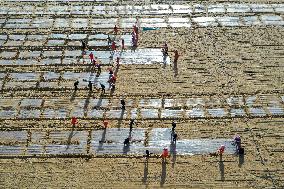
An aerial drone photo taken on May 29, 2024 shows straw checkerboards in the Tengger Desert, northwest China's Ningxia Hui Autonomous Region. In the 1950s, to protect China's first railway that runs through a desert, the city of Zhongwei embarked on a journey of desert mitigation. Scientists at the Shapotou Desert Research and Experiment Station, part of the Northwest Institute of Eco-Environment and Resources of the Chinese Academy of Sciences, along with local residents, developed straw checkerboards to stabilize the sand and prevent dunes from shifting. Tang Ximing, a senior engineer at a state-owned forestry farm in Zhongwei, crafted a steel tool that differs from regular shovels by featuring two horizontal bars at the front tip. This innovative tool enables the planting of seedling roots 50 centimeters deep into the moist sand layer. This simple tool increases the survival rate of afforestation by 25 percent to over 85 percent. It has been widely promoted and used in afforestation projects across other r

  •  
Chinese Experience in Desert Controi

Chinese Experience in Desert Controi

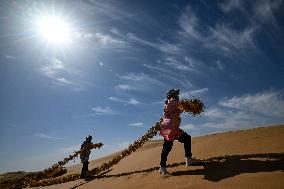
Workers carry straw checkerboards in the Tengger Desert, in Zhongwei of northwest China's Ningxia Hui Autonomous Region, May 30, 2024. In the 1950s, to protect China's first railway that runs through a desert, the city of Zhongwei embarked on a journey of desert mitigation. Scientists at the Shapotou Desert Research and Experiment Station, part of the Northwest Institute of Eco-Environment and Resources of the Chinese Academy of Sciences, along with local residents, developed straw checkerboards to stabilize the sand and prevent dunes from shifting. Tang Ximing, a senior engineer at a state-owned forestry farm in Zhongwei, crafted a steel tool that differs from regular shovels by featuring two horizontal bars at the front tip. This innovative tool enables the planting of seedling roots 50 centimeters deep into the moist sand layer. This simple tool increases the survival rate of afforestation by 25 percent to over 85 percent. It has been widely promoted and used in afforestation projects across other regions

  •  
Chinese Experience in Desert Controi

Chinese Experience in Desert Controi

An aerial drone photo taken on May 30, 2024 shows workers paving straw checkerboards in the Tengger Desert, in Zhongwei of northwest China's Ningxia Hui Autonomous Region. In the 1950s, to protect China's first railway that runs through a desert, the city of Zhongwei embarked on a journey of desert mitigation. Scientists at the Shapotou Desert Research and Experiment Station, part of the Northwest Institute of Eco-Environment and Resources of the Chinese Academy of Sciences, along with local residents, developed straw checkerboards to stabilize the sand and prevent dunes from shifting. Tang Ximing, a senior engineer at a state-owned forestry farm in Zhongwei, crafted a steel tool that differs from regular shovels by featuring two horizontal bars at the front tip. This innovative tool enables the planting of seedling roots 50 centimeters deep into the moist sand layer. This simple tool increases the survival rate of afforestation by 25 percent to over 85 percent. It has been widely promoted and used in affores

  •  
Chinese Experience in Desert Controi

Chinese Experience in Desert Controi

Workers pave straw checkerboards in the Tengger Desert, in Zhongwei of northwest China's Ningxia Hui Autonomous Region, May 30, 2024. In the 1950s, to protect China's first railway that runs through a desert, the city of Zhongwei embarked on a journey of desert mitigation. Scientists at the Shapotou Desert Research and Experiment Station, part of the Northwest Institute of Eco-Environment and Resources of the Chinese Academy of Sciences, along with local residents, developed straw checkerboards to stabilize the sand and prevent dunes from shifting. Tang Ximing, a senior engineer at a state-owned forestry farm in Zhongwei, crafted a steel tool that differs from regular shovels by featuring two horizontal bars at the front tip. This innovative tool enables the planting of seedling roots 50 centimeters deep into the moist sand layer. This simple tool increases the survival rate of afforestation by 25 percent to over 85 percent. It has been widely promoted and used in afforestation projects across other regions i

  •  
Chinese Experience in Desert Controi

Chinese Experience in Desert Controi

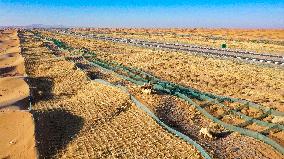
An aerial drone photo taken on Dec. 29, 2021 shows a section of an express way protected by straw checkerboards from the sand in the Tengger Desert, northwest China's Ningxia Hui Autonomous Region. In the 1950s, to protect China's first railway that runs through a desert, the city of Zhongwei embarked on a journey of desert mitigation. Scientists at the Shapotou Desert Research and Experiment Station, part of the Northwest Institute of Eco-Environment and Resources of the Chinese Academy of Sciences, along with local residents, developed straw checkerboards to stabilize the sand and prevent dunes from shifting. Tang Ximing, a senior engineer at a state-owned forestry farm in Zhongwei, crafted a steel tool that differs from regular shovels by featuring two horizontal bars at the front tip. This innovative tool enables the planting of seedling roots 50 centimeters deep into the moist sand layer. This simple tool increases the survival rate of afforestation by 25 percent to over 85 percent. It has been widely pr

  •  
(VistaNingxia)CHINA-NINGXIA-ZHONGWEI-ENVIRONMENT-SAND CONTROL (CN)

(VistaNingxia)CHINA-NINGXIA-ZHONGWEI-ENVIRONMENT-SAND CONTROL (CN)

(240616) -- ZHONGWEI, June 16, 2024 Photo by Xinhua/ABACAPRESS.COM) -- An aerial drone photo taken on May 30, 2024 shows workers paving straw checkerboards in the Tengger Desert, in Zhongwei of northwest China's Ningxia Hui Autonomous Region. In the 1950s, to protect China's first railway that runs through a desert, the city of Zhongwei embarked on a journey of desert mitigation. Scientists at the Shapotou Desert Research and Experiment Station, part of the Northwest Institute of Eco-Environment and Resources of the Chinese Academy of Sciences, along with local residents, developed straw checkerboards to stabilize the sand and prevent dunes from shifting. Tang Ximing, a senior engineer at a state-owned forestry farm in Zhongwei, crafted a steel tool that differs from regular shovels by featuring two horizontal bars at the front tip. This innovative tool enables the planting of seedling roots 50 centimeters deep into the moist sand layer. This simple tool increases the survival rate of afforestation by 25 perc

  •  
(VistaNingxia)CHINA-NINGXIA-ZHONGWEI-ENVIRONMENT-SAND CONTROL (CN)

(VistaNingxia)CHINA-NINGXIA-ZHONGWEI-ENVIRONMENT-SAND CONTROL (CN)

(240616) -- ZHONGWEI, June 16, 2024 Photo by Xinhua/ABACAPRESS.COM) -- Workers pave straw checkerboards in the Tengger Desert, in Zhongwei of northwest China's Ningxia Hui Autonomous Region, May 30, 2024. In the 1950s, to protect China's first railway that runs through a desert, the city of Zhongwei embarked on a journey of desert mitigation. Scientists at the Shapotou Desert Research and Experiment Station, part of the Northwest Institute of Eco-Environment and Resources of the Chinese Academy of Sciences, along with local residents, developed straw checkerboards to stabilize the sand and prevent dunes from shifting. Tang Ximing, a senior engineer at a state-owned forestry farm in Zhongwei, crafted a steel tool that differs from regular shovels by featuring two horizontal bars at the front tip. This innovative tool enables the planting of seedling roots 50 centimeters deep into the moist sand layer. This simple tool increases the survival rate of afforestation by 25 percent to over 85 percent. It has been wi

  •  
(VistaNingxia)CHINA-NINGXIA-ZHONGWEI-ENVIRONMENT-SAND CONTROL (CN)

(VistaNingxia)CHINA-NINGXIA-ZHONGWEI-ENVIRONMENT-SAND CONTROL (CN)

(240616) -- ZHONGWEI, June 16, 2024 Photo by Xinhua/ABACAPRESS.COM) -- Workers set up straw checkerboards in Zhongwei, northwest China's Ningxia Hui Autonomous Region, June 13, 2019. In the 1950s, to protect China's first railway that runs through a desert, the city of Zhongwei embarked on a journey of desert mitigation. Scientists at the Shapotou Desert Research and Experiment Station, part of the Northwest Institute of Eco-Environment and Resources of the Chinese Academy of Sciences, along with local residents, developed straw checkerboards to stabilize the sand and prevent dunes from shifting. Tang Ximing, a senior engineer at a state-owned forestry farm in Zhongwei, crafted a steel tool that differs from regular shovels by featuring two horizontal bars at the front tip. This innovative tool enables the planting of seedling roots 50 centimeters deep into the moist sand layer. This simple tool increases the survival rate of afforestation by 25 percent to over 85 percent. It has been widely promoted and used

  •  
(VistaNingxia)CHINA-NINGXIA-ZHONGWEI-ENVIRONMENT-SAND CONTROL (CN)

(VistaNingxia)CHINA-NINGXIA-ZHONGWEI-ENVIRONMENT-SAND CONTROL (CN)

(240616) -- ZHONGWEI, June 16, 2024 Photo by Xinhua/ABACAPRESS.COM) -- Workers pave straw checkerboards in the Tengger Desert, in Zhongwei of northwest China's Ningxia Hui Autonomous Region, May 29, 2024. In the 1950s, to protect China's first railway that runs through a desert, the city of Zhongwei embarked on a journey of desert mitigation. Scientists at the Shapotou Desert Research and Experiment Station, part of the Northwest Institute of Eco-Environment and Resources of the Chinese Academy of Sciences, along with local residents, developed straw checkerboards to stabilize the sand and prevent dunes from shifting. Tang Ximing, a senior engineer at a state-owned forestry farm in Zhongwei, crafted a steel tool that differs from regular shovels by featuring two horizontal bars at the front tip. This innovative tool enables the planting of seedling roots 50 centimeters deep into the moist sand layer. This simple tool increases the survival rate of afforestation by 25 percent to over 85 percent. It has been wi

  •  
(VistaNingxia)CHINA-NINGXIA-ZHONGWEI-ENVIRONMENT-SAND CONTROL (CN)

(VistaNingxia)CHINA-NINGXIA-ZHONGWEI-ENVIRONMENT-SAND CONTROL (CN)

(240616) -- ZHONGWEI, June 16, 2024 Photo by Xinhua/ABACAPRESS.COM) -- Workers pave straw checkerboards in Zhongwei, northwest China's Ningxia Hui Autonomous Region, May 29, 2024. In the 1950s, to protect China's first railway that runs through a desert, the city of Zhongwei embarked on a journey of desert mitigation. Scientists at the Shapotou Desert Research and Experiment Station, part of the Northwest Institute of Eco-Environment and Resources of the Chinese Academy of Sciences, along with local residents, developed straw checkerboards to stabilize the sand and prevent dunes from shifting. Tang Ximing, a senior engineer at a state-owned forestry farm in Zhongwei, crafted a steel tool that differs from regular shovels by featuring two horizontal bars at the front tip. This innovative tool enables the planting of seedling roots 50 centimeters deep into the moist sand layer. This simple tool increases the survival rate of afforestation by 25 percent to over 85 percent. It has been widely promoted and used in

  •  
(VistaNingxia)CHINA-NINGXIA-ZHONGWEI-ENVIRONMENT-SAND CONTROL (CN)

(VistaNingxia)CHINA-NINGXIA-ZHONGWEI-ENVIRONMENT-SAND CONTROL (CN)

(240616) -- ZHONGWEI, June 16, 2024 Photo by Xinhua/ABACAPRESS.COM) -- A worker paves straw checkerboards in the Tengger Desert, in Zhongwei of northwest China's Ningxia Hui Autonomous Region, May 30, 2024. In the 1950s, to protect China's first railway that runs through a desert, the city of Zhongwei embarked on a journey of desert mitigation. Scientists at the Shapotou Desert Research and Experiment Station, part of the Northwest Institute of Eco-Environment and Resources of the Chinese Academy of Sciences, along with local residents, developed straw checkerboards to stabilize the sand and prevent dunes from shifting. Tang Ximing, a senior engineer at a state-owned forestry farm in Zhongwei, crafted a steel tool that differs from regular shovels by featuring two horizontal bars at the front tip. This innovative tool enables the planting of seedling roots 50 centimeters deep into the moist sand layer. This simple tool increases the survival rate of afforestation by 25 percent to over 85 percent. It has been

  •  
(VistaNingxia)CHINA-NINGXIA-ZHONGWEI-ENVIRONMENT-SAND CONTROL (CN)

(VistaNingxia)CHINA-NINGXIA-ZHONGWEI-ENVIRONMENT-SAND CONTROL (CN)

(240616) -- ZHONGWEI, June 16, 2024 Photo by Xinhua/ABACAPRESS.COM) -- Workers produce straw checkerboard materials in Zhongwei of northwest China's Ningxia Hui Autonomous Region, May 29, 2024. In the 1950s, to protect China's first railway that runs through a desert, the city of Zhongwei embarked on a journey of desert mitigation. Scientists at the Shapotou Desert Research and Experiment Station, part of the Northwest Institute of Eco-Environment and Resources of the Chinese Academy of Sciences, along with local residents, developed straw checkerboards to stabilize the sand and prevent dunes from shifting. Tang Ximing, a senior engineer at a state-owned forestry farm in Zhongwei, crafted a steel tool that differs from regular shovels by featuring two horizontal bars at the front tip. This innovative tool enables the planting of seedling roots 50 centimeters deep into the moist sand layer. This simple tool increases the survival rate of afforestation by 25 percent to over 85 percent. It has been widely promot

  • Main
  • Top
  • Editorial
  • Creative
  • About Us
  • About ILG
  • Terms of use
  • Company
  • BEHIND
  • Price List
  • Single Plan
  • Monthly Plan
  • Services
  • Shooting
  • Rights Clearance
  • Support
  • FAQ
  • How To Buy
  • Contact Us
  • Become a Partner

© KYODO NEWS IMAGES INC

All Rights Reserved.

  • Editorial
  • Olympics
  • News
  • Sports
  • Japan
  • Tech
  • Royal
  • Disaster
  • NorthKorea
  • Old Japan
  • SNS
  • Creative
  • Food
  • Japan
  • Landscape
  • Animal
  • Popular
  • #Ukraine
  • #Thailand
  • #coronavirus
  • #N. Korea
  • #China
  • #Russia
  • #Ukraine
  • #Thailand
  • #coronavirus
  • #N. Korea
  • #China
  • #Russia
  • Food
  • Japan
  • Landscape
  • Animal
  • Olympics
  • News
  • Sports
  • Japan
  • Tech
  • Royal
  • Disaster
  • NorthKorea
  • Old Japan
  • SNS