•  
Offshore Yellowfin Tuna Breeding Base - China

Offshore Yellowfin Tuna Breeding Base - China

Qin Chuanxin, a researcher at the South China Sea Fisheries Research Institute of the Chinese Academy of Fishery Sciences, shows a specimen of yellowfin tuna in Lingshui Li Autonomous County, south China's Hainan Province, on Sept. 17, 2025. In recent years, Hainan Province has accelerated the development of its fishery industry by giving full play to its advantages in marine fisheries. Thanks to technological breakthroughs, the South China Sea Fisheries Research Institute of the Chinese Academy of Fishery Sciences established an offshore yellowfin tuna breeding base in Lingshui, which has achieved artificial spawning and hatching of yellowfin tunas. Photo by Xinhua/Guo Cheng/ABACAPRESS.COM

  •  
Offshore Yellowfin Tuna Breeding Base - China

Offshore Yellowfin Tuna Breeding Base - China

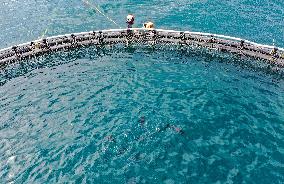
An aerial drone photo taken on Sept. 17, 2025 shows staff members feeding tunas at an offshore yellowfin tuna breeding base in Lingshui Li Autonomous County, south China's Hainan Province. In recent years, Hainan Province has accelerated the development of its fishery industry by giving full play to its advantages in marine fisheries. Thanks to technological breakthroughs, the South China Sea Fisheries Research Institute of the Chinese Academy of Fishery Sciences established an offshore yellowfin tuna breeding base in Lingshui, which has achieved artificial spawning and hatching of yellowfin tunas. Photo by Xinhua/Guo Cheng/ABACAPRESS.COM

  •  
Offshore Yellowfin Tuna Breeding Base - China

Offshore Yellowfin Tuna Breeding Base - China

An aerial drone photo taken on Sept. 17, 2025 shows staff members feeding tunas at an offshore yellowfin tuna breeding base in Lingshui Li Autonomous County, south China's Hainan Province. In recent years, Hainan Province has accelerated the development of its fishery industry by giving full play to its advantages in marine fisheries. Thanks to technological breakthroughs, the South China Sea Fisheries Research Institute of the Chinese Academy of Fishery Sciences established an offshore yellowfin tuna breeding base in Lingshui, which has achieved artificial spawning and hatching of yellowfin tunas. Photo by Xinhua/Guo Cheng/ABACAPRESS.COM

  •  
Offshore Yellowfin Tuna Breeding Base - China

Offshore Yellowfin Tuna Breeding Base - China

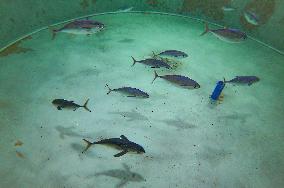
This photo taken on Sept. 17, 2025 shows yellowfin tunas undergoing an experiment at the South China Sea Fisheries Research Institute of the Chinese Academy of Fishery Sciences in Lingshui Li Autonomous County, south China's Hainan Province. In recent years, Hainan Province has accelerated the development of its fishery industry by giving full play to its advantages in marine fisheries. Thanks to technological breakthroughs, the South China Sea Fisheries Research Institute of the Chinese Academy of Fishery Sciences established an offshore yellowfin tuna breeding base in Lingshui, which has achieved artificial spawning and hatching of yellowfin tunas. Photo by Xinhua/Guo Cheng/ABACAPRESS.COM

  •  
Offshore Yellowfin Tuna Breeding Base - China

Offshore Yellowfin Tuna Breeding Base - China

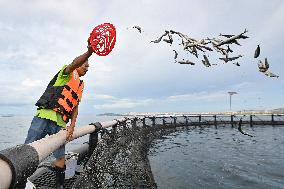
A staff member feeds tunas at an offshore yellowfin tuna breeding base in Lingshui Li Autonomous County, south China's Hainan Province, on Sept. 17, 2025. In recent years, Hainan Province has accelerated the development of its fishery industry by giving full play to its advantages in marine fisheries. Thanks to technological breakthroughs, the South China Sea Fisheries Research Institute of the Chinese Academy of Fishery Sciences established an offshore yellowfin tuna breeding base in Lingshui, which has achieved artificial spawning and hatching of yellowfin tunas. Photo by Xinhua/Guo Cheng/ABACAPRESS.COM

  •  
Offshore Yellowfin Tuna Breeding Base - China

Offshore Yellowfin Tuna Breeding Base - China

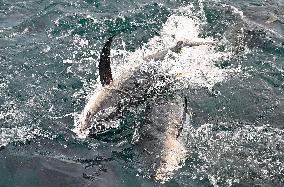
This photo taken on Sept. 17, 2025 shows tunas vying for food at an offshore yellowfin tuna breeding base in Lingshui Li Autonomous County, south China's Hainan Province. In recent years, Hainan Province has accelerated the development of its fishery industry by giving full play to its advantages in marine fisheries. Thanks to technological breakthroughs, the South China Sea Fisheries Research Institute of the Chinese Academy of Fishery Sciences established an offshore yellowfin tuna breeding base in Lingshui, which has achieved artificial spawning and hatching of yellowfin tunas. Photo by Xinhua/Guo Cheng/ABACAPRESS.COM

  •  
Oriental White Storks - Fungin

Oriental White Storks - Fungin

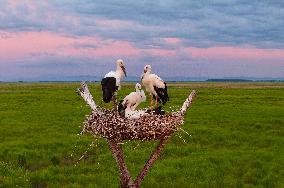
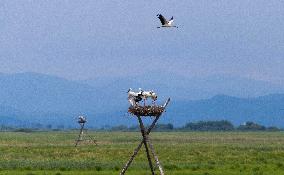
A drone photo taken on July 13, 2025 shows oriental white storks in an artificial nest at Sanhuanpao National Nature Reserve, in Fujin City, northeast China's Heilongjiang Province.. Midsummer is the typical fledging season for oriental white stork chicks, which will later leave their parents. The bird species is under first-class national protection in China. Every spring, the birds migrate from the middle and lower reaches of the Yangtze River back to their breeding habitats in northeast China. Photo by Qu Yubao/Xinhua/ABACAPRESS.COM

  •  
Oriental White Storks - Fungin

Oriental White Storks - Fungin

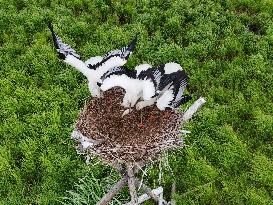
A drone photo taken on July 13, 2025 shows oriental white stork chicks feeding in an artificial nest at Sanhuanpao National Nature Reserve, in Fujin City, northeast China's Heilongjiang Province. Midsummer is the typical fledging season for oriental white stork chicks, which will later leave their parents. The bird species is under first-class national protection in China. Every spring, the birds migrate from the middle and lower reaches of the Yangtze River back to their breeding habitats in northeast China. Photo by Qu Yubao/Xinhua/ABACAPRESS.COM

  •  
Oriental White Storks - Fungin

Oriental White Storks - Fungin

A drone photo taken on July 13, 2025 shows oriental white storks at Sanhuanpao National Nature Reserve, in Fujin City, northeast China's Heilongjiang Province. Midsummer is the typical fledging season for oriental white stork chicks, which will later leave their parents. The bird species is under first-class national protection in China. Every spring, the birds migrate from the middle and lower reaches of the Yangtze River back to their breeding habitats in northeast China. Photo by Qu Yubao/Xinhua/ABACAPRESS.COM

  •  
Red-Crowned Crane Chick - China

Red-Crowned Crane Chick - China

A red-crowned crane chick is carried by an adult bird on the back at Zhalong National Nature Reserve in Qiqihar, northeast China's Heilongjiang Province, May 14, 2025. Captive-bred red-crowned cranes at Zhalong National Nature Reserve in Qiqihar have recently entered their breeding season, with many crane couples welcoming new offspring. With a total area of 2,100 square kilometers, the reserve is dubbed "home of red-crowned cranes" in China, and serves as the world's largest red-crowned crane habitat and largest captive-bred red-crowned crane rewilding base. Photo by Wang Yonggang/Xinhua/ABACAPRESS.COM

  •  
Red-Crowned Crane Chick - China

Red-Crowned Crane Chick - China

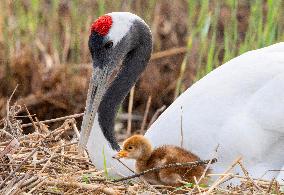
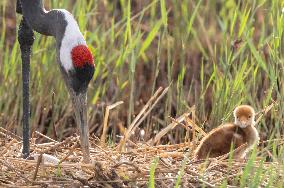
A red-crowned crane chick is accompanied by an adult bird at Zhalong National Nature Reserve in Qiqihar, northeast China's Heilongjiang Province, May 14, 2025. Captive-bred red-crowned cranes at Zhalong National Nature Reserve in Qiqihar have recently entered their breeding season, with many crane couples welcoming new offspring. With a total area of 2,100 square kilometers, the reserve is dubbed "home of red-crowned cranes" in China, and serves as the world's largest red-crowned crane habitat and largest captive-bred red-crowned crane rewilding base. Photo by Wang Yonggang/Xinhua/ABACAPRESS.COM

  •  
Red-Crowned Crane Chick - China

Red-Crowned Crane Chick - China

Red-crowned crane chicks have fun next to an adult bird at Zhalong National Nature Reserve in Qiqihar, northeast China's Heilongjiang Province, May 14, 2025. Captive-bred red-crowned cranes at Zhalong National Nature Reserve in Qiqihar have recently entered their breeding season, with many crane couples welcoming new offspring. With a total area of 2,100 square kilometers, the reserve is dubbed "home of red-crowned cranes" in China, and serves as the world's largest red-crowned crane habitat and largest captive-bred red-crowned crane rewilding base. Photo by Wang Yonggang/Xinhua/ABACAPRESS.COM

  •  
Red-Crowned Crane Chick - China

Red-Crowned Crane Chick - China

A red-crowned crane chick is carried by an adult bird on the back at Zhalong National Nature Reserve in Qiqihar, northeast China's Heilongjiang Province, May 14, 2025. Captive-bred red-crowned cranes at Zhalong National Nature Reserve in Qiqihar have recently entered their breeding season, with many crane couples welcoming new offspring. With a total area of 2,100 square kilometers, the reserve is dubbed "home of red-crowned cranes" in China, and serves as the world's largest red-crowned crane habitat and largest captive-bred red-crowned crane rewilding base. Photo by Wang Yonggang/Xinhua/ABACAPRESS.COM

  •  
Red-Crowned Crane Chick - China

Red-Crowned Crane Chick - China

A red-crowned crane chick is accompanied by an adult bird at Zhalong National Nature Reserve in Qiqihar, northeast China's Heilongjiang Province, May 14, 2025. Captive-bred red-crowned cranes at Zhalong National Nature Reserve in Qiqihar have recently entered their breeding season, with many crane couples welcoming new offspring. With a total area of 2,100 square kilometers, the reserve is dubbed "home of red-crowned cranes" in China, and serves as the world's largest red-crowned crane habitat and largest captive-bred red-crowned crane rewilding base. Photo by Wang Yonggang/Xinhua/ABACAPRESS.COM

  •  
Red-Crowned Crane Chick - China

Red-Crowned Crane Chick - China

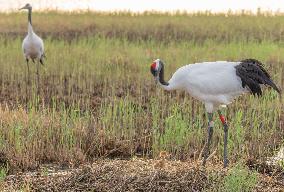
A red-crowned crane family is seen at Zhalong National Nature Reserve in Qiqihar, northeast China's Heilongjiang Province, May 14, 2025. Captive-bred red-crowned cranes at Zhalong National Nature Reserve in Qiqihar have recently entered their breeding season, with many crane couples welcoming new offspring. With a total area of 2,100 square kilometers, the reserve is dubbed "home of red-crowned cranes" in China, and serves as the world's largest red-crowned crane habitat and largest captive-bred red-crowned crane rewilding base. Photo by Wang Yonggang/Xinhua/ABACAPRESS.COM

  •  
Red-Crowned Crane Chick - China

Red-Crowned Crane Chick - China

A red-crowned crane family is seen at Zhalong National Nature Reserve in Qiqihar, northeast China's Heilongjiang Province, May 14, 2025. Captive-bred red-crowned cranes at Zhalong National Nature Reserve in Qiqihar have recently entered their breeding season, with many crane couples welcoming new offspring. With a total area of 2,100 square kilometers, the reserve is dubbed "home of red-crowned cranes" in China, and serves as the world's largest red-crowned crane habitat and largest captive-bred red-crowned crane rewilding base. Photo by Wang Yonggang/Xinhua/ABACAPRESS.COM

  •  
Przewalski s horses at the Helan Mountain Nature Reserve - China

Przewalski s horses at the Helan Mountain Nature Reserve - China

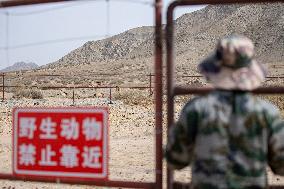
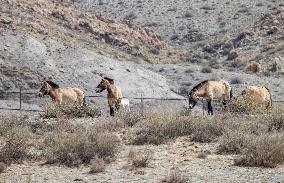
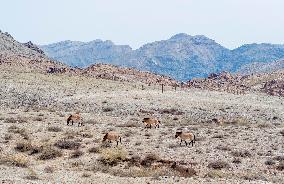
A staff member checks the Przewalski's horses at the Helan Mountain Nature Reserve in northwest China's Ningxia Hui Autonomous Region, April 17, 2025. The Przewalski's horse is listed as endangered by the International Union for Conservation of Nature Red List of Threatened Species and is under first-class national protection. Once extinct in China due to excessive poaching and environmental degradation, the Przewalski's horses were reintroduced to the country from Britain, Germany and the United States starting in the mid-1980s, and were raised in northwest China's Xinjiang Uygur Autonomous Region and Gansu Province. Since 2024, a total of 18 Przewalski's horses in three batches from Xinjiang have been released into the Helan Mountain Nature Reserve in Ningxia, as a way to protect the endangered species. On April 13 this year, a Przewalski's horse gave birth to a foal, marking the first case of breeding after the reintroduction of the Przewalski's horse in the nature reserve. Photo by Yang Zhisen/Xinhua/ABAC

  •  
Przewalski s horses at the Helan Mountain Nature Reserve - China

Przewalski s horses at the Helan Mountain Nature Reserve - China

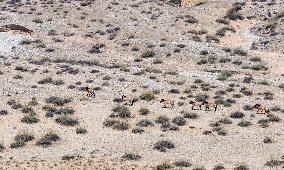
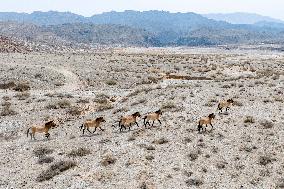
An aerial drone photo shows Przewalski's horses at the Helan Mountain Nature Reserve in northwest China's Ningxia Hui Autonomous Region, April 17, 2025. The Przewalski's horse is listed as endangered by the International Union for Conservation of Nature Red List of Threatened Species and is under first-class national protection. Once extinct in China due to excessive poaching and environmental degradation, the Przewalski's horses were reintroduced to the country from Britain, Germany and the United States starting in the mid-1980s, and were raised in northwest China's Xinjiang Uygur Autonomous Region and Gansu Province. Since 2024, a total of 18 Przewalski's horses in three batches from Xinjiang have been released into the Helan Mountain Nature Reserve in Ningxia, as a way to protect the endangered species. On April 13 this year, a Przewalski's horse gave birth to a foal, marking the first case of breeding after the reintroduction of the Przewalski's horse in the nature reserve. Photo by Yang Zhisen/Xinhua/AB

  •  
Przewalski s horses at the Helan Mountain Nature Reserve - China

Przewalski s horses at the Helan Mountain Nature Reserve - China

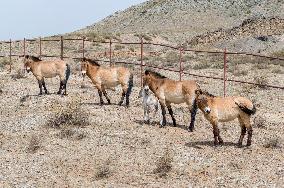
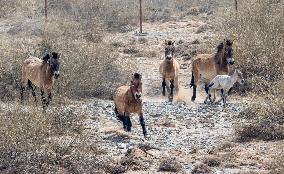
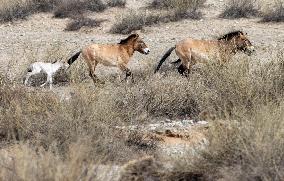
Przewalski's horses and a foal are seen at the Helan Mountain Nature Reserve in northwest China's Ningxia Hui Autonomous Region, April 17, 2025. The Przewalski's horse is listed as endangered by the International Union for Conservation of Nature Red List of Threatened Species and is under first-class national protection. Once extinct in China due to excessive poaching and environmental degradation, the Przewalski's horses were reintroduced to the country from Britain, Germany and the United States starting in the mid-1980s, and were raised in northwest China's Xinjiang Uygur Autonomous Region and Gansu Province. Since 2024, a total of 18 Przewalski's horses in three batches from Xinjiang have been released into the Helan Mountain Nature Reserve in Ningxia, as a way to protect the endangered species. On April 13 this year, a Przewalski's horse gave birth to a foal, marking the first case of breeding after the reintroduction of the Przewalski's horse in the nature reserve. Photo by Yang Zhisen/Xinhua/ABACAPRESS

  •  
Przewalski s horses at the Helan Mountain Nature Reserve - China

Przewalski s horses at the Helan Mountain Nature Reserve - China

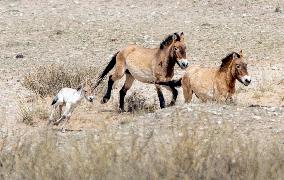
An aerial drone photo shows Przewalski's horses and a foal at the Helan Mountain Nature Reserve in northwest China's Ningxia Hui Autonomous Region, April 17, 2025. The Przewalski's horse is listed as endangered by the International Union for Conservation of Nature Red List of Threatened Species and is under first-class national protection. Once extinct in China due to excessive poaching and environmental degradation, the Przewalski's horses were reintroduced to the country from Britain, Germany and the United States starting in the mid-1980s, and were raised in northwest China's Xinjiang Uygur Autonomous Region and Gansu Province. Since 2024, a total of 18 Przewalski's horses in three batches from Xinjiang have been released into the Helan Mountain Nature Reserve in Ningxia, as a way to protect the endangered species. On April 13 this year, a Przewalski's horse gave birth to a foal, marking the first case of breeding after the reintroduction of the Przewalski's horse in the nature reserve. Photo by Yang Zhise

  •  
Przewalski s horses at the Helan Mountain Nature Reserve - China

Przewalski s horses at the Helan Mountain Nature Reserve - China

An aerial drone photo shows Przewalski's horses at the Helan Mountain Nature Reserve in northwest China's Ningxia Hui Autonomous Region, April 17, 2025. The Przewalski's horse is listed as endangered by the International Union for Conservation of Nature Red List of Threatened Species and is under first-class national protection. Once extinct in China due to excessive poaching and environmental degradation, the Przewalski's horses were reintroduced to the country from Britain, Germany and the United States starting in the mid-1980s, and were raised in northwest China's Xinjiang Uygur Autonomous Region and Gansu Province. Since 2024, a total of 18 Przewalski's horses in three batches from Xinjiang have been released into the Helan Mountain Nature Reserve in Ningxia, as a way to protect the endangered species. On April 13 this year, a Przewalski's horse gave birth to a foal, marking the first case of breeding after the reintroduction of the Przewalski's horse in the nature reserve. Photo by Yang Zhisen/Xinhua/AB

  •  
Przewalski s horses at the Helan Mountain Nature Reserve - China

Przewalski s horses at the Helan Mountain Nature Reserve - China

Przewalski's horses and a foal are seen at the Helan Mountain Nature Reserve in northwest China's Ningxia Hui Autonomous Region, April 17, 2025. The Przewalski's horse is listed as endangered by the International Union for Conservation of Nature Red List of Threatened Species and is under first-class national protection. Once extinct in China due to excessive poaching and environmental degradation, the Przewalski's horses were reintroduced to the country from Britain, Germany and the United States starting in the mid-1980s, and were raised in northwest China's Xinjiang Uygur Autonomous Region and Gansu Province. Since 2024, a total of 18 Przewalski's horses in three batches from Xinjiang have been released into the Helan Mountain Nature Reserve in Ningxia, as a way to protect the endangered species. On April 13 this year, a Przewalski's horse gave birth to a foal, marking the first case of breeding after the reintroduction of the Przewalski's horse in the nature reserve. Photo by Yang Zhisen/Xinhua/ABACAPRESS

  •  
Przewalski s horses at the Helan Mountain Nature Reserve - China

Przewalski s horses at the Helan Mountain Nature Reserve - China

An aerial drone photo shows Przewalski's horses at the Helan Mountain Nature Reserve in northwest China's Ningxia Hui Autonomous Region, April 17, 2025. The Przewalski's horse is listed as endangered by the International Union for Conservation of Nature Red List of Threatened Species and is under first-class national protection. Once extinct in China due to excessive poaching and environmental degradation, the Przewalski's horses were reintroduced to the country from Britain, Germany and the United States starting in the mid-1980s, and were raised in northwest China's Xinjiang Uygur Autonomous Region and Gansu Province. Since 2024, a total of 18 Przewalski's horses in three batches from Xinjiang have been released into the Helan Mountain Nature Reserve in Ningxia, as a way to protect the endangered species. On April 13 this year, a Przewalski's horse gave birth to a foal, marking the first case of breeding after the reintroduction of the Przewalski's horse in the nature reserve. Photo by Yang Zhisen/Xinhua/AB

  •  
Przewalski s horses at the Helan Mountain Nature Reserve - China

Przewalski s horses at the Helan Mountain Nature Reserve - China

Przewalski's horses and a foal are seen at the Helan Mountain Nature Reserve in northwest China's Ningxia Hui Autonomous Region, April 17, 2025. The Przewalski's horse is listed as endangered by the International Union for Conservation of Nature Red List of Threatened Species and is under first-class national protection. Once extinct in China due to excessive poaching and environmental degradation, the Przewalski's horses were reintroduced to the country from Britain, Germany and the United States starting in the mid-1980s, and were raised in northwest China's Xinjiang Uygur Autonomous Region and Gansu Province. Since 2024, a total of 18 Przewalski's horses in three batches from Xinjiang have been released into the Helan Mountain Nature Reserve in Ningxia, as a way to protect the endangered species. On April 13 this year, a Przewalski's horse gave birth to a foal, marking the first case of breeding after the reintroduction of the Przewalski's horse in the nature reserve. Photo by Yang Zhisen/Xinhua/ABACAPRESS

  •  
Przewalski s horses at the Helan Mountain Nature Reserve - China

Przewalski s horses at the Helan Mountain Nature Reserve - China

Staff members monitor and record the state of Przewalski's horses at a management station of the Helan Mountain Nature Reserve in northwest China's Ningxia Hui Autonomous Region, April 17, 2025. The Przewalski's horse is listed as endangered by the International Union for Conservation of Nature Red List of Threatened Species and is under first-class national protection. Once extinct in China due to excessive poaching and environmental degradation, the Przewalski's horses were reintroduced to the country from Britain, Germany and the United States starting in the mid-1980s, and were raised in northwest China's Xinjiang Uygur Autonomous Region and Gansu Province. Since 2024, a total of 18 Przewalski's horses in three batches from Xinjiang have been released into the Helan Mountain Nature Reserve in Ningxia, as a way to protect the endangered species. On April 13 this year, a Przewalski's horse gave birth to a foal, marking the first case of breeding after the reintroduction of the Przewalski's horse in the natu

  •  
Przewalski s horses at the Helan Mountain Nature Reserve - China

Przewalski s horses at the Helan Mountain Nature Reserve - China

Przewalski's horses and a foal are seen at the Helan Mountain Nature Reserve in northwest China's Ningxia Hui Autonomous Region, April 17, 2025. The Przewalski's horse is listed as endangered by the International Union for Conservation of Nature Red List of Threatened Species and is under first-class national protection. Once extinct in China due to excessive poaching and environmental degradation, the Przewalski's horses were reintroduced to the country from Britain, Germany and the United States starting in the mid-1980s, and were raised in northwest China's Xinjiang Uygur Autonomous Region and Gansu Province. Since 2024, a total of 18 Przewalski's horses in three batches from Xinjiang have been released into the Helan Mountain Nature Reserve in Ningxia, as a way to protect the endangered species. On April 13 this year, a Przewalski's horse gave birth to a foal, marking the first case of breeding after the reintroduction of the Przewalski's horse in the nature reserve. Photo by Yang Zhisen/Xinhua/ABACAPRESS

  •  
Przewalski s horses at the Helan Mountain Nature Reserve - China

Przewalski s horses at the Helan Mountain Nature Reserve - China

Przewalski's horses are seen at the Helan Mountain Nature Reserve in northwest China's Ningxia Hui Autonomous Region, April 17, 2025. The Przewalski's horse is listed as endangered by the International Union for Conservation of Nature Red List of Threatened Species and is under first-class national protection. Once extinct in China due to excessive poaching and environmental degradation, the Przewalski's horses were reintroduced to the country from Britain, Germany and the United States starting in the mid-1980s, and were raised in northwest China's Xinjiang Uygur Autonomous Region and Gansu Province. Since 2024, a total of 18 Przewalski's horses in three batches from Xinjiang have been released into the Helan Mountain Nature Reserve in Ningxia, as a way to protect the endangered species. On April 13 this year, a Przewalski's horse gave birth to a foal, marking the first case of breeding after the reintroduction of the Przewalski's horse in the nature reserve. Photo by Yang Zhisen/Xinhua/ABACAPRESS.COM

  •  
Przewalski s horses at the Helan Mountain Nature Reserve - China

Przewalski s horses at the Helan Mountain Nature Reserve - China

Staff members check the faeces of Przewalski's horses at the Helan Mountain Nature Reserve in northwest China's Ningxia Hui Autonomous Region, April 17, 2025. The Przewalski's horse is listed as endangered by the International Union for Conservation of Nature Red List of Threatened Species and is under first-class national protection. Once extinct in China due to excessive poaching and environmental degradation, the Przewalski's horses were reintroduced to the country from Britain, Germany and the United States starting in the mid-1980s, and were raised in northwest China's Xinjiang Uygur Autonomous Region and Gansu Province. Since 2024, a total of 18 Przewalski's horses in three batches from Xinjiang have been released into the Helan Mountain Nature Reserve in Ningxia, as a way to protect the endangered species. On April 13 this year, a Przewalski's horse gave birth to a foal, marking the first case of breeding after the reintroduction of the Przewalski's horse in the nature reserve. Photo by Yang Zhisen/Xin

  •  
Giant Panda Cubs Presented for Spring Festival - China

Giant Panda Cubs Presented for Spring Festival - China

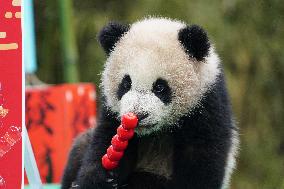
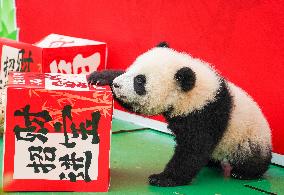
A giant panda cub is pictured during a group appearance event in celebration of the Spring Festival at the Shenshuping giant panda base of the China Conservation and Research Center for the Giant Panda in Wolong, southwest China's Sichuan Province, January 23, 2025. Twenty-five giant panda cubs were gathered at two breeding bases in southwest China's Sichuan Province on Thursday to send Spring Festival greetings to global audiences. All the cubs were born in 2024 -- 13 at the China Conservation and Research Center for the Giant Panda, and 12 at the Chengdu Research Base of Giant Panda Breeding. Photo by Xinhua/ABACAPRESS.COM

  •  
Giant Panda Cubs Presented for Spring Festival - China

Giant Panda Cubs Presented for Spring Festival - China

A giant panda cub is pictured during a group appearance event in celebration of the Spring Festival at the Shenshuping giant panda base of the China Conservation and Research Center for the Giant Panda in Wolong, southwest China's Sichuan Province, January 23, 2025. Twenty-five giant panda cubs were gathered at two breeding bases in southwest China's Sichuan Province on Thursday to send Spring Festival greetings to global audiences. All the cubs were born in 2024 -- 13 at the China Conservation and Research Center for the Giant Panda, and 12 at the Chengdu Research Base of Giant Panda Breeding. Photo by Xinhua/ABACAPRESS.COM

  •  
Giant Panda Cubs Presented for Spring Festival - China

Giant Panda Cubs Presented for Spring Festival - China

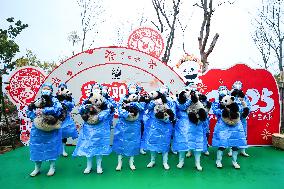
Staff members holding giant panda cubs pose for a group photo during a group appearance event in celebration of the Spring Festival at the Chengdu Research Base of Giant Panda Breeding in Chengdu, southwest China's Sichuan Province, January 23, 2025. Twenty-five giant panda cubs were gathered at two breeding bases in southwest China's Sichuan Province on Thursday to send Spring Festival greetings to global audiences. All the cubs were born in 2024 -- 13 at the China Conservation and Research Center for the Giant Panda, and 12 at the Chengdu Research Base of Giant Panda Breeding. Photo by Xinhua/ABACAPRESS.COM

  •  
Giant Panda Cubs Presented for Spring Festival - China

Giant Panda Cubs Presented for Spring Festival - China

Giant panda cubs are pictured during a group appearance event in celebration of the Spring Festival at the Shenshuping giant panda base of the China Conservation and Research Center for the Giant Panda in Wolong, southwest China's Sichuan Province, January 23, 2025. Twenty-five giant panda cubs were gathered at two breeding bases in southwest China's Sichuan Province on Thursday to send Spring Festival greetings to global audiences. All the cubs were born in 2024 -- 13 at the China Conservation and Research Center for the Giant Panda, and 12 at the Chengdu Research Base of Giant Panda Breeding. Photo by Xinhua/ABACAPRESS.COM

  •  
Giant Panda Cubs Presented for Spring Festival - China

Giant Panda Cubs Presented for Spring Festival - China

Staff members holding giant panda cubs pose for a group photo during a group appearance event in celebration of the Spring Festival at the Shenshuping giant panda base of the China Conservation and Research Center for the Giant Panda in Wolong, southwest China's Sichuan Province, January 23, 2025. Twenty-five giant panda cubs were gathered at two breeding bases in southwest China's Sichuan Province on Thursday to send Spring Festival greetings to global audiences. All the cubs were born in 2024 -- 13 at the China Conservation and Research Center for the Giant Panda, and 12 at the Chengdu Research Base of Giant Panda Breeding. Photo by Xinhua/ABACAPRESS.COM

  •  
Giant Panda Cubs Presented for Spring Festival - China

Giant Panda Cubs Presented for Spring Festival - China

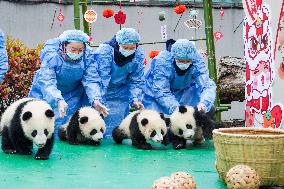
Giant panda cubs are pictured during a group appearance event in celebration of the Spring Festival at the Chengdu Research Base of Giant Panda Breeding in Chengdu, southwest China's Sichuan Province, January 23, 2025. Twenty-five giant panda cubs were gathered at two breeding bases in southwest China's Sichuan Province on Thursday to send Spring Festival greetings to global audiences. All the cubs were born in 2024 -- 13 at the China Conservation and Research Center for the Giant Panda, and 12 at the Chengdu Research Base of Giant Panda Breeding. Photo by Xinhua/ABACAPRESS.COM

  •  
Giant Panda Cubs Presented for Spring Festival - China

Giant Panda Cubs Presented for Spring Festival - China

A giant panda cub is pictured during a group appearance event in celebration of the Spring Festival at the Chengdu Research Base of Giant Panda Breeding in Chengdu, southwest China's Sichuan Province, January 23, 2025. Twenty-five giant panda cubs were gathered at two breeding bases in southwest China's Sichuan Province on Thursday to send Spring Festival greetings to global audiences. All the cubs were born in 2024 -- 13 at the China Conservation and Research Center for the Giant Panda, and 12 at the Chengdu Research Base of Giant Panda Breeding. Photo by Xinhua/ABACAPRESS.COM

  •  
Giant Panda Cubs Presented for Spring Festival - China

Giant Panda Cubs Presented for Spring Festival - China

A giant panda cub is pictured during a group appearance event in celebration of the Spring Festival at the Shenshuping giant panda base of the China Conservation and Research Center for the Giant Panda in Wolong, southwest China's Sichuan Province, January 23, 2025. Twenty-five giant panda cubs were gathered at two breeding bases in southwest China's Sichuan Province on Thursday to send Spring Festival greetings to global audiences. All the cubs were born in 2024 -- 13 at the China Conservation and Research Center for the Giant Panda, and 12 at the Chengdu Research Base of Giant Panda Breeding. Photo by Xinhua/ABACAPRESS.COM

  •  
Wild Elephant Rescue - China

Wild Elephant Rescue - China

Chen Jiming plays with an elephant calf at the Xishuangbanna Asian Elephant Breeding and Rescue Center in Xishuangbanna Dai Autonomous Prefecture, southwest China's Yunnan Province, December 8, 2024. TO GO WITH "Rescued wild elephant calf in SW China makes good recovery" Photo by Hu Chao/Xinhua/ABACAPRESS.COM

  •  
Wild Elephant Rescue - China

Wild Elephant Rescue - China

Mo Shiyu nurses an elephant calf at the Xishuangbanna Asian Elephant Breeding and Rescue Center in Xishuangbanna Dai Autonomous Prefecture, southwest China's Yunnan Province, December 8, 2024. TO GO WITH "Rescued wild elephant calf in SW China makes good recovery". Photo by Hu Chao/Xinhua/ABACAPRESS.COM

  •  
Wild Elephant Rescue - China

Wild Elephant Rescue - China

Chen Jiming (L) and Mo Shiyu give an elephant calf a physical examination at the Xishuangbanna Asian Elephant Breeding and Rescue Center in Xishuangbanna Dai Autonomous Prefecture, southwest China's Yunnan Province, December 8, 2024. TO GO WITH "Rescued wild elephant calf in SW China makes good recovery". Photo by Hu Chao/Xinhua/ABACAPRESS.COM

  •  
Panda Family in Macao - China

Panda Family in Macao - China

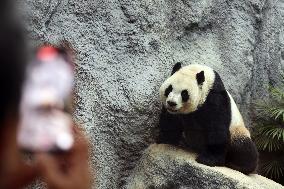
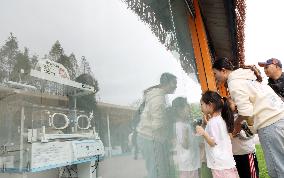
A tourist takes photos of giant panda Jianjian in Macao, south China, on November 20, 2024. A pair of giant pandas Kaikai and Xinxin were chosen from Chengdu Research Base of Giant Panda Breeding in southwest China's Sichuan Province as a gift of the central government to Macao Special Administrative Region in 2015. They gave birth to twin brothers Jianjian and Kangkang here in 2016. The panda family is now living a happy and leisured life. Photo by Wang Yiliang/Xinhua/ABACAPRESS.COM

  •  
Panda Family in Macao - China

Panda Family in Macao - China

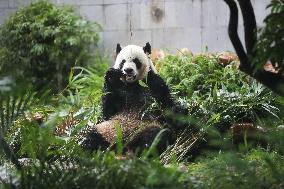
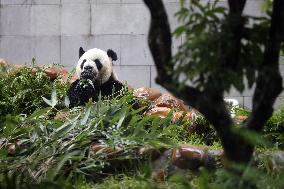
Giant panda Kaikai eats bamboo in Macao, south China, on November 20, 2024. A pair of giant pandas Kaikai and Xinxin were chosen from Chengdu Research Base of Giant Panda Breeding in southwest China's Sichuan Province as a gift of the central government to Macao Special Administrative Region in 2015. They gave birth to twin brothers Jianjian and Kangkang here in 2016. The panda family is now living a happy and leisured life. Photo by Wang Yiliang/Xinhua/ABACAPRESS.COM

  •  
Panda Family in Macao - China

Panda Family in Macao - China

A tourist takes photos of giant panda Jianjian in Macao, south China, on November 20, 2024. A pair of giant pandas Kaikai and Xinxin were chosen from Chengdu Research Base of Giant Panda Breeding in southwest China's Sichuan Province as a gift of the central government to Macao Special Administrative Region in 2015. They gave birth to twin brothers Jianjian and Kangkang here in 2016. The panda family is now living a happy and leisured life. Photo by Wang Yiliang/Xinhua/ABACAPRESS.COM

  •  
Panda Family in Macao - China

Panda Family in Macao - China

Giant panda Kaikai eats bamboo in Macao, south China, on November 20, 2024. A pair of giant pandas Kaikai and Xinxin were chosen from Chengdu Research Base of Giant Panda Breeding in southwest China's Sichuan Province as a gift of the central government to Macao Special Administrative Region in 2015. They gave birth to twin brothers Jianjian and Kangkang here in 2016. The panda family is now living a happy and leisured life. Photo by Wang Yiliang/Xinhua/ABACAPRESS.COM

  •  
Panda Family in Macao - China

Panda Family in Macao - China

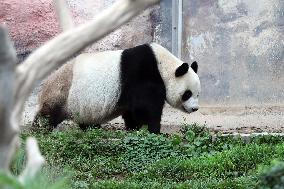
Giant panda Xinxin is pictured in Macao, south China, on November 20, 2024. A pair of giant pandas Kaikai and Xinxin were chosen from Chengdu Research Base of Giant Panda Breeding in southwest China's Sichuan Province as a gift of the central government to Macao Special Administrative Region in 2015. They gave birth to twin brothers Jianjian and Kangkang here in 2016. The panda family is now living a happy and leisured life. Photo by Wang Yiliang/Xinhua/ABACAPRESS.COM

  •  
Panda Family in Macao - China

Panda Family in Macao - China

Giant panda Kaikai eats bamboo in Macao, south China, on November 20, 2024. A pair of giant pandas Kaikai and Xinxin were chosen from Chengdu Research Base of Giant Panda Breeding in southwest China's Sichuan Province as a gift of the central government to Macao Special Administrative Region in 2015. They gave birth to twin brothers Jianjian and Kangkang here in 2016. The panda family is now living a happy and leisured life. Photo by Wang Yiliang/Xinhua/ABACAPRESS.COM

  •  
Panda Family in Macao - China

Panda Family in Macao - China

Children pose for a photo inside giant panda-shaped decorations in Macao, south China, on November 20, 2024. A pair of giant pandas Kaikai and Xinxin were chosen from Chengdu Research Base of Giant Panda Breeding in southwest China's Sichuan Province as a gift of the central government to Macao Special Administrative Region in 2015. They gave birth to twin brothers Jianjian and Kangkang here in 2016. The panda family is now living a happy and leisured life. Photo by Wang Yiliang/Xinhua/ABACAPRESS.COM

  •  
An Animal Theme Park in Chongqing

An Animal Theme Park in Chongqing

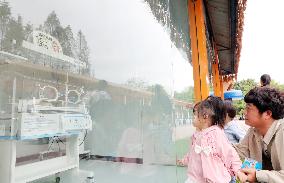
CHONGQING, CHINA - OCTOBER 3, 2024 - Visitors and children observe the behavior of a baby African lion in the breeding room of an animal theme park in Chongqing, China, October 3, 2024.

  •  
An Animal Theme Park in Chongqing

An Animal Theme Park in Chongqing

CHONGQING, CHINA - OCTOBER 3, 2024 - Visitors and children observe the behavior of a baby African lion in the breeding room of an animal theme park in Chongqing, China, October 3, 2024.

  •  
An Animal Theme Park in Chongqing

An Animal Theme Park in Chongqing

CHONGQING, CHINA - OCTOBER 3, 2024 - Visitors and children observe the behavior of a baby African lion in the breeding room of an animal theme park in Chongqing, China, October 3, 2024.

  •  

China: Swarms Of Mayflies Cluster Around Bridge In Changde, Hunan

On September 1, 2024, in Changde, a city in Hunan Province in central China, a video captured a swarm of moths clustering around the Yuanshui Bridge on a dark night. According to local media reports, this is the nuptial flight during the mayfly breeding season, with large numbers of mayflies gathering on the bridge where there are lights, creating a snow-like spectacle. Insect carcasses piled up on the bridge up to 5 centimeters deep, and traffic on the bridge was paralyzed for a while due to slippery road surface. The local agricultural department introduced mayflies as a kind of beneficial insects, which belong to a link of the biological chain of the lake zone. Their massive appearance indicates that the ecological environment of local waters continues to improve.

  • Main
  • Top
  • Editorial
  • Creative
  • About Us
  • About ILG
  • Terms of use
  • Company
  • BEHIND
  • Price List
  • Single Plan
  • Monthly Plan
  • Services
  • Shooting
  • Rights Clearance
  • Support
  • FAQ
  • How To Buy
  • Contact Us
  • Become a Partner

© KYODO NEWS IMAGES INC

All Rights Reserved.

  • Editorial
  • Olympics
  • News
  • Sports
  • Japan
  • Tech
  • Royal
  • Disaster
  • NorthKorea
  • Old Japan
  • SNS

  • Creative
  • Food
  • Japan
  • Landscape
  • Animal
  • Popular
  • #Ukraine
  • #Russia
  • #coronavirus
  • #N. Korea
  • #China
  • #Thailand
  • #Ukraine
  • #Russia
  • #coronavirus
  • #N. Korea
  • #China
  • #Thailand
  • Food
  • Japan
  • Landscape
  • Animal
  • Olympics
  • News
  • Sports
  • Japan
  • Tech
  • Royal
  • Disaster
  • NorthKorea
  • Old Japan
  • SNS