•  
Satellite View of Graham Land - Antarctica

Satellite View of Graham Land - Antarctica

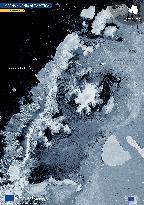
Handout Satellite views dated on November 21, 2025, shows Graham Land. Graham Land, the northernmost stretch of the Antarctic Peninsula, is one of the most rapidly warming regions on Earth. Its mountainous spine and outlet glaciers drain into the Weddell Sea, forming an important transition zone between grounded ice, floating shelves, and open water. This dynamic landscape supports rich marine ecosystems, including krill-dependent species such as seals, penguins, and seabirds, and plays an important role in global ocean circulation and climate regulation. This Copernicus Sentinel-1 image, acquired on 21 November 2025, shows the contrasting textures of grounded ice, fragmented sea ice, and dark, open ocean, revealing key glaciological features in radar backscatter. Copernicus data is essential to climate science. A recent study published in Nature used Copernicus Sentinel-1 and Sentinel-2 data to analyse glacier dynamics in Graham Land, Antarctica. Photo by European Union, Copernicus Sentinel-1 imagery via ABA

  •  
Illustration - Surtourisme

Illustration - Surtourisme

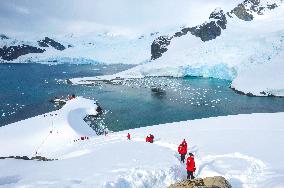
ANTARCTIQUE. PARADISE BAY. CHAQUE JOUR, LES PASSAGERS DU BATEAU DE CROISIERE L'AUSTRAL (COMPAGNIE DU PONANT) EFFECTUENT UNE OU DEUX SORTIES SELON LA METEO. ICI RANDONNEE A PARADISE BAY Photo by Antoine Lorgnier/Only World/ABACAPRESS.COM

  •  
Glacial forces at the edge of Antarctica

Glacial forces at the edge of Antarctica

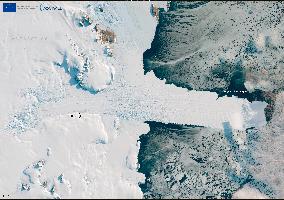
Handout photo show Copernicus Sentinel-2 image, acquired on 17 March 2025, shows the flow of the David Glacier as it feeds into the Drygalski Ice Tongue in East Antarctica. Stretching 90 km into the Ross Sea, the ice tongue is one of the largest floating ice extensions in Antarctica. The linear structure of the ice tongue reveals its dynamic forward movement over time, shaped by internal flow and ocean interaction. Ice tongues like this change in size and shape over time, reshaped by calving events, waves and storms. Copernicus delivers key data for tracking glacier dynamics and calving events in remote areas. Regular monitoring supports climate research, helping scientists assess how Antarctic ice loss contributes to global sea-level rise. Drygalski Ice Tongue, Antartica on March 17, 2025. Photo by European Union, Copernicus Sentinel-2 imagery via ABACAPRESS.COM

  • Main
  • Top
  • Editorial
  • Creative
  • About Us
  • About ILG
  • Terms of use
  • Company
  • BEHIND
  • Price List
  • Single Plan
  • Monthly Plan
  • Services
  • Shooting
  • Rights Clearance
  • Support
  • FAQ
  • How To Buy
  • Contact Us
  • Become a Partner

© KYODO NEWS IMAGES INC

All Rights Reserved.

  • Editorial
  • Olympics
  • News
  • Sports
  • Japan
  • Tech
  • Royal
  • Disaster
  • NorthKorea
  • Old Japan
  • SNS
  • Creative
  • Food
  • Japan
  • Landscape
  • Animal
  • Popular
  • #Ukraine
  • #Russia
  • #coronavirus
  • #N. Korea
  • #China
  • #Thailand
  • #Ukraine
  • #Russia
  • #coronavirus
  • #N. Korea
  • #China
  • #Thailand
  • Food
  • Japan
  • Landscape
  • Animal
  • Olympics
  • News
  • Sports
  • Japan
  • Tech
  • Royal
  • Disaster
  • NorthKorea
  • Old Japan
  • SNS