•  
Major Chinese pharmaceutical company expands into Japan

Major Chinese pharmaceutical company expands into Japan

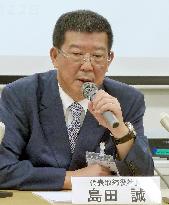
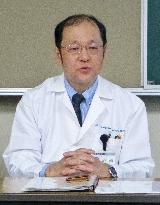
NAGOYA, Japan - Hengrui Medicine Japan President Makoto Shimada attends a press conference in Nagoya, Japan, on July 22, 2014. Major Chinese drugmaker Jiangsu Hengrui Medicine Co. said that day it has established a Japanese subsidiary in Nagoya to sell anticancer drugs in Japan.

  •  
Anticancer sake festival held at Nara temple

Anticancer sake festival held at Nara temple

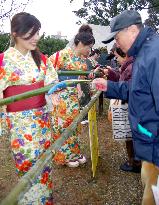
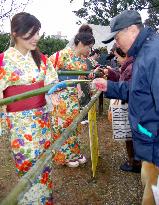
NARA, Japan - Women in kimono, each holding a 1-meter-long bamboo tube, serve hot sake to visitors at a festival to pray for cancer prevention at Daianji Temple in the city of Nara on Jan. 23. Sake is first poured into the bamboo tube and heated with fire before being given to visitors in the ''Sasazake Matsuri'' (bamboo leaf sake festival), which dates back to the eighth century.

  •  
Death toll from anticancer drug rises to over 100 in Japan

Death toll from anticancer drug rises to over 100 in Japan

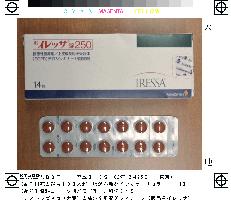
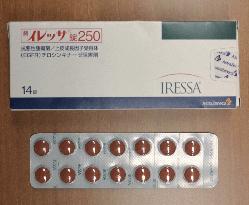
TOKYO, Japan - Nearly 500 people experienced debilitating side effects from an anticancer British-made drug called Iressa (in file photo), resulting in more than 100 deaths in Japan, the Ministry of Health, Labor and Welfare said Dec. 25. As of Dec. 13, of the 358 people who experienced side effects such as pneumonia and lung damage, 114 died, the ministry said.

  •  
Gov't warns of fatal cases involving anticancer drug gefitinib

Gov't warns of fatal cases involving anticancer drug gefitinib

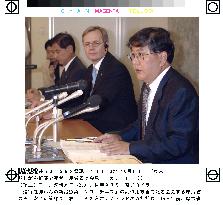
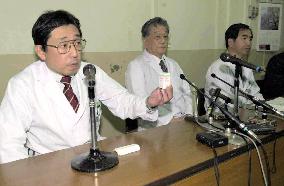
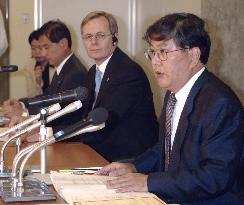
TOKYO, Japan - Ministry of Health, Labor and Welfare officials speak at a news conference in Tokyo on Oct. 15. They said the ministry has confirmed 26 cases of debilitating side effects from the use of anticancer drug gefitinib, and attributed 13 deaths to it.

  •  
Osaka_RedCross_Hospital-Press_Conference

Osaka_RedCross_Hospital-Press_Conference

Osaka Red Cross - Press Conference : March 10, 2000 (March 11, 2000) Police on Saturday raided the Osaka Red Cross Hospital over the death last year of a cancer patient who was accidentally given an incorrect dosage of an anticancer agent. The hospital in Osaka's Tennoji Ward is accused of professional negligence resulting in death. Following the instructions of a 27-year-old male intern who was the patient's attending physician, a nurse administered 80 milligrams of an anticancer agent intravenously to the patient on the morning on Dec. 27 last year, investigators said. By the evening of the same day, the 63-year-old patient was suffering stomach pains, diarrhea and other side affects. He died of multiple organ failure on Jan. 13, the investigators said. The doctor had intended the patient to receive 10 mg of an anticancer agent but accidentally prescribed a different agent and gave incorrect guidance to the nurse on the adequate dosage, the investigators said.

  •  
Researchers report positive results in use of virus for cancer therapy

Researchers report positive results in use of virus for cancer therapy

Toshiyoshi Fujiwara, professor at Okayama University, explains at a press conference on April 10, 2015, in Okayama, western Japan, about findings from his team's clinical study on a new treatment method combining the injection of an anticancer virus solution and radiation therapy. Cancer cells in five of the seven patients involved with esophageal cancer were found to have either reduced in size or completely disappeared after the treatment. (Kyodo) ==Kyodo

  •  
Japan fails to toughen passive smoking ban due to resistance

Japan fails to toughen passive smoking ban due to resistance

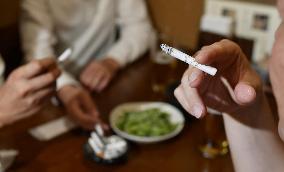
The Japanese government failed to toughen a passive smoking ban as part of its new anticancer program, approved by the Cabinet on Oct. 24, 2017, as the ruling Liberal Democratic Party failed to provide support due to pressure from industries set to be affected by the measure. (Kyodo) ==Kyodo

  •  
Kyushu Univ. unveils gear for automatic blending of anticancer drugs

Kyushu Univ. unveils gear for automatic blending of anticancer drugs

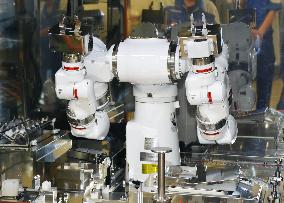
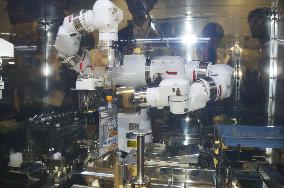
A robotic-arm device developed by Kyushu University and two Japanese companies is shown to the press on Oct. 15, 2015, in Fukuoka, southwestern Japan. Developed with industrial robot maker Yaskawa Electric Corp. and medical equipment manufacturer Nikka Micron Co., the device is the world's first of its kind that is capable of completing the entire unmanned process of automatically blending and bottling anticancer drugs, according to the national university. (Kyodo) ==Kyodo

  •  
Kyushu Univ. unveils gear for automatic blending of anticancer drugs

Kyushu Univ. unveils gear for automatic blending of anticancer drugs

A robotic-armed device developed by Kyushu University and two Japanese companies is shown to the press on Oct. 15, 2015, in Fukuoka, southwestern Japan. Developed with industrial robot maker Yaskawa Electric Corp. and medical equipment manufacturer Nikka Micron Co., the device is the world's first of its kind that is capable of completing the entire unmanned process of automatically blending and bottling anticancer drugs, according to the national university. (Kyodo) ==Kyodo

  •  
Anticancer sake festival held at Nara temple

Anticancer sake festival held at Nara temple

NARA, Japan - Women in kimono, each holding a 1-meter-long bamboo tube, serve hot sake to visitors at a festival to pray for cancer prevention at Daianji Temple in the city of Nara on Jan. 23. Sake is first poured into the bamboo tube and heated with fire before being given to visitors in the ''Sasazake Matsuri'' (bamboo leaf sake festival), which dates back to the eighth century. (Kyodo)

  •  
Takeda Pharmaceutical CEO Christophe Weber

Takeda Pharmaceutical CEO Christophe Weber

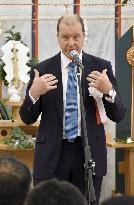
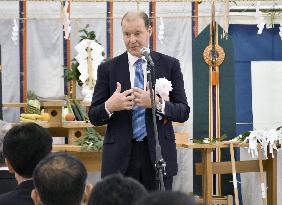
Christophe Weber, president and CEO of Takeda Pharmaceutical Co., speaks in Osaka on May 28, 2019. The Japanese company will build a new facility to ramp up production of an anticancer drug at its plant in Osaka. (Kyodo) ==Kyodo

  •  
Takeda Pharmaceutical CEO Christophe Weber

Takeda Pharmaceutical CEO Christophe Weber

Christophe Weber, president and CEO of Takeda Pharmaceutical Co., speaks in Osaka on May 28, 2019. The Japanese company will build a new facility to ramp up production of an anticancer drug at its plant in Osaka. (Kyodo) ==Kyodo

  •  
Japan's Honjo wins Nobel medicine prize for work on anticancer care

Japan's Honjo wins Nobel medicine prize for work on anticancer care

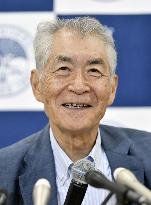
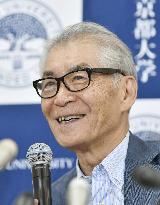
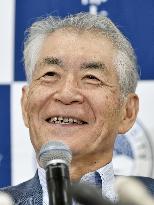
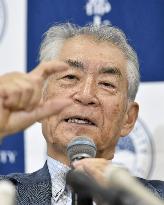
Tasuku Honjo, a 76-year-old professor emeritus at Kyoto University and the year's joint winner of the Nobel Prize in physiology or medicine, meets the press in Kyoto on Oct. 1, 2018, following the announcement by the Karolinska Institute earlier in the day. (Kyodo) ==Kyodo

  •  
Japan's Honjo wins Nobel medicine prize for work on anticancer care

Japan's Honjo wins Nobel medicine prize for work on anticancer care

Tasuku Honjo, a 76-year-old professor emeritus at Kyoto University and the year's joint winner of the Nobel Prize in physiology or medicine, meets the press in Kyoto on Oct. 1, 2018, following the announcement by the Karolinska Institute earlier in the day. (Kyodo) ==Kyodo

  •  
Japan's Honjo wins Nobel medicine prize for work on anticancer care

Japan's Honjo wins Nobel medicine prize for work on anticancer care

Tasuku Honjo, a 76-year-old professor emeritus at Kyoto University and the year's joint winner of the Nobel Prize in physiology or medicine, meets the press in Kyoto on Oct. 1, 2018, following the announcement by the Karolinska Institute earlier in the day. (Kyodo) ==Kyodo

  •  
Japan's Honjo wins Nobel medicine prize for work on anticancer care

Japan's Honjo wins Nobel medicine prize for work on anticancer care

Tasuku Honjo, a 76-year-old professor emeritus at Kyoto University and the year's joint winner of the Nobel Prize in physiology or medicine, meets the press in Kyoto on Oct. 1, 2018, following the announcement by the Karolinska Institute earlier in the day. (Kyodo) ==Kyodo

  •  
Death toll from anticancer drug rises to over 100 in Japan

Death toll from anticancer drug rises to over 100 in Japan

TOKYO, Japan - Nearly 500 people experienced debilitating side effects from an anticancer British-made drug called Iressa (in file photo), resulting in more than 100 deaths in Japan, the Ministry of Health, Labor and Welfare said Dec. 25. As of Dec. 13, of the 358 people who experienced side effects such as pneumonia and lung damage, 114 died, the ministry said. (Kyodo)

  •  
Gov't warns of fatal cases involving anticancer drug gefitinib

Gov't warns of fatal cases involving anticancer drug gefitinib

TOKYO, Japan - Ministry of Health, Labor and Welfare officials speak at a news conference in Tokyo on Oct. 15. They said the ministry has confirmed 26 cases of debilitating side effects from the use of anticancer drug gefitinib, and attributed 13 deaths to it. (Kyodo)

  • Main
  • Top
  • Editorial
  • Creative
  • About Us
  • About ILG
  • Terms of use
  • Company
  • BEHIND
  • Price List
  • Single Plan
  • Monthly Plan
  • Services
  • Shooting
  • Rights Clearance
  • Support
  • FAQ
  • How To Buy
  • Contact Us
  • Become a Partner

© KYODO NEWS IMAGES INC

All Rights Reserved.

  • Editorial
  • Olympics
  • News
  • Sports
  • Japan
  • Tech
  • Royal
  • Disaster
  • NorthKorea
  • Old Japan
  • SNS
  • Creative
  • Food
  • Japan
  • Landscape
  • Animal
  • Popular
  • #Ukraine
  • #China
  • #coronavirus
  • #N. Korea
  • #Russia
  • #Thailand
  • #Ukraine
  • #China
  • #coronavirus
  • #N. Korea
  • #Russia
  • #Thailand
  • Food
  • Japan
  • Landscape
  • Animal
  • Olympics
  • News
  • Sports
  • Japan
  • Tech
  • Royal
  • Disaster
  • NorthKorea
  • Old Japan
  • SNS