•  
Komazawa Univ. wins 1st day of Tokyo-Hakone ekiden

Komazawa Univ. wins 1st day of Tokyo-Hakone ekiden

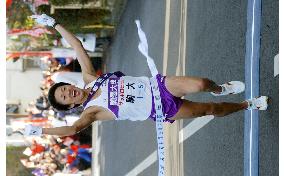
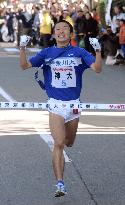
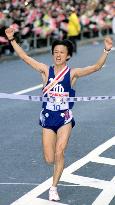
HAKONE, Japan - Komazawa University anchor Kazuharu Murakami throws up arms in joy as he crosses the finish line to lead his team to victory on the first day of the Tokyo-Hakone collegiate ekiden road relay on Jan. 2. Komazawa, which is seeking its third straight overall victory, finished the 107.2-kilometer course from Tokyo's Otemachi to Lake Ashinoko in the hot-springs resort of Hakone in 5 hours, 34 minutes, 34 seconds to claim its first opening day win in four years.

  •  
Kanagawa Univ. wins 1st day of Tokyo-Hakone ekiden relay

Kanagawa Univ. wins 1st day of Tokyo-Hakone ekiden relay

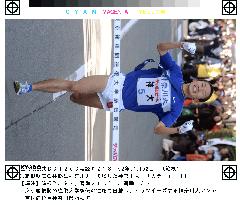
HAKONE, Japan - Shogo Yoshimura of Kanagawa University, running the final section of the 107.2-km Tokyo-Hakone collegiate ekiden road relay, cuts the tape at Lake Ashinoko on Jan. 2 to give his team a first-day victory. Yoshimura turned a deficit of 1:13 into a 23-second advantage for his university at the start of the return trip to Tokyo on Jan. 3, which will decide the overall winner of the annual New Year event.

  •  
Juntendo University wins Tokyo-Hakone relay

Juntendo University wins Tokyo-Hakone relay

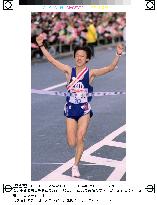
TOKYO, Japan - Anchor Nobuhito Miyazaki cuts the tape as Juntendo University won its 10th championship in the Tokyo-Hakone collegiate ekiden road relay Jan. 3. The five Juntendo runners completed the 109.2-kilometer relay from Lake Ashinoko in Kanagawa Prefecture to Tokyo's Otemachi business district in 5 hours, 30 minutes and 57 seconds to win the two-day event with a total time of 11:14:05. Defending champion Komazawa University came in second at 11:17:00 while Chuo University, which won the outward leg of the competition Jan. 2, finished third at 11:19:17.

  •  
Chuo relay team wins 1st half of Tokyo-Hakone ekiden

Chuo relay team wins 1st half of Tokyo-Hakone ekiden

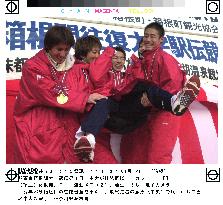
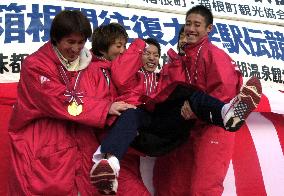
HAKONE, Japan - Members of Chuo University's road relay team give anchor Masakazu Fujiwara (C) a victory toss Jan. 2 after the Tokyo school posted an eight-second victory in the first half of the Tokyo-Hakone collegiate ekiden. Chuo posted a time of 5:43:00 over 107.2 kilometers from Tokyo's Otemachi business district to Lake Ashinoko in Kanagawa Prefecture for its first victory in 37 years in the New Year event.

  •  
Tang, Kono go on a boat excursion on scenic Lake Ashinoko

Tang, Kono go on a boat excursion on scenic Lake Ashinoko

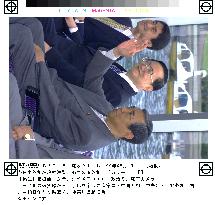
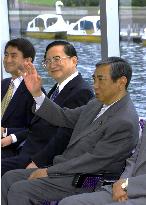
HAKONE, Japan - Visiting Chinese Foreign Minister Tang Jiaxuan went on a boat excursion May 13 on scenic Lake Ashinoko in Hakone, Kanagawa Prefecture, west of Tokyo, with Japanese Foreign Minister Yohei Kono, before returning home later in the day. Photo shows Kono (R) and Tang (C) in the boat's cabin.

  •  
Kanagawa Univ. wins 1st day of Tokyo-Hakone ekiden relay

Kanagawa Univ. wins 1st day of Tokyo-Hakone ekiden relay

HAKONE, Japan - Shogo Yoshimura of Kanagawa University, running the final section of the 107.2-km Tokyo-Hakone collegiate ekiden road relay, cuts the tape at Lake Ashinoko on Jan. 2 to give his team a first-day victory. Yoshimura turned a deficit of 1:13 into a 23-second advantage for his university at the start of the return trip to Tokyo on Jan. 3, which will decide the overall winner of the annual New Year event.

  •  
Old town by lake ashinoko

Old town by lake ashinoko

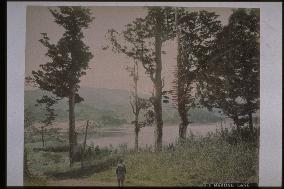
Scene near the entrance of the cedar tree boulevard by Ashino Lake. A telephone pole is seen in the picture. Telecommunications came to Hakone post office only in July 1881, so the photo was taken after that. If this is an electric pole, the date of the photo goes back to 1912.==Date:unknown, Place:Hakone, Photo:Ogawa Kazumasa, (Credit:Nagasaki University Library/Kyodo News Images) [Cabinet Number7‐23‐0]

  •  
Mt. Fuji in the morning seen from Lake Ashi

Mt. Fuji in the morning seen from Lake Ashi

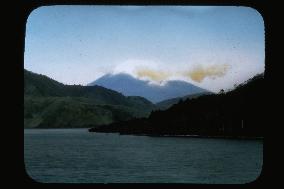
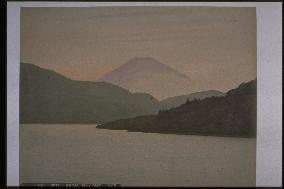
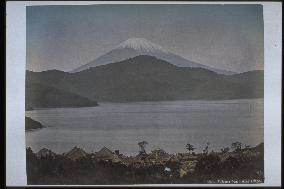
This is Mt. Fuji as veiwed from Moto-Hakone by Lake Ashinoko. The dark forest on the right is Hakone Shrine precincts. This site was called Hakone Gongen before the Japanese government instituted a policy in 1868 separating Buddhism and Shinto. The name Hakone Gongen appears in many ancient tales such as the Tale of The Soga written in the Kamakura Period. The mountain on the left is the foot of Mt. Mikuni, one of the outer moutain range of Hakone. This scene of Mt. Fuji behind the lake and the mountains is famous.==Date:unknown, Place:Hakone, Photo:unknown, (Credit:Nagasaki University Library/Kyodo News Images) [Cabinet Number98‐44‐0]

  •  
Lake Ashi

Lake Ashi

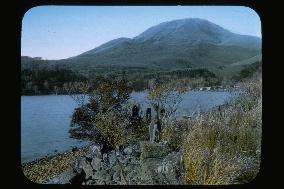
This photo captures the old town of Motohakone, with Mt. Komagadake viewed from Sainogahara by Lake Ashinoko. It is known that Sainogahara had many stone towers and stone Buddhas druing the Edo Period according to Tokaido Hakone Sanchu-zu (Ukiyoe; Color woodblock print of Hakone's everyday life in Edo period by Gountei Sadahide, 1863). This photo was taken after 1868 when Haibutsukishaku (anti-Buddhist movement at the beginning of the Meiji era) took place and many stones were destroyed or broken .==Date:unknown, Place:Hakone, Photo:unknown, (Credit:Nagasaki University Library/Kyodo News Images) [Cabinet Number98‐32‐0]

  •  
The torii gate on the approach to Hakone Shrine

The torii gate on the approach to Hakone Shrine

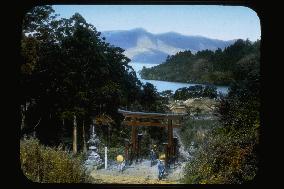
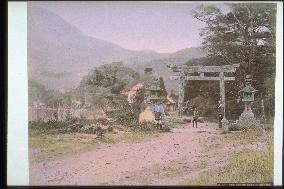
This is the Byobu Torii Gate located at the intersection of present-day National Route 1 after going down Gongen Slope after walking up the old Hakone Highway from the post town of Hata area. This site was very popular because Lake Ashinoko and the village of Moto-Hakone could be seen as well as the traffic hub. Many photos taken here remain.==Date:unknown, Place:Hakone, Photo:unknown, (Credit:Nagasaki University Library/Kyodo News Images) [Cabinet Number98‐16‐0]

  •  
The shore of Lake Ashi

The shore of Lake Ashi

This is not Lake Ashinoko, but Gora Park opened in August, 1914 as viewed from its fountain pond. The park was built as the central development project of the Gora area by Odawara Electric Railway (present day Hakone Tozan Railway). The park was designed by Shichigoro Ishhiki and is known as the first rock garden in the French style. The mountain behind the forest is Mt. Sounzan.==Date:unknown, Place:Hakone, Photo:unknown, (Credit:Nagasaki University Library/Kyodo News Images) [Cabinet Number96‐9‐0]

  •  
Lake Ashi

Lake Ashi

The Hakone Imperial Villa is visible on top of the hill of Dogashima. It was built in 1886 as a villa for Emperor Meiji. This site had been called Dogashima (Dogashima- the island of tower) because there was a tower at the Hakone Gongen Shrine in the ancient times. The imperial villa was built because this is the best location to see the inverted reflection of Fuji on the furface of Lake Ashinoko. Also, this site is close enough to Tokyo to avoid the summer heat. This site is now named Onshi Hakone Park.==Date:unknown, Place:Hakone, Photo:unknown, (Credit:Nagasaki University Library/Kyodo News Images) [Cabinet Number89‐6‐0]

  •  
Lake Ashi

Lake Ashi

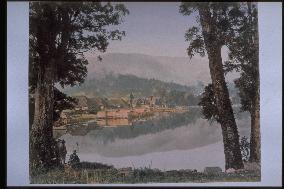
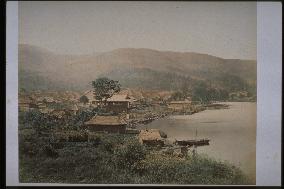
This is the post town of Hakone, with Lake Ashinoko, as seen from what was once Hakone barrier station. As the power lines installed in 1873 from Tokyo to Nagasaki are visible, this photo must have been taken after that. The thatched roofs of honjin are seen. The round, wooded mountain is Mt. Hatabiki. Behind it is Mt. Kurakake which is a part of the outer mountain range of Hakone. A child is looking at the lake.==Date:unknown, Place:Hakone, Photo:Tamamura Kozaburo, (Credit:Nagasaki University Library/Kyodo News Images) [Cabinet Number80‐17‐0]

  •  
Mt. Fuji seen from Lake Ashi

Mt. Fuji seen from Lake Ashi

This photo has almost the same composition as that of catalogue #5080. It captures Mt. Fuji viewed from Motohakone on Lake Ashinoko. It gives the impression of the mountain emerging from the sunset. The compositon with the lake in the foreground, the forest of Hakone Shrine on the right, the foot of Mt. Mikuni on the left, and the cone-shaped Mt. Fuji is known as a scene representative of Hakone.==Date:unknown, Place:Hakone, Photo:Tamamura Kozaburo, (Credit:Nagasaki University Library/Kyodo News Images) [Cabinet Number80‐15‐0]

  •  
Lake Ashi

Lake Ashi

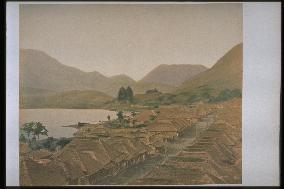
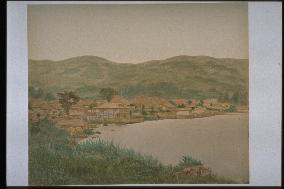
This is the post town of Hakone as seen from what was once the Hakone barrier station. The buildings on the banks of Lake Ashinoko are part of the thatched roofed building complex, the honjin. The large structures with thatched roofs to the right are officially appointed inns (Honjin). Feudal lords stayed or rested here during the Sankinkoutai (A bi-annual period of madatory alternate residence in Edo for feudal lords, known as Daimyo). The mountain in the background is Mt. Kurakake. There appear to be craftsmen looking at the lake in the foreground.==Date:unknown, Place:Hakone, Photo:R. Stillfried, (Credit:Nagasaki University Library/Kyodo News Images) [Cabinet Number77‐17‐0]

  •  
The Hakone Road

The Hakone Road

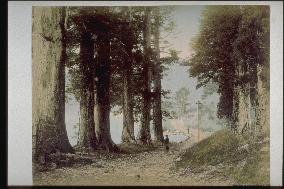
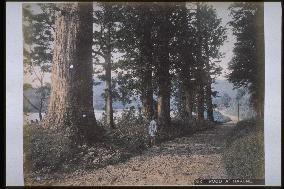
This is the old Hakone Highway near Ichinotorii gate at Moto-Hakone, and the cedar trees. The elctric pole is for the telegraph which opened between Tokyo and Nagasaki in 1873. Since the electric line was placed along the Tokaido Highway during the Edo Period, it is visible at Hakone Hachiri in the Old Tokaido Highway. Lake Ashinoko and Hakone Shrine can be seen between the trees. This photo was taken after 1873.==Date:unknown, Place:Hakone, Photo:Tamamura Kozaburo, (Credit:Nagasaki University Library/Kyodo News Images) [Cabinet Number68‐5‐0]

  •  
The Hakone post town

The Hakone post town

This is the post town of Hakone viewed from Mishima-cho when facing Odawara-cho. Since the telegraph pole placed between Tokyo and Nagasaki in 1873 is visible, and the Hakone Imperial Villa at Dogashima by Lake Ashinoko in 1886 cannot be seen, this photo is assumed to have been taken between those periods. The post town of Hakone has not changed since the Edo Period.==Date:unknown, Place:Hakone, Photo:Usui Shuzaburo?, (Credit:Nagasaki University Library/Kyodo News Images) [Cabinet Number65‐19‐0]

  •  
The Hakone post town

The Hakone post town

This photo depicts the post town of Hakone viewed from around the old Hakone check point site. The two-storied house behind the tree in the centre is Hatago Hafuya (present-day Hokone Hotel), an inn for commoners. The huge thatched roofed houses behind are, Kawada Honjin, an officially appointed inn for feudal lords, Koma Honjin, Ishiuchi Honjin, and Amano Heizaemon Honjin. Compared to catalogue # 2945, the backyards of honjins appear to be sticking out to Lake Ashinoko. The mountain behind on the left is Mt. Kurakake and the one in the centre is Hakone Pass.==Date:unknown, Place:Hakone, Photo:unknown, (Credit:Nagasaki University Library/Kyodo News Images) [Cabinet Number64‐46‐0]

  •  
Mt. Fuji seen from Lake Ashi

Mt. Fuji seen from Lake Ashi

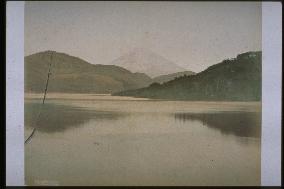
The compositon of the photo is almost the same as that of catalogue #5080 and #4147. It captures Mt. Fuji viewed from Motohakone by Lake Ashinoko. The compositon with the lake in the foreground, the forest of Hakone Shrine on the right, the foot of Mt. Mikuni on the left, and the cone-shaped Mt. Fuji is known as a scene representative of Hakone. One difference from the other photos is that here Mt. Fuji is reflected on the surface of the lake.==Date:unknown, Place:Hakone, Photo:unknown, (Credit:Nagasaki University Library/Kyodo News Images) [Cabinet Number64‐47‐0]

  •  
A woman holding a doll

A woman holding a doll

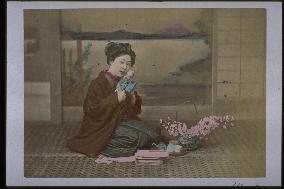
The shape of Mt. Fuji in the background suggests that this is a scene near Lake Ashinoko. The colouring of the cherry blossoms, bamboo basket and books near the knee of this woman, as well as fence and Mt. Fuji, is amateurish. Two different people seem to have applied the colours.==Date:unknown, Place:unknown, Photo:unknown, (Credit:Nagasaki University Library/Kyodo News Images) [Cabinet Number64‐12‐0]

  •  
Lake Ashi seen from Hakone Shrine

Lake Ashi seen from Hakone Shrine

This is a byobu torii gate located at a crossing at present-day National route 1 after going down Gongen Slope after going up the Old Hakone Highway from the post town of Hata. This is a scenic point where Lake Ashinoko and the village of Moto-Hakone can be seen as well as the traffic hub. There seemed to have been teahouses and there are many photos taken at this location. One of the reasons for that is because the photography equipment was quite heavy those days and many photos were taken at the resting spots.==Date:unknown, Place:Hakone, Photo:unknown, (Credit:Nagasaki University Library/Kyodo News Images) [Cabinet Number59‐64‐0]

  •  
Hakone Shrine

Hakone Shrine

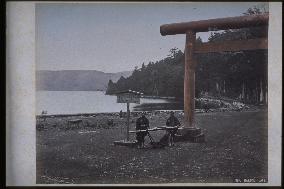
This is a photo with the Second Torii Gate of Hakone Shrine and the palanquin men. Although the sign board is on the right side of the gate in the picture painted by Kiyochika Kobayashi in 1880, it is moved to the left of the gate. Two iron pots made during the Kamakura Period to thank gods (Designated Important Cultural Asset) were moved to the main hall of the shrine and not visible on this photo. Lake Ashinoko can be seen behind.==Date:unknown, Place:Hakone, Photo:unknown, (Credit:Nagasaki University Library/Kyodo News Images) [Cabinet Number59‐53‐0]

  •  
Mt. Fuji seen from the Hakone post town

Mt. Fuji seen from the Hakone post town

This photo captures Mt. Fuji with Lake Ashinoko and the post town of Hakone in the foreground. The two-storied house with a gentle sloped roof in the centre is Hafuya (present-day Hakone Hotel), the pyramid shaped roofs on the left of it are, from the right, Matahara, Kawada, Koma, and Ishiuchi Honjins (officially appointed inns for feudal lords). The peninsulas on the left sticking out to the lake are, from the foreground, Hatabikiyama, Mikuniyama, and Nagao Pass just before Mt. Fuji can be seen.==Date:unknown, Place:Hakone, Photo:unknown, (Credit:Nagasaki University Library/Kyodo News Images) [Cabinet Number59‐46‐0]

  •  
Lake Ashi

Lake Ashi

This is the post town of Hakone as seen from what was once the Hakone barrier station. The two-storied building projecting into Lake Ashinoko is the Hafuya Inn (present day Hakone Hotel). The large structures with thatched roofs to its right are officially appointed inns (Honjin) for the feudal lords (Daimyo) and other noblemen. They are from the left, Kawada Honjin, Koma Honjin, Ishiuchi Honjin, and Amano Heizaemon Honjin. The mountain on the left is Mt. Kurakake, and Hakone Pass is located to the right.==Date:unknown, Place:Hakone, Photo:unknown, (Credit:Nagasaki University Library/Kyodo News Images) [Cabinet Number59‐34‐2]

  •  
Moto-Hakone Park

Moto-Hakone Park

The first stone torii gate of Hakone Shrine. The present gate is wood and painted red. This is the crossing of the approach to the shrine and the old Tokaido Highway (present-day National Route 1). The telegraph lines installed between Tokyo and Nagasaki in 1873 are not visible. Hence, this photo was taken prior to that. The all-night light has been transferred to the third torii gate. Lake Ashinoko and Komagadake Mountain are on the left. Three workers are posing for the photo.==Date:unknown, Place:Hakone, Photo:unknown, (Credit:Nagasaki University Library/Kyodo News Images) [Cabinet Number51‐164‐0]

  •  
Lake Ashi

Lake Ashi

This photo captures Lake Ashinoko, Dogashima, and Mt. Fuji viewed from Tomi-bansho (lookout station) of Hakone barrier station. If the Imperial Villa on the peninsula projecting in the lake on the right side of the photo can be seen, it was taken after 1886. However, it is outside of the photo, and therefore, cannot be verified. The triangular mountain before Mt. Fuji is Mt. Mikuni (alt. 1,102m), one of the outer mountain range of Hakone.==Date:unknown, Place:Hakone, Photo:unknown, (Credit:Nagasaki University Library/Kyodo News Images) [Cabinet Number47‐19‐0]

  •  
The approach to Hakone Shrine

The approach to Hakone Shrine

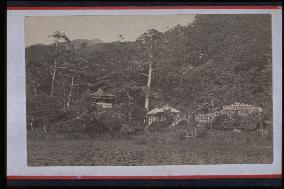
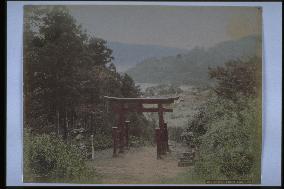
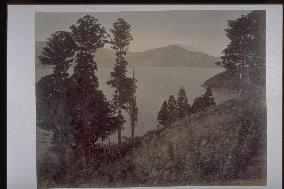
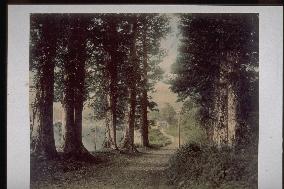
This is the shrine approach going down toward Lake Ashinoko viewed from the main building of Hakone Shrine. There are many cedar trees in the area just as the cedars line along the approach as well as Yatateno-sugi and Anzan-sugi in the shrine precincts and Sakasa-sugi by the Lake Ashinoko. The late afternoon sun is hitting the approach. Two workers are visible.==Date:unknown, Place:Hakone, Photo:unknown, (Credit:Nagasaki University Library/Kyodo News Images) [Cabinet Number47‐17‐0]

  •  
The approach to Hakone Shrine

The approach to Hakone Shrine

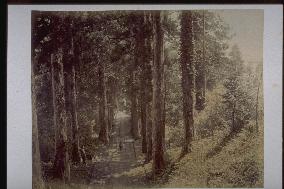
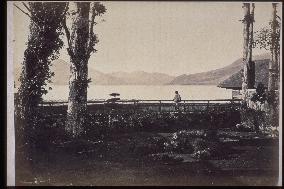
The Ichino Torii Gate (the First Gate) of Hakone Shrine ca be seen at the end of the street. The shrine approach begins from the gate. This street is Tokaido Highway (present-day National Route 1) where ceder trees line along. Since the telegraoh pole is present, this photo must have been taken after 1873 when the line was placed between Tokyo and Nagasaki. The lake visible among the trees is Ashinoko and Hakone Shrine is behind it.==Date:unknown, Place:Hakone, Photo:unknown, (Credit:Nagasaki University Library/Kyodo News Images) [Cabinet Number47‐16‐0]

  •  
Sunset glow in lake ashinoko

Sunset glow in lake ashinoko

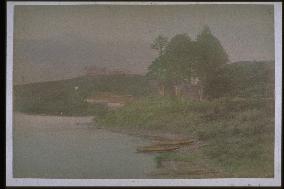
A view to the west from Mishimacho of Hakonejuku. Although not clear in this picture, it is a scenic spot where Mt. Fuji can be seen in the distance. Lake Ashino belonged to Hakone Shrine, and was called the water for washing hands of Hakone Gongen. At present, Shizuoka Prefecture holds the water rights due to the Shinra irrigation channel.==Date:unknown, Place:Hakone, Photo:unknown, (Credit:Nagasaki University Library/Kyodo News Images) [Cabinet Number31‐54‐0]

  •  
Lake ashinoko from hakone teahouse

Lake ashinoko from hakone teahouse

A view of Ashino Lake from Mibuya, a hotel in Hakone. The same camera angle is observed in The Far East Vol. 2-14. Newspapers at that time pasted photos directly on the paper, so the photos differed slightly with each newspaper.==Date:unknown, Place:Hakone, Photo:unknown, (Credit:Nagasaki University Library/Kyodo News Images) [Cabinet Number19‐42‐0]

  •  
Statues of Enmeijizo (giving a long-life) by Lake Ashi

Statues of Enmeijizo (giving a long-life) by Lake Ashi

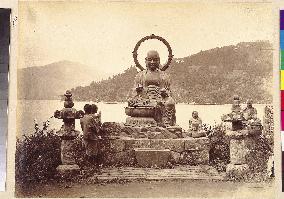
This is Enmei Jizo around 1867 before Haibutsukishaku (anti-Buddhist movement at the beginning of the Meiji era). Compared with the figure in catalogue #4603 taken after Haibutsukishaku, the intact halo, flanking jizo figures, and the stone lanterns are extant. According to Tokaido Hakone Sanchuzu printed in 1867 by Sadahide Gountei, there once existed many stone Buddhas and towers at Sainogahara on the shore of Lake Ashinoko.==Date:unknown, Place:Hakone, Photo:F. Beato, (Credit:Nagasaki University Library/Kyodo News Images) [Cabinet Number104‐2‐0]

  •  
Hakone Shrine: Around Ichino Torii Gate and Lake Ashinoko

Hakone Shrine: Around Ichino Torii Gate and Lake Ashinoko

Hakone Shrine: Around Ichino Torii Gate and Lake Ashinoko==Date:unknown, Place:Hakone, Photo:Ogawa Kazumasa?, (Credit:Nagasaki University Library/Kyodo News Images)

  •  
Juntendo University wins Tokyo-Hakone relay

Juntendo University wins Tokyo-Hakone relay

TOKYO, Japan - Anchor Nobuhito Miyazaki cuts the tape as Juntendo University won its 10th championship in the Tokyo-Hakone collegiate ekiden road relay Jan. 3. The five Juntendo runners completed the 109.2-kilometer relay from Lake Ashinoko in Kanagawa Prefecture to Tokyo's Otemachi business district in 5 hours, 30 minutes and 57 seconds to win the two-day event with a total time of 11:14:05. Defending champion Komazawa University came in second at 11:17:00 while Chuo University, which won the outward leg of the competition Jan. 2, finished third at 11:19:17.

  •  
Chuo relay team wins 1st half of Tokyo-Hakone ekiden

Chuo relay team wins 1st half of Tokyo-Hakone ekiden

HAKONE, Japan - Members of Chuo University's road relay team give anchor Masakazu Fujiwara (C) a victory toss Jan. 2 after the Tokyo school posted an eight-second victory in the first half of the Tokyo-Hakone collegiate ekiden. Chuo posted a time of 5:43:00 over 107.2 kilometers from Tokyo's Otemachi business district to Lake Ashinoko in Kanagawa Prefecture for its first victory in 37 years in the New Year event.

  •  
Tang, Kono go on a boat excursion on scenic Lake Ashinoko

Tang, Kono go on a boat excursion on scenic Lake Ashinoko

HAKONE, Japan - Visiting Chinese Foreign Minister Tang Jiaxuan went on a boat excursion May 13 on scenic Lake Ashinoko in Hakone, Kanagawa Prefecture, west of Tokyo, with Japanese Foreign Minister Yohei Kono, before returning home later in the day. Photo shows Kono (R) and Tang (C) in the boat's cabin.

  • Main
  • Top
  • Editorial
  • Creative
  • About Us
  • About ILG
  • Terms of use
  • Company
  • BEHIND
  • Price List
  • Single Plan
  • Monthly Plan
  • Services
  • Shooting
  • Rights Clearance
  • Support
  • FAQ
  • How To Buy
  • Contact Us
  • Become a Partner

© KYODO NEWS IMAGES INC

All Rights Reserved.

  • Editorial
  • Olympics
  • News
  • Sports
  • Japan
  • Tech
  • Royal
  • Disaster
  • NorthKorea
  • Old Japan
  • SNS
  • Creative
  • Food
  • Japan
  • Landscape
  • Animal
  • Popular
  • #Ukraine
  • #Russia
  • #coronavirus
  • #N. Korea
  • #China
  • #Thailand
  • #Ukraine
  • #Russia
  • #coronavirus
  • #N. Korea
  • #China
  • #Thailand
  • Food
  • Japan
  • Landscape
  • Animal
  • Olympics
  • News
  • Sports
  • Japan
  • Tech
  • Royal
  • Disaster
  • NorthKorea
  • Old Japan
  • SNS