•  
Arctic Ocean Scientific Expedition

Arctic Ocean Scientific Expedition

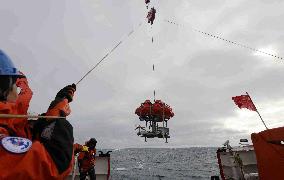
Scientific expedition team members retrieve a benthic lander while conducting scientific research in the Arctic Ocean aboard China's research icebreaker Xuelong 2, Aug. 14, 2025. China's research icebreaker Xuelong 2, or Snow Dragon 2, arrived in Shanghai on Friday, marking the completion of the country's hitherto largest Arctic Ocean scientific expedition. A total of 100 members of China's 15th Arctic Ocean scientific expedition were aboard the vessel. Organized by the Ministry of Natural Resources, this round of Arctic survey was jointly carried out by four vessels, including Xuelong 2, Jidi, Shenhai-1 and Tansuo-3. This Arctic expedition has further enhanced China's understanding of the rapid changes in the Arctic Ocean and their impacts, providing important support for a deeper understanding and effective response to global climate change, according to the researchers. Photo by Xinhua/Liu Shiping/ABACAPRESS.COM

  •  
ChineseToday | Chinese expedition team braves river headwaters

ChineseToday | Chinese expedition team braves river headwaters

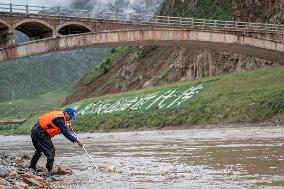
(240731) -- WUHAN, July 31, 2024 Photo by Xinhua/ABACAPRESS.COM) -- A researcher picks out benthic organisms in northwest China's Qinghai Province, July 24, 2024. Since July 20, a Chinese expedition team has been conducting research on the water resources and ecological environment in the headwater regions of the Yangtze and Lancang rivers. The expedition, comprising around 20 members, carried out scientific investigations into river hydrology, water ecology, soil erosion, glaciers and permafrost in Qinghai Province. Key research projects include estimating the carbon stock of wetlands, assessing the impacts of permafrost thawing on the plateau, and measuring the thickness of permafrost on glaciers. Qinghai is home to the Sanjiangyuan area, which contains the headwaters of China's three major rivers: the Yangtze River, the longest in China; the Yellow River, the second-longest; and the Lancang River, which is known as the Mekong River after it flows out of China. As important parts of the Qinghai-Xizang Plate

  •  
ChineseToday | Chinese expedition team braves river headwaters

ChineseToday | Chinese expedition team braves river headwaters

(240731) -- WUHAN, July 31, 2024 Photo by Xinhua/ABACAPRESS.COM) -- A researcher collects samples of benthic organisms in Nangqian County, northwest China's Qinghai Province, July 21, 2024. Since July 20, a Chinese expedition team has been conducting research on the water resources and ecological environment in the headwater regions of the Yangtze and Lancang rivers. The expedition, comprising around 20 members, carried out scientific investigations into river hydrology, water ecology, soil erosion, glaciers and permafrost in Qinghai Province. Key research projects include estimating the carbon stock of wetlands, assessing the impacts of permafrost thawing on the plateau, and measuring the thickness of permafrost on glaciers. Qinghai is home to the Sanjiangyuan area, which contains the headwaters of China's three major rivers: the Yangtze River, the longest in China; the Yellow River, the second-longest; and the Lancang River, which is known as the Mekong River after it flows out of China. As important parts

  •  
Marine Animal Specimen At The Nature Museum

Marine Animal Specimen At The Nature Museum

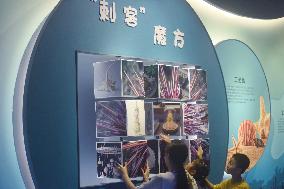
HANGZHOU, CHINA - AUGUST 16, 2023 - Visitors learn about the life habits of Marine benthic animals through a Rubik's cube interactive game at the Zhejiang Provincial Nature Museum on August 16, 2023.

  •  

China's Yangtze River undergoes "physical examination"

STORY: China's Yangtze River undergoes "physical examination" DATELINE: May 18, 2023 LENGTH: 00:01:25 LOCATION: WUHAN, China CATEGORY: ENVIRONMENT SHOTLIST: 1. various of staff members carring out examinations along the Yangtze River 2. SOUNDBITE (Chinese): ZHANG JING, Head of pilot project of Yangtze River water ecological assessment and monitoring STORYLINE: The Yangtze River, the longest waterway in China, has undergone "physical examinations." Since April this year, China has launched an assessment of the water ecology in the Yangtze River Basin. Researchers from multiple departments will carry out "physical examinations" for 331 point positions, which are set in the Yangtze River's mainstream and tributaries, main lakes and water reservoirs. These point positions are distributed from northwest China's Qinghai Province to Shanghai, and the examinations will last until June this year. One of the important tasks of the examinations is to collect samples of large benthic invertebrates and zooplankton,

  •  
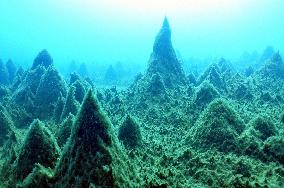
Benthic moss pillars in Antarctic lake

Benthic moss pillars in Antarctic lake

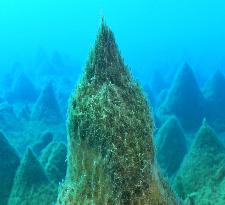
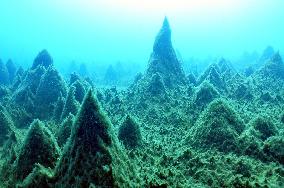
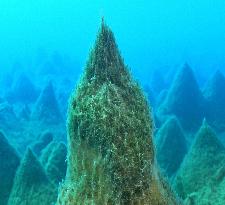
TOKYO, Japan - Photo shows colonies of Benthic moss pillars (Koke Bouzu) discovered at the bottom of ''Nagaike'' lake, some 40 kilometers south of Japan's Showa Station in the Antarctic. Members of the Japanese Antarctic expedition team found the moss pillars measuring 20-50 centimeters high at a depth of eight meters on Jan. 22, 2010. (Pool photo)

  •  
Benthic moss pillars in Antarctic lake

Benthic moss pillars in Antarctic lake

TOKYO, Japan - Photo shows colonies of Benthic moss pillars (Koke Bouzu) discovered at the bottom of ''Nagaike'' lake, some 40 kilometers south of Japan's Showa Station in the Antarctic. Members of the Japanese Antarctic expedition team found the moss pillars measuring 20-50 centimeters high at a depth of eight meters on Jan. 22, 2010. (Pool photo)

  •  
Benthic moss pillars in Antarctic lake

Benthic moss pillars in Antarctic lake

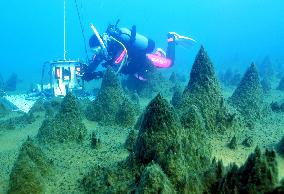
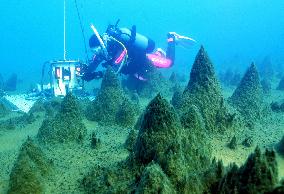
TOKYO, Japan - A diver works near Benthic moss pillars on the bottom of a lake around 40 kilometers south of Japan's Showa Station in Antarctica on Jan. 22, 2010. Members of the Japanese Antarctic expedition team found the moss pillars measuring 20-50 centimeters high at a depth of eight meters. (Pool photo)

  •  

Scientists investigate micro ecosystem in Yangtze headwaters

STORY: Scientists investigate micro ecosystem in Yangtze headwaters DATELINE: Aug. 3, 2022 LENGTH: 00:01:13 LOCATION: XINING, China CATEGORY: SCIENCE SHOTLIST: 1. various of Chinese scientists investigating micro ecosystem in Yangtze headwaters STORYLINE: Chinese scientists launched an expedition on Sunday in the headwater regions of the Yangtze and Lancang rivers in northwest China's Qinghai Province, to investigate the regions' water resources and ecological environment. The headwaters of the Yangtze River, located on the Qinghai-Tibet Plateau, are rich in microscopic organisms such as phytoplankton, zooplankton and benthic animals.    These biological communities which need to be observed under a microscope contain various species of different shapes. They provide energy for the aquatic ecosystem including food for fish.    They are an indicator for the ecological health status of the Yangtze headwaters, and can reflect water quality.    Data from the expedition shows that now there are more than 40 sp

  •  
Benthic moss pillars in Antarctic lake

Benthic moss pillars in Antarctic lake

TOKYO, Japan - A diver works near Benthic moss pillars on the bottom of a lake around 40 kilometers south of Japan's Showa Station in Antarctica on Jan. 22, 2010. Members of the Japanese Antarctic expedition team found the moss pillars measuring 20-50 centimeters high at a depth of eight meters. (Pool photo)(Kyodo)

  •  
Benthic moss pillars in Antarctic lake

Benthic moss pillars in Antarctic lake

TOKYO, Japan - Photo shows colonies of Benthic moss pillars (Koke Bouzu) discovered at the bottom of ''Nagaike'' lake, some 40 kilometers south of Japan's Showa Station in the Antarctic. Members of the Japanese Antarctic expedition team found the moss pillars measuring 20-50 centimeters high at a depth of eight meters on Jan. 22, 2010. (Pool photo)(Kyodo)

  •  
Benthic moss pillars in Antarctic lake

Benthic moss pillars in Antarctic lake

TOKYO, Japan - Photo shows colonies of Benthic moss pillars (Koke Bouzu) discovered at the bottom of ''Nagaike'' lake, some 40 kilometers south of Japan's Showa Station in the Antarctic. Members of the Japanese Antarctic expedition team found the moss pillars measuring 20-50 centimeters high at a depth of eight meters on Jan. 22, 2010. (Pool photo)(Kyodo)

  • Main
  • Top
  • Editorial
  • Creative
  • About Us
  • About ILG
  • Terms of use
  • Company
  • BEHIND
  • Price List
  • Single Plan
  • Monthly Plan
  • Services
  • Shooting
  • Rights Clearance
  • Support
  • FAQ
  • How To Buy
  • Contact Us
  • Become a Partner

© KYODO NEWS IMAGES INC

All Rights Reserved.

  • Editorial
  • Olympics
  • News
  • Sports
  • Japan
  • Tech
  • Royal
  • Disaster
  • NorthKorea
  • Old Japan
  • SNS
  • Creative
  • Food
  • Japan
  • Landscape
  • Animal
  • Popular
  • #Ukraine
  • #Russia
  • #coronavirus
  • #N. Korea
  • #Thailand
  • #China
  • #Ukraine
  • #Russia
  • #coronavirus
  • #N. Korea
  • #Thailand
  • #China
  • Food
  • Japan
  • Landscape
  • Animal
  • Olympics
  • News
  • Sports
  • Japan
  • Tech
  • Royal
  • Disaster
  • NorthKorea
  • Old Japan
  • SNS