•  
Inner Mongolia Deserts Photovoltaic Projects - China

Inner Mongolia Deserts Photovoltaic Projects - China

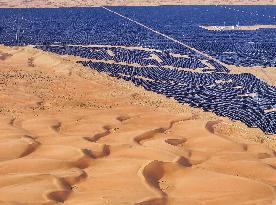
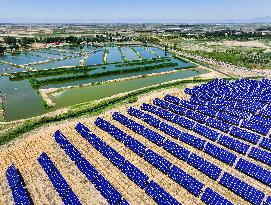
A worker installs photovoltaic panels at a photovoltaic project in Kubuqi Desert, north China's Inner Mongolia Autonomous Region, June 6, 2025. In recent years, Inner Mongolia has made all-out efforts to tackle the ecological challenges in the areas along the Yellow River, and has treated land covering a total of 14.89 million mu (about 992,667 hectares). In deserts of Kubuqi and Ulan Buh, the sand control model with photovoltaic projects has been widely implemented, transforming stretches of sandy terrain into vast "blue seas" brimming with green energy. Photo by Li Zhipeng/Xinhua/ABACAPRESS.COM

  •  
Inner Mongolia Deserts Photovoltaic Projects - China

Inner Mongolia Deserts Photovoltaic Projects - China

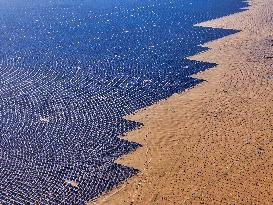
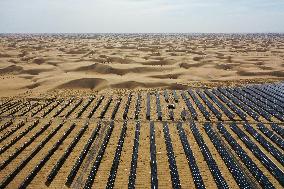
An aerial drone photo taken on June 5, 2025 shows a photovoltaic project in Ulan Buh Desert, in Dengkou County of Bayannur, north China's Inner Mongolia Autonomous Region. In recent years, Inner Mongolia has made all-out efforts to tackle the ecological challenges in the areas along the Yellow River, and has treated land covering a total of 14.89 million mu (about 992,667 hectares). In deserts of Kubuqi and Ulan Buh, the sand control model with photovoltaic projects has been widely implemented, transforming stretches of sandy terrain into vast "blue seas" brimming with green energy. Photo by Lian Zhen/Xinhua/ABACAPRESS.COM

  •  
Inner Mongolia Deserts Photovoltaic Projects - China

Inner Mongolia Deserts Photovoltaic Projects - China

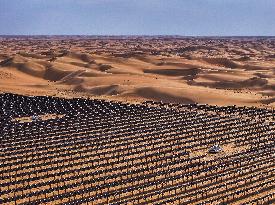
An aerial drone photo taken on June 6, 2025 shows a photovoltaic project in Kubuqi Desert, north China's Inner Mongolia Autonomous Region. In recent years, Inner Mongolia has made all-out efforts to tackle the ecological challenges in the areas along the Yellow River, and has treated land covering a total of 14.89 million mu (about 992,667 hectares). In deserts of Kubuqi and Ulan Buh, the sand control model with photovoltaic projects has been widely implemented, transforming stretches of sandy terrain into vast "blue seas" brimming with green energy. Photo by Lian Zhen/Xinhua/ABACAPRESS.COM

  •  
Inner Mongolia Deserts Photovoltaic Projects - China

Inner Mongolia Deserts Photovoltaic Projects - China

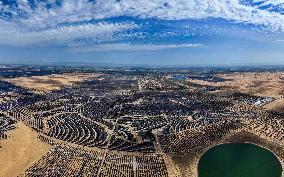
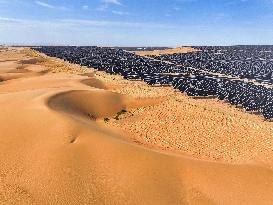
An aerial drone photo taken on June 7, 2025 shows a photovoltaic project in Kubuqi Desert in north China's Inner Mongolia Autonomous Region. In recent years, Inner Mongolia has made all-out efforts to tackle the ecological challenges in the areas along the Yellow River, and has treated land covering a total of 14.89 million mu (about 992,667 hectares). In deserts of Kubuqi and Ulan Buh, the sand control model with photovoltaic projects has been widely implemented, transforming stretches of sandy terrain into vast "blue seas" brimming with green energy. Photo by Lian Zhen/Xinhua/ABACAPRESS.COM

  •  
Inner Mongolia Deserts Photovoltaic Projects - China

Inner Mongolia Deserts Photovoltaic Projects - China

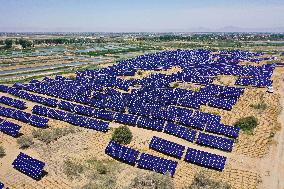
An aerial drone photo taken on June 5, 2025 shows an integrated sand control and photovoltaic project at a state forestry area in the edge of Ulan Buh Desert in Linhe District of Bayannur, north China's Inner Mongolia Autonomous Region. In recent years, Inner Mongolia has made all-out efforts to tackle the ecological challenges in the areas along the Yellow River, and has treated land covering a total of 14.89 million mu (about 992,667 hectares). In deserts of Kubuqi and Ulan Buh, the sand control model with photovoltaic projects has been widely implemented, transforming stretches of sandy terrain into vast "blue seas" brimming with green energy. Photo by Li Zhipeng/Xinhua/ABACAPRESS.COM

  •  
Inner Mongolia Deserts Photovoltaic Projects - China

Inner Mongolia Deserts Photovoltaic Projects - China

An aerial drone photo taken on June 5, 2025 shows an integrated sand control and photovoltaic project at a state forestry area in the edge of Ulan Buh Desert in Linhe District of Bayannur, north China's Inner Mongolia Autonomous Region. In recent years, Inner Mongolia has made all-out efforts to tackle the ecological challenges in the areas along the Yellow River, and has treated land covering a total of 14.89 million mu (about 992,667 hectares). In deserts of Kubuqi and Ulan Buh, the sand control model with photovoltaic projects has been widely implemented, transforming stretches of sandy terrain into vast "blue seas" brimming with green energy. Photo by Lian Zhen/Xinhua/ABACAPRESS.COM

  •  
Inner Mongolia Deserts Photovoltaic Projects - China

Inner Mongolia Deserts Photovoltaic Projects - China

An aerial drone photo taken on June 5, 2025 shows a photovoltaic project in Ulan Buh Desert, in Dengkou County of Bayannur, north China's Inner Mongolia Autonomous Region. In recent years, Inner Mongolia has made all-out efforts to tackle the ecological challenges in the areas along the Yellow River, and has treated land covering a total of 14.89 million mu (about 992,667 hectares). In deserts of Kubuqi and Ulan Buh, the sand control model with photovoltaic projects has been widely implemented, transforming stretches of sandy terrain into vast "blue seas" brimming with green energy. Photo by Li Zhipeng/Xinhua/ABACAPRESS.COM

  •  
Inner Mongolia Deserts Photovoltaic Projects - China

Inner Mongolia Deserts Photovoltaic Projects - China

An aerial drone photo taken on June 5, 2025 shows a photovoltaic project in Ulan Buh Desert, in Dengkou County of Bayannur, north China's Inner Mongolia Autonomous Region. In recent years, Inner Mongolia has made all-out efforts to tackle the ecological challenges in the areas along the Yellow River, and has treated land covering a total of 14.89 million mu (about 992,667 hectares). In deserts of Kubuqi and Ulan Buh, the sand control model with photovoltaic projects has been widely implemented, transforming stretches of sandy terrain into vast "blue seas" brimming with green energy. Photo by Lian Zhen/Xinhua/ABACAPRESS.COM

  •  
Inner Mongolia Deserts Photovoltaic Projects - China

Inner Mongolia Deserts Photovoltaic Projects - China

An aerial drone photo taken on June 5, 2025 shows a photovoltaic project in Ulan Buh Desert, in Dengkou County of Bayannur, north China's Inner Mongolia Autonomous Region. In recent years, Inner Mongolia has made all-out efforts to tackle the ecological challenges in the areas along the Yellow River, and has treated land covering a total of 14.89 million mu (about 992,667 hectares). In deserts of Kubuqi and Ulan Buh, the sand control model with photovoltaic projects has been widely implemented, transforming stretches of sandy terrain into vast "blue seas" brimming with green energy. Photo by Lian Zhen/Xinhua/ABACAPRESS.COM

  •  
CHINA-YELLOW RIVER-SPRING AFFORESTATION (CN)

CHINA-YELLOW RIVER-SPRING AFFORESTATION (CN)

(240320) -- HOHHOT, March 20, 2024 (Xinhua) -- An aerial drone photo shows workers transporting saplings on the edge of the Ulan Buh Desert in north China's Inner Mongolia Autonomous Region, March 17, 2024. TO GO WITH "Spring afforestation in full swing on banks of thawing Yellow River" (Xinhua/Li Yunping)

  •  
CHINA-YELLOW RIVER-SPRING AFFORESTATION (CN)

CHINA-YELLOW RIVER-SPRING AFFORESTATION (CN)

(240320) -- HOHHOT, March 20, 2024 (Xinhua) -- Workers transport saplings on the edge of the Ulan Buh Desert in north China's Inner Mongolia Autonomous Region, March 17, 2024. TO GO WITH "Spring afforestation in full swing on banks of thawing Yellow River" (Xinhua/Li Yunping)

  •  
(SkyEye)CHINA-INNER MONGOLIA-BAYANNUR-AERIAL VIEW (CN)

(SkyEye)CHINA-INNER MONGOLIA-BAYANNUR-AERIAL VIEW (CN)

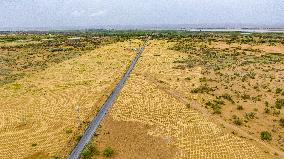
(230620) -- BAYANNUR, June 20, 2023 (Xinhua) -- This aerial photo taken on June 18, 2023 shows straw checkerboards, a local method to prevent the sand from moving, in the Ulan Buh Desert in Dengkou County in Bayannur, north China's Inner Mongolia Autonomous Region. Situated in the central and western part of Inner Mongolia, the city of Bayannur has rich agricultural resources as the Yellow River flows through the city. The Hetao Irrigation Area, located in the city of Bayannur, has been diverting water from the Yellow River. (Xinhua/Peng Yuan)

  •  

Sci-tech innovation turns desert sands into arable land

STORY: Sci-tech innovation turns desert sands into arable land DATELINE: June 18, 2023 LENGTH: 00:01:52 LOCATION: CHONGQING, China CATEGORY: ENVIRONMENT/TECHNOLOGY SHOTLIST: 1. various of the pilot fields in the Ulan Buh Desert in Inner Mongolia 2. SOUNDBITE 1 (Chinese): LI YA, Desert soilization team, Chongqing Jiaotong University 3. various of the pilot fields in the Taklimakan Desert in Xinjiang Uygur Autonomous Region 4. SOUNDBITE 2 (Chinese): WANG ZHIXIANG, Desert soilization team, Chongqing Jiaotong University STORYLINE: Using an innovative technique called "desert soilization," a group of Chinese scientists have turned barren desert sands into productive, farmable land at an affordable cost in northwest China. In 2013, Professor Yi Zhijian and his team from Chongqing Jiaotong University patented the technique after years of research, giving sands the same properties as soil -- with the same capacity to sustain water, air and fertilizer. The first test plot was established in the Ulan Buh Desert in

  •  
Xinhua Headlines: China beefs up wetlands conservation to enhance people's well-being

Xinhua Headlines: China beefs up wetlands conservation to enhance people's well-being

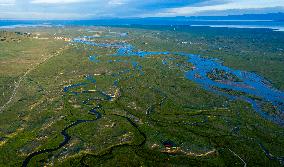
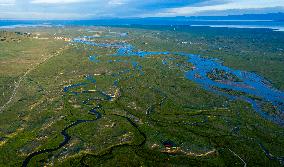
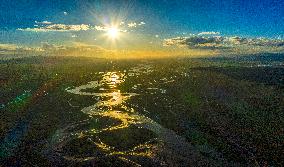
(221109) -- CHANGSHA/XINING, Nov. 9, 2022 (Xinhua) -- This aerial photo taken on July 18, 2020 shows a view of Buh River wetland at Qinghai Lake in northwest China's Qinghai Province. (Photo by Yang Tao/Xinhua)

  •  
Xinhua Headlines: China progressing in wetlands conservation for high-quality development

Xinhua Headlines: China progressing in wetlands conservation for high-quality development

(221106) -- WUHAN/GENEVA, Nov. 6, 2022 (Xinhua) -- This aerial photo taken on July 19, 2020 shows a view of Buh River wetland at Qinghai Lake in northwest China's Qinghai Province. (Photo by Yang Tao/Xinhua)

  •  
CHINA-QINGHAI-QINGHAI LAKE-WETLAND (CN)

CHINA-QINGHAI-QINGHAI LAKE-WETLAND (CN)

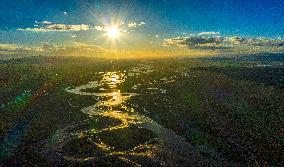
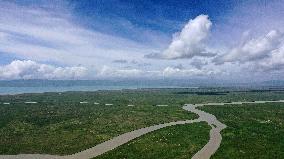
(221101) -- XINING, Nov. 1, 2022 (Xinhua) -- This aerial photo taken on July 10, 2020 shows a view of Buh River wetland at Qinghai Lake in northwest China's Qinghai Province. Qinghai Lake, located in northwest China's Qinghai Province, is China's largest inland saltwater lake. It is a major transit point for migratory birds from Central Asia to India and East Asia to Australia. It also serves as an important winter home for waterbirds on the Qinghai-Tibet Plateau. Qinghai Lake is a crucial body of water to maintain ecological security in the northeastern Qinghai-Tibet Plateau. It is also a natural barrier for controlling the eastward spread of desertification. The improving ecosystem of the lake in recent years has benefited a variety of plant and animal species. (Xinhua/Zhang Hongxiang)

  •  
CHINA-QINGHAI-QINGHAI LAKE-WETLAND (CN)

CHINA-QINGHAI-QINGHAI LAKE-WETLAND (CN)

(221101) -- XINING, Nov. 1, 2022 (Xinhua) -- This aerial photo taken on July 19, 2020 shows a view of Buh River wetland at Qinghai Lake in northwest China's Qinghai Province. Qinghai Lake, located in northwest China's Qinghai Province, is China's largest inland saltwater lake. It is a major transit point for migratory birds from Central Asia to India and East Asia to Australia. It also serves as an important winter home for waterbirds on the Qinghai-Tibet Plateau. Qinghai Lake is a crucial body of water to maintain ecological security in the northeastern Qinghai-Tibet Plateau. It is also a natural barrier for controlling the eastward spread of desertification. The improving ecosystem of the lake in recent years has benefited a variety of plant and animal species. (Photo by Yang Tao/Xinhua)

  •  
CHINA-QINGHAI-QINGHAI LAKE-WETLAND (CN)

CHINA-QINGHAI-QINGHAI LAKE-WETLAND (CN)

(221101) -- XINING, Nov. 1, 2022 (Xinhua) -- This aerial photo taken on July 18, 2020 shows a view of Buh River wetland at Qinghai Lake in northwest China's Qinghai Province. Qinghai Lake, located in northwest China's Qinghai Province, is China's largest inland saltwater lake. It is a major transit point for migratory birds from Central Asia to India and East Asia to Australia. It also serves as an important winter home for waterbirds on the Qinghai-Tibet Plateau. Qinghai Lake is a crucial body of water to maintain ecological security in the northeastern Qinghai-Tibet Plateau. It is also a natural barrier for controlling the eastward spread of desertification. The improving ecosystem of the lake in recent years has benefited a variety of plant and animal species. (Photo by Yang Tao/Xinhua)

  •  

Bumper harvest of potatoes in China's eighth largest desert

STORY: Bumper harvest of potatoes in China's eighth largest desert DATELINE: Oct. 26, 2022 LENGTH: 00:00:40 LOCATION: HOHHOT, China CATEGORY: ENVIRONMENT SHOTLIST: 1. various of farmers harvesting potatoes in Ulan Buh Desert STORYLINE: Potatoes have been grown in Ulan Buh Desert in Inner Mongolia, the 8th largest desert in China. Up to now, 90 percent of the 56,000 mu (3,733 hectares) of potatoes grown in the desert have been harvested. Among the 15 million mu (1 million hectares) of desert, 2.1 million mu (140,000 hectares) in Bayan Nur City has been greened. The potato harvests have helped local farmers increase their incomes. Xinhua News Agency correspondents reporting from Hohhot, China. (XHTV)

  •  

Straw checkerboards help with sand control in China's Ulan Buh Desert

STORY: Straw checkerboards help with sand control in China's Ulan Buh Desert DATELINE: April 4, 2022 LENGTH: 00:02:59 LOCATION: HOHHOT, China CATEGORY: ENVIRONMENT SHOTLIST: 1. various of Ulan Buh Desert 2. SOUNDBITE (Chinese): HE WENQIANG, Staff of sand prevention and control bureau of Dengkou County, Inner Mongolia 3. various of the desert STORYLINE: In the heart of Ulan Buh Desert, China's eighth largest desert in Inner Mongolia Autonomous Region, straw checkerboards are playing a key role in sand control work. SOUNDBITE (Chinese): HE WENQIANG, Staff of sand prevention and control bureau of Dengkou County, Inner Mongolia "We usually use straws of 30 to 40 centimeters to pave a square of 1 meter by 1 meter. These straw checkerboards have three advantages. The first is to reduce wind speed; the second is that it enables us to plant sacsaouls in it and provide them with fertilizers; the third is it can hold water so that the sacsaouls can have enough water to grow." Ulan Buh Desert covers an area of a

  • Main
  • Top
  • Editorial
  • Creative
  • About Us
  • About ILG
  • Terms of use
  • Company
  • BEHIND
  • Price List
  • Single Plan
  • Monthly Plan
  • Services
  • Shooting
  • Rights Clearance
  • Support
  • FAQ
  • How To Buy
  • Contact Us
  • Become a Partner

© KYODO NEWS IMAGES INC

All Rights Reserved.

  • Editorial
  • Olympics
  • News
  • Sports
  • Japan
  • Tech
  • Royal
  • Disaster
  • NorthKorea
  • Old Japan
  • SNS
  • Creative
  • Food
  • Japan
  • Landscape
  • Animal
  • Popular
  • #Ukraine
  • #Thailand
  • #coronavirus
  • #N. Korea
  • #China
  • #Russia
  • #Ukraine
  • #Thailand
  • #coronavirus
  • #N. Korea
  • #China
  • #Russia
  • Food
  • Japan
  • Landscape
  • Animal
  • Olympics
  • News
  • Sports
  • Japan
  • Tech
  • Royal
  • Disaster
  • NorthKorea
  • Old Japan
  • SNS