•  
Hyper-Kamiokande neutrino observatory

Hyper-Kamiokande neutrino observatory

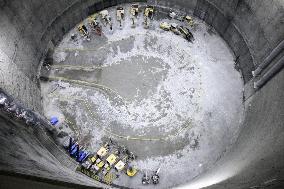
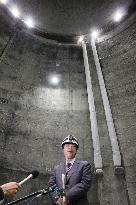
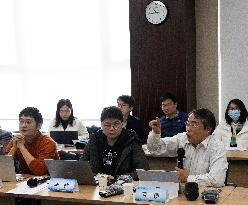
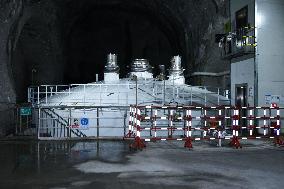
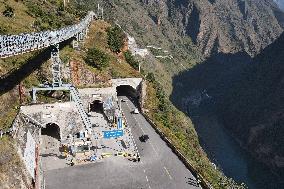
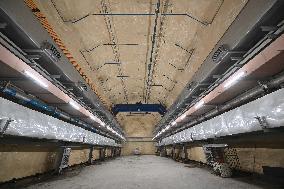
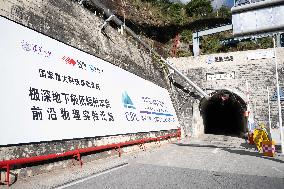
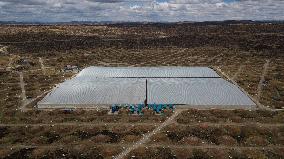
The University of Tokyo's Institute for Cosmic Ray Research unveils to the media on June 28, 2025, a huge cavity excavated in the mountains of Hida in Gifu Prefecture, central Japan, for the installation of the Hyper-Kamiokande neutrino observatory.

  •  
Hyper-Kamiokande neutrino observatory

Hyper-Kamiokande neutrino observatory

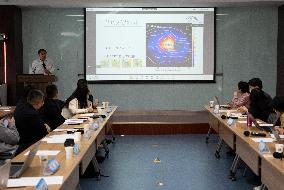
The University of Tokyo's Institute for Cosmic Ray Research unveils to the media on June 28, 2025, a huge cavity excavated in the mountains of Hida in Gifu Prefecture, central Japan, for the installation of the Hyper-Kamiokande neutrino observatory.

  •  
China Space Science Popularization Exhibition in Shanghai

China Space Science Popularization Exhibition in Shanghai

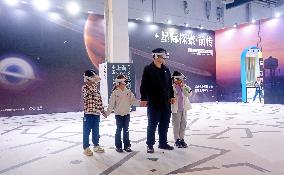
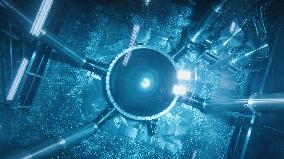
SHANGHAI, CHINA - APRIL 27, 2025 - Parents led their children to the China Space Science Popularization Exhibition, where they put on VR glasses to experience the journey of traversing cosmic black holes and landing on Mars in an immersive way in Shanghai, China on April 27, 2025.

  •  
Webb Reveals Sombrero Galaxy's Hidden Details

Webb Reveals Sombrero Galaxy's Hidden Details

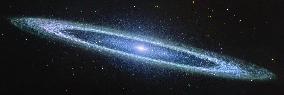
Handout photo dated November 25, 2024 shows NASA’s James Webb Space Telescope recently imaged the Sombrero Galaxy with its MIRI (Mid-Infrared Instrument), resolving the clumpy nature of the dust along the galaxy’s outer ring. NASA’s James Webb Space Telescope captures the Sombrero Galaxy (Messier 104) in stunning mid-infrared detail. This oblong galaxy, named for its resemblance to a wide-brimmed hat, reveals intricate clumps of dust along its outer ring, illuminated in shades of blue and white. Speckles of stars scatter its inner disk, while distant galaxies dot the black cosmic canvas in the background. The new image, taken with Webb's MIRI instrument, offers unprecedented insight into the galaxy’s structure and the faint traces of young star-forming regions. November 25, 2024. Photo by NASA via ABACAPRESS.COM

  •  
Webb Reveals Sombrero Galaxy's Hidden Details

Webb Reveals Sombrero Galaxy's Hidden Details

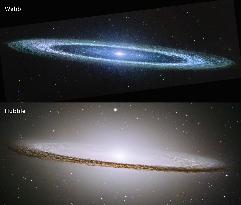
Handout photo dated November 25, 2024 shows the view of the famous Sombrero Galaxy in mid-infrared light (top) and visible light (bottom). The James Webb Space Telescope’s MIRI (Mid-Infrared Instrument) reveals the smooth inner disk of the galaxy, while the Hubble Space Telescope’s visible-light image shows the large and extended glow of the central bulge of stars. NASA’s James Webb Space Telescope captures the Sombrero Galaxy (Messier 104) in stunning mid-infrared detail. This oblong galaxy, named for its resemblance to a wide-brimmed hat, reveals intricate clumps of dust along its outer ring, illuminated in shades of blue and white. Speckles of stars scatter its inner disk, while distant galaxies dot the black cosmic canvas in the background. The new image, taken with Webb's MIRI instrument, offers unprecedented insight into the galaxy’s structure and the faint traces of young star-forming regions. November 25, 2024. Photo by NASA via ABACAPRESS.COM

  •  
Ukraines National Bank releases Pliontanism coin

Ukraines National Bank releases Pliontanism coin

KYIV, UKRAINE - AUGUST 23, 2024 - Governor of the National Bank of Ukraine Andriy Pyshnyy visits the Ivan Marchuk. Cosmic Mystery of Life exhibition at the Kyiv History Museum focusing on the works of Peoples Artist of Ukraine, Shevchenko National Prize laureate Ivan Marchuk during the presentation of the Pliontanism (Ivan Marchuk) coin from the Ukrainian Heritage series of the National Bank which celebrates Ivan Marchuks painting technique, Kyiv, capital of Ukraine.

  •  
Ukraines National Bank releases Pliontanism coin

Ukraines National Bank releases Pliontanism coin

KYIV, UKRAINE - AUGUST 23, 2024 - Governor of the National Bank of Ukraine Andriy Pyshnyy (2nd L) visits the Ivan Marchuk. Cosmic Mystery of Life exhibition at the Kyiv History Museum focusing on the works of Peoples Artist of Ukraine, Shevchenko National Prize laureate Ivan Marchuk during the presentation of the Pliontanism (Ivan Marchuk) coin from the Ukrainian Heritage series of the National Bank which celebrates Ivan Marchuks painting technique, Kyiv, capital of Ukraine.

  •  
Ukraines National Bank releases Pliontanism coin

Ukraines National Bank releases Pliontanism coin

KYIV, UKRAINE - AUGUST 23, 2024 - Governor of the National Bank of Ukraine Andriy Pyshnyy visits the Ivan Marchuk. Cosmic Mystery of Life exhibition at the Kyiv History Museum focusing on the works of Peoples Artist of Ukraine, Shevchenko National Prize laureate Ivan Marchuk during the presentation of the Pliontanism (Ivan Marchuk) coin from the Ukrainian Heritage series of the National Bank which celebrates Ivan Marchuks painting technique, Kyiv, capital of Ukraine.

  •  
Ukraines National Bank releases Pliontanism coin

Ukraines National Bank releases Pliontanism coin

KYIV, UKRAINE - AUGUST 23, 2024 - Governor of the National Bank of Ukraine Andriy Pyshnyy accompanied by Kyiv History Museum director general Diana Popova visits the Ivan Marchuk. Cosmic Mystery of Life exhibition focusing on the works of Peoples Artist of Ukraine, Shevchenko National Prize laureate Ivan Marchuk during the presentation of the Pliontanism (Ivan Marchuk) coin from the Ukrainian Heritage series of the National Bank which celebrates Ivan Marchuks painting technique at the Kyiv History Museum, Kyiv, capital of Ukraine.

  •  
Ukraines National Bank releases Pliontanism coin

Ukraines National Bank releases Pliontanism coin

KYIV, UKRAINE - AUGUST 23, 2024 - Governor of the National Bank of Ukraine Andriy Pyshnyy accompanied by Kyiv History Museum director general Diana Popova visits the Ivan Marchuk. Cosmic Mystery of Life exhibition focusing on the works of Peoples Artist of Ukraine, Shevchenko National Prize laureate Ivan Marchuk during the presentation of the Pliontanism (Ivan Marchuk) coin from the Ukrainian Heritage series of the National Bank which celebrates Ivan Marchuks painting technique at the Kyiv History Museum, Kyiv, capital of Ukraine.

  •  
Ukraines National Bank releases Pliontanism coin

Ukraines National Bank releases Pliontanism coin

KYIV, UKRAINE - AUGUST 23, 2024 - Governor of the National Bank of Ukraine Andriy Pyshnyy (L) accompanied by Kyiv History Museum director general Diana Popova visits the Ivan Marchuk. Cosmic Mystery of Life exhibition focusing on the works of Peoples Artist of Ukraine, Shevchenko National Prize laureate Ivan Marchuk during the presentation of the Pliontanism (Ivan Marchuk) coin from the Ukrainian Heritage series of the National Bank which celebrates Ivan Marchuks painting technique at the Kyiv History Museum, Kyiv, capital of Ukraine.

  •  
XINHUA PHOTOS OF THE DAY

XINHUA PHOTOS OF THE DAY

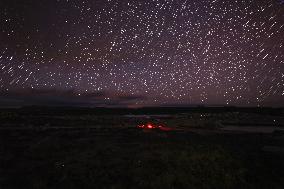
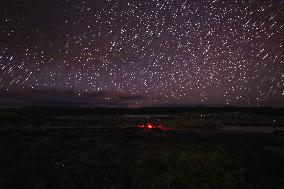
(240227) -- BEIJING, Feb. 27, 2024 (Xinhua) -- This composite photo taken on April 21, 2023 shows the Large High Altitude Air Shower Observatory (LHAASO) at an altitude of 4,410 meters on Mount Haizi in Daocheng County, southwest China's Sichuan Province. China's cosmic ray observatory has discovered a giant ultra-high-energy gamma-ray bubble structure, about ten million times larger than our solar system, in the Cygnus star-forming region, around 5,000 light years from Earth. Based on the observations made by China's LHAASO, scientists identified that star-forming region as one source of the cosmic rays in the Milky Way with an energy level higher than 10 peta-electron volts (quadrillion electron volts or PeV), about 1,000 times more than the record high achieved by any manmade accelerator on Earth. (Xinhua/Jin Liwang)

  •  
(EyesonSci) CHINA-LHAASO-GAMMA-RAY-DISCOVERY (CN)

(EyesonSci) CHINA-LHAASO-GAMMA-RAY-DISCOVERY (CN)

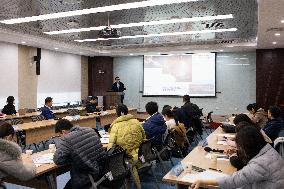
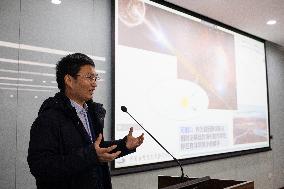
(240226) -- BEIJING, Feb. 26, 2024 (Xinhua) -- Cao Zhen, principal investigator of Large High Altitude Air Shower Observatory (LHAASO) and an academician of Chinese Academy of Sciences (CAS), introduces research findings at the Institute of High Energy Physics of CAS, in Beijing, capital of China, Feb. 22, 2024. China's cosmic ray observatory has discovered a giant ultra-high-energy gamma-ray bubble structure, about ten million times larger than our solar system, in the Cygnus star-forming region, around 5,000 light years from Earth. Based on the observations made by China's LHAASO, scientists identified that star-forming region as one source of the cosmic rays in the Milky Way with an energy level higher than 10 peta-electron volts (quadrillion electron volts or PeV), about 1,000 times more than the record high achieved by any manmade accelerator on Earth. (Xinhua/Jin Liwang)

  •  
(EyesonSci) CHINA-LHAASO-GAMMA-RAY-DISCOVERY (CN)

(EyesonSci) CHINA-LHAASO-GAMMA-RAY-DISCOVERY (CN)

(240226) -- BEIJING, Feb. 26, 2024 (Xinhua) -- This composite photo taken on April 21, 2023 shows the Large High Altitude Air Shower Observatory (LHAASO) at an altitude of 4,410 meters on Mount Haizi in Daocheng County, southwest China's Sichuan Province. China's cosmic ray observatory has discovered a giant ultra-high-energy gamma-ray bubble structure, about ten million times larger than our solar system, in the Cygnus star-forming region, around 5,000 light years from Earth. Based on the observations made by China's LHAASO, scientists identified that star-forming region as one source of the cosmic rays in the Milky Way with an energy level higher than 10 peta-electron volts (quadrillion electron volts or PeV), about 1,000 times more than the record high achieved by any manmade accelerator on Earth. (Xinhua/Jin Liwang)

  •  
(EyesonSci) CHINA-LHAASO-GAMMA-RAY-DISCOVERY (CN)

(EyesonSci) CHINA-LHAASO-GAMMA-RAY-DISCOVERY (CN)

(240226) -- BEIJING, Feb. 26, 2024 (Xinhua) -- Cao Zhen (1st R, front), principal investigator of Large High Altitude Air Shower Observatory (LHAASO) and an academician of Chinese Academy of Sciences (CAS), answers questions at the Institute of High Energy Physics of CAS, in Beijing, capital of China, Feb. 22, 2024. China's cosmic ray observatory has discovered a giant ultra-high-energy gamma-ray bubble structure, about ten million times larger than our solar system, in the Cygnus star-forming region, around 5,000 light years from Earth. Based on the observations made by China's LHAASO, scientists identified that star-forming region as one source of the cosmic rays in the Milky Way with an energy level higher than 10 peta-electron volts (quadrillion electron volts or PeV), about 1,000 times more than the record high achieved by any manmade accelerator on Earth. (Xinhua/Jin Liwang)

  •  
(EyesonSci) CHINA-LHAASO-GAMMA-RAY-DISCOVERY (CN)

(EyesonSci) CHINA-LHAASO-GAMMA-RAY-DISCOVERY (CN)

(240226) -- BEIJING, Feb. 26, 2024 (Xinhua) -- Cao Zhen (at the podium), principal investigator of Large High Altitude Air Shower Observatory (LHAASO) and an academician of Chinese Academy of Sciences (CAS), introduces research findings at the Institute of High Energy Physics of CAS, in Beijing, capital of China, Feb. 22, 2024. China's cosmic ray observatory has discovered a giant ultra-high-energy gamma-ray bubble structure, about ten million times larger than our solar system, in the Cygnus star-forming region, around 5,000 light years from Earth. Based on the observations made by China's LHAASO, scientists identified that star-forming region as one source of the cosmic rays in the Milky Way with an energy level higher than 10 peta-electron volts (quadrillion electron volts or PeV), about 1,000 times more than the record high achieved by any manmade accelerator on Earth. (Xinhua/Jin Liwang)

  •  
XINHUA-PICTURES OF THE YEAR 2023-CHINA NEWS

XINHUA-PICTURES OF THE YEAR 2023-CHINA NEWS

(240105) -- BEIJING, Jan. 5, 2024 (Xinhua) -- This composite photo taken on April 21, 2023 shows the Large High Altitude Air Shower Observatory (LHAASO) in southwest China's Sichuan Province. China's LHAASO, a high-altitude cosmic ray observatory, has released the precise energy spectrum for the highest-energy gamma-ray radiation from the brightest gamma-ray burst (GRB) observed to date. (Xinhua/Jin Liwang)

  •  
XINHUA PHOTOS OF THE DAY

XINHUA PHOTOS OF THE DAY

(231208) -- BEIJING, Dec. 8, 2023 (Xinhua) -- This file photo shows the PandaX-4T experiment facility, at the second phase of China Jinping Underground Laboratory in Liangshan Yi Autonomous Prefecture of southwest China's Sichuan Province. A 2,400-meter-deep physics laboratory in southwest China's Sichuan Province became operational on Thursday, making it the deepest and largest underground lab in the world. Scientists believe the laboratory provides a "clean" space for them to pursue the invisible substance known as dark matter. They said the extreme depth helps block most cosmic rays that mess with the observation. The Deep Underground and Ultra-low Radiation Background Facility for Frontier Physics Experiments (DURF) is located beneath Jinping Mountain in Sichuan's Liangshan Yi Autonomous Prefecture. The DURF, with a total room capacity of 330,000 cubic meters, is the second phase of China Jinping Underground Laboratory. It started construction in December 2020 and was jointly built by Tsinghua Un

  •  
(EyesonSci)CHINA-SICHUAN-UNDERGROUND LAB-OPERATION (CN)

(EyesonSci)CHINA-SICHUAN-UNDERGROUND LAB-OPERATION (CN)

(231207) -- JINPING, Dec. 7, 2023 (Xinhua) -- This file photo taken in 2020 shows a giant liquid nitrogen cryostat at the second phase of China Jinping Underground Laboratory in Liangshan Yi Autonomous Prefecture of southwest China's Sichuan Province. A 2,400-meter-deep physics laboratory in southwest China's Sichuan Province became operational on Thursday, making it the deepest and largest underground lab in the world. Scientists believe the laboratory provides a "clean" space for them to pursue the invisible substance known as dark matter. They said the extreme depth helps block most cosmic rays that mess with the observation. The Deep Underground and Ultra-low Radiation Background Facility for Frontier Physics Experiments (DURF) is located beneath Jinping Mountain in Sichuan's Liangshan Yi Autonomous Prefecture. The DURF, with a total room capacity of 330,000 cubic meters, is the second phase of China Jinping Underground Laboratory. It started construction in December 2020 and was jointly built by Tsinghua

  •  
(EyesonSci)CHINA-SICHUAN-UNDERGROUND LAB-OPERATION (CN)

(EyesonSci)CHINA-SICHUAN-UNDERGROUND LAB-OPERATION (CN)

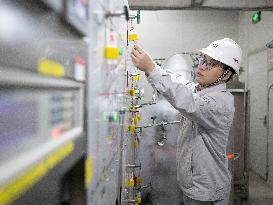
(231207) -- JINPING, Dec. 7, 2023 (Xinhua) -- This photo taken on Nov. 7, 2023 shows a researcher from Shanghai Jiao Tong University debugging experimental facilities at the Deep Underground and Ultra-low Radiation Background Facility for Frontier Physics Experiments (DURF) in Liangshan Yi Autonomous Prefecture of southwest China's Sichuan Province. A 2,400-meter-deep physics laboratory in southwest China's Sichuan Province became operational on Thursday, making it the deepest and largest underground lab in the world. Scientists believe the laboratory provides a "clean" space for them to pursue the invisible substance known as dark matter. They said the extreme depth helps block most cosmic rays that mess with the observation. The Deep Underground and Ultra-low Radiation Background Facility for Frontier Physics Experiments (DURF) is located beneath Jinping Mountain in Sichuan's Liangshan Yi Autonomous Prefecture. The DURF, with a total room capacity of 330,000 cubic meters, is the second phase of China Jinpin

  •  
(EyesonSci)CHINA-SICHUAN-UNDERGROUND LAB-OPERATION (CN)

(EyesonSci)CHINA-SICHUAN-UNDERGROUND LAB-OPERATION (CN)

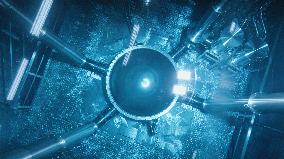
(231207) -- JINPING, Dec. 7, 2023 (Xinhua) -- This file photo shows the PandaX-4T experiment facility, at the second phase of China Jinping Underground Laboratory in Liangshan Yi Autonomous Prefecture of southwest China's Sichuan Province. A 2,400-meter-deep physics laboratory in southwest China's Sichuan Province became operational on Thursday, making it the deepest and largest underground lab in the world. Scientists believe the laboratory provides a "clean" space for them to pursue the invisible substance known as dark matter. They said the extreme depth helps block most cosmic rays that mess with the observation. The Deep Underground and Ultra-low Radiation Background Facility for Frontier Physics Experiments (DURF) is located beneath Jinping Mountain in Sichuan's Liangshan Yi Autonomous Prefecture. The DURF, with a total room capacity of 330,000 cubic meters, is the second phase of China Jinping Underground Laboratory. It started construction in December 2020 and was jointly built by Tsinghua University

  •  
(EyesonSci)CHINA-SICHUAN-UNDERGROUND LAB-OPERATION (CN)

(EyesonSci)CHINA-SICHUAN-UNDERGROUND LAB-OPERATION (CN)

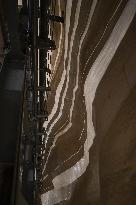
(231207) -- JINPING, Dec. 7, 2023 (Xinhua) -- This photo taken on Nov. 7, 2023 shows a piece of waterproof radon-inhibiting layer at the Deep Underground and Ultra-low Radiation Background Facility for Frontier Physics Experiments (DURF) in Liangshan Yi Autonomous Prefecture of southwest China's Sichuan Province. A 2,400-meter-deep physics laboratory in southwest China's Sichuan Province became operational on Thursday, making it the deepest and largest underground lab in the world. Scientists believe the laboratory provides a "clean" space for them to pursue the invisible substance known as dark matter. They said the extreme depth helps block most cosmic rays that mess with the observation. The Deep Underground and Ultra-low Radiation Background Facility for Frontier Physics Experiments (DURF) is located beneath Jinping Mountain in Sichuan's Liangshan Yi Autonomous Prefecture. The DURF, with a total room capacity of 330,000 cubic meters, is the second phase of China Jinping Underground Laboratory. It started

  •  
(EyesonSci)CHINA-SICHUAN-UNDERGROUND LAB-OPERATION (CN)

(EyesonSci)CHINA-SICHUAN-UNDERGROUND LAB-OPERATION (CN)

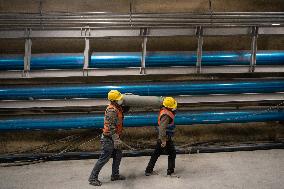
(231207) -- JINPING, Dec. 7, 2023 (Xinhua) -- This photo taken on Nov. 7, 2023 shows workers transporting a gas argon tank at the Deep Underground and Ultra-low Radiation Background Facility for Frontier Physics Experiments (DURF) in Liangshan Yi Autonomous Prefecture of southwest China's Sichuan Province. A 2,400-meter-deep physics laboratory in southwest China's Sichuan Province became operational on Thursday, making it the deepest and largest underground lab in the world. Scientists believe the laboratory provides a "clean" space for them to pursue the invisible substance known as dark matter. They said the extreme depth helps block most cosmic rays that mess with the observation. The Deep Underground and Ultra-low Radiation Background Facility for Frontier Physics Experiments (DURF) is located beneath Jinping Mountain in Sichuan's Liangshan Yi Autonomous Prefecture. The DURF, with a total room capacity of 330,000 cubic meters, is the second phase of China Jinping Underground Laboratory. It started constru

  •  
(EyesonSci)CHINA-SICHUAN-UNDERGROUND LAB-OPERATION (CN)

(EyesonSci)CHINA-SICHUAN-UNDERGROUND LAB-OPERATION (CN)

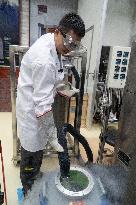
(231207) -- JINPING, Dec. 7, 2023 (Xinhua) -- This photo taken on Sept. 19, 2023 shows a researcher from Tsinghua University canning liquid nitrogen at the first phase of China Jinping Underground Laboratory in Liangshan Yi Autonomous Prefecture of southwest China's Sichuan Province. A 2,400-meter-deep physics laboratory in southwest China's Sichuan Province became operational on Thursday, making it the deepest and largest underground lab in the world. Scientists believe the laboratory provides a "clean" space for them to pursue the invisible substance known as dark matter. They said the extreme depth helps block most cosmic rays that mess with the observation. The Deep Underground and Ultra-low Radiation Background Facility for Frontier Physics Experiments (DURF) is located beneath Jinping Mountain in Sichuan's Liangshan Yi Autonomous Prefecture. The DURF, with a total room capacity of 330,000 cubic meters, is the second phase of China Jinping Underground Laboratory. It started construction in December 2020

  •  
(EyesonSci)CHINA-SICHUAN-UNDERGROUND LAB-OPERATION (CN)

(EyesonSci)CHINA-SICHUAN-UNDERGROUND LAB-OPERATION (CN)

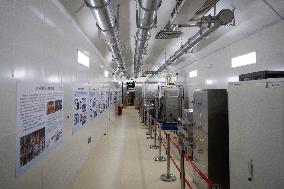
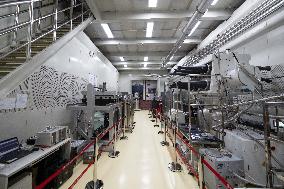
(231207) -- JINPING, Dec. 7, 2023 (Xinhua) -- This photo taken on Nov. 7, 2023 shows the interior view of the first phase of China Jinping Underground Laboratory in Liangshan Yi Autonomous Prefecture of southwest China's Sichuan Province. A 2,400-meter-deep physics laboratory in southwest China's Sichuan Province became operational on Thursday, making it the deepest and largest underground lab in the world. Scientists believe the laboratory provides a "clean" space for them to pursue the invisible substance known as dark matter. They said the extreme depth helps block most cosmic rays that mess with the observation. The Deep Underground and Ultra-low Radiation Background Facility for Frontier Physics Experiments (DURF) is located beneath Jinping Mountain in Sichuan's Liangshan Yi Autonomous Prefecture. The DURF, with a total room capacity of 330,000 cubic meters, is the second phase of China Jinping Underground Laboratory. It started construction in December 2020 and was jointly built by Tsinghua University a

  •  
(EyesonSci)CHINA-SICHUAN-UNDERGROUND LAB-OPERATION (CN)

(EyesonSci)CHINA-SICHUAN-UNDERGROUND LAB-OPERATION (CN)

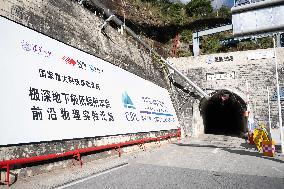
(231207) -- JINPING, Dec. 7, 2023 (Xinhua) -- This photo taken on Nov. 8, 2023 shows the tunnel entrance of China Jinping Underground Laboratory in Liangshan Yi Autonomous Prefecture, southwest China's Sichuan Province. A 2,400-meter-deep physics laboratory in southwest China's Sichuan Province became operational on Thursday, making it the deepest and largest underground lab in the world. Scientists believe the laboratory provides a "clean" space for them to pursue the invisible substance known as dark matter. They said the extreme depth helps block most cosmic rays that mess with the observation. The Deep Underground and Ultra-low Radiation Background Facility for Frontier Physics Experiments (DURF) is located beneath Jinping Mountain in Sichuan's Liangshan Yi Autonomous Prefecture. The DURF, with a total room capacity of 330,000 cubic meters, is the second phase of China Jinping Underground Laboratory. It started construction in December 2020 and was jointly built by Tsinghua University and Yalong River Hyd

  •  
(EyesonSci)CHINA-SICHUAN-UNDERGROUND LAB-OPERATION (CN)

(EyesonSci)CHINA-SICHUAN-UNDERGROUND LAB-OPERATION (CN)

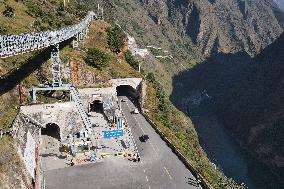
(231207) -- JINPING, Dec. 7, 2023 (Xinhua) -- This aerial photo taken on Nov. 8, 2023 shows the tunnel entrance of the China Jinping Underground Laboratory in Liangshan Yi Autonomous Prefecture, southwest China's Sichuan Province. A 2,400-meter-deep physics laboratory in southwest China's Sichuan Province became operational on Thursday, making it the deepest and largest underground lab in the world. Scientists believe the laboratory provides a "clean" space for them to pursue the invisible substance known as dark matter. They said the extreme depth helps block most cosmic rays that mess with the observation. The Deep Underground and Ultra-low Radiation Background Facility for Frontier Physics Experiments (DURF) is located beneath Jinping Mountain in Sichuan's Liangshan Yi Autonomous Prefecture. The DURF, with a total room capacity of 330,000 cubic meters, is the second phase of China Jinping Underground Laboratory. It started construction in December 2020 and was jointly built by Tsinghua University and Yalon

  •  
(EyesonSci)CHINA-SICHUAN-UNDERGROUND LAB-OPERATION (CN)

(EyesonSci)CHINA-SICHUAN-UNDERGROUND LAB-OPERATION (CN)

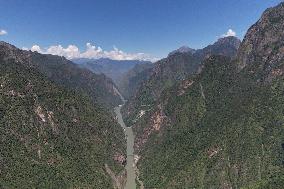
(231207) -- JINPING, Dec. 7, 2023 (Xinhua) -- This aerial photo taken on Sept. 15, 2023 shows the Jinping Mountain in Liangshan Yi Autonomous Prefecture of southwest China's Sichuan Province. A 2,400-meter-deep physics laboratory in southwest China's Sichuan Province became operational on Thursday, making it the deepest and largest underground lab in the world. Scientists believe the laboratory provides a "clean" space for them to pursue the invisible substance known as dark matter. They said the extreme depth helps block most cosmic rays that mess with the observation. The Deep Underground and Ultra-low Radiation Background Facility for Frontier Physics Experiments (DURF) is located beneath Jinping Mountain in Sichuan's Liangshan Yi Autonomous Prefecture. The DURF, with a total room capacity of 330,000 cubic meters, is the second phase of China Jinping Underground Laboratory. It started construction in December 2020 and was jointly built by Tsinghua University and Yalong River Hydropower Development Company,

  •  
(EyesonSci)CHINA-SICHUAN-UNDERGROUND LAB-OPERATION (CN)

(EyesonSci)CHINA-SICHUAN-UNDERGROUND LAB-OPERATION (CN)

(231207) -- JINPING, Dec. 7, 2023 (Xinhua) -- This photo taken on Nov. 7, 2023 shows the interior view of the first phase of China Jinping Underground Laboratory in Liangshan Yi Autonomous Prefecture of southwest China's Sichuan Province. A 2,400-meter-deep physics laboratory in southwest China's Sichuan Province became operational on Thursday, making it the deepest and largest underground lab in the world. Scientists believe the laboratory provides a "clean" space for them to pursue the invisible substance known as dark matter. They said the extreme depth helps block most cosmic rays that mess with the observation. The Deep Underground and Ultra-low Radiation Background Facility for Frontier Physics Experiments (DURF) is located beneath Jinping Mountain in Sichuan's Liangshan Yi Autonomous Prefecture. The DURF, with a total room capacity of 330,000 cubic meters, is the second phase of China Jinping Underground Laboratory. It started construction in December 2020 and was jointly built by Tsinghua University a

  •  
(EyesonSci)CHINA-SICHUAN-UNDERGROUND LAB-OPERATIONAL (CN)

(EyesonSci)CHINA-SICHUAN-UNDERGROUND LAB-OPERATIONAL (CN)

(231207) -- CHENGDU, Dec. 7, 2023 (Xinhua) -- This photo taken on Nov. 7, 2023 shows the first phase of the China Jinping Underground Laboratory in Liangshan Yi Autonomous Prefecture, southwest China's Sichuan Province. A 2,400-meter-deep physics laboratory in southwest China's Sichuan Province became operational on Thursday, making it the deepest and largest underground lab in the world. Scientists believe the laboratory provides a "clean" space for them to pursue the invisible substance known as dark matter. They said the extreme depth helps block most cosmic rays that mess with the observation. (Xinhua/Xu Bingjie)

  •  
(EyesonSci)CHINA-SICHUAN-UNDERGROUND LAB-OPERATIONAL (CN)

(EyesonSci)CHINA-SICHUAN-UNDERGROUND LAB-OPERATIONAL (CN)

(231207) -- CHENGDU, Dec. 7, 2023 (Xinhua) -- This aerial photo taken on Nov. 8, 2023 shows the tunnel entrance of the China Jinping Underground Laboratory in Liangshan Yi Autonomous Prefecture, southwest China's Sichuan Province. A 2,400-meter-deep physics laboratory in southwest China's Sichuan Province became operational on Thursday, making it the deepest and largest underground lab in the world. Scientists believe the laboratory provides a "clean" space for them to pursue the invisible substance known as dark matter. They said the extreme depth helps block most cosmic rays that mess with the observation. (Xinhua/Xu Bingjie)

  •  
(EyesonSci)CHINA-SICHUAN-UNDERGROUND LAB-OPERATIONAL (CN)

(EyesonSci)CHINA-SICHUAN-UNDERGROUND LAB-OPERATIONAL (CN)

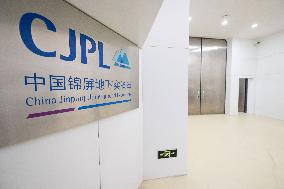
(231207) -- CHENGDU, Dec. 7, 2023 (Xinhua) -- This photo taken on Nov. 7, 2023 shows an interior view of the China Jinping Underground Laboratory in Liangshan Yi Autonomous Prefecture, southwest China's Sichuan Province. A 2,400-meter-deep physics laboratory in southwest China's Sichuan Province became operational on Thursday, making it the deepest and largest underground lab in the world. Scientists believe the laboratory provides a "clean" space for them to pursue the invisible substance known as dark matter. They said the extreme depth helps block most cosmic rays that mess with the observation. (Xinhua/Xu Bingjie)

  •  
(EyesonSci)CHINA-SICHUAN-UNDERGROUND LAB-OPERATIONAL (CN)

(EyesonSci)CHINA-SICHUAN-UNDERGROUND LAB-OPERATIONAL (CN)

(231207) -- CHENGDU, Dec. 7, 2023 (Xinhua) -- This photo taken on Nov. 8, 2023 shows the tunnel entrance of China Jinping Underground Laboratory in Liangshan Yi Autonomous Prefecture, southwest China's Sichuan Province. A 2,400-meter-deep physics laboratory in southwest China's Sichuan Province became operational on Thursday, making it the deepest and largest underground lab in the world. Scientists believe the laboratory provides a "clean" space for them to pursue the invisible substance known as dark matter. They said the extreme depth helps block most cosmic rays that mess with the observation. (Xinhua/Xu Bingjie)

  •  

World's deepest, largest underground lab operational in China

STORY: World's deepest, largest underground lab operational in China SHOOTING TIME: Dec. 6, 2023 DATELINE: Dec. 7, 2023 LENGTH: 0:00:23 LOCATION: CHENGDU, China CATEGORY: TECHNOLOGY SHOTLIST: 1. various of Jinping Mountain 2. various of the underground passage to the scientific research center 3. various of the underground lab STORYLINE: A 2,400-meter-deep physics laboratory in southwest China's Sichuan Province became operational on Thursday, making it the deepest and largest underground lab in the world. Scientists believe the laboratory provides a "clean" space for them to pursue the invisible substance known as dark matter. They said the extreme depth helps block most cosmic rays that mess with the observation. The Deep Underground and Ultra-low Radiation Background Facility for Frontier Physics Experiments (DURF) is located beneath Jinping Mountain in Sichuan's Liangshan Yi Autonomous Prefecture. The DURF, with a total room capacity of 330,000 cubic meters, is the second phase of China Jinping Unde

  •  
Japan Tokusatsu IP Exhibition in Shanghai

Japan Tokusatsu IP Exhibition in Shanghai

SHANGHAI, CHINA - DECEMBER 2, 2023 - A 5-meter sculpture of cosmic heroes Ultraman Tiga, Ultraman Dyna and Ultraman Gaia in the outdoor square of a shopping mall in Shanghai, China, December 2, 2023.

  •  
Japan Tokusatsu IP Exhibition in Shanghai

Japan Tokusatsu IP Exhibition in Shanghai

SHANGHAI, CHINA - DECEMBER 2, 2023 - A 5-meter sculpture of cosmic heroes Ultraman Tiga, Ultraman Dyna and Ultraman Gaia in the outdoor square of a shopping mall in Shanghai, China, December 2, 2023.

  •  
Japan Tokusatsu IP Exhibition in Shanghai

Japan Tokusatsu IP Exhibition in Shanghai

SHANGHAI, CHINA - DECEMBER 2, 2023 - A 5-meter sculpture of cosmic heroes Ultraman Tiga, Ultraman Dyna and Ultraman Gaia in the outdoor square of a shopping mall in Shanghai, China, December 2, 2023.

  •  
(EyesonSci) CHINA-LHAASO-ENERGY SPECTRUM-GAMA-RAY RADIATION (CN)

(EyesonSci) CHINA-LHAASO-ENERGY SPECTRUM-GAMA-RAY RADIATION (CN)

(231117) -- BEIJING, Nov. 17, 2023 (Xinhua) -- This aerial photo taken on April 21, 2023 shows the Large High Altitude Air Shower Observatory (LHAASO) about 4,410 meters above sea level in southwest China's Sichuan Province. China's Large High Altitude Air Shower Observatory (LHAASO), a high-altitude cosmic ray observatory, has released the precise energy spectrum for the highest-energy gamma-ray radiation from the brightest gamma-ray burst (GRB) observed to date. The study, conducted by the LHAASO collaboration team, was led by the Institute of High Energy Physics of the Chinese Academy of Sciences, and the findings were published recently in the journal Science Advances. TO GO WITH "Across China: China's cosmic ray observatory releases energy spectrum for highest-energy gamma ray" (Xinhua/Jin Liwang)

  •  
(EyesonSci) CHINA-LHAASO-ENERGY SPECTRUM-GAMA-RAY RADIATION (CN)

(EyesonSci) CHINA-LHAASO-ENERGY SPECTRUM-GAMA-RAY RADIATION (CN)

(231117) -- BEIJING, Nov. 17, 2023 (Xinhua) -- Chen Songzhan, the corresponding author of the study and a researcher at the Institute of High Energy Physics (IHEP) of the Chinese Academy of Sciences, introduces research findings at the IHEP of the Chinese Academy of Sciences in Beijing, capital of China, on Nov. 14, 2023. China's Large High Altitude Air Shower Observatory (LHAASO), a high-altitude cosmic ray observatory, has released the precise energy spectrum for the highest-energy gamma-ray radiation from the brightest gamma-ray burst (GRB) observed to date. The study, conducted by the LHAASO collaboration team, was led by the Institute of High Energy Physics of the Chinese Academy of Sciences, and the findings were published recently in the journal Science Advances. TO GO WITH "Across China: China's cosmic ray observatory releases energy spectrum for highest-energy gamma ray" (Xinhua/Jin Liwang)

  •  
(EyesonSci) CHINA-LHAASO-ENERGY SPECTRUM-GAMA-RAY RADIATION (CN)

(EyesonSci) CHINA-LHAASO-ENERGY SPECTRUM-GAMA-RAY RADIATION (CN)

(231117) -- BEIJING, Nov. 17, 2023 (Xinhua) -- This composite photo taken on April 21, 2023 shows the Large High Altitude Air Shower Observatory (LHAASO) about 4,410 meters above sea level in southwest China's Sichuan Province. China's Large High Altitude Air Shower Observatory (LHAASO), a high-altitude cosmic ray observatory, has released the precise energy spectrum for the highest-energy gamma-ray radiation from the brightest gamma-ray burst (GRB) observed to date. The study, conducted by the LHAASO collaboration team, was led by the Institute of High Energy Physics of the Chinese Academy of Sciences, and the findings were published recently in the journal Science Advances. TO GO WITH "Across China: China's cosmic ray observatory releases energy spectrum for highest-energy gamma ray" (Xinhua/Jin Liwang)

  •  
(EyesonSci) CHINA-LHAASO-ENERGY SPECTRUM-GAMA-RAY RADIATION (CN)

(EyesonSci) CHINA-LHAASO-ENERGY SPECTRUM-GAMA-RAY RADIATION (CN)

(231117) -- BEIJING, Nov. 17, 2023 (Xinhua) -- Chen Songzhan, the corresponding author of the study and a researcher at the Institute of High Energy Physics (IHEP) of the Chinese Academy of Sciences, introduces research findings at the IHEP of the Chinese Academy of Sciences in Beijing, capital of China, on Nov. 14, 2023. China's Large High Altitude Air Shower Observatory (LHAASO), a high-altitude cosmic ray observatory, has released the precise energy spectrum for the highest-energy gamma-ray radiation from the brightest gamma-ray burst (GRB) observed to date. The study, conducted by the LHAASO collaboration team, was led by the Institute of High Energy Physics of the Chinese Academy of Sciences, and the findings were published recently in the journal Science Advances. TO GO WITH "Across China: China's cosmic ray observatory releases energy spectrum for highest-energy gamma ray" (Xinhua/Jin Liwang)

  •  
NASA X-ray Telescopes Reveal the 'Bones' of a Ghostly Cosmic Hand

NASA X-ray Telescopes Reveal the 'Bones' of a Ghostly Cosmic Hand

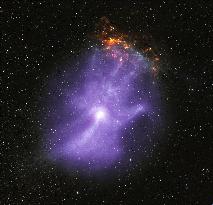
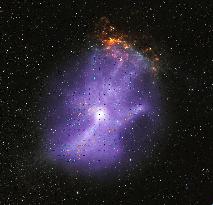
Handout - New composite image showing pulsar wind nebula (referred to as MSH 15-52) resembling a human hand, combining Chandra telescope data (seen in orange (low-energy X-rays), green, and blue (higher-energy X-rays)), while the diffuse purple represents the IXPE X-ray telescope observations. Scientists say they have revealed the "bones" of a ghostly cosmic hand. Two of NASA’s X-ray space telescopes have combined their imaging powers to unveil the magnetic field “bones” of a remarkable hand-shaped structure in space. The space agency says that together these telescopes reveal the behaviour of a dead collapsed star that lives on through plumes of particles of energised matter and antimatter. In 2001, NASA’s Chandra X-ray Observatory first observed the pulsar PSR B1509-58 and revealed that its pulsar wind nebula (referred to as MSH 15-52) resembles a human hand. The pulsar is located at the base of the “palm” of the nebula, while MSH 15-52 is located 16,000 light-years from Earth. Now, NASA’s newest X-ray tele

  •  
NASA X-ray Telescopes Reveal the 'Bones' of a Ghostly Cosmic Hand

NASA X-ray Telescopes Reveal the 'Bones' of a Ghostly Cosmic Hand

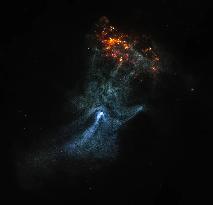
Handout - New composite image showing pulsar wind nebula (referred to as MSH 15-52) resembling a human hand, combining Chandra telescope data (seen in orange (low-energy X-rays), green, and blue (higher-energy X-rays)), while the diffuse purple represents the IXPE X-ray telescope observations. This image shows vectors that represent the magnetic field “bones” revealed by the two X-ray space telescopes. Scientists say they have revealed the "bones" of a ghostly cosmic hand. Two of NASA’s X-ray space telescopes have combined their imaging powers to unveil the magnetic field “bones” of a remarkable hand-shaped structure in space. The space agency says that together these telescopes reveal the behaviour of a dead collapsed star that lives on through plumes of particles of energised matter and antimatter. In 2001, NASA’s Chandra X-ray Observatory first observed the pulsar PSR B1509-58 and revealed that its pulsar wind nebula (referred to as MSH 15-52) resembles a human hand. The pulsar is located at the base of th

  •  
NASA X-ray Telescopes Reveal the 'Bones' of a Ghostly Cosmic Hand

NASA X-ray Telescopes Reveal the 'Bones' of a Ghostly Cosmic Hand

Handout - In 2001, NASA’s Chandra X-ray Observatory first observed the pulsar PSR B1509-58 and revealed that its pulsar wind nebula (referred to as MSH 15-52) resembles a human hand. Scientists say they have revealed the "bones" of a ghostly cosmic hand. Two of NASA’s X-ray space telescopes have combined their imaging powers to unveil the magnetic field “bones” of a remarkable hand-shaped structure in space. The space agency says that together these telescopes reveal the behaviour of a dead collapsed star that lives on through plumes of particles of energised matter and antimatter. In 2001, NASA’s Chandra X-ray Observatory first observed the pulsar PSR B1509-58 and revealed that its pulsar wind nebula (referred to as MSH 15-52) resembles a human hand. The pulsar is located at the base of the “palm” of the nebula, while MSH 15-52 is located 16,000 light-years from Earth. Now, NASA’s newest X-ray telescope, the Imaging X-ray Polarimetry Explorer (IXPE), has observed MSH 15-52 for about 17 days, the longest it h

  •  
CHINA-YUNNAN-SPACE BREEDING-NEW FLOWER SPECIES (CN)

CHINA-YUNNAN-SPACE BREEDING-NEW FLOWER SPECIES (CN)

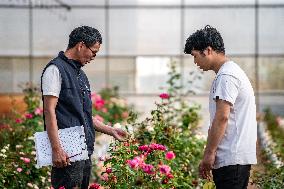
(231028) -- KUNMING, Oct. 28, 2023 (Xinhua) -- Tian Liantong (L) talks with his colleague at a roses plantation demonstration garden of a modern agricultural park in Anning City, southwest China's Yunnan Province on Oct. 20, 2023. In August of 2022, over 8,000 flower seeds arrived at Yunnan Jinke Flower Engineering Research Center Co., Ltd. after their spaceflight trip aboard Shenzhou manned spaceship. Space breeding refers to exposing seeds or strains to cosmic radiation and microgravity in space to mutate their genes, so as to create new species or varieties with greater performances like shorter growth periods, higher yield and better resistance to diseases. According to Tian Liantong, a technologist of Jinke Flower Engineering Research Center Co., Ltd., usually it takes five years to breed new flower species which consumers could buy on market, and some species even need ten years to go through the process from breeding to becoming commodity, as they have to pass various and harsh growth conditions

  •  
CHINA-YUNNAN-SPACE BREEDING-NEW FLOWER SPECIES (CN)

CHINA-YUNNAN-SPACE BREEDING-NEW FLOWER SPECIES (CN)

(231028) -- KUNMING, Oct. 28, 2023 (Xinhua) -- Tian Liantong takes notes of the condition of roses at a roses plantation demonstration garden of a modern agricultural park in Anning City, southwest China's Yunnan Province on Oct. 20, 2023. In August of 2022, over 8,000 flower seeds arrived at Yunnan Jinke Flower Engineering Research Center Co., Ltd. after their spaceflight trip aboard Shenzhou manned spaceship. Space breeding refers to exposing seeds or strains to cosmic radiation and microgravity in space to mutate their genes, so as to create new species or varieties with greater performances like shorter growth periods, higher yield and better resistance to diseases. According to Tian Liantong, a technologist of Jinke Flower Engineering Research Center Co., Ltd., usually it takes five years to breed new flower species which consumers could buy on market, and some species even need ten years to go through the process from breeding to becoming commodity, as they have to pass various and harsh growth c

  •  
CHINA-YUNNAN-SPACE BREEDING-NEW FLOWER SPECIES (CN)

CHINA-YUNNAN-SPACE BREEDING-NEW FLOWER SPECIES (CN)

(231028) -- KUNMING, Oct. 28, 2023 (Xinhua) -- Tian Liantong breeds seeds brought back from space at a lab in Anning City, southwest China's Yunnan Province on April 3, 2023. In August of 2022, over 8,000 flower seeds arrived at Yunnan Jinke Flower Engineering Research Center Co., Ltd. after their spaceflight trip aboard Shenzhou manned spaceship. Space breeding refers to exposing seeds or strains to cosmic radiation and microgravity in space to mutate their genes, so as to create new species or varieties with greater performances like shorter growth periods, higher yield and better resistance to diseases. According to Tian Liantong, a technologist of Jinke Flower Engineering Research Center Co., Ltd., usually it takes five years to breed new flower species which consumers could buy on market, and some species even need ten years to go through the process from breeding to becoming commodity, as they have to pass various and harsh growth conditions including temperature, humidity and nutrition supply.

  •  
CHINA-YUNNAN-SPACE BREEDING-NEW FLOWER SPECIES (CN)

CHINA-YUNNAN-SPACE BREEDING-NEW FLOWER SPECIES (CN)

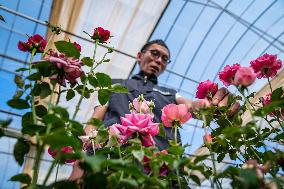
(231028) -- KUNMING, Oct. 28, 2023 (Xinhua) -- Tian Liantong checks roses at a roses plantation demonstration garden of a modern agricultural park in Anning City, southwest China's Yunnan Province on Oct. 20, 2023. In August of 2022, over 8,000 flower seeds arrived at Yunnan Jinke Flower Engineering Research Center Co., Ltd. after their spaceflight trip aboard Shenzhou manned spaceship. Space breeding refers to exposing seeds or strains to cosmic radiation and microgravity in space to mutate their genes, so as to create new species or varieties with greater performances like shorter growth periods, higher yield and better resistance to diseases. According to Tian Liantong, a technologist of Jinke Flower Engineering Research Center Co., Ltd., usually it takes five years to breed new flower species which consumers could buy on market, and some species even need ten years to go through the process from breeding to becoming commodity, as they have to pass various and harsh growth conditions including tempe

  •  
CHINA-YUNNAN-SPACE BREEDING-NEW FLOWER SPECIES (CN)

CHINA-YUNNAN-SPACE BREEDING-NEW FLOWER SPECIES (CN)

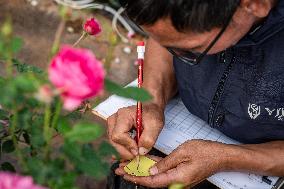
(231028) -- KUNMING, Oct. 28, 2023 (Xinhua) -- Tian Liantong takes notes of the serial numbers of roses at a roses plantation demonstration garden of a modern agricultural park in Anning City, southwest China's Yunnan Province on Oct. 20, 2023. In August of 2022, over 8,000 flower seeds arrived at Yunnan Jinke Flower Engineering Research Center Co., Ltd. after their spaceflight trip aboard Shenzhou manned spaceship. Space breeding refers to exposing seeds or strains to cosmic radiation and microgravity in space to mutate their genes, so as to create new species or varieties with greater performances like shorter growth periods, higher yield and better resistance to diseases. According to Tian Liantong, a technologist of Jinke Flower Engineering Research Center Co., Ltd., usually it takes five years to breed new flower species which consumers could buy on market, and some species even need ten years to go through the process from breeding to becoming commodity, as they have to pass various and harsh gro

  •  
CHINA-YUNNAN-SPACE BREEDING-NEW FLOWER SPECIES (CN)

CHINA-YUNNAN-SPACE BREEDING-NEW FLOWER SPECIES (CN)

(231028) -- KUNMING, Oct. 28, 2023 (Xinhua) -- Tian Liantong checks roses at a roses plantation demonstration garden of a modern agricultural park in Anning City, southwest China's Yunnan Province on Oct. 20, 2023. In August of 2022, over 8,000 flower seeds arrived at Yunnan Jinke Flower Engineering Research Center Co., Ltd. after their spaceflight trip aboard Shenzhou manned spaceship. Space breeding refers to exposing seeds or strains to cosmic radiation and microgravity in space to mutate their genes, so as to create new species or varieties with greater performances like shorter growth periods, higher yield and better resistance to diseases. According to Tian Liantong, a technologist of Jinke Flower Engineering Research Center Co., Ltd., usually it takes five years to breed new flower species which consumers could buy on market, and some species even need ten years to go through the process from breeding to becoming commodity, as they have to pass various and harsh growth conditions including tempe

  • Main
  • Top
  • Editorial
  • Creative
  • About Us
  • About ILG
  • Terms of use
  • Company
  • BEHIND
  • Price List
  • Single Plan
  • Monthly Plan
  • Services
  • Shooting
  • Rights Clearance
  • Support
  • FAQ
  • How To Buy
  • Contact Us
  • Become a Partner

© KYODO NEWS IMAGES INC

All Rights Reserved.

  • Editorial
  • Olympics
  • News
  • Sports
  • Japan
  • Tech
  • Royal
  • Disaster
  • NorthKorea
  • Old Japan
  • SNS

  • Creative
  • Food
  • Japan
  • Landscape
  • Animal
  • Popular
  • #Ukraine
  • #Russia
  • #coronavirus
  • #N. Korea
  • #Thailand
  • #China
  • #Ukraine
  • #Russia
  • #coronavirus
  • #N. Korea
  • #Thailand
  • #China
  • Food
  • Japan
  • Landscape
  • Animal
  • Olympics
  • News
  • Sports
  • Japan
  • Tech
  • Royal
  • Disaster
  • NorthKorea
  • Old Japan
  • SNS