•  

China: Hikers Rescue Woman Clinging to Cliff in Shanxi

On October 3, 2025, in Changzhi, Shanxi, hikers rescued a woman who slipped and clung to a tree branch above a steep cliff. Using makeshift ropes from torn blankets, they safely pulled her up after about 30 tense minutes.

  •  
CHINA-SHANXI-CHANGZHI-HOMESTAY OWNER-MILLET FIELDS (CN)

CHINA-SHANXI-CHANGZHI-HOMESTAY OWNER-MILLET FIELDS (CN)

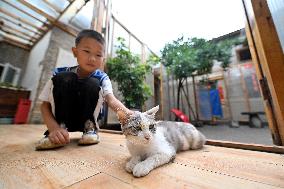
(240730) -- CHANGZHI, July 30, 2024 Photo by Xinhua/ABACAPRESS.COM) -- A boy interacts with a cat at Wei Meiling's homestay in Langshuyuan Village, Changzhi City of north China's Shanxi Province, July 25, 2024. Changzhi City, located in the southeast of Shanxi Province, has a long history of millet planting. Wei Meiling, 44 years old, who had been worked in the millet fields with her parents since her childhood, returned to her hometown in 2015 after years of working in the city. Here in Changzhi City, she set up a cooperative which now owns more than 2,000 mu (about 133.3 hectares) of millet fields, and has helped 800 plus villagers increase their incomes. She often does livestreaming in the millet fields to introduce and promote local millet products, attracting many customers by the stunning natural scenery. She opened a homestay in 2023, which was transformed from her old houses. The homestay is popular among tourists especially during vacations. Wei also plans to expand the millet planting area, while in

  •  
CHINA-SHANXI-CHANGZHI-HOMESTAY OWNER-MILLET FIELDS (CN)

CHINA-SHANXI-CHANGZHI-HOMESTAY OWNER-MILLET FIELDS (CN)

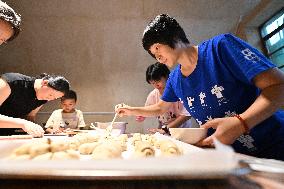
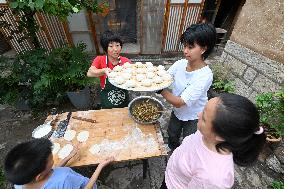
(240730) -- CHANGZHI, July 30, 2024 Photo by Xinhua/ABACAPRESS.COM) -- Wei Meiling (1st, R) makes bread with customers at her homestay in Langshuyuan Village, Changzhi City of north China's Shanxi Province, July 23, 2024. Changzhi City, located in the southeast of Shanxi Province, has a long history of millet planting. Wei Meiling, 44 years old, who had been worked in the millet fields with her parents since her childhood, returned to her hometown in 2015 after years of working in the city. Here in Changzhi City, she set up a cooperative which now owns more than 2,000 mu (about 133.3 hectares) of millet fields, and has helped 800 plus villagers increase their incomes. She often does livestreaming in the millet fields to introduce and promote local millet products, attracting many customers by the stunning natural scenery. She opened a homestay in 2023, which was transformed from her old houses. The homestay is popular among tourists especially during vacations. Wei also plans to expand the millet planting are

  •  
CHINA-SHANXI-CHANGZHI-HOMESTAY OWNER-MILLET FIELDS (CN)

CHINA-SHANXI-CHANGZHI-HOMESTAY OWNER-MILLET FIELDS (CN)

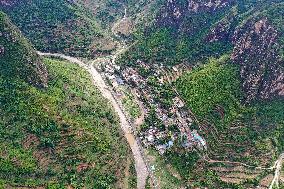
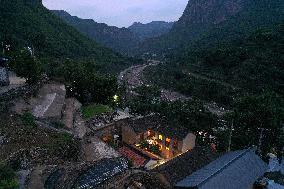
(240730) -- CHANGZHI, July 30, 2024 Photo by Xinhua/ABACAPRESS.COM) -- An aerial drone photo taken on July 24, 2024 shows the Langshuyuan Village, Changzhi City of north China's Shanxi Province. Changzhi City, located in the southeast of Shanxi Province, has a long history of millet planting. Wei Meiling, 44 years old, who had been worked in the millet fields with her parents since her childhood, returned to her hometown in 2015 after years of working in the city. Here in Changzhi City, she set up a cooperative which now owns more than 2,000 mu (about 133.3 hectares) of millet fields, and has helped 800 plus villagers increase their incomes. She often does livestreaming in the millet fields to introduce and promote local millet products, attracting many customers by the stunning natural scenery. She opened a homestay in 2023, which was transformed from her old houses. The homestay is popular among tourists especially during vacations. Wei also plans to expand the millet planting area, while integrating the lo

  •  
CHINA-SHANXI-CHANGZHI-HOMESTAY OWNER-MILLET FIELDS (CN)

CHINA-SHANXI-CHANGZHI-HOMESTAY OWNER-MILLET FIELDS (CN)

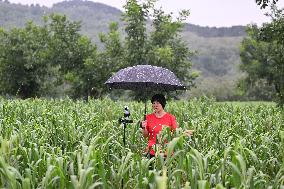
(240730) -- CHANGZHI, July 30, 2024 Photo by Xinhua/ABACAPRESS.COM) -- Wei Meiling introduces the growth of millet via livestreaming in Yanjing Village, Changzhi City of north China's Shanxi Province, July 25, 2024. Changzhi City, located in the southeast of Shanxi Province, has a long history of millet planting. Wei Meiling, 44 years old, who had been worked in the millet fields with her parents since her childhood, returned to her hometown in 2015 after years of working in the city. Here in Changzhi City, she set up a cooperative which now owns more than 2,000 mu (about 133.3 hectares) of millet fields, and has helped 800 plus villagers increase their incomes. She often does livestreaming in the millet fields to introduce and promote local millet products, attracting many customers by the stunning natural scenery. She opened a homestay in 2023, which was transformed from her old houses. The homestay is popular among tourists especially during vacations. Wei also plans to expand the millet planting area, whi

  •  
CHINA-SHANXI-CHANGZHI-HOMESTAY OWNER-MILLET FIELDS (CN)

CHINA-SHANXI-CHANGZHI-HOMESTAY OWNER-MILLET FIELDS (CN)

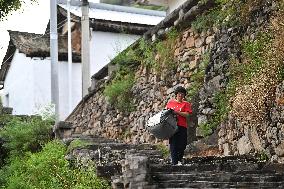
(240730) -- CHANGZHI, July 30, 2024 Photo by Xinhua/ABACAPRESS.COM) -- Wei Meiling carries bedding for cleaning in Langshuyuan Village, Changzhi City of north China's Shanxi Province, July 24, 2024. Changzhi City, located in the southeast of Shanxi Province, has a long history of millet planting. Wei Meiling, 44 years old, who had been worked in the millet fields with her parents since her childhood, returned to her hometown in 2015 after years of working in the city. Here in Changzhi City, she set up a cooperative which now owns more than 2,000 mu (about 133.3 hectares) of millet fields, and has helped 800 plus villagers increase their incomes. She often does livestreaming in the millet fields to introduce and promote local millet products, attracting many customers by the stunning natural scenery. She opened a homestay in 2023, which was transformed from her old houses. The homestay is popular among tourists especially during vacations. Wei also plans to expand the millet planting area, while integrating th

  •  
CHINA-SHANXI-CHANGZHI-HOMESTAY OWNER-MILLET FIELDS (CN)

CHINA-SHANXI-CHANGZHI-HOMESTAY OWNER-MILLET FIELDS (CN)

(240730) -- CHANGZHI, July 30, 2024 Photo by Xinhua/ABACAPRESS.COM) -- An aerial drone photo taken on July 24, 2024 shows Wei Meiling's homestay in Langshuyuan Village, Changzhi City of north China's Shanxi Province. Changzhi City, located in the southeast of Shanxi Province, has a long history of millet planting. Wei Meiling, 44 years old, who had been worked in the millet fields with her parents since her childhood, returned to her hometown in 2015 after years of working in the city. Here in Changzhi City, she set up a cooperative which now owns more than 2,000 mu (about 133.3 hectares) of millet fields, and has helped 800 plus villagers increase their incomes. She often does livestreaming in the millet fields to introduce and promote local millet products, attracting many customers by the stunning natural scenery. She opened a homestay in 2023, which was transformed from her old houses. The homestay is popular among tourists especially during vacations. Wei also plans to expand the millet planting area, wh

  •  
CHINA-SHANXI-CHANGZHI-HOMESTAY OWNER-MILLET FIELDS (CN)

CHINA-SHANXI-CHANGZHI-HOMESTAY OWNER-MILLET FIELDS (CN)

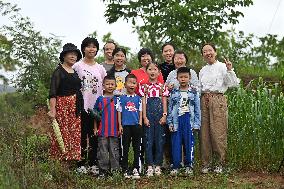
(240730) -- CHANGZHI, July 30, 2024 Photo by Xinhua/ABACAPRESS.COM) -- Wei Meiling (4th R, back) poses for a photo with customers and a staff member of her homestay (1st R) in a millet field in Yanjing Village, Changzhi City of north China's Shanxi Province, July 25, 2024. Changzhi City, located in the southeast of Shanxi Province, has a long history of millet planting. Wei Meiling, 44 years old, who had been worked in the millet fields with her parents since her childhood, returned to her hometown in 2015 after years of working in the city. Here in Changzhi City, she set up a cooperative which now owns more than 2,000 mu (about 133.3 hectares) of millet fields, and has helped 800 plus villagers increase their incomes. She often does livestreaming in the millet fields to introduce and promote local millet products, attracting many customers by the stunning natural scenery. She opened a homestay in 2023, which was transformed from her old houses. The homestay is popular among tourists especially during vacatio

  •  
CHINA-SHANXI-CHANGZHI-HOMESTAY OWNER-MILLET FIELDS (CN)

CHINA-SHANXI-CHANGZHI-HOMESTAY OWNER-MILLET FIELDS (CN)

(240730) -- CHANGZHI, July 30, 2024 Photo by Xinhua/ABACAPRESS.COM) -- Wei Meiling (L, back) makes steamed buns with customers at her homestay in Langshuyuan Village, Changzhi City of north China's Shanxi Province, July 24, 2024. Changzhi City, located in the southeast of Shanxi Province, has a long history of millet planting. Wei Meiling, 44 years old, who had been worked in the millet fields with her parents since her childhood, returned to her hometown in 2015 after years of working in the city. Here in Changzhi City, she set up a cooperative which now owns more than 2,000 mu (about 133.3 hectares) of millet fields, and has helped 800 plus villagers increase their incomes. She often does livestreaming in the millet fields to introduce and promote local millet products, attracting many customers by the stunning natural scenery. She opened a homestay in 2023, which was transformed from her old houses. The homestay is popular among tourists especially during vacations. Wei also plans to expand the millet plan

  •  
CHINA-SHANXI-CHANGZHI-HOMESTAY OWNER-MILLET FIELDS (CN)

CHINA-SHANXI-CHANGZHI-HOMESTAY OWNER-MILLET FIELDS (CN)

(240730) -- CHANGZHI, July 30, 2024 Photo by Xinhua/ABACAPRESS.COM) -- An aerial drone photo taken on July 26, 2024 shows the scenery of Taihang Mountains in Langshuyuan Village, Changzhi City of north China's Shanxi Province. Changzhi City, located in the southeast of Shanxi Province, has a long history of millet planting. Wei Meiling, 44 years old, who had been worked in the millet fields with her parents since her childhood, returned to her hometown in 2015 after years of working in the city. Here in Changzhi City, she set up a cooperative which now owns more than 2,000 mu (about 133.3 hectares) of millet fields, and has helped 800 plus villagers increase their incomes. She often does livestreaming in the millet fields to introduce and promote local millet products, attracting many customers by the stunning natural scenery. She opened a homestay in 2023, which was transformed from her old houses. The homestay is popular among tourists especially during vacations. Wei also plans to expand the millet plantin

  •  
CHINA-SHANXI-CHANGZHI-HOMESTAY OWNER-MILLET FIELDS (CN)

CHINA-SHANXI-CHANGZHI-HOMESTAY OWNER-MILLET FIELDS (CN)

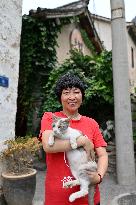
(240730) -- CHANGZHI, July 30, 2024 Photo by Xinhua/ABACAPRESS.COM) -- Wei Meiling poses for a photo in front of her homestay in Langshuyuan Village, Changzhi City of north China's Shanxi Province, July 24, 2024. Changzhi City, located in the southeast of Shanxi Province, has a long history of millet planting. Wei Meiling, 44 years old, who had been worked in the millet fields with her parents since her childhood, returned to her hometown in 2015 after years of working in the city. Here in Changzhi City, she set up a cooperative which now owns more than 2,000 mu (about 133.3 hectares) of millet fields, and has helped 800 plus villagers increase their incomes. She often does livestreaming in the millet fields to introduce and promote local millet products, attracting many customers by the stunning natural scenery. She opened a homestay in 2023, which was transformed from her old houses. The homestay is popular among tourists especially during vacations. Wei also plans to expand the millet planting area, while

  •  
CHINA-SHANXI-CHANGZHI-HOMESTAY OWNER-MILLET FIELDS (CN)

CHINA-SHANXI-CHANGZHI-HOMESTAY OWNER-MILLET FIELDS (CN)

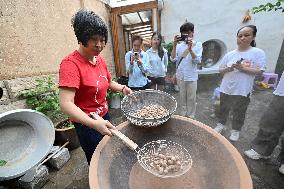
(240730) -- CHANGZHI, July 30, 2024 Photo by Xinhua/ABACAPRESS.COM) -- Wei Meiling (front) makes traditional local food for customers at her homestay in Langshuyuan Village, Changzhi City of north China's Shanxi Province, July 24, 2024. Changzhi City, located in the southeast of Shanxi Province, has a long history of millet planting. Wei Meiling, 44 years old, who had been worked in the millet fields with her parents since her childhood, returned to her hometown in 2015 after years of working in the city. Here in Changzhi City, she set up a cooperative which now owns more than 2,000 mu (about 133.3 hectares) of millet fields, and has helped 800 plus villagers increase their incomes. She often does livestreaming in the millet fields to introduce and promote local millet products, attracting many customers by the stunning natural scenery. She opened a homestay in 2023, which was transformed from her old houses. The homestay is popular among tourists especially during vacations. Wei also plans to expand the mill

  •  
CHINA-SHANXI-CHANGZHI-HOMESTAY OWNER-MILLET FIELDS (CN)

CHINA-SHANXI-CHANGZHI-HOMESTAY OWNER-MILLET FIELDS (CN)

(240730) -- CHANGZHI, July 30, 2024 Photo by Xinhua/ABACAPRESS.COM) -- Wei Meiling carries baked bread for customers of her homestay in Langshuyuan Village, Changzhi City of north China's Shanxi Province, July 23, 2024. Changzhi City, located in the southeast of Shanxi Province, has a long history of millet planting. Wei Meiling, 44 years old, who had been worked in the millet fields with her parents since her childhood, returned to her hometown in 2015 after years of working in the city. Here in Changzhi City, she set up a cooperative which now owns more than 2,000 mu (about 133.3 hectares) of millet fields, and has helped 800 plus villagers increase their incomes. She often does livestreaming in the millet fields to introduce and promote local millet products, attracting many customers by the stunning natural scenery. She opened a homestay in 2023, which was transformed from her old houses. The homestay is popular among tourists especially during vacations. Wei also plans to expand the millet planting area,

  •  
CHINA-SHANXI-CHANGZHI-HOMESTAY OWNER-MILLET FIELDS (CN)

CHINA-SHANXI-CHANGZHI-HOMESTAY OWNER-MILLET FIELDS (CN)

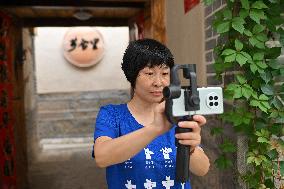
(240730) -- CHANGZHI, July 30, 2024 Photo by Xinhua/ABACAPRESS.COM) -- Wei Meiling introduces her homestay via livestreaming in Langshuyuan Village, Changzhi City of north China's Shanxi Province, July 24, 2024. Changzhi City, located in the southeast of Shanxi Province, has a long history of millet planting. Wei Meiling, 44 years old, who had been worked in the millet fields with her parents since her childhood, returned to her hometown in 2015 after years of working in the city. Here in Changzhi City, she set up a cooperative which now owns more than 2,000 mu (about 133.3 hectares) of millet fields, and has helped 800 plus villagers increase their incomes. She often does livestreaming in the millet fields to introduce and promote local millet products, attracting many customers by the stunning natural scenery. She opened a homestay in 2023, which was transformed from her old houses. The homestay is popular among tourists especially during vacations. Wei also plans to expand the millet planting area, while i

  •  
CHINA-SHANXI-CHANGZHI-HOMESTAY OWNER-MILLET FIELDS (CN)

CHINA-SHANXI-CHANGZHI-HOMESTAY OWNER-MILLET FIELDS (CN)

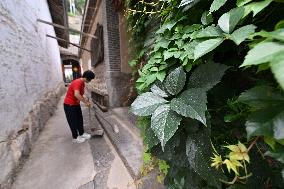
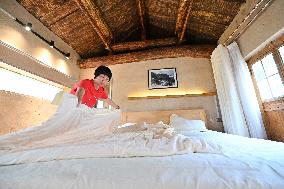
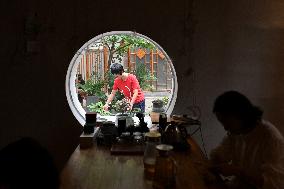
(240730) -- CHANGZHI, July 30, 2024 Photo by Xinhua/ABACAPRESS.COM) -- Wei Meiling cleans her homestay in Langshuyuan Village, Changzhi City of north China's Shanxi Province, July 24, 2024. Changzhi City, located in the southeast of Shanxi Province, has a long history of millet planting. Wei Meiling, 44 years old, who had been worked in the millet fields with her parents since her childhood, returned to her hometown in 2015 after years of working in the city. Here in Changzhi City, she set up a cooperative which now owns more than 2,000 mu (about 133.3 hectares) of millet fields, and has helped 800 plus villagers increase their incomes. She often does livestreaming in the millet fields to introduce and promote local millet products, attracting many customers by the stunning natural scenery. She opened a homestay in 2023, which was transformed from her old houses. The homestay is popular among tourists especially during vacations. Wei also plans to expand the millet planting area, while integrating the long-te

  •  
CHINA-SHANXI-CHANGZHI-HOMESTAY OWNER-MILLET FIELDS (CN)

CHINA-SHANXI-CHANGZHI-HOMESTAY OWNER-MILLET FIELDS (CN)

(240730) -- CHANGZHI, July 30, 2024 Photo by Xinhua/ABACAPRESS.COM) -- Wei Meiling makes bed at her homestay in Langshuyuan Village, Changzhi City of north China's Shanxi Province, July 24, 2024. Changzhi City, located in the southeast of Shanxi Province, has a long history of millet planting. Wei Meiling, 44 years old, who had been worked in the millet fields with her parents since her childhood, returned to her hometown in 2015 after years of working in the city. Here in Changzhi City, she set up a cooperative which now owns more than 2,000 mu (about 133.3 hectares) of millet fields, and has helped 800 plus villagers increase their incomes. She often does livestreaming in the millet fields to introduce and promote local millet products, attracting many customers by the stunning natural scenery. She opened a homestay in 2023, which was transformed from her old houses. The homestay is popular among tourists especially during vacations. Wei also plans to expand the millet planting area, while integrating the l

  •  
CHINA-SHANXI-CHANGZHI-HOMESTAY OWNER-MILLET FIELDS (CN)

CHINA-SHANXI-CHANGZHI-HOMESTAY OWNER-MILLET FIELDS (CN)

(240730) -- CHANGZHI, July 30, 2024 Photo by Xinhua/ABACAPRESS.COM) -- Wei Meiling cleans her homestay in Langshuyuan Village, Changzhi City of north China's Shanxi Province, July 24, 2024. Changzhi City, located in the southeast of Shanxi Province, has a long history of millet planting. Wei Meiling, 44 years old, who had been worked in the millet fields with her parents since her childhood, returned to her hometown in 2015 after years of working in the city. Here in Changzhi City, she set up a cooperative which now owns more than 2,000 mu (about 133.3 hectares) of millet fields, and has helped 800 plus villagers increase their incomes. She often does livestreaming in the millet fields to introduce and promote local millet products, attracting many customers by the stunning natural scenery. She opened a homestay in 2023, which was transformed from her old houses. The homestay is popular among tourists especially during vacations. Wei also plans to expand the millet planting area, while integrating the long-te

  •  
CHINA-SHANXI-TAIHANG MOUNTAIN-SCENERY (CN)

CHINA-SHANXI-TAIHANG MOUNTAIN-SCENERY (CN)

(240726) -- CHANGZHI, July 26, 2024 Photo by Xinhua/ABACAPRESS.COM) -- An aerial drone photo taken on July 26, 2024 shows a view of the Taihang Mountain in Pingshun County, Changzhi City of north China's Shanxi Province. Photo by Xinhua/ABACAPRESS.COM/Zhan Yan)

  •  
CHINA-SHANXI-TAIHANG MOUNTAIN-SCENERY (CN)

CHINA-SHANXI-TAIHANG MOUNTAIN-SCENERY (CN)

(240726) -- CHANGZHI, July 26, 2024 Photo by Xinhua/ABACAPRESS.COM) -- An aerial drone photo taken on July 24, 2024 shows a view of the Taihang Mountain in Pingshun County, Changzhi City of north China's Shanxi Province. Photo by Xinhua/ABACAPRESS.COM/Zhan Yan)

  •  
CHINA-SHANXI-TAIHANG MOUNTAIN-SCENERY (CN)

CHINA-SHANXI-TAIHANG MOUNTAIN-SCENERY (CN)

(240726) -- CHANGZHI, July 26, 2024 Photo by Xinhua/ABACAPRESS.COM) -- An aerial drone photo taken on July 26, 2024 shows a view of the Taihang Mountain in Pingshun County, Changzhi City of north China's Shanxi Province. Photo by Xinhua/ABACAPRESS.COM/Zhan Yan)

  •  
CHINA-SHANXI-TAIHANG MOUNTAIN-SCENERY (CN)

CHINA-SHANXI-TAIHANG MOUNTAIN-SCENERY (CN)

(240726) -- CHANGZHI, July 26, 2024 Photo by Xinhua/ABACAPRESS.COM) -- An aerial drone photo taken on July 24, 2024 shows a view of the Taihang Mountain in Pingshun County, Changzhi City of north China's Shanxi Province. Photo by Xinhua/ABACAPRESS.COM/Zhan Yan)

  •  
CHINA-SHANXI-TAIHANG MOUNTAIN-SCENERY (CN)

CHINA-SHANXI-TAIHANG MOUNTAIN-SCENERY (CN)

(240726) -- CHANGZHI, July 26, 2024 Photo by Xinhua/ABACAPRESS.COM) -- An aerial drone photo taken on July 26, 2024 shows a view of the Taihang Mountain in Pingshun County, Changzhi City of north China's Shanxi Province. Photo by Xinhua/ABACAPRESS.COM/Zhan Yan)

  •  
CHINA-SHANXI-TAIHANG MOUNTAIN-SCENERY (CN)

CHINA-SHANXI-TAIHANG MOUNTAIN-SCENERY (CN)

(240726) -- CHANGZHI, July 26, 2024 Photo by Xinhua/ABACAPRESS.COM) -- An aerial drone photo taken on July 26, 2024 shows a view of the Taihang Mountain in Pingshun County, Changzhi City of north China's Shanxi Province. Photo by Xinhua/ABACAPRESS.COM/Zhan Yan)

  •  
(MASTER OF CRAFTS)CHINA-SHANXI-COLOR PORCELAIN-INHERITOR (CN)

(MASTER OF CRAFTS)CHINA-SHANXI-COLOR PORCELAIN-INHERITOR (CN)

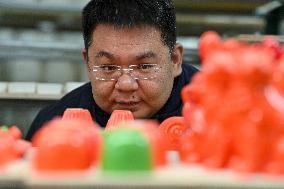
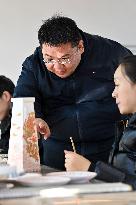
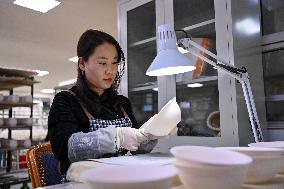
(240112) -- SHANGDANG, Jan. 12, 2024 (Xinhua) -- Li Yamin (L) talks with a craftsman at a production base of Honglyucai (Red and Green Color) Porcelain in Honglyucai Village, Changzhi City of north China's Shanxi Province, Jan. 4, 2024. The Honglyucai (Red and Green Color) Porcelain of Bayi kiln was originated from the Song Dynasty (960-1279) and became popular in the Jin Dynasty (1115-1234). Its pioneering twice-firing technique allows the use of multiple colors on one piece of porcelain, which is regarded as a major breakthrough in China's porcelain history. To make a Honglyucai porcelain item, it needs to go through 72 procedures, which is so complicated that the technique was almost lost in the 1980's. In 2021, the crafts of making Honglyucai Porcelain of Bayi kiln was listed as a national intangible cultural heritage. Li Yamin, a native in the Honglyucai Village of Bayi Town, is an inheritor of the craft. Under the influence of his father Li Jianping, a provincial-level inheritor of the craft, Li

  •  
(MASTER OF CRAFTS)CHINA-SHANXI-COLOR PORCELAIN-INHERITOR (CN)

(MASTER OF CRAFTS)CHINA-SHANXI-COLOR PORCELAIN-INHERITOR (CN)

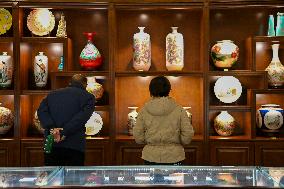
(240112) -- SHANGDANG, Jan. 12, 2024 (Xinhua) -- People visit a Honglyucai (Red and Green Color) Porcelain museum in Honglyucai Village, Changzhi City of north China's Shanxi Province, Jan. 4, 2024. The Honglyucai (Red and Green Color) Porcelain of Bayi kiln was originated from the Song Dynasty (960-1279) and became popular in the Jin Dynasty (1115-1234). Its pioneering twice-firing technique allows the use of multiple colors on one piece of porcelain, which is regarded as a major breakthrough in China's porcelain history. To make a Honglyucai porcelain item, it needs to go through 72 procedures, which is so complicated that the technique was almost lost in the 1980's. In 2021, the crafts of making Honglyucai Porcelain of Bayi kiln was listed as a national intangible cultural heritage. Li Yamin, a native in the Honglyucai Village of Bayi Town, is an inheritor of the craft. Under the influence of his father Li Jianping, a provincial-level inheritor of the craft, Li Yamin started to learn porcelain makin

  •  
(MASTER OF CRAFTS)CHINA-SHANXI-COLOR PORCELAIN-INHERITOR (CN)

(MASTER OF CRAFTS)CHINA-SHANXI-COLOR PORCELAIN-INHERITOR (CN)

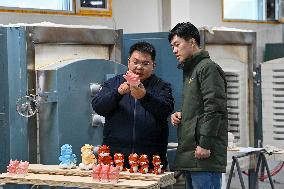
(240112) -- SHANGDANG, Jan. 12, 2024 (Xinhua) -- Li Yamin checks the finished products at a production base of Honglyucai (Red and Green Color) Porcelain in Honglyucai Village, Changzhi City of north China's Shanxi Province, Jan. 3, 2024. The Honglyucai (Red and Green Color) Porcelain of Bayi kiln was originated from the Song Dynasty (960-1279) and became popular in the Jin Dynasty (1115-1234). Its pioneering twice-firing technique allows the use of multiple colors on one piece of porcelain, which is regarded as a major breakthrough in China's porcelain history. To make a Honglyucai porcelain item, it needs to go through 72 procedures, which is so complicated that the technique was almost lost in the 1980's. In 2021, the crafts of making Honglyucai Porcelain of Bayi kiln was listed as a national intangible cultural heritage. Li Yamin, a native in the Honglyucai Village of Bayi Town, is an inheritor of the craft. Under the influence of his father Li Jianping, a provincial-level inheritor of the craft, L

  •  
(MASTER OF CRAFTS)CHINA-SHANXI-COLOR PORCELAIN-INHERITOR (CN)

(MASTER OF CRAFTS)CHINA-SHANXI-COLOR PORCELAIN-INHERITOR (CN)

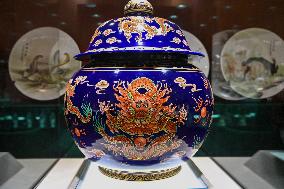
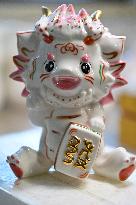
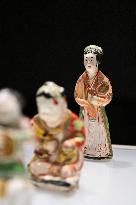
(240112) -- SHANGDANG, Jan. 12, 2024 (Xinhua) -- A porcelain ware is displayed at a Honglyucai (Red and Green Color) Porcelain museum in Honglyucai Village, Changzhi City of north China's Shanxi Province, Jan. 3, 2024. The Honglyucai (Red and Green Color) Porcelain of Bayi kiln was originated from the Song Dynasty (960-1279) and became popular in the Jin Dynasty (1115-1234). Its pioneering twice-firing technique allows the use of multiple colors on one piece of porcelain, which is regarded as a major breakthrough in China's porcelain history. To make a Honglyucai porcelain item, it needs to go through 72 procedures, which is so complicated that the technique was almost lost in the 1980's. In 2021, the crafts of making Honglyucai Porcelain of Bayi kiln was listed as a national intangible cultural heritage. Li Yamin, a native in the Honglyucai Village of Bayi Town, is an inheritor of the craft. Under the influence of his father Li Jianping, a provincial-level inheritor of the craft, Li Yamin started to l

  •  
(MASTER OF CRAFTS)CHINA-SHANXI-COLOR PORCELAIN-INHERITOR (CN)

(MASTER OF CRAFTS)CHINA-SHANXI-COLOR PORCELAIN-INHERITOR (CN)

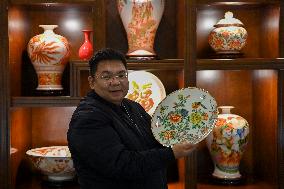
(240112) -- SHANGDANG, Jan. 12, 2024 (Xinhua) -- Li Yamin shows a porcelain ware he collected at a Honglyucai (Red and Green Color) Porcelain museum in Honglyucai Village, Changzhi City of north China's Shanxi Province, Jan. 4, 2024. The Honglyucai (Red and Green Color) Porcelain of Bayi kiln was originated from the Song Dynasty (960-1279) and became popular in the Jin Dynasty (1115-1234). Its pioneering twice-firing technique allows the use of multiple colors on one piece of porcelain, which is regarded as a major breakthrough in China's porcelain history. To make a Honglyucai porcelain item, it needs to go through 72 procedures, which is so complicated that the technique was almost lost in the 1980's. In 2021, the crafts of making Honglyucai Porcelain of Bayi kiln was listed as a national intangible cultural heritage. Li Yamin, a native in the Honglyucai Village of Bayi Town, is an inheritor of the craft. Under the influence of his father Li Jianping, a provincial-level inheritor of the craft, Li Yam

  •  
(MASTER OF CRAFTS)CHINA-SHANXI-COLOR PORCELAIN-INHERITOR (CN)

(MASTER OF CRAFTS)CHINA-SHANXI-COLOR PORCELAIN-INHERITOR (CN)

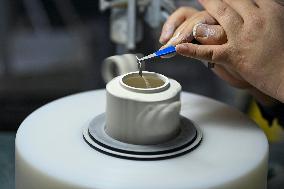
(240112) -- SHANGDANG, Jan. 12, 2024 (Xinhua) -- A craftsman fixes a ceramic body at a production base of Honglyucai (Red and Green Color) Porcelain in Honglyucai Village, Changzhi City of north China's Shanxi Province, Jan. 4, 2024. The Honglyucai (Red and Green Color) Porcelain of Bayi kiln was originated from the Song Dynasty (960-1279) and became popular in the Jin Dynasty (1115-1234). Its pioneering twice-firing technique allows the use of multiple colors on one piece of porcelain, which is regarded as a major breakthrough in China's porcelain history. To make a Honglyucai porcelain item, it needs to go through 72 procedures, which is so complicated that the technique was almost lost in the 1980's. In 2021, the crafts of making Honglyucai Porcelain of Bayi kiln was listed as a national intangible cultural heritage. Li Yamin, a native in the Honglyucai Village of Bayi Town, is an inheritor of the craft. Under the influence of his father Li Jianping, a provincial-level inheritor of the craft, Li Yam

  •  
(MASTER OF CRAFTS)CHINA-SHANXI-COLOR PORCELAIN-INHERITOR (CN)

(MASTER OF CRAFTS)CHINA-SHANXI-COLOR PORCELAIN-INHERITOR (CN)

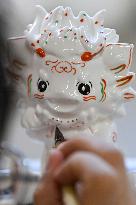
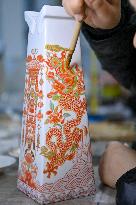
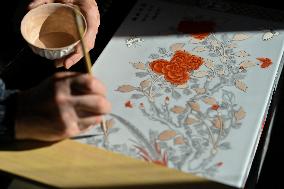
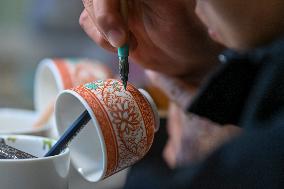
(240112) -- SHANGDANG, Jan. 12, 2024 (Xinhua) -- A craftsman paints on a piece of porcelain at a production base of Honglyucai (Red and Green Color) Porcelain in Honglyucai Village, Changzhi City of north China's Shanxi Province, Jan. 4, 2024. The Honglyucai (Red and Green Color) Porcelain of Bayi kiln was originated from the Song Dynasty (960-1279) and became popular in the Jin Dynasty (1115-1234). Its pioneering twice-firing technique allows the use of multiple colors on one piece of porcelain, which is regarded as a major breakthrough in China's porcelain history. To make a Honglyucai porcelain item, it needs to go through 72 procedures, which is so complicated that the technique was almost lost in the 1980's. In 2021, the crafts of making Honglyucai Porcelain of Bayi kiln was listed as a national intangible cultural heritage. Li Yamin, a native in the Honglyucai Village of Bayi Town, is an inheritor of the craft. Under the influence of his father Li Jianping, a provincial-level inheritor of the cra

  •  
(MASTER OF CRAFTS)CHINA-SHANXI-COLOR PORCELAIN-INHERITOR (CN)

(MASTER OF CRAFTS)CHINA-SHANXI-COLOR PORCELAIN-INHERITOR (CN)

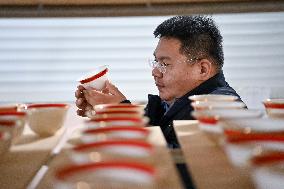
(240112) -- SHANGDANG, Jan. 12, 2024 (Xinhua) -- Fired porcelain artworks wait for cooling down at a production base of Honglyucai (Red and Green Color) Porcelain in Honglyucai Village, Changzhi City of north China's Shanxi Province, Jan. 4, 2024. The Honglyucai (Red and Green Color) Porcelain of Bayi kiln was originated from the Song Dynasty (960-1279) and became popular in the Jin Dynasty (1115-1234). Its pioneering twice-firing technique allows the use of multiple colors on one piece of porcelain, which is regarded as a major breakthrough in China's porcelain history. To make a Honglyucai porcelain item, it needs to go through 72 procedures, which is so complicated that the technique was almost lost in the 1980's. In 2021, the crafts of making Honglyucai Porcelain of Bayi kiln was listed as a national intangible cultural heritage. Li Yamin, a native in the Honglyucai Village of Bayi Town, is an inheritor of the craft. Under the influence of his father Li Jianping, a provincial-level inheritor of the

  •  
(MASTER OF CRAFTS)CHINA-SHANXI-COLOR PORCELAIN-INHERITOR (CN)

(MASTER OF CRAFTS)CHINA-SHANXI-COLOR PORCELAIN-INHERITOR (CN)

(240112) -- SHANGDANG, Jan. 12, 2024 (Xinhua) -- A porcelain artwork is displayed at a Honglyucai (Red and Green Color) Porcelain museum in Honglyucai Village, Changzhi City of north China's Shanxi Province, Jan. 3, 2024. The Honglyucai (Red and Green Color) Porcelain of Bayi kiln was originated from the Song Dynasty (960-1279) and became popular in the Jin Dynasty (1115-1234). Its pioneering twice-firing technique allows the use of multiple colors on one piece of porcelain, which is regarded as a major breakthrough in China's porcelain history. To make a Honglyucai porcelain item, it needs to go through 72 procedures, which is so complicated that the technique was almost lost in the 1980's. In 2021, the crafts of making Honglyucai Porcelain of Bayi kiln was listed as a national intangible cultural heritage. Li Yamin, a native in the Honglyucai Village of Bayi Town, is an inheritor of the craft. Under the influence of his father Li Jianping, a provincial-level inheritor of the craft, Li Yamin started t

  •  
(MASTER OF CRAFTS)CHINA-SHANXI-COLOR PORCELAIN-INHERITOR (CN)

(MASTER OF CRAFTS)CHINA-SHANXI-COLOR PORCELAIN-INHERITOR (CN)

(240112) -- SHANGDANG, Jan. 12, 2024 (Xinhua) -- Li Yamin checks a finished artwork at a production base of Honglyucai (Red and Green Color) Porcelain in Honglyucai Village, Changzhi City of north China's Shanxi Province, Jan. 3, 2024. The Honglyucai (Red and Green Color) Porcelain of Bayi kiln was originated from the Song Dynasty (960-1279) and became popular in the Jin Dynasty (1115-1234). Its pioneering twice-firing technique allows the use of multiple colors on one piece of porcelain, which is regarded as a major breakthrough in China's porcelain history. To make a Honglyucai porcelain item, it needs to go through 72 procedures, which is so complicated that the technique was almost lost in the 1980's. In 2021, the crafts of making Honglyucai Porcelain of Bayi kiln was listed as a national intangible cultural heritage. Li Yamin, a native in the Honglyucai Village of Bayi Town, is an inheritor of the craft. Under the influence of his father Li Jianping, a provincial-level inheritor of the craft, Li Y

  •  
(MASTER OF CRAFTS)CHINA-SHANXI-COLOR PORCELAIN-INHERITOR (CN)

(MASTER OF CRAFTS)CHINA-SHANXI-COLOR PORCELAIN-INHERITOR (CN)

(240112) -- SHANGDANG, Jan. 12, 2024 (Xinhua) -- A porcelain artwork is displayed at a Honglyucai (Red and Green Color) Porcelain museum in Honglyucai Village, Changzhi City of north China's Shanxi Province, Jan. 3, 2024. The Honglyucai (Red and Green Color) Porcelain of Bayi kiln was originated from the Song Dynasty (960-1279) and became popular in the Jin Dynasty (1115-1234). Its pioneering twice-firing technique allows the use of multiple colors on one piece of porcelain, which is regarded as a major breakthrough in China's porcelain history. To make a Honglyucai porcelain item, it needs to go through 72 procedures, which is so complicated that the technique was almost lost in the 1980's. In 2021, the crafts of making Honglyucai Porcelain of Bayi kiln was listed as a national intangible cultural heritage. Li Yamin, a native in the Honglyucai Village of Bayi Town, is an inheritor of the craft. Under the influence of his father Li Jianping, a provincial-level inheritor of the craft, Li Yamin started t

  •  
(MASTER OF CRAFTS)CHINA-SHANXI-COLOR PORCELAIN-INHERITOR (CN)

(MASTER OF CRAFTS)CHINA-SHANXI-COLOR PORCELAIN-INHERITOR (CN)

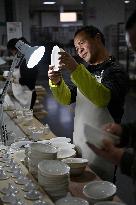
(240112) -- SHANGDANG, Jan. 12, 2024 (Xinhua) -- A craftsman checks a piece of porcelain at a production base of Honglyucai (Red and Green Color) Porcelain in Honglyucai Village, Changzhi City of north China's Shanxi Province, Jan. 3, 2024. The Honglyucai (Red and Green Color) Porcelain of Bayi kiln was originated from the Song Dynasty (960-1279) and became popular in the Jin Dynasty (1115-1234). Its pioneering twice-firing technique allows the use of multiple colors on one piece of porcelain, which is regarded as a major breakthrough in China's porcelain history. To make a Honglyucai porcelain item, it needs to go through 72 procedures, which is so complicated that the technique was almost lost in the 1980's. In 2021, the crafts of making Honglyucai Porcelain of Bayi kiln was listed as a national intangible cultural heritage. Li Yamin, a native in the Honglyucai Village of Bayi Town, is an inheritor of the craft. Under the influence of his father Li Jianping, a provincial-level inheritor of the craft,

  •  
(MASTER OF CRAFTS)CHINA-SHANXI-COLOR PORCELAIN-INHERITOR (CN)

(MASTER OF CRAFTS)CHINA-SHANXI-COLOR PORCELAIN-INHERITOR (CN)

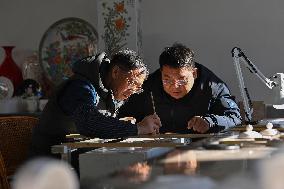
(240112) -- SHANGDANG, Jan. 12, 2024 (Xinhua) -- Li Yamin (R) asks for advice from an experienced craftsman at a production base of Honglyucai (Red and Green Color) Porcelain in Honglyucai Village, Changzhi City of north China's Shanxi Province, Jan. 4, 2024. The Honglyucai (Red and Green Color) Porcelain of Bayi kiln was originated from the Song Dynasty (960-1279) and became popular in the Jin Dynasty (1115-1234). Its pioneering twice-firing technique allows the use of multiple colors on one piece of porcelain, which is regarded as a major breakthrough in China's porcelain history. To make a Honglyucai porcelain item, it needs to go through 72 procedures, which is so complicated that the technique was almost lost in the 1980's. In 2021, the crafts of making Honglyucai Porcelain of Bayi kiln was listed as a national intangible cultural heritage. Li Yamin, a native in the Honglyucai Village of Bayi Town, is an inheritor of the craft. Under the influence of his father Li Jianping, a provincial-level inhe

  •  
(MASTER OF CRAFTS)CHINA-SHANXI-COLOR PORCELAIN-INHERITOR (CN)

(MASTER OF CRAFTS)CHINA-SHANXI-COLOR PORCELAIN-INHERITOR (CN)

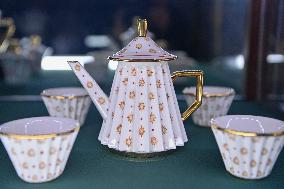
(240112) -- SHANGDANG, Jan. 12, 2024 (Xinhua) -- Porcelain tea sets are displayed at a production base of Honglyucai (Red and Green Color) Porcelain in Honglyucai Village, Changzhi City of north China's Shanxi Province, Jan. 3, 2024. The Honglyucai (Red and Green Color) Porcelain of Bayi kiln was originated from the Song Dynasty (960-1279) and became popular in the Jin Dynasty (1115-1234). Its pioneering twice-firing technique allows the use of multiple colors on one piece of porcelain, which is regarded as a major breakthrough in China's porcelain history. To make a Honglyucai porcelain item, it needs to go through 72 procedures, which is so complicated that the technique was almost lost in the 1980's. In 2021, the crafts of making Honglyucai Porcelain of Bayi kiln was listed as a national intangible cultural heritage. Li Yamin, a native in the Honglyucai Village of Bayi Town, is an inheritor of the craft. Under the influence of his father Li Jianping, a provincial-level inheritor of the craft, Li Yam

  •  
(MASTER OF CRAFTS)CHINA-SHANXI-COLOR PORCELAIN-INHERITOR (CN)

(MASTER OF CRAFTS)CHINA-SHANXI-COLOR PORCELAIN-INHERITOR (CN)

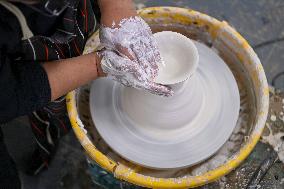
(240112) -- SHANGDANG, Jan. 12, 2024 (Xinhua) -- A craftsman makes a ceramic body at a production base of Honglyucai (Red and Green Color) Porcelain in Honglyucai Village, Changzhi City of north China's Shanxi Province, Jan. 3, 2024. The Honglyucai (Red and Green Color) Porcelain of Bayi kiln was originated from the Song Dynasty (960-1279) and became popular in the Jin Dynasty (1115-1234). Its pioneering twice-firing technique allows the use of multiple colors on one piece of porcelain, which is regarded as a major breakthrough in China's porcelain history. To make a Honglyucai porcelain item, it needs to go through 72 procedures, which is so complicated that the technique was almost lost in the 1980's. In 2021, the crafts of making Honglyucai Porcelain of Bayi kiln was listed as a national intangible cultural heritage. Li Yamin, a native in the Honglyucai Village of Bayi Town, is an inheritor of the craft. Under the influence of his father Li Jianping, a provincial-level inheritor of the craft, Li Yam

  •  
(MASTER OF CRAFTS)CHINA-SHANXI-COLOR PORCELAIN-INHERITOR (CN)

(MASTER OF CRAFTS)CHINA-SHANXI-COLOR PORCELAIN-INHERITOR (CN)

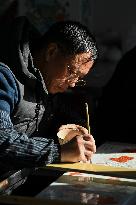
(240112) -- SHANGDANG, Jan. 12, 2024 (Xinhua) -- A craftsman paints on a piece of porcelain at a production base of Honglyucai (Red and Green Color) Porcelain in Honglyucai Village, Changzhi City of north China's Shanxi Province, Jan. 4, 2024. The Honglyucai (Red and Green Color) Porcelain of Bayi kiln was originated from the Song Dynasty (960-1279) and became popular in the Jin Dynasty (1115-1234). Its pioneering twice-firing technique allows the use of multiple colors on one piece of porcelain, which is regarded as a major breakthrough in China's porcelain history. To make a Honglyucai porcelain item, it needs to go through 72 procedures, which is so complicated that the technique was almost lost in the 1980's. In 2021, the crafts of making Honglyucai Porcelain of Bayi kiln was listed as a national intangible cultural heritage. Li Yamin, a native in the Honglyucai Village of Bayi Town, is an inheritor of the craft. Under the influence of his father Li Jianping, a provincial-level inheritor of the cra

  •  
(MASTER OF CRAFTS)CHINA-SHANXI-COLOR PORCELAIN-INHERITOR (CN)

(MASTER OF CRAFTS)CHINA-SHANXI-COLOR PORCELAIN-INHERITOR (CN)

(240112) -- SHANGDANG, Jan. 12, 2024 (Xinhua) -- Li Yamin checks the color of porcelain at a production base of Honglyucai (Red and Green Color) Porcelain in Honglyucai Village, Changzhi City of north China's Shanxi Province, Jan. 4, 2024. The Honglyucai (Red and Green Color) Porcelain of Bayi kiln was originated from the Song Dynasty (960-1279) and became popular in the Jin Dynasty (1115-1234). Its pioneering twice-firing technique allows the use of multiple colors on one piece of porcelain, which is regarded as a major breakthrough in China's porcelain history. To make a Honglyucai porcelain item, it needs to go through 72 procedures, which is so complicated that the technique was almost lost in the 1980's. In 2021, the crafts of making Honglyucai Porcelain of Bayi kiln was listed as a national intangible cultural heritage. Li Yamin, a native in the Honglyucai Village of Bayi Town, is an inheritor of the craft. Under the influence of his father Li Jianping, a provincial-level inheritor of the craft,

  •  
(MASTER OF CRAFTS)CHINA-SHANXI-COLOR PORCELAIN-INHERITOR (CN)

(MASTER OF CRAFTS)CHINA-SHANXI-COLOR PORCELAIN-INHERITOR (CN)

(240112) -- SHANGDANG, Jan. 12, 2024 (Xinhua) -- A porcelain ware is displayed at a Honglyucai (Red and Green Color) Porcelain museum in Honglyucai Village, Changzhi City of north China's Shanxi Province, Jan. 3, 2024. The Honglyucai (Red and Green Color) Porcelain of Bayi kiln was originated from the Song Dynasty (960-1279) and became popular in the Jin Dynasty (1115-1234). Its pioneering twice-firing technique allows the use of multiple colors on one piece of porcelain, which is regarded as a major breakthrough in China's porcelain history. To make a Honglyucai porcelain item, it needs to go through 72 procedures, which is so complicated that the technique was almost lost in the 1980's. In 2021, the crafts of making Honglyucai Porcelain of Bayi kiln was listed as a national intangible cultural heritage. Li Yamin, a native in the Honglyucai Village of Bayi Town, is an inheritor of the craft. Under the influence of his father Li Jianping, a provincial-level inheritor of the craft, Li Yamin started to l

  •  
(MASTER OF CRAFTS)CHINA-SHANXI-COLOR PORCELAIN-INHERITOR (CN)

(MASTER OF CRAFTS)CHINA-SHANXI-COLOR PORCELAIN-INHERITOR (CN)

(240112) -- SHANGDANG, Jan. 12, 2024 (Xinhua) -- A craftsman paints on a piece of porcelain at a production base of Honglyucai (Red and Green Color) Porcelain in Honglyucai Village, Changzhi City of north China's Shanxi Province, Jan. 3, 2024. The Honglyucai (Red and Green Color) Porcelain of Bayi kiln was originated from the Song Dynasty (960-1279) and became popular in the Jin Dynasty (1115-1234). Its pioneering twice-firing technique allows the use of multiple colors on one piece of porcelain, which is regarded as a major breakthrough in China's porcelain history. To make a Honglyucai porcelain item, it needs to go through 72 procedures, which is so complicated that the technique was almost lost in the 1980's. In 2021, the crafts of making Honglyucai Porcelain of Bayi kiln was listed as a national intangible cultural heritage. Li Yamin, a native in the Honglyucai Village of Bayi Town, is an inheritor of the craft. Under the influence of his father Li Jianping, a provincial-level inheritor of the cra

  •  
(MASTER OF CRAFTS)CHINA-SHANXI-COLOR PORCELAIN-INHERITOR (CN)

(MASTER OF CRAFTS)CHINA-SHANXI-COLOR PORCELAIN-INHERITOR (CN)

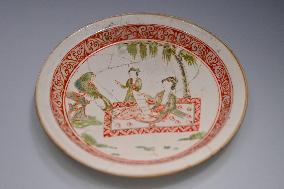
(240112) -- SHANGDANG, Jan. 12, 2024 (Xinhua) -- An ancient porcelain dish is displayed at Honglyucai (Red and Green Color) Porcelain museum in Honglyucai Village, Changzhi City of north China's Shanxi Province, Jan. 3, 2024. The Honglyucai (Red and Green Color) Porcelain of Bayi kiln was originated from the Song Dynasty (960-1279) and became popular in the Jin Dynasty (1115-1234). Its pioneering twice-firing technique allows the use of multiple colors on one piece of porcelain, which is regarded as a major breakthrough in China's porcelain history. To make a Honglyucai porcelain item, it needs to go through 72 procedures, which is so complicated that the technique was almost lost in the 1980's. In 2021, the crafts of making Honglyucai Porcelain of Bayi kiln was listed as a national intangible cultural heritage. Li Yamin, a native in the Honglyucai Village of Bayi Town, is an inheritor of the craft. Under the influence of his father Li Jianping, a provincial-level inheritor of the craft, Li Yamin start

  •  
(MASTER OF CRAFTS)CHINA-SHANXI-COLOR PORCELAIN-INHERITOR (CN)

(MASTER OF CRAFTS)CHINA-SHANXI-COLOR PORCELAIN-INHERITOR (CN)

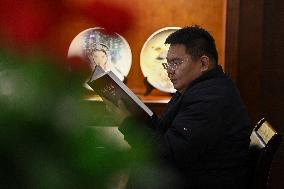
(240112) -- SHANGDANG, Jan. 12, 2024 (Xinhua) -- Li Yamin checks data at a Honglyucai (Red and Green Color) Porcelain museum in Honglyucai Village, Changzhi City of north China's Shanxi Province, Jan. 4, 2024. The Honglyucai (Red and Green Color) Porcelain of Bayi kiln was originated from the Song Dynasty (960-1279) and became popular in the Jin Dynasty (1115-1234). Its pioneering twice-firing technique allows the use of multiple colors on one piece of porcelain, which is regarded as a major breakthrough in China's porcelain history. To make a Honglyucai porcelain item, it needs to go through 72 procedures, which is so complicated that the technique was almost lost in the 1980's. In 2021, the crafts of making Honglyucai Porcelain of Bayi kiln was listed as a national intangible cultural heritage. Li Yamin, a native in the Honglyucai Village of Bayi Town, is an inheritor of the craft. Under the influence of his father Li Jianping, a provincial-level inheritor of the craft, Li Yamin started to learn porc

  •  
(MASTER OF CRAFTS)CHINA-SHANXI-COLOR PORCELAIN-INHERITOR (CN)

(MASTER OF CRAFTS)CHINA-SHANXI-COLOR PORCELAIN-INHERITOR (CN)

(240112) -- SHANGDANG, Jan. 12, 2024 (Xinhua) -- A porcelain artwork is displayed at a production base of Honglyucai (Red and Green Color) Porcelain in Honglyucai Village, Changzhi City of north China's Shanxi Province, Jan. 3, 2024. The Honglyucai (Red and Green Color) Porcelain of Bayi kiln was originated from the Song Dynasty (960-1279) and became popular in the Jin Dynasty (1115-1234). Its pioneering twice-firing technique allows the use of multiple colors on one piece of porcelain, which is regarded as a major breakthrough in China's porcelain history. To make a Honglyucai porcelain item, it needs to go through 72 procedures, which is so complicated that the technique was almost lost in the 1980's. In 2021, the crafts of making Honglyucai Porcelain of Bayi kiln was listed as a national intangible cultural heritage. Li Yamin, a native in the Honglyucai Village of Bayi Town, is an inheritor of the craft. Under the influence of his father Li Jianping, a provincial-level inheritor of the craft, Li Yam

  •  
(MASTER OF CRAFTS)CHINA-SHANXI-COLOR PORCELAIN-INHERITOR (CN)

(MASTER OF CRAFTS)CHINA-SHANXI-COLOR PORCELAIN-INHERITOR (CN)

(240112) -- SHANGDANG, Jan. 12, 2024 (Xinhua) -- Li Yamin talks with a craftswoman at a production base of Honglyucai (Red and Green Color) Porcelain in Honglyucai Village, Changzhi City of north China's Shanxi Province, Jan. 4, 2024. The Honglyucai (Red and Green Color) Porcelain of Bayi kiln was originated from the Song Dynasty (960-1279) and became popular in the Jin Dynasty (1115-1234). Its pioneering twice-firing technique allows the use of multiple colors on one piece of porcelain, which is regarded as a major breakthrough in China's porcelain history. To make a Honglyucai porcelain item, it needs to go through 72 procedures, which is so complicated that the technique was almost lost in the 1980's. In 2021, the crafts of making Honglyucai Porcelain of Bayi kiln was listed as a national intangible cultural heritage. Li Yamin, a native in the Honglyucai Village of Bayi Town, is an inheritor of the craft. Under the influence of his father Li Jianping, a provincial-level inheritor of the craft, Li Ya

  •  
(MASTER OF CRAFTS)CHINA-SHANXI-COLOR PORCELAIN-INHERITOR (CN)

(MASTER OF CRAFTS)CHINA-SHANXI-COLOR PORCELAIN-INHERITOR (CN)

(240112) -- SHANGDANG, Jan. 12, 2024 (Xinhua) -- A craftsman paints on a piece of porcelain at a production base of Honglyucai (Red and Green Color) Porcelain in Honglyucai Village, Changzhi City of north China's Shanxi Province, Jan. 4, 2024. The Honglyucai (Red and Green Color) Porcelain of Bayi kiln was originated from the Song Dynasty (960-1279) and became popular in the Jin Dynasty (1115-1234). Its pioneering twice-firing technique allows the use of multiple colors on one piece of porcelain, which is regarded as a major breakthrough in China's porcelain history. To make a Honglyucai porcelain item, it needs to go through 72 procedures, which is so complicated that the technique was almost lost in the 1980's. In 2021, the crafts of making Honglyucai Porcelain of Bayi kiln was listed as a national intangible cultural heritage. Li Yamin, a native in the Honglyucai Village of Bayi Town, is an inheritor of the craft. Under the influence of his father Li Jianping, a provincial-level inheritor of the cra

  •  
(MASTER OF CRAFTS)CHINA-SHANXI-COLOR PORCELAIN-INHERITOR (CN)

(MASTER OF CRAFTS)CHINA-SHANXI-COLOR PORCELAIN-INHERITOR (CN)

(240112) -- SHANGDANG, Jan. 12, 2024 (Xinhua) -- A craftswoman checks a ceramic body at a production base of Honglyucai (Red and Green Color) Porcelain in Honglyucai Village, Changzhi City of north China's Shanxi Province, Jan. 3, 2024. The Honglyucai (Red and Green Color) Porcelain of Bayi kiln was originated from the Song Dynasty (960-1279) and became popular in the Jin Dynasty (1115-1234). Its pioneering twice-firing technique allows the use of multiple colors on one piece of porcelain, which is regarded as a major breakthrough in China's porcelain history. To make a Honglyucai porcelain item, it needs to go through 72 procedures, which is so complicated that the technique was almost lost in the 1980's. In 2021, the crafts of making Honglyucai Porcelain of Bayi kiln was listed as a national intangible cultural heritage. Li Yamin, a native in the Honglyucai Village of Bayi Town, is an inheritor of the craft. Under the influence of his father Li Jianping, a provincial-level inheritor of the craft, Li

  •  
(MASTER OF CRAFTS)CHINA-SHANXI-COLOR PORCELAIN-INHERITOR (CN)

(MASTER OF CRAFTS)CHINA-SHANXI-COLOR PORCELAIN-INHERITOR (CN)

(240112) -- SHANGDANG, Jan. 12, 2024 (Xinhua) -- A craftsman paints on a porcelain at a production base of Honglyucai (Red and Green Color) Porcelain in Honglyucai Village, Changzhi City of north China's Shanxi Province, Jan. 4, 2024. The Honglyucai (Red and Green Color) Porcelain of Bayi kiln was originated from the Song Dynasty (960-1279) and became popular in the Jin Dynasty (1115-1234). Its pioneering twice-firing technique allows the use of multiple colors on one piece of porcelain, which is regarded as a major breakthrough in China's porcelain history. To make a Honglyucai porcelain item, it needs to go through 72 procedures, which is so complicated that the technique was almost lost in the 1980's. In 2021, the crafts of making Honglyucai Porcelain of Bayi kiln was listed as a national intangible cultural heritage. Li Yamin, a native in the Honglyucai Village of Bayi Town, is an inheritor of the craft. Under the influence of his father Li Jianping, a provincial-level inheritor of the craft, Li Ya

  •  
(MASTER OF CRAFTS)CHINA-SHANXI-COLOR PORCELAIN-INHERITOR (CN)

(MASTER OF CRAFTS)CHINA-SHANXI-COLOR PORCELAIN-INHERITOR (CN)

(240112) -- SHANGDANG, Jan. 12, 2024 (Xinhua) -- Porcelain artworks are displayed at a Honglyucai (Red and Green Color) Porcelain museum in Honglyucai Village, Changzhi City of north China's Shanxi Province, Jan. 3, 2024. The Honglyucai (Red and Green Color) Porcelain of Bayi kiln was originated from the Song Dynasty (960-1279) and became popular in the Jin Dynasty (1115-1234). Its pioneering twice-firing technique allows the use of multiple colors on one piece of porcelain, which is regarded as a major breakthrough in China's porcelain history. To make a Honglyucai porcelain item, it needs to go through 72 procedures, which is so complicated that the technique was almost lost in the 1980's. In 2021, the crafts of making Honglyucai Porcelain of Bayi kiln was listed as a national intangible cultural heritage. Li Yamin, a native in the Honglyucai Village of Bayi Town, is an inheritor of the craft. Under the influence of his father Li Jianping, a provincial-level inheritor of the craft, Li Yamin started t

  • Main
  • Top
  • Editorial
  • Creative
  • About Us
  • About ILG
  • Terms of use
  • Company
  • BEHIND
  • Price List
  • Single Plan
  • Monthly Plan
  • Services
  • Shooting
  • Rights Clearance
  • Support
  • FAQ
  • How To Buy
  • Contact Us
  • Become a Partner

© KYODO NEWS IMAGES INC

All Rights Reserved.

  • Editorial
  • Olympics
  • News
  • Sports
  • Japan
  • Tech
  • Royal
  • Disaster
  • NorthKorea
  • Old Japan
  • SNS
  • Creative
  • Food
  • Japan
  • Landscape
  • Animal
  • Popular
  • #Ukraine
  • #China
  • #coronavirus
  • #N. Korea
  • #Thailand
  • #Russia
  • #Ukraine
  • #China
  • #coronavirus
  • #N. Korea
  • #Thailand
  • #Russia
  • Food
  • Japan
  • Landscape
  • Animal
  • Olympics
  • News
  • Sports
  • Japan
  • Tech
  • Royal
  • Disaster
  • NorthKorea
  • Old Japan
  • SNS