•  
Guizhou Bridges - China

Guizhou Bridges - China

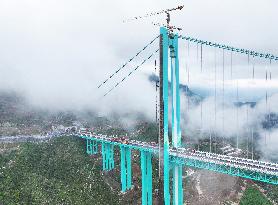
This aerial panoramic drone photo taken on Sept. 5, 2025 shows the Daxiaojing Grand Bridge in southwest China's Guizhou Province. Guizhou, the only province in China without a single plain and home to deep ravines, has long relied on tunnels and bridges to overcome its jagged karst landscape. Since 2012, the province has accelerated its bridge construction endeavors. Guizhou now has over 32,000 bridges either already built or under construction -- a tenfold increase compared to the 1980s. Due to its sheer number of bridges, diverse bridge types and complex construction technologies, Guizhou has earned the title of "the world's bridge museum." Photo by Ou Dongqu /Xinhua/ABACAPRESS.COM

  •  
Guizhou Bridges - China

Guizhou Bridges - China

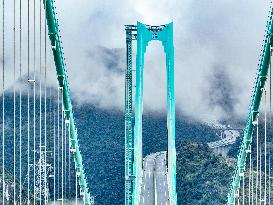
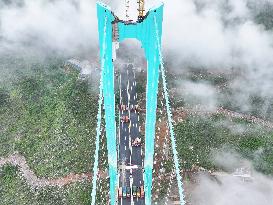
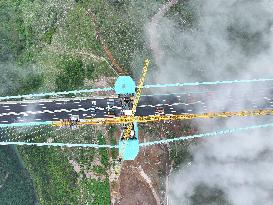
This aerial drone photo taken on Sept. 27, 2025 shows the Huajiang Grand Canyon Bridge in southwest China's Guizhou Province. Guizhou, the only province in China without a single plain and home to deep ravines, has long relied on tunnels and bridges to overcome its jagged karst landscape. Since 2012, the province has accelerated its bridge construction endeavors. Guizhou now has over 32,000 bridges either already built or under construction -- a tenfold increase compared to the 1980s. Due to its sheer number of bridges, diverse bridge types and complex construction technologies, Guizhou has earned the title of "the world's bridge museum." Photo by Ou Dongqu /Xinhua/ABACAPRESS.COM

  •  
Guizhou Bridges - China

Guizhou Bridges - China

This aerial drone photo taken on Nov. 25, 2021 shows the Pingtang Grand Bridge in southwest China's Guizhou Province. Guizhou, the only province in China without a single plain and home to deep ravines, has long relied on tunnels and bridges to overcome its jagged karst landscape. Since 2012, the province has accelerated its bridge construction endeavors. Guizhou now has over 32,000 bridges either already built or under construction -- a tenfold increase compared to the 1980s. Due to its sheer number of bridges, diverse bridge types and complex construction technologies, Guizhou has earned the title of "the world's bridge museum." Photo by Ou Dongqu /Xinhua/ABACAPRESS.COM

  •  
Guizhou Bridges - China

Guizhou Bridges - China

This aerial drone photo taken on Sept. 27, 2025 shows the Huajiang Grand Canyon Bridge in southwest China's Guizhou Province. Guizhou, the only province in China without a single plain and home to deep ravines, has long relied on tunnels and bridges to overcome its jagged karst landscape. Since 2012, the province has accelerated its bridge construction endeavors. Guizhou now has over 32,000 bridges either already built or under construction -- a tenfold increase compared to the 1980s. Due to its sheer number of bridges, diverse bridge types and complex construction technologies, Guizhou has earned the title of "the world's bridge museum." Photo by Ou Dongqu /Xinhua/ABACAPRESS.COM

  •  
Guizhou Bridges - China

Guizhou Bridges - China

This aerial drone photo taken on Sept. 27, 2025 shows the Huajiang Grand Canyon Bridge in southwest China's Guizhou Province. Guizhou, the only province in China without a single plain and home to deep ravines, has long relied on tunnels and bridges to overcome its jagged karst landscape. Since 2012, the province has accelerated its bridge construction endeavors. Guizhou now has over 32,000 bridges either already built or under construction -- a tenfold increase compared to the 1980s. Due to its sheer number of bridges, diverse bridge types and complex construction technologies, Guizhou has earned the title of "the world's bridge museum." Photo by Ou Dongqu /Xinhua/ABACAPRESS.COM

  •  
Guizhou Bridges - China

Guizhou Bridges - China

This aerial panoramic drone photo taken on Feb. 2, 2023 shows the Dafaqu Grand Bridge in southwest China's Guizhou Province. Guizhou, the only province in China without a single plain and home to deep ravines, has long relied on tunnels and bridges to overcome its jagged karst landscape. Since 2012, the province has accelerated its bridge construction endeavors. Guizhou now has over 32,000 bridges either already built or under construction -- a tenfold increase compared to the 1980s. Due to its sheer number of bridges, diverse bridge types and complex construction technologies, Guizhou has earned the title of "the world's bridge museum." Photo by Ou Dongqu /Xinhua/ABACAPRESS.COM

  •  
Guizhou Bridges - China

Guizhou Bridges - China

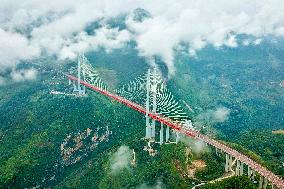
This aerial drone photo taken on Aug. 9, 2018 shows the Beipanjiang Bridge in southwest China's Guizhou Province. Guizhou, the only province in China without a single plain and home to deep ravines, has long relied on tunnels and bridges to overcome its jagged karst landscape. Since 2012, the province has accelerated its bridge construction endeavors. Guizhou now has over 32,000 bridges either already built or under construction -- a tenfold increase compared to the 1980s. Due to its sheer number of bridges, diverse bridge types and complex construction technologies, Guizhou has earned the title of "the world's bridge museum." Photo by Ou Dongqu /Xinhua/ABACAPRESS.COM

  •  
Huajiang Grand Canyon Bridge - China

Huajiang Grand Canyon Bridge - China

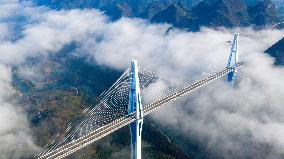
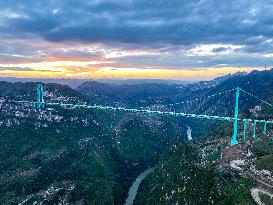
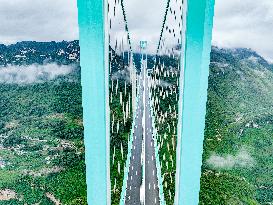
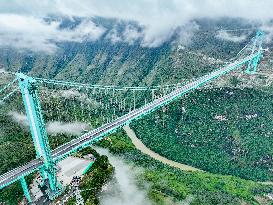
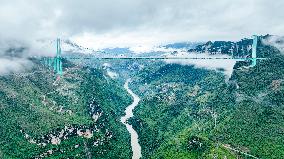
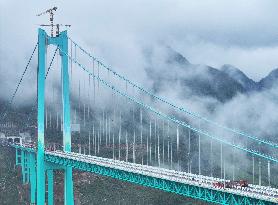
An aerial drone photo taken on Sept. 26, 2025 shows the Huajiang Grand Canyon Bridge in southwest China's Guizhou Province. The Huajiang Grand Canyon Bridge in southwest China's Guizhou Province -- set to become the world's tallest bridge -- will open to traffic on Sept. 28 after more than three years of construction, local government announced on Wednesday. The bridge is 2,890 meters long with a main span of 1,420 meters. Rising 625 meters above the river, it will become both the world's tallest bridge and the world's largest-span bridge built in a mountainous area, the provincial government said. Photo by Ou Dongqu/Xinhua/ABACAPRESS.COM

  •  
Huajiang Grand Canyon Bridge - China

Huajiang Grand Canyon Bridge - China

An aerial drone photo taken on Sept. 26, 2025 shows the Huajiang Grand Canyon Bridge in southwest China's Guizhou Province. The Huajiang Grand Canyon Bridge in southwest China's Guizhou Province -- set to become the world's tallest bridge -- will open to traffic on Sept. 28 after more than three years of construction, local government announced on Wednesday. The bridge is 2,890 meters long with a main span of 1,420 meters. Rising 625 meters above the river, it will become both the world's tallest bridge and the world's largest-span bridge built in a mountainous area, the provincial government said. Photo by Ou Dongqu/Xinhua/ABACAPRESS.COM

  •  
Huajiang Grand Canyon Bridge - China

Huajiang Grand Canyon Bridge - China

An aerial drone photo taken on Sept. 26, 2025 shows the Huajiang Grand Canyon Bridge in southwest China's Guizhou Province. The Huajiang Grand Canyon Bridge in southwest China's Guizhou Province -- set to become the world's tallest bridge -- will open to traffic on Sept. 28 after more than three years of construction, local government announced on Wednesday. The bridge is 2,890 meters long with a main span of 1,420 meters. Rising 625 meters above the river, it will become both the world's tallest bridge and the world's largest-span bridge built in a mountainous area, the provincial government said. Photo by Ou Dongqu/Xinhua/ABACAPRESS.COM

  •  
Huajiang Grand Canyon Bridge - China

Huajiang Grand Canyon Bridge - China

An aerial drone photo taken on Sept. 26, 2025 shows the Huajiang Grand Canyon Bridge in southwest China's Guizhou Province. The Huajiang Grand Canyon Bridge in southwest China's Guizhou Province -- set to become the world's tallest bridge -- will open to traffic on Sept. 28 after more than three years of construction, local government announced on Wednesday. The bridge is 2,890 meters long with a main span of 1,420 meters. Rising 625 meters above the river, it will become both the world's tallest bridge and the world's largest-span bridge built in a mountainous area, the provincial government said. Photo by Ou Dongqu/Xinhua/ABACAPRESS.COM

  •  
Huajiang Grand Canyon Bridge - China

Huajiang Grand Canyon Bridge - China

An aerial drone photo taken on Sept. 26, 2025 shows the Huajiang Grand Canyon Bridge in southwest China's Guizhou Province. The Huajiang Grand Canyon Bridge in southwest China's Guizhou Province -- set to become the world's tallest bridge -- will open to traffic on Sept. 28 after more than three years of construction, local government announced on Wednesday. The bridge is 2,890 meters long with a main span of 1,420 meters. Rising 625 meters above the river, it will become both the world's tallest bridge and the world's largest-span bridge built in a mountainous area, the provincial government said. Photo by Ou Dongqu/Xinhua/ABACAPRESS.COM

  •  
Load Testing on The Huajiang Grand Canyon Bridge - China

Load Testing on The Huajiang Grand Canyon Bridge - China

This aerial drone photo taken on August 21, 2025 shows a load testing on the Huajiang Grand Canyon Bridge in southwest China's Guizhou Province. Engineers on Thursday launched a load testing on the Huajiang Grand Canyon Bridge, which is set to become the world's tallest bridge. The suspension bridge has a vertical height of 625 meters from the bridge deck down to the river surface. The 2,890-meter bridge, with a span of 1,420 meters, is also the world's largest span bridge to be built in a mountainous area. Photo by Xinhua/Ou Dongqu/ABACAPRESS.COM

  •  
Load Testing on The Huajiang Grand Canyon Bridge - China

Load Testing on The Huajiang Grand Canyon Bridge - China

This aerial drone photo taken on August 21, 2025 shows a load testing on the Huajiang Grand Canyon Bridge in southwest China's Guizhou Province. Engineers on Thursday launched a load testing on the Huajiang Grand Canyon Bridge, which is set to become the world's tallest bridge. The suspension bridge has a vertical height of 625 meters from the bridge deck down to the river surface. The 2,890-meter bridge, with a span of 1,420 meters, is also the world's largest span bridge to be built in a mountainous area. Photo by Xinhua/Ou Dongqu/ABACAPRESS.COM

  •  
Load Testing on The Huajiang Grand Canyon Bridge - China

Load Testing on The Huajiang Grand Canyon Bridge - China

This aerial drone photo taken on August 21, 2025 shows a load testing on the Huajiang Grand Canyon Bridge in southwest China's Guizhou Province. Engineers on Thursday launched a load testing on the Huajiang Grand Canyon Bridge, which is set to become the world's tallest bridge. The suspension bridge has a vertical height of 625 meters from the bridge deck down to the river surface. The 2,890-meter bridge, with a span of 1,420 meters, is also the world's largest span bridge to be built in a mountainous area. Photo by Xinhua/Ou Dongqu/ABACAPRESS.COM

  •  
Load Testing on The Huajiang Grand Canyon Bridge - China

Load Testing on The Huajiang Grand Canyon Bridge - China

This aerial drone photo taken on August 21, 2025 shows a load testing on the Huajiang Grand Canyon Bridge in southwest China's Guizhou Province. Engineers on Thursday launched a load testing on the Huajiang Grand Canyon Bridge, which is set to become the world's tallest bridge. The suspension bridge has a vertical height of 625 meters from the bridge deck down to the river surface. The 2,890-meter bridge, with a span of 1,420 meters, is also the world's largest span bridge to be built in a mountainous area. Photo by Xinhua/Ou Dongqu/ABACAPRESS.COM

  •  
Load Testing on The Huajiang Grand Canyon Bridge - China

Load Testing on The Huajiang Grand Canyon Bridge - China

This aerial drone photo taken on August 21, 2025 shows a load testing on the Huajiang Grand Canyon Bridge in southwest China's Guizhou Province. Engineers on Thursday launched a load testing on the Huajiang Grand Canyon Bridge, which is set to become the world's tallest bridge. The suspension bridge has a vertical height of 625 meters from the bridge deck down to the river surface. The 2,890-meter bridge, with a span of 1,420 meters, is also the world's largest span bridge to be built in a mountainous area. Photo by Xinhua/Ou Dongqu/ABACAPRESS.COM

  •  
Dragon Boat Festival Across China

Dragon Boat Festival Across China

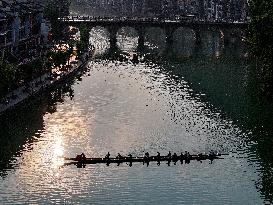
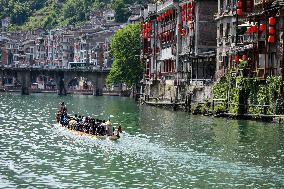
Locals row a dragon boat in Zhenyuan ancient town in Qiandongnan Miao and Dong Autonomous Prefecture in southwest China's Guizhou Province, May 20, 2025. Zhenyuan boasts a 22-century-long tradition of dragon boat races, and the county is also well noted for the large sizes and intricate decorations of its dragon boats. The dragon boat racing in Zhenyuan was inscribed in the third batch of China's national intangible cultural heritage list in 2011. Dragon Boat Festival, also known as Duanwu Festival, falls on the fifth day of the fifth month in the Chinese lunar calendar. It is celebrated on May 31 this year. Photo by Ou Dongqu/Xinhua/ABACAPRESS.COM

  •  
Dragon Boat Festival Across China

Dragon Boat Festival Across China

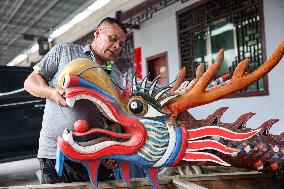
Craftsman Li Qifa checks the newly assembled dragon head for a dragon boat in Zhenyuan ancient town in Qiandongnan Miao and Dong Autonomous Prefecture in southwest China's Guizhou Province, May 20, 2025. Zhenyuan boasts a 22-century-long tradition of dragon boat races, and the county is also well noted for the large sizes and intricate decorations of its dragon boats. The dragon boat racing in Zhenyuan was inscribed in the third batch of China's national intangible cultural heritage list in 2011. Dragon Boat Festival, also known as Duanwu Festival, falls on the fifth day of the fifth month in the Chinese lunar calendar. It is celebrated on May 31 this year. Photo by Ou Dongqu/Xinhua/ABACAPRESS.COM

  •  
Dragon Boat Festival Across China

Dragon Boat Festival Across China

Craftsman Li Qifa carves the dragon tail for a dragon boat in Zhenyuan ancient town in Qiandongnan Miao and Dong Autonomous Prefecture in southwest China's Guizhou Province, May 20, 2025. Zhenyuan boasts a 22-century-long tradition of dragon boat races, and the county is also well noted for the large sizes and intricate decorations of its dragon boats. The dragon boat racing in Zhenyuan was inscribed in the third batch of China's national intangible cultural heritage list in 2011. Dragon Boat Festival, also known as Duanwu Festival, falls on the fifth day of the fifth month in the Chinese lunar calendar. It is celebrated on May 31 this year. Photo by Ou Dongqu/Xinhua/ABACAPRESS.COM

  •  
Dragon Boat Festival Across China

Dragon Boat Festival Across China

Craftsman Li Qifa checks partially assembled dragon boats in Zhenyuan ancient town in Qiandongnan Miao and Dong Autonomous Prefecture in southwest China's Guizhou Province, May 20, 2025. Zhenyuan boasts a 22-century-long tradition of dragon boat races, and the county is also well noted for the large sizes and intricate decorations of its dragon boats. The dragon boat racing in Zhenyuan was inscribed in the third batch of China's national intangible cultural heritage list in 2011. Dragon Boat Festival, also known as Duanwu Festival, falls on the fifth day of the fifth month in the Chinese lunar calendar. It is celebrated on May 31 this year. Photo by Ou Dongqu/Xinhua/ABACAPRESS.COM

  •  
Dragon Boat Festival Across China

Dragon Boat Festival Across China

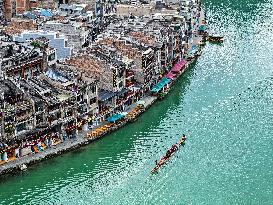
An aerial drone photo shows locals rowing a dragon boat in Zhenyuan ancient town in Qiandongnan Miao and Dong Autonomous Prefecture in southwest China's Guizhou Province, May 20, 2025. Zhenyuan boasts a 22-century-long tradition of dragon boat races, and the county is also well noted for the large sizes and intricate decorations of its dragon boats. The dragon boat racing in Zhenyuan was inscribed in the third batch of China's national intangible cultural heritage list in 2011. Dragon Boat Festival, also known as Duanwu Festival, falls on the fifth day of the fifth month in the Chinese lunar calendar. It is celebrated on May 31 this year. Photo by Ou Dongqu/Xinhua/ABACAPRESS.COM

  •  
Dragon Boat Festival Across China

Dragon Boat Festival Across China

An aerial drone photo shows locals rowing a dragon boat in Zhenyuan ancient town in Qiandongnan Miao and Dong Autonomous Prefecture in southwest China's Guizhou Province, May 20, 2025. Zhenyuan boasts a 22-century-long tradition of dragon boat races, and the county is also well noted for the large sizes and intricate decorations of its dragon boats. The dragon boat racing in Zhenyuan was inscribed in the third batch of China's national intangible cultural heritage list in 2011. Dragon Boat Festival, also known as Duanwu Festival, falls on the fifth day of the fifth month in the Chinese lunar calendar. It is celebrated on May 31 this year. Photo by Ou Dongqu/Xinhua/ABACAPRESS.COM

  •  
Dragon Boat Festival Across China

Dragon Boat Festival Across China

Locals row a dragon boat in Zhenyuan ancient town in Qiandongnan Miao and Dong Autonomous Prefecture in southwest China's Guizhou Province, May 20, 2025. Zhenyuan boasts a 22-century-long tradition of dragon boat races, and the county is also well noted for the large sizes and intricate decorations of its dragon boats. The dragon boat racing in Zhenyuan was inscribed in the third batch of China's national intangible cultural heritage list in 2011. Dragon Boat Festival, also known as Duanwu Festival, falls on the fifth day of the fifth month in the Chinese lunar calendar. It is celebrated on May 31 this year. Photo by Ou Dongqu/Xinhua/ABACAPRESS.COM

  •  
Dragon Boat Festival Across China

Dragon Boat Festival Across China

An aerial drone photo shows local people rowing a dragon boat in Zhenyuan ancient town in Qiandongnan Miao and Dong Autonomous Prefecture in southwest China's Guizhou Province, May 20, 2025. Zhenyuan boasts a 22-century-long tradition of dragon boat races, and the county is also well noted for the large sizes and intricate decorations of its dragon boats. The dragon boat racing in Zhenyuan was inscribed in the third batch of China's national intangible cultural heritage list in 2011. Dragon Boat Festival, also known as Duanwu Festival, falls on the fifth day of the fifth month in the Chinese lunar calendar. It is celebrated on May 31 this year. Photo by Ou Dongqu/Xinhua/ABACAPRESS.COM

  •  
Dragon Boat Festival Across China

Dragon Boat Festival Across China

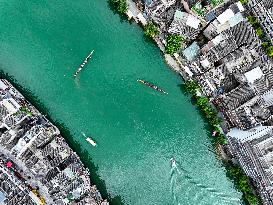
An aerial drone photo shows locals rowing dragon boats in Zhenyuan ancient town in Qiandongnan Miao and Dong Autonomous Prefecture in southwest China's Guizhou Province, May 20, 2025. Zhenyuan boasts a 22-century-long tradition of dragon boat races, and the county is also well noted for the large sizes and intricate decorations of its dragon boats. The dragon boat racing in Zhenyuan was inscribed in the third batch of China's national intangible cultural heritage list in 2011. Dragon Boat Festival, also known as Duanwu Festival, falls on the fifth day of the fifth month in the Chinese lunar calendar. It is celebrated on May 31 this year. Photo by Ou Dongqu/Xinhua/ABACAPRESS.COM

  •  
Dragon Boat Festival Across China

Dragon Boat Festival Across China

Locals row a dragon boat in Zhenyuan ancient town in Qiandongnan Miao and Dong Autonomous Prefecture in southwest China's Guizhou Province, May 20, 2025. Zhenyuan boasts a 22-century-long tradition of dragon boat races, and the county is also well noted for the large sizes and intricate decorations of its dragon boats. The dragon boat racing in Zhenyuan was inscribed in the third batch of China's national intangible cultural heritage list in 2011. Dragon Boat Festival, also known as Duanwu Festival, falls on the fifth day of the fifth month in the Chinese lunar calendar. It is celebrated on May 31 this year. Photo by Ou Dongqu/Xinhua/ABACAPRESS.COM

  •  
Dragon Boat Festival Across China

Dragon Boat Festival Across China

Craftsman Li Qifa polishes a dragon boat in Zhenyuan ancient town in Qiandongnan Miao and Dong Autonomous Prefecture in southwest China's Guizhou Province, May 20, 2025. Zhenyuan boasts a 22-century-long tradition of dragon boat races, and the county is also well noted for the large sizes and intricate decorations of its dragon boats. The dragon boat racing in Zhenyuan was inscribed in the third batch of China's national intangible cultural heritage list in 2011. Dragon Boat Festival, also known as Duanwu Festival, falls on the fifth day of the fifth month in the Chinese lunar calendar. It is celebrated on May 31 this year. Photo by Ou Dongqu/Xinhua/ABACAPRESS.COM

  •  
Dragon Boat Festival Across China

Dragon Boat Festival Across China

Locals row a dragon boat in Zhenyuan ancient town in Qiandongnan Miao and Dong Autonomous Prefecture in southwest China's Guizhou Province, May 20, 2025. Zhenyuan boasts a 22-century-long tradition of dragon boat races, and the county is also well noted for the large sizes and intricate decorations of its dragon boats. The dragon boat racing in Zhenyuan was inscribed in the third batch of China's national intangible cultural heritage list in 2011. Dragon Boat Festival, also known as Duanwu Festival, falls on the fifth day of the fifth month in the Chinese lunar calendar. It is celebrated on May 31 this year. Photo by Ou Dongqu/Xinhua/ABACAPRESS.COM

  •  
Dragon Boat Festival Across China

Dragon Boat Festival Across China

Craftsman Li Qifa draws a dragon pattern on a plank for dragon boat in Zhenyuan ancient town in Qiandongnan Miao and Dong Autonomous Prefecture in southwest China's Guizhou Province, May 20, 2025. Zhenyuan boasts a 22-century-long tradition of dragon boat races, and the county is also well noted for the large sizes and intricate decorations of its dragon boats. The dragon boat racing in Zhenyuan was inscribed in the third batch of China's national intangible cultural heritage list in 2011. Dragon Boat Festival, also known as Duanwu Festival, falls on the fifth day of the fifth month in the Chinese lunar calendar. It is celebrated on May 31 this year. Photo by Ou Dongqu/Xinhua/ABACAPRESS.COM

  •  
Dragon Boat Festival Across China

Dragon Boat Festival Across China

Locals row a dragon boat in Zhenyuan ancient town in Qiandongnan Miao and Dong Autonomous Prefecture in southwest China's Guizhou Province, May 20, 2025. Zhenyuan boasts a 22-century-long tradition of dragon boat races, and the county is also well noted for the large sizes and intricate decorations of its dragon boats. The dragon boat racing in Zhenyuan was inscribed in the third batch of China's national intangible cultural heritage list in 2011. Dragon Boat Festival, also known as Duanwu Festival, falls on the fifth day of the fifth month in the Chinese lunar calendar. It is celebrated on May 31 this year. Photo by Ou Dongqu/Xinhua/ABACAPRESS.COM

  •  
Dragon Boat Festival Across China

Dragon Boat Festival Across China

An aerial drone photo shows locals rowing dragon boats in Zhenyuan ancient town in Qiandongnan Miao and Dong Autonomous Prefecture in southwest China's Guizhou Province, May 20, 2025. Zhenyuan boasts a 22-century-long tradition of dragon boat races, and the county is also well noted for the large sizes and intricate decorations of its dragon boats. The dragon boat racing in Zhenyuan was inscribed in the third batch of China's national intangible cultural heritage list in 2011. Dragon Boat Festival, also known as Duanwu Festival, falls on the fifth day of the fifth month in the Chinese lunar calendar. It is celebrated on May 31 this year. Photo by Ou Dongqu/Xinhua/ABACAPRESS.COM

  •  
Dragon Boat Festival Across China

Dragon Boat Festival Across China

An aerial drone photo shows locals rowing dragon boats in Zhenyuan ancient town in Qiandongnan Miao and Dong Autonomous Prefecture in southwest China's Guizhou Province, May 20, 2025. Zhenyuan boasts a 22-century-long tradition of dragon boat races, and the county is also well noted for the large sizes and intricate decorations of its dragon boats. The dragon boat racing in Zhenyuan was inscribed in the third batch of China's national intangible cultural heritage list in 2011. Dragon Boat Festival, also known as Duanwu Festival, falls on the fifth day of the fifth month in the Chinese lunar calendar. It is celebrated on May 31 this year. Photo by Ou Dongqu/Xinhua/ABACAPRESS.COM

  •  
Mount Fanjing Matcha Industry - China

Mount Fanjing Matcha Industry - China

A drone photo shows a farmer weeding at a tea garden in Jiangkou County of Tongren, southwest China's Guizhou Province, on April 16, 2025. Located at the foot of Mount Fanjing, a UNESCO World Heritage Site, Jiangkou County is a powerhouse in the world's matcha industry. The county boasts over 10,000 hectares of tea plantations, nearly a fifth of which are dedicated to matcha production. In 2024, Jiangkou County produced more than 1,200 tonnes of matcha with a total output value of 350 million yuan (about 48.02 million U.S. dollars). The local matcha products have been exported to more than 40 overseas markets. Experts and agronomists believe that Guizhou, located on a plateau, possesses geographical and climatic advantages such as high altitude, low latitude, abundant fog and limited sunlight ideal for growing tea. Therefore, tea produced in this area is green, ecological and organic. Photo by Ou Dongqu/Xinhua/ABACAPRESS.COM

  •  
Mount Fanjing Matcha Industry - China

Mount Fanjing Matcha Industry - China

A worker packs matcha powder at a tea industrial park in Jiangkou County of Tongren, southwest China's Guizhou Province, on April 14, 2025. Located at the foot of Mount Fanjing, a UNESCO World Heritage Site, Jiangkou County is a powerhouse in the world's matcha industry. The county boasts over 10,000 hectares of tea plantations, nearly a fifth of which are dedicated to matcha production. In 2024, Jiangkou County produced more than 1,200 tonnes of matcha with a total output value of 350 million yuan (about 48.02 million U.S. dollars). The local matcha products have been exported to more than 40 overseas markets. Experts and agronomists believe that Guizhou, located on a plateau, possesses geographical and climatic advantages such as high altitude, low latitude, abundant fog and limited sunlight ideal for growing tea. Therefore, tea produced in this area is green, ecological and organic. Photo by Ou Dongqu/Xinhua/ABACAPRESS.COM

  •  
Mount Fanjing Matcha Industry - China

Mount Fanjing Matcha Industry - China

A staff member checks the raw materials for matcha production at a tea industrial park in Jiangkou County of Tongren, southwest China's Guizhou Province, on April 14, 2025. Located at the foot of Mount Fanjing, a UNESCO World Heritage Site, Jiangkou County is a powerhouse in the world's matcha industry. The county boasts over 10,000 hectares of tea plantations, nearly a fifth of which are dedicated to matcha production. In 2024, Jiangkou County produced more than 1,200 tonnes of matcha with a total output value of 350 million yuan (about 48.02 million U.S. dollars). The local matcha products have been exported to more than 40 overseas markets. Experts and agronomists believe that Guizhou, located on a plateau, possesses geographical and climatic advantages such as high altitude, low latitude, abundant fog and limited sunlight ideal for growing tea. Therefore, tea produced in this area is green, ecological and organic. Photo by Ou Dongqu/Xinhua/ABACAPRESS.COM

  •  
Mount Fanjing Matcha Industry - China

Mount Fanjing Matcha Industry - China

Raw materials for matcha production are on display in a tea industrial park in Jiangkou County of Tongren, southwest China's Guizhou Province, on April 14, 2025. Located at the foot of Mount Fanjing, a UNESCO World Heritage Site, Jiangkou County is a powerhouse in the world's matcha industry. The county boasts over 10,000 hectares of tea plantations, nearly a fifth of which are dedicated to matcha production. In 2024, Jiangkou County produced more than 1,200 tonnes of matcha with a total output value of 350 million yuan (about 48.02 million U.S. dollars). The local matcha products have been exported to more than 40 overseas markets. Experts and agronomists believe that Guizhou, located on a plateau, possesses geographical and climatic advantages such as high altitude, low latitude, abundant fog and limited sunlight ideal for growing tea. Therefore, tea produced in this area is green, ecological and organic. Photo by Ou Dongqu/Xinhua/ABACAPRESS.COM

  •  
Mount Fanjing Matcha Industry - China

Mount Fanjing Matcha Industry - China

A staff member produces matcha at a tea industrial park in Jiangkou County of Tongren, southwest China's Guizhou Province, on April 14, 2025. Located at the foot of Mount Fanjing, a UNESCO World Heritage Site, Jiangkou County is a powerhouse in the world's matcha industry. The county boasts over 10,000 hectares of tea plantations, nearly a fifth of which are dedicated to matcha production. In 2024, Jiangkou County produced more than 1,200 tonnes of matcha with a total output value of 350 million yuan (about 48.02 million U.S. dollars). The local matcha products have been exported to more than 40 overseas markets. Experts and agronomists believe that Guizhou, located on a plateau, possesses geographical and climatic advantages such as high altitude, low latitude, abundant fog and limited sunlight ideal for growing tea. Therefore, tea produced in this area is green, ecological and organic. Photo by Ou Dongqu/Xinhua/ABACAPRESS.COM

  •  
Mount Fanjing Matcha Industry - China

Mount Fanjing Matcha Industry - China

An aerial drone photo shows a farmer applying shading nets at a tea garden in Jiangkou County of Tongren, southwest China's Guizhou Province, on April 16, 2025. Located at the foot of Mount Fanjing, a UNESCO World Heritage Site, Jiangkou County is a powerhouse in the world's matcha industry. The county boasts over 10,000 hectares of tea plantations, nearly a fifth of which are dedicated to matcha production. In 2024, Jiangkou County produced more than 1,200 tonnes of matcha with a total output value of 350 million yuan (about 48.02 million U.S. dollars). The local matcha products have been exported to more than 40 overseas markets. Experts and agronomists believe that Guizhou, located on a plateau, possesses geographical and climatic advantages such as high altitude, low latitude, abundant fog and limited sunlight ideal for growing tea. Therefore, tea produced in this area is green, ecological and organic. Photo by Ou Dongqu/Xinhua/ABACAPRESS.COM

  •  
Mount Fanjing Matcha Industry - China

Mount Fanjing Matcha Industry - China

A staff member works at a matcha factory in Jiangkou County of Tongren, southwest China's Guizhou Province, on April 14, 2025. Located at the foot of Mount Fanjing, a UNESCO World Heritage Site, Jiangkou County is a powerhouse in the world's matcha industry. The county boasts over 10,000 hectares of tea plantations, nearly a fifth of which are dedicated to matcha production. In 2024, Jiangkou County produced more than 1,200 tonnes of matcha with a total output value of 350 million yuan (about 48.02 million U.S. dollars). The local matcha products have been exported to more than 40 overseas markets. Experts and agronomists believe that Guizhou, located on a plateau, possesses geographical and climatic advantages such as high altitude, low latitude, abundant fog and limited sunlight ideal for growing tea. Therefore, tea produced in this area is green, ecological and organic. Photo by Ou Dongqu/Xinhua/ABACAPRESS.COM

  •  
Mount Fanjing Matcha Industry - China

Mount Fanjing Matcha Industry - China

A staff member makes matcha beverage at a tea industrial park in Jiangkou County of Tongren, southwest China's Guizhou Province, on April 14, 2025. Located at the foot of Mount Fanjing, a UNESCO World Heritage Site, Jiangkou County is a powerhouse in the world's matcha industry. The county boasts over 10,000 hectares of tea plantations, nearly a fifth of which are dedicated to matcha production. In 2024, Jiangkou County produced more than 1,200 tonnes of matcha with a total output value of 350 million yuan (about 48.02 million U.S. dollars). The local matcha products have been exported to more than 40 overseas markets. Experts and agronomists believe that Guizhou, located on a plateau, possesses geographical and climatic advantages such as high altitude, low latitude, abundant fog and limited sunlight ideal for growing tea. Therefore, tea produced in this area is green, ecological and organic. Photo by Ou Dongqu/Xinhua/ABACAPRESS.COM

  •  
Mount Fanjing Matcha Industry - China

Mount Fanjing Matcha Industry - China

A staff member makes matcha beverage at a tea industrial park in Jiangkou County of Tongren, southwest China's Guizhou Province, on April 14, 2025. Located at the foot of Mount Fanjing, a UNESCO World Heritage Site, Jiangkou County is a powerhouse in the world's matcha industry. The county boasts over 10,000 hectares of tea plantations, nearly a fifth of which are dedicated to matcha production. In 2024, Jiangkou County produced more than 1,200 tonnes of matcha with a total output value of 350 million yuan (about 48.02 million U.S. dollars). The local matcha products have been exported to more than 40 overseas markets. Experts and agronomists believe that Guizhou, located on a plateau, possesses geographical and climatic advantages such as high altitude, low latitude, abundant fog and limited sunlight ideal for growing tea. Therefore, tea produced in this area is green, ecological and organic. Photo by Ou Dongqu/Xinhua/ABACAPRESS.COM

  •  
Mount Fanjing Matcha Industry - China

Mount Fanjing Matcha Industry - China

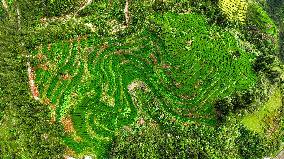
An aerial drone photo shows a tea garden in Jiangkou County of Tongren, southwest China's Guizhou Province, on April 16, 2025. Located at the foot of Mount Fanjing, a UNESCO World Heritage Site, Jiangkou County is a powerhouse in the world's matcha industry. The county boasts over 10,000 hectares of tea plantations, nearly a fifth of which are dedicated to matcha production. In 2024, Jiangkou County produced more than 1,200 tonnes of matcha with a total output value of 350 million yuan (about 48.02 million U.S. dollars). The local matcha products have been exported to more than 40 overseas markets. Experts and agronomists believe that Guizhou, located on a plateau, possesses geographical and climatic advantages such as high altitude, low latitude, abundant fog and limited sunlight ideal for growing tea. Therefore, tea produced in this area is green, ecological and organic. Photo by Ou Dongqu/Xinhua/ABACAPRESS.COM

  •  
Snub-Nosed Monkey - China

Snub-Nosed Monkey - China

A keeper interacts with a Guizhou snub-nosed monkey in a Guizhou snub-nosed monkey research center of Mount Fanjing National Nature Reserve in southwest China's Guizhou Province, April 15, 2025. The rare Guizhou snub-nosed monkey, or Guizhou golden monkey, exclusively nestled within the expanse of Mount Fanjing, a UNESCO World Natural Heritage Site, is under top-level protection in China and is listed as a "critically endangered" species by the International Union for Conservation of Nature. Among the three species of golden snub-nosed monkeys endemic to China, the Guizhou snub-nosed monkey is the one with the smallest population, the narrowest habitat and the least ecological information. At present, there are nine captive Guizhou snub-nosed monkeys at the Guizhou snub-nosed monkey research center of Mount Fanjing National Nature Reserve, according to data from the reserve administration. Photo by Ou Dongqu/Xinhua/ABACAPRESS.COM

  •  
Snub-Nosed Monkey - China

Snub-Nosed Monkey - China

A Guizhou snub-nosed monkey is seen in a Guizhou snub-nosed monkey research center of Mount Fanjing National Nature Reserve in southwest China's Guizhou Province, April 15, 2025. The rare Guizhou snub-nosed monkey, or Guizhou golden monkey, exclusively nestled within the expanse of Mount Fanjing, a UNESCO World Natural Heritage Site, is under top-level protection in China and is listed as a "critically endangered" species by the International Union for Conservation of Nature. Among the three species of golden snub-nosed monkeys endemic to China, the Guizhou snub-nosed monkey is the one with the smallest population, the narrowest habitat and the least ecological information. At present, there are nine captive Guizhou snub-nosed monkeys at the Guizhou snub-nosed monkey research center of Mount Fanjing National Nature Reserve, according to data from the reserve administration. Photo by Ou Dongqu/Xinhua/ABACAPRESS.COM

  •  
Snub-Nosed Monkey - China

Snub-Nosed Monkey - China

A Guizhou snub-nosed monkey is seen in a Guizhou snub-nosed monkey research center of Mount Fanjing National Nature Reserve in southwest China's Guizhou Province, April 15, 2025. The rare Guizhou snub-nosed monkey, or Guizhou golden monkey, exclusively nestled within the expanse of Mount Fanjing, a UNESCO World Natural Heritage Site, is under top-level protection in China and is listed as a "critically endangered" species by the International Union for Conservation of Nature. Among the three species of golden snub-nosed monkeys endemic to China, the Guizhou snub-nosed monkey is the one with the smallest population, the narrowest habitat and the least ecological information. At present, there are nine captive Guizhou snub-nosed monkeys at the Guizhou snub-nosed monkey research center of Mount Fanjing National Nature Reserve, according to data from the reserve administration. Photo by Ou Dongqu/Xinhua/ABACAPRESS.COM

  •  
Snub-Nosed Monkey - China

Snub-Nosed Monkey - China

A Guizhou snub-nosed monkey is seen in a Guizhou snub-nosed monkey research center of Mount Fanjing National Nature Reserve in southwest China's Guizhou Province, April 15, 2025. The rare Guizhou snub-nosed monkey, or Guizhou golden monkey, exclusively nestled within the expanse of Mount Fanjing, a UNESCO World Natural Heritage Site, is under top-level protection in China and is listed as a "critically endangered" species by the International Union for Conservation of Nature. Among the three species of golden snub-nosed monkeys endemic to China, the Guizhou snub-nosed monkey is the one with the smallest population, the narrowest habitat and the least ecological information. At present, there are nine captive Guizhou snub-nosed monkeys at the Guizhou snub-nosed monkey research center of Mount Fanjing National Nature Reserve, according to data from the reserve administration. Photo by Ou Dongqu/Xinhua/ABACAPRESS.COM

  •  
Snub-Nosed Monkey - China

Snub-Nosed Monkey - China

A Guizhou snub-nosed monkey is seen in a Guizhou snub-nosed monkey research center of Mount Fanjing National Nature Reserve in southwest China's Guizhou Province, April 15, 2025. The rare Guizhou snub-nosed monkey, or Guizhou golden monkey, exclusively nestled within the expanse of Mount Fanjing, a UNESCO World Natural Heritage Site, is under top-level protection in China and is listed as a "critically endangered" species by the International Union for Conservation of Nature. Among the three species of golden snub-nosed monkeys endemic to China, the Guizhou snub-nosed monkey is the one with the smallest population, the narrowest habitat and the least ecological information. At present, there are nine captive Guizhou snub-nosed monkeys at the Guizhou snub-nosed monkey research center of Mount Fanjing National Nature Reserve, according to data from the reserve administration. Photo by Ou Dongqu/Xinhua/ABACAPRESS.COM

  •  
Snub-Nosed Monkey - China

Snub-Nosed Monkey - China

A Guizhou snub-nosed monkey is seen in a Guizhou snub-nosed monkey research center of Mount Fanjing National Nature Reserve in southwest China's Guizhou Province, April 15, 2025. The rare Guizhou snub-nosed monkey, or Guizhou golden monkey, exclusively nestled within the expanse of Mount Fanjing, a UNESCO World Natural Heritage Site, is under top-level protection in China and is listed as a "critically endangered" species by the International Union for Conservation of Nature. Among the three species of golden snub-nosed monkeys endemic to China, the Guizhou snub-nosed monkey is the one with the smallest population, the narrowest habitat and the least ecological information. At present, there are nine captive Guizhou snub-nosed monkeys at the Guizhou snub-nosed monkey research center of Mount Fanjing National Nature Reserve, according to data from the reserve administration. Photo by Ou Dongqu/Xinhua/ABACAPRESS.COM

  •  
Spherical Radio Telescope - China

Spherical Radio Telescope - China

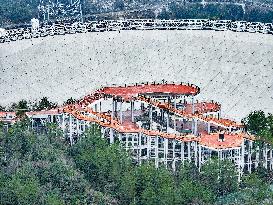
An aerial drone photo taken on February 18, 2025 shows tourists visiting China's Five-hundred-meter Aperture Spherical Radio Telescope (FAST) under maintenance in southwest China's Guizhou Province. In recent years, Guizhou has leveraged its scientific research resources such as FAST to develop educational travel for science, a favorable choice across China for inquisitive minds seeking to embark on a journey of knowledge and exploration in science. For example, FAST, the world's largest single-dish radio telescope, attracted 1.298 million visitors for educational travel for science in 2024. Photo by Xinhua/Ou Dongqu/ABACAPRESS.COM

  • Main
  • Top
  • Editorial
  • Creative
  • About Us
  • About ILG
  • Terms of use
  • Company
  • BEHIND
  • Price List
  • Single Plan
  • Monthly Plan
  • Services
  • Shooting
  • Rights Clearance
  • Support
  • FAQ
  • How To Buy
  • Contact Us
  • Become a Partner

© KYODO NEWS IMAGES INC

All Rights Reserved.

  • Editorial
  • Olympics
  • News
  • Sports
  • Japan
  • Tech
  • Royal
  • Disaster
  • NorthKorea
  • Old Japan
  • SNS

  • Creative
  • Food
  • Japan
  • Landscape
  • Animal
  • Popular
  • #Ukraine
  • #China
  • #coronavirus
  • #N. Korea
  • #Russia
  • #Thailand
  • #Ukraine
  • #China
  • #coronavirus
  • #N. Korea
  • #Russia
  • #Thailand
  • Food
  • Japan
  • Landscape
  • Animal
  • Olympics
  • News
  • Sports
  • Japan
  • Tech
  • Royal
  • Disaster
  • NorthKorea
  • Old Japan
  • SNS