•  
Copernicus Sentinel-1D Launches Into Orbit - French Guiana

Copernicus Sentinel-1D Launches Into Orbit - French Guiana

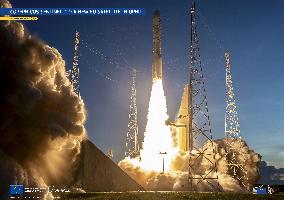
Handout photo dated on November 4, 2025 shows Copernicus Sentinel-1D was successfully launched on 4 November 2025 at 22:02 CET (21:02 UTC) aboard an Ariane 6 rocket from the European Spaceport in Kourou, French Guiana. The satellite was released into orbit 34 minutes after launch, and the first signal was received at 23:22 CET by the Troll ground station in Antarctica. At the heart of Copernicus Sentinel-1 is the C-SAR (C-band Synthetic Aperture Radar) instrument, operating at 5.405 GHz. It provides high-resolution imaging of the Earth's surface regardless of weather conditions, day or night. The radar supports four operational modes: Strip Map (5 × 5 m resolution, 80 km swath), Interferometric Wide Swath (5 × 20 m resolution, 250 km swath), Extra Wide Swath (20 × 40 m resolution, 400 km swath), and Wave mode for ocean monitoring. A key feature of Sentinel-1D, also present on Sentinel-1C, is the integration of the Automatic Identification System (AIS), which enables detection and tracking of ship signals in c

  •  
Sunflower Field Illustrations - Spain

Sunflower Field Illustrations - Spain

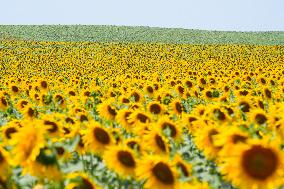
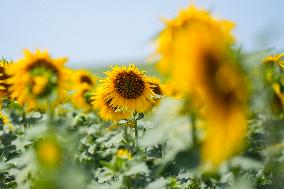
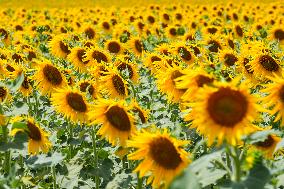
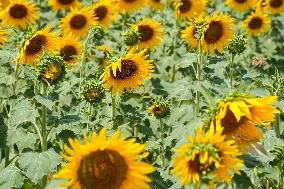
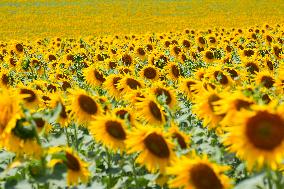
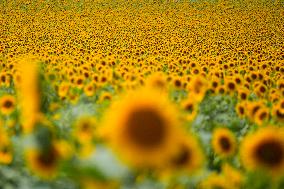
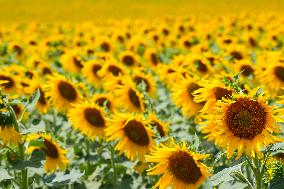
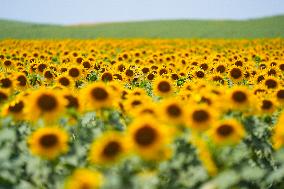
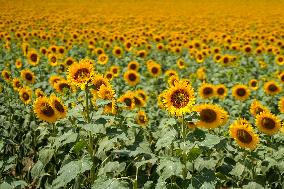
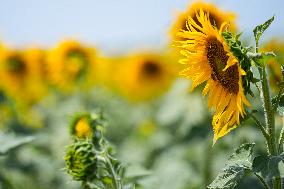
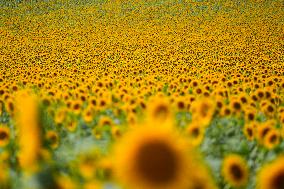
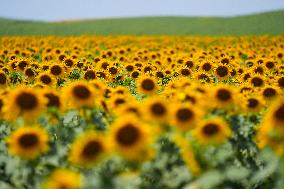
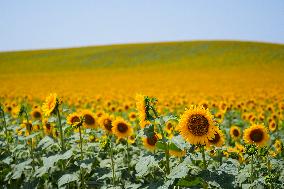
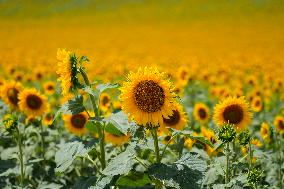
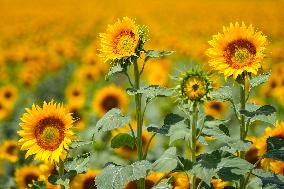
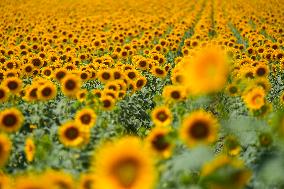
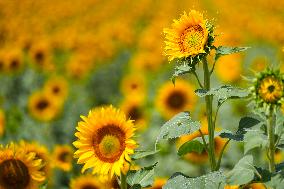
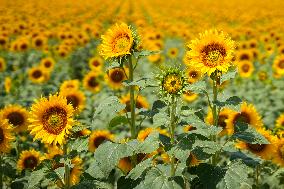
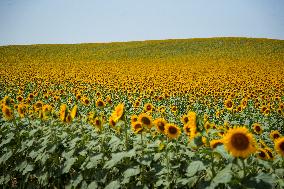
Images of a field of sunflowers in bloom in the Sevillian town of Sanlucar la Mayor, on June 20, 2025, in Seville, Andalusia, Spain. This Saturday, June 21, at 2 hours 42 minutes UTC, according to calculations by the National Astronomical Observatory, the summer solstice will occur, a phenomenon in which the Sun reaches its maximum declination projecting its light over the maximum geographic latitude on Earth. This astronomical event starts the summer in the northern hemisphere and the winter in the southern hemisphere. In addition, the day of the summer solstice corresponds to the longest day of the year, since it is the day on which the Sun rises the earliest and the day on which it sets the latest. Photo by Joaquin Corchero/Europa Press/ABACAPRESS.COM

  •  
Sunflower Field Illustrations - Spain

Sunflower Field Illustrations - Spain

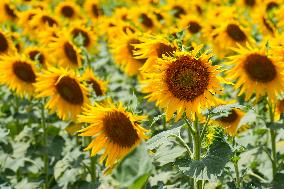
Images of a field of sunflowers in bloom in the Sevillian town of Sanlucar la Mayor, on June 20, 2025, in Seville, Andalusia, Spain. This Saturday, June 21, at 2 hours 42 minutes UTC, according to calculations by the National Astronomical Observatory, the summer solstice will occur, a phenomenon in which the Sun reaches its maximum declination projecting its light over the maximum geographic latitude on Earth. This astronomical event starts the summer in the northern hemisphere and the winter in the southern hemisphere. In addition, the day of the summer solstice corresponds to the longest day of the year, since it is the day on which the Sun rises the earliest and the day on which it sets the latest. Photo by Joaquin Corchero/Europa Press/ABACAPRESS.COM

  •  
Sunflower Field Illustrations - Spain

Sunflower Field Illustrations - Spain

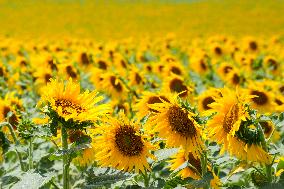
Images of a field of sunflowers in bloom in the Sevillian town of Sanlucar la Mayor, on June 20, 2025, in Seville, Andalusia, Spain. This Saturday, June 21, at 2 hours 42 minutes UTC, according to calculations by the National Astronomical Observatory, the summer solstice will occur, a phenomenon in which the Sun reaches its maximum declination projecting its light over the maximum geographic latitude on Earth. This astronomical event starts the summer in the northern hemisphere and the winter in the southern hemisphere. In addition, the day of the summer solstice corresponds to the longest day of the year, since it is the day on which the Sun rises the earliest and the day on which it sets the latest. Photo by Joaquin Corchero/Europa Press/ABACAPRESS.COM

  •  
Sunflower Field Illustrations - Spain

Sunflower Field Illustrations - Spain

Images of a field of sunflowers in bloom in the Sevillian town of Sanlucar la Mayor, on June 20, 2025, in Seville, Andalusia, Spain. This Saturday, June 21, at 2 hours 42 minutes UTC, according to calculations by the National Astronomical Observatory, the summer solstice will occur, a phenomenon in which the Sun reaches its maximum declination projecting its light over the maximum geographic latitude on Earth. This astronomical event starts the summer in the northern hemisphere and the winter in the southern hemisphere. In addition, the day of the summer solstice corresponds to the longest day of the year, since it is the day on which the Sun rises the earliest and the day on which it sets the latest. Photo by Joaquin Corchero/Europa Press/ABACAPRESS.COM

  •  
Sunflower Field Illustrations - Spain

Sunflower Field Illustrations - Spain

Images of a field of sunflowers in bloom in the Sevillian town of Sanlucar la Mayor, on June 20, 2025, in Seville, Andalusia, Spain. This Saturday, June 21, at 2 hours 42 minutes UTC, according to calculations by the National Astronomical Observatory, the summer solstice will occur, a phenomenon in which the Sun reaches its maximum declination projecting its light over the maximum geographic latitude on Earth. This astronomical event starts the summer in the northern hemisphere and the winter in the southern hemisphere. In addition, the day of the summer solstice corresponds to the longest day of the year, since it is the day on which the Sun rises the earliest and the day on which it sets the latest. Photo by Joaquin Corchero/Europa Press/ABACAPRESS.COM

  •  
Sunflower Field Illustrations - Spain

Sunflower Field Illustrations - Spain

Images of a field of sunflowers in bloom in the Sevillian town of Sanlucar la Mayor, on June 20, 2025, in Seville, Andalusia, Spain. This Saturday, June 21, at 2 hours 42 minutes UTC, according to calculations by the National Astronomical Observatory, the summer solstice will occur, a phenomenon in which the Sun reaches its maximum declination projecting its light over the maximum geographic latitude on Earth. This astronomical event starts the summer in the northern hemisphere and the winter in the southern hemisphere. In addition, the day of the summer solstice corresponds to the longest day of the year, since it is the day on which the Sun rises the earliest and the day on which it sets the latest. Photo by Joaquin Corchero/Europa Press/ABACAPRESS.COM

  •  
Sunflower Field Illustrations - Spain

Sunflower Field Illustrations - Spain

Images of a field of sunflowers in bloom in the Sevillian town of Sanlucar la Mayor, on June 20, 2025, in Seville, Andalusia, Spain. This Saturday, June 21, at 2 hours 42 minutes UTC, according to calculations by the National Astronomical Observatory, the summer solstice will occur, a phenomenon in which the Sun reaches its maximum declination projecting its light over the maximum geographic latitude on Earth. This astronomical event starts the summer in the northern hemisphere and the winter in the southern hemisphere. In addition, the day of the summer solstice corresponds to the longest day of the year, since it is the day on which the Sun rises the earliest and the day on which it sets the latest. Photo by Joaquin Corchero/Europa Press/ABACAPRESS.COM

  •  
Sunflower Field Illustrations - Spain

Sunflower Field Illustrations - Spain

Images of a field of sunflowers in bloom in the Sevillian town of Sanlucar la Mayor, on June 20, 2025, in Seville, Andalusia, Spain. This Saturday, June 21, at 2 hours 42 minutes UTC, according to calculations by the National Astronomical Observatory, the summer solstice will occur, a phenomenon in which the Sun reaches its maximum declination projecting its light over the maximum geographic latitude on Earth. This astronomical event starts the summer in the northern hemisphere and the winter in the southern hemisphere. In addition, the day of the summer solstice corresponds to the longest day of the year, since it is the day on which the Sun rises the earliest and the day on which it sets the latest. Photo by Joaquin Corchero/Europa Press/ABACAPRESS.COM

  •  
Sunflower Field Illustrations - Spain

Sunflower Field Illustrations - Spain

Images of a field of sunflowers in bloom in the Sevillian town of Sanlucar la Mayor, on June 20, 2025, in Seville, Andalusia, Spain. This Saturday, June 21, at 2 hours 42 minutes UTC, according to calculations by the National Astronomical Observatory, the summer solstice will occur, a phenomenon in which the Sun reaches its maximum declination projecting its light over the maximum geographic latitude on Earth. This astronomical event starts the summer in the northern hemisphere and the winter in the southern hemisphere. In addition, the day of the summer solstice corresponds to the longest day of the year, since it is the day on which the Sun rises the earliest and the day on which it sets the latest. Photo by Joaquin Corchero/Europa Press/ABACAPRESS.COM

  •  
Sunflower Field Illustrations - Spain

Sunflower Field Illustrations - Spain

Images of a field of sunflowers in bloom in the Sevillian town of Sanlucar la Mayor, on June 20, 2025, in Seville, Andalusia, Spain. This Saturday, June 21, at 2 hours 42 minutes UTC, according to calculations by the National Astronomical Observatory, the summer solstice will occur, a phenomenon in which the Sun reaches its maximum declination projecting its light over the maximum geographic latitude on Earth. This astronomical event starts the summer in the northern hemisphere and the winter in the southern hemisphere. In addition, the day of the summer solstice corresponds to the longest day of the year, since it is the day on which the Sun rises the earliest and the day on which it sets the latest. Photo by Joaquin Corchero/Europa Press/ABACAPRESS.COM

  •  
Sunflower Field Illustrations - Spain

Sunflower Field Illustrations - Spain

Images of a field of sunflowers in bloom in the Sevillian town of Sanlucar la Mayor, on June 20, 2025, in Seville, Andalusia, Spain. This Saturday, June 21, at 2 hours 42 minutes UTC, according to calculations by the National Astronomical Observatory, the summer solstice will occur, a phenomenon in which the Sun reaches its maximum declination projecting its light over the maximum geographic latitude on Earth. This astronomical event starts the summer in the northern hemisphere and the winter in the southern hemisphere. In addition, the day of the summer solstice corresponds to the longest day of the year, since it is the day on which the Sun rises the earliest and the day on which it sets the latest. Photo by Joaquin Corchero/Europa Press/ABACAPRESS.COM

  •  
Sunflower Field Illustrations - Spain

Sunflower Field Illustrations - Spain

Images of a field of sunflowers in bloom in the Sevillian town of Sanlucar la Mayor, on June 20, 2025, in Seville, Andalusia, Spain. This Saturday, June 21, at 2 hours 42 minutes UTC, according to calculations by the National Astronomical Observatory, the summer solstice will occur, a phenomenon in which the Sun reaches its maximum declination projecting its light over the maximum geographic latitude on Earth. This astronomical event starts the summer in the northern hemisphere and the winter in the southern hemisphere. In addition, the day of the summer solstice corresponds to the longest day of the year, since it is the day on which the Sun rises the earliest and the day on which it sets the latest. Photo by Joaquin Corchero/Europa Press/ABACAPRESS.COM

  •  
Sunflower Field Illustrations - Spain

Sunflower Field Illustrations - Spain

Images of a field of sunflowers in bloom in the Sevillian town of Sanlucar la Mayor, on June 20, 2025, in Seville, Andalusia, Spain. This Saturday, June 21, at 2 hours 42 minutes UTC, according to calculations by the National Astronomical Observatory, the summer solstice will occur, a phenomenon in which the Sun reaches its maximum declination projecting its light over the maximum geographic latitude on Earth. This astronomical event starts the summer in the northern hemisphere and the winter in the southern hemisphere. In addition, the day of the summer solstice corresponds to the longest day of the year, since it is the day on which the Sun rises the earliest and the day on which it sets the latest. Photo by Joaquin Corchero/Europa Press/ABACAPRESS.COM

  •  
Sunflower Field Illustrations - Spain

Sunflower Field Illustrations - Spain

Images of a field of sunflowers in bloom in the Sevillian town of Sanlucar la Mayor, on June 20, 2025, in Seville, Andalusia, Spain. This Saturday, June 21, at 2 hours 42 minutes UTC, according to calculations by the National Astronomical Observatory, the summer solstice will occur, a phenomenon in which the Sun reaches its maximum declination projecting its light over the maximum geographic latitude on Earth. This astronomical event starts the summer in the northern hemisphere and the winter in the southern hemisphere. In addition, the day of the summer solstice corresponds to the longest day of the year, since it is the day on which the Sun rises the earliest and the day on which it sets the latest. Photo by Joaquin Corchero/Europa Press/ABACAPRESS.COM

  •  
Sunflower Field Illustrations - Spain

Sunflower Field Illustrations - Spain

Images of a field of sunflowers in bloom in the Sevillian town of Sanlucar la Mayor, on June 20, 2025, in Seville, Andalusia, Spain. This Saturday, June 21, at 2 hours 42 minutes UTC, according to calculations by the National Astronomical Observatory, the summer solstice will occur, a phenomenon in which the Sun reaches its maximum declination projecting its light over the maximum geographic latitude on Earth. This astronomical event starts the summer in the northern hemisphere and the winter in the southern hemisphere. In addition, the day of the summer solstice corresponds to the longest day of the year, since it is the day on which the Sun rises the earliest and the day on which it sets the latest. Photo by Joaquin Corchero/Europa Press/ABACAPRESS.COM

  •  
Sunflower Field Illustrations - Spain

Sunflower Field Illustrations - Spain

Images of a field of sunflowers in bloom in the Sevillian town of Sanlucar la Mayor, on June 20, 2025, in Seville, Andalusia, Spain. This Saturday, June 21, at 2 hours 42 minutes UTC, according to calculations by the National Astronomical Observatory, the summer solstice will occur, a phenomenon in which the Sun reaches its maximum declination projecting its light over the maximum geographic latitude on Earth. This astronomical event starts the summer in the northern hemisphere and the winter in the southern hemisphere. In addition, the day of the summer solstice corresponds to the longest day of the year, since it is the day on which the Sun rises the earliest and the day on which it sets the latest. Photo by Joaquin Corchero/Europa Press/ABACAPRESS.COM

  •  
Sunflower Field Illustrations - Spain

Sunflower Field Illustrations - Spain

Images of a field of sunflowers in bloom in the Sevillian town of Sanlucar la Mayor, on June 20, 2025, in Seville, Andalusia, Spain. This Saturday, June 21, at 2 hours 42 minutes UTC, according to calculations by the National Astronomical Observatory, the summer solstice will occur, a phenomenon in which the Sun reaches its maximum declination projecting its light over the maximum geographic latitude on Earth. This astronomical event starts the summer in the northern hemisphere and the winter in the southern hemisphere. In addition, the day of the summer solstice corresponds to the longest day of the year, since it is the day on which the Sun rises the earliest and the day on which it sets the latest. Photo by Joaquin Corchero/Europa Press/ABACAPRESS.COM

  •  
Sunflower Field Illustrations - Spain

Sunflower Field Illustrations - Spain

Images of a field of sunflowers in bloom in the Sevillian town of Sanlucar la Mayor, on June 20, 2025, in Seville, Andalusia, Spain. This Saturday, June 21, at 2 hours 42 minutes UTC, according to calculations by the National Astronomical Observatory, the summer solstice will occur, a phenomenon in which the Sun reaches its maximum declination projecting its light over the maximum geographic latitude on Earth. This astronomical event starts the summer in the northern hemisphere and the winter in the southern hemisphere. In addition, the day of the summer solstice corresponds to the longest day of the year, since it is the day on which the Sun rises the earliest and the day on which it sets the latest. Photo by Joaquin Corchero/Europa Press/ABACAPRESS.COM

  •  
Sunflower Field Illustrations - Spain

Sunflower Field Illustrations - Spain

Images of a field of sunflowers in bloom in the Sevillian town of Sanlucar la Mayor, on June 20, 2025, in Seville, Andalusia, Spain. This Saturday, June 21, at 2 hours 42 minutes UTC, according to calculations by the National Astronomical Observatory, the summer solstice will occur, a phenomenon in which the Sun reaches its maximum declination projecting its light over the maximum geographic latitude on Earth. This astronomical event starts the summer in the northern hemisphere and the winter in the southern hemisphere. In addition, the day of the summer solstice corresponds to the longest day of the year, since it is the day on which the Sun rises the earliest and the day on which it sets the latest. Photo by Joaquin Corchero/Europa Press/ABACAPRESS.COM

  •  
Sunflower Field Illustrations - Spain

Sunflower Field Illustrations - Spain

Images of a field of sunflowers in bloom in the Sevillian town of Sanlucar la Mayor, on June 20, 2025, in Seville, Andalusia, Spain. This Saturday, June 21, at 2 hours 42 minutes UTC, according to calculations by the National Astronomical Observatory, the summer solstice will occur, a phenomenon in which the Sun reaches its maximum declination projecting its light over the maximum geographic latitude on Earth. This astronomical event starts the summer in the northern hemisphere and the winter in the southern hemisphere. In addition, the day of the summer solstice corresponds to the longest day of the year, since it is the day on which the Sun rises the earliest and the day on which it sets the latest. Photo by Joaquin Corchero/Europa Press/ABACAPRESS.COM

  •  
Sunflower Field Illustrations - Spain

Sunflower Field Illustrations - Spain

Images of a field of sunflowers in bloom in the Sevillian town of Sanlucar la Mayor, on June 20, 2025, in Seville, Andalusia, Spain. This Saturday, June 21, at 2 hours 42 minutes UTC, according to calculations by the National Astronomical Observatory, the summer solstice will occur, a phenomenon in which the Sun reaches its maximum declination projecting its light over the maximum geographic latitude on Earth. This astronomical event starts the summer in the northern hemisphere and the winter in the southern hemisphere. In addition, the day of the summer solstice corresponds to the longest day of the year, since it is the day on which the Sun rises the earliest and the day on which it sets the latest. Photo by Joaquin Corchero/Europa Press/ABACAPRESS.COM

  •  
Sunflower Field Illustrations - Spain

Sunflower Field Illustrations - Spain

Images of a field of sunflowers in bloom in the Sevillian town of Sanlucar la Mayor, on June 20, 2025, in Seville, Andalusia, Spain. This Saturday, June 21, at 2 hours 42 minutes UTC, according to calculations by the National Astronomical Observatory, the summer solstice will occur, a phenomenon in which the Sun reaches its maximum declination projecting its light over the maximum geographic latitude on Earth. This astronomical event starts the summer in the northern hemisphere and the winter in the southern hemisphere. In addition, the day of the summer solstice corresponds to the longest day of the year, since it is the day on which the Sun rises the earliest and the day on which it sets the latest. Photo by Joaquin Corchero/Europa Press/ABACAPRESS.COM

  •  
Sunflower Field Illustrations - Spain

Sunflower Field Illustrations - Spain

Images of a field of sunflowers in bloom in the Sevillian town of Sanlucar la Mayor, on June 20, 2025, in Seville, Andalusia, Spain. This Saturday, June 21, at 2 hours 42 minutes UTC, according to calculations by the National Astronomical Observatory, the summer solstice will occur, a phenomenon in which the Sun reaches its maximum declination projecting its light over the maximum geographic latitude on Earth. This astronomical event starts the summer in the northern hemisphere and the winter in the southern hemisphere. In addition, the day of the summer solstice corresponds to the longest day of the year, since it is the day on which the Sun rises the earliest and the day on which it sets the latest. Photo by Joaquin Corchero/Europa Press/ABACAPRESS.COM

  •  
Sunflower Field Illustrations - Spain

Sunflower Field Illustrations - Spain

Images of a field of sunflowers in bloom in the Sevillian town of Sanlucar la Mayor, on June 20, 2025, in Seville, Andalusia, Spain. This Saturday, June 21, at 2 hours 42 minutes UTC, according to calculations by the National Astronomical Observatory, the summer solstice will occur, a phenomenon in which the Sun reaches its maximum declination projecting its light over the maximum geographic latitude on Earth. This astronomical event starts the summer in the northern hemisphere and the winter in the southern hemisphere. In addition, the day of the summer solstice corresponds to the longest day of the year, since it is the day on which the Sun rises the earliest and the day on which it sets the latest. Photo by Joaquin Corchero/Europa Press/ABACAPRESS.COM

  •  
Sunflower Field Illustrations - Spain

Sunflower Field Illustrations - Spain

Images of a field of sunflowers in bloom in the Sevillian town of Sanlucar la Mayor, on June 20, 2025, in Seville, Andalusia, Spain. This Saturday, June 21, at 2 hours 42 minutes UTC, according to calculations by the National Astronomical Observatory, the summer solstice will occur, a phenomenon in which the Sun reaches its maximum declination projecting its light over the maximum geographic latitude on Earth. This astronomical event starts the summer in the northern hemisphere and the winter in the southern hemisphere. In addition, the day of the summer solstice corresponds to the longest day of the year, since it is the day on which the Sun rises the earliest and the day on which it sets the latest. Photo by Joaquin Corchero/Europa Press/ABACAPRESS.COM

  •  

World Exposition in Osaka

OSAKA, Japan, June 6 Kyodo - A plum pickling ceremony is held on Plum Day on June 6, 2025, at the Earth Mart pavilion at the World Exposition in Osaka. (Kyodo)

  •  
World Exposition in Osaka

World Exposition in Osaka

A plum pickling ceremony is held on Plum Day on June 6, 2025, at the Earth Mart pavilion at the World Exposition in Osaka.

  •  
World Exposition in Osaka

World Exposition in Osaka

A plum pickling ceremony is held on Plum Day on June 6, 2025, at the Earth Mart pavilion at the World Exposition in Osaka.

  •  
World Exposition in Osaka

World Exposition in Osaka

A plum pickling ceremony is held on Plum Day on June 6, 2025, at the Earth Mart pavilion at the World Exposition in Osaka.

  •  

[Breaking News]Remotely controlled excavator

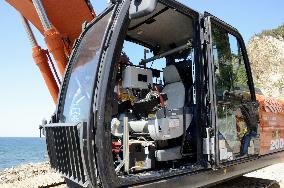
WAJIMA, Japan, May 8 Kyodo - A remotely controlled unmanned excavator removes earth and sand at the site of a landslide caused by the Jan. 1, 2024 massive earthquake in Wajima, Ishikawa Prefecture, central Japan, on May 8, 2025. The excavator, controlled from an office in Chiba Prefecture, eastern Japan -- over 300 kilometers away from the site -- was introduced by the land ministry the same day. (Kyodo)

  •  
Remotely controlled excavator

Remotely controlled excavator

A remotely controlled unmanned excavator removes earth and sand at the site of a landslide caused by the Jan. 1, 2024 massive earthquake in Wajima, Ishikawa Prefecture, central Japan, on May 8, 2025. The excavator, controlled from an office in Chiba Prefecture, eastern Japan -- over 300 kilometers away from the site -- was introduced by the land ministry the same day.

  •  
Remotely controlled excavator

Remotely controlled excavator

A remotely controlled unmanned excavator removes earth and sand at the site of a landslide caused by the Jan. 1, 2024 massive earthquake in Wajima, Ishikawa Prefecture, central Japan, on May 8, 2025. The excavator, controlled from an office in Chiba Prefecture, eastern Japan -- over 300 kilometers away from the site -- was introduced by the land ministry the same day.

  •  
Waste Pickers And Solid Waste During Earth Day - India

Waste Pickers And Solid Waste During Earth Day - India

A female labour searches for reusable plastic and other at a roadside garbage store during Earth Day in Siliguri on April 22, 2025. Earth Day is marked on April 22 to inspire awareness of and appreciation for the earth's environment. Photo by Diptendu Dutta/Middle East Images/ABACAPRESS.COM

  •  
Waste Pickers And Solid Waste During Earth Day - India

Waste Pickers And Solid Waste During Earth Day - India

Child ragpickers searches for reusable plastic and other at a roadside garbage thrown area during Earth Day at Dagapur area on the outskirts of Siliguri on April 22, 2025. Earth Day is marked on April 22 to inspire awareness of and appreciation for the earth's environment. Photo by Diptendu Dutta/Middle East Images/ABACAPRESS.COM

  •  
Waste Pickers And Solid Waste During Earth Day - India

Waste Pickers And Solid Waste During Earth Day - India

A worker and ragpickers searches for reusable plastic and other at a roadside garbage store during Earth Day at Dagapur area on the outskirts of Siliguri on April 22, 2025. Earth Day is marked on April 22 to inspire awareness of and appreciation for the earth's environment. Photo by Diptendu Dutta/Middle East Images/ABACAPRESS.COM

  •  
Waste Pickers And Solid Waste During Earth Day - India

Waste Pickers And Solid Waste During Earth Day - India

Ragpickers searches for reusable plastic and other at a roadside garbage store during Earth Day in Siliguri on April 22, 2025. Earth Day is marked on April 22 to inspire awareness of and appreciation for the earth's environment. Photo by Diptendu Dutta/Middle East Images/ABACAPRESS.COM

  •  
Waste Pickers And Solid Waste During Earth Day - India

Waste Pickers And Solid Waste During Earth Day - India

A worker and ragpickers searches for reusable plastic and other at a roadside garbage store during Earth Day at Dagapur area on the outskirts of Siliguri on April 22, 2025. Earth Day is marked on April 22 to inspire awareness of and appreciation for the earth's environment. Photo by Diptendu Dutta/Middle East Images/ABACAPRESS.COM

  •  
Waste Pickers And Solid Waste During Earth Day - India

Waste Pickers And Solid Waste During Earth Day - India

Worker and ragpickers searches for reusable plastic and other at a roadside garbage store during Earth Day at Dagapur area on the outskirts of Siliguri on April 22, 2025. Earth Day is marked on April 22 to inspire awareness of and appreciation for the earth's environment. Photo by Diptendu Dutta/Middle East Images/ABACAPRESS.COM

  •  
Waste Pickers And Solid Waste During Earth Day - India

Waste Pickers And Solid Waste During Earth Day - India

A female labour searches for reusable plastic and other at a roadside garbage store during Earth Day in Siliguri on April 22, 2025. Earth Day is marked on April 22 to inspire awareness of and appreciation for the earth's environment. Photo by Diptendu Dutta/Middle East Images/ABACAPRESS.COM

  •  
Waste Pickers And Solid Waste During Earth Day - India

Waste Pickers And Solid Waste During Earth Day - India

A female labour searches for reusable plastic and other at a roadside garbage store during Earth Day in Siliguri on April 22, 2025. Earth Day is marked on April 22 to inspire awareness of and appreciation for the earth's environment. Photo by Diptendu Dutta/Middle East Images/ABACAPRESS.COM

  •  
Waste Pickers And Solid Waste During Earth Day - India

Waste Pickers And Solid Waste During Earth Day - India

Ragpickers searches for reusable plastic and other at a roadside garbage store during Earth Day in Siliguri on April 22, 2025. Earth Day is marked on April 22 to inspire awareness of and appreciation for the earth's environment. Photo by Diptendu Dutta/Middle East Images/ABACAPRESS.COM

  •  
Expedition 72 Soyuz Landing in Kazakhstan

Expedition 72 Soyuz Landing in Kazakhstan

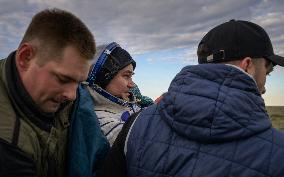
Handout photo dated on April 20, 2025 shows NASA astronaut Don Pettit boards a NASA airplane to take him from Karaganda, Kazakhstan to Houston after he, Roscosmos cosmonauts Alexey Ovchinin, and Ivan Vagner landed in their Soyuz MS-26 spacecraft near the town of Zhezkazgan, Kazakhstan on Sunday, April 20, 2025, (April 19 Eastern). The trio returned to Earth after logging 220 days in space as members of Expeditions 71 and 72 aboard the International Space Station. NASA astronaut Don Pettit has safely returned to Earth after a seven-month mission aboard the ISS, landing with Roscosmos cosmonauts Alexey Ovchinin and Ivan Vagner. Their Soyuz MS-26 capsule touched down near Zhezkazgan, Kazakhstan, on Sunday, 20 April. Pettit’s 70th birthday. During their 220-day stay, the crew orbited Earth 3,520 times and traveled 93.3 million miles. Pettit participated in key experiments, including 3D printing in microgravity, water purification, plant growth studies, and fire behavior in space. He also shared images of Earth an

  •  
Expedition 72 Soyuz Landing in Kazakhstan

Expedition 72 Soyuz Landing in Kazakhstan

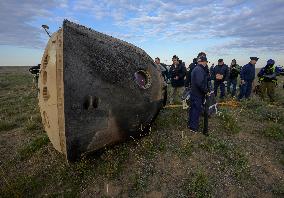
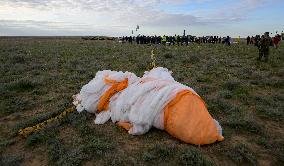
Handout photo dated on April 20, 2025 shows Russian Search and Rescue teams arrive at the Soyuz MS-26 spacecraft shortly after it landed in a remote area near the town of Zhezkazgan, Kazakhstan with Expedition 72 NASA astronaut Don Pettit, and Roscosmos cosmonauts Alexey Ovchinin and Ivan Vagner aboard, Sunday, April 20, 2025, (April 19 Eastern). The trio returned to Earth after logging 220 days in space as members of Expeditions 71 and 72 aboard the International Space Station. NASA astronaut Don Pettit has safely returned to Earth after a seven-month mission aboard the ISS, landing with Roscosmos cosmonauts Alexey Ovchinin and Ivan Vagner. Their Soyuz MS-26 capsule touched down near Zhezkazgan, Kazakhstan, on Sunday, 20 April. Pettit’s 70th birthday. During their 220-day stay, the crew orbited Earth 3,520 times and traveled 93.3 million miles. Pettit participated in key experiments, including 3D printing in microgravity, water purification, plant growth studies, and fire behavior in space. He also shared im

  •  
Expedition 72 Soyuz Landing in Kazakhstan

Expedition 72 Soyuz Landing in Kazakhstan

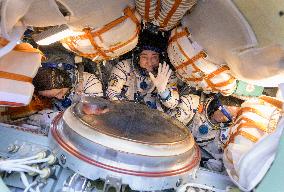
Handout photo dated on April 20, 2025 shows NASA astronaut Don Pettit, left, Roscosmos cosmonaut Alexey Ovchinin, center, and Roscosmos cosmonaut Ivan Vagner are seen inside the Soyuz MS-26 spacecraft after they landed in a remote area near the town of Zhezkazgan, Kazakhstan on Sunday, April 20, 2025, (April 19 Eastern). The trio returned to Earth after logging 220 days in space as members of Expeditions 71 and 72 aboard the International Space Station. NASA astronaut Don Pettit has safely returned to Earth after a seven-month mission aboard the ISS, landing with Roscosmos cosmonauts Alexey Ovchinin and Ivan Vagner. Their Soyuz MS-26 capsule touched down near Zhezkazgan, Kazakhstan, on Sunday, 20 April. Pettit’s 70th birthday. During their 220-day stay, the crew orbited Earth 3,520 times and traveled 93.3 million miles. Pettit participated in key experiments, including 3D printing in microgravity, water purification, plant growth studies, and fire behavior in space. He also shared images of Earth and conducte

  •  
Expedition 72 Soyuz Landing in Kazakhstan

Expedition 72 Soyuz Landing in Kazakhstan

Handout photo dated on April 20, 2025 shows Roscosmos cosmonaut Ivan Vagner is helped out of the Soyuz MS-26 spacecraft just minutes after he, Roscosmos cosmonaut Alexey Ovchinin, and NASA astronaut Don Pettit, landed in a remote area near the town of Zhezkazgan, Kazakhstan on Sunday, April 20, 2025, (April 19 Eastern). The trio returned to Earth after logging 220 days in space as members of Expeditions 71 and 72 aboard the International Space Station. NASA astronaut Don Pettit has safely returned to Earth after a seven-month mission aboard the ISS, landing with Roscosmos cosmonauts Alexey Ovchinin and Ivan Vagner. Their Soyuz MS-26 capsule touched down near Zhezkazgan, Kazakhstan, on Sunday, 20 April. Pettit’s 70th birthday. During their 220-day stay, the crew orbited Earth 3,520 times and traveled 93.3 million miles. Pettit participated in key experiments, including 3D printing in microgravity, water purification, plant growth studies, and fire behavior in space. He also shared images of Earth and conducted

  •  
Expedition 72 Soyuz Landing in Kazakhstan

Expedition 72 Soyuz Landing in Kazakhstan

Handout photo dated on April 20, 2025 shows Russian Search and Rescue teams arrive at the Soyuz MS-26 spacecraft shortly after it landed in a remote area near the town of Zhezkazgan, Kazakhstan with Expedition 72 NASA astronaut Don Pettit, and Roscosmos cosmonauts Alexey Ovchinin and Ivan Vagner aboard, Sunday, April 20, 2025, (April 19 Eastern). The trio returned to Earth after logging 220 days in space as members of Expeditions 71 and 72 aboard the International Space Station. NASA astronaut Don Pettit has safely returned to Earth after a seven-month mission aboard the ISS, landing with Roscosmos cosmonauts Alexey Ovchinin and Ivan Vagner. Their Soyuz MS-26 capsule touched down near Zhezkazgan, Kazakhstan, on Sunday, 20 April. Pettit’s 70th birthday. During their 220-day stay, the crew orbited Earth 3,520 times and traveled 93.3 million miles. Pettit participated in key experiments, including 3D printing in microgravity, water purification, plant growth studies, and fire behavior in space. He also shared im

  •  
Expedition 72 Soyuz Landing in Kazakhstan

Expedition 72 Soyuz Landing in Kazakhstan

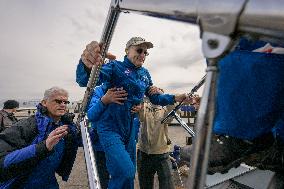
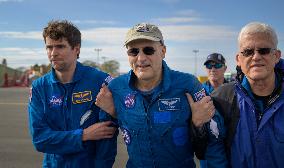
Handout photo dated on April 20, 2025 shows NASA astronaut Don Pettit, center, walks and smiles, while supported by NASA Flight Surgeons Quinn Dufurrena, left, Rainer Effenhauser, right, and Richard Scheuring, background, during a brief layover in Prestwick, Scotland during his return flight to Houston from Karaganda, Kazakhstan, Sunday, April 20, 2025. Pettit, along with Roscosmos cosmonauts Alexey Ovchinin, and Ivan Vagner, returned to Earth earlier in the day after logging 220 days in space as members of Expeditions 71 and 72 aboard the International Space Station. NASA astronaut Don Pettit has safely returned to Earth after a seven-month mission aboard the ISS, landing with Roscosmos cosmonauts Alexey Ovchinin and Ivan Vagner. Their Soyuz MS-26 capsule touched down near Zhezkazgan, Kazakhstan, on Sunday, 20 April. Pettit’s 70th birthday. During their 220-day stay, the crew orbited Earth 3,520 times and traveled 93.3 million miles. Pettit participated in key experiments, including 3D printing in microgravi

  •  
Expedition 72 Soyuz Landing in Kazakhstan

Expedition 72 Soyuz Landing in Kazakhstan

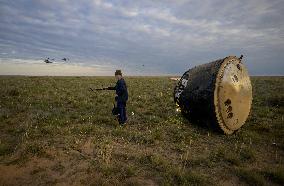
Handout photo dated on April 20, 2025 shows Roscosmos cosmonaut Alexey Ovchinin is seen outside the Soyuz MS-26 spacecraft after he landed with Roscosmos cosmonaut Ivan Vagner, and NASA astronaut Don Pettit in a remote area near the town of Zhezkazgan, Kazakhstan on Sunday, April 20, 2025, (April 19 Eastern). The trio returned to Earth after logging 220 days in space as members of Expeditions 71 and 72 aboard the International Space Station. NASA astronaut Don Pettit has safely returned to Earth after a seven-month mission aboard the ISS, landing with Roscosmos cosmonauts Alexey Ovchinin and Ivan Vagner. Their Soyuz MS-26 capsule touched down near Zhezkazgan, Kazakhstan, on Sunday, 20 April. Pettit’s 70th birthday. During their 220-day stay, the crew orbited Earth 3,520 times and traveled 93.3 million miles. Pettit participated in key experiments, including 3D printing in microgravity, water purification, plant growth studies, and fire behavior in space. He also shared images of Earth and conducted informal s

  •  
Expedition 72 Soyuz Landing in Kazakhstan

Expedition 72 Soyuz Landing in Kazakhstan

Handout photo dated on April 20, 2025 shows Russian support personnel work around the Soyuz MS-26 spacecraft shortly after it landed in a remote area near the town of Zhezkazgan, Kazakhstan with Expedition 72 NASA astronaut Don Pettit, and Roscosmos cosmonauts Alexey Ovchinin and Ivan Vagner aboard, Sunday, April 20, 2025, (April 19 Eastern). The trio returned to Earth after logging 220 days in space as members of Expeditions 71 and 72 aboard the International Space Station. NASA astronaut Don Pettit has safely returned to Earth after a seven-month mission aboard the ISS, landing with Roscosmos cosmonauts Alexey Ovchinin and Ivan Vagner. Their Soyuz MS-26 capsule touched down near Zhezkazgan, Kazakhstan, on Sunday, 20 April. Pettit’s 70th birthday. During their 220-day stay, the crew orbited Earth 3,520 times and traveled 93.3 million miles. Pettit participated in key experiments, including 3D printing in microgravity, water purification, plant growth studies, and fire behavior in space. He also shared images

  • Main
  • Top
  • Editorial
  • Creative
  • About Us
  • About ILG
  • Terms of use
  • Company
  • BEHIND
  • Price List
  • Single Plan
  • Monthly Plan
  • Services
  • Shooting
  • Rights Clearance
  • Support
  • FAQ
  • How To Buy
  • Contact Us
  • Become a Partner

© KYODO NEWS IMAGES INC

All Rights Reserved.

  • Editorial
  • Olympics
  • News
  • Sports
  • Japan
  • Tech
  • Royal
  • Disaster
  • NorthKorea
  • Old Japan
  • SNS

  • Creative
  • Food
  • Japan
  • Landscape
  • Animal
  • Popular
  • #Ukraine
  • #Thailand
  • #coronavirus
  • #N. Korea
  • #China
  • #Russia
  • #Ukraine
  • #Thailand
  • #coronavirus
  • #N. Korea
  • #China
  • #Russia
  • Food
  • Japan
  • Landscape
  • Animal
  • Olympics
  • News
  • Sports
  • Japan
  • Tech
  • Royal
  • Disaster
  • NorthKorea
  • Old Japan
  • SNS