•  
Imperial Palace tours becoming popular

Imperial Palace tours becoming popular

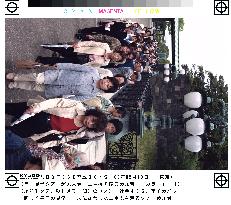
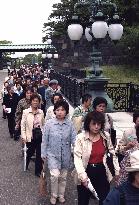
TOKYO, Japan - Visitors cross Niju-bashi, or the Double Bridge, the main gateway to the Imperial Palace in central Tokyo. Tours of the palace are becoming popular this year, the 400th anniversary of the establishment of the Tokugawa shogunate in Edo, the old name for Tokyo. Edo Castle, the seat of the Tokugawa shoguns, stood on the grounds of the palace.

  •  
The gate of the Imperial Palace

The gate of the Imperial Palace

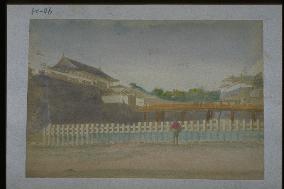
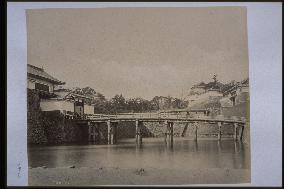
Honmaru (Dungeon) Otemon was the main gate of Edo Castle during the Edo Period, but Nishinomaru Otemon (the gate on the left) became the main gate of the Imperial Palace in the Meiji Period. Koraimon is visible at the edge of Nishinomaru Otemon in the foreground. However, the gate was removed during construction of Meiji Palace in 1888. In December of the same year, the bridge was rebuilt in stone. Taken in 1868.==Date:unknown, Place:Tokyo, Photo:unknown, (Credit:Nagasaki University Library/Kyodo News Images) [Cabinet Number90‐21‐0]

  •  
Niju-bashi Bridge,the Imperial Palace

Niju-bashi Bridge,the Imperial Palace

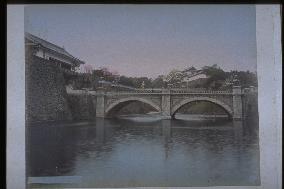
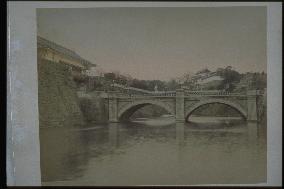
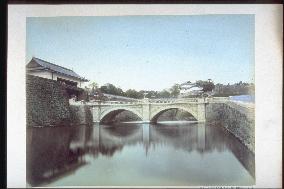
Kakumon Bridge spanning the inner moat (Nijubashi Moat) is said to have been built during the Kansei Period (1789-1801). During the Edo and Meiji Periods, the bridge in the foreground was called Nishinomaru Ote-bashi and the one behind it Nishinomaru Shimojo-bashi. The names currently used by the Imperial House Agency are Imperial Palace Main Gate Stone Bridge and Imperial Palace Main Gate Iron Bridge, respectively. Since 1948, commoners have been allowed to cross these bridges on January 2 and on the Emperor's birthday. Mid-Meiji Period.==Date:unknown, Place:Tokyo, Photo:unknown, (Credit:Nagasaki University Library/Kyodo News Images) [Cabinet Number88‐36‐0]

  •  
Niju-bashi Bridge,the Imperial Palace

Niju-bashi Bridge,the Imperial Palace

Kakumon Bridge spanning the inner moat (Nijubashi Moat) is said to have been built during the Kansei Period (1789-1801). During the Edo and Meiji Periods, the bridge in the foreground was called Nishinomaru Ote-bashi and the one behind it Nishinomaru Shimojo-bashi. The names currently used by the Imperial House Agency are Imperial Palace Main Gate Stone Bridge and Imperial Palace Main Gate Iron Bridge, respectively. Since 1948, commoners have been allowed to cross these bridges on January 2 and on the Emperor's birthday. Mid-Meiji Period.==Date:unknown, Place:Tokyo, Photo:unknown, (Credit:Nagasaki University Library/Kyodo News Images) [Cabinet Number87‐1‐0]

  •  
Niju-bashi Bridge,the Imperial Palace

Niju-bashi Bridge,the Imperial Palace

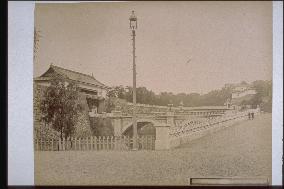
The gate on the left, called Nishinomaru Ote-mon during the Edo Period, became the main gate of the Imperial Palace in 1889 after the construction of the new palace the previous year. The first gate, Korai-mon, in front of the main gate was later removed and only the Watari Yagura-mon exists today. Mid-Meiji Period.==Date:unknown, Place:Tokyo, Photo:A. Farsari, (Credit:Nagasaki University Library/Kyodo News Images) [Cabinet Number81‐17‐0]

  •  
Niju-bashi Bridge,Edo Castle

Niju-bashi Bridge,Edo Castle

Niju-bashi Bridge,Edo Castle==Date:unknown, Place:Tokyo, Photo:R. Stillfried, (Credit:Nagasaki University Library/Kyodo News Images)

  •  
Odawara Castle

Odawara Castle

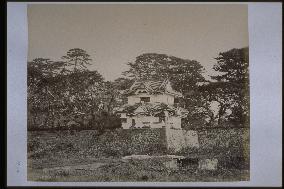
This is the Minami-Kuruwa area of Odawara Castle, site of present-day Odawara City Museum. This photograph was taken from the front gate of Sannomaru Primary School (the old Honcho Primary School). Since the main castle's donjon is not visible, it must have been taken after November 1871 when the tower was disassembled and sold. The bridge in the foreground is Ochatsubo-bashi (the official name is Komine-bashi). It received this name (which means tea jar bridge ) because the tea brought to the shogun during the Edo period had to come across this bridge.==Date:unknown, Place:Odawara, Photo:R. Stillfried, (Credit:Nagasaki University Library/Kyodo News Images) [Cabinet Number78‐14‐0]

  •  
The Imperial Palace

The Imperial Palace

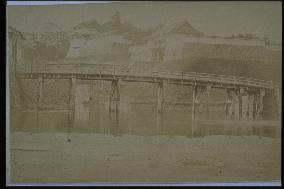
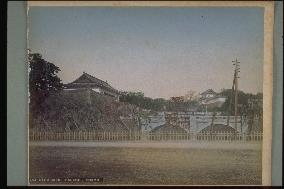
Nishinomaru Ote Bridge and Nishinomaru Shimojo Bridge seen from Nishinomaru Shita (present-day Imperial Palace Outer Garden). Nishinomaru Shimojo Bridge featured rare two-stage girders because of a deep moat. Thus, it was called Niju-bashi (double level bridge). The gate on the left is Nishinomaru Ote-mon. The gate on the right is Nishinomaru Shoinmae-mon. Next to it are Jurokken Tamon and Fushimi watchtower. Taken at the beginning of the Meiji Period.==Date:unknown, Place:Tokyo, Photo:unknown, (Credit:Nagasaki University Library/Kyodo News Images) [Cabinet Number69‐74‐2]

  •  
The outer moat of the Imperial Palace

The outer moat of the Imperial Palace

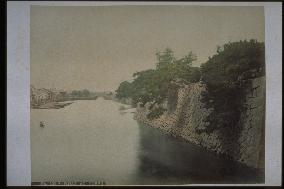
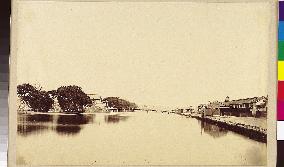
Southern view from the riverbank in Honmachi, near Tokiwa Bridge. Two waterways intersect here and, although not visible, a stone bridge called Ikkokubashi was located on the left spanning the canal which eventually becomes Nihonbashi River. The gap in the wall on the right is Dosan Moat, which originates from Ryunokuchi where the excess water from the inside moats is released. The moat was filled in around 1909. The outer moats beyond Nihonbashi River were filled in after World War II. Consequently, the waterway intersection can no longer be seen. Taken in the mid-Meiji Period. Same as photograph #2199.==Date:unknown, Place:Tokyo, Photo:unknown, (Credit:Nagasaki University Library/Kyodo News Images) [Cabinet Number59‐77‐0]

  •  
Niju-bashi Bridge,the Imperial Palace

Niju-bashi Bridge,the Imperial Palace

Ote Bridge of Nishinomaru (foreground) was replaced with an arched stone bridge in 1887. Although it is hidden behind the stone bridge, Nishinomaru Shimojo-bashi was replaced with an iron bridge in October 1888 at the time of the construction of new palace buildings. Ornamental lamps were installed for the first time here. (One of these is preserved at the Meiji Village theme park). The present-day Nishinomaru Shimojo-bashi Bridge was rebuilt in a similar design in 1964. The watchtower on the right was transferred from Fushimi Castle in Kyoto and re-named Fushimi Yagura. Mid-Meiji Period.==Date:unknown, Place:Tokyo, Photo:unknown, (Credit:Nagasaki University Library/Kyodo News Images) [Cabinet Number53‐41‐0]

  •  
Cherry trees at Ueno Park

Cherry trees at Ueno Park

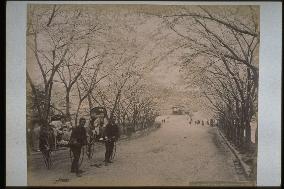
Akasaka Mitsuke was one of the watchtowers at Edo Castle and had an outer gate. The gate, Akasaka Gomon, was destroyed in 1872, leaving only the stone wall. This photograph was taken from the site of the former gate (present-day Akasaka Mitsuke intersection). On the right is Benkei Moat and on the left Tameike (pond). The cherry trees were apparently planted in 1881. Since the photograph does not show Benkei Bridge, constructed in 1889, this photograph was probably taken around 1887.==Date:unknown, Place:Tokyo, Photo:unknown, (Credit:Nagasaki University Library/Kyodo News Images) [Cabinet Number53‐45‐2]

  •  
Stonewalls along the moat

Stonewalls along the moat

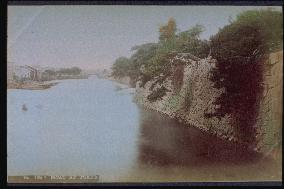
View of the outer moat of Edo Castle looking south from the eastern edge of Tokiwa Bridge, with Gofuku Bridge in the distance to the south. The Gofuku-bashi Gomon Gate was removed in 1873, and the wooden bridge was replaced with a stone bridge in 1880. This photograph was therefore taken after 1880. The break in the middle of the stone wall on the right is the junction of the Dosan Moat and the outer moat. Zenikame Bridge is to the right.==Date:unknown, Place:Tokyo, Photo:Tamamura Kozaburo, (Credit:Nagasaki University Library/Kyodo News Images) [Cabinet Number48‐52‐0]

  •  
Niju-bashi Bridge,the Imperial Palace

Niju-bashi Bridge,the Imperial Palace

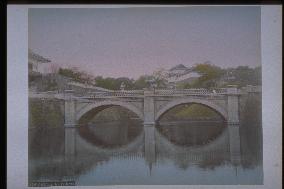
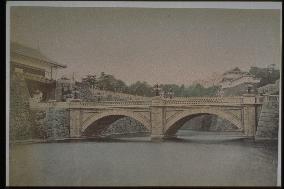
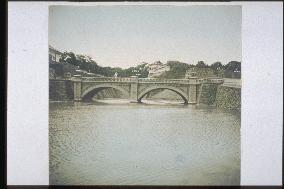
The double arch stone bridge at the front gate of the Imperial Palace, popularly known as the spectacles Megane bridge. Fushimi turret can be seen over the bridge. The so-called double arched bridge is not this stone bridge but the steel bridge of the front gate located at the Fushimi turret.==Date:unknown, Place:Tokyo, Photo:unknown, (Credit:Nagasaki University Library/Kyodo News Images) [Cabinet Number46‐147‐0]

  •  
Niju-bashi Bridge,the Imperial Palace

Niju-bashi Bridge,the Imperial Palace

The double arched bridge of the front gate of the Imperial Palace, popularly known as the Megane bridge (bridge shaped in spectacles). Over the bridge is seen the Fushimi turret. The so-called Niju bridge is not this bridge, but the steel bridge over the Fushimi turret at the front entrance.==Date:unknown, Place:Tokyo, Photo:Kusakabe Kinbei, (Credit:Nagasaki University Library/Kyodo News Images) [Cabinet Number40‐3‐0]

  •  
Niju-bashi Bridge,the Imperial Palace

Niju-bashi Bridge,the Imperial Palace

The stone bridge of the Imperial Palace popularly called Meganebashi (spectacles bridge ). Over the bridge can be seen the Fushimi turret. The so-called Nijubashi is not this bridge but the steel bridge at the front gate where the Fushimi turret stands. The water surface of the moat is hidden by the fenced grounds to the fore.==Date:unknown, Place:Tokyo, Photo:Ogawa Kazumasa, (Credit:Nagasaki University Library/Kyodo News Images) [Cabinet Number25‐50‐0]

  •  
Niju-bashi Bridge,the Imperial Palace

Niju-bashi Bridge,the Imperial Palace

This stone bridge was built after the imperial palace was built. The former bridge was built in the 1614 and was called Nijubashi because the bridge girders were doubled.==Date:unknown, Place:Tokyo, Photo:Ogawa Kazumasa, (Credit:Nagasaki University Library/Kyodo News Images) [Cabinet Number8‐16‐0]

  •  
The moat around Edo Castle

The moat around Edo Castle

View of Babasaki Gate from the vicinity of Hibiya-gomon Gate. The building on the right is the former main residence of the Ikeda family of Inaba Tottori Clan. It was acquired for military purposes in 1869 and became the Army Ministry three years later. This area is now Marunouchi 3-chome, site of the Teikoku Theatre and Tokyo Kaikan Hall. The street by the moat is now Hibiya Dori. The masugata (square plot of land in between the first and second castle gates) of Babasaki Gate and the Babasaki Gate Bridge were removed in 1906 as part of the construction of Gaisen Doro. Taken in 1868.==Date:unknown, Place:Tokyo, Photo:F. Beato, (Credit:Nagasaki University Library/Kyodo News Images) [Cabinet Number104‐8‐0]

  •  
Imperial Palace tours becoming popular

Imperial Palace tours becoming popular

TOKYO, Japan - Visitors cross Niju-bashi, or the Double Bridge, the main gateway to the Imperial Palace in central Tokyo. Tours of the palace are becoming popular this year, the 400th anniversary of the establishment of the Tokugawa shogunate in Edo, the old name for Tokyo. Edo Castle, the seat of the Tokugawa shoguns, stood on the grounds of the palace. (Kyodo)

  • Main
  • Top
  • Editorial
  • Creative
  • About Us
  • About ILG
  • Terms of use
  • Company
  • BEHIND
  • Price List
  • Single Plan
  • Monthly Plan
  • Services
  • Shooting
  • Rights Clearance
  • Support
  • FAQ
  • How To Buy
  • Contact Us
  • Become a Partner

© KYODO NEWS IMAGES INC

All Rights Reserved.

  • Editorial
  • Olympics
  • News
  • Sports
  • Japan
  • Tech
  • Royal
  • Disaster
  • NorthKorea
  • Old Japan
  • SNS
  • Creative
  • Food
  • Japan
  • Landscape
  • Animal
  • Popular
  • #Ukraine
  • #Thailand
  • #coronavirus
  • #N. Korea
  • #Russia
  • #China
  • #Ukraine
  • #Thailand
  • #coronavirus
  • #N. Korea
  • #Russia
  • #China
  • Food
  • Japan
  • Landscape
  • Animal
  • Olympics
  • News
  • Sports
  • Japan
  • Tech
  • Royal
  • Disaster
  • NorthKorea
  • Old Japan
  • SNS