•  

World Exposition in Osaka

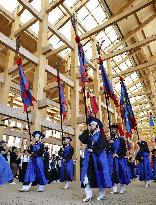
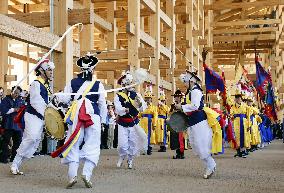
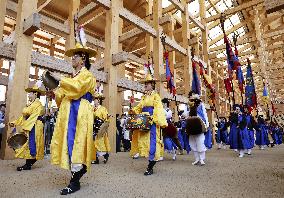
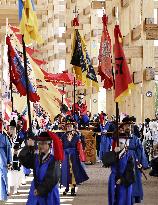
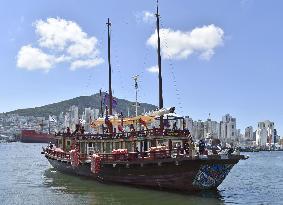
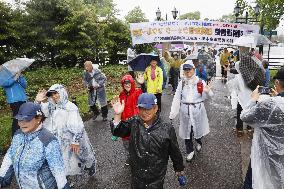
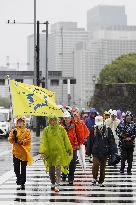
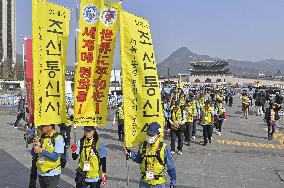
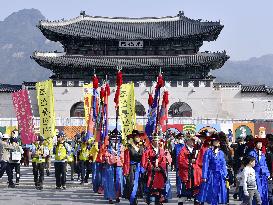
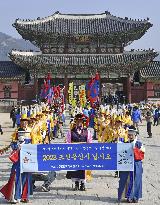
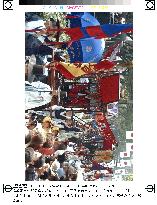
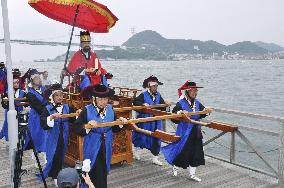
OSAKA, Japan, May 14 Kyodo - A parade replicating a diplomatic mission from the Joseon dynasty on the Korean Peninsula to Japan's Tokugawa shogunate during the Edo period (17th-19th century) is held at the World Exposition in Osaka on May 13, 2025, marking the event's South Korean day. (Kyodo)

  •  
World Exposition in Osaka

World Exposition in Osaka

A parade replicating a diplomatic mission from the Joseon dynasty on the Korean Peninsula to Japan's Tokugawa shogunate during the Edo period (17th-19th century) is held at the World Exposition in Osaka on May 13, 2025, marking the event's South Korean day.

  •  
World Exposition in Osaka

World Exposition in Osaka

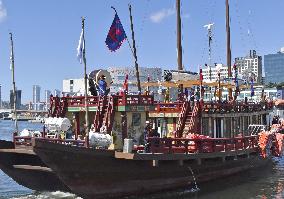
A parade replicating a diplomatic mission from the Joseon dynasty on the Korean Peninsula to Japan's Tokugawa shogunate during the Edo period (17th-19th century) is held at the World Exposition in Osaka on May 13, 2025, marking the event's South Korean day.

  •  
World Exposition in Osaka

World Exposition in Osaka

A parade replicating a diplomatic mission from the Joseon dynasty on the Korean Peninsula to Japan's Tokugawa shogunate during the Edo period (17th-19th century) is held at the World Exposition in Osaka on May 13, 2025, marking the event's South Korean day.

  •  
World Exposition in Osaka

World Exposition in Osaka

A parade replicating a diplomatic mission from the Joseon dynasty on the Korean Peninsula to Japan's Tokugawa shogunate during the Edo period (17th-19th century) is held at the World Exposition in Osaka on May 13, 2025, marking the event's South Korean day.

  •  
Historical ship replica sails from Busan to Japan

Historical ship replica sails from Busan to Japan

A replica of a wooden ship that carried a diplomatic mission from the Joseon dynasty on the Korean Peninsula to Japan's Tokugawa shogunate during the Edo period (17-19 century) departs a port in the southern South Korean city of Busan for Tsushima, Nagasaki Prefecture in southwestern Japan on Aug. 1, 2023. The ship reproduced in 2018 traces the sea route the Korean emissaries took in the old days.

  •  
Historical ship replica sails from Busan to Japan

Historical ship replica sails from Busan to Japan

A replica of a wooden ship that carried a diplomatic mission from the Joseon dynasty on the Korean Peninsula to Japan's Tokugawa shogunate during the Edo period (17-19 century) departs a port in the southern South Korean city of Busan for Tsushima, Nagasaki Prefecture in southwestern Japan on Aug. 1, 2023. The ship reproduced in 2018 traces the sea route the Korean emissaries took in the old days.

  •  
Seoul-Tokyo parade to promote bilateral cultural exchange

Seoul-Tokyo parade to promote bilateral cultural exchange

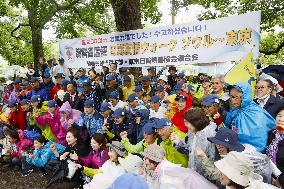
Japanese and South Korean people participating in a parade replicating a diplomatic mission from the Joseon dynasty on the Korean Peninsula to Japan's Tokugawa shogunate during the Edo period pose for a photo after arriving in Tokyo's Hibiya Park on May 23, 2023, after departing Seoul on April 1 for the over 1,000-kilometer journey. The biennial event that began in 2007 to deepen friendly ties between the two countries on a nongovernmental basis resumed after a three-year hiatus due to the COVID-19 pandemic.

  •  
Seoul-Tokyo parade to promote bilateral cultural exchange

Seoul-Tokyo parade to promote bilateral cultural exchange

Japanese and South Korean people participating in a parade replicating a diplomatic mission from the Joseon dynasty on the Korean Peninsula to Japan's Tokugawa shogunate during the Edo period celebrate after arriving in Tokyo's Hibiya Park on May 23, 2023, after departing Seoul on April 1 for the over 1,000-kilometer journey. The biennial event that began in 2007 to deepen friendly ties between the two countries on a nongovernmental basis resumed after a three-year hiatus due to the COVID-19 pandemic.

  •  
Seoul-Tokyo parade to promote bilateral cultural exchange

Seoul-Tokyo parade to promote bilateral cultural exchange

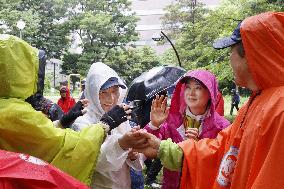
Japanese and South Korean people participating in a parade replicating a diplomatic mission from the Joseon dynasty on the Korean Peninsula to Japan's Tokugawa shogunate during the Edo period arrive in Tokyo's Hibiya Park on May 23, 2023, after departing Seoul on April 1 for the over 1,000-kilometer journey. The biennial event that began in 2007 to deepen friendly ties between the two countries on a nongovernmental basis resumed after a three-year hiatus due to the COVID-19 pandemic.

  •  
Seoul-Tokyo parade to promote bilateral cultural exchange

Seoul-Tokyo parade to promote bilateral cultural exchange

Japanese and South Korean people participating in a parade replicating a diplomatic mission from the Joseon dynasty on the Korean Peninsula to Japan's Tokugawa shogunate during the Edo period head to its destination, Tokyo's Hibiya Park, on May 23, 2023, after departing Seoul on April 1 for the over 1,000-kilometer journey. The biennial event that began in 2007 to deepen friendly ties between the two countries on a nongovernmental basis resumed after a three-year hiatus due to the COVID-19 pandemic.

  •  
CORRECTED: Seoul-Tokyo parade to promote bilateral cultural exchange

CORRECTED: Seoul-Tokyo parade to promote bilateral cultural exchange

Japanese and South Korean people participating in a parade replicating a diplomatic mission from the Joseon dynasty on the Korean Peninsula to Japan's Tokugawa shogunate during the Edo period leave Seoul's Gyeongbokgung Palace on April 1, 2023, for an over 1,000-kilometer and some 50-day journey bound for Tokyo's Hibiya Park. The biennial event that began in 2007 to deepen friendly ties between the two countries on a nongovernmental basis resumed after a three-year hiatus due to the COVID-19 pandemic.

  •  
Seoul-Tokyo parade to promote bilateral cultural exchange

Seoul-Tokyo parade to promote bilateral cultural exchange

Japanese and South Korean people participating in a parade replicating a diplomatic mission from the Joseon dynasty on the Korean Peninsula to Japan's Tokugawa shogunate during the Edo period leave Seoul's Gyeongbokgung Palace on April 1, 2023, for an over 1,000-kilometer and some 50-day journey bound for Tokyo's Hibiya Park. The biennial event that began in 2007 to deepen friendly ties between the two countries on a nongovernmental basis resumed after a four-year hiatus due to the COVID-19 pandemic.

  •  
CORRECTED: Seoul-Tokyo parade to promote bilateral cultural exchange

CORRECTED: Seoul-Tokyo parade to promote bilateral cultural exchange

Japanese and South Korean people participating in a parade replicating a diplomatic mission from the Joseon dynasty on the Korean Peninsula to Japan's Tokugawa shogunate during the Edo period leave Seoul's Gyeongbokgung Palace on April 1, 2023, for an over 1,000-kilometer and some 50-day journey bound for Tokyo's Hibiya Park. The biennial event that began in 2007 to deepen friendly ties between the two countries on a nongovernmental basis resumed after a three-year hiatus due to the COVID-19 pandemic.

  •  
Huge signboard of Hokusai exhibition stands in Paris

Huge signboard of Hokusai exhibition stands in Paris

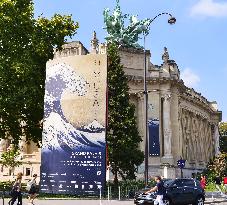
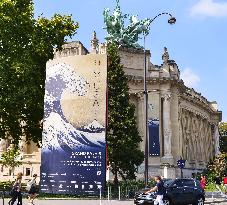
PARIS, France - A huge signboard stands in front of the Grand Palais museum in Paris on Sept. 25, 2014, to promote an exhibition featuring famed Japanese "ukiyo-e" artist Katsushika Hokusai. The exhibition, opening on Oct. 1, will display more than 700 works by the Japanese artist of the Edo period (1603-1867) under the Tokugawa shogunate.

  •  
Record reveals Shinsengumi struggled in summer heat

Record reveals Shinsengumi struggled in summer heat

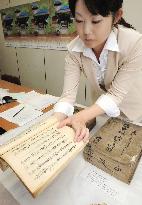
KYOTO, Japan - A woman shows a temple record in Kyoto on Sept. 2, 2014, which revealed that Hijikata Toshizo, deputy commander of the Shinsengumi security force for the Edo shogunate, asked Nishi-Hongwanji, a Buddhist temple where the force was stationed between March 1865 to June 1867 in Kyoto, to provide more space for its members to give them relief from the scorching summer heat.

  •  
Records show exchanges between Hijikata, temple

Records show exchanges between Hijikata, temple

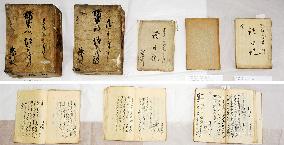
KYOTO, Japan - The Hongwanji research center in Kyoto discloses on Sept. 2, 2014, documents including records of exchanges between Hijikata Toshizo, deputy commander of the Shinsengumi security force for the Edo shogunate, and Nishi-Hongwanji, a Buddhist temple where the force was stationed between March 1865 to June 1867 in Kyoto.

  •  
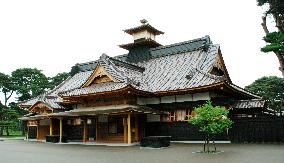
Hakoda Bugyosho restored after around 140 years

Hakoda Bugyosho restored after around 140 years

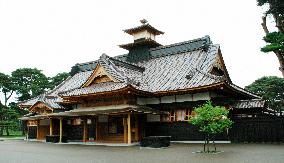
HAKODATE, Japan - The restored building of Hakodate Bugyosho (Magistrate's Office) is unveiled to the media in Hakodate, a port city in southern Hokkaido, on July 16, 2010. The office, built in 1802 at the end of the Edo Period by the Tokugawa shogunate as an outpost to check Russian moves, was destroyed in 1871. Work to restore the office began in June 2006 and cost 2.8 billion yen, and it will open to the public on July 29.

  •  
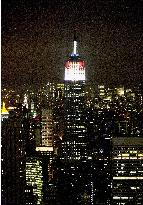
Empire State Building lit up for Japan mission anniversary

Empire State Building lit up for Japan mission anniversary

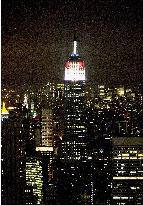
NEW YORK, United States - The Empire State Building in New York City was lit up in red and white on the night of June 16, 2010 to mark the 150th anniversary of the arrival in the city of Japan's first diplomatic mission to the United States. The top part of the 443.2-meter skyscraper was lit up in the colors of the Japanese flag to honor the delegation sent by the Tokugawa shogunate government during the final years of the Edo period.

  •  
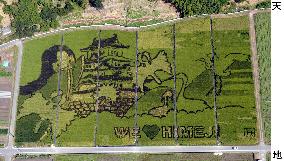
Himeji Castle appears on rice field

Himeji Castle appears on rice field

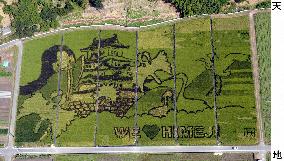
YUMESAKI, Japan - An image of world heritage-designated Himeji Castle, created from the leaves and ears of six different rice varieties in a rice field in Yumesaki, Hyogo Prefecture, is clearly seen on Sept. 13, 2009. The castle, together with Princess Sen (L, top), granddaughter of Edo Shogunate founder Tokugawa Ieyasu, can be observed until the rice is reaped in early October. About 1,500 students and volunteers helped plant rice seedlings in June under a farmer's project in the hope of drawing tourists.

  •  
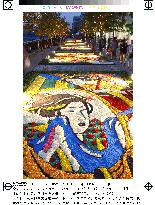
Pedestrians enjoy watching flower art

Pedestrians enjoy watching flower art

TOKTO, Japan - Pedestrians enjoy watching ''geisha'' and ''samurai'' depicted on the pavement with rose petals at Triton Square in downtown Tokyo on Nov. 1 in an event marking the 400th anniversary of the Edo (Tokyo) Shogunate government.

  •  
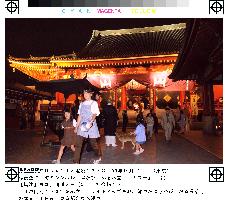
(1)Sensoji Temple lit up as symbol of downtown Tokyo

(1)Sensoji Temple lit up as symbol of downtown Tokyo

TOKYO, Japan - People visit Sensoji Temple in Tokyo's Asakusa district which was lit up Oct. 1 to serve as a nighttime symbol of downtown Tokyo as the Japanese capital celebrates the 400th anniversary of the start of the Edo shogunate.

  •  
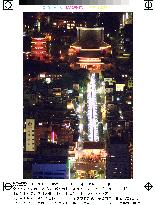
(2)Sensoji Temple lit up as symbol of downtown Tokyo

(2)Sensoji Temple lit up as symbol of downtown Tokyo

TOKYO, Japan - Sensoji Temple in Tokyo's Asakusa district is lit up Oct. 1 to serve as a nighttime symbol of downtown Tokyo as the Japanese capital celebrates the 400th anniversary of the start of the Edo shogunate.

  •  
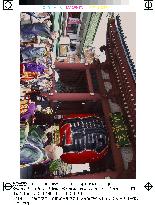
New lantern installed at Tokyo's Sensoji Temple

New lantern installed at Tokyo's Sensoji Temple

TOKYO, Japan - A new lantern, a symbol of Tokyo's Asakusa district, is displayed at Sensoji Temple in an unveiling ceremony on Aug. 3. The lantern was replaced for the first time in 11 years to commemorate the 400th anniversary of the establishment of the Tokugawa shogunate in Edo, the former name of Tokyo.

  •  
Imperial Palace tours becoming popular

Imperial Palace tours becoming popular

TOKYO, Japan - Visitors cross Niju-bashi, or the Double Bridge, the main gateway to the Imperial Palace in central Tokyo. Tours of the palace are becoming popular this year, the 400th anniversary of the establishment of the Tokugawa shogunate in Edo, the old name for Tokyo. Edo Castle, the seat of the Tokugawa shoguns, stood on the grounds of the palace.

  •  
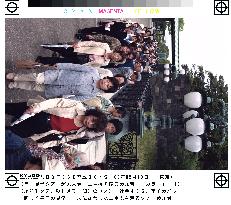
Dressed Korean students parade in Tokyo

Dressed Korean students parade in Tokyo

TOKYO, Japan - About 150 students from South Korea, dressed as members of a Korean tributary mission sent to Japan during the Edo Period (1600-1868), parade along the Omotesando Avenue in Tokyo on Aug. 25. The envoy or the head of the delegation is seated in the palanquin carried by bearers. Korea sent a total of 12 delegations to Japan during the reign of the Tokugawa Shogunate. The last visit took place in 1811. The students organized the parade as part of events marking the FIFA 2002 World Cup finals co-hoted by Japan and South Korea.

  •  
Japanese, Korean students exchange friendly messages

Japanese, Korean students exchange friendly messages

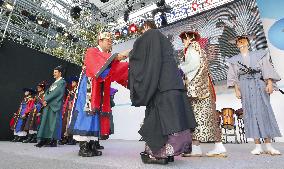
Japanese and South Korean students wearing costumes of representatives of the Tokugawa shogunate and Joseon mission to Japan in the Edo period exchange messages of peace and friendship at Tokyo's Hibiya Park on Sept. 26, 2015, prior to the opening ceremony of the annual Japan-Korea Exchange Festival 2015 in Tokyo. (Kyodo) ==Kyodo

  •  
West Japan city begins events to mark 200th anniv. of feudal lord's birth

West Japan city begins events to mark 200th anniv. of feudal lord's birth

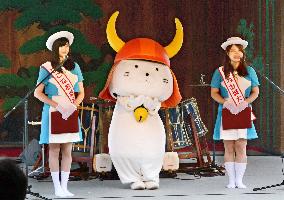
Hikonyan (C), a mascot character of Hikone in Shiga Prefecture, takes part in a ceremony in the western Japanese city on July 10, 2015, to kick off events marking the 200th anniversary of the birth of Ii Naosuke, a feudal lord of Hikone whom locals praise as having played a significant role in opening Japan to international trade and diplomacy toward the end of the Edo shogunate era in the late 19th century. (Kyodo) ==Kyodo

  •  
Man in news: British buyer of old photos taken in Japan

Man in news: British buyer of old photos taken in Japan

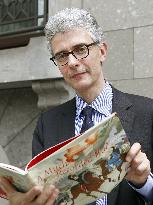
Sebastian Dobson, a British collector and buyer in Europe of Japanese photos taken in the late 19th to early 20th centuries, poses in Tokyo on May 19, 2015. He says photos taken between the end of the Edo shogunate era and the Meiji period tended to be better kept in Europe. (Kyodo) ==Kyodo

  •  
Woman in news: Curator sending out info on revolution hero Ryoma

Woman in news: Curator sending out info on revolution hero Ryoma

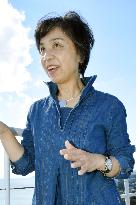
Yukie Maeda, a curator at the Sakamoto Ryoma Memorial Museum in Kochi, western Japan, talks on Nov. 10, 2015, about the prominent figure in the movement to overthrow the Tokugawa shogunate in the late Edo period (1603-1867). The 180th anniversary of Ryoma's birth was celebrated on Nov. 15. (Kyodo) ==Kyodo

  •  
Representative of Ryoma's Sakamoto family appears at fan gathering

Representative of Ryoma's Sakamoto family appears at fan gathering

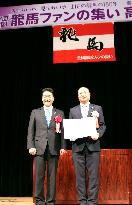
Masahiro Sakamoto (R), the 10th head of Sakamoto family known for Sakamoto Ryoma, who played a major role in dethroning the Tokugawa shogunate toward the end of the Edo period, is introduced as Kochi Prefecture's special tourism envoy during an event in Kochi, western Japan, on Nov. 14, 2015, a day before the 180th anniversary of the birth of Ryoma. About 500 fans from across Japan and abroad gathered for the event. Standing in the left is Kochi Gov. Masanao Ozaki. (Kyodo) ==Kyodo

  •  
Tokyo snapshot: Vegetable fields dotting Tokyo's Edogawa area

Tokyo snapshot: Vegetable fields dotting Tokyo's Edogawa area

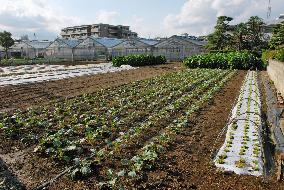
Photo taken on Sept. 11, 2015, shows a vegetable field in a residential area of Tokyo's Edogawa district. The Komatsugawa area produces a leafy vegetable variety known as "komatsuna," a name given by feudal ruler Tokugawa Yoshimune during the Edo shogunate period. (Kyodo) ==Kyodo

  •  
Himeji Castle appears on rice field

Himeji Castle appears on rice field

YUMESAKI, Japan - An image of world heritage-designated Himeji Castle, created from the leaves and ears of six different rice varieties in a rice field in Yumesaki, Hyogo Prefecture, is clearly seen on Sept. 13, 2009. The castle, together with Princess Sen (L, top), granddaughter of Edo Shogunate founder Tokugawa Ieyasu, can be observed until the rice is reaped in early October. About 1,500 students and volunteers helped plant rice seedlings in June under a farmer's project in the hope of drawing tourists. (Kyodo)

  •  
Hakoda Bugyosho restored after around 140 years

Hakoda Bugyosho restored after around 140 years

HAKODATE, Japan - The restored building of Hakodate Bugyosho (Magistrate's Office) is unveiled to the media in Hakodate, a port city in southern Hokkaido, on July 16, 2010. The office, built in 1802 at the end of the Edo Period by the Tokugawa shogunate as an outpost to check Russian moves, was destroyed in 1871. Work to restore the office began in June 2006 and cost 2.8 billion yen, and it will open to the public on July 29. (Kyodo)

  •  
Empire State Building lit up for Japan mission anniversary

Empire State Building lit up for Japan mission anniversary

NEW YORK, United States - The Empire State Building in New York City was lit up in red and white on the night of June 16, 2010 to mark the 150th anniversary of the arrival in the city of Japan's first diplomatic mission to the United States. The top part of the 443.2-meter skyscraper was lit up in the colors of the Japanese flag to honor the delegation sent by the Tokugawa shogunate government during the final years of the Edo period. (Kyodo)

  •  
Shiba Zojoji Temple

Shiba Zojoji Temple

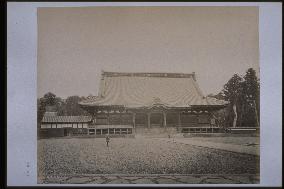
The main hall of Zojoji, built in 1605 after the relocation of the temple to Shiba from its original location at Edo Kaizuka (present-day Kioi-machi, Kanda Ward) in 1598. The temple was under the protection of the shogunate because it was the main temple of the Jodo sect of Buddhism in the Kanto area. Thus, the roof beam is embellished with the five gold hollyhock crests of the Tokugawa Shogunate. The building was destroyed by arson in December 1873. Although rebuilt in 1890, it burnt down again as a result of a bonfire lit by a homeless man in 1909. Although reconstructed in 1922, it was destroyed for a third time by American air raids in 1945. The present main hall was built in 1974.==Date:unknown, Place:Tokyo, Photo:R. Stillfried, (Credit:Nagasaki University Library/Kyodo News Images) [Cabinet Number78‐27‐0]

  •  
The gate to Takanawa Tozenji Temple,the British Legation

The gate to Takanawa Tozenji Temple,the British Legation

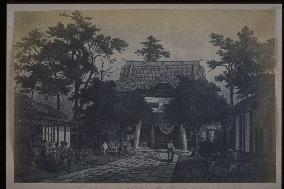
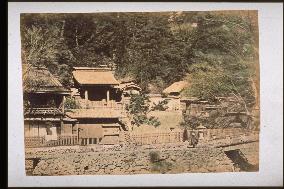
This stereograph bears the caption View taken from the United States Legation, at Yedo and is said to depict Tempukuji Temple in Azabu, but this is incorrect. The temple is actually Tozenji, located in present-day Takanawa 3-chome. The Shogunate concluded a treaty pact with Great Britain (Anglo-Japanese Treaty of Commerce) in 1858, and Tozenji Temple was designated as the site of the British Legation. This was taken by Swiss Pierre Rossier at the end of the Edo Period. This is a side view of the sanmon gate, also seen in photographs #3420 and #3443.==Date:1859, Place:Tokyo, Photo:Pierre Rossier, (Credit:Nagasaki University Library/Kyodo News Images) [Cabinet Number70‐7‐0]

  •  
A shrine

A shrine

Kanda Myojin Shrine prospered under the protection of the Tokugawa Shogunate as a guardian deity of Edo. Taira Masakado is enshrined here as the Oanamuchi-no-mikoto deity. The shrine moved to its current location (present-day Sotokanda 2-chome) from Surugadai in 1616. It was renamed Kanda Shinto Shrine in 1872. The Kanda Festival, one of the three major festivals in Tokyo, is held here every other year, formerly on September 15, now in May. This is a photograph of a sketch (probably stone print) made by a member of a Prussian expedition.==Date:unknown, Place:Tokyo, Photo:unknown, (Credit:Nagasaki University Library/Kyodo News Images) [Cabinet Number55‐27‐2]

  •  
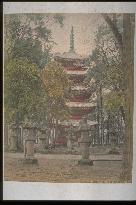
The five-story pagoda of Kaneiji Temple

The five-story pagoda of Kaneiji Temple

This five-storied pagoda was built in 1631by Doi Toshikatsu, a minister of the Shogunate, and was donated to Ueno Toshogu Shrine (the shrine dedicated to the first Shogun Tokugawa Iemitsu). The original pagoda was destroyed by a fire at Yakushi-do in 1636 and replaced with this pagoda by Doi Toshikatsu the same year. The stone lanterns of Toshogu visible in the foreground are still remain on the north side of the approach to Ueno Zoo. Ownership transferred to Kan'eiji Temple in 1868 and then the Metropolitan Tokyo Government after World War II. Today it is referred to as the former pagoda of Kan'eiji Temple. Only two pagodas from the Edo Period remain in Tokyo at present, this one and another at Honmonji Temple in Ikegami.==Date:unknown, Place:Tokyo, Photo:unknown, (Credit:Nagasaki University Library/Kyodo News Images) [Cabinet Number53‐16‐2]

  •  
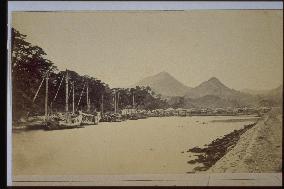
Entrance of the simoda harbour

Entrance of the simoda harbour

Shimoda is known as a port opened to foreigners at the end of the Edo era. The Shogunate appointed a Shimoda Bugyo (magistrate) there in 1853, when the US fleet came to Uraga and demanded that ports be opened for trade. The Shogunate ordered them to enter Shimoda Harbour. It was also here that Perry landed in 1854. Shimoda was blessed with the features of a good natural harbor. The first US Consulate was opened here, the scene of a diplomatic drama between the US and Japan.==Date:unknown, Place:Shimoda, Photo:unknown, (Credit:Nagasaki University Library/Kyodo News Images) [Cabinet Number19‐29‐0]

  •  
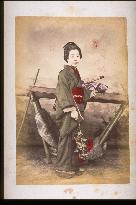
Palanquin and woman

Palanquin and woman

There were many types of palanquins, from the norimono with decorations on all four sides to the simple one for commoners without an enclosure. The Edo Shogunate designated the rank of people who could ride Norimono . The palanquin in the picture is the simplest form called Yamakago .==Date:unknown, Place:unknown, Photo:unknown, (Credit:Nagasaki University Library/Kyodo News Images) [Cabinet Number16‐20‐0]

  •  
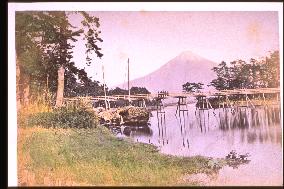
Mt. Fuji seen from Numakawa,Tagonoura

Mt. Fuji seen from Numakawa,Tagonoura

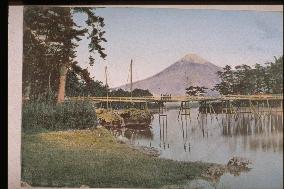
The boat is probably the cargo boat of the time, the Bezai boat. The sail has been folded, and the boat is anchored and covered with a straw mat. Tagonoura was a port of the Edo era where sengokubune (junks with a capacity for a thousand koku of rice) came in and out from Kashima, a territory of the Shogunate. The shadow of the wooden bridge is beautiful. * A photo from the same angle is in the book edited by Ozawa Kenji The End of the Bakufu and Meiji in Pictures , entitled Mt.Fuji from Tagonoura 1880s Kinpei Album, p.67. The only difference with (7) is the angle.==Date:unknown, Place:Shizuoka, Photo:unknown, (Credit:Nagasaki University Library/Kyodo News Images) [Cabinet Number15‐45‐0]

  •  
Mt. Fuji seen from Numakawa,Tagonoura

Mt. Fuji seen from Numakawa,Tagonoura

The boat is probably the cargo vessel of the time, the Bezai boat. The sail has been folded, and the boat is anchored with a straw matting. Tagonoura was a port of the Edo era for Sengokubune (junk boats with capacity for one thousand koku of rice) of the Shogunate that came in and out from Kashima, a territory of the Shogunate. The shadow of the wooden bridge is beautiful. * A photo taken from the same angle is included in the book edited by Ozawa Kenji The End of the Bakufu and Meiji in Pictures , entitled Mt.Fuji from Tagonoura 1880s Kinpei album ( p.67).==Date:unknown, Place:Shizuoka, Photo:unknown, (Credit:Nagasaki University Library/Kyodo News Images) [Cabinet Number14‐1‐0]

  •  
Post town

Post town

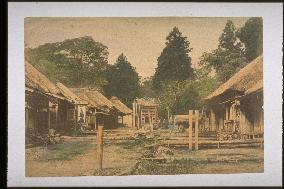
The shukuba (post-town) goes back to the Taika Reformation of 645. It developed significantly during the Edo era, and many shukuba towns were formed, such as the Gojusan-tsugi (53 Shukuba) of Tokaido and Rokujunana-tsugi (67 Shukuba) of Nakasendo. A certain number of people and horses were prepared for use by the Shogunate, and transport workers to provide convenience to general travelers also assembled in these towns. Many hotels and tea houses were opened for lodging and rest.==Date:unknown, Place:unknown, Photo:unknown, (Credit:Nagasaki University Library/Kyodo News Images) [Cabinet Number13‐21‐0]

  •  
Honjin,an officially appointed inn for daimyo,in a post town

Honjin,an officially appointed inn for daimyo,in a post town

A honjin (officially appointed inn) is a place of lodging for war lords, officials of the Shogunate and the aristocracy. The origin is derived from Ashikaga Yoshiaki, who raised a plaque at his lodging on the way to Kyoto. The characteristics are spacious grounds with a gate entrance and rooms in the upper tier. The honjin developed with the sankinkotai (warlord's alternate-year residence in Edo), and its managers were allowed to have last names and to wear swords.==Date:unknown, Place:unknown, Photo:unknown, (Credit:Nagasaki University Library/Kyodo News Images) [Cabinet Number13‐24‐0]

  •  
Huge signboard of Hokusai exhibition stands in Paris

Huge signboard of Hokusai exhibition stands in Paris

PARIS, France - A huge signboard stands in front of the Grand Palais museum in Paris on Sept. 25, 2014, to promote an exhibition featuring famed Japanese "ukiyo-e" artist Katsushika Hokusai. The exhibition, opening on Oct. 1, will display more than 700 works by the Japanese artist of the Edo period (1603-1867) under the Tokugawa shogunate. (Kyodo)

  •  
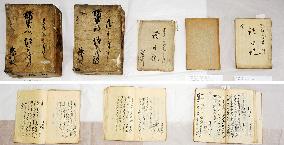
Records show exchanges between Hijikata, temple

Records show exchanges between Hijikata, temple

KYOTO, Japan - The Hongwanji research center in Kyoto discloses on Sept. 2, 2014, documents including records of exchanges between Hijikata Toshizo, deputy commander of the Shinsengumi security force for the Edo shogunate, and Nishi-Hongwanji, a Buddhist temple where the force was stationed between March 1865 to June 1867 in Kyoto. (Kyodo)

  •  
Cultural exchange between Japan, S. Korea

Cultural exchange between Japan, S. Korea

A parade replicating a diplomatic mission from the Joseon dynasty on the Korean Peninsula to Japan's Tokugawa shogunate during the Edo period is held in Shimonoseki, Yamaguchi Prefecture, western Japan, on Aug. 24, 2019, to promote cultural exchange between Japan and South Korea. About 160 people, including 100 from South Korea's Busan, took part in the event, which began in 2004 to deepen friendly ties between the two countries on a nongovernmental basis. (Kyodo) ==Kyodo

  •  
Japanese Christian warlord Takayama Ukon beatified

Japanese Christian warlord Takayama Ukon beatified

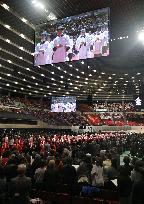
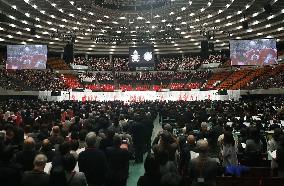
About 10,000 Catholics and other people from Japan and abroad attend a beatification ceremony for Takayama Ukon, a Japanese Christian warlord, in Osaka, western Japan, on Feb. 7, 2017. Vatican officially endorsed Ukon, who served as a warrior and was exiled to Manila in 1614 due to the Edo Shogunate's ban on Christianity, as "beatus," or "blessed," the stage below a saint. (Kyodo) ==Kyodo

  •  
Japanese Christian warlord Takayama Ukon beatified

Japanese Christian warlord Takayama Ukon beatified

About 10,000 Catholics and other people from Japan and abroad attend a beatification ceremony for Takayama Ukon, a Japanese Christian warlord, in Osaka, western Japan, on Feb. 7, 2017. Vatican officially endorsed Ukon, who served as a warrior and was exiled to Manila in 1614 due to the Edo Shogunate's ban on Christianity, as "beatus," or "blessed," the stage below a saint. (Kyodo) ==Kyodo

  • Main
  • Top
  • Editorial
  • Creative
  • About Us
  • About ILG
  • Terms of use
  • Company
  • BEHIND
  • Price List
  • Single Plan
  • Monthly Plan
  • Services
  • Shooting
  • Rights Clearance
  • Support
  • FAQ
  • How To Buy
  • Contact Us
  • Become a Partner

© KYODO NEWS IMAGES INC

All Rights Reserved.

  • Editorial
  • Olympics
  • News
  • Sports
  • Japan
  • Tech
  • Royal
  • Disaster
  • NorthKorea
  • Old Japan
  • SNS
  • Creative
  • Food
  • Japan
  • Landscape
  • Animal
  • Popular
  • #Ukraine
  • #Russia
  • #coronavirus
  • #N. Korea
  • #China
  • #Thailand
  • #Ukraine
  • #Russia
  • #coronavirus
  • #N. Korea
  • #China
  • #Thailand
  • Food
  • Japan
  • Landscape
  • Animal
  • Olympics
  • News
  • Sports
  • Japan
  • Tech
  • Royal
  • Disaster
  • NorthKorea
  • Old Japan
  • SNS