•  
Mobile bridge for disaster

Mobile bridge for disaster

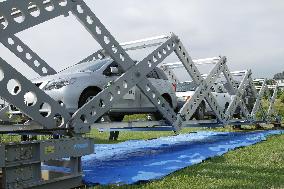
SHIZUOKA, Japan - The "Mobile Bridge," a transportable bridge that extends like a pair of lazy tongs and can be installed over a river as wide as 17 meters in about 10 minutes, is unveiled in an experiment in Fuji, Shizuoka Prefecture on Sept. 12, 2013. The bridge was developed by engineers from Hiroshima University and a group of businesses, conceived with the aim of providing a quick fix to restore transportation infrastructure in the event of a disaster.

  •  
Mobile bridge for disaster

Mobile bridge for disaster

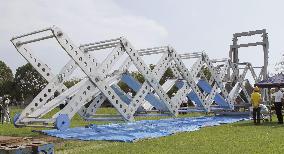
SHIZUOKA, Japan - The "Mobile Bridge," a transportable bridge that extends like a pair of lazy tongs and can be installed over a river as wide as 17 meters in about 10 minutes, is unveiled in an experiment in Fuji, Shizuoka Prefecture on Sept. 12, 2013. The bridge was developed by engineers from Hiroshima University and a group of businesses, conceived with the aim of providing a quick fix to restore transportation infrastructure in the event of a disaster.

  •  
Mobile bridge for disaster

Mobile bridge for disaster

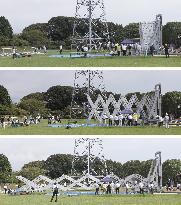
SHIZUOKA, Japan - Combination photos (from top to bottom) shows an experiment of the "Mobile Bridge," a transportable bridge that extends like a pair of lazy tongs and can be installed over a river as wide as 17 meters in about 10 minutes, unveiled in Fuji, Shizuoka Prefecture on Sept. 12, 2013. The bridge was developed by engineers from Hiroshima University and a group of businesses, conceived with the aim of providing a quick fix to restore transportation infrastructure in the event of a disaster.

  •  
Mt. Fuji seen from Numakawa,Tagonoura

Mt. Fuji seen from Numakawa,Tagonoura

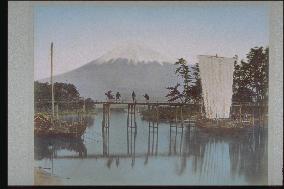
With Mt. Fuji topped with white snow in the background, a rickshaw, people and aged person appear on the wooden bridge over Numa River. The boat has one mast, and a square sail is placed in the middle. This is probably a cargo boat of the time called Bezai boat. The bay with Mt. Fuji in the background is a very popular scene in Japan.==Date:unknown, Place:Shizuoka, Photo:Ogawa Kazumasa, (Credit:Nagasaki University Library/Kyodo News Images) [Cabinet Number10‐15‐0]

  •  
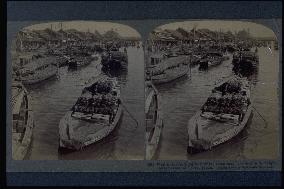
A cargo boat on the Nihonbashi River

A cargo boat on the Nihonbashi River

View of Nihonbashi River looking west, taken from Nihonbashi Bridge. The river is busy with cargo boats. Mt. Fuji was visible from this spot on clear days. The left side of the river is Nishi-gashi (west riverside), and the bridge visible in the far right is Nishi (West) Bridge. This was a transitional period when land transportation was replacing water transportation, but at this time the canal still played a major role in transporting goods. This stereograph was published in 1904 in a book-shaped case.==Date:1904, Place:Tokyo, Photo:Underwood, (Credit:Nagasaki University Library/Kyodo News Images) [Cabinet Number97‐78‐0]

  •  
Mt. Fuji seen from the Fuji River

Mt. Fuji seen from the Fuji River

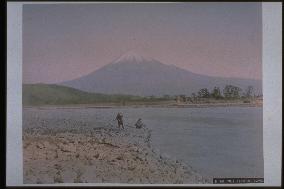
Northeastern view of the snow-capped peak of Mt. Fuji, taken from the bank of Fuji River in Iwabuchi, Fujikawa-machi. The mountain on the left is Mt. Iwamoto, and the tree line reaches to the forest of Matsuoka Sui Shinto Shrine (Fuji City) on the left. Two men are at the riverside, and Fujigawa Bridge, which crosses from the south of the shrine to Iwabuchi, is visible. This bridge was washed away many times from the beginning of the Meiji Period. It is difficult to determine exactly when this photograph was taken.==Date:unknown, Place:Shizuoka, Photo:unknown, (Credit:Nagasaki University Library/Kyodo News Images) [Cabinet Number86‐5‐0]

  •  
The Kamaguchi-bashi,a suspension bridge over the Fuji River

The Kamaguchi-bashi,a suspension bridge over the Fuji River

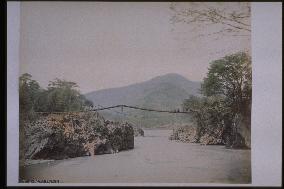
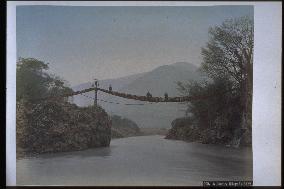
View, facing south, of the suspension bridge over Kamaguchi Gorge (a rugged section of Fuji River) between Naganuki in Shibakawa-cho and Setojima. The rapid flow of Fuji River makes bridges difficult to maintain. During the Edo Period, this was the only bridge over the river. Both banks are cliffs, and the width of the river is at its narrowest here. Several people are on the bridge, which is made of wisteria vines and planks. There is also a suspension bridge made only of vines.==Date:unknown, Place:Shizuoka, Photo:A. Farsari, (Credit:Nagasaki University Library/Kyodo News Images) [Cabinet Number82‐51‐0]

  •  
Mt. Fuji seen from a bridge on the Tokaido Road

Mt. Fuji seen from a bridge on the Tokaido Road

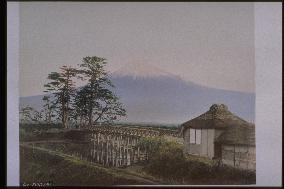
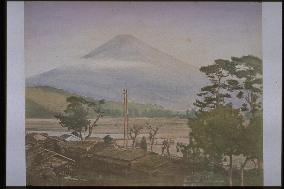
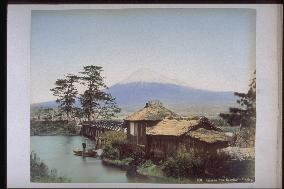
Northern view of Mt. Fuji from Kawai Bridge in Suzukawa, Fuji City. The bridge crosses Numa River on the Tokaido Highway. Pine trees are growing on the west side of the bridge. Huts with thatched roofs stand on the east side, which serves as a harbor. The absence of carriage tracks on the bridge indicates that this photograph was taken before 1891.==Date:unknown, Place:Shizuoka, Photo:A. Farsari, (Credit:Nagasaki University Library/Kyodo News Images) [Cabinet Number82‐1‐0]

  •  
Mt. Fuji seen from the Fuji River

Mt. Fuji seen from the Fuji River

Northeastern view of Mt. Fuji from the bank of Fuji River at Iwabuchi in Fujigawa-machi. The ferry port of Iwabuchi is in the foreground, and Matsuoka Sui Shinto Shrine of Fuji City is visible in the forest on the other side. The bridge between the shrine and Iwabuchi is not visible in this photograph, perhaps because it had been recently washed away, which often happened due to the rapid flow of Fuji River. The mountain on the left is Mt. Iwamoto, and pine trees line the other side of the river.==Date:unknown, Place:Shizuoka, Photo:Tamamura Kozaburo, (Credit:Nagasaki University Library/Kyodo News Images) [Cabinet Number79‐16‐0]

  •  
Mt. Fuji seen from Iwabuchi,Tokaido Road

Mt. Fuji seen from Iwabuchi,Tokaido Road

Northeastern view of Mt. Fuji from the terraced bank of Fuji River near Iwabuchi, Fujigawa-cho. Houses line the Tokaido Highway, and Fujigawa Bridge is visible on the north side of the town. Pine trees line the riverbank on the right, and Mt. Iwamoto is visible on the left. Fujigawa Bridge was built in the beginning of the Meiji Period. However, it was washed away and repaired many times.==Date:unknown, Place:Shizuoka, Photo:unknown, (Credit:Nagasaki University Library/Kyodo News Images) [Cabinet Number64‐20‐0]

  •  
Mt. Fuji seen from Iwabuchi,Tokaido Road

Mt. Fuji seen from Iwabuchi,Tokaido Road

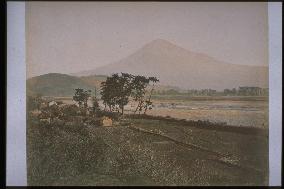
Northeastern view of Mt. Fuji from the terraced bank of Fuji River near Iwabuchi, Fujigawa-cho. Rice paddies stretch away from the foot of the hill, and the village of Iwabuchi is visible on the left. Fujigawa Bridge is visible beyond the pine trees on the right of Fuji River. Due to the rapid flow of the river, the bridge was washed away many times. The mountain on the left is Mt. Iwamoto, and pine trees line the other side of the river.==Date:unknown, Place:Shizuoka, Photo:unknown, (Credit:Nagasaki University Library/Kyodo News Images) [Cabinet Number64‐18‐0]

  •  
The Kamaguchi-bashi,a suspension bridge over the Fuji River

The Kamaguchi-bashi,a suspension bridge over the Fuji River

View, facing south, of the suspension bridge over Kamaguchi Gorge (a rugged section of Fuji River) between Naganuki in Shibakawa-cho and Setojima. The rapid flow of Fuji River makes bridges difficult to maintain. During the Edo Period, this was the only bridge over the river. Both banks are cliffs, and the width of the river is at its narrowest here. Several people are on the bridge, which is made of wisteria vines and planks. The village of Ozaki and Mt. Shiratori are visible in the background.==Date:unknown, Place:Shizuoka, Photo:unknown, (Credit:Nagasaki University Library/Kyodo News Images) [Cabinet Number64‐16‐0]

  •  
Yumoto Spa

Yumoto Spa

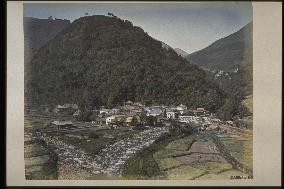
The wooden truss Asahi Bridge over Hayakawa River, which was completed in September, 1885, is connecting to Fukuzumi Inn, and the station building of Odawara Coach Railway cannot be seen. Thus, this photo was taken between those times. Yumoto Spa and Mt. Yusaka are visible behind the river, and Miyanoshita Spa and Mt. Fuji can be seen far right.==Date:unknown, Place:Hakone, Photo:unknown, (Credit:Nagasaki University Library/Kyodo News Images) [Cabinet Number59‐36‐0]

  •  
The Kamaguchi-bashi,a suspension bridge over the Fuji River

The Kamaguchi-bashi,a suspension bridge over the Fuji River

The Kamaguchi-bashi,a suspension bridge over the Fuji River==Date:unknown, Place:Shizuoka, Photo:unknown, (Credit:Nagasaki University Library/Kyodo News Images)

  •  
Mt. Fuji from Tokaido Kawai Bridge

Mt. Fuji from Tokaido Kawai Bridge

Part of the caption cannot be read, but it could be a distant view of Mt. Fuji from the former Kawai village (part of the present Shizuoka City). A bridge can be seen over the houses, and underneath is a person taking the helm of a small boat.==Date:unknown, Place:Shizuoka, Photo:Kusakabe Kinbei, (Credit:Nagasaki University Library/Kyodo News Images) [Cabinet Number40‐17‐0]

  •  
Mt. FUJI and a small river

Mt. FUJI and a small river

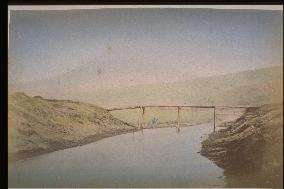
There are many photos of Mt.Fuji taken from various places. This is a very simple and dreary photo. This natural view may be the true view of Japan at that time.==Date:unknown, Place:unknown, Photo:unknown, (Credit:Nagasaki University Library/Kyodo News Images) [Cabinet Number16‐45‐0]

  •  
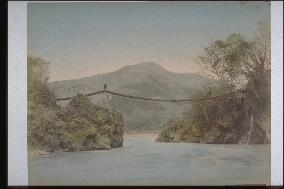
Rope bridge at FUJIGAWA river

Rope bridge at FUJIGAWA river

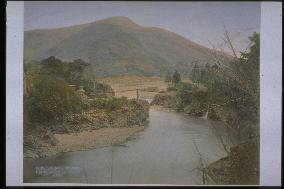
The Kamaguchi Bridge spanning the inner stream of Fuji River. It is located about 51 km from the source of the river, and to the south is an stream called Choko. The flow of the river bends and crashes against the rocks to the left and right.==Date:unknown, Place:Shizuoka, Photo:Ogawa Kazumasa, (Credit:Nagasaki University Library/Kyodo News Images) [Cabinet Number7‐26‐0]

  •  
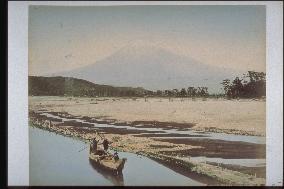
FUJIGAWA river and Mt. FUJI from iwabuchi,tokaido

FUJIGAWA river and Mt. FUJI from iwabuchi,tokaido

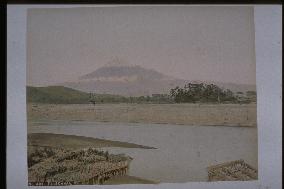
Iwabuchi was a Bakufu territory located on the left bank of Fuji River. In the foreground is a boat which may have been used to cross the Fuji River. From1603 the role of commuter boats was designated, and 10 boatmen administered the commuter boats. A wooden bridge can be seen in the distance.==Date:unknown, Place:Shizuoka, Photo:Ogawa Kazumasa, (Credit:Nagasaki University Library/Kyodo News Images) [Cabinet Number7‐25‐0]

  •  
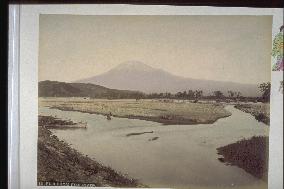
Mt. Fuji seen from the Fuji River

Mt. Fuji seen from the Fuji River

Fuji River, which is known as one of the three fastest rivers in Japan, has many branches and has troubled travelers from the early days. A wooden bridge stands on the other side of the inner island (should be confirmed). A boat might have been necessary to cross the river.==Date:unknown, Place:Shizuoka, Photo:Ogawa Kazumasa, (Credit:Nagasaki University Library/Kyodo News Images) [Cabinet Number5‐29‐0]

  •  
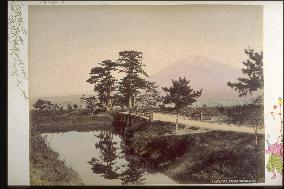
Mt. FUJI from kawai bridge of suzukawa river

Mt. FUJI from kawai bridge of suzukawa river

Suzu River was formerly called Moto Yoshiwara. Yoshiwara station was moved to avoid floods in 1639, and Suzukawa station was later built on the spot. The railroad station is the nearest station to Mt. Fuji, and the coast opens on Tagonoura Bay.==Date:unknown, Place:Shizuoka, Photo:Ogawa Kazumasa, (Credit:Nagasaki University Library/Kyodo News Images) [Cabinet Number5‐30‐0]

  • Main
  • Top
  • Editorial
  • Creative
  • About Us
  • About ILG
  • Terms of use
  • Company
  • BEHIND
  • Price List
  • Single Plan
  • Monthly Plan
  • Services
  • Shooting
  • Rights Clearance
  • Support
  • FAQ
  • How To Buy
  • Contact Us
  • Become a Partner

© KYODO NEWS IMAGES INC

All Rights Reserved.

  • Editorial
  • Olympics
  • News
  • Sports
  • Japan
  • Tech
  • Royal
  • Disaster
  • NorthKorea
  • Old Japan
  • SNS
  • Creative
  • Food
  • Japan
  • Landscape
  • Animal
  • Popular
  • #Ukraine
  • #China
  • #coronavirus
  • #N. Korea
  • #Thailand
  • #Russia
  • #Ukraine
  • #China
  • #coronavirus
  • #N. Korea
  • #Thailand
  • #Russia
  • Food
  • Japan
  • Landscape
  • Animal
  • Olympics
  • News
  • Sports
  • Japan
  • Tech
  • Royal
  • Disaster
  • NorthKorea
  • Old Japan
  • SNS