•  

Storm Kathleen Brings Strong Winds, High Waves To Ireland, UK Coasts 2

Storm Kathleen brought strong winds to Ireland, Northern Ireland, Scotland and parts of western England on Saturday, April 6. Videos posted on social media show big waves hitting the coasts across the regions.

  •  
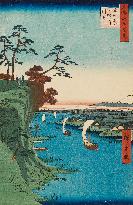
Konodai Tonegawa fukei - View of Konodai and the Tone River

Konodai Tonegawa fukei - View of Konodai and the Tone River

Utagawa Hiroshige print of Konodai Tonegawa fukei. View of Konodai and the Tone River from the 'One Hundred Famous Views of Edo' series.

  •  
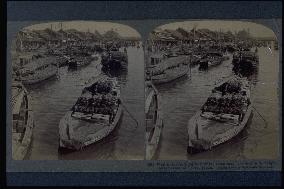
A cargo boat on the Nihonbashi River

A cargo boat on the Nihonbashi River

View of Nihonbashi River looking west, taken from Nihonbashi Bridge. The river is busy with cargo boats. Mt. Fuji was visible from this spot on clear days. The left side of the river is Nishi-gashi (west riverside), and the bridge visible in the far right is Nishi (West) Bridge. This was a transitional period when land transportation was replacing water transportation, but at this time the canal still played a major role in transporting goods. This stereograph was published in 1904 in a book-shaped case.==Date:1904, Place:Tokyo, Photo:Underwood, (Credit:Nagasaki University Library/Kyodo News Images) [Cabinet Number97‐78‐0]

  •  
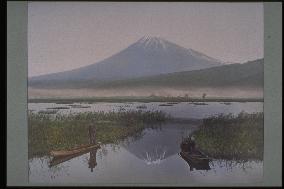
Mt. Fuji seen from Kashiwabara

Mt. Fuji seen from Kashiwabara

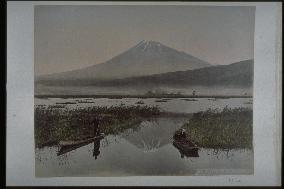
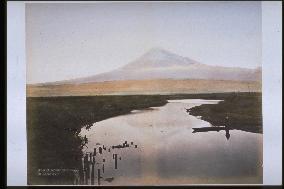
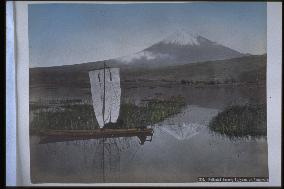
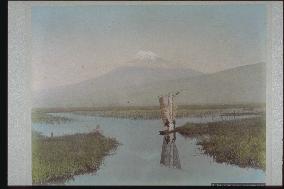
Northern view of a slightly snow-capped Mt. Fuji from Ukishimanuma (Floating Island Bog) near Kashiwabara-Shinden in Fuji City. The water from the bog becomes Numa River and flows into Tagonoura. Mt. Fuji is reflected on the surface of the bog. Two boats, one with a man standing and the other with a man sitting, are visible. Islands are visible in the background. Taken by Mizuno Hanbei.==Date:unknown, Place:Shizuoka, Photo:Mizuno Hanbei, (Credit:Nagasaki University Library/Kyodo News Images) [Cabinet Number96‐44‐0]

  •  
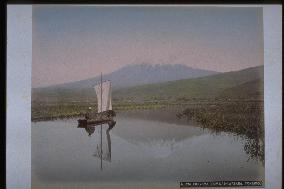
Mt. Fuji seen from Kashiwabara

Mt. Fuji seen from Kashiwabara

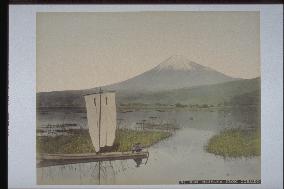
Northern view of the snow-capped peak of Mt. Fuji from Ukishimanuma (Floating Island Bog) near Kashiwabara-Shinden in Fuji City. The water from the pond becomes Numa River and flows into Tagonoura. The area surrounding Ukishimanuma Pond was a marsh called Ukishimagahara. People moved around by boat, creating a water traffic network. Two men are riding a river boat with sail, and Mt. Fuji is reflected upside down on the pond.==Date:unknown, Place:Shizuoka, Photo:unknown, (Credit:Nagasaki University Library/Kyodo News Images) [Cabinet Number88‐37‐0]

  •  
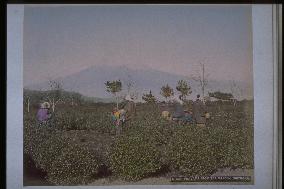
Mt. Fuji seen from a tea field

Mt. Fuji seen from a tea field

Northeastern view of snow-capped Mt. Fuji from a terraced tea field on the bank of Fuji River near Iwabuchi in Fujigawa-cho. The river runs below the terraced field, and Mt. Iwamoto is visible on the other side of the river. Five women picking tea leaves and a child carrying a smaller child are visible.==Date:unknown, Place:Shizuoka, Photo:unknown, (Credit:Nagasaki University Library/Kyodo News Images) [Cabinet Number88‐41‐0]

  •  
Mt. Fuji seen from Kashiwabara

Mt. Fuji seen from Kashiwabara

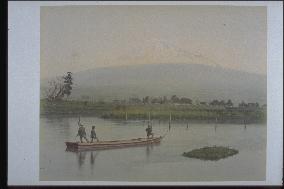
Northern view of a slightly snow-capped Mt. Fuji from Ukishimanuma (Floating Island Bog) near Kashiwabara-Shinden in Fuji City. The water from the bog becomes Numa River and flows into Tagonoura. Mt. Fuji is reflected on the surface of the bog. Two boats, one with a man standing and the other with a man sitting, are visible. Islands are visible in the background. Taken by Mizuno Hanbei.==Date:unknown, Place:Shizuoka, Photo:Mizuno Hanbei, (Credit:Nagasaki University Library/Kyodo News Images) [Cabinet Number87‐32‐0]

  •  
Mt. Fuji seen from the Fuji River

Mt. Fuji seen from the Fuji River

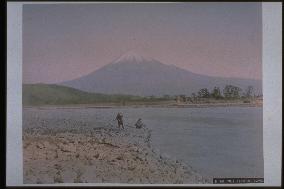
Northeastern view of the snow-capped peak of Mt. Fuji, taken from the bank of Fuji River in Iwabuchi, Fujikawa-machi. The mountain on the left is Mt. Iwamoto, and the tree line reaches to the forest of Matsuoka Sui Shinto Shrine (Fuji City) on the left. Two men are at the riverside, and Fujigawa Bridge, which crosses from the south of the shrine to Iwabuchi, is visible. This bridge was washed away many times from the beginning of the Meiji Period. It is difficult to determine exactly when this photograph was taken.==Date:unknown, Place:Shizuoka, Photo:unknown, (Credit:Nagasaki University Library/Kyodo News Images) [Cabinet Number86‐5‐0]

  •  
The Kamaguchi-bashi,a suspension bridge over the Fuji River

The Kamaguchi-bashi,a suspension bridge over the Fuji River

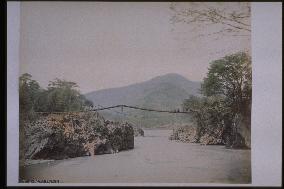
View, facing south, of the suspension bridge over Kamaguchi Gorge (a rugged section of Fuji River) between Naganuki in Shibakawa-cho and Setojima. The rapid flow of Fuji River makes bridges difficult to maintain. During the Edo Period, this was the only bridge over the river. Both banks are cliffs, and the width of the river is at its narrowest here. Several people are on the bridge, which is made of wisteria vines and planks. There is also a suspension bridge made only of vines.==Date:unknown, Place:Shizuoka, Photo:A. Farsari, (Credit:Nagasaki University Library/Kyodo News Images) [Cabinet Number82‐51‐0]

  •  
Shiraito Falls

Shiraito Falls

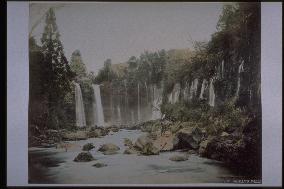
Distant view of Shiraito Falls. Water wells up from the 20 meter-high lava bed which stretches for two hundred meters, and spills over as hundreds of white threads into the basin below. The water creates Shiba River and flows into Fuji River. These falls were designated as a National Scenic Spot in 1936.==Date:unknown, Place:Shizuoka, Photo:A. Farsari, (Credit:Nagasaki University Library/Kyodo News Images) [Cabinet Number82‐50‐0]

  •  
Mt. Fuji seen from a bridge on the Tokaido Road

Mt. Fuji seen from a bridge on the Tokaido Road

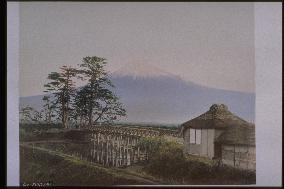
Northern view of Mt. Fuji from Kawai Bridge in Suzukawa, Fuji City. The bridge crosses Numa River on the Tokaido Highway. Pine trees are growing on the west side of the bridge. Huts with thatched roofs stand on the east side, which serves as a harbor. The absence of carriage tracks on the bridge indicates that this photograph was taken before 1891.==Date:unknown, Place:Shizuoka, Photo:A. Farsari, (Credit:Nagasaki University Library/Kyodo News Images) [Cabinet Number82‐1‐0]

  •  
Mt. Fuji seen from Kashiwabara

Mt. Fuji seen from Kashiwabara

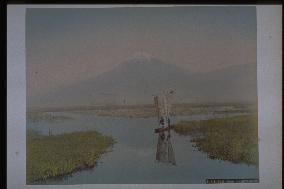
Northern view of the snow-capped peak of Mt. Fuji from Ukishimanuma (Floating Island Bog) near Kashiwabara-Shinden in Fuji City. The water from the bog becomes Numa River and flows into Tagonoura harbour. The area surrounding Ukishimanuma was a marsh called Ukishimagahara. People moved around by boat, creating a water traffic network. Two men are riding a river boat with a sail.==Date:unknown, Place:Shizuoka, Photo:A. Farsari, (Credit:Nagasaki University Library/Kyodo News Images) [Cabinet Number81‐23‐0]

  •  
Mt. Fuji seen from the Fuji River

Mt. Fuji seen from the Fuji River

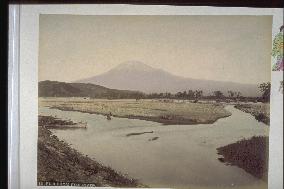
Northeastern view of Mt. Fuji from the bank of Fuji River at Iwabuchi in Fujigawa-machi. The ferry port of Iwabuchi is in the foreground, and Matsuoka Sui Shinto Shrine of Fuji City is visible in the forest on the other side. The bridge between the shrine and Iwabuchi is not visible in this photograph, perhaps because it had been recently washed away, which often happened due to the rapid flow of Fuji River. The mountain on the left is Mt. Iwamoto, and pine trees line the other side of the river.==Date:unknown, Place:Shizuoka, Photo:Tamamura Kozaburo, (Credit:Nagasaki University Library/Kyodo News Images) [Cabinet Number79‐16‐0]

  •  
The village in the mountains, looked up Mt. Fuji

The village in the mountains, looked up Mt. Fuji

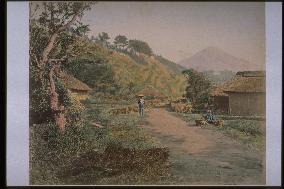
The village seems near Iwamotoyama, Fuji-kawa(river), Tokaido. It looked up from southwest, and see the upheaval of Hoeizan at right side of Mt. Fuji. It is near Fujikawa SA of Tomei Express Way in today. The view of an autumn day which finished rice-harvesting.==Date:unknown, Place:Shizuoka, Photo:unknown, (Credit:Nagasaki University Library/Kyodo News Images) [Cabinet Number64‐64‐0]

  •  
Mt. Fuji seen from Numakawa,Tagonoura

Mt. Fuji seen from Numakawa,Tagonoura

Northern view of Mt. Fuji from Ukishimanuma (Floating Island Bog) near Kashiwabara-Shinden in Fuji City. Ukishimagahara is the land surrounding Ukishimanuma Bog. The water from the bog becomes Numa River and flows into Tagonoura harbour. This photograph was taken near the origin of Numa River, with Mt. Fuji reflected upside down on the bog. The foot of Mt. Fuji is tinted roughly. There is a small boat on the right, and many wooden posts are visible on the left.==Date:unknown, Place:Shizuoka, Photo:unknown, (Credit:Nagasaki University Library/Kyodo News Images) [Cabinet Number64‐62‐0]

  •  
Mt. Fuji seen from Iwabuchi,Tokaido Road

Mt. Fuji seen from Iwabuchi,Tokaido Road

Northeastern view of Mt. Fuji from the terraced bank of Fuji River near Iwabuchi, Fujigawa-cho. Houses line the Tokaido Highway, and Fujigawa Bridge is visible on the north side of the town. Pine trees line the riverbank on the right, and Mt. Iwamoto is visible on the left. Fujigawa Bridge was built in the beginning of the Meiji Period. However, it was washed away and repaired many times.==Date:unknown, Place:Shizuoka, Photo:unknown, (Credit:Nagasaki University Library/Kyodo News Images) [Cabinet Number64‐20‐0]

  •  
Mt. Fuji seen from Iwabuchi,Tokaido Road

Mt. Fuji seen from Iwabuchi,Tokaido Road

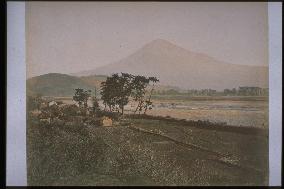
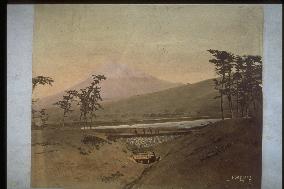
Northeastern view of Mt. Fuji from the terraced bank of Fuji River near Iwabuchi, Fujigawa-cho. Rice paddies stretch away from the foot of the hill, and the village of Iwabuchi is visible on the left. Fujigawa Bridge is visible beyond the pine trees on the right of Fuji River. Due to the rapid flow of the river, the bridge was washed away many times. The mountain on the left is Mt. Iwamoto, and pine trees line the other side of the river.==Date:unknown, Place:Shizuoka, Photo:unknown, (Credit:Nagasaki University Library/Kyodo News Images) [Cabinet Number64‐18‐0]

  •  
The Kamaguchi-bashi,a suspension bridge over the Fuji River

The Kamaguchi-bashi,a suspension bridge over the Fuji River

View, facing south, of the suspension bridge over Kamaguchi Gorge (a rugged section of Fuji River) between Naganuki in Shibakawa-cho and Setojima. The rapid flow of Fuji River makes bridges difficult to maintain. During the Edo Period, this was the only bridge over the river. Both banks are cliffs, and the width of the river is at its narrowest here. Several people are on the bridge, which is made of wisteria vines and planks. The village of Ozaki and Mt. Shiratori are visible in the background.==Date:unknown, Place:Shizuoka, Photo:unknown, (Credit:Nagasaki University Library/Kyodo News Images) [Cabinet Number64‐16‐0]

  •  
Mt. Fuji seen from Numakawa,Tagonoura

Mt. Fuji seen from Numakawa,Tagonoura

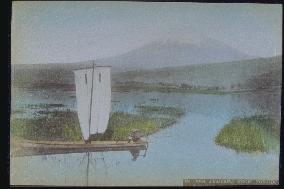
Northern view of Mt. Fuji from Ukishimanuma (Floating Island Bog) near Kashiwabara-Shinden in Fuji City. Ukishimanuma was formerly a stretch of low land between the southern foot of Mt. Fuji/Mt. Ashitaka and Suruga Bay. It flows into Numa River and Tagonoura harbour. Mt. Fuji and a sailboat are reflected on the pond. A man is on a small craft, with small islands scattered in the background.==Date:unknown, Place:Shizuoka, Photo:unknown, (Credit:Nagasaki University Library/Kyodo News Images) [Cabinet Number59‐48‐0]

  •  
Mt. Fuji seen from Numakawa,Tagonoura

Mt. Fuji seen from Numakawa,Tagonoura

Northern view of Mt. Fuji from Ukishimanuma (Floating Island Bog) near Kashiwabara-Shinden in Fuji City. Ukishimanuma was formerly a stretch of low land between the southern foot of Mt. Fuji/Mt. Ashitaka and Suruga Bay. It flows into Numa River and Tagonoura harbour. Mt. Fuji and a sailboat are reflected on the pond. A man is on a small craft, with small islands scattered in the background.==Date:unknown, Place:Shizuoka, Photo:unknown, (Credit:Nagasaki University Library/Kyodo News Images) [Cabinet Number59‐8‐2]

  •  
Mt. Fuji seen from Numakawa,Tokaido Road

Mt. Fuji seen from Numakawa,Tokaido Road

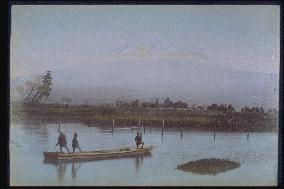
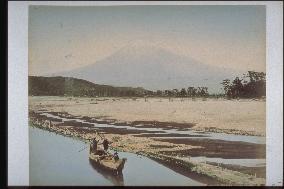
View of the snow-capped peak of Mt. Fuji from the mouth of Numa River at Tagonoura, Fuji City. This photograph was probably taken from the Suruga Bay side, because Mt. Hoei is visible on the right side of Mt. Fuji. Three men are riding a river boat, and a few wooden posts are visible. Pine trees line the Tokaido Highway in the centre.==Date:unknown, Place:Shizuoka, Photo:Tamamura Kozaburo, (Credit:Nagasaki University Library/Kyodo News Images) [Cabinet Number48‐99‐0]

  •  
Mt. Fuji seen from Numakawa,Tokaido Road

Mt. Fuji seen from Numakawa,Tokaido Road

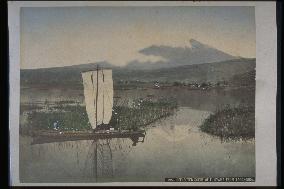
Northern view of snow-capped Mt. Fuji from Ukishimanuma (Floating Island Pond) around Kashiwabara-Shinden in Fuji City. The water from the pond becomes Numa River and flows into Tagonoura. The area surrounding Ukishimanuma Pond was marshland called Ukishimagahara. Water traffic increased there as people moved around by riverboats. A man sits on the sailboat.==Date:unknown, Place:Shizuoka, Photo:Tamamura Kozaburo, (Credit:Nagasaki University Library/Kyodo News Images) [Cabinet Number48‐98‐0]

  •  
Mt. Fuji seen from Numakawa,Tagonoura

Mt. Fuji seen from Numakawa,Tagonoura

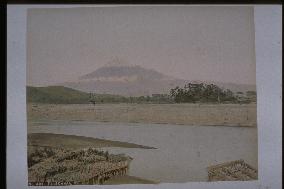
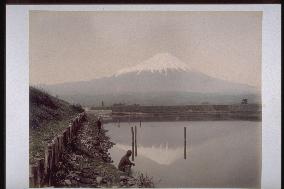
Northern view of snow-capped Mt. Fuji from the mouth of Numa River, which flows into Tagonoura Harbour in Fuji City. The location of Mt. Hoei indicates that this was developed from the wrong side of the negative. The piled stones on the left could be part of a stone gate. A retaining wall constructed of wooden posts and pebbles protect the riverbank. Two men are visible.==Date:unknown, Place:Shizuoka, Photo:unknown, (Credit:Nagasaki University Library/Kyodo News Images) [Cabinet Number47‐21‐0]

  •  
FUJIGAWA river and Mt. FUJI from iwabuchi,tokaido

FUJIGAWA river and Mt. FUJI from iwabuchi,tokaido

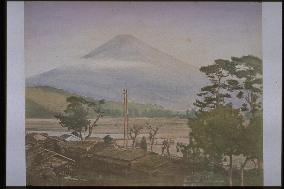
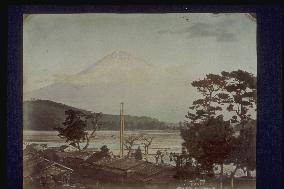
A view of Mt. Fuji over the Fuji River from the former Iwabuchi village which is now part of Fujigawa village. The two pillars seen over the house in the centre bottom may be for a fire bell.==Date:unknown, Place:Shizuoka, Photo:unknown, (Credit:Nagasaki University Library/Kyodo News Images) [Cabinet Number37‐14‐0]

  •  
A distant view of Mt. Fuji

A distant view of Mt. Fuji

The location is unknown, but Mt. Fuji can be seen in the front. A river flows in the middle of the photo, and people on palanquins along the road by the river and men taking the lead holding umbrellas are clearly seen. What is grown in the depression in the fore cannot be seen.==Date:unknown, Place:unknown, Photo:unknown, (Credit:Nagasaki University Library/Kyodo News Images) [Cabinet Number26‐32‐0]

  •  
Mt. FUJI and a small river

Mt. FUJI and a small river

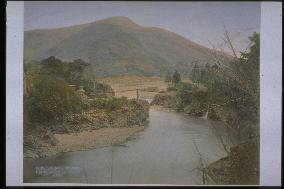
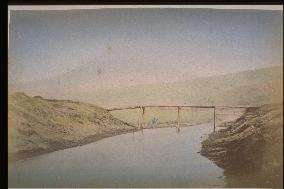
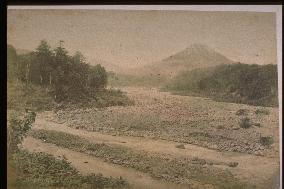
There are many photos of Mt.Fuji taken from various places. This is a very simple and dreary photo. This natural view may be the true view of Japan at that time.==Date:unknown, Place:unknown, Photo:unknown, (Credit:Nagasaki University Library/Kyodo News Images) [Cabinet Number16‐45‐0]

  •  
Mt. Fuji seen from the Fuji River

Mt. Fuji seen from the Fuji River

During the Edo era, the lack of sophisticated civil engineering techniques made the construction of bridges impossible over many rivers. Fuji River was one. There were no bridges, and travelers had a hard time crossing the river. From the Meiji era, abundant water made this location a base for the paper industry.==Date:unknown, Place:Shizuoka, Photo:unknown, (Credit:Nagasaki University Library/Kyodo News Images) [Cabinet Number14‐3‐0]

  •  
Mt. Fuji seen from Numakawa,Tagonoura

Mt. Fuji seen from Numakawa,Tagonoura

A sand delta developed on the north bank of Suruga Bay with the sand carried by the Fuji River and Kano River. A lagoon was formed, and further sand accumulation created the peculiar Ukishimagahara. The boat in the photo is a flat bottom river boat. The river boats had a simple structure with boards stuck together in the shape of boxes.==Date:unknown, Place:Shizuoka, Photo:unknown, (Credit:Nagasaki University Library/Kyodo News Images) [Cabinet Number11‐28‐0]

  •  
Mt. Fuji seen from Kashiwabara

Mt. Fuji seen from Kashiwabara

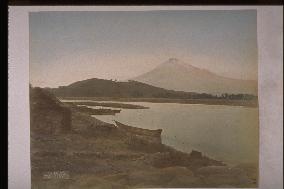
Kashiwabara is located on the left bank of the mouth of Katsumata River, which pours into Suruga Bay. This may be the low wetlands near the mouth of the river. A sailing boat can be seen to the left and Mt. Fuji in the centre. The cameraman may have taken the photo from a boat. In the Morse Collection at the Salem Peabody Museum, there is a photo which is believed to be developed from the same negative as this photo. ( Japan as seen by Morse , published by Shogakkan).==Date:unknown, Place:Shizuoka, Photo:Tamamura Kozaburo, (Credit:Nagasaki University Library/Kyodo News Images) [Cabinet Number11‐29‐0]

  •  
Mt. Fuji seen from Kashiwabara

Mt. Fuji seen from Kashiwabara

Kashiwabara is located to the left of the mouth of the Katsumata River which pours into Suruga Bay. This may be the low wet lands near the river mouth. A sail boat is visible with Mt. Fuji in the distance. It is interesting from the angle of the camera to imagine that the cameraman took this picture from a boat.==Date:unknown, Place:Shizuoka, Photo:Ogawa Kazumasa, (Credit:Nagasaki University Library/Kyodo News Images) [Cabinet Number10‐18‐0]

  •  
FUJIGAWA river and Mt. FUJI from iwabuchi,tokaido

FUJIGAWA river and Mt. FUJI from iwabuchi,tokaido

Iwabuchi was a Bakufu territory located on the left bank of Fuji River. In the foreground is a boat which may have been used to cross the Fuji River. From1603 the role of commuter boats was designated, and 10 boatmen administered the commuter boats. A wooden bridge can be seen in the distance.==Date:unknown, Place:Shizuoka, Photo:Ogawa Kazumasa, (Credit:Nagasaki University Library/Kyodo News Images) [Cabinet Number7‐25‐0]

  •  
Mt. Fuji seen from the Fuji River

Mt. Fuji seen from the Fuji River

Fuji River, which is known as one of the three fastest rivers in Japan, has many branches and has troubled travelers from the early days. A wooden bridge stands on the other side of the inner island (should be confirmed). A boat might have been necessary to cross the river.==Date:unknown, Place:Shizuoka, Photo:Ogawa Kazumasa, (Credit:Nagasaki University Library/Kyodo News Images) [Cabinet Number5‐29‐0]

  •  
Mt. Fuji seen from the Fuji River

Mt. Fuji seen from the Fuji River

Fuji River, which at present runs through Shizuoka, Nagano and Yamanashi prefectures is known to be one of the three fastest rivers in Japan and a difficult route for transport since olden times. Maritime transport on the Fuji River, which thrived during the Edo Period, connected Iwabuchi near the mouth of the river with the banks of Akisawa in Kai, Aoyagi and Kurosawa.==Date:unknown, Place:Shizuoka, Photo:Kusakabe Kinbei, (Credit:Nagasaki University Library/Kyodo News Images) [Cabinet Number3‐44‐0]

  • Main
  • Top
  • Editorial
  • Creative
  • About Us
  • About ILG
  • Terms of use
  • Company
  • BEHIND
  • Price List
  • Single Plan
  • Monthly Plan
  • Services
  • Shooting
  • Rights Clearance
  • Support
  • FAQ
  • How To Buy
  • Contact Us
  • Become a Partner

© KYODO NEWS IMAGES INC

All Rights Reserved.

  • Editorial
  • Olympics
  • News
  • Sports
  • Japan
  • Tech
  • Royal
  • Disaster
  • NorthKorea
  • Old Japan
  • SNS
  • Creative
  • Food
  • Japan
  • Landscape
  • Animal
  • Popular
  • #Ukraine
  • #Russia
  • #coronavirus
  • #N. Korea
  • #Thailand
  • #China
  • #Ukraine
  • #Russia
  • #coronavirus
  • #N. Korea
  • #Thailand
  • #China
  • Food
  • Japan
  • Landscape
  • Animal
  • Olympics
  • News
  • Sports
  • Japan
  • Tech
  • Royal
  • Disaster
  • NorthKorea
  • Old Japan
  • SNS