•  
ICE Raids Spark Protest Riot - LA

ICE Raids Spark Protest Riot - LA

(250610) -- LOS ANGELES, June 10, 2025 (Xinhua) -- A protester is arrested by police officers in front of the Los Angeles Federal Detention Center in Los Angeles, California, the United States, June 8, 2025. The protests initially began in response to immigration enforcement operations. In recent days, administration officials have focused their efforts on major Democratic-led cities, including Los Angeles, Chicago and New York. Tensions between protesters and law enforcement escalated on Friday, as some demonstrators threw objects and police responded with pepper balls and flash-bang devices. In response, Trump ordered the deployment of 2,000 National Guard members on Saturday. The protests intensified further on Sunday, with growing crowds and heightened confrontations between demonstrators and law enforcement officers. Photo by Qiu Chen/Xinhua/ABACAPRESS.COM

  •  
ICE Raids Spark Protest Riot - LA

ICE Raids Spark Protest Riot - LA

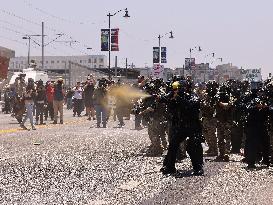
(250610) -- LOS ANGELES, June 10, 2025 (Xinhua) -- Police officers try to disperse protesters in front of the Los Angeles Federal Detention Center in Los Angeles, California, the United States, June 8, 2025. The protests initially began in response to immigration enforcement operations. In recent days, administration officials have focused their efforts on major Democratic-led cities, including Los Angeles, Chicago and New York. Tensions between protesters and law enforcement escalated on Friday, as some demonstrators threw objects and police responded with pepper balls and flash-bang devices. In response, Trump ordered the deployment of 2,000 National Guard members on Saturday. The protests intensified further on Sunday, with growing crowds and heightened confrontations between demonstrators and law enforcement officers. Photo by Qiu Chen/Xinhua/ABACAPRESS.COM

  •  
ICE Raids Spark Protest Riot - LA

ICE Raids Spark Protest Riot - LA

(250610) -- LOS ANGELES, June 10, 2025 (Xinhua) -- Police officers try to disperse protesters in front of the Los Angeles Federal Detention Center in Los Angeles, California, the United States, June 8, 2025. The protests initially began in response to immigration enforcement operations. In recent days, administration officials have focused their efforts on major Democratic-led cities, including Los Angeles, Chicago and New York. Tensions between protesters and law enforcement escalated on Friday, as some demonstrators threw objects and police responded with pepper balls and flash-bang devices. In response, Trump ordered the deployment of 2,000 National Guard members on Saturday. The protests intensified further on Sunday, with growing crowds and heightened confrontations between demonstrators and law enforcement officers. Photo by Qiu Chen/Xinhua/ABACAPRESS.COM

  •  
ICE Raids Spark Protest Riot - LA

ICE Raids Spark Protest Riot - LA

(250610) -- LOS ANGELES, June 10, 2025 (Xinhua) -- Police officers try to disperse protesters in front of the Los Angeles Federal Detention Center in Los Angeles, California, the United States, June 8, 2025. The protests initially began in response to immigration enforcement operations. In recent days, administration officials have focused their efforts on major Democratic-led cities, including Los Angeles, Chicago and New York. Tensions between protesters and law enforcement escalated on Friday, as some demonstrators threw objects and police responded with pepper balls and flash-bang devices. In response, Trump ordered the deployment of 2,000 National Guard members on Saturday. The protests intensified further on Sunday, with growing crowds and heightened confrontations between demonstrators and law enforcement officers. Photo by Qiu Chen/Xinhua/ABACAPRESS.COM

  •  
ICE Raids Spark Protest Riot - LA

ICE Raids Spark Protest Riot - LA

(250610) -- LOS ANGELES, June 10, 2025 (Xinhua) -- A protester is arrested by police officers in front of the Los Angeles Federal Detention Center in Los Angeles, California, the United States, June 8, 2025. The protests initially began in response to immigration enforcement operations. In recent days, administration officials have focused their efforts on major Democratic-led cities, including Los Angeles, Chicago and New York. Tensions between protesters and law enforcement escalated on Friday, as some demonstrators threw objects and police responded with pepper balls and flash-bang devices. In response, Trump ordered the deployment of 2,000 National Guard members on Saturday. The protests intensified further on Sunday, with growing crowds and heightened confrontations between demonstrators and law enforcement officers. Photo by Qiu Chen/Xinhua/ABACAPRESS.COM

  •  
Taklimakan Desert Control Afforestation - China

Taklimakan Desert Control Afforestation - China

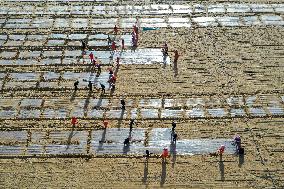
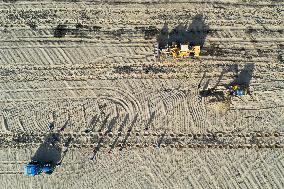
An aerial drone photo taken on April 8, 2025 shows people planting coix at a sand industry experimental base in Yutian County of Hotan Prefecture, northwest China's Xinjiang Uygur Autonomous Region. The Taklimakan Desert in northwest China's Xinjiang Uygur Autonomous Region covers 337,600 square kilometers and its circumference measures 3,046 kilometers, making it the largest desert in China and the second-largest drifting desert in the world. Thanks to decades-long sand prevention and control efforts, the Taklimakan Desert was completely encircled with a sand-blocking green belt on Nov. 28, 2024. In 2025, Xinjiang aims to afforest a land area of about 796,000 hectares, including 562,666 hectares for frontline control in the Taklimakan Desert. These afforestations form a part of the Three-North Shelterbelt Forest Program, the world's largest afforestation program, which tackles desertification in northwest, north and northeast China. Meanwhile, Xinjiang will further widen the sand-blocking green belt and enha

  •  
Taklimakan Desert Control Afforestation - China

Taklimakan Desert Control Afforestation - China

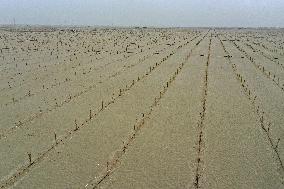
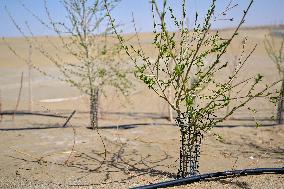
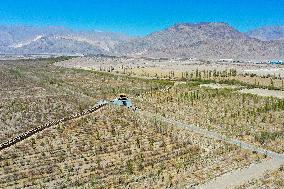
An aerial drone photo taken on April 7, 2025 shows oleaster saplings in Hotan County of Hotan Prefecture, northwest China's Xinjiang Uygur Autonomous Region. The Taklimakan Desert in northwest China's Xinjiang Uygur Autonomous Region covers 337,600 square kilometers and its circumference measures 3,046 kilometers, making it the largest desert in China and the second-largest drifting desert in the world. Thanks to decades-long sand prevention and control efforts, the Taklimakan Desert was completely encircled with a sand-blocking green belt on Nov. 28, 2024. In 2025, Xinjiang aims to afforest a land area of about 796,000 hectares, including 562,666 hectares for frontline control in the Taklimakan Desert. These afforestations form a part of the Three-North Shelterbelt Forest Program, the world's largest afforestation program, which tackles desertification in northwest, north and northeast China. Meanwhile, Xinjiang will further widen the sand-blocking green belt and enhance desert-locking efforts to achieve sus

  •  
Taklimakan Desert Control Afforestation - China

Taklimakan Desert Control Afforestation - China

Staff members plant onions in sandy land at a sand-control experimental station in Minfeng County of Hotan Prefecture, northwest China's Xinjiang Uygur Autonomous Region on April 8, 2025. The Taklimakan Desert in northwest China's Xinjiang Uygur Autonomous Region covers 337,600 square kilometers and its circumference measures 3,046 kilometers, making it the largest desert in China and the second-largest drifting desert in the world. Thanks to decades-long sand prevention and control efforts, the Taklimakan Desert was completely encircled with a sand-blocking green belt on Nov. 28, 2024. In 2025, Xinjiang aims to afforest a land area of about 796,000 hectares, including 562,666 hectares for frontline control in the Taklimakan Desert. These afforestations form a part of the Three-North Shelterbelt Forest Program, the world's largest afforestation program, which tackles desertification in northwest, north and northeast China. Meanwhile, Xinjiang will further widen the sand-blocking green belt and enhance desert-

  •  
Taklimakan Desert Control Afforestation - China

Taklimakan Desert Control Afforestation - China

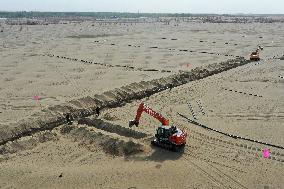
An aerial drone photo taken on April 8, 2025 shows staff members embedding water pipelines in Minfeng County of Hotan Prefecture, northwest China's Xinjiang Uygur Autonomous Region. The Taklimakan Desert in northwest China's Xinjiang Uygur Autonomous Region covers 337,600 square kilometers and its circumference measures 3,046 kilometers, making it the largest desert in China and the second-largest drifting desert in the world. Thanks to decades-long sand prevention and control efforts, the Taklimakan Desert was completely encircled with a sand-blocking green belt on Nov. 28, 2024. In 2025, Xinjiang aims to afforest a land area of about 796,000 hectares, including 562,666 hectares for frontline control in the Taklimakan Desert. These afforestations form a part of the Three-North Shelterbelt Forest Program, the world's largest afforestation program, which tackles desertification in northwest, north and northeast China. Meanwhile, Xinjiang will further widen the sand-blocking green belt and enhance desert-lockin

  •  
Taklimakan Desert Control Afforestation - China

Taklimakan Desert Control Afforestation - China

An aerial drone photo taken on April 9, 2025 shows staff members planting seedlings at a sand-control base in Qiemo County, the Mongolian Autonomous Prefecture of Bayingolin, northwest China's Xinjiang Uygur Autonomous Region. The Taklimakan Desert in northwest China's Xinjiang Uygur Autonomous Region covers 337,600 square kilometers and its circumference measures 3,046 kilometers, making it the largest desert in China and the second-largest drifting desert in the world. Thanks to decades-long sand prevention and control efforts, the Taklimakan Desert was completely encircled with a sand-blocking green belt on Nov. 28, 2024. In 2025, Xinjiang aims to afforest a land area of about 796,000 hectares, including 562,666 hectares for frontline control in the Taklimakan Desert. These afforestations form a part of the Three-North Shelterbelt Forest Program, the world's largest afforestation program, which tackles desertification in northwest, north and northeast China. Meanwhile, Xinjiang will further widen the sand-

  •  
Taklimakan Desert Control Afforestation - China

Taklimakan Desert Control Afforestation - China

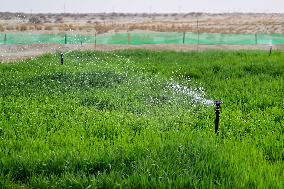
This photo taken on April 13, 2025 shows a wheat field irrigated by desalinated water in Xayar County, Aksu Prefecture, northwest China's Xinjiang Uygur Autonomous Region. The Taklimakan Desert in northwest China's Xinjiang Uygur Autonomous Region covers 337,600 square kilometers and its circumference measures 3,046 kilometers, making it the largest desert in China and the second-largest drifting desert in the world. Thanks to decades-long sand prevention and control efforts, the Taklimakan Desert was completely encircled with a sand-blocking green belt on Nov. 28, 2024. In 2025, Xinjiang aims to afforest a land area of about 796,000 hectares, including 562,666 hectares for frontline control in the Taklimakan Desert. These afforestations form a part of the Three-North Shelterbelt Forest Program, the world's largest afforestation program, which tackles desertification in northwest, north and northeast China. Meanwhile, Xinjiang will further widen the sand-blocking green belt and enhance desert-locking efforts

  •  
Taklimakan Desert Control Afforestation - China

Taklimakan Desert Control Afforestation - China

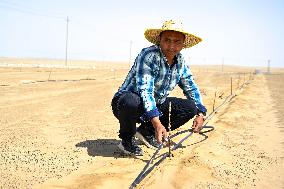
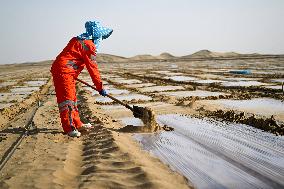
A villager arranges a drip irrigation pipe at a desert-control model zone in Yutian County of Hotan Prefecture, northwest China's Xinjiang Uygur Autonomous Region, April 8, 2025. The Taklimakan Desert in northwest China's Xinjiang Uygur Autonomous Region covers 337,600 square kilometers and its circumference measures 3,046 kilometers, making it the largest desert in China and the second-largest drifting desert in the world. Thanks to decades-long sand prevention and control efforts, the Taklimakan Desert was completely encircled with a sand-blocking green belt on Nov. 28, 2024. In 2025, Xinjiang aims to afforest a land area of about 796,000 hectares, including 562,666 hectares for frontline control in the Taklimakan Desert. These afforestations form a part of the Three-North Shelterbelt Forest Program, the world's largest afforestation program, which tackles desertification in northwest, north and northeast China. Meanwhile, Xinjiang will further widen the sand-blocking green belt and enhance desert-locking e

  •  
Taklimakan Desert Control Afforestation - China

Taklimakan Desert Control Afforestation - China

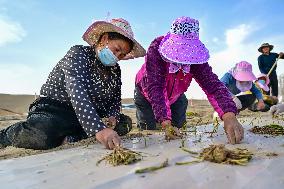
A villager plants coix at a sand industry experimental base in Yutian County of Hotan Prefecture, northwest China's Xinjiang Uygur Autonomous Region on April 8, 2025. The Taklimakan Desert in northwest China's Xinjiang Uygur Autonomous Region covers 337,600 square kilometers and its circumference measures 3,046 kilometers, making it the largest desert in China and the second-largest drifting desert in the world. Thanks to decades-long sand prevention and control efforts, the Taklimakan Desert was completely encircled with a sand-blocking green belt on Nov. 28, 2024. In 2025, Xinjiang aims to afforest a land area of about 796,000 hectares, including 562,666 hectares for frontline control in the Taklimakan Desert. These afforestations form a part of the Three-North Shelterbelt Forest Program, the world's largest afforestation program, which tackles desertification in northwest, north and northeast China. Meanwhile, Xinjiang will further widen the sand-blocking green belt and enhance desert-locking efforts to ac

  •  
Taklimakan Desert Control Afforestation - China

Taklimakan Desert Control Afforestation - China

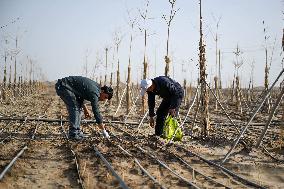
Protective nets are attached to seedlings to prevent animals from eating them at a sand-control base in Qiemo County, the Mongolian Autonomous Prefecture of Bayingolin, northwest China's Xinjiang Uygur Autonomous Region, April 9, 2025. The Taklimakan Desert in northwest China's Xinjiang Uygur Autonomous Region covers 337,600 square kilometers and its circumference measures 3,046 kilometers, making it the largest desert in China and the second-largest drifting desert in the world. Thanks to decades-long sand prevention and control efforts, the Taklimakan Desert was completely encircled with a sand-blocking green belt on Nov. 28, 2024. In 2025, Xinjiang aims to afforest a land area of about 796,000 hectares, including 562,666 hectares for frontline control in the Taklimakan Desert. These afforestations form a part of the Three-North Shelterbelt Forest Program, the world's largest afforestation program, which tackles desertification in northwest, north and northeast China. Meanwhile, Xinjiang will further widen

  •  
Taklimakan Desert Control Afforestation - China

Taklimakan Desert Control Afforestation - China

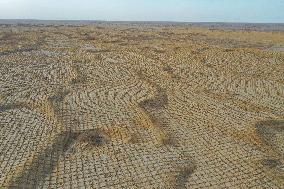
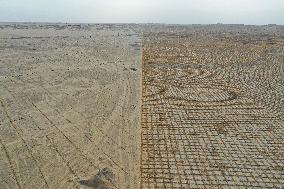
An aerial drone photo taken on April 8, 2025 shows checkerboard sand barriers in Minfeng County of Hotan Prefecture, northwest China's Xinjiang Uygur Autonomous Region. The Taklimakan Desert in northwest China's Xinjiang Uygur Autonomous Region covers 337,600 square kilometers and its circumference measures 3,046 kilometers, making it the largest desert in China and the second-largest drifting desert in the world. Thanks to decades-long sand prevention and control efforts, the Taklimakan Desert was completely encircled with a sand-blocking green belt on Nov. 28, 2024. In 2025, Xinjiang aims to afforest a land area of about 796,000 hectares, including 562,666 hectares for frontline control in the Taklimakan Desert. These afforestations form a part of the Three-North Shelterbelt Forest Program, the world's largest afforestation program, which tackles desertification in northwest, north and northeast China. Meanwhile, Xinjiang will further widen the sand-blocking green belt and enhance desert-locking efforts to

  •  
Taklimakan Desert Control Afforestation - China

Taklimakan Desert Control Afforestation - China

People arrange drip irrigation pipes at a sand-control experimental base in Yutian County of Hotan Prefecture, northwest China's Xinjiang Uygur Autonomous Region, April 8, 2025. The Taklimakan Desert in northwest China's Xinjiang Uygur Autonomous Region covers 337,600 square kilometers and its circumference measures 3,046 kilometers, making it the largest desert in China and the second-largest drifting desert in the world. Thanks to decades-long sand prevention and control efforts, the Taklimakan Desert was completely encircled with a sand-blocking green belt on Nov. 28, 2024. In 2025, Xinjiang aims to afforest a land area of about 796,000 hectares, including 562,666 hectares for frontline control in the Taklimakan Desert. These afforestations form a part of the Three-North Shelterbelt Forest Program, the world's largest afforestation program, which tackles desertification in northwest, north and northeast China. Meanwhile, Xinjiang will further widen the sand-blocking green belt and enhance desert-locking ef

  •  
Taklimakan Desert Control Afforestation - China

Taklimakan Desert Control Afforestation - China

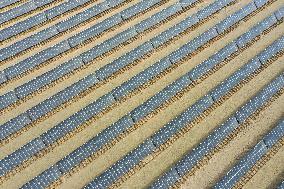
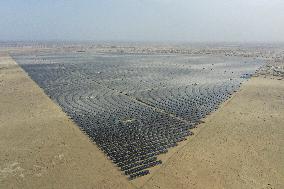
An aerial drone photo taken on April 13, 2025 shows a photovoltaic power project in Xayar County, Aksu Prefecture, northwest China's Xinjiang Uygur Autonomous Region. The Taklimakan Desert in northwest China's Xinjiang Uygur Autonomous Region covers 337,600 square kilometers and its circumference measures 3,046 kilometers, making it the largest desert in China and the second-largest drifting desert in the world. Thanks to decades-long sand prevention and control efforts, the Taklimakan Desert was completely encircled with a sand-blocking green belt on Nov. 28, 2024. In 2025, Xinjiang aims to afforest a land area of about 796,000 hectares, including 562,666 hectares for frontline control in the Taklimakan Desert. These afforestations form a part of the Three-North Shelterbelt Forest Program, the world's largest afforestation program, which tackles desertification in northwest, north and northeast China. Meanwhile, Xinjiang will further widen the sand-blocking green belt and enhance desert-locking efforts to ac

  •  
Taklimakan Desert Control Afforestation - China

Taklimakan Desert Control Afforestation - China

An aerial drone photo taken on April 8, 2025 shows checkerboard sand barriers at a sand-control zone in Minfeng County of Hotan Prefecture, northwest China's Xinjiang Uygur Autonomous Region. The Taklimakan Desert in northwest China's Xinjiang Uygur Autonomous Region covers 337,600 square kilometers and its circumference measures 3,046 kilometers, making it the largest desert in China and the second-largest drifting desert in the world. Thanks to decades-long sand prevention and control efforts, the Taklimakan Desert was completely encircled with a sand-blocking green belt on Nov. 28, 2024. In 2025, Xinjiang aims to afforest a land area of about 796,000 hectares, including 562,666 hectares for frontline control in the Taklimakan Desert. These afforestations form a part of the Three-North Shelterbelt Forest Program, the world's largest afforestation program, which tackles desertification in northwest, north and northeast China. Meanwhile, Xinjiang will further widen the sand-blocking green belt and enhance des

  •  
Taklimakan Desert Control Afforestation - China

Taklimakan Desert Control Afforestation - China

An aerial drone photo taken on April 11, 2025 shows a forest park in Hejing County, the Mongolian Autonomous Prefecture of Bayingolin, northwest China's Xinjiang Uygur Autonomous Region. The Taklimakan Desert in northwest China's Xinjiang Uygur Autonomous Region covers 337,600 square kilometers and its circumference measures 3,046 kilometers, making it the largest desert in China and the second-largest drifting desert in the world. Thanks to decades-long sand prevention and control efforts, the Taklimakan Desert was completely encircled with a sand-blocking green belt on Nov. 28, 2024. In 2025, Xinjiang aims to afforest a land area of about 796,000 hectares, including 562,666 hectares for frontline control in the Taklimakan Desert. These afforestations form a part of the Three-North Shelterbelt Forest Program, the world's largest afforestation program, which tackles desertification in northwest, north and northeast China. Meanwhile, Xinjiang will further widen the sand-blocking green belt and enhance desert-l

  •  
Taklimakan Desert Control Afforestation - China

Taklimakan Desert Control Afforestation - China

An aerial drone photo taken on April 13, 2025 shows a photovoltaic power project in Xayar County, Aksu Prefecture, northwest China's Xinjiang Uygur Autonomous Region. The Taklimakan Desert in northwest China's Xinjiang Uygur Autonomous Region covers 337,600 square kilometers and its circumference measures 3,046 kilometers, making it the largest desert in China and the second-largest drifting desert in the world. Thanks to decades-long sand prevention and control efforts, the Taklimakan Desert was completely encircled with a sand-blocking green belt on Nov. 28, 2024. In 2025, Xinjiang aims to afforest a land area of about 796,000 hectares, including 562,666 hectares for frontline control in the Taklimakan Desert. These afforestations form a part of the Three-North Shelterbelt Forest Program, the world's largest afforestation program, which tackles desertification in northwest, north and northeast China. Meanwhile, Xinjiang will further widen the sand-blocking green belt and enhance desert-locking efforts to ac

  •  
Taklimakan Desert Control Afforestation - China

Taklimakan Desert Control Afforestation - China

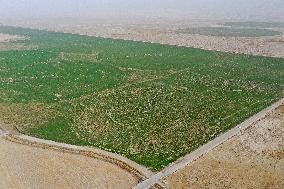
An aerial drone photo taken on April 12, 2025 shows a grassland in Baicheng County, Aksu Prefecture, northwest China's Xinjiang Uygur Autonomous Region. The Taklimakan Desert in northwest China's Xinjiang Uygur Autonomous Region covers 337,600 square kilometers and its circumference measures 3,046 kilometers, making it the largest desert in China and the second-largest drifting desert in the world. Thanks to decades-long sand prevention and control efforts, the Taklimakan Desert was completely encircled with a sand-blocking green belt on Nov. 28, 2024. In 2025, Xinjiang aims to afforest a land area of about 796,000 hectares, including 562,666 hectares for frontline control in the Taklimakan Desert. These afforestations form a part of the Three-North Shelterbelt Forest Program, the world's largest afforestation program, which tackles desertification in northwest, north and northeast China. Meanwhile, Xinjiang will further widen the sand-blocking green belt and enhance desert-locking efforts to achieve sustaina

  •  
Wildfire Spreads In Rabweh - Mount Lebanon

Wildfire Spreads In Rabweh - Mount Lebanon

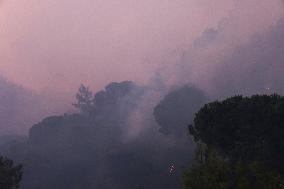
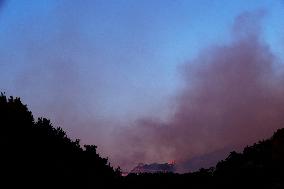
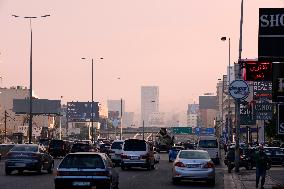
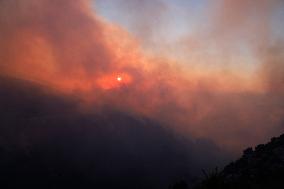
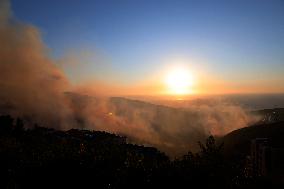
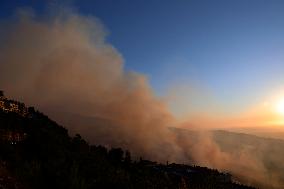
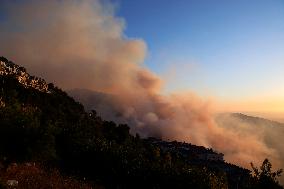
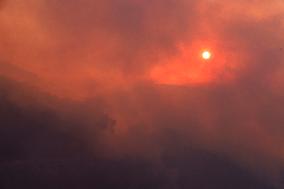
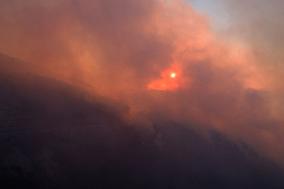
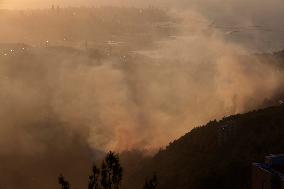
The fire in the Rabweh forests in Mount Lebanon continues to rage, expanding to the forests of Nabiyeh and Beit Misk, October 22, 2024. Strong winds have worsened the situation, pushing large clouds of smoke across the area and forcing authorities to close both directions of the Metn highway due to poor visibility as night falls. Civil Defense teams, supported by over ten fire trucks and army helicopters, are working to contain the blaze and prevent further spread. The situation remains critical as efforts to control the fire continue. Photo by Marc Fayad/ABACAPRESS.COM

  •  
Wildfire Spreads In Rabweh - Mount Lebanon

Wildfire Spreads In Rabweh - Mount Lebanon

The fire in the Rabweh forests in Mount Lebanon continues to rage, expanding to the forests of Nabiyeh and Beit Misk, October 22, 2024. Strong winds have worsened the situation, pushing large clouds of smoke across the area and forcing authorities to close both directions of the Metn highway due to poor visibility as night falls. Civil Defense teams, supported by over ten fire trucks and army helicopters, are working to contain the blaze and prevent further spread. The situation remains critical as efforts to control the fire continue. Photo by Marc Fayad/ABACAPRESS.COM

  •  
Wildfire Spreads In Rabweh - Mount Lebanon

Wildfire Spreads In Rabweh - Mount Lebanon

The fire in the Rabweh forests in Mount Lebanon continues to rage, expanding to the forests of Nabiyeh and Beit Misk, October 22, 2024. Strong winds have worsened the situation, pushing large clouds of smoke across the area and forcing authorities to close both directions of the Metn highway due to poor visibility as night falls. Civil Defense teams, supported by over ten fire trucks and army helicopters, are working to contain the blaze and prevent further spread. The situation remains critical as efforts to control the fire continue. Photo by Marc Fayad/ABACAPRESS.COM

  •  
Wildfire Spreads In Rabweh - Mount Lebanon

Wildfire Spreads In Rabweh - Mount Lebanon

The fire in the Rabweh forests in Mount Lebanon continues to rage, expanding to the forests of Nabiyeh and Beit Misk, October 22, 2024. Strong winds have worsened the situation, pushing large clouds of smoke across the area and forcing authorities to close both directions of the Metn highway due to poor visibility as night falls. Civil Defense teams, supported by over ten fire trucks and army helicopters, are working to contain the blaze and prevent further spread. The situation remains critical as efforts to control the fire continue. Photo by Marc Fayad/ABACAPRESS.COM

  •  
Wildfire Spreads In Rabweh - Mount Lebanon

Wildfire Spreads In Rabweh - Mount Lebanon

The fire in the Rabweh forests in Mount Lebanon continues to rage, expanding to the forests of Nabiyeh and Beit Misk, October 22, 2024. Strong winds have worsened the situation, pushing large clouds of smoke across the area and forcing authorities to close both directions of the Metn highway due to poor visibility as night falls. Civil Defense teams, supported by over ten fire trucks and army helicopters, are working to contain the blaze and prevent further spread. The situation remains critical as efforts to control the fire continue. Photo by Marc Fayad/ABACAPRESS.COM

  •  
Wildfire Spreads In Rabweh - Mount Lebanon

Wildfire Spreads In Rabweh - Mount Lebanon

The fire in the Rabweh forests in Mount Lebanon continues to rage, expanding to the forests of Nabiyeh and Beit Misk, October 22, 2024. Strong winds have worsened the situation, pushing large clouds of smoke across the area and forcing authorities to close both directions of the Metn highway due to poor visibility as night falls. Civil Defense teams, supported by over ten fire trucks and army helicopters, are working to contain the blaze and prevent further spread. The situation remains critical as efforts to control the fire continue. Photo by Marc Fayad/ABACAPRESS.COM

  •  
Wildfire Spreads In Rabweh - Mount Lebanon

Wildfire Spreads In Rabweh - Mount Lebanon

The fire in the Rabweh forests in Mount Lebanon continues to rage, expanding to the forests of Nabiyeh and Beit Misk, October 22, 2024. Strong winds have worsened the situation, pushing large clouds of smoke across the area and forcing authorities to close both directions of the Metn highway due to poor visibility as night falls. Civil Defense teams, supported by over ten fire trucks and army helicopters, are working to contain the blaze and prevent further spread. The situation remains critical as efforts to control the fire continue. Photo by Marc Fayad/ABACAPRESS.COM

  •  
Wildfire Spreads In Rabweh - Mount Lebanon

Wildfire Spreads In Rabweh - Mount Lebanon

The fire in the Rabweh forests in Mount Lebanon continues to rage, expanding to the forests of Nabiyeh and Beit Misk, October 22, 2024. Strong winds have worsened the situation, pushing large clouds of smoke across the area and forcing authorities to close both directions of the Metn highway due to poor visibility as night falls. Civil Defense teams, supported by over ten fire trucks and army helicopters, are working to contain the blaze and prevent further spread. The situation remains critical as efforts to control the fire continue. Photo by Marc Fayad/ABACAPRESS.COM

  •  
Wildfire Spreads In Rabweh - Mount Lebanon

Wildfire Spreads In Rabweh - Mount Lebanon

The fire in the Rabweh forests in Mount Lebanon continues to rage, expanding to the forests of Nabiyeh and Beit Misk, October 22, 2024. Strong winds have worsened the situation, pushing large clouds of smoke across the area and forcing authorities to close both directions of the Metn highway due to poor visibility as night falls. Civil Defense teams, supported by over ten fire trucks and army helicopters, are working to contain the blaze and prevent further spread. The situation remains critical as efforts to control the fire continue. Photo by Marc Fayad/ABACAPRESS.COM

  •  
Wildfire Spreads In Rabweh - Mount Lebanon

Wildfire Spreads In Rabweh - Mount Lebanon

The fire in the Rabweh forests in Mount Lebanon continues to rage, expanding to the forests of Nabiyeh and Beit Misk, October 22, 2024. Strong winds have worsened the situation, pushing large clouds of smoke across the area and forcing authorities to close both directions of the Metn highway due to poor visibility as night falls. Civil Defense teams, supported by over ten fire trucks and army helicopters, are working to contain the blaze and prevent further spread. The situation remains critical as efforts to control the fire continue. Photo by Marc Fayad/ABACAPRESS.COM

  •  
Wildfire Spreads In Rabweh - Mount Lebanon

Wildfire Spreads In Rabweh - Mount Lebanon

The fire in the Rabweh forests in Mount Lebanon continues to rage, expanding to the forests of Nabiyeh and Beit Misk, October 22, 2024. Strong winds have worsened the situation, pushing large clouds of smoke across the area and forcing authorities to close both directions of the Metn highway due to poor visibility as night falls. Civil Defense teams, supported by over ten fire trucks and army helicopters, are working to contain the blaze and prevent further spread. The situation remains critical as efforts to control the fire continue. Photo by Marc Fayad/ABACAPRESS.COM

  •  
XINHUA PHOTOS OF THE DAY

XINHUA PHOTOS OF THE DAY

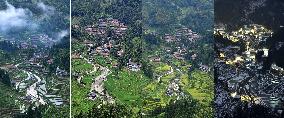
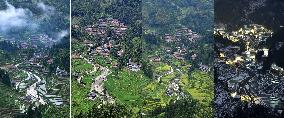
(240719) -- BEIJING, July 19, 2024 Photo by Xinhua/ABACAPRESS.COM) -- This combo photo taken from 2021 to 2024 shows the spring, summer, autumn and winter views (from L to R) of Wuying Village on the border between south China's Guangxi Zhuang Autonomous Region and southwest China's Guizhou Province. Wuying Village, spanning a history of over 200 years, is a Miao ethnic-minority hamlet that nestles snugly in the towering mountains stretching across the border between Guangxi and Guizhou. In the past, the impassable mountains and rugged landscape rendered locals extremely poor. In recent years, Wuying Village has made efforts in the fields of economy, education, culture and ethnic unity, etc. to promote rural revitalization for further development. Photo by Xinhua/ABACAPRESS.COM/Huang Xiaobang)

  •  
(EnchantingGuangxi)CHINA-GUANGXI-MIAO ETHNIC GROUP (CN)

(EnchantingGuangxi)CHINA-GUANGXI-MIAO ETHNIC GROUP (CN)

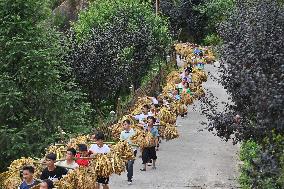
(240718) -- LIUZHOU, July 18, 2024 Photo by Xinhua/ABACAPRESS.COM) -- Villagers carry crop bundles to attend a feast celebrating the first month of a newborn baby in Wuying Village on the border between south China's Guangxi Zhuang Autonomous Region and southwest China's Guizhou Province, July 13, 2024. Wuying Village, spanning a history of over 200 years, is a Miao ethnic group hamlet that nestles snugly in the towering mountains stretching across the border between Guangxi and Guizhou. In the past, the impassable mountains and rugged landscape rendered locals extremely poor. In recent years, Wuying Village has made efforts in the fields of economy, education, culture and ethnic unity, etc. to promote rural vitalization for further development. Photo by Xinhua/ABACAPRESS.COM/Huang Xiaobang)

  •  
(EnchantingGuangxi)CHINA-GUANGXI-MIAO ETHNIC GROUP (CN)

(EnchantingGuangxi)CHINA-GUANGXI-MIAO ETHNIC GROUP (CN)

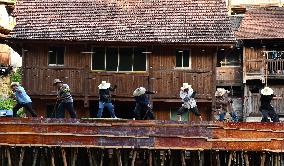
(240718) -- LIUZHOU, July 18, 2024 Photo by Xinhua/ABACAPRESS.COM) -- Villagers construct a wood building in Wuying Village on the border between south China's Guangxi Zhuang Autonomous Region and southwest China's Guizhou Province, July 21, 2022. Wuying Village, spanning a history of over 200 years, is a Miao ethnic group hamlet that nestles snugly in the towering mountains stretching across the border between Guangxi and Guizhou. In the past, the impassable mountains and rugged landscape rendered locals extremely poor. In recent years, Wuying Village has made efforts in the fields of economy, education, culture and ethnic unity, etc. to promote rural vitalization for further development. Photo by Xinhua/ABACAPRESS.COM/Huang Xiaobang)

  •  
(EnchantingGuangxi)CHINA-GUANGXI-MIAO ETHNIC GROUP (CN)

(EnchantingGuangxi)CHINA-GUANGXI-MIAO ETHNIC GROUP (CN)

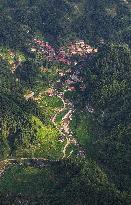
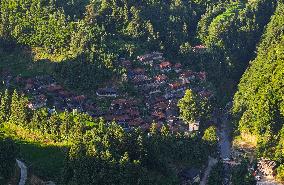
(240718) -- LIUZHOU, July 18, 2024 Photo by Xinhua/ABACAPRESS.COM) -- This aerial drone photo taken on July 10, 2024 shows a view of the Wuying Village on the border between south China's Guangxi Zhuang Autonomous Region and southwest China's Guizhou Province. Wuying Village, spanning a history of over 200 years, is a Miao ethnic group hamlet that nestles snugly in the towering mountains stretching across the border between Guangxi and Guizhou. In the past, the impassable mountains and rugged landscape rendered locals extremely poor. In recent years, Wuying Village has made efforts in the fields of economy, education, culture and ethnic unity, etc. to promote rural vitalization for further development. Photo by Xinhua/ABACAPRESS.COM/Huang Xiaobang)

  •  
(EnchantingGuangxi)CHINA-GUANGXI-MIAO ETHNIC GROUP (CN)

(EnchantingGuangxi)CHINA-GUANGXI-MIAO ETHNIC GROUP (CN)

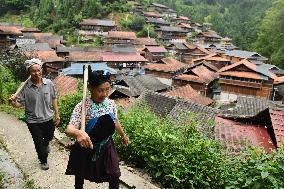
(240718) -- LIUZHOU, July 18, 2024 Photo by Xinhua/ABACAPRESS.COM) -- Villager Liang Yingmi (L) and his wife Liang Anhe go to work in Wuying Village on the border between south China's Guangxi Zhuang Autonomous Region and southwest China's Guizhou Province, July 18, 2024. Wuying Village, spanning a history of over 200 years, is a Miao ethnic group hamlet that nestles snugly in the towering mountains stretching across the border between Guangxi and Guizhou. In the past, the impassable mountains and rugged landscape rendered locals extremely poor. In recent years, Wuying Village has made efforts in the fields of economy, education, culture and ethnic unity, etc. to promote rural vitalization for further development. Photo by Xinhua/ABACAPRESS.COM/Huang Xiaobang)

  •  
(EnchantingGuangxi)CHINA-GUANGXI-MIAO ETHNIC GROUP (CN)

(EnchantingGuangxi)CHINA-GUANGXI-MIAO ETHNIC GROUP (CN)

(240718) -- LIUZHOU, July 18, 2024 Photo by Xinhua/ABACAPRESS.COM) -- Villager Pan Zhongqing goes to work in Wuying Village on the border between south China's Guangxi Zhuang Autonomous Region and southwest China's Guizhou Province, April 12, 2024. Wuying Village, spanning a history of over 200 years, is a Miao ethnic group hamlet that nestles snugly in the towering mountains stretching across the border between Guangxi and Guizhou. In the past, the impassable mountains and rugged landscape rendered locals extremely poor. In recent years, Wuying Village has made efforts in the fields of economy, education, culture and ethnic unity, etc. to promote rural vitalization for further development. Photo by Xinhua/ABACAPRESS.COM/Huang Xiaobang)

  •  
(EnchantingGuangxi)CHINA-GUANGXI-MIAO ETHNIC GROUP (CN)

(EnchantingGuangxi)CHINA-GUANGXI-MIAO ETHNIC GROUP (CN)

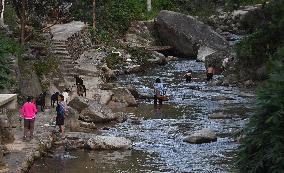
(240718) -- LIUZHOU, July 18, 2024 Photo by Xinhua/ABACAPRESS.COM) -- Chickens cross a river in Wuying Village on the border between south China's Guangxi Zhuang Autonomous Region and southwest China's Guizhou Province, Aug. 21, 2021. Wuying Village, spanning a history of over 200 years, is a Miao ethnic group hamlet that nestles snugly in the towering mountains stretching across the border between Guangxi and Guizhou. In the past, the impassable mountains and rugged landscape rendered locals extremely poor. In recent years, Wuying Village has made efforts in the fields of economy, education, culture and ethnic unity, etc. to promote rural vitalization for further development. Photo by Xinhua/ABACAPRESS.COM/Huang Xiaobang)

  •  
(EnchantingGuangxi)CHINA-GUANGXI-MIAO ETHNIC GROUP (CN)

(EnchantingGuangxi)CHINA-GUANGXI-MIAO ETHNIC GROUP (CN)

(240718) -- LIUZHOU, July 18, 2024 Photo by Xinhua/ABACAPRESS.COM) -- Children play under an ancient tree in Wuying Village on the border between south China's Guangxi Zhuang Autonomous Region and southwest China's Guizhou Province, July 18, 2024. Wuying Village, spanning a history of over 200 years, is a Miao ethnic group hamlet that nestles snugly in the towering mountains stretching across the border between Guangxi and Guizhou. In the past, the impassable mountains and rugged landscape rendered locals extremely poor. In recent years, Wuying Village has made efforts in the fields of economy, education, culture and ethnic unity, etc. to promote rural vitalization for further development. Photo by Xinhua/ABACAPRESS.COM/Huang Xiaobang)

  •  
(EnchantingGuangxi)CHINA-GUANGXI-MIAO ETHNIC GROUP (CN)

(EnchantingGuangxi)CHINA-GUANGXI-MIAO ETHNIC GROUP (CN)

(240718) -- LIUZHOU, July 18, 2024 Photo by Xinhua/ABACAPRESS.COM) -- This aerial drone photo taken on July 11, 2024 shows a view of the Wuying Village at sunrise on the border between south China's Guangxi Zhuang Autonomous Region and southwest China's Guizhou Province. Wuying Village, spanning a history of over 200 years, is a Miao ethnic group hamlet that nestles snugly in the towering mountains stretching across the border between Guangxi and Guizhou. In the past, the impassable mountains and rugged landscape rendered locals extremely poor. In recent years, Wuying Village has made efforts in the fields of economy, education, culture and ethnic unity, etc. to promote rural vitalization for further development. Photo by Xinhua/ABACAPRESS.COM/Huang Xiaobang)

  •  
(EnchantingGuangxi)CHINA-GUANGXI-MIAO ETHNIC GROUP (CN)

(EnchantingGuangxi)CHINA-GUANGXI-MIAO ETHNIC GROUP (CN)

(240718) -- LIUZHOU, July 18, 2024 Photo by Xinhua/ABACAPRESS.COM) -- This combo photo taken from 2021 to 2024 shows the spring, summer, autumn and winter (from L to R) views of Wuying Village on the border between south China's Guangxi Zhuang Autonomous Region and southwest China's Guizhou Province. Wuying Village, spanning a history of over 200 years, is a Miao ethnic group hamlet that nestles snugly in the towering mountains stretching across the border between Guangxi and Guizhou. In the past, the impassable mountains and rugged landscape rendered locals extremely poor. In recent years, Wuying Village has made efforts in the fields of economy, education, culture and ethnic unity, etc. to promote rural vitalization for further development. Photo by Xinhua/ABACAPRESS.COM/Huang Xiaobang)

  •  
(EnchantingGuangxi)CHINA-GUANGXI-MIAO ETHNIC GROUP (CN)

(EnchantingGuangxi)CHINA-GUANGXI-MIAO ETHNIC GROUP (CN)

(240718) -- LIUZHOU, July 18, 2024 Photo by Xinhua/ABACAPRESS.COM) -- Villagers attend a wedding in Wuying Village on the border between south China's Guangxi Zhuang Autonomous Region and southwest China's Guizhou Province, Jan. 27, 2024. Wuying Village, spanning a history of over 200 years, is a Miao ethnic group hamlet that nestles snugly in the towering mountains stretching across the border between Guangxi and Guizhou. In the past, the impassable mountains and rugged landscape rendered locals extremely poor. In recent years, Wuying Village has made efforts in the fields of economy, education, culture and ethnic unity, etc. to promote rural vitalization for further development. Photo by Xinhua/ABACAPRESS.COM/Huang Xiaobang)

  •  
(EnchantingGuangxi)CHINA-GUANGXI-MIAO ETHNIC GROUP (CN)

(EnchantingGuangxi)CHINA-GUANGXI-MIAO ETHNIC GROUP (CN)

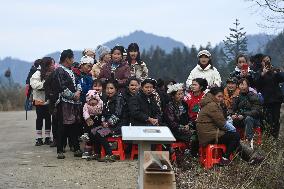
(240718) -- LIUZHOU, July 18, 2024 Photo by Xinhua/ABACAPRESS.COM) -- This aerial drone photo taken on Feb. 14, 2024 shows villagers attending an open-air banquet in Wuying Village on the border between south China's Guangxi Zhuang Autonomous Region and southwest China's Guizhou Province. Wuying Village, spanning a history of over 200 years, is a Miao ethnic group hamlet that nestles snugly in the towering mountains stretching across the border between Guangxi and Guizhou. In the past, the impassable mountains and rugged landscape rendered locals extremely poor. In recent years, Wuying Village has made efforts in the fields of economy, education, culture and ethnic unity, etc. to promote rural vitalization for further development. Photo by Xinhua/ABACAPRESS.COM/Huang Xiaobang)

  •  
(EnchantingGuangxi)CHINA-GUANGXI-MIAO ETHNIC GROUP (CN)

(EnchantingGuangxi)CHINA-GUANGXI-MIAO ETHNIC GROUP (CN)

(240718) -- LIUZHOU, July 18, 2024 Photo by Xinhua/ABACAPRESS.COM) -- Children practice Lusheng, a traditional reed-pipe wind instrument, under the guidance of a teacher in Wuying Village on the border between south China's Guangxi Zhuang Autonomous Region and southwest China's Guizhou Province, July 9, 2024. Wuying Village, spanning a history of over 200 years, is a Miao ethnic group hamlet that nestles snugly in the towering mountains stretching across the border between Guangxi and Guizhou. In the past, the impassable mountains and rugged landscape rendered locals extremely poor. In recent years, Wuying Village has made efforts in the fields of economy, education, culture and ethnic unity, etc. to promote rural vitalization for further development. Photo by Xinhua/ABACAPRESS.COM/Huang Xiaobang)

  •  
(EnchantingGuangxi)CHINA-GUANGXI-MIAO ETHNIC GROUP (CN)

(EnchantingGuangxi)CHINA-GUANGXI-MIAO ETHNIC GROUP (CN)

(240718) -- LIUZHOU, July 18, 2024 Photo by Xinhua/ABACAPRESS.COM) -- Villager Pan Meilan (1st R) dresses her daughter for a folk activity in Wuying Village on the border between south China's Guangxi Zhuang Autonomous Region and southwest China's Guizhou Province, Feb. 12, 2024. Wuying Village, spanning a history of over 200 years, is a Miao ethnic group hamlet that nestles snugly in the towering mountains stretching across the border between Guangxi and Guizhou. In the past, the impassable mountains and rugged landscape rendered locals extremely poor. In recent years, Wuying Village has made efforts in the fields of economy, education, culture and ethnic unity, etc. to promote rural vitalization for further development. Photo by Xinhua/ABACAPRESS.COM/Huang Xiaobang)

  •  
(EnchantingGuangxi)CHINA-GUANGXI-MIAO ETHNIC GROUP (CN)

(EnchantingGuangxi)CHINA-GUANGXI-MIAO ETHNIC GROUP (CN)

(240718) -- LIUZHOU, July 18, 2024 Photo by Xinhua/ABACAPRESS.COM) -- A villager works in a field in Wuying Village on the border between south China's Guangxi Zhuang Autonomous Region and southwest China's Guizhou Province, April 12, 2024. Wuying Village, spanning a history of over 200 years, is a Miao ethnic group hamlet that nestles snugly in the towering mountains stretching across the border between Guangxi and Guizhou. In the past, the impassable mountains and rugged landscape rendered locals extremely poor. In recent years, Wuying Village has made efforts in the fields of economy, education, culture and ethnic unity, etc. to promote rural vitalization for further development. Photo by Xinhua/ABACAPRESS.COM/Huang Xiaobang)

  •  
(EnchantingGuangxi)CHINA-GUANGXI-MIAO ETHNIC GROUP (CN)

(EnchantingGuangxi)CHINA-GUANGXI-MIAO ETHNIC GROUP (CN)

(240718) -- LIUZHOU, July 18, 2024 Photo by Xinhua/ABACAPRESS.COM) -- A villager with wooden benches and a child on his back walks to an open-air banquet in Wuying Village on the border between south China's Guangxi Zhuang Autonomous Region and southwest China's Guizhou Province, Feb. 14, 2024. Wuying Village, spanning a history of over 200 years, is a Miao ethnic group hamlet that nestles snugly in the towering mountains stretching across the border between Guangxi and Guizhou. In the past, the impassable mountains and rugged landscape rendered locals extremely poor. In recent years, Wuying Village has made efforts in the fields of economy, education, culture and ethnic unity, etc. to promote rural vitalization for further development. Photo by Xinhua/ABACAPRESS.COM/Huang Xiaobang)

  •  
(EnchantingGuangxi)CHINA-GUANGXI-MIAO ETHNIC GROUP (CN)

(EnchantingGuangxi)CHINA-GUANGXI-MIAO ETHNIC GROUP (CN)

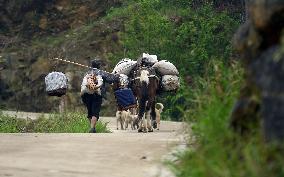
(240718) -- LIUZHOU, July 18, 2024 Photo by Xinhua/ABACAPRESS.COM) -- Villagers engage in conversations after herding sheep in Wuying Village on the border between south China's Guangxi Zhuang Autonomous Region and southwest China's Guizhou Province, July 12, 2024. Wuying Village, spanning a history of over 200 years, is a Miao ethnic group hamlet that nestles snugly in the towering mountains stretching across the border between Guangxi and Guizhou. In the past, the impassable mountains and rugged landscape rendered locals extremely poor. In recent years, Wuying Village has made efforts in the fields of economy, education, culture and ethnic unity, etc. to promote rural vitalization for further development. Photo by Xinhua/ABACAPRESS.COM/Huang Xiaobang)

  •  
XINHUA PHOTOS OF THE DAY

XINHUA PHOTOS OF THE DAY

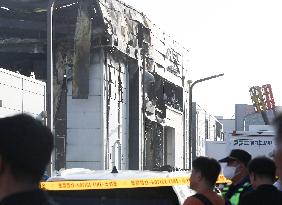
(240625) -- BEIJING, June 25, 2024 Photo by Xinhua/ABACAPRESS.COM) -- This photo taken on June 24, 2024 shows the battery plant fire site in Hwaseong, South Korea. South Korean fire department officials said late Monday night that around 17 Chinese nationals were killed in the Hwaseong battery plant fire on the day earlier, but the exact number still needs to be further confirmed. South Korean officials, including Gyeonggi Province Second Vice Governor Oh Who-seok, Hwaseong City Mayor Jeong Myeong-geun, and officials from the fire department, briefed Chinese Ambassador to South Korea Xing Haiming on the accident and the progress of search and rescue efforts at the scene. Photo by Xinhua/ABACAPRESS.COM/Yao Qilin)

  • Main
  • Top
  • Editorial
  • Creative
  • About Us
  • About ILG
  • Terms of use
  • Company
  • BEHIND
  • Price List
  • Single Plan
  • Monthly Plan
  • Services
  • Shooting
  • Rights Clearance
  • Support
  • FAQ
  • How To Buy
  • Contact Us
  • Become a Partner

© KYODO NEWS IMAGES INC

All Rights Reserved.

  • Editorial
  • Olympics
  • News
  • Sports
  • Japan
  • Tech
  • Royal
  • Disaster
  • NorthKorea
  • Old Japan
  • SNS
  • Creative
  • Food
  • Japan
  • Landscape
  • Animal
  • Popular
  • #Ukraine
  • #Thailand
  • #coronavirus
  • #N. Korea
  • #Russia
  • #China
  • #Ukraine
  • #Thailand
  • #coronavirus
  • #N. Korea
  • #Russia
  • #China
  • Food
  • Japan
  • Landscape
  • Animal
  • Olympics
  • News
  • Sports
  • Japan
  • Tech
  • Royal
  • Disaster
  • NorthKorea
  • Old Japan
  • SNS