•  

China's gigantic telescope detects over 900 new pulsars

STORY: China's gigantic telescope detects over 900 new pulsars SHOOTING TIME: recent footages DATELINE: April 17, 2024 LENGTH: 00:02:11 LOCATION: GUIYANG, China CATEGORY: SCIENCE SHOTLIST: 1. various of the Five-hundred-meter Aperture Spherical Radio Telescope (FAST) 2. SOUNDBITE 1 (Chinese): HAN JINLIN, Scientist with the National Astronomical Observatories under the Chinese Academy of Sciences (NAOC) 3. various of the Five-hundred-meter Aperture Spherical Radio Telescope (FAST) 4. SOUNDBITE 2 (Chinese): JIANG PENG, Chief engineer of the FAST STORYLINE: China's Five-hundred-meter Aperture Spherical Radio Telescope (FAST), the world's largest single-dish radio telescope, has identified more than 900 new pulsars since its launch in 2016, its operator said Wednesday. Pulsars, or fast-spinning neutron stars, originate from the imploded cores of massive dying stars through supernova explosions. Pulsar observation is an important task for FAST, which can be used to confirm the existence of gravitational radia

  •  

China's FAST telescope finds key evidence for nanohertz gravitational waves

STORY: China's FAST telescope finds key evidence for nanohertz gravitational waves DATELINE: June 29, 2023 LENGTH: 00:01:42 LOCATION: GUIYANG, China CATEGORY: TECHNOLOGY SHOTLIST: 1. various of FAST telescope 2. various of scientists and their research work with FAST telescope 3. various of images caught by FAST telescope STORYLINE: China's FAST telescope has found key evidence for the existence of nanohertz gravitational waves. The research, conducted by scientists from the National Astronomical Observatories of the Chinese Academy of Sciences (NAOC) and other institutes, was published in the journal Research in Astronomy and Astrophysics Thursday. Gravitational waves are the "ripples" produced by massive objects such as black holes as they rapidly move through the fabric of spacetime. The scientists monitored 57 millisecond pulsars with regular cadence for 41 months by taking advantage of the high sensitivity of FAST. Eventually, they found key evidence for quadrupole correlation signatures compatibl

  •  
CHINA-BEIJING-GRAVITATIONAL WAVE-RESEARCHER (CN)

CHINA-BEIJING-GRAVITATIONAL WAVE-RESEARCHER (CN)

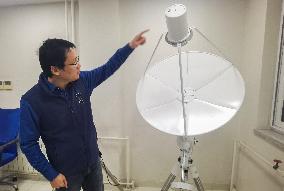
(230420) -- BEIJING, April 20, 2023 (Xinhua) -- Shao Lijing, researcher from the Kavli Institute for Astronomy and Astrophysics at Peking University, demonstrates how a radio telescope works at Peking University in Beijing, capital of China, on Nov. 1, 2022. TO GO WITH "Profile: Exploring mysteries of gravity in 'cosmic laboratory'" (Xinhua/Yu Fei)

  •  
CHINA-BEIJING-GRAVITATIONAL WAVE-RESEARCHER (CN)

CHINA-BEIJING-GRAVITATIONAL WAVE-RESEARCHER (CN)

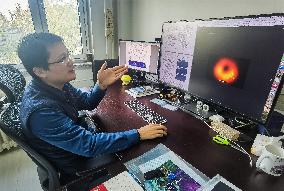
(230420) -- BEIJING, April 20, 2023 (Xinhua) -- Shao Lijing, researcher from the Kavli Institute for Astronomy and Astrophysics at Peking University, introduces an image of a black hole at Peking University in Beijing, capital of China, on Nov. 1, 2022. TO GO WITH "Profile: Exploring mysteries of gravity in 'cosmic laboratory'" (Xinhua/Yu Fei)

  •  

China's gigantic telescope identifies over 740 pulsars

STORY: China's gigantic telescope identifies over 740 pulsars DATELINE: Feb. 15, 2023 LENGTH: 00:00:45 LOCATION: GUIYANG, China CATEGORY: SCIENCE SHOTLIST: 1. various of the FAST telescope 2. SOUNDBITE (Chinese): JIANG PENG, Chief engineer of the telescope STORYLINE: China's Five-hundred-meter Aperture Spherical Radio Telescope (FAST), the world's largest single-dish radio telescope, has identified over 740 pulsars since its launch, the research team has announced. SOUNDBITE (Chinese): JIANG PENG, Chief engineer of FAST "The FAST telescope provides us an important opportunity in finding some unique pulsars for producing premises for significant scientific results." Pulsars, or fast-spinning neutron stars, originate from the imploded cores of massive dying stars through supernova explosions. Pulsar observation is an important task for FAST, which can be used to confirm the existence of gravitational radiation and black holes, and help solve many other major questions in physics. Dubbed the "China Sky

  •  
Residents invited to tunnel for housing huge telescope

Residents invited to tunnel for housing huge telescope

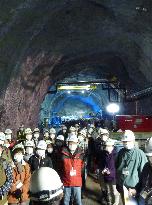
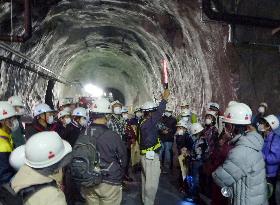
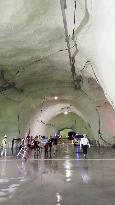
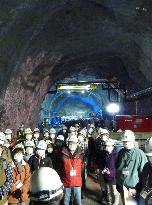
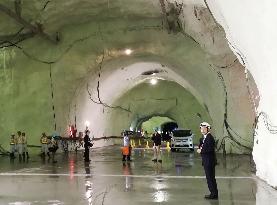
GIFU, Japan - Invited residents in Hida, Gifu Prefecture, central Japan, walk about 1.5 kilometers along a 6-kilometer L-shaped tunnel intended to house the large-scale cryogenic gravitational wave telescope "KAGRA" some 200 meters below the surface of the Kamioka mining area near the Super-Kamiokande neutrino observatory on Oct. 26, 2014.

  •  
Citizens see tunnel for housing huge telescope

Citizens see tunnel for housing huge telescope

GIFU, Japan - Invited residents in Hida, Gifu Prefecture, central Japan, observe a tunnel below the Kamioka mining area intended to house the large-scale cryogenic gravitational wave telescope "KAGRA" on Oct. 26, 2014.

  •  
University of Tokyo professor at press conference

University of Tokyo professor at press conference

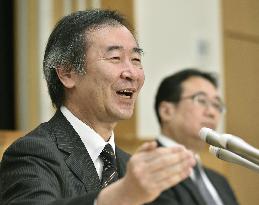
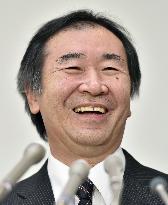
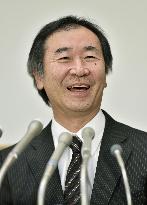
GIFU, Japan - Takaaki Kajita, director of the University of Tokyo's Institute for Cosmic Ray Research, speaks at a press conference in Hida, Gifu Prefecture, central Japan, on July 4, 2014. Tunnels to be used for the "Kagura" gravitational wave telescope system were unveiled to the press the same day.

  •  
Tunnel for gravitational wave telescope unveiled

Tunnel for gravitational wave telescope unveiled

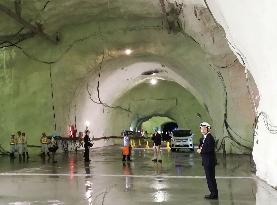
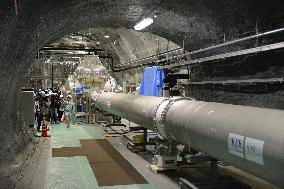
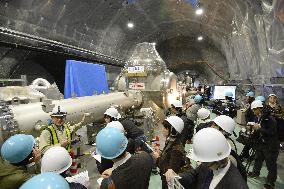
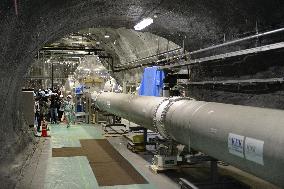
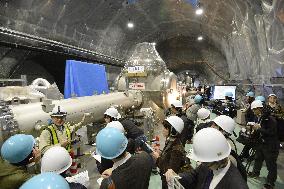
GIFU, Japan - Part of a 3-kilometer tunnel built underground at the Kamioka mine in Hida, Gifu Prefecture, central Japan, for the large-scale cryogenic gravitational wave telescope system is shown to the press on July 4, 2014.

  •  
Tunnel for gravitational wave telescope unveiled

Tunnel for gravitational wave telescope unveiled

GIFU, Japan - Part of a tunnel built underground at the Kamioka mine in Hida, Gifu Prefecture, central Japan, for the large-scale cryogenic gravitational wave telescope system is shown to the press on July 4, 2014.

  •  

Maglev car completes 1st road test in China's Jiangsu

STORY: Maglev car completes 1st road test in China's Jiangsu DATELINE: Sept. 8, 2022 LENGTH: 0:00:20 LOCATION: NANJING, China CATEGORY: TECHNOLOGY SHOTLIST: 1. various of the road test STORYLINE: A maglev car completed its first road test in China's Jiangsu Province. The car ran 35 millimeters above the road. Magnetic levitation, or maglev, is the method through which a vehicle is suspended in the air by using magnetic force to counter gravitational force. Xinhua News Agency correspondents reporting from Nanjing, China. (XHTV)

  •  
Japan starts test run of gravity wave detector

Japan starts test run of gravity wave detector

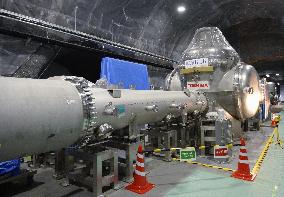
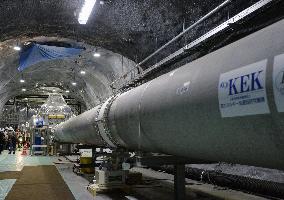
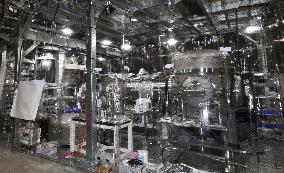
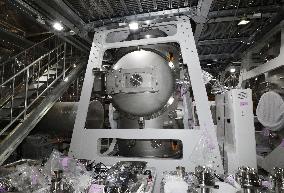
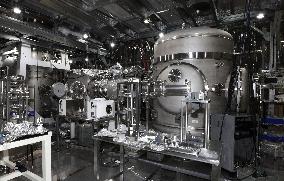
Photo taken in November 2015 shows a part of "Kagra," a giant underground telescope, installed in Hida, Gifu Prefecture. Japan started a test run of the equipment on March 25, 2016 aiming to detect so-called "gravitational waves" and gain a better understanding of the universe by observing the ripples in space-time from colliding black holes and supernova explosions. (Kyodo) ==Kyodo

  •  
Japan starts test run of gravity wave detector

Japan starts test run of gravity wave detector

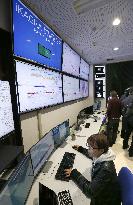
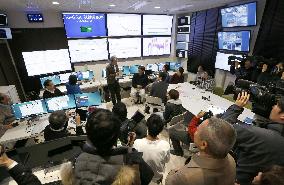
The control room for the Kagra underground telescope is shown to the media in Hida, Gifu Prefecture on March 25, 2016. Japan started a test run of the equipment aiming to detect so-called "gravitational waves" and gain a better understanding of the universe by observing the ripples in space-time from colliding black holes and supernova explosions. (Kyodo) ==Kyodo

  •  
Japan starts test run of gravity wave detector

Japan starts test run of gravity wave detector

The control room for the Kagra underground telescope is shown to the media in Hida, Gifu Prefecture on March 25, 2016. Japan started a test run of the equipment aiming to detect so-called "gravitational waves" and gain a better understanding of the universe by observing the ripples in space-time from colliding black holes and supernova explosions. (Kyodo) ==Kyodo

  •  
Japan starts test run of gravity wave detector

Japan starts test run of gravity wave detector

Photo taken in November 2015 shows a part of "Kagra," a giant underground telescope, installed in Hida, Gifu Prefecture. Japan started a test run of the equipment on March 25, 2016 aiming to detect so-called "gravitational waves" and gain a better understanding of the universe by observing the ripples in space-time from colliding black holes and supernova explosions. (Kyodo) ==Kyodo

  •  
Scientists report detection of gravity waves theorized by Einstein

Scientists report detection of gravity waves theorized by Einstein

Takaaki Kajita, a Nobel laureate in physics, holds a press conference in Kashiwa, Japan, on Feb. 12, 2016, after an international team of scientists announced the detection of gravitational waves, ripples in space-time predicted 100 years ago by Albert Einstein in a physics theory, from colliding black holes. (Kyodo) ==Kyodo

  •  
Scientists report detection of gravity waves theorized by Einstein

Scientists report detection of gravity waves theorized by Einstein

File photo taken in November 2015 shows a part of "KAGRA," a gravitational wave detector, installed in Hida in the central Japan prefecture of Gifu. KAGRA research team members celebrated in Osaka on Feb. 12, 2016 the detection by an international team of scientists of gravitational waves, ripples in space-time predicted 100 years ago by Albert Einstein in a physics theory, from colliding black holes. (Kyodo) ==Kyodo

  •  
Scientists report detection of gravity waves theorized by Einstein

Scientists report detection of gravity waves theorized by Einstein

Takaaki Kajita, a Nobel laureate in physics, holds a press conference in Kashiwa, Japan, on Feb. 12, 2016, after an international team of scientists announced the detection of gravitational waves, ripples in space-time predicted 100 years ago by Albert Einstein in a physics theory, from colliding black holes. (Kyodo) ==Kyodo

  •  
Scientists report detection of gravity waves theorized by Einstein

Scientists report detection of gravity waves theorized by Einstein

Takaaki Kajita, a Nobel laureate in physics, holds a press conference in Kashiwa, Japan, on Feb. 12, 2016, after an international team of scientists announced the detection of gravitational waves, ripples in space-time predicted 100 years ago by Albert Einstein in a physics theory, from colliding black holes. (Kyodo) ==Kyodo

  •  
Scientists report detection of gravity waves theorized by Einstein

Scientists report detection of gravity waves theorized by Einstein

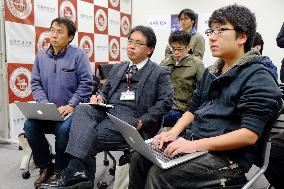
Members of the research team on "KAGRA," a gravitational wave detector, watch a screen at Osaka City University in the early hours of Feb. 12, 2016, broadcasting an announcement by an international team of scientists on its detection of gravitational waves, ripples in space-time predicted 100 years ago by Albert Einstein in a physics theory, from colliding black holes. (Kyodo) ==Kyodo

  •  
Scientists report detection of gravity waves theorized by Einstein

Scientists report detection of gravity waves theorized by Einstein

File photo taken in November 2015 shows a part of "KAGRA," a gravitational wave detector, installed in Hida in the central Japan prefecture of Gifu. KAGRA research team members celebrated in Osaka on Feb. 12, 2016 the detection by an international team of scientists of gravitational waves, ripples in space-time predicted 100 years ago by Albert Einstein in a physics theory, from colliding black holes. (Kyodo) ==Kyodo

  •  
Gravitational wave detector revealed to media

Gravitational wave detector revealed to media

Photo taken in the central Japan city of Hida shows a large-scale gravitational wave detector, KAGRA, revealed to the media on Nov. 6, 2015. Under the KAGRA project, led by the University of Tokyo professor Takaaki Kajita, winner of the Nobel Physics Prize, researchers aim to determine the structure and evolution of the cosmos by using the telescope. (Kyodo) ==Kyodo

  •  
Gravitational wave detector revealed to media

Gravitational wave detector revealed to media

Photo taken in the central Japan city of Hida shows a large-scale gravitational wave detector, KAGRA, revealed to the media on Nov. 6, 2015. Under the KAGRA project, led by the University of Tokyo professor Takaaki Kajita, winner of the Nobel Physics Prize, researchers aim to determine the structure and evolution of the cosmos by using the telescope. (Kyodo) ==Kyodo

  •  
Scientists report detection of gravity waves theorized by Einstein

Scientists report detection of gravity waves theorized by Einstein

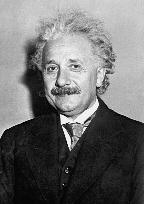
File photo shows theoretical physicist Albert Einstein, who postulated the existence of space-time ripples caused by whirling massive objects in his general theory of relativity. An international team of scientists announced on Feb. 11, 2016 that they have detected gravitational waves, ripples in space-time predicted by Einstein 100 years ago, from colliding black holes. (Kyodo) ==Kyodo

  •  
Nobel laureate Kajita seeks to confirm Einstein's prediction

Nobel laureate Kajita seeks to confirm Einstein's prediction

A tunnel in the central Japanese city of Hida, Gifu Prefecture, where the KAGRA cryogenic gravitational wave telescope will be housed, is shown to local citizens in October 2014. Institute for Cosmic Ray Research Director Takaaki Kajita, co-recipient of the Nobel Prize in Physics 2015, is expected to work on the detection of gravitational waves in space to confirm Albert Einstein's prediction. (Kyodo) ==Kyodo

  •  
University of Tokyo professor at press conference

University of Tokyo professor at press conference

GIFU, Japan - Takaaki Kajita, director of the University of Tokyo's Institute for Cosmic Ray Research, speaks at a press conference in Hida, Gifu Prefecture, central Japan, on July 4, 2014. Tunnels to be used for the "Kagura" gravitational wave telescope system were unveiled to the press the same day. (Kyodo)

  •  
Tunnel for gravitational wave telescope unveiled

Tunnel for gravitational wave telescope unveiled

GIFU, Japan - Part of a tunnel built underground at the Kamioka mine in Hida, Gifu Prefecture, central Japan, for the large-scale cryogenic gravitational wave telescope system is shown to the press on July 4, 2014. (Kyodo)

  •  
RAINER WEISS

RAINER WEISS

Nobel Prize winner for the observation of gravitational waves Rainer Weiss gives lecture in Prague, Czech Republic, July 17, 2019. (CTK Photo/Michal Kamaryt)

  •  
RAINER WEISS

RAINER WEISS

Nobel Prize winner for the observation of gravitational waves Rainer Weiss gives lecture in Prague, Czech Republic, July 17, 2019. (CTK Photo/Michal Kamaryt)

  •  
RAINER WEISS

RAINER WEISS

Nobel Prize winner for the observation of gravitational waves Rainer Weiss gives lecture in Prague, Czech Republic, July 17, 2019. (CTK Photo/Michal Kamaryt)

  •  
RAINER WEISS

RAINER WEISS

Nobel Prize winner for the observation of gravitational waves Rainer Weiss gives lecture in Prague, Czech Republic, July 17, 2019. (CTK Photo/Michal Kamaryt)

  •  
RAINER WEISS

RAINER WEISS

Nobel Prize winner for the observation of gravitational waves Rainer Weiss gives lecture in Prague, Czech Republic, July 17, 2019. (CTK Photo/Michal Kamaryt)

  •  
Underground telescope in Japan

Underground telescope in Japan

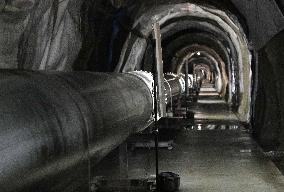
File photo taken on Nov. 17, 2018, shows an underground telescope deep under a mountain in Hida, Gifu Prefecture, central Japan. The telescope, called "Kagura," is designed to detect and measure gravitational waves that are originated from gravity of mass as part of a project to clarify many unfathomed abyss about black holes. (Kyodo) ==Kyodo

  •  
Underground telescope in Japan

Underground telescope in Japan

File photo taken on Nov. 17, 2018, shows an underground telescope deep under a mountain in Hida, Gifu Prefecture, central Japan. The telescope, called "Kagura," is designed to detect and measure gravitational waves that are originated from gravity of mass as part of a project to clarify many unfathomed abyss about black holes. (Kyodo) ==Kyodo

  •  
Underground telescope in Japan

Underground telescope in Japan

File photo taken on Nov. 17, 2018, shows an underground telescope deep under a mountain in Hida, Gifu Prefecture, central Japan. The telescope, called "Kagura," is designed to detect and measure gravitational waves that are originated from gravity of mass as part of a project to clarify many unfathomed abyss about black holes. (Kyodo) ==Kyodo

  •  
Underground telescope in Japan

Underground telescope in Japan

File photo taken on Nov. 17, 2018, shows an underground telescope deep under a mountain in Hida, Gifu Prefecture, central Japan. The telescope, called "Kagura," is designed to detect and measure gravitational waves that are originated from gravity of mass as part of a project to clarify many unfathomed abyss about black holes. (Kyodo) ==Kyodo

  • Main
  • Top
  • Editorial
  • Creative
  • About Us
  • About ILG
  • Terms of use
  • Company
  • BEHIND
  • Price List
  • Single Plan
  • Monthly Plan
  • Services
  • Shooting
  • Rights Clearance
  • Support
  • FAQ
  • How To Buy
  • Contact Us
  • Become a Partner

© KYODO NEWS IMAGES INC

All Rights Reserved.

  • Editorial
  • Olympics
  • News
  • Sports
  • Japan
  • Tech
  • Royal
  • Disaster
  • NorthKorea
  • Old Japan
  • SNS
  • Creative
  • Food
  • Japan
  • Landscape
  • Animal
  • Popular
  • #Ukraine
  • #Russia
  • #coronavirus
  • #N. Korea
  • #Thailand
  • #China
  • #Ukraine
  • #Russia
  • #coronavirus
  • #N. Korea
  • #Thailand
  • #China
  • Food
  • Japan
  • Landscape
  • Animal
  • Olympics
  • News
  • Sports
  • Japan
  • Tech
  • Royal
  • Disaster
  • NorthKorea
  • Old Japan
  • SNS