•  
Scientists Develop Gene-Edited Sheep - India

Scientists Develop Gene-Edited Sheep - India

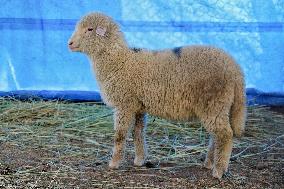
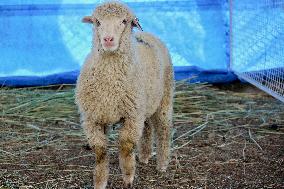
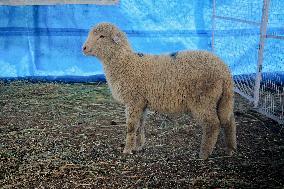
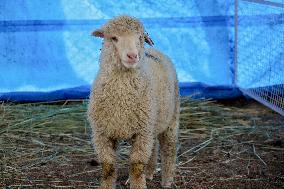
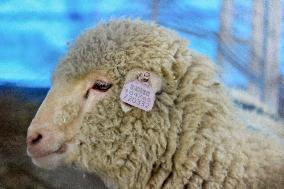
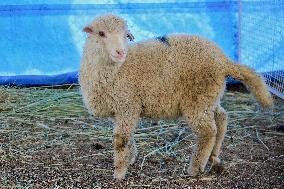
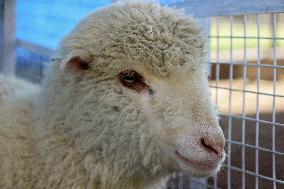
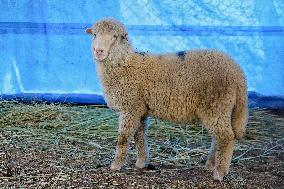
A gene-edited sheep stands inside a pen at SKUAST-Kashmir in Srinagar, India, on May 28, 2025. Scientists developed India’s first gene-edited sheep to improve wool quality and disease resistance. Photo by Numan Bhat/Middle East Images/ABACAPRESS.COM

  •  
Scientists Develop Gene-Edited Sheep - India

Scientists Develop Gene-Edited Sheep - India

A gene-edited sheep stands inside a pen at SKUAST-Kashmir in Srinagar, India, on May 28, 2025. Scientists developed India’s first gene-edited sheep to improve wool quality and disease resistance. Photo by Numan Bhat/Middle East Images/ABACAPRESS.COM

  •  
Scientists Develop Gene-Edited Sheep - India

Scientists Develop Gene-Edited Sheep - India

A gene-edited sheep stands inside a pen at SKUAST-Kashmir in Srinagar, India, on May 28, 2025. Scientists developed India’s first gene-edited sheep to improve wool quality and disease resistance. Photo by Numan Bhat/Middle East Images/ABACAPRESS.COM

  •  
Scientists Develop Gene-Edited Sheep - India

Scientists Develop Gene-Edited Sheep - India

A gene-edited sheep stands inside a pen at SKUAST-Kashmir in Srinagar, India, on May 28, 2025. Scientists developed India’s first gene-edited sheep to improve wool quality and disease resistance. Photo by Numan Bhat/Middle East Images/ABACAPRESS.COM

  •  
Scientists Develop Gene-Edited Sheep - India

Scientists Develop Gene-Edited Sheep - India

A gene-edited sheep stands inside a pen at SKUAST-Kashmir in Srinagar, India, on May 28, 2025. Scientists developed India’s first gene-edited sheep to improve wool quality and disease resistance. Photo by Numan Bhat/Middle East Images/ABACAPRESS.COM

  •  
Scientists Develop Gene-Edited Sheep - India

Scientists Develop Gene-Edited Sheep - India

A gene-edited sheep stands inside a pen at SKUAST-Kashmir in Srinagar, India, on May 28, 2025. Scientists developed India’s first gene-edited sheep to improve wool quality and disease resistance. Photo by Numan Bhat/Middle East Images/ABACAPRESS.COM

  •  
Scientists Develop Gene-Edited Sheep - India

Scientists Develop Gene-Edited Sheep - India

A gene-edited sheep stands inside a pen at SKUAST-Kashmir in Srinagar, India, on May 28, 2025. Scientists developed India’s first gene-edited sheep to improve wool quality and disease resistance. Photo by Numan Bhat/Middle East Images/ABACAPRESS.COM

  •  
Scientists Develop Gene-Edited Sheep - India

Scientists Develop Gene-Edited Sheep - India

A gene-edited sheep stands inside a pen at SKUAST-Kashmir in Srinagar, India, on May 28, 2025. Scientists developed India’s first gene-edited sheep to improve wool quality and disease resistance. Photo by Numan Bhat/Middle East Images/ABACAPRESS.COM

  •  
Mammoth Three-dimensional Chromosome

Mammoth Three-dimensional Chromosome

A mammoth model is displayed at the Changbai Mountain Mammoth theme park in Yanbian, Northeast China's Jilin province, July 16, 2024. An international research team has successfully reconstructed the genome and three-dimensional chromosome structure of a mammoth that lived 52,000 years ago, the first such study using ancient DNA samples, the Chinese Science Journal reported.

  •  
Mammoth Three-dimensional Chromosome

Mammoth Three-dimensional Chromosome

A mammoth model is displayed at the Changbai Mountain Mammoth theme park in Yanbian, Northeast China's Jilin province, July 16, 2024. An international research team has successfully reconstructed the genome and three-dimensional chromosome structure of a mammoth that lived 52,000 years ago, the first such study using ancient DNA samples, the Chinese Science Journal reported.

  •  
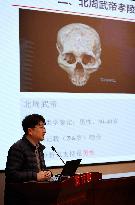
CHINA-SHAANXI-XI'AN-ANCIENT CHINESE EMPEROR-GENETIC PROFILE-COMPLETION (CN)

CHINA-SHAANXI-XI'AN-ANCIENT CHINESE EMPEROR-GENETIC PROFILE-COMPLETION (CN)

(240330) -- XI'AN, March 30, 2024 (Xinhua) -- Wen Shaoqing, an associate professor of the Institute of Archaeological Science of Fudan University, introduces archaeological achievements of the tomb of Emperor Wu of the Xianbei-led Northern Zhou Dynasty (557-581), during a press conference in Xi'an, northwest China's Shaanxi Province, March 28, 2024. A team of Chinese scientists have completed the genetic profile of an ancient Chinese ethnic minority emperor via genome analysis, according to local archaeologists on Thursday. TO GO WITH "China Focus: Scientists restore profile of ancient Chinese emperor through genetic analysis" (Xinhua/Li Yibo)

  •  
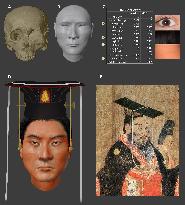
CHINA-SHAANXI-XI'AN-ANCIENT CHINESE EMPEROR-GENETIC PROFILE-COMPLETION (CN)

CHINA-SHAANXI-XI'AN-ANCIENT CHINESE EMPEROR-GENETIC PROFILE-COMPLETION (CN)

(240330) -- XI'AN, March 30, 2024 (Xinhua) -- This picture published on March 28, 2024 shows the restored image of Yuwen Yong, Emperor Wu of the Xianbei-led Northern Zhou Dynasty (557-581). A team of Chinese scientists have completed the genetic profile of an ancient Chinese ethnic minority emperor via genome analysis, according to local archaeologists on Thursday. TO GO WITH "China Focus: Scientists restore profile of ancient Chinese emperor through genetic analysis" (Xinhua/Li Yibo)

  •  
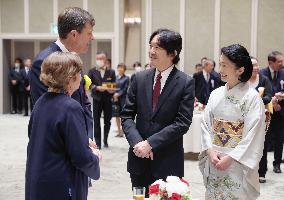
Crown Prince Fumihito at award ceremony

Crown Prince Fumihito at award ceremony

Japanese Crown Prince Fumihito (2nd from R) and his wife and Crown Princess Kiko (R) chat with University of Cambridge genetics professor Richard Durbin (back, L) after an award ceremony in Tokyo on Dec. 14, 2023. Durbin received the 39th International Prize for Biology for his contributions in the genome field. (Pool photo)

  •  

Oldest human genome discovered from southern Spain: researchers

STORY: Oldest human genome discovered from southern Spain: researchers DATELINE: March 15, 2023 LENGTH: 00:01:36 LOCATION: BARCELONA, Spain CATEGORY: CULTURE SHOTLIST: 1. various of researchers in the cave of Malalmuerzo in the south of Spain (Courtesy of regional government of Andalusia and the University of Cadiz) 2. various of remains with ancient human DNA from 23,000 years ago at the height of the Ice Age (Courtesy of regional government of Andalusia and the University of Cadiz) 3. various of researchers who located the human remains (Courtesy of regional government of Andalusia and the University of Cadiz) 4. various of the Andalusia region where important archaeological sites are located 5. various of the cave of Ardales in the south of Spain (Courtesy of regional government of Andalusia and the University of Cadiz) STORYLINE: An international team of researchers has discovered the oldest human genome from southern Spain. The genome belonged to a 23,000-year-old individual who lived at the peak of

  •  
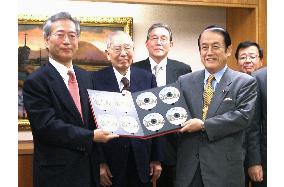
Int'l team of researchers completes rice genome decoding

Int'l team of researchers completes rice genome decoding

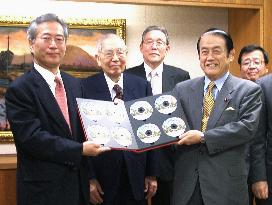
TOKYO, Japan - An international team of scientists has completed the sequencing of the rice genome, an accomplishment that should lead to the development of new varieties of rice to meet different needs. Researcher Takuji Sasaki (L) hands a CD set containing the research results to Japanese agriculture minister Yoshinobu Shimamura (R in front) in Tokyo on Dec. 13.

  •  
Decoding sequence of human genome completed

Decoding sequence of human genome completed

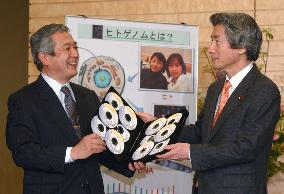
TOKYO, Japan - Yoshiyuki Sakaki (L), Japanese director of a project to decode the sequence of the human genome, presents Prime Minister Junichiro Koizumi with a set of CD-ROMs recording a map of the human genome at the prime minister's office in Tokyo on April 14. The leaders of six countries -- Japan, the United States, Britain, France, Germany and China -- issued a joint statement marking the completion of decoding of the human genome.

  •  
Research team says rice genome decoding completed

Research team says rice genome decoding completed

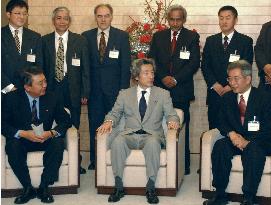
TOKYO, Japan - Prime Minister Junichiro Koizumi (C in front) and Agriculture, Forestry and Fisheries Minister (L in front) meet with representatives of an international research team at the prime minister's office in Tokyo on Dec. 18. The team reported the completion of deciphering the rice genome.

  •  
Human genome to be fully mapped by April: int'l group

Human genome to be fully mapped by April: int'l group

TOKYO, Japan - Francis Collins (L), a scientist at the National Institute of Health of the Untied States, and Yoshiyuki Sakaki, a project director for the Institute of Physical and Chemical Research (Riken), speak Aug. 29 at the Ministry of Education, Culture, Sports, Science and Technology in Tokyo about the progress in international research on the sequence of the human genome.

  •  
Mitsubishi Chemical, Fujitsu to team up on biotech drugs

Mitsubishi Chemical, Fujitsu to team up on biotech drugs

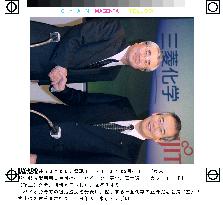
TOKYO, Japan - Kanji Shono (L), president of Mitsubishi Chemical Corp., and Naoyuki Akikusa, president of Fujitsu Ltd., shake hands at a news conference in Tokyo on March 5. They announced that their companies have agreed to form an alliance in the field of biotechnology, focusing on research and development of pharmaceuticals using human genome data.

  •  
Researchers decode plant genome for 1st time

Researchers decode plant genome for 1st time

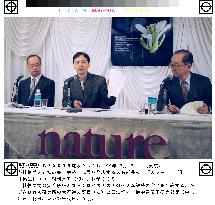
TOKYO, Japan - Michio Oishi (R) and Satoshi Tabata (C), of the Kazusa DNA Research Institute in Kisarazu, Chiba Prefecture, speak at a news conference in Tokyo on Dec. 13. They and researchers in the United States, Britain, France and Germany have succeeded in decoding the genome of a plant for the first time.

  •  
Gov't panel discusses guidelines on human genome research

Gov't panel discusses guidelines on human genome research

TOKYO, Japan - A governmental panel, charged with drawing up guidelines on research into the human genome, holds its first meeting at the National Cancer Center in Tokyo on Aug. 14. The 19-member panel, established by the education, health and trade ministries and the Science and Technology Agency, is tasked with establishing draft guidelines by September and finalizing them by the end of next March.

  •  

Sweden's Svante Paabo wins 2022 Nobel Prize in Physiology or Medicine

STORY: Sweden's Svante Paabo wins 2022 Nobel Prize in Physiology or Medicine DATELINE: Oct. 3, 2022 LENGTH: 00:01:31 LOCATION: Stockholm CATEGORY: TECHNOLOGY SHOTLIST: 1. various of press conference for Nobel Prize in Physiology or Medicine STORYLINE: Swedish geneticist Svante Paabo won the 2022 Nobel Prize in Physiology or Medicine for his discoveries "concerning the genomes of extinct hominins and human evolution," the Nobel committee announced here on Monday. "Through his pioneering research, Svante Paabo accomplished something seemingly impossible: sequencing the genome of the Neanderthal, an extinct relative of present-day humans," the committee said in a statement. "He also made the sensational discovery of a previously unknown hominin, Denisova." The scientist found that gene transfer had occurred from these now extinct hominins to Homo sapiens following the migration out of Africa around 70,000 years ago. "This ancient flow of genes to present-day humans has physiological relevance today, for ex

  •  

Spanish scientists reveal genetic secrets of "immortal" jellyfish

STORY: Spanish scientists reveal genetic secrets of "immortal" jellyfish DATELINE: Sept. 10, 2022 LENGTH: 00:01:40 LOCATION: Madrid CATEGORY: SCIENCE SHOTLIST: various of street views in SpainSOUNDBITE 1 (Spanish): MARIA PASCUAL, Researcher at the Department of Biochemistry and Molecular Biology at the University of Oviedovarious of the jellyfishSOUNDBITE 2 (Spanish): MARIA PASCUAL, Researcher at the Department of Biochemistry and Molecular Biology at the University of Oviedo STORYLINE: Spanish scientists have discovered the genetic secrets of "immortal" jellyfish and opened a door to anti-aging research. After five years of study on Turritopsis dohrnii, which can revert to its larval form at will, researchers from the Department of Biochemistry and Molecular Biology at the University of Oviedo in Spain sequenced the jellyfish's genome and identified variations that make it better at copying and repairing DNA, which provides it with its rejuvenation abilities. SOUNDBITE 1 (Spanish): MARIA PASCUAL, Resea

  •  

Legionella suspected as cause of illness killing 4, sickening 7 in Argentina

STORY: Legionella suspected as cause of illness killing 4, sickening 7 in Argentina DATELINE: Sept. 4, 2022 LENGTH: 0:01:39 LOCATION: Buenos Aires CATEGORY: HEALTH SHOTLIST: 1. various of website pages 2. various of street views in Argentina STORYLINE: Argentine Health Minister Carla Vizzotti said on Saturday that Legionella may be the cause of the illness that has killed four and sickened 7 in the country. The main symptoms include pneumonia, fever and abdominal pain. "We have preliminary information, the definitive confirmation remains to be done through serological studies. In 4 samples (3 respiratory samples and a biopsy puncture of one of the deceased patients) the genome of the Legionella bacteria was detected, pending its typification (the suspicion is that it is Legionella pneumophila," said Vizzotti in a press conference. Xinhua News Agency correspondents reporting from Buenos Aires. (XHTV)

  •  
CHINA-YUNNAN-MENGZI-MENGZI REN-HUMAN GENOME-FINDING (CN)

CHINA-YUNNAN-MENGZI-MENGZI REN-HUMAN GENOME-FINDING (CN)

(220715) -- KUNMING, July 15, 2022 (Xinhua) -- A drawing provided by Kunming Institute of Zoology under the Chinese Academy of Sciences shows the reconstruction of a female "Mengzi Ren (MZR)" and her living environment. Scientists have unveiled a Late Pleistocene human genome from southwest China. Their findings were published online in the journal Current Biology on Thursday night. The scientists conducted the genome sequencing of the 14,000-year-old human remains of the "Mengzi Ren (MZR)," which were unearthed in 1989 in a cave in Mengzi, Yunnan Province. More than 30 human fossils, as well as fossils of animals such as the red deer, the macaque and the black bear, were discovered in the cave. TO GO WITH "Chinese scientists sequence genome of 14,000-yr-old human" (Kunming Institute of Zoology under the Chinese Academy of Sciences/Handout via Xinhua)

  •  
CHINA-YUNNAN-MENGZI-MENGZI REN-HUMAN GENOME-FINDING (CN)

CHINA-YUNNAN-MENGZI-MENGZI REN-HUMAN GENOME-FINDING (CN)

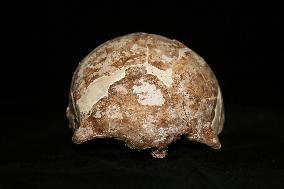
(220715) -- KUNMING, July 15, 2022 (Xinhua) -- Undated photo provided by Mengzi Institute of Cultural Relics shows the skull of Mengzi Ren (MZR) in Mengzi, southwest China's Yunnan Province. Scientists have unveiled a Late Pleistocene human genome from southwest China. Their findings were published online in the journal Current Biology on Thursday night. The scientists conducted the genome sequencing of the 14,000-year-old human remains of the "Mengzi Ren (MZR)," which were unearthed in 1989 in a cave in Mengzi, Yunnan Province. More than 30 human fossils, as well as fossils of animals such as the red deer, the macaque and the black bear, were discovered in the cave. TO GO WITH "Chinese scientists sequence genome of 14,000-yr-old human" (Mengzi Institute of Cultural Relics/Handout via Xinhua)

  •  
CHINA-YUNNAN-MENGZI-MENGZI REN-HUMAN GENOME-FINDING (CN)

CHINA-YUNNAN-MENGZI-MENGZI REN-HUMAN GENOME-FINDING (CN)

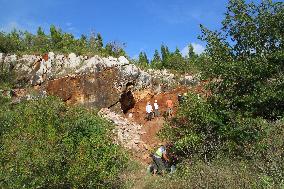
(220715) -- KUNMING, July 15, 2022 (Xinhua) -- Undated photo provided by Yunnan Institute of Cultural Relics and Archaeology shows a cave where the remains of the "Mengzi Ren (MZR)" are unearthed, in Mengzi, southwest China's Yunnan Province. Scientists have unveiled a Late Pleistocene human genome from southwest China. Their findings were published online in the journal Current Biology on Thursday night. The scientists conducted the genome sequencing of the 14,000-year-old human remains of the "Mengzi Ren (MZR)," which were unearthed in 1989 in a cave in Mengzi, Yunnan Province. More than 30 human fossils, as well as fossils of animals such as the red deer, the macaque and the black bear, were discovered in the cave. TO GO WITH "Chinese scientists sequence genome of 14,000-yr-old human" (Yunnan Institute of Cultural Relics and Archaeology/Handout via Xinhua)

  •  

Peru isolates monkeypox virus genome

STORY: Peru isolates monkeypox virus genome DATELINE: July 2, 2022 LENGTH: 00:02:41 LOCATION: Lima CATEGORY: MEDICINE/SOCIETY SHOTLIST: 1. various of laboratory 2. SOUNDBITE (Spanish): OSCAR ESCALANTE, Executive Director of Health at Transmissible Diseases at National Health Institute 3. various of people doing research work STORYLINE: Health Authorities in Peru have achieved the isolation of the complete genome of the virus that generates monkeypox in just a few days. It's the first isolated case, the national health institute in Peru confirmed on Friday. SOUNDBITE (Spanish): OSCAR ESCALANTE, Executive Director of Health at Transmissible Diseases at National Health Institute "This is the first isolated case. It's a starting point. We know the variant that has entered the country. What happens now is that we must be vigilant because we know that these viruses constantly mutate, so the system of genome vigilance is very important to determine if there is some mutation of the virus or not." In May, the Min

  •  

Australia's diverse genetic koala to help save local population

STORY: Australia's diverse genetic koala to help save local population DATELINE: March 31, 2022 LENGTH: 0:01:55 LOCATION: SYDNEY, Australia CATEGORY: ENVIRONMENT SHOTLIST: 1. various of the koala 2. SOUNDBITE (English): STEVEN JOHNSTON, Associate Professor, University of Queensland's School of Agriculture and Food Sciences STORYLINE: A koala with diverse genetics could turn around the fate of endangered koala colonies along Australia's east coast, researchers from the Living Koala Genome Bank pilot program said. Jagger is the first koala to be bred as part of the pilot program, led by the University of Queensland, and was introduced to the public on Tuesday. The koala has been released into a colony at a conservation park on the Gold Coast, with the hope to improve the genetic diversity of the population in the long term. Researchers said as Jagger is now in a new wild population, it will bring new genetics into that population to help improve the genetic makeup of the population that researche

  •  
Int'l team of researchers completes rice genome decoding

Int'l team of researchers completes rice genome decoding

TOKYO, Japan - An international team of scientists has completed the sequencing of the rice genome, an accomplishment that should lead to the development of new varieties of rice to meet different needs. Researcher Takuji Sasaki (L) hands a CD set containing the research results to Japanese agriculture minister Yoshinobu Shimamura (R in front) in Tokyo on Dec. 13.

  •  
Scientists mull issues tied to genome editing in Washington

Scientists mull issues tied to genome editing in Washington

Scientists from China and Europe discuss the need to lay down ethical standards and rules in research and development of human genome-editing techniques at the National Academy of Sciences in Washington on Oct. 5, 2015. (Kyodo) ==Kyodo

  •  
2020 Nobel chemistry prize winners

2020 Nobel chemistry prize winners

File photo taken in April 2017 shows Emmanuelle Charpentier (L) and Jennifer Doudna giving an interview in Tokyo. The two won the 2020 Nobel Prize in chemistry for discovering a revolutionary genome editing technique.

  •  
2020 Nobel chemistry prize winner

2020 Nobel chemistry prize winner

File photo in April 2017 shows Emmanuelle Charpentier giving an interview in Tokyo. The director of the Max Planck Unit for the Science of Pathogens in Berlin won the 2020 Nobel Prize in chemistry with Jennifer Doudna for discovering a revolutionary genome editing technique.

  •  
2020 Nobel chemistry prize winner

2020 Nobel chemistry prize winner

File photo taken in April 2017 shows Jennifer Doudna giving an interview in Tokyo. The professor at the University of California, Berkeley, won the 2020 Nobel Prize in chemistry with Emmanuelle Charpentier for discovering a revolutionary genome editing technique.

  •  
Gene editing research

Gene editing research

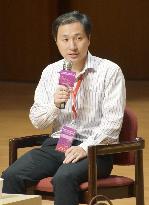
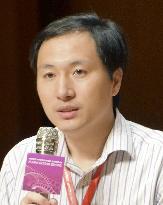
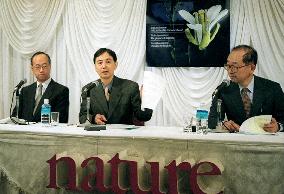
He Jiankui, a biology professor at the Southern University of Science and Technology in Shenzen, China, speaks at the Second International Summit on Human Genome Editing in Hong Kong on Nov. 28, 2018. He claimed to have produced the world's first genetically edited baby. (Kyodo) ==Kyodo

  •  
Gene editing research

Gene editing research

He Jiankui, a biology professor at the Southern University of Science and Technology in Shenzen, China, speaks at the Second International Summit on Human Genome Editing in Hong Kong on Nov. 28, 2018. He claimed to have produced the world's first genetically edited baby. (Kyodo) ==Kyodo

  •  
Emperor, empress talk with Japan Prize laureate

Emperor, empress talk with Japan Prize laureate

Emperor Akihito and Empress Michiko talk to Jennifer Doudna (L), professor at the University of California, Berkeley, who received the Japan Prize for elucidating the genome editing mechanism, on April 19, 2017, in Tokyo. (Kyodo) ==Kyodo

  •  
Decoding sequence of human genome completed

Decoding sequence of human genome completed

TOKYO, Japan - Yoshiyuki Sakaki (L), Japanese director of a project to decode the sequence of the human genome, presents Prime Minister Junichiro Koizumi with a set of CD-ROMs recording a map of the human genome at the prime minister's office in Tokyo on April 14. The leaders of six countries -- Japan, the United States, Britain, France, Germany and China -- issued a joint statement marking the completion of decoding of the human genome. (Kyodo)

  •  
Research team says rice genome decoding completed

Research team says rice genome decoding completed

TOKYO, Japan - Prime Minister Junichiro Koizumi (C in front) and Agriculture, Forestry and Fisheries Minister (L in front) meet with representatives of an international research team at the prime minister's office in Tokyo on Dec. 18. The team reported the completion of deciphering the rice genome. (Kyodo)

  •  
Human genome to be fully mapped by April: int'l group

Human genome to be fully mapped by April: int'l group

TOKYO, Japan - Francis Collins (L), a scientist at the National Institute of Health of the Untied States, and Yoshiyuki Sakaki, a project director for the Institute of Physical and Chemical Research (Riken), speak Aug. 29 at the Ministry of Education, Culture, Sports, Science and Technology in Tokyo about the progress in international research on the sequence of the human genome. (Kyodo)

  •  
Researchers decode plant genome for 1st time

Researchers decode plant genome for 1st time

TOKYO, Japan - Michio Oishi (R) and Satoshi Tabata (C), of the Kazusa DNA Research Institute in Kisarazu, Chiba Prefecture, speak at a news conference in Tokyo on Dec. 13. They and researchers in the United States, Britain, France and Germany have succeeded in decoding the genome of a plant for the first time.

  • Main
  • Top
  • Editorial
  • Creative
  • About Us
  • About ILG
  • Terms of use
  • Company
  • BEHIND
  • Price List
  • Single Plan
  • Monthly Plan
  • Services
  • Shooting
  • Rights Clearance
  • Support
  • FAQ
  • How To Buy
  • Contact Us
  • Become a Partner

© KYODO NEWS IMAGES INC

All Rights Reserved.

  • Editorial
  • Olympics
  • News
  • Sports
  • Japan
  • Tech
  • Royal
  • Disaster
  • NorthKorea
  • Old Japan
  • SNS
  • Creative
  • Food
  • Japan
  • Landscape
  • Animal
  • Popular
  • #Ukraine
  • #Russia
  • #coronavirus
  • #N. Korea
  • #China
  • #Thailand
  • #Ukraine
  • #Russia
  • #coronavirus
  • #N. Korea
  • #China
  • #Thailand
  • Food
  • Japan
  • Landscape
  • Animal
  • Olympics
  • News
  • Sports
  • Japan
  • Tech
  • Royal
  • Disaster
  • NorthKorea
  • Old Japan
  • SNS