•  
Ukrainian woman to publish Japanese-style poetry anthology

Ukrainian woman to publish Japanese-style poetry anthology

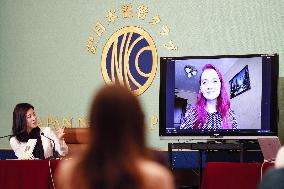
Photo taken at the Japan National Press Club in Tokyo shows Vladislava Simonova (on screen), a 24-year-old woman living in Ukraine, holding a virtual press conference on Aug. 21, 2023, before publishing on Aug. 25 a Russian-language anthology of "haiku," Japanese-style short form poetry, centering around her experiences in the war-torn country.

  •  
Ukrainian woman to publish Japanese-style poetry anthology

Ukrainian woman to publish Japanese-style poetry anthology

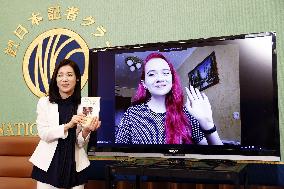
Photo taken at the Japan National Press Club in Tokyo shows Vladislava Simonova (on screen), a 24-year-old woman living in Ukraine, holding a virtual press conference on Aug. 21, 2023, before publishing on Aug. 25 a Russian-language anthology of "haiku," Japanese-style short form poetry, centering around her experiences in the war-torn country.

  •  
Ukrainian woman to publish Japanese-style poetry anthology

Ukrainian woman to publish Japanese-style poetry anthology

Photo taken at the Japan National Press Club in Tokyo shows Vladislava Simonova (on screen), a 24-year-old woman living in Ukraine, holding a virtual press conference on Aug. 21, 2023, before publishing on Aug. 25 a Russian-language anthology of "haiku," Japanese-style short form poetry, centering around her experiences in the war-torn country.

  •  
'Haiku' anthology from 1899 gathering hosted by Masaoka Shiki

'Haiku' anthology from 1899 gathering hosted by Masaoka Shiki

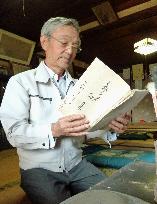
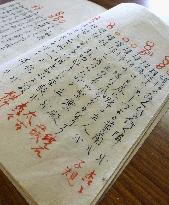
AKITA, Japan - Seiichi Hasebe reads the original handwritten anthology of 300 Japanese "haiku" poems, a collection of poems from a New Year's haiku gathering in 1899 hosted by famed poet Masaoka Shiki (1867-1902), in Akita, northeastern Japan. He found the collection in May 2014 when sorting the belongings of Akita native poet Ishii Rogetsu.

  •  
'Haiku' anthology from 1899 gathering hosted by Masaoka Shiki

'Haiku' anthology from 1899 gathering hosted by Masaoka Shiki

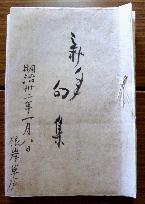
AKITA, Japan - Cover of the recently-discovered original handwritten anthology of 300 Japanese "haiku" poems, a collection of poems from a New Year's haiku gathering in 1899 hosted by famed poet Masaoka Shiki (1867-1902), is seen in this photo. The collection found in May 2014 in Akita, northeastern Japan, contains Shiki's handwriting.

  •  
'Haiku' anthology from 1899 gathering hosted by Masaoka Shiki

'Haiku' anthology from 1899 gathering hosted by Masaoka Shiki

AKITA, Japan - The recently-discovered original handwritten anthology of 300 Japanese "haiku" poems, a collection of poems from a New Year's haiku gathering in 1899 hosted by famed poet Masaoka Shiki (1867-1902), is seen in this photo. The collection found in May 2014 in Akita, northeastern Japan, contains Shiki's handwriting.

  •  
Letter from famed novelist to 'haiku' master found

Letter from famed novelist to 'haiku' master found

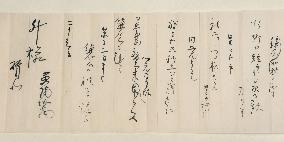
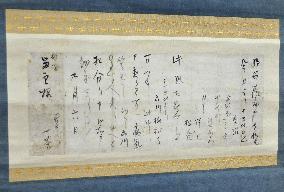
TOKYO, Japan - Part of a letter addressed to prominent "haiku" writer Shiki Masaoka (1867-1902) from renowned novelist Soseki Natsume (1867-1916) is shown on Aug. 22, 2014. The letter, which contained Natsume's unpublished haiku or 17-syllable poems, indicates a firm friendship between the two.

  •  
Author Tanizaki's 'haiku' poems on postcard discovered

Author Tanizaki's 'haiku' poems on postcard discovered

NARA, Japan - A postcard (R) written by novelist Junichiro Tanizaki (1886-1965) containing "haiku" poems describing his sense of uneasiness during the Pacific War is photographed at Tezukayama University's library in Nara City on July 4, 2014.

  •  
Shiki Masaoka's letter shown to press

Shiki Masaoka's letter shown to press

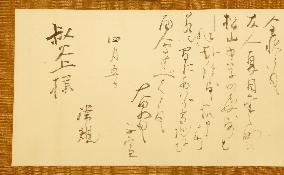
TOKYO, Japan - A letter written by haiku great Shiki Masaoka (1867-1902) to his uncle is shown to the press on July 3, 2014, a day before a two-day preview for an auction in Tokyo. The letter mentions Masaoka's friend Kinnosuke Natsume (author Soseki Natsume, 1867-1916).

  •  
Issa museum unveils Issa's letter to his wife

Issa museum unveils Issa's letter to his wife

SHINANO, Japan - The Issa Memorial Museum in the town of Shinano in Nagano Prefecture, central Japan, unveils to the press on March 19, 2014, a letter which Kobayashi Issa (1763-1827), a Japanese "haiku" poet from the Edo period, sent to his wife.

  •  
U.S. envoy Kennedy attends haiku contest in Kagoshima

U.S. envoy Kennedy attends haiku contest in Kagoshima

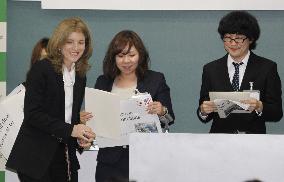
FUKUOKA, Japan - U.S. Ambassador to Japan Caroline Kennedy (L) interacts with students taking part in an international haiku contest at the International University of Kagoshima in Kagoshima, southwestern Japan, on Feb. 26, 2014.

  •  
U.S. envoy Kennedy visits Kagoshima, southern Japan

U.S. envoy Kennedy visits Kagoshima, southern Japan

FUKUOKA, Japan - U.S. Ambassador to Japan Caroline Kennedy addresses an international "haiku" contest at the International University of Kagoshima in Kagoshima, southwestern Japan, on Feb. 26, 2014, during a trip intended mainly to watch the launch at a nearby site of a precipitation observation satellite jointly developed by Japan and the United States.

  •  
Int'l 'haiku' symposium held in Brussels

Int'l 'haiku' symposium held in Brussels

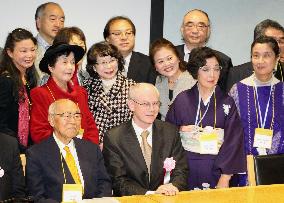
BRUSSELS, Belgium - European Council President Herman Van Rompuy (center, front row) and Akito Arima (left), president of the Haiku International Association, pose with other participants in a symposium in Brussels on Jan. 24, 2014, marking the 25th anniversary of the HIA.

  •  
European Council president in haiku capital

European Council president in haiku capital

MATSUYAMA, Japan - European Council President Herman van Rompuy (R), a haiku poet, is given the title of an "honorary citizen" of Matsuyama, Ehime Prefecture, known as the capital of haiku in western Japan, on Nov. 18, 2013, from Matsuyama Mayor Katsuhito Noshi (L).

  •  
European Council president in haiku capital

European Council president in haiku capital

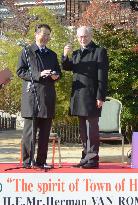
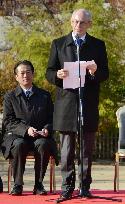
MATSUYAMA, Japan - European Council President Herman van Rompuy (R), a haiku poet, speaks during a ceremony to welcome him in Matsuyama, Ehime Prefecture, known as the capital of haiku, in western Japan, on Nov. 18, 2013. At left is Matsuyama Mayor Katsuhito Noshi.

  •  
European Council president presents 2nd volume of haiku

European Council president presents 2nd volume of haiku

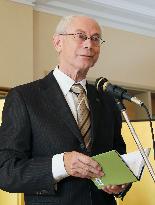
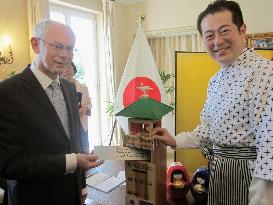
BRUSSELS, Belgium - European Council President Herman van Rompuy presents his second volume of haiku at the Japanese ambassador's residence in Brussels on Oct. 3, 2013. Published three years after his first volume, "Haiku 2" is not only accompanied by drawings but also Japanese translations of the original Dutch verses.

  •  
Haiku post placed in Belgium

Haiku post placed in Belgium

BRUSSELS, Belgium - European Council President Herman Van Rompuy (L) puts his haiku, written in English, into a ''haiku post'' during a ceremony in Brussels, Belgium, on April 19, 2012. At right is Katsuhito Noshi, mayor of Matsuyama, Ehime Prefecture, known as the hometown of renowned haiku poet Shiki Masaoka. The haiku post will be placed at the office of Japan's mission to the European Union in Brussels. The Matsuyama municipal government has placed such posts in the city for visitors to put haiku in them and selected excellent works from among them.

  •  
U.S. envoy in Yamagata

U.S. envoy in Yamagata

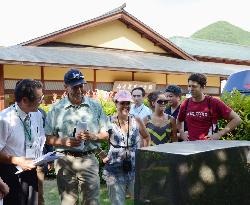
YAMAGATA, Japan - U.S. Ambassador to Japan John Roos (2nd from L) looks at the writing on a monument contributed by former U.S. Ambassador to Japan Edwin Reischauer at Yamadera Basho Museum, a museum for Japanese haiku master Matsuo Basho, in Yamagata, northeastern Japan, on July 24, 2011, with his family. Roos said he would like to let people around the world know that Japan is safe as the country has suffered a significant drop in foreign tourists following the March 11 earthquake and tsunami.

  •  
Unpublished haiku poems by Shiki Masaoka found

Unpublished haiku poems by Shiki Masaoka found

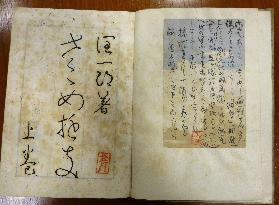
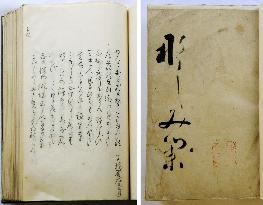
TOKYO, Japan - Photos show the cover (R) of an autographed collection of poems by haiku great Shiki Masaoka that includes unpublished verse (L), which was found recently and will be auctioned soon during a secondhand book fair, literary sources said July 2.

  •  
Lee speaks about impressions of Japan visit

Lee speaks about impressions of Japan visit

HIRAIZUMI, Japan - Former Taiwan President Lee Teng-hui, accompanied by his wife Tseng Wen-fui, speaks about impressions of his 11-day Japan visit in Hiraizumi, Iwate Prefecture, on June 4. Arriving in Tokyo on May 30, Lee said he will follow in the footsteps of 17th century haiku master Matsuo Basho.

  •  
Ex-Taiwan President Lee visits Basho museum in Tokyo

Ex-Taiwan President Lee visits Basho museum in Tokyo

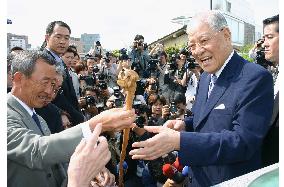
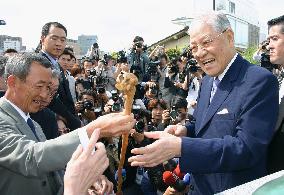
TOKYO, Japan - Former Taiwan President Lee Teng-hui (R) is presented with a walking stick as he visits Japanese haiku master Matsuo Basho's museum in Tokyo on May 31. Lee arrived in Japan on May 30 for an 11-day stay during which he is scheduled to make his first speech in Tokyo and to visit five Japanese prefectures following in the footsteps of 17th century haiku poet Matsuo Basho.

  •  
Ex-Taiwan President Lee arrives in Japan

Ex-Taiwan President Lee arrives in Japan

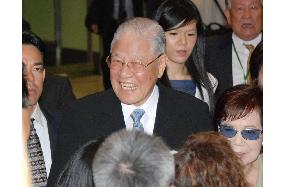
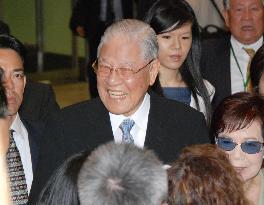
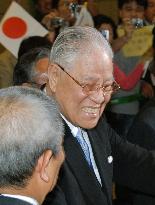
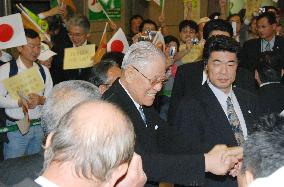
NARITA, Japan - Former Taiwan President Lee Teng-hui arrives at Narita International Airport, northeast of Tokyo, on May 30 for an 11-day stay in Japan. Lee is scheduled to make his first speech in Tokyo and to visit five Japanese prefectures in the footsteps of 17th century haiku poet Matsuo Basho.

  •  
Ex-Taiwan President Lee arrives in Japan

Ex-Taiwan President Lee arrives in Japan

NARITA, Japan - Former Taiwan President Lee Teng-hui arrives at Narita International Airport, northeast of Tokyo, on May 30 for an 11-day stay in Japan. Lee is scheduled to make his first speech in Tokyo and to visit five Japanese prefectures in the footsteps of 17th century haiku poet Matsuo Basho.

  •  
Ex-Taiwan President Lee arrives in Japan

Ex-Taiwan President Lee arrives in Japan

NARITA, Japan - Former Taiwan President Lee Teng-hui arrives at Narita International Airport, northeast of Tokyo, on May 30 for an 11-day stay in Japan. Lee is scheduled to make his first speech in Tokyo and to visit five Japanese prefectures in the footsteps of 17th century haiku poet Matsuo Basho.

  •  
Ex-Taiwan President Lee arrives in Japan

Ex-Taiwan President Lee arrives in Japan

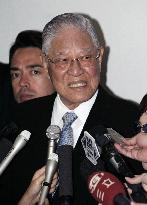
NARITA, Japan - Former Taiwan President Lee Teng-hui speaks to reporters at Narita International Airport, northeast of Tokyo, on May 30 after arriving there for an 11-day stay in Japan. Lee is scheduled to make his first speech in Tokyo and to visit five Japanese prefectures in the footsteps of 17th century haiku poet Matsuo Basho.

  •  
Poet writes poem to pray for Kojiri

Poet writes poem to pray for Kojiri

AMAGASAKI, Japan - Haiku poet Daiyu Kiwari writes a poem in Amagasaki, Hyogo Prefecture, on May 3, to pray for Tomohiro Kojiri, an Asahi Shimbun reporter fatally shot in 1987 by a suspected right-wing extremist at the newspaper's bureau in Nishinomiya in the prefecture.

  •  
Ex-Taiwan President Lee arrives in Japan

Ex-Taiwan President Lee arrives in Japan

NARITA, Japan - Former Taiwan President Lee Teng-hui arrives at Narita International Airport, northeast of Tokyo, on May 30 for an 11-day stay in Japan. Lee is scheduled to make his first speech in Tokyo and to visit five Japanese prefectures in the footsteps of 17th century haiku poet Matsuo Basho. (Kyodo)

  •  
Ex-Taiwan President Lee arrives in Japan

Ex-Taiwan President Lee arrives in Japan

NARITA, Japan - Former Taiwan President Lee Teng-hui speaks to reporters at Narita International Airport, northeast of Tokyo, on May 30 after arriving there for an 11-day stay in Japan. Lee is scheduled to make his first speech in Tokyo and to visit five Japanese prefectures in the footsteps of 17th century haiku poet Matsuo Basho. (Kyodo)

  •  
Ex-Taiwan President Lee arrives in Japan

Ex-Taiwan President Lee arrives in Japan

NARITA, Japan - Former Taiwan President Lee Teng-hui arrives at Narita International Airport, northeast of Tokyo, on May 30 for an 11-day stay in Japan. Lee is scheduled to make his first speech in Tokyo and to visit five Japanese prefectures in the footsteps of 17th century haiku poet Matsuo Basho. (Kyodo)

  •  
Ex-Taiwan President Lee arrives in Japan

Ex-Taiwan President Lee arrives in Japan

NARITA, Japan - Former Taiwan President Lee Teng-hui arrives at Narita International Airport, northeast of Tokyo, on May 30 for an 11-day stay in Japan. Lee is scheduled to make his first speech in Tokyo and to visit five Japanese prefectures in the footsteps of 17th century haiku poet Matsuo Basho. (Kyodo)

  •  
Hiroshige - 53 Stations of the Tokaido - Print 21

Hiroshige - 53 Stations of the Tokaido - Print 21

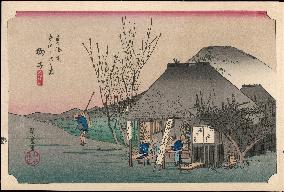
21 Mariko - Two travellers having refreshment at a wayside teahouse, from which another traveller has just departed, and a woman with a child on her back waiting on them. Beside the teahouse grows a plum tree, just bursting into blossom against the rosy sky; behind rises a grey hill tinted with brown. Here, travellers enjoy grated yam broth, the local speciality, while appreciating the green leaves and plum flowers of the early spring. Basho, the most famous haiku poet in Japan, praised the scenery and the broth in one of his haiku poems. Utagawa Hiroshige (1797 - 1858). The Fifty-Three Stations of the Tokaido - Hoeido edition (1831-4) Date: 1831 - 1834

  •  
Rehearsal of Noh play written by famed haiku poet

Rehearsal of Noh play written by famed haiku poet

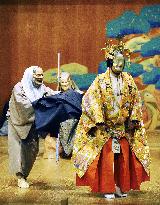
Photo taken April 5, 2016, in Kyoto shows the rehearsal of a Noh play written by famed haiku poet Takahama Kyoshi (1874-1959). The play, based on Takahama's experience of losing his daughter, will be performed in June in the ancient city for the first time in 100 years. (Kyodo) ==Kyodo

  •  
Rehearsal of Noh play written by famed haiku poet

Rehearsal of Noh play written by famed haiku poet

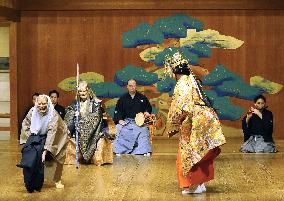
Photo taken April 5, 2016, in Kyoto shows the rehearsal of a Noh play written by famed haiku poet Takahama Kyoshi (1874-1959). The play, based on Takahama's experience of losing his daughter, will be performed in June in the ancient city for the first time in 100 years. (Kyodo) ==Kyodo

  •  
More than 200 unknown haiku poems by Yosa Buson found

More than 200 unknown haiku poems by Yosa Buson found

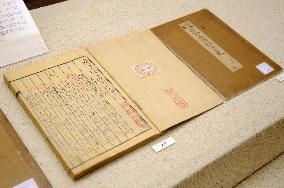
Photo taken Oct. 14, 2015, shows a collection of Japanese 17-syllable "haiku" poems by Yosa Buson, a haiku poet of the Edo Period. It has been found that the collection, housed at Tenri University in the western Japan city of Tenri, includes 212 unknown poems. (Kyodo) ==Kyodo

  •  
Ex-Taiwan leader Lee revisits northeastern Japan temple

Ex-Taiwan leader Lee revisits northeastern Japan temple

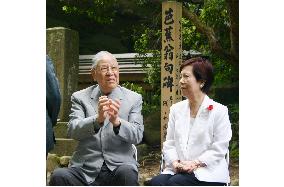
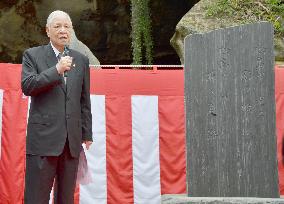
Former Taiwan President Lee Teng-hui speaks in front of a slab with his and his wife's "haiku" poems at Zuigan-ji temple in Matsushima, Miyagi Prefecture, northeastern Japan, on July 25, 2015. The couple read the poems when they visited the temple in 2007. (Kyodo) ==Kyodo

  •  
Ex-Taiwan leader Lee plants tree at northeastern Japan temple

Ex-Taiwan leader Lee plants tree at northeastern Japan temple

Former Taiwan President Lee Teng-hui (C) and his daughters plant a tree at Zuigan-ji temple in Matsushima, Miyagi Prefecture, northeastern Japan, on July 25, 2015, to commemorate their previous visit in 2007. Standing behind them is a slab inscribed with "haiku" Japanese poems of Lee and his wife built in 2008. (Kyodo) ==Kyodo

  •  
Ex-European Council president becomes Japan-EU haiku ambassador

Ex-European Council president becomes Japan-EU haiku ambassador

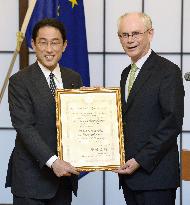
Japanese Foreign Minister Fumio Kishida (L) hands former European Council President Herman Van Rompuy a certificate of appointment as ambassador of the Japan-EU haiku exchange program in Tokyo on June 2, 2015. Van Rompuy said the same day that for the Western world, haiku plays the role of a bridge to understand Japan. (Kyodo) ==Kyodo

  •  
Film depicting 19th-century Japanese "haiku" poet screened at Expo Milano

Film depicting 19th-century Japanese "haiku" poet screened at Expo Milano

A Japanese movie depicting "haiku" poet Inoue Seigetsu who spent most of his life wandering in the Inadani region of Shinshu, today's Nagano Prefecture, central Japan, in the 19th century is screened at the Japan Pavilion on May 19, 2015, during Expo Milano 2015 in Milan, Italy. (Kyodo) ==Kyodo

  •  
People watch film on 19th-century Japanese "haiku" poet at Expo Milano

People watch film on 19th-century Japanese "haiku" poet at Expo Milano

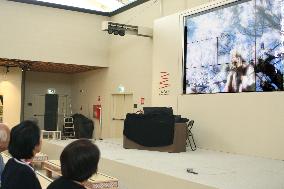
A Japanese movie depicting "haiku" poet Inoue Seigetsu who spent most of his life wandering in the Inadani region of Shinshu, today's Nagano Prefecture, central Japan, in the 19th century is screened at the Japan Pavilion on May 19, 2015, during Expo Milano 2015 in Milan, Italy. (Kyodo) ==Kyodo

  •  
British schoolgirl wins haiku competition

British schoolgirl wins haiku competition

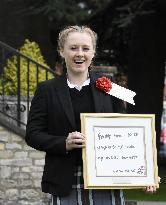
Gracie Starkey, a 14-year-old student at Wycliffe College, Gloucestershire, England holds up her winning entry to Japanese tea company Ito En's annual haiku poetry competition on the school lawn on Sept. 11, 2017. (Kyodo) ==Kyodo

  •  
Soseki's letter sent to haiku poet Seigetsu Murakami discovered

Soseki's letter sent to haiku poet Seigetsu Murakami discovered

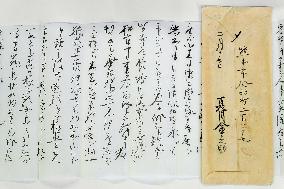
A newly discovered letter written by Japanese novelist Soseki Natsume (1867-1916), postmarked Feb. 17, 1897, to his friend Hantaro Murakami, known as haiku poet Seigetsu Murakami, is shown on Nov. 19, 2015. The letter addressed to Murakami in Matsuyama, western Japan, reveals young Soseki's loneliness as a high school teacher in Kumamoto, southwestern Japan, and contains his 26 haiku of which two are not believed to have been included in his haiku anthology. (Kyodo) ==Kyodo

  •  
Unpublished haiku poems by Shiki Masaoka found

Unpublished haiku poems by Shiki Masaoka found

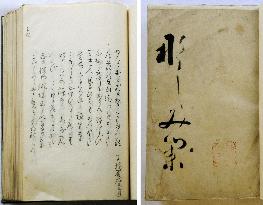
TOKYO, Japan - Photos show the cover (R) of an autographed collection of poems by haiku great Shiki Masaoka that includes unpublished verse (L), which was found recently and will be auctioned soon during a secondhand book fair, literary sources said July 2. (Kyodo)

  •  
Lee speaks about impressions of Japan visit

Lee speaks about impressions of Japan visit

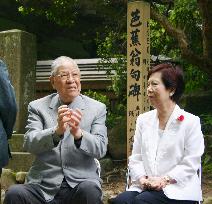
HIRAIZUMI, Japan - Former Taiwan President Lee Teng-hui, accompanied by his wife Tseng Wen-fui, speaks about impressions of his 11-day Japan visit in Hiraizumi, Iwate Prefecture, on June 4. Arriving in Tokyo on May 30, Lee said he will follow in the footsteps of 17th century haiku master Matsuo Basho. (Kyodo)

  •  
Ex-Taiwan President Lee visits Basho museum in Tokyo

Ex-Taiwan President Lee visits Basho museum in Tokyo

TOKYO, Japan - Former Taiwan President Lee Teng-hui (R) is presented with a walking stick as he visits Japanese haiku master Matsuo Basho's museum in Tokyo on May 31. Lee arrived in Japan on May 30 for an 11-day stay during which he is scheduled to make his first speech in Tokyo and to visit five Japanese prefectures following in the footsteps of 17th century haiku poet Matsuo Basho. (Kyodo)

  •  
A mosquito net and a couple

A mosquito net and a couple

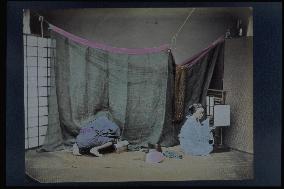
A kaya (mosquito net) is attached to the four corners of a room to form a tent over the sleeping area. The word kaya is used as a haiku seasonal term and a poetic symbol of summer, but the mosquito net fell out of use in the 1960's. The trick is to lift the lower end slightly and enter quickly as demonstrated by the man in the photograph.==Date:unknown, Place:unknown, Photo:unknown, (Credit:Nagasaki University Library/Kyodo News Images) [Cabinet Number96‐110‐0]

  •  
Urami Falls,Nikko

Urami Falls,Nikko

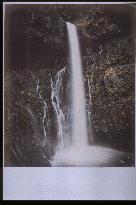
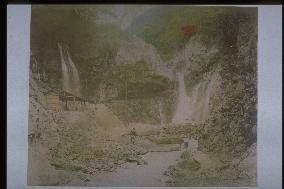
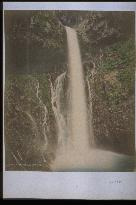
Located on Arasawa River, a tributary of Daiya River, Urami Falls is one of the three famous waterfalls of Nikko along with Kegon Falls and Kirifuri Falls. The road leading to the back of the falls, where Fudomyo'o is enshrined, was destroyed by the flood of 1902. The poet Matsuo Basho, who visited the area in 1689, composed the following haiku: Early summer, resting under the falls, a little while.==Date:unknown, Place:Nikko, Photo:Usui Shuzaburo, (Credit:Nagasaki University Library/Kyodo News Images) [Cabinet Number94‐12‐0]

  •  
Urami Falls,Nikko

Urami Falls,Nikko

Located on Arasawa River, a tributary of Daiya River, Urami Falls is one of the three famous waterfalls of Nikko along with Kegon Falls and Kirifuri Falls. The poet Matsuo Basho, who visited the area in 1689, composed the following haiku: Early summer, resting under the falls, a little while. The road leading to the back of the falls, where Fudomyo'o is enshrined, was destroyed by the flood of 1902 as shown by this photograph.==Date:unknown, Place:Nikko, Photo:unknown, (Credit:Nagasaki University Library/Kyodo News Images) [Cabinet Number88‐12‐0]

  •  
A wisteria trellis at Kameido Shrine

A wisteria trellis at Kameido Shrine

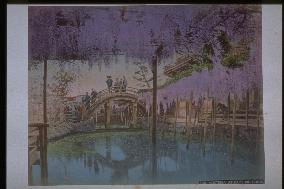
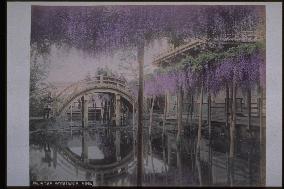
This is the smaller Taiko-bashi (Sori-bashi) located in front of the Romon (Sakura Gate) on the right. The Wisteria Festival of Kameido Tenjin Shrine held from mid-April to mid-May every year is a harbinger of summer. There are many other events held at the shrine. The parents of young children release carp into Shinji Pond during the Shichi-Go-San Festival on November 15 to pray for the healthy growth of their children. Masaoka shiki wrote the haiku poem: Sori-bashi, the wisteria are purple and carp red.==Date:unknown, Place:Tokyo, Photo:A. Farsari, (Credit:Nagasaki University Library/Kyodo News Images) [Cabinet Number81‐15‐0]

  •  
A wisteria trellis at Kameido Shrine

A wisteria trellis at Kameido Shrine

This is the smaller Taiko-bashi (Sori-bashi) located in front of the Romon (Sakura Gate) on the right. The Wisteria Festival of Kameido Tenjin Shrine held from mid-April to mid-May every year is a harbinger of summer. There are many other events held at the shrine. The parents of young children release carp into Shinji Pond during the Shichi-Go-San Festival on November 15 to pray for the healthy growth of their children. Masaoka shiki wrote the haiku poem: Sori-bashi, the wisteria are purple and carp red.==Date:unknown, Place:Tokyo, Photo:Tamamura Kozaburo, (Credit:Nagasaki University Library/Kyodo News Images) [Cabinet Number80‐25‐0]

  •  
Urami Falls,Nikko

Urami Falls,Nikko

Located on Arasawa River, a tributary of Daiya River, Urami Falls is one of the three famous waterfalls of Nikko along with Kegon Falls and Kirifuri Falls. The road leading to the back of the falls, where Fudomyo'o is enshrined, was destroyed by the flood of 1902. The poet Matsuo Basho, who visited the area in 1689, composed the following haiku: Early summer, resting under the falls, a little while.==Date:unknown, Place:Nikko, Photo:Usui Shuzaburo?, (Credit:Nagasaki University Library/Kyodo News Images) [Cabinet Number65‐23‐2]

  • Main
  • Top
  • Editorial
  • Creative
  • About Us
  • About ILG
  • Terms of use
  • Company
  • BEHIND
  • Price List
  • Single Plan
  • Monthly Plan
  • Services
  • Shooting
  • Rights Clearance
  • Support
  • FAQ
  • How To Buy
  • Contact Us
  • Become a Partner

© KYODO NEWS IMAGES INC

All Rights Reserved.

  • Editorial
  • Olympics
  • News
  • Sports
  • Japan
  • Tech
  • Royal
  • Disaster
  • NorthKorea
  • Old Japan
  • SNS
  • Creative
  • Food
  • Japan
  • Landscape
  • Animal
  • Popular
  • #Ukraine
  • #Russia
  • #coronavirus
  • #N. Korea
  • #Thailand
  • #China
  • #Ukraine
  • #Russia
  • #coronavirus
  • #N. Korea
  • #Thailand
  • #China
  • Food
  • Japan
  • Landscape
  • Animal
  • Olympics
  • News
  • Sports
  • Japan
  • Tech
  • Royal
  • Disaster
  • NorthKorea
  • Old Japan
  • SNS