•  
XINHUA PHOTOS OF THE DAY

XINHUA PHOTOS OF THE DAY

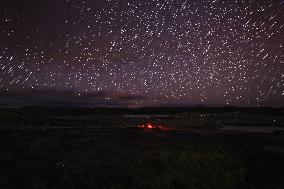
(240227) -- BEIJING, Feb. 27, 2024 (Xinhua) -- This composite photo taken on April 21, 2023 shows the Large High Altitude Air Shower Observatory (LHAASO) at an altitude of 4,410 meters on Mount Haizi in Daocheng County, southwest China's Sichuan Province. China's cosmic ray observatory has discovered a giant ultra-high-energy gamma-ray bubble structure, about ten million times larger than our solar system, in the Cygnus star-forming region, around 5,000 light years from Earth. Based on the observations made by China's LHAASO, scientists identified that star-forming region as one source of the cosmic rays in the Milky Way with an energy level higher than 10 peta-electron volts (quadrillion electron volts or PeV), about 1,000 times more than the record high achieved by any manmade accelerator on Earth. (Xinhua/Jin Liwang)

  •  
(EyesonSci) CHINA-LHAASO-GAMMA-RAY-DISCOVERY (CN)

(EyesonSci) CHINA-LHAASO-GAMMA-RAY-DISCOVERY (CN)

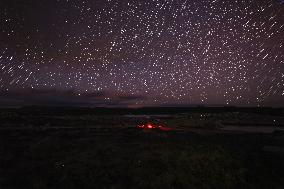
(240226) -- BEIJING, Feb. 26, 2024 (Xinhua) -- This composite photo taken on April 21, 2023 shows the Large High Altitude Air Shower Observatory (LHAASO) at an altitude of 4,410 meters on Mount Haizi in Daocheng County, southwest China's Sichuan Province. China's cosmic ray observatory has discovered a giant ultra-high-energy gamma-ray bubble structure, about ten million times larger than our solar system, in the Cygnus star-forming region, around 5,000 light years from Earth. Based on the observations made by China's LHAASO, scientists identified that star-forming region as one source of the cosmic rays in the Milky Way with an energy level higher than 10 peta-electron volts (quadrillion electron volts or PeV), about 1,000 times more than the record high achieved by any manmade accelerator on Earth. (Xinhua/Jin Liwang)

  •  
CHINA-SICHUAN-SANXINGDUI RUINS-BRONZE SCULPTURE-COMBINATION (CN)

CHINA-SICHUAN-SANXINGDUI RUINS-BRONZE SCULPTURE-COMBINATION (CN)

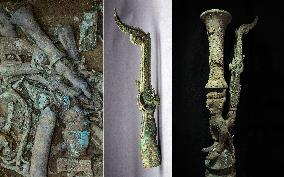
(220616) -- GUANGHAN, June 16, 2022 (Xinhua) -- Combo photo shows scattered parts of a newly unearthed bronze sculpture (L) at the No. 8 sacrificial pit at the Sanxingdui Ruins site (photo taken by Xinhua journalist Shen Bohan on June 1, 2022); a bronzeware part (C) that was unearthed from the No. 2 sacrificial pit in 1986 (photo taken on June 15, 2022 and provided by Sanxingdui Museum); and the combination of the two parts (photo taken by Lu Haizi on June 15, 2022), in southwest China's Sichuan Province. A newly unearthed bronze sculpture at the famed Sanxingdui Ruins site was successfully matched with another bronzeware part after being set apart about 3,000 years ago, the archaeological team confirmed Thursday. The sophisticated bronze sculpture depicts a figure of a human head and snake body, with protruding eyes, tusks, and horns. Above the head is a cinnabar trumpet-shaped zun (an ancient wine vessel) and the figure is linked by its hands and a square pedestal urn-shaped lei (an ancient wine vesse

  • Main
  • Top
  • Editorial
  • Creative
  • About Us
  • About ILG
  • Terms of use
  • Company
  • BEHIND
  • Price List
  • Single Plan
  • Monthly Plan
  • Services
  • Shooting
  • Rights Clearance
  • Support
  • FAQ
  • How To Buy
  • Contact Us
  • Become a Partner

© KYODO NEWS IMAGES INC

All Rights Reserved.

  • Editorial
  • Olympics
  • News
  • Sports
  • Japan
  • Tech
  • Royal
  • Disaster
  • NorthKorea
  • Old Japan
  • SNS
  • Creative
  • Food
  • Japan
  • Landscape
  • Animal
  • Popular
  • #Ukraine
  • #China
  • #coronavirus
  • #N. Korea
  • #Thailand
  • #Russia
  • #Ukraine
  • #China
  • #coronavirus
  • #N. Korea
  • #Thailand
  • #Russia
  • Food
  • Japan
  • Landscape
  • Animal
  • Olympics
  • News
  • Sports
  • Japan
  • Tech
  • Royal
  • Disaster
  • NorthKorea
  • Old Japan
  • SNS