•  
Japan launches Hayabusa2 space probe

Japan launches Hayabusa2 space probe

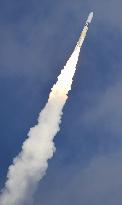
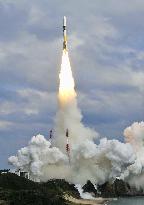
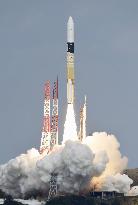
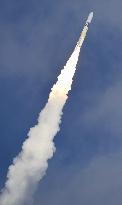
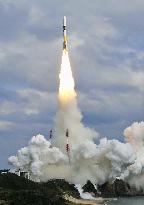
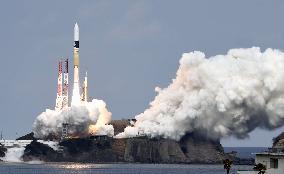
TANEGASHIMA, Japan - An H-2A rocket carrying the Hayabusa2 asteroid explorer ascends in the sky after liftoff from the Tanegashima Space Center in southwestern Japan on Dec. 3, 2014. The probe will travel to an asteroid 300 million kilometers from Earth to collect rock samples before returning in late 2020.

  •  
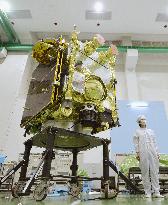
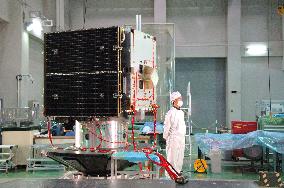
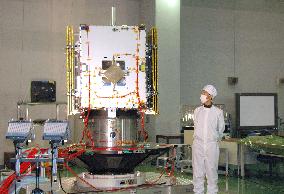
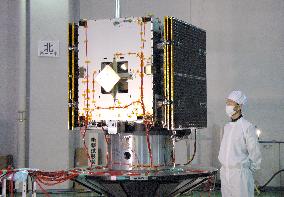
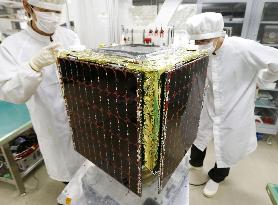
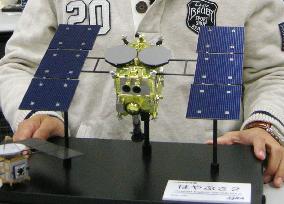
Model of Hayabusa2 asteroid explorer

Model of Hayabusa2 asteroid explorer

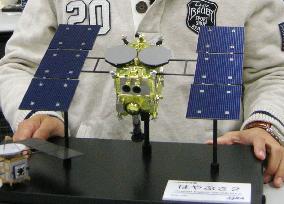
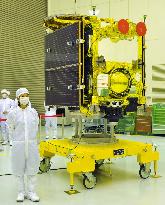
FUKUOKA, Japan - A model of the Hayabusa2 asteroid explorer is shown in this undated photo. Hayabusa2 was successfully launched on Dec. 3, 2014, from the Tanegashima Space Station in the southwestern Japanese prefecture of Kagoshima for a mission to collect samples of an asteroid.

  •  
Japan launches Hayabusa2 space probe

Japan launches Hayabusa2 space probe

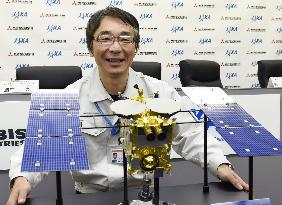
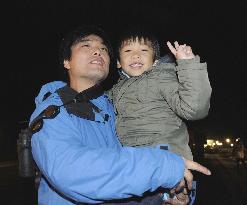
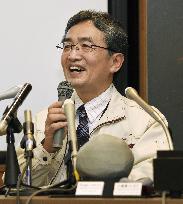
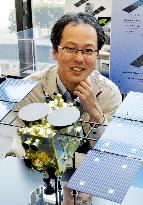
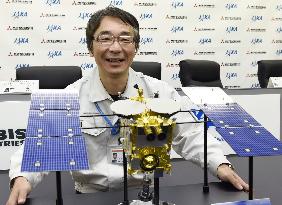
TANEGASHIMA, Japan - Hitoshi Kuninaka, a professor at the Japan Aerospace Exploration Agency, smiles in front of a model of the Hayabusa2 asteroid explorer at the Tanegashima Space Center in southwestern Japan on Dec. 3, 2014, after an H-2A rocket carrying the probe was successfully launched. Kuninaka is in charge of the Hayabusa2 program in which the probe is set to travel to an asteroid 300 million kilometers from Earth to collect rock samples before returning in late 2020.

  •  
Hayabusa2 space probe successfully launched

Hayabusa2 space probe successfully launched

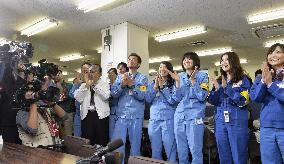
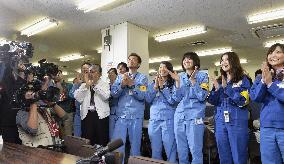
TANEGASHIMA, Japan - Staff applaud on Dec. 3, 2014, at the Tanegashima Space Center in the southwestern Japanese prefecture of Kagoshima after the asteroid explorer Hayabusa2 was separated from the H-IIA F26 following liftoff. Hayabusa2's mission is to explore one of the C-type asteroids in the universe and bring retrieved materials to Earth.

  •  
Japan launches Hayabusa2 space probe

Japan launches Hayabusa2 space probe

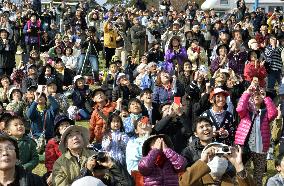
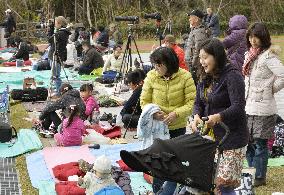
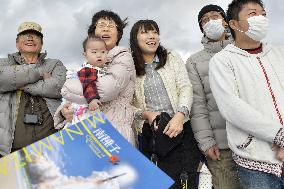
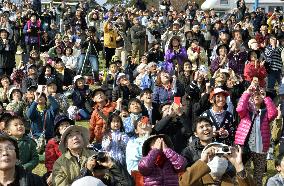
TANEGASHIMA, Japan - A crowd watches the launch of an H-2A rocket carrying the Hayabusa2 asteroid explorer at 1:22 p.m. on Dec. 3, 2014, near the Tanegashima Space Center in southwestern Japan. The liftoff originally slated for Nov. 30 was delayed twice due to adverse weather conditions.

  •  
Japan launches Hayabusa2 space probe

Japan launches Hayabusa2 space probe

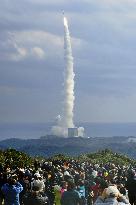
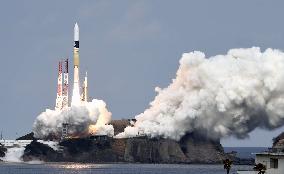
TANEGASHIMA, Japan - Photo shows an H-2A rocket carrying the Hayabusa2 asteroid explorer launching off from the Tanegashima Space Center in southwestern Japan at 1:22 p.m. on Dec. 3, 2014. The probe will travel to an asteroid 300 million kilometers from Earth to collect rock samples before returning in late 2020.

  •  
Japan launches Hayabusa2 space probe

Japan launches Hayabusa2 space probe

TANEGASHIMA, Japan - A crowd observes the launch of an H-2A rocket carrying the Hayabusa2 asteroid explorer on Dec. 3, 2014, near the Tanegashima Space Center in southwestern Japan. The liftoff originally slated for Nov. 30 was delayed twice due to adverse weather conditions.

  •  
Japan launches Hayabusa2 space probe

Japan launches Hayabusa2 space probe

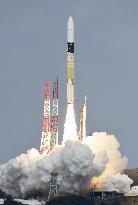
TANEGASHIMA, Japan - Photo taken on Dec. 3, 2014, shows the launch of an H-2A rocket carrying the Hayabusa2 asteroid explorer from the Tanegashima Space Center in southwestern Japan. The probe will travel to an asteroid 300 million kilometers from Earth to reach it in 2018 and collect rock samples before returning to Earth in 2020.

  •  
Japan launches Hayabusa2 space probe

Japan launches Hayabusa2 space probe

TANEGASHIMA, Japan - Photo taken on Dec. 3, 2014, shows the launch of an H-2A rocket carrying the Hayabusa2 asteroid explorer from the Tanegashima Space Center in southwestern Japan. The probe will travel to an asteroid 300 million kilometers from Earth to reach it in 2018 and collect rock samples before returning to Earth in 2020.

  •  
Space probe Hayabusa2 to be launched

Space probe Hayabusa2 to be launched

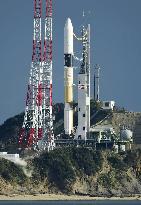
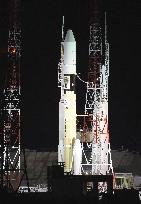
TANEGASHIMA, Japan - Photo take on Dec. 3, 2014, at the Tanegashima Space Center in southwestern Japan shows an H-2A rocket installed with the Hayabusa2 asteroid explorer, which has been set at its launch pad. The rocket is expected to be launched later in the day.

  •  
Space probe Hayabusa2 to be launched

Space probe Hayabusa2 to be launched

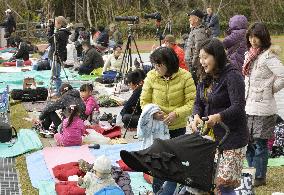
TANEGASHIMA, Japan - People gather to watch the launch of an H-2A rocket installed with the Hayabusa2 asteroid explorer on Dec. 3, 2014, near the Tanegashima Space Center in southwestern Japan.

  •  
Space probe Hayabusa2 to be launched

Space probe Hayabusa2 to be launched

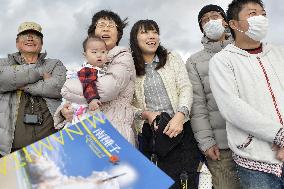
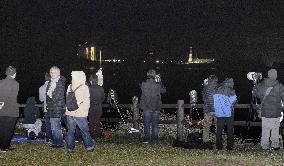
TANEGASHIMA, Japan - Observers wait for the launch of an H-2A rocket installed with the Hayabusa2 asteroid explorer on Dec. 3, 2014, at the Tanegashima Space Center in southwestern Japan.

  •  
Space probe Hayabusa2 to be launched

Space probe Hayabusa2 to be launched

TANEGASHIMA, Japan - Photo take on Dec. 3, 2014, at the Tanegashima Space Center in southwestern Japan shows an H-2A rocket installed with the Hayabusa2 asteroid explorer, which has been set at its launch pad. The rocket is expected to be launched later in the day.

  •  
Space probe Hayabusa2 to be launched

Space probe Hayabusa2 to be launched

TANEGASHIMA, Japan - The impending launch of an H-2A rocket installed with the Hayabusa2 asteroid explorer has drawn a crowd of observers, as the rocket is moved from the assembly plant to its launch pad on Dec. 2, 2014, at the Tanegashima Space Center in southwestern Japan. The rocket is expected to be launched on Dec. 3.

  •  
Space probe Hayabusa2 to be launched

Space probe Hayabusa2 to be launched

TANEGASHIMA, Japan - The impending launch of an H-2A rocket installed with the Hayabusa2 asteroid explorer has drawn a crowd of observers, as the rocket is moved from the assembly plant to its launch pad on Dec. 2, 2014, at the Tanegashima Space Center in southwestern Japan. The rocket is expected to be launched on Dec. 3.

  •  
Hayabusa2 asteroid explorer unveiled

Hayabusa2 asteroid explorer unveiled

KAGOSHIMA, Japan - Photo taken on Oct. 27, 2014, at the Tanegashima Space Center in southwestern Japan shows the Hayabusa2 asteroid explorer to be launched on Nov. 30. Hayabusa2 will target an asteroid named "1999 JU3" in 2018 and return to Earth in 2020 in a mission to clarify the origin of the solar system.

  •  
Japan to launch Hayabusa2 space probe

Japan to launch Hayabusa2 space probe

SAGAMIHARA, Japan - File photo taken in August 2014 in Sagamihara, near Tokyo, shows the Hayabusa2 asteroid explorer that the Japan Aerospace Exploration Agency will launch on Nov. 30, 2014, the successor to the Hayabusa probe that returned to Earth in June 2010 after its unprecedented collection of asteroid surface samples.

  •  
New asteroid explorer

New asteroid explorer

TOKYO, Japan - The Japan Aerospace Exploration Agency, known as JAXA, unveils a new asteroid explorer, Hayabusa2, in Sagamihara, Kanagawa Prefecture, on Dec. 26, 2012.

  •  
New asteroid explorer

New asteroid explorer

TOKYO, Japan - The Japan Aerospace Exploration Agency, known as JAXA, unveils a new asteroid explorer, Hayabusa2, in Sagamihara, Kanagawa Prefecture, on Dec. 26, 2012.

  •  
New asteroid explorer

New asteroid explorer

TOKYO, Japan - The Japan Aerospace Exploration Agency, known as JAXA, unveils a new asteroid explorer, Hayabusa2, in Sagamihara, Kanagawa Prefecture, on Dec. 26, 2012.

  •  
JAXA logo

JAXA logo

JAXA, Japan Aerospace Exploration Agency, aerospace development, research and development period, national research and development corporation, rocket, satellite, Hayabusa, Hayabusa2, weather satellite Himawari, company, signboard, logo, logo mark = JAXA Tokyo Office in Kanda-Surugadai, Chiyoda-ku, Tokyo on July 12, 2019 Credit: The Nikkan Kogyo Shimbun / Kyodo News Images

  •  

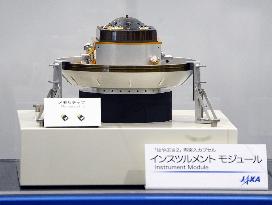
Capsule from JAXA's Hayabusa2 space probe

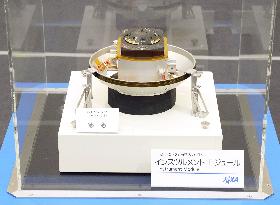
A capsule used to send asteroid samples to Earth from the Japan Aerospace Exploration Agency's Hayabusa2 space probe is displayed to the public at Sagamihara City Museum in Kanagawa Prefecture on March 12, 2021. The capsule from Hayabusa2 landed in an Australian desert on Dec. 6, 2020, containing more than 5.4 grams of soil samples from the Ryugu asteroid.

  •  
Engine of deep-space explorer "Procyon" stops

Engine of deep-space explorer "Procyon" stops

File photo taken in Tokyo in November 2014 shows the Micro deep-space explorer "Procyon" which was launched as a secondary payload of the Asteroid Explorer "Hayabusa2" in December 2014. The University of Tokyo announced April 6, 2015, that the engine of the explorer stopped due possibly to metal dust inside the engine and repair work is under way. (Kyodo) ==Kyodo

  •  
Hayabusa2 probe approaches Earth for swingby on way to asteroid

Hayabusa2 probe approaches Earth for swingby on way to asteroid

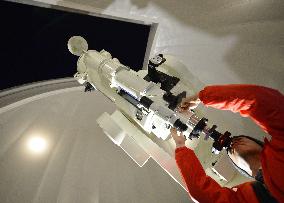
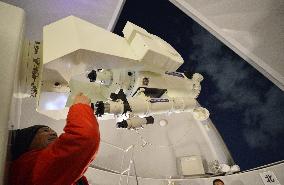
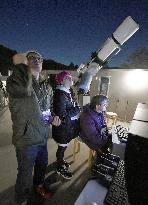
Takeshi Inoue, the head curator at the Akashi Municipal Planetarium, looks to view the Hayabusa2 space probe through a telescope in the western Japan city of Akashi on Dec. 3, 2015. The probe made its closest approach to the Earth to perform a swingby to set it on course for its target asteroid 300 million kilometers, according to the Japan Aerospace Exploration Agency. (Kyodo) ==Kyodo

  •  
Hayabusa2 probe approaches Earth for swingby on way to asteroid

Hayabusa2 probe approaches Earth for swingby on way to asteroid

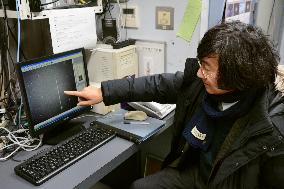
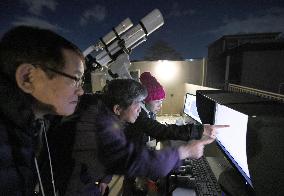
Kazuya Ayani, head of the Bisei Astronomical Observatory in Japan's Okayama Prefecture, points at the moving light of the country's Hayabusa2 space probe captured by the observatory on Dec. 3, 2015. The probe made its closest approach to the Earth the same day to perform a swingby to set it on course for its target asteroid 300 million kilometers away, according to the Japan Aerospace Exploration Agency. (Kyodo) ==Kyodo

  •  
Hayabusa2 probe approaches Earth for swingby on way to asteroid

Hayabusa2 probe approaches Earth for swingby on way to asteroid

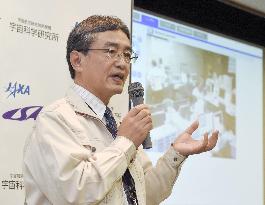
Makoto Yoshikawa, associate professor of the Japan Aerospace Exploration Agency, speaks to reporters in Sagamihara, southwest of Tokyo, on Dec. 3, 2015, after the Hayabusa2 space probe completed a swingby to set it on course for its target asteroid 300 million kilometers away. (Kyodo) ==Kyodo

  •  
Hayabusa2 probe approaches Earth for swingby on way to asteroid

Hayabusa2 probe approaches Earth for swingby on way to asteroid

Takeshi Inoue, the head curator at the Akashi Municipal Planetarium, looks to view the Hayabusa2 space probe through a telescope in the western Japan city of Akashi on Dec. 3, 2015. The probe made its closest approach to the Earth to perform a swingby to set it on course for its target asteroid 300 million kilometers, according to the Japan Aerospace Exploration Agency. (Kyodo) ==Kyodo

  •  
Hayabusa2 probe approaches Earth for swingby on way to asteroid

Hayabusa2 probe approaches Earth for swingby on way to asteroid

People attempt to take pictures of Japan's Hayabusa2 space probe from Kawasaki Municipal Science Museum, near Tokyo, on Dec. 3, 2015. The probe made its closest approach to the Earth to perform a swingby to set it on course for its target asteroid 300 million kilometers from Earth, according to the Japan Aerospace Exploration Agency. (Kyodo) ==Kyodo

  •  
Hayabusa2 probe approaches Earth for swingby on way to asteroid

Hayabusa2 probe approaches Earth for swingby on way to asteroid

Makoto Yoshikawa, associate professor of the Japan Aerospace Exploration Agency, answers questions from reporters in Sagamihara, southwest of Tokyo, on Dec. 3, 2015, before the Hayabusa2 space probe's approach to Earth for a swingby to set it on course for its target asteroid 300 million kilometers away. (Kyodo) ==Kyodo

  •  
Hayabusa2 probe approaches Earth for swingby on way to asteroid

Hayabusa2 probe approaches Earth for swingby on way to asteroid

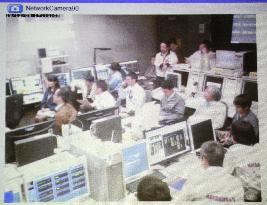
Photo taken Dec. 3, 2015, from a video monitor shows Japan Aerospace Exploration Agency staff in Sagamihara, southwest of Tokyo, looking at the Hayabusa2 space probe's approach to Earth for a swingby to set it on course for its target asteroid 300 million kilometers away. (Kyodo) ==Kyodo

  •  
Hayabusa2 probe approaches Earth for swingby on way to asteroid

Hayabusa2 probe approaches Earth for swingby on way to asteroid

People attempt to take pictures of Japan's Hayabusa2 space probe from Kawasaki Municipal Science Museum, near Tokyo, on Dec. 3, 2015. The probe made its closest approach to the Earth to perform a swingby to set it on course for its target asteroid 300 million kilometers from Earth, according to the Japan Aerospace Exploration Agency. (Kyodo) ==Kyodo

  •  
Tsuda, new Hayabusa2 project manager

Tsuda, new Hayabusa2 project manager

Photo shows Yuichi Tsuda, an associate professor at the Japan Aerospace Exploration Agency who became the new project manager of the Hayabusa2 asteroid explorer in April 2015. (Kyodo) ==Kyodo

  •  
JAXA says Hayabusa2's ion engines functioning normally

JAXA says Hayabusa2's ion engines functioning normally

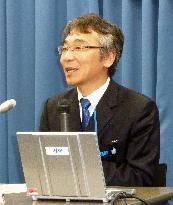
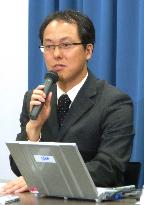
Hitoshi Kuninaka, project manager of the Hayabusa2 asteroid explorer at the Japan Aerospace Exploration Agency, attends a press conference in Tokyo on Jan. 28, 2015. Kuninaka said the four ion engines installed on the Hayabusa2 launched in December 2014 are functioning normally. (Kyodo) ==Kyodo

  •  
Capsule from JAXA's Hayabusa2 space probe

Capsule from JAXA's Hayabusa2 space probe

A capsule used to send asteroid samples to Earth from the Japan Aerospace Exploration Agency's Hayabusa2 space probe is displayed to the public at Sagamihara City Museum in Kanagawa Prefecture on March 12, 2021. The capsule from Hayabusa2 landed in an Australian desert on Dec. 6, 2020, containing more than 5.4 grams of soil samples from the Ryugu asteroid.

  •  
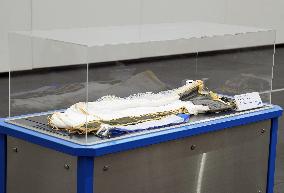
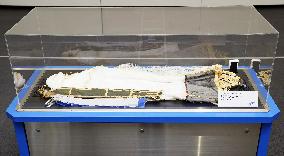
Parachute used for capsule's return from Hayabusa2 space probe

Parachute used for capsule's return from Hayabusa2 space probe

A parachute used to send a capsule containing asteroid samples to Earth from the Japan Aerospace Exploration Agency's Hayabusa2 space probe is displayed to the public at Sagamihara City Museum in Kanagawa Prefecture on March 12, 2021. The capsule from Hayabusa2 landed in an Australian desert on Dec. 6, 2020, containing more than 5.4 grams of soil samples from the Ryugu asteroid.

  •  
Parachute used for capsule's return from Hayabusa2 space probe

Parachute used for capsule's return from Hayabusa2 space probe

A parachute used to send a capsule containing asteroid samples to Earth from the Japan Aerospace Exploration Agency's Hayabusa2 space probe is displayed to the public at Sagamihara City Museum in Kanagawa Prefecture on March 12, 2021. The capsule from Hayabusa2 landed in an Australian desert on Dec. 6, 2020, containing more than 5.4 grams of soil samples from the Ryugu asteroid.

  •  
Capsule from JAXA's Hayabusa2 space probe

Capsule from JAXA's Hayabusa2 space probe

A capsule used to send asteroid samples to Earth from the Japan Aerospace Exploration Agency's Hayabusa2 space probe is displayed to the public at Sagamihara City Museum in Kanagawa Prefecture on March 12, 2021. The capsule from Hayabusa2 landed in an Australian desert on Dec. 6, 2020, containing more than 5.4 grams of soil samples from the Ryugu asteroid.

  •  
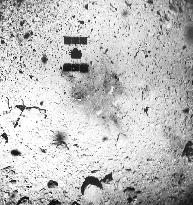
Landing of Japan's Hayabusa2 probe on asteroid

Landing of Japan's Hayabusa2 probe on asteroid

A monitor at the Japan Aerospace Exploration Agency's facility in Sagamihara, near Tokyo, on Feb. 22, 2019, shows the Hayabusa2 space probe -- the black, off-center object in the image -- after it landed on the Ryugu asteroid, 340 million kilometers from Earth. (Kyodo) ==Kyodo

  •  
New project manager of Hayabusa2 meets press

New project manager of Hayabusa2 meets press

Yuichi Tsuda, associate professor at the Japan Aerospace Exploration Agency, speaks to reporters as the new manager of JAXA's Hayabusa2 asteroid probe project in Tokyo on April 27, 2015. Tsuda took over the mission from his predecessor Hitoshi Kuninaka as the asteroid probe has been stably flying since its launch. (Kyodo) ==Kyodo

  •  
Japan launches Hayabusa2 space probe

Japan launches Hayabusa2 space probe

TANEGASHIMA, Japan - Hitoshi Kuninaka, a professor at the Japan Aerospace Exploration Agency, smiles in front of a model of the Hayabusa2 asteroid explorer at the Tanegashima Space Center in southwestern Japan on Dec. 3, 2014, after an H-2A rocket carrying the probe was successfully launched. Kuninaka is in charge of the Hayabusa2 program in which the probe is set to travel to an asteroid 300 million kilometers from Earth to collect rock samples before returning in late 2020. (Kyodo)

  •  
Hayabusa2 space probe successfully launched

Hayabusa2 space probe successfully launched

TANEGASHIMA, Japan - Staff applaud on Dec. 3, 2014, at the Tanegashima Space Center in the southwestern Japanese prefecture of Kagoshima after the asteroid explorer Hayabusa2 was separated from the H-IIA F26 following liftoff. Hayabusa2's mission is to explore one of the C-type asteroids in the universe and bring retrieved materials to Earth. (Kyodo)

  •  
Japan launches Hayabusa2 space probe

Japan launches Hayabusa2 space probe

TANEGASHIMA, Japan - An H-2A rocket carrying the Hayabusa2 asteroid explorer ascends in the sky after liftoff from the Tanegashima Space Center in southwestern Japan on Dec. 3, 2014. The probe will travel to an asteroid 300 million kilometers from Earth to collect rock samples before returning in late 2020. (Kyodo)

  •  
Model of Hayabusa2 asteroid explorer

Model of Hayabusa2 asteroid explorer

FUKUOKA, Japan - A model of the Hayabusa2 asteroid explorer is shown in this undated photo. Hayabusa2 was successfully launched on Dec. 3, 2014, from the Tanegashima Space Station in the southwestern Japanese prefecture of Kagoshima for a mission to collect samples of an asteroid. (Kyodo)

  •  
Japan launches Hayabusa2 space probe

Japan launches Hayabusa2 space probe

TANEGASHIMA, Japan - Photo shows an H-2A rocket carrying the Hayabusa2 asteroid explorer launching off from the Tanegashima Space Center in southwestern Japan at 1:22 p.m. on Dec. 3, 2014. The probe will travel to an asteroid 300 million kilometers from Earth to collect rock samples before returning in late 2020. (Kyodo)

  •  
Japan launches Hayabusa2 space probe

Japan launches Hayabusa2 space probe

TANEGASHIMA, Japan - Photo taken on Dec. 3, 2014, shows the launch of an H-2A rocket carrying the Hayabusa2 asteroid explorer from the Tanegashima Space Center in southwestern Japan. The probe will travel to an asteroid 300 million kilometers from Earth to reach it in 2018 and collect rock samples before returning to Earth in 2020. (Kyodo)

  •  
Space probe Hayabusa2 to be launched

Space probe Hayabusa2 to be launched

TANEGASHIMA, Japan - Observers wait for the launch of an H-2A rocket installed with the Hayabusa2 asteroid explorer on Dec. 3, 2014, at the Tanegashima Space Center in southwestern Japan. (Kyodo)

  •  
Japan launches Hayabusa2 space probe

Japan launches Hayabusa2 space probe

TANEGASHIMA, Japan - A crowd observes the launch of an H-2A rocket carrying the Hayabusa2 asteroid explorer on Dec. 3, 2014, near the Tanegashima Space Center in southwestern Japan. The liftoff originally slated for Nov. 30 was delayed twice due to adverse weather conditions. (Kyodo)

  •  
Japan launches Hayabusa2 space probe

Japan launches Hayabusa2 space probe

TANEGASHIMA, Japan - Photo taken on Dec. 3, 2014, shows the launch of an H-2A rocket carrying the Hayabusa2 asteroid explorer from the Tanegashima Space Center in southwestern Japan. The probe will travel to an asteroid 300 million kilometers from Earth to reach it in 2018 and collect rock samples before returning to Earth in 2020. (Kyodo)

  •  
Space probe Hayabusa2 to be launched

Space probe Hayabusa2 to be launched

TANEGASHIMA, Japan - People gather to watch the launch of an H-2A rocket installed with the Hayabusa2 asteroid explorer on Dec. 3, 2014, near the Tanegashima Space Center in southwestern Japan. (Kyodo)

  •  
Space probe Hayabusa2 to be launched

Space probe Hayabusa2 to be launched

TANEGASHIMA, Japan - The impending launch of an H-2A rocket installed with the Hayabusa2 asteroid explorer has drawn a crowd of observers, as the rocket is moved from the assembly plant to its launch pad on Dec. 2, 2014, at the Tanegashima Space Center in southwestern Japan. The rocket is expected to be launched on Dec. 3. (Kyodo)

  • Main
  • Top
  • Editorial
  • Creative
  • About Us
  • About ILG
  • Terms of use
  • Company
  • BEHIND
  • Price List
  • Single Plan
  • Monthly Plan
  • Services
  • Shooting
  • Rights Clearance
  • Support
  • FAQ
  • How To Buy
  • Contact Us
  • Become a Partner

© KYODO NEWS IMAGES INC

All Rights Reserved.

  • Editorial
  • Olympics
  • News
  • Sports
  • Japan
  • Tech
  • Royal
  • Disaster
  • NorthKorea
  • Old Japan
  • SNS
  • Creative
  • Food
  • Japan
  • Landscape
  • Animal
  • Popular
  • #Ukraine
  • #China
  • #coronavirus
  • #N. Korea
  • #Russia
  • #Thailand
  • #Ukraine
  • #China
  • #coronavirus
  • #N. Korea
  • #Russia
  • #Thailand
  • Food
  • Japan
  • Landscape
  • Animal
  • Olympics
  • News
  • Sports
  • Japan
  • Tech
  • Royal
  • Disaster
  • NorthKorea
  • Old Japan
  • SNS