•  
Aoi Festival in Kyoto

Aoi Festival in Kyoto

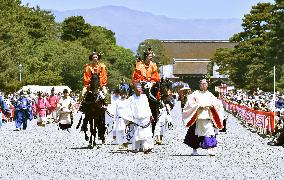
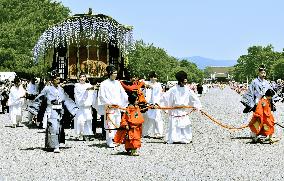
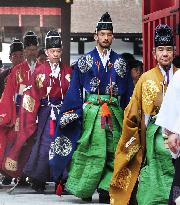
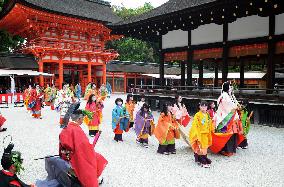
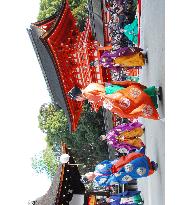
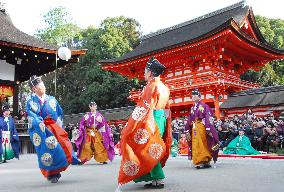
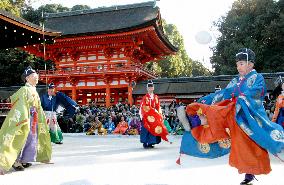
People dressed as nobles of the ancient Heian Era parade in the Kyoto Gyoen National Garden during the Aoi Festival in Kyoto, western Japan, on May 16, 2023.

  •  
Aoi Festival in Kyoto

Aoi Festival in Kyoto

People dressed as nobles of the ancient Heian Era parade in the Kyoto Gyoen National Garden during the Aoi Festival in Kyoto, western Japan, on May 16, 2023.

  •  
Ex-Japanese emperor, empress in Kyoto

Ex-Japanese emperor, empress in Kyoto

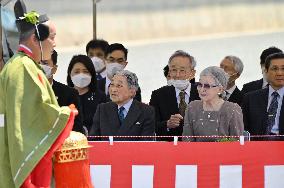
Former Japanese Emperor Akihito (front row, L) and former Empress Michiko (front row, R) watch a parade by people dressed as nobles of the ancient Heian Era during the Aoi Festival in Kyoto, western Japan, on May 16, 2023. (Pool photo)

  •  
Ex-Japanese emperor, empress in Kyoto

Ex-Japanese emperor, empress in Kyoto

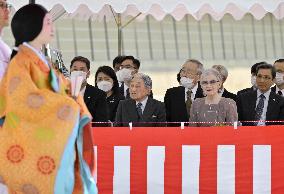
Former Japanese Emperor Akihito (front row, 2nd from R) and former Empress Michiko (front row, R) watch a parade by people dressed as nobles of the ancient Heian Era during the Aoi Festival in Kyoto, western Japan, on May 16, 2023. (Pool photo)

  •  
Ancient football

Ancient football

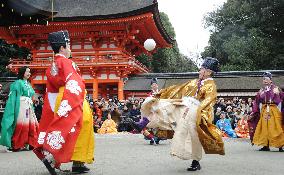
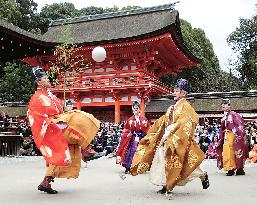
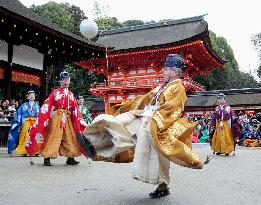
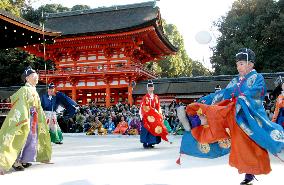
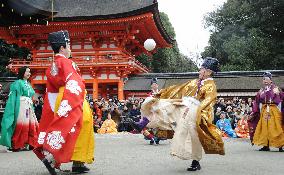
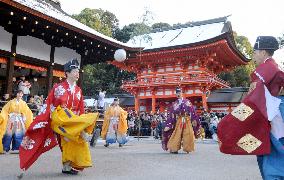
KYOTO, Japan - Men in Heian era (eighth to 12th centuries) aristocratic attire demonstrate ''kemari'' (ancient football) in an event at Shimogamo Shrine in Kyoto on Jan. 4, 2012.

  •  
Ancient-era coins, pot found at Todai-ji temple

Ancient-era coins, pot found at Todai-ji temple

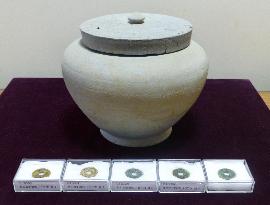
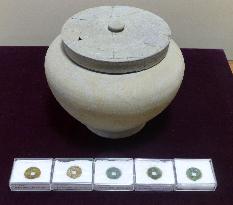
KASHIHARA, Japan - Five "Wado-kaichin" coins, Japan's first circulated copper coinage, kept in an earthenware pot in the Heian era (eighth-12th centuries), are shown together with the pot at the Todai-ji temple in Nara, western Japan, on July 10, 2014.

  •  
Ancient-era coins, pot found at Todai-ji temple

Ancient-era coins, pot found at Todai-ji temple

KASHIHARA, Japan - Five "Wado-kaichin" coins, Japan's first circulated copper coinage, kept in an earthenware pot in the Heian era (eighth-12th centuries), are shown together with the pot at the Todai-ji temple in Nara, western Japan, on July 10, 2014.

  •  
Traditional Kemari event held to pray for Japan's victory in World Cup

Traditional Kemari event held to pray for Japan's victory in World Cup

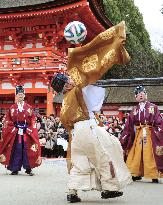
KYOTO, Japan - A man in Heian era (eighth to 12th century) aristocratic attire kicks a ball made of deer skin at a "Kemari" event at Shimogamo Shrine in Kyoto on May 31, 2014. The event was held to pray for Japan's victory in the upcoming World Cup soccer tournament in Brazil.

  •  
Traditional Kemari event held to pray for Japan's victory in World Cup

Traditional Kemari event held to pray for Japan's victory in World Cup

KYOTO, Japan - Hidetoshi Nakata (2nd from R), a former top Japanese soccer player, walks wearing Heian era (eighth to 12th century) aristocratic attire to attend a "Kemari" event at Shimogamo Shrine in Kyoto on May 31, 2014. The event was held to pray for Japan's victory in the upcoming World Cup soccer tournament in Brazil.

  •  
Missing piece of ancient classic writing found in Kyoto

Missing piece of ancient classic writing found in Kyoto

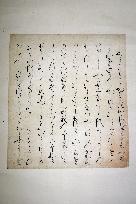
TOKYO, Japan - A partial script of "Yoru no Nezame" (Awakening at Night), a classic tale from the Heian era (794-1192) believed to have been written by a daughter of nobleman Sugawara no Takasue, is displayed in Kyoto, western Japan, on May 29, 2014. It was found at an antiquarian bookstore in the ancient Japanese capital.

  •  
Heian-style procession in Tottori Pref.

Heian-style procession in Tottori Pref.

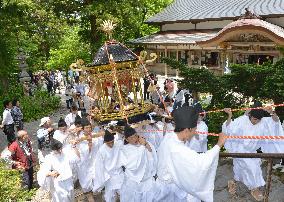
YONAGO, Japan - People dressed in ancient attire from the Heian era (794-1192) carry a ''mikoshi'' (portable shrine) along the approach of Daisenji, a Buddhist temple in Daisen, Tottori Prefecture, on May 24, 2014.

  •  
Ancient court-style parade held in Kyoto

Ancient court-style parade held in Kyoto

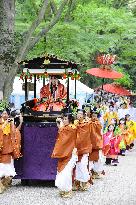
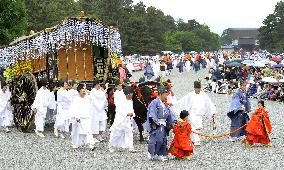
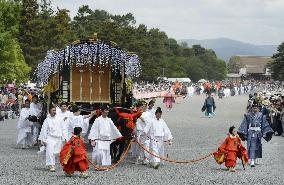
KYOTO, Japan - A procession of people dressed as nobles in ancient court-style attire from the Heian era (794-1192) reaches the Shimogamo Shrine on May 15, 2014, during the Aoi Festival, one of three major festivals in Kyoto, western Japan.

  •  
Ancient court-style parade held in Kyoto

Ancient court-style parade held in Kyoto

KYOTO, Japan - A procession of people dressed as nobles in ancient court-style attire from the Heian era (794-1192) goes through the Shimogamo Shrine on May 15, 2014, during the Aoi Festival, one of three major festivals in Kyoto, western Japan.

  •  
Ancient court-style parade held in Kyoto

Ancient court-style parade held in Kyoto

KYOTO, Japan - A procession of people dressed as nobles in ancient court-style attire from the Heian era (794-1192) departs from the Old Imperial Palace in Kyoto, western Japan, on May 15, 2014, for an 8-kilometer parade during the Aoi Festival, one of three major festivals in the old Japanese capital.

  •  
Traditional Kemari event held at Shimogamo Shrine in Kyoto

Traditional Kemari event held at Shimogamo Shrine in Kyoto

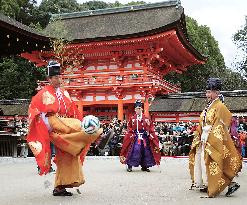
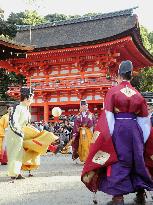
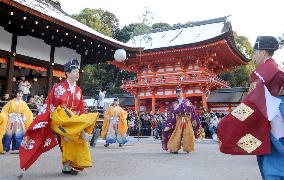
KYOTO, Japan - A man in Heian era (eighth to 12th century) aristocratic attire keeps a soccer ball in the air during an traditional annual "Kemari-hajime" event at Shimogamo Shrine in Kyoto on Jan. 4, 2014. The soccer ball was used instead of a traditional ball made of deer skin in tribute to the World Cup soccer tournament in Brazil this year. In Kemari, players continue kicking the mari (ball) in the air to a fixed height as many times as possible.

  •  
Traditional Kemari event held at Shimogamo Shrine in Kyoto

Traditional Kemari event held at Shimogamo Shrine in Kyoto

KYOTO, Japan - People in Heian era (eighth to 12th century) aristocratic attire kick a soccer ball, instead of a traditional ball made of deer skin, in an annual "Kemari-hajime" event at Shimogamo Shrine in Kyoto on Jan. 4, 2014. The soccer ball was used in tribute to the World Cup soccer tournament in Brazil this year. In Kemari, players continue kicking the mari (ball) in the air to a fixed height as many times as possible.

  •  
Traditional Kemari event held at Shimogamo Shrine in Kyoto

Traditional Kemari event held at Shimogamo Shrine in Kyoto

KYOTO, Japan - People in Heian era (eighth to 12th century) aristocratic attire kick a ball made of deer skin in a traditional annual "Kemari-hajime" event at Shimogamo Shrine in Kyoto on Jan. 4, 2014. In Kemari, players continue kicking the mari (ball) in the air to a fixed height as many times as possible.

  •  
Ancient football in Kyoto

Ancient football in Kyoto

KYOTO, Japan - Men in Heian era (eighth to 12th centuries) aristocratic attire demonstrate "kemari" (ancient football) in an event at Shimogamo Shrine in Kyoto on Jan. 4, 2013.

  •  
Ancient football in Kyoto

Ancient football in Kyoto

KYOTO, Japan - Men in Heian era (eighth to 12th centuries) aristocratic attire demonstrate "kemari" (ancient football) in an event at Shimogamo Shrine in Kyoto on Jan. 4, 2013.

  •  
Ancient football

Ancient football

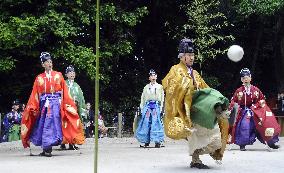
KYOTO, Japan - Men in Heian era (eighth to 12th centuries) aristocratic attire demonstrate ''kemari'' (ancient football) in an event at Shimogamo Shrine in Kyoto on Jan. 4, 2011.

  •  
Ancient waterside tanka event in Kyoto

Ancient waterside tanka event in Kyoto

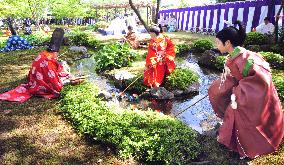
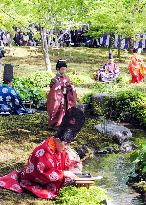
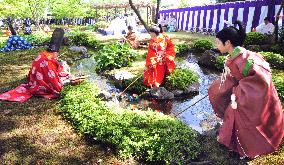
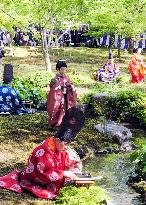
KYOTO, Japan - Performers show tourists the ''kyokusui no en'' ancient waterside pastime near a winding stream at Jonangu shrine in Kyoto on April 29, 2010. The performers dressed as the nobles of the Heian Era, which started in 794, make tanka poems before floating cups of sake reach them.

  •  
Ancient waterside tanka event in Kyoto

Ancient waterside tanka event in Kyoto

KYOTO, Japan - Performers show tourists the ''kyokusui no en'' ancient waterside pastime near a winding stream at Jonangu shrine in Kyoto on April 29, 2010. The performers dressed as the nobles of the Heian Era, which started in 794, make tanka poems before floating cups of sake reach them.

  •  
Ancient New Year 'Kemari' ball game reenacted in Kyoto

Ancient New Year 'Kemari' ball game reenacted in Kyoto

KYOTO, Japan - Members of the Kemari Preservation Society dressed in court costume play the ancient ball game in the courtyard of Shimogamo Shrine in Kyoto on Jan. 4, 2010, during the traditional ''First Kemari of the Year'' festival. Introduced from China, Kemari, played with a ball made of deer leather, was popular among aristocrats during Japan's Heian era (794-1192).

  •  
Kyoto's 'Miyako Odori' festival to feature 'Tales of Genji'

Kyoto's 'Miyako Odori' festival to feature 'Tales of Genji'

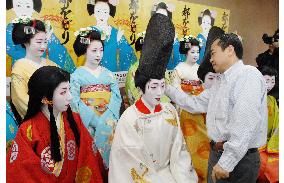
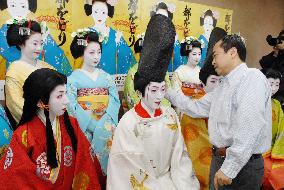
KYOTO, Japan - A hair stylist puts the final touches on the hairpiece of a geisha dancer dressed in Heian era costumes as geisha dancers prepare for a dress match-up session at the Gion Koubu Kaburenjo Theatre in preparation for the monthlong ''Miyako Odori'' festival in April. The program of this year's festival features a performance of Murasaki Shikibu's ''The Tales of Genji,'' as 2008 marks the 1,000th anniversary of the discovery of the Shikibu masterpiece. The show will open April 1 and run through April 30. Admission, with tea coupon, is 4,300 yen. Contact: 075-541-3391.

  •  
Ancient New Year 'Kemari' ball game reenacted in Kyoto

Ancient New Year 'Kemari' ball game reenacted in Kyoto

KYOTO, Japan - Dressed in ancient court costume, members of the Kemari Preservation Society in Kyoto play a ''Kemari'' ball game in the courtyard of Shimogamo Shrine in Kyoto on Jan. 4 in the traditional ''First Kemari of the Year'' festival. First introduced from China, Kemari, a game with a ball made of deer leather, was popular among aristocrats in Japan's Heian era (circa 794-1185 A.D.). The team that keeps the ball in the air with the largest number of kicks wins the game.

  •  
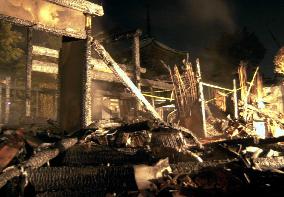
Fire destroys Aichi temple, state cultural treasure

Fire destroys Aichi temple, state cultural treasure

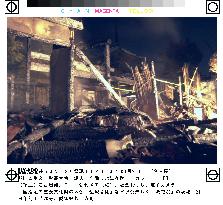
NAGOYA, Japan - A fire broke out at the Hokkein temple in Jimokuji, Aichi Prefecture, Jan. 20, destroying the main temple along with a wooden Goddess of Mercy sculpture. The image, created in the Heian era (A.D. 794-1185), was designated an important cultural treasure of the state in 1937. The fire broke out shortly after 8 p.m.

  •  
Event held to promote "udon" noodle dish revived from ancient era

Event held to promote "udon" noodle dish revived from ancient era

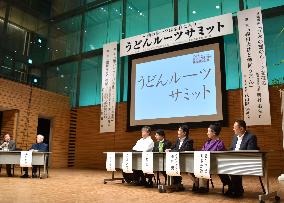
Panelists attend a meeting on the origin of "udon" noodles hosted by a nonprofit organization in Nara, western Japan, on Sept. 19, 2015. The NPO, the Society of Research on Food and Culture of Nara, is promoting a noodle dish said to have been served to Emperor Ichijo during his visit to Kasuga Shrine in Nara in 989 in the Heian period (794-1192). (Kyodo) ==Kyodo

  •  
Kyoto's 'Miyako Odori' festival to feature 'Tales of Genji'

Kyoto's 'Miyako Odori' festival to feature 'Tales of Genji'

KYOTO, Japan - A hair stylist puts the final touches on the hairpiece of a geisha dancer dressed in Heian era costumes as geisha dancers prepare for a dress match-up session at the Gion Koubu Kaburenjo Theatre in preparation for the monthlong ''Miyako Odori'' festival in April. The program of this year's festival features a performance of Murasaki Shikibu's ''The Tales of Genji,'' as 2008 marks the 1,000th anniversary of the discovery of the Shikibu masterpiece. The show will open April 1 and run through April 30. Admission, with tea coupon, is 4,300 yen. Contact: 075-541-3391. (Kyodo)

  •  
Ancient New Year 'Kemari' ball game reenacted in Kyoto

Ancient New Year 'Kemari' ball game reenacted in Kyoto

KYOTO, Japan - Dressed in ancient court costume, members of the Kemari Preservation Society in Kyoto play a ''Kemari'' ball game in the courtyard of Shimogamo Shrine in Kyoto on Jan. 4 in the traditional ''First Kemari of the Year'' festival. First introduced from China, Kemari, a game with a ball made of deer leather, was popular among aristocrats in Japan's Heian era (circa 794-1185 A.D.). The team that keeps the ball in the air with the largest number of kicks wins the game. (Kyodo)

  •  
Scene of a festival

Scene of a festival

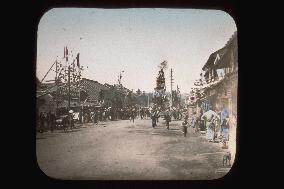
A festival scene in a city. A cart with decorations comes from the opposite direction. The cart is characteristic of festivities in the city and originates from the many festivals in Kyoto during the Heian Era. There are no electric poles, and the cart stands like a mountain.==Date:unknown, Place:unknown, Photo:unknown, (Credit:Nagasaki University Library/Kyodo News Images) [Cabinet Number31‐48‐0]

  •  
Banboo grove at uji and a jinrikisha,a man-pulled cart

Banboo grove at uji and a jinrikisha,a man-pulled cart

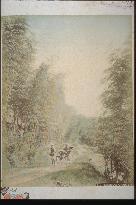
Uji was an important crossroad of maritime transport between Kyoto and Nara, and flourished as a spot for country villas of the nobility in the Heian era. To the right and left of the road are bamboo groves with not much artificial work done, and a rickshaw carrying a male passenger.==Date:unknown, Place:Uji, Photo:Ogawa Kazumasa, (Credit:Nagasaki University Library/Kyodo News Images) [Cabinet Number5‐39‐0]

  •  
Ancient waterside tanka event in Kyoto

Ancient waterside tanka event in Kyoto

KYOTO, Japan - Performers show tourists the ''kyokusui no en'' ancient waterside pastime near a winding stream at Jonangu shrine in Kyoto on April 29, 2010. The performers dressed as the nobles of the Heian Era, which started in 794, make tanka poems before floating cups of sake reach them. (Kyodo)

  •  
Ancient waterside tanka event in Kyoto

Ancient waterside tanka event in Kyoto

KYOTO, Japan - Performers show tourists the ''kyokusui no en'' ancient waterside pastime near a winding stream at Jonangu shrine in Kyoto on April 29, 2010. The performers dressed as the nobles of the Heian Era, which started in 794, make tanka poems before floating cups of sake reach them. (Kyodo)

  •  
Ancient football

Ancient football

KYOTO, Japan - Men in Heian era (eighth to 12th centuries) aristocratic attire demonstrate ''kemari'' (ancient football) in an event at Shimogamo Shrine in Kyoto on Jan. 4, 2012. (Kyodo)

  •  
Ancient football

Ancient football

KYOTO, Japan - Men in Heian era (eighth to 12th centuries) aristocratic attire demonstrate ''kemari'' (ancient football) in an event at Shimogamo Shrine in Kyoto on Jan. 4, 2011. (Kyodo)

  •  
Ancient New Year 'Kemari' ball game reenacted in Kyoto

Ancient New Year 'Kemari' ball game reenacted in Kyoto

KYOTO, Japan - Members of the Kemari Preservation Society dressed in court costume play the ancient ball game in the courtyard of Shimogamo Shrine in Kyoto on Jan. 4, 2010, during the traditional ''First Kemari of the Year'' festival. Introduced from China, Kemari, played with a ball made of deer leather, was popular among aristocrats during Japan's Heian era (794-1192). (Kyodo)

  •  
Aoi festival in Kyoto

Aoi festival in Kyoto

Participants dressed as nobles of the Heian Era parade around the Kyoto Imperial Palace during the Aoi Festival, one of the three main festivals of Kyoto, on May 15, 2019. (Kyodo) ==Kyodo

  •  
Fire destroys Aichi temple, state cultural treasure

Fire destroys Aichi temple, state cultural treasure

NAGOYA, Japan - A fire broke out at the Hokkein temple in Jimokuji, Aichi Prefecture, Jan. 20, destroying the main temple along with a wooden Goddess of Mercy sculpture. The image, created in the Heian era (A.D. 794-1185), was designated an important cultural treasure of the state in 1937. The fire broke out shortly after 8 p.m.

  • Main
  • Top
  • Editorial
  • Creative
  • About Us
  • About ILG
  • Terms of use
  • Company
  • BEHIND
  • Price List
  • Single Plan
  • Monthly Plan
  • Services
  • Shooting
  • Rights Clearance
  • Support
  • FAQ
  • How To Buy
  • Contact Us
  • Become a Partner

© KYODO NEWS IMAGES INC

All Rights Reserved.

  • Editorial
  • Olympics
  • News
  • Sports
  • Japan
  • Tech
  • Royal
  • Disaster
  • NorthKorea
  • Old Japan
  • SNS
  • Creative
  • Food
  • Japan
  • Landscape
  • Animal
  • Popular
  • #Ukraine
  • #Thailand
  • #coronavirus
  • #N. Korea
  • #Russia
  • #China
  • #Ukraine
  • #Thailand
  • #coronavirus
  • #N. Korea
  • #Russia
  • #China
  • Food
  • Japan
  • Landscape
  • Animal
  • Olympics
  • News
  • Sports
  • Japan
  • Tech
  • Royal
  • Disaster
  • NorthKorea
  • Old Japan
  • SNS