•  
Lake Ashi

Lake Ashi

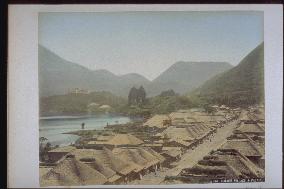
This is the post town of Hakone, with Lake Ashinoko, as seen from what was once Hakone barrier station. As the power lines installed in 1873 from Tokyo to Nagasaki are visible, this photo must have been taken after that. The thatched roofs of honjin are seen. The round, wooded mountain is Mt. Hatabiki. Behind it is Mt. Kurakake which is a part of the outer mountain range of Hakone. A child is looking at the lake.==Date:unknown, Place:Hakone, Photo:Tamamura Kozaburo, (Credit:Nagasaki University Library/Kyodo News Images) [Cabinet Number80‐17‐0]

  •  
Lake Ashi

Lake Ashi

This is the post town of Hakone as seen from what was once the Hakone barrier station. The buildings on the banks of Lake Ashinoko are part of the thatched roofed building complex, the honjin. The large structures with thatched roofs to the right are officially appointed inns (Honjin). Feudal lords stayed or rested here during the Sankinkoutai (A bi-annual period of madatory alternate residence in Edo for feudal lords, known as Daimyo). The mountain in the background is Mt. Kurakake. There appear to be craftsmen looking at the lake in the foreground.==Date:unknown, Place:Hakone, Photo:R. Stillfried, (Credit:Nagasaki University Library/Kyodo News Images) [Cabinet Number77‐17‐0]

  •  
The Hakone post town

The Hakone post town

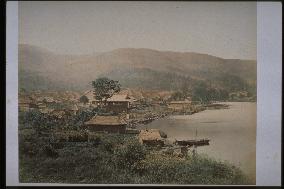
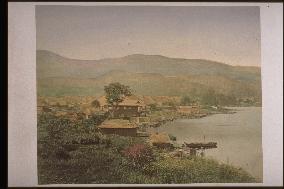
This photo depicts the post town of Hakone viewed from around the old Hakone check point site. The two-storied house behind the tree in the centre is Hatago Hafuya (present-day Hokone Hotel), an inn for commoners. The huge thatched roofed houses behind are, Kawada Honjin, an officially appointed inn for feudal lords, Koma Honjin, Ishiuchi Honjin, and Amano Heizaemon Honjin. Compared to catalogue # 2945, the backyards of honjins appear to be sticking out to Lake Ashinoko. The mountain behind on the left is Mt. Kurakake and the one in the centre is Hakone Pass.==Date:unknown, Place:Hakone, Photo:unknown, (Credit:Nagasaki University Library/Kyodo News Images) [Cabinet Number64‐46‐0]

  •  
Lake Ashi

Lake Ashi

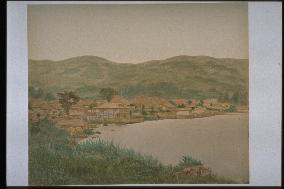
This is the post town of Hakone as seen from what was once the Hakone barrier station. The two-storied building projecting into Lake Ashinoko is the Hafuya Inn (present day Hakone Hotel). The large structures with thatched roofs to its right are officially appointed inns (Honjin) for the feudal lords (Daimyo) and other noblemen. They are from the left, Kawada Honjin, Koma Honjin, Ishiuchi Honjin, and Amano Heizaemon Honjin. The mountain on the left is Mt. Kurakake, and Hakone Pass is located to the right.==Date:unknown, Place:Hakone, Photo:unknown, (Credit:Nagasaki University Library/Kyodo News Images) [Cabinet Number59‐34‐2]

  •  
The Hakone post town

The Hakone post town

The Hakonejuku from the Mishima-cho towards the direction of Odawara. It was a small shukuba with a population of 5000 and 150 houses, but it had six Honjin (lodgings for the provincial lords), which was the largest numbers together with Hamamatsu. The Hakone summer palace can be seen to the left in the hills which was completed in 1886.==Date:unknown, Place:Hakone, Photo:Kusakabe Kinbei, (Credit:Nagasaki University Library/Kyodo News Images) [Cabinet Number40‐16‐0]

  •  
Lake Ashi

Lake Ashi

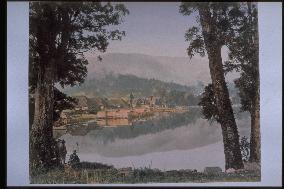
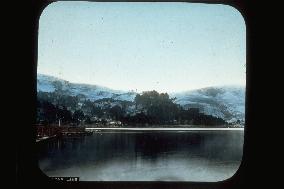
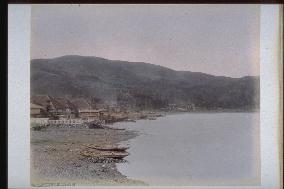
Lake Ashino and the Sekisho of Hakone can be seen to the left. The Sekisho of Hakone was famous as a place to guard the Tokaido, together with the Sekisho of Arai. It was established with a double fence built in the lake. To the distance is the Honjin where the warrior lords stayed during trips back and forth to Edo.==Date:unknown, Place:Hakone, Photo:unknown, (Credit:Nagasaki University Library/Kyodo News Images) [Cabinet Number31‐73‐0]

  •  
Lake Ashi

Lake Ashi

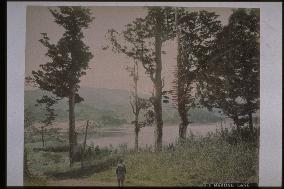
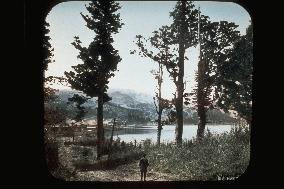
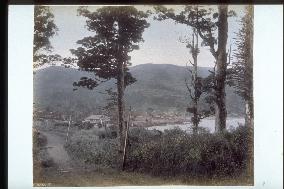
A photo of a person wearing a hanten and standing backwards on the cedar boulevard by the shores of Lake Ashino. From the telegraph pole, we know this picture was taken after 1881 when telegraphy started around Lake Ashino. The building to the left is the so-called Honjin of the Hakonejuku. This was taken from very near the ruins of the Sekisho.==Date:unknown, Place:Hakone, Photo:unknown, (Credit:Nagasaki University Library/Kyodo News Images) [Cabinet Number31‐26‐0]

  •  
The Hakone post town

The Hakone post town

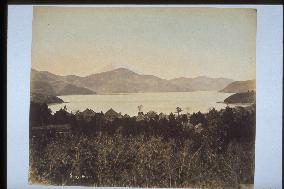
With Mt. Fuji in the background, this is a picture of Lake Ashi and Hakone city. The pyramid-shaped roofs to the left are the Honjin, or lodgings of feudal lords during the Sankin Kotai of the Edo Era. From the right, they may be Matahara, Kawada, Koma and Ishiuchi, but this is not certain.==Date:unknown, Place:Hakone, Photo:unknown, (Credit:Nagasaki University Library/Kyodo News Images) [Cabinet Number26‐6‐0]

  •  
Honjin,an officially appointed inn for daimyo,in a post town

Honjin,an officially appointed inn for daimyo,in a post town

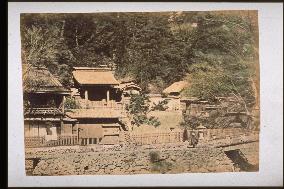
A honjin (officially appointed inn) is a place of lodging for war lords, officials of the Shogunate and the aristocracy. The origin is derived from Ashikaga Yoshiaki, who raised a plaque at his lodging on the way to Kyoto. The characteristics are spacious grounds with a gate entrance and rooms in the upper tier. The honjin developed with the sankinkotai (warlord's alternate-year residence in Edo), and its managers were allowed to have last names and to wear swords.==Date:unknown, Place:unknown, Photo:unknown, (Credit:Nagasaki University Library/Kyodo News Images) [Cabinet Number13‐24‐0]

  •  
HAKONE

HAKONE

A photo of Hakonejuku from near the remains of Hakone sekisho (checking station). The building to the left is Hafuya Hotel, with remains of honjin (the lodgings of warrior lords) in the rear. Where Ashino Lake can be seen in the photo is at present a pier for tourist boats. The electric poles indicate that this was taken after 1881.==Date:unknown, Place:Hakone, Photo:Ogawa Kazumasa, (Credit:Nagasaki University Library/Kyodo News Images) [Cabinet Number9‐9‐0]

  •  
Lake Ashi

Lake Ashi

The white pole shows the remains of the sekisho (check point).In the left corner is the Hafuya Hotel, and to the right are remains of the honjin (officially appointed inns) of the lords Kawada Kakuemon, Komasa Goemon, Ishiuchi Tarozaemon and Amano Hirazaemon. The photo portrays the area which at present is a pier for tourist boats on Ashino Lake.==Date:unknown, Place:Hakone, Photo:Ogawa Kazumasa, (Credit:Nagasaki University Library/Kyodo News Images) [Cabinet Number6‐11‐0]

  •  
The Hakone post town

The Hakone post town

A scene in Hakone. The four houses in the centre are honjin (main lodgings) used by the feudal lords when they paid visits to Edo. The forefront is the Hafuya Hotel, which was absorbed into the Fujiya Hotel Group and later became the Hakone Hotel. To the right is Ashino Lake. In the background is Mt.Daikan and Kurakake on the left.==Date:Early Meiji, Place:Hakone, Photo:Kusakabe Kinbei, (Credit:Nagasaki University Library/Kyodo News Images) [Cabinet Number3‐41‐0]

  •  
Hafuya hotel

Hafuya hotel

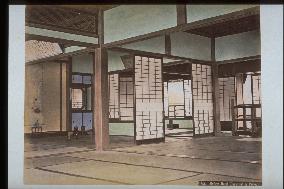
The interior of the Hafuya Hotel in Hakone near Hakone Honjin. Wooden dividers are seen in the shoji (paper screens) damashie (trompe l'oeil) style, and the elaborate interior can be observed. This hotel was later bought by the Fujiya Hotel. This photo shows the hotel before it was redecorated in Western-style. This is the present Hakone Hotel.==Date:Middle Meiji, Place:Hakone, Photo:Kusakabe Kinbei, (Credit:Nagasaki University Library/Kyodo News Images) [Cabinet Number2‐50‐0]

  •  
Aftermath of torrential rain in southwestern Japan

Aftermath of torrential rain in southwestern Japan

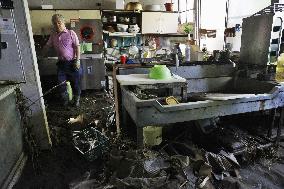
Kiyomi Oba, the owner of the Japanese-style inn Honjin in the Amagase hot spring resort in Hita, Oita Prefecture, stands in the inn's mud-covered kitchen on July 8, 2020, after flooding triggered by torrential rain.

  •  
Court rejects appeal by former head of Hokkoku Bank

Court rejects appeal by former head of Hokkoku Bank

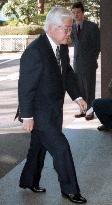
NAGOYA, Japan - Yasumori Honjin, a former president of Hokkoku Bank, a regional bank based in Kanazawa, Ishikawa Prefecture, enters the Nagoya High Court on Jan. 24. The court upheld a ruling sentencing him to a suspended jail term for breach of trust. Honjin was convicted for causing a prefectural credit insurance association to suffer 80 million yen in losses by covering bad loans made by the bank.

  • Main
  • Top
  • Editorial
  • Creative
  • About Us
  • About ILG
  • Terms of use
  • Company
  • BEHIND
  • Price List
  • Single Plan
  • Monthly Plan
  • Services
  • Shooting
  • Rights Clearance
  • Support
  • FAQ
  • How To Buy
  • Contact Us
  • Become a Partner

© KYODO NEWS IMAGES INC

All Rights Reserved.

  • Editorial
  • Olympics
  • News
  • Sports
  • Japan
  • Tech
  • Royal
  • Disaster
  • NorthKorea
  • Old Japan
  • SNS
  • Creative
  • Food
  • Japan
  • Landscape
  • Animal
  • Popular
  • #Ukraine
  • #China
  • #coronavirus
  • #N. Korea
  • #Thailand
  • #Russia
  • #Ukraine
  • #China
  • #coronavirus
  • #N. Korea
  • #Thailand
  • #Russia
  • Food
  • Japan
  • Landscape
  • Animal
  • Olympics
  • News
  • Sports
  • Japan
  • Tech
  • Royal
  • Disaster
  • NorthKorea
  • Old Japan
  • SNS