•  
NASA’s Webb Finds Signs of Possible Aurorae on Isolated Brown Dwarf

NASA’s Webb Finds Signs of Possible Aurorae on Isolated Brown Dwarf

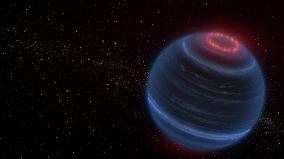
Handout photo - This artist concept portrays the brown dwarf W1935, which is located 47 light-years from Earth. Astronomers using NASA’s James Webb Space Telescope found infrared emission from methane coming from W1935. This is an unexpected discovery because the brown dwarf is cold and lacks a host star; therefore, there is no obvious source of energy to heat its upper atmosphere and make the methane glow. The team speculates that the methane emission may be due to processes generating aurorae, shown here in red. Infrared emission from methane suggests atmospheric heating by auroral processes. These findings are being presented at the 243rd meeting of the American Astronomical Society in New Orleans. To help explain the mystery of the infrared emission from methane, the team turned to our solar system. Methane in emission is a common feature in gas giants like Jupiter and Saturn. The upper-atmosphere heating that powers this emission is linked to aurorae. Photo by NASA, ESA, CSA, and L. Hustak (STScI) via AB

  • Main
  • Top
  • Editorial
  • Creative
  • About Us
  • About ILG
  • Terms of use
  • Company
  • BEHIND
  • Price List
  • Single Plan
  • Monthly Plan
  • Services
  • Shooting
  • Rights Clearance
  • Support
  • FAQ
  • How To Buy
  • Contact Us
  • Become a Partner

© KYODO NEWS IMAGES INC

All Rights Reserved.

  • Editorial
  • Olympics
  • News
  • Sports
  • Japan
  • Tech
  • Royal
  • Disaster
  • NorthKorea
  • Old Japan
  • SNS
  • Creative
  • Food
  • Japan
  • Landscape
  • Animal
  • Popular
  • #Ukraine
  • #China
  • #coronavirus
  • #N. Korea
  • #Russia
  • #Thailand
  • #Ukraine
  • #China
  • #coronavirus
  • #N. Korea
  • #Russia
  • #Thailand
  • Food
  • Japan
  • Landscape
  • Animal
  • Olympics
  • News
  • Sports
  • Japan
  • Tech
  • Royal
  • Disaster
  • NorthKorea
  • Old Japan
  • SNS