•  

China: Pet Owner Reveals Unusual Two-Headed Bearded Dragon

This is the rare moment that a Chinese man presented an unusual two-headed bearded dragon, drawing attention as the reptile calmly moved with both heads sharing a single body. On December 8, 2025, in Hubei, China, the video captured a pet owner gently holding out his finger while the small reptile slowly crawled forward. The bearded dragon appeared to have two fully formed heads connected to one body, each head moving slightly independently as it balanced itself. The man kept his hand steady, allowing the creature to explore without disturbance. The reptile’s tiny claws gripped his finger as both heads looked around, creating a striking and rare visual. The video ended with the two-headed bearded dragon continuing to crawl calmly along the man’s finger as he observed it closely.

  •  
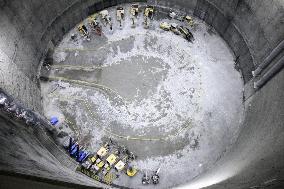
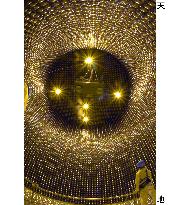
Hyper-Kamiokande neutrino observatory

Hyper-Kamiokande neutrino observatory

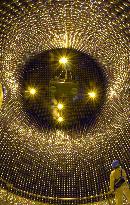
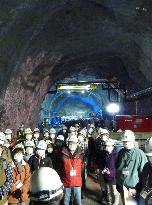
The University of Tokyo's Institute for Cosmic Ray Research unveils to the media on June 28, 2025, a huge cavity excavated in the mountains of Hida in Gifu Prefecture, central Japan, for the installation of the Hyper-Kamiokande neutrino observatory.

  •  
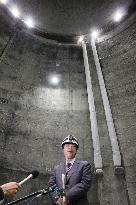
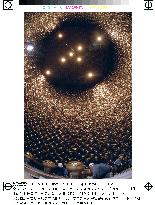
Hyper-Kamiokande neutrino observatory

Hyper-Kamiokande neutrino observatory

The University of Tokyo's Institute for Cosmic Ray Research unveils to the media on June 28, 2025, a huge cavity excavated in the mountains of Hida in Gifu Prefecture, central Japan, for the installation of the Hyper-Kamiokande neutrino observatory.

  •  

Jerusalem: Protesters March Against Benjamin Netanyahu

Thousands of anti-government protesters marched toward Israeli Prime Minister Benjamin Netanyahu's residence in Jerusalem, blocking the city's main entrance. The protest, which occurred on Wednesday morning, March 19, was driven by opposition to Netanyahu's decision to dismiss the head of the Shin Bet domestic security service and his move to resume the war in the Gaza Strip.

  •  

Philippines: Tropical Storm Yagi Dumps Heavy Rain Leaving Multiple Dead 3

Tropical Storm Yagi, locally known as Enteng, brought heavy rainfall to Manila and nearby provinces on Monday, September 2 causing flooding and landslides. Floods and a landslide killed at least eight people in the Province of Rizal. Fatalities were also reported Bicol and Cebu.

  •  

Philippines: Tropical Storm Yagi Dumps Heavy Rain Leaving Multiple Dead 4

Tropical Storm Yagi, locally known as Enteng, brought heavy rainfall to Manila and nearby provinces on Monday, September 2 causing flooding and landslides. Floods and a landslide killed at least eight people in the Province of Rizal. Fatalities were also reported Bicol and Cebu.

  •  

Philippines: Tropical Storm Yagi Dumps Heavy Rain Leaving Multiple Dead 2

Tropical Storm Yagi, locally known as Enteng, brought heavy rainfall to Manila and nearby provinces on Monday, September 2 causing flooding and landslides. Floods and a landslide killed at least eight people in the Province of Rizal. Fatalities were also reported Bicol and Cebu.

  •  

Philippines: Tropical Storm Yagi Dumps Heavy Rain Leaving Multiple Dead

Tropical Storm Yagi, locally known as Enteng, brought heavy rainfall to Manila and nearby provinces on Monday, September 2 causing flooding and landslides. Floods and a landslide killed at least eight people in the Province of Rizal. Fatalities were also reported Bicol and Cebu.

  •  

US: Powerful Storm With Hurricane-Force Winds Leaves Trail Of Destruction In Houston

A powerful storm with hurricane-force winds swept through the Houston metropolitan area on Thursday, May 16, leaving multiple dead. The storm blew out walls and windows of buildings downtown, leaving a trail of destruction and hundreds of thousands of homes without power.

  •  
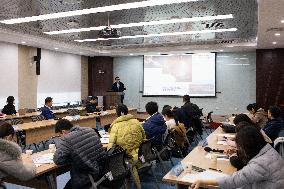
(EyesonSci) CHINA-LHAASO-ENERGY SPECTRUM-GAMA-RAY RADIATION (CN)

(EyesonSci) CHINA-LHAASO-ENERGY SPECTRUM-GAMA-RAY RADIATION (CN)

(231117) -- BEIJING, Nov. 17, 2023 (Xinhua) -- Chen Songzhan, the corresponding author of the study and a researcher at the Institute of High Energy Physics (IHEP) of the Chinese Academy of Sciences, introduces research findings at the IHEP of the Chinese Academy of Sciences in Beijing, capital of China, on Nov. 14, 2023. China's Large High Altitude Air Shower Observatory (LHAASO), a high-altitude cosmic ray observatory, has released the precise energy spectrum for the highest-energy gamma-ray radiation from the brightest gamma-ray burst (GRB) observed to date. The study, conducted by the LHAASO collaboration team, was led by the Institute of High Energy Physics of the Chinese Academy of Sciences, and the findings were published recently in the journal Science Advances. TO GO WITH "Across China: China's cosmic ray observatory releases energy spectrum for highest-energy gamma ray" (Xinhua/Jin Liwang)

  •  
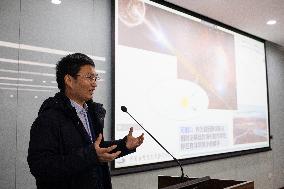
(EyesonSci) CHINA-LHAASO-ENERGY SPECTRUM-GAMA-RAY RADIATION (CN)

(EyesonSci) CHINA-LHAASO-ENERGY SPECTRUM-GAMA-RAY RADIATION (CN)

(231117) -- BEIJING, Nov. 17, 2023 (Xinhua) -- Chen Songzhan, the corresponding author of the study and a researcher at the Institute of High Energy Physics (IHEP) of the Chinese Academy of Sciences, introduces research findings at the IHEP of the Chinese Academy of Sciences in Beijing, capital of China, on Nov. 14, 2023. China's Large High Altitude Air Shower Observatory (LHAASO), a high-altitude cosmic ray observatory, has released the precise energy spectrum for the highest-energy gamma-ray radiation from the brightest gamma-ray burst (GRB) observed to date. The study, conducted by the LHAASO collaboration team, was led by the Institute of High Energy Physics of the Chinese Academy of Sciences, and the findings were published recently in the journal Science Advances. TO GO WITH "Across China: China's cosmic ray observatory releases energy spectrum for highest-energy gamma ray" (Xinhua/Jin Liwang)

  •  
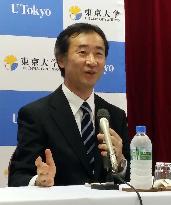
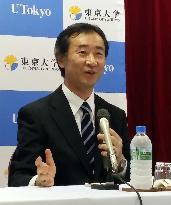
University of Tokyo professor at press conference

University of Tokyo professor at press conference

GIFU, Japan - Takaaki Kajita, director of the University of Tokyo's Institute for Cosmic Ray Research, speaks at a press conference in Hida, Gifu Prefecture, central Japan, on July 4, 2014. Tunnels to be used for the "Kagura" gravitational wave telescope system were unveiled to the press the same day.

  •  
Repair on damaged neutrino detector to be completed in mid-April

Repair on damaged neutrino detector to be completed in mid-April

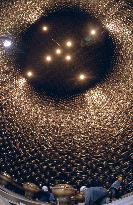
GIFU, Japan - A large neutrino detector operated by the University of Tokyo's Institute for Cosmic Ray Research was shown off to media organizations on April 7 before the completion of its repair work in mid-April following severe damage sustained in an accident in November 2001. The institute will partially resume experiments with the ''Super-Kamiokande'' detector immediately after the completion of the reconstruction work before its full resumption in around late June, the institute said.

  •  
Damaged neutrino detector 'Super Kamiokande' restored

Damaged neutrino detector 'Super Kamiokande' restored

GIFU, Japan - A large neutrino detector operated by the University of Tokyo's Institute for Cosmic Ray Research (ICRR) in Gifu Prefecture is shown off to the media Sept. 24 after it was repaired following severe damage sustained in an accident in November 2001. About 7,000 or 60% of the 11,000 photomultiplier tubes (PMTs) attached to the neutrino detector in the town of Kamioka in the central Japanese prefecture were found broken last Nov. 12 due to a chain reaction, but it is now repaired to a level that experiments can resume, ICRR officials said.

  •  
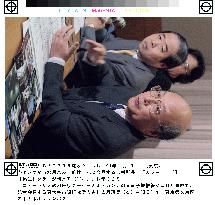
Tokyo Univ. continuing probes into neutrino research accident

Tokyo Univ. continuing probes into neutrino research accident

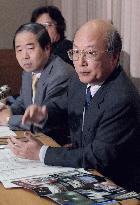
TOKYO, Japan - Motohiko Yoshimura (R), director at the University of Tokyo's Institute for Cosmic Ray Research (ICRR),speaks at a news conference at the university Nov. 13, 2001 on an accident the previous day at its cosmic ray research body in Gifu Prefecture where more than half of the 11,000 photomultiplier tubes (PMTs) attached to a large neutrino detector were found broken.

  •  
Tokyo Univ. continuing probes into neutrino research accident

Tokyo Univ. continuing probes into neutrino research accident

TOKYO, Japan - Motohiko Yoshimura (R), director at the University of Tokyo's Institute for Cosmic Ray Research (ICRR),speaks at a news conference at the university Nov. 13, 2001 on an accident the previous day at its cosmic ray research body in Gifu Prefecture where more than half of the 11,000 photomultiplier tubes (PMTs) attached to a large neutrino detector were found broken.

  •  
Repair on damaged neutrino detector to be completed in mid-April

Repair on damaged neutrino detector to be completed in mid-April

GIFU, Japan - A large neutrino detector operated by the University of Tokyo's Institute for Cosmic Ray Research was shown off to media organizations on April 7 before the completion of its repair work in mid-April following severe damage sustained in an accident in November 2001. The institute will partially resume experiments with the ''Super-Kamiokande'' detector immediately after the completion of the reconstruction work before its full resumption in around late June, the institute said. (Kyodo)

  •  
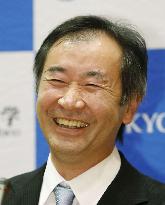
Japan's Kajita shares Nobel Prize in Physics with Canada's McDonald

Japan's Kajita shares Nobel Prize in Physics with Canada's McDonald

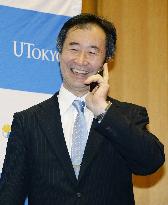
Japanese scientist Takaaki Kajita, 56, a professor at the University of Tokyo and director of the university's Institute for Cosmic Ray Research, talks with Prime Minister Shinzo Abe by phone during a press conference in Tokyo on Oct. 6, 2015, as he shared the Nobel Prize in Physics with Canada's Arthur McDonald for their discovery of neutrino oscillations. (Kyodo) ==Kyodo

  •  
Japan's Kajita shares Nobel Prize in Physics with Canada's McDonald

Japan's Kajita shares Nobel Prize in Physics with Canada's McDonald

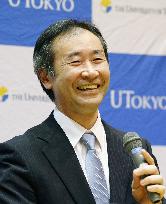
Japanese scientist Takaaki Kajita, 56, a professor at the University of Tokyo and director of the university's Institute for Cosmic Ray Research, attends a press conference in Tokyo on Oct. 6, 2015, as he shared the Nobel Prize in Physics with Canada's Arthur McDonald for their discovery of neutrino oscillations. (Kyodo) ==Kyodo

  •  
Nobel laureate Kajita seeks to confirm Einstein's prediction

Nobel laureate Kajita seeks to confirm Einstein's prediction

A tunnel in the central Japanese city of Hida, Gifu Prefecture, where the KAGRA cryogenic gravitational wave telescope will be housed, is shown to local citizens in October 2014. Institute for Cosmic Ray Research Director Takaaki Kajita, co-recipient of the Nobel Prize in Physics 2015, is expected to work on the detection of gravitational waves in space to confirm Albert Einstein's prediction. (Kyodo) ==Kyodo

  •  
Expert explains work at facility linked to Nobel physics prize

Expert explains work at facility linked to Nobel physics prize

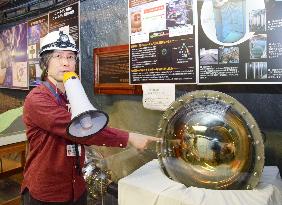
Yoshinari Hayato, associate professor at the University of Tokyo's Institute for Cosmic Ray Research, shows one of the photomultiplier tubes at Super-Kamiokande, the world's largest underground neutrino detector facility, in Hida, Gifu Prefecture, central Japan, on Oct. 9, 2015. The detector was instrumental in research by Japanese scientist Takaaki Kajita, who was named a co-recipient of the Nobel Prize in Physics on Oct. 6 "for the discovery of neutrino oscillations, which shows that neutrinos have mass." (Kyodo) ==Kyodo

  •  
Expert explains work at facility linked to Nobel physics prize

Expert explains work at facility linked to Nobel physics prize

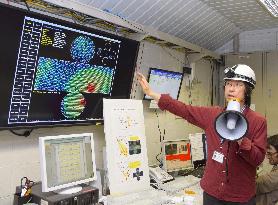
Yoshinari Hayato, associate professor at the University of Tokyo's Institute for Cosmic Ray Research, explains work in the control room at Super-Kamiokande, the world's largest underground neutrino detector facility, in Hida, Gifu Prefecture, central Japan, on Oct. 9, 2015. The detector was instrumental in research by Japanese scientist Takaaki Kajita, who was named a co-recipient of the Nobel Prize in Physics on Oct. 6 "for the discovery of neutrino oscillations, which shows that neutrinos have mass." (Kyodo) ==Kyodo

  •  
Japan's Kajita shares Nobel Prize in Physics with Canada's McDonald

Japan's Kajita shares Nobel Prize in Physics with Canada's McDonald

Japanese scientist Takaaki Kajita, 56, a professor at the University of Tokyo and director of the university's Institute for Cosmic Ray Research, attends a press conference in Tokyo on Oct. 6, 2015, as he shared the Nobel Prize in Physics with Canada's Arthur McDonald for their discovery of neutrino oscillations. (Kyodo) ==Kyodo

  •  
Japan's Kajita shares Nobel Prize in Physics with Canada's McDonald

Japan's Kajita shares Nobel Prize in Physics with Canada's McDonald

Japanese scientist Takaaki Kajita, 56, a professor at the University of Tokyo and director of the university's Institute for Cosmic Ray Research, attends a press conference in Tokyo on Oct. 6, 2015, as he shared the Nobel Prize in Physics with Canada's Arthur McDonald for their discovery of neutrino oscillations. (Kyodo) ==Kyodo

  •  
University of Tokyo professor at press conference

University of Tokyo professor at press conference

GIFU, Japan - Takaaki Kajita, director of the University of Tokyo's Institute for Cosmic Ray Research, speaks at a press conference in Hida, Gifu Prefecture, central Japan, on July 4, 2014. Tunnels to be used for the "Kagura" gravitational wave telescope system were unveiled to the press the same day. (Kyodo)

  •  
Damaged neutrino detector 'Super Kamiokande' restored

Damaged neutrino detector 'Super Kamiokande' restored

GIFU, Japan - A large neutrino detector operated by the University of Tokyo's Institute for Cosmic Ray Research (ICRR) in Gifu Prefecture is shown off to the media Sept. 24 after it was repaired following severe damage sustained in an accident in November 2001. About 7,000 or 60% of the 11,000 photomultiplier tubes (PMTs) attached to the neutrino detector in the town of Kamioka in the central Japanese prefecture were found broken last Nov. 12 due to a chain reaction, but it is now repaired to a level that experiments can resume, ICRR officials said. (Kyodo)

  •  
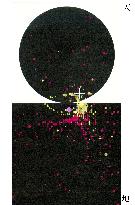
Scientists detect neutrino beam traversing 250 km

Scientists detect neutrino beam traversing 250 km

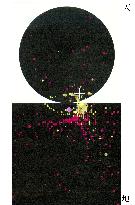
The photo shows a neutrino beam traversing 250 kilometers between the High Energy Accelerator Research Organization facility in Tsukuba, Ibaraki Prefecture, and the Super-Kamiokande detector in the town of Kamioka, Gifu Prefecture. An international team of scientists announced June 28 the detection of the beam's passage. The photos were provided by the University of Tokyo's Institute for Cosmic Ray Research, which led the experiment.

  •  
Scientists detect neutrino beam traversing 250 km

Scientists detect neutrino beam traversing 250 km

The photo shows a neutrino beam traversing 250 kilometers between the High Energy Accelerator Research Organization facility in Tsukuba, Ibaraki Prefecture, and the Super-Kamiokande detector in the town of Kamioka, Gifu Prefecture. An international team of scientists announced June 28 the detection of the beam's passage. The photos were provided by the University of Tokyo's Institute for Cosmic Ray Research, which led the experiment.

  • Main
  • Top
  • Editorial
  • Creative
  • About Us
  • About ILG
  • Terms of use
  • Company
  • BEHIND
  • Price List
  • Single Plan
  • Monthly Plan
  • Services
  • Shooting
  • Rights Clearance
  • Support
  • FAQ
  • How To Buy
  • Contact Us
  • Become a Partner

© KYODO NEWS IMAGES INC

All Rights Reserved.

  • Editorial
  • Olympics
  • News
  • Sports
  • Japan
  • Tech
  • Royal
  • Disaster
  • NorthKorea
  • Old Japan
  • SNS
  • Creative
  • Food
  • Japan
  • Landscape
  • Animal
  • Popular
  • #Ukraine
  • #Thailand
  • #coronavirus
  • #N. Korea
  • #Russia
  • #China
  • #Ukraine
  • #Thailand
  • #coronavirus
  • #N. Korea
  • #Russia
  • #China
  • Food
  • Japan
  • Landscape
  • Animal
  • Olympics
  • News
  • Sports
  • Japan
  • Tech
  • Royal
  • Disaster
  • NorthKorea
  • Old Japan
  • SNS