•  
James Webb Telescope Finds Most Distant Known Galaxy

James Webb Telescope Finds Most Distant Known Galaxy

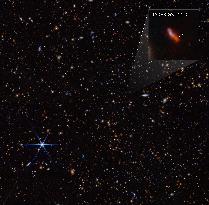
Handout infrared image from NASA’s James Webb Space Telescope (also called Webb or JWST) was taken by the NIRCam (Near-Infrared Camera) for the JWST Advanced Deep Extragalactic Survey, or JADES, program. The NIRCam data was used to determine which galaxies to study further with spectroscopic observations. One such galaxy, JADES-GS-z14-0 (shown in the pullout), was determined to be at a redshift of 14.32 (+0.08/-0.20), making it the current record-holder for the most distant known galaxy. This corresponds to a time less than 300 million years after the big bang. In the background image, blue represents light at 0.9, 1.15, and 1.5 microns (filters F090W + F115W + F150W), green is 2.0 and 2.77 microns (F200W + F277W), and red is 3.56, 4.1, and 4.44 microns (F356W + F410M + F444W). The pullout image shows light at 0.9 and 1.15 microns (F090W + F115W) as blue, 1.5 and 2.0 microns (F150W + F200W) as green, and 2.77 microns (F277W) as red. Photo by Nasa via ABACAPRESS.COM

  •  
Saturn Captured By James Webb Space Telescope

Saturn Captured By James Webb Space Telescope

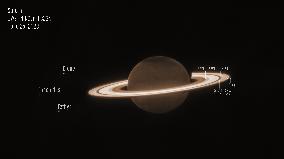
This image shows Saturn and some of its moons, captured by the James Webb Space Telescope’s (JWST) NIRCam instrument on June 25, 2023. In this monochrome image, NIRCam filter F323N (3.23 microns) was color mapped with an orange hue. JWST turned to the ringed world Saturn in June 2023 to conduct a deep search for new ring structure and faint moons. Saturn itself appears to extremely dark at the infrared wavelengths sensed by JWST’s Near-Infrared Camera (NIRCam), as methane gas absorbs almost all of the sunlight falling on the atmosphere. However, the icy rings stay relatively bright, leading to the unusual appearance of Saturn in the JWST image. Several very deep Saturn exposures taken together with this image were designed to test JWST’s capacity to detect faint moons around the planet and its bright rings. Any newly discovered moons would be important dynamical tracers of the current Saturn system as well as its past history. This context image clearly shows details within the ring system, along with many of

  •  
Saturn Captured By James Webb Space Telescope

Saturn Captured By James Webb Space Telescope

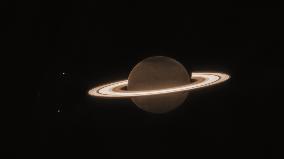
This image shows Saturn and some of its moons, captured by the James Webb Space Telescope’s (JWST) NIRCam instrument on June 25, 2023. In this monochrome image, NIRCam filter F323N (3.23 microns) was color mapped with an orange hue. JWST turned to the ringed world Saturn in June 2023 to conduct a deep search for new ring structure and faint moons. Saturn itself appears to extremely dark at the infrared wavelengths sensed by JWST’s Near-Infrared Camera (NIRCam), as methane gas absorbs almost all of the sunlight falling on the atmosphere. However, the icy rings stay relatively bright, leading to the unusual appearance of Saturn in the JWST image. Several very deep Saturn exposures taken together with this image were designed to test JWST’s capacity to detect faint moons around the planet and its bright rings. Any newly discovered moons would be important dynamical tracers of the current Saturn system as well as its past history. This context image clearly shows details within the ring system, along with many of

  •  
NASA Delays The James Webb Space Telescope Launch Again

NASA Delays The James Webb Space Telescope Launch Again

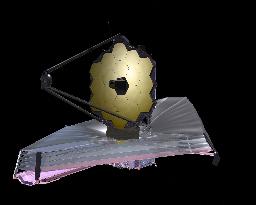
★Handout photo dated June 27, 2014 of The James Webb Space Telescope (sometimes called JWST or Webb) is an orbiting infrared observatory that will complement and extend the discoveries of the Hubble Space Telescope, with longer wavelength coverage and greatly improved sensitivity. Last summer, NASA and the European Space Agency (ESA) set an October 31, 2021, launch date for the $ 10 billion James Webb Space Telescope, but it's having to delay the science observatory's trip into space once again. Thankfully, the launch might take place just a few weeks later, in November or early December. A rescheduled date is unlikely to be confirmed until later this summer or perhaps in the fall. The instrument, successor to NASA's Hubble Space Telescope, which is the largest science observatory ever placed into space, will launch on a European Ariane 5 rocket from a spaceport in French Guiana. Photo by

  • Main
  • Top
  • Editorial
  • Creative
  • About Us
  • About ILG
  • Terms of use
  • Company
  • BEHIND
  • Price List
  • Single Plan
  • Monthly Plan
  • Services
  • Shooting
  • Rights Clearance
  • Support
  • FAQ
  • How To Buy
  • Contact Us
  • Become a Partner

© KYODO NEWS IMAGES INC

All Rights Reserved.

  • Editorial
  • Olympics
  • News
  • Sports
  • Japan
  • Tech
  • Royal
  • Disaster
  • NorthKorea
  • Old Japan
  • SNS
  • Creative
  • Food
  • Japan
  • Landscape
  • Animal
  • Popular
  • #Ukraine
  • #Thailand
  • #coronavirus
  • #N. Korea
  • #Russia
  • #China
  • #Ukraine
  • #Thailand
  • #coronavirus
  • #N. Korea
  • #Russia
  • #China
  • Food
  • Japan
  • Landscape
  • Animal
  • Olympics
  • News
  • Sports
  • Japan
  • Tech
  • Royal
  • Disaster
  • NorthKorea
  • Old Japan
  • SNS