•  
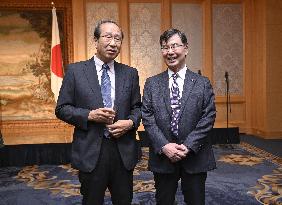
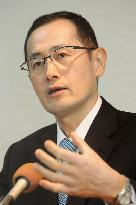
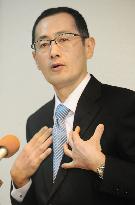
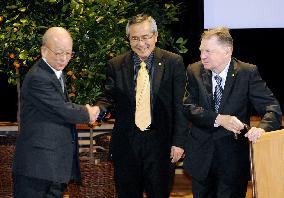
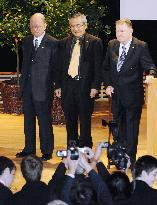
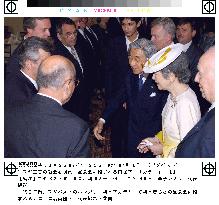
Nobel Prize winners Sakaguchi and Kitagawa

Nobel Prize winners Sakaguchi and Kitagawa

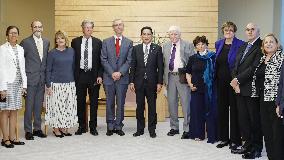
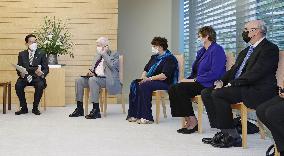
Japanese scientists, Susumu Kitagawa and Shimon Sakaguchi, winners of the 2025 Nobel Prize in chemistry and in physiology or medicine, respectively, attend a reception for visiting Swedish Crown Princess Victoria at a hotel in Tokyo on Oct. 13, 2025.

  •  
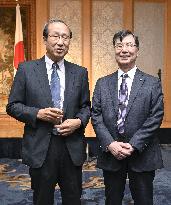
Nobel Prize winners Sakaguchi and Kitagawa

Nobel Prize winners Sakaguchi and Kitagawa

Japanese scientists, Susumu Kitagawa and Shimon Sakaguchi, winners of the 2025 Nobel Prize in chemistry and in physiology or medicine, respectively, attend a reception for visiting Swedish Crown Princess Victoria at a hotel in Tokyo on Oct. 13, 2025.

  •  
Nobel Prize winners Sakaguchi and Kitagawa

Nobel Prize winners Sakaguchi and Kitagawa

Japanese scientists, Susumu Kitagawa and Shimon Sakaguchi, winners of the 2025 Nobel Prize in chemistry and in physiology or medicine, respectively, attend a reception for visiting Swedish Crown Princess Victoria at a hotel in Tokyo on Oct. 13, 2025.

  •  
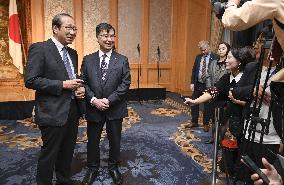
Nobel Prize winners Sakaguchi and Kitagawa

Nobel Prize winners Sakaguchi and Kitagawa

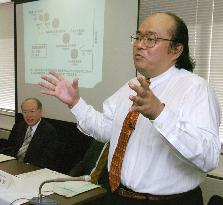
Japanese scientists, Susumu Kitagawa and Shimon Sakaguchi, winners of the 2025 Nobel Prize in chemistry and in physiology or medicine, respectively, speak with the press as they attend a reception for visiting Swedish Crown Princess Victoria at a hotel in Tokyo on Oct. 13, 2025.

  •  

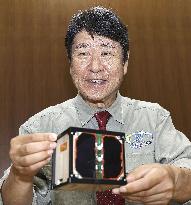
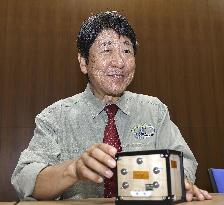
World's 1st wooden satellite

Takao Doi, a Japanese astronaut and a program-specific professor at Kyoto University, speaks about the world's first-ever wooden satellite "LignoSat" during an interview in Kyoto, western Japan, on May 28, 2024. Scientists at Kyoto University and Tokyo-based wood products company Sumitomo Forestry Co. developed the spacecraft, a cube with 10-centimeter sides and weighing 1 kilogram.(Kyodo)

  •  
World's 1st wooden satellite

World's 1st wooden satellite

Takao Doi, a Japanese astronaut and a program-specific professor at Kyoto University, speaks about the world's first-ever wooden satellite "LignoSat" during an interview in Kyoto, western Japan, on May 28, 2024. Scientists at Kyoto University and Tokyo-based wood products company Sumitomo Forestry Co. developed the spacecraft, a cube with 10-centimeter sides and weighing 1 kilogram.

  •  
World's 1st wooden satellite

World's 1st wooden satellite

Takao Doi, a Japanese astronaut and a program-specific professor at Kyoto University, speaks about the world's first-ever wooden satellite "LignoSat" during an interview in Kyoto, western Japan, on May 28, 2024. Scientists at Kyoto University and Tokyo-based wood products company Sumitomo Forestry Co. developed the spacecraft, a cube with 10-centimeter sides and weighing 1 kilogram.

  •  
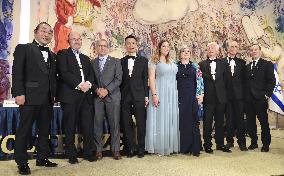
Japanese Wolf Prize winner Suga

Japanese Wolf Prize winner Suga

Professor Hiroaki Suga (far L) of the University of Tokyo, a winner of the Wolf Prize in Chemistry, poses with the other recipients of the prestigious awards given to outstanding scientists and artists, in Jerusalem on June 15, 2023.

  •  
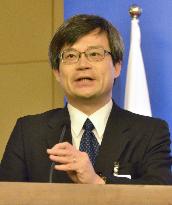
Japan, China hold 1st gov't meeting since leaders' summit

Japan, China hold 1st gov't meeting since leaders' summit

BEIJING, China - Hiroshi Amano, one of the three Japan-born scientists to win this year's Nobel Prize in Physics for inventing efficient blue light-emitting diodes, delivers a speech at the eighth Japan-China Energy Conservation Forum in China's capital Beijing on Dec. 28, 2014. The forum is the first major governmental meeting since Japanese Prime Minister Shinzo Abe's first meeting with Chinese President Xi Jinping on Nov. 10.

  •  
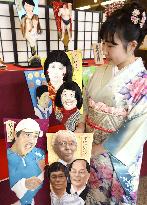
Japan's 2014 newsmakers featured on battledores

Japan's 2014 newsmakers featured on battledores

TOKYO, Japan - Tokyo's doll maker Kyugetsu Co. displays on Dec. 3, 2014, traditional Japanese "hagoita" battledores decorated with reliefs featuring this year's newsmakers such as red-hot tennis player Kei Nishikori, female comic duo "Nippon Erekiteru Rengo" and scientists awarded the Nobel Prize in Physics.

  •  
Winter illuminations light up Nagoya

Winter illuminations light up Nagoya

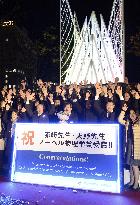
NAGOYA, Japan - Nagoya University professor Hiroshi Amano (front C) is congratulated on his winning of the 2014 Nobel Prize in Physics along with two other Japanese-born scientists, as he participated in a lighting ceremony to kick off winter illuminations in Nagoya, central Japan, on Nov. 14, 2014.

  •  
Winter illuminations light up Nagoya

Winter illuminations light up Nagoya

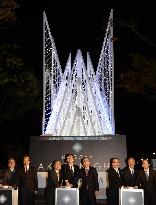
NAGOYA, Japan - Hiroshi Amano (4th from L), one of the three Japanese-born scientists who won the 2014 Nobel Prize in Physics, joins others at a ceremony to light up the "Rainbow Tree" on Nov. 14, 2014, kicking off winter illuminations around the Nagoya TV Tower in Nagoya, central Japan.

  •  
Nobel laureate Amano addresses gov't innovation panel

Nobel laureate Amano addresses gov't innovation panel

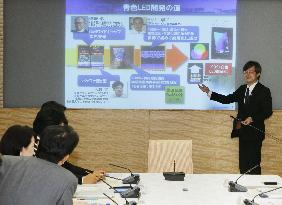
TOKYO, Japan - Nagoya University professor Hiroshi Amano, one of the three Japanese-born scientists awarded this year's Nobel Prize in Physics, delivers a lecture at the government's Council for Science, Technology and Innovation at the Prime Minister' Office in Tokyo on Oct. 22, 2014.

  •  
Fukuoka Tower illuminated with blue LEDs

Fukuoka Tower illuminated with blue LEDs

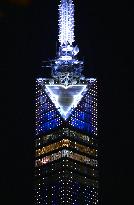
FUKUOKA, Japan - The 234-meter-tall Fukuoka Tower in the city of Fukuoka, southwestern Japan, is illuminated with blue light-emitting diodes and other lighting equipment on Oct. 7, 2014. Two Japanese scientists and one Japan-born scientist with U.S. citizenship were announced the same day as the winners of this year's Nobel Prize in Physics for the invention of blue LEDs.

  •  
PM Abe congratulates Nobel Prize winner Akasaki

PM Abe congratulates Nobel Prize winner Akasaki

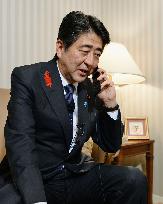
TOKYO, Japan - Japanese Prime Minister Shinzo Abe offers congratulations over the phone to Isamu Akasaki, professor at Meijo University, who was announced as a winner of the Nobel Prize in Physics 2014 for the invention of efficient blue LEDs with two other scientists, in Tokyo on Oct. 7, 2014. (Pool photo)

  •  
2014 Nobel winner Nakamura in 2005

2014 Nobel winner Nakamura in 2005

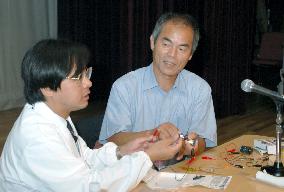
TOKYO, Japan - Shuji Nakamura (R), a Japan-born professor at UC Santa Barbara, conducts an experiment using light-emitting diodes before junior and senior high school students in Sakae village, Nagano Prefecture, central Japan, in July 2005. Nakamura was announced as a winner of the Nobel Prize in Physics 2014 for the invention of efficient blue LEDs along with two other Japanese scientists in October 2014.

  •  
1955 U.N. confab on atomic energy

1955 U.N. confab on atomic energy

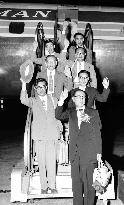
TOKYO, Japan - File photo shows the Japanese government delegation leaving Tokyo's Haneda airport on Aug. 5, 1955, for a U.N. conference on atomic energy in Geneva. U.S. documents show the Japanese government, facing U.S. pressure, moved to block presentations by Japanese scientists at the conference about the effects of radioactivity.

  •  
Yamanaka on STAP cells

Yamanaka on STAP cells

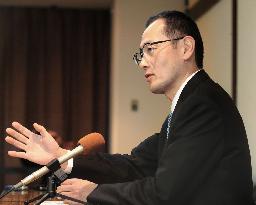
KYOTO, Japan - Nobel Prize-winning Japanese scientist Shinya Yamanaka speaks during a press conference in Kyoto, western Japan, on Feb. 10, 2014. Yamanaka spoke about the recent announcement by a group of scientists regarding stimulus-triggered acquisition of pluripotency, or STAP, cells.

  •  
Yamanaka on STAP cells

Yamanaka on STAP cells

KYOTO, Japan - Nobel Prize-winning Japanese scientist Shinya Yamanaka speaks during a press conference in Kyoto, western Japan, on Feb. 10, 2014. Yamanaka spoke about the recent announcement by a group of scientists regarding stimulus-triggered acquisition of pluripotency, or STAP, cells.

  •  
Yamanaka on STAP cells

Yamanaka on STAP cells

KYOTO, Japan - Nobel Prize-winning Japanese scientist Shinya Yamanaka speaks during a press conference in Kyoto, western Japan, on Feb. 10, 2014. Yamanaka spoke about the recent announcement by a group of scientists regarding stimulus-triggered acquisition of pluripotency, or STAP, cells.

  •  
Nobel laureates in chemistry give lectures

Nobel laureates in chemistry give lectures

STOCKHOLM, Sweden - (From L to R) Japanese scientists Akira Suzuki and Eiichi Negishi and American chemist Richard Heck, who won this year's Nobel Prize in chemistry, stand together after giving lectures at Stockholm University on Dec. 8, 2010.

  •  
Nobel laureates in chemistry give lectures

Nobel laureates in chemistry give lectures

STOCKHOLM, Sweden - (From L to R) Japanese scientists Akira Suzuki and Eiichi Negishi and American chemist Richard Heck, who won this year's Nobel Prize in chemistry, stand together after giving lectures at Stockholm University on Dec. 8, 2010.

  •  
Nobel laureates Suzuki, Negishi awarded Order of Culture

Nobel laureates Suzuki, Negishi awarded Order of Culture

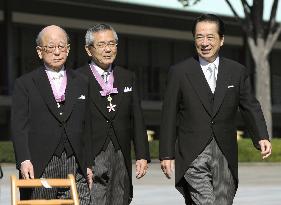
TOKYO, Japan - Akira Suzuki (L) and Eiichi Negishi (C), who shared the 2010 Nobel Prize in chemistry with American scientist Richard Heck, head to a photo session with Japanese Prime Minister Naoto Kan (R) at the Imperial Palace in Tokyo on Nov. 3, 2010, a national holiday, Culture Day. The two Japanese scientists received the Order of Culture from Emperor Akihito.

  •  
Japanese firms played key role in Pakistan's nuclear program

Japanese firms played key role in Pakistan's nuclear program

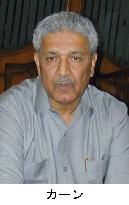
TOKYO, Japan - File photo of Pakistani disgraced nuclear scientist Abdul Qadeer Khan taken during an exclusive interview with Kyodo News on Aug. 16, 2000. Recent investigations by Kyodo News in Islamabad and Tokyo, which include comments by the scientists, have revealed that Japanese companies played a key role in supplying equipment used for Pakistan's nuclear development.

  •  
Nobel award ceremony takes place, 3 Japanese scientists honored

Nobel award ceremony takes place, 3 Japanese scientists honored

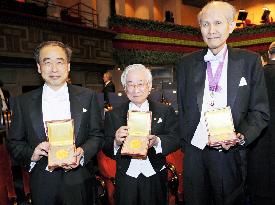
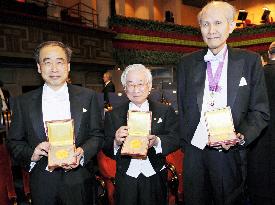
STOCKHOLM, Sweden - (From left) Makoto Kobayashi, professor emeritus at the High Energy Accelerator Research Organization, Toshihide Masukawa, professor emeritus at Kyoto University, and Osamu Shimomura, professor emeritus at Boston University, show their Nobel Prize medals after receiving them from Sweden's King Carl XVI Gustaf at the Stockholm Concert Hall on Dec. 10. (Pool photo by Kyodo)

  •  
3 Japanese scientists given Nobel prizes in ceremony

3 Japanese scientists given Nobel prizes in ceremony

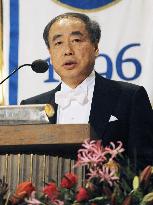
STOCKHOLM, Sweden - Makoto Kobayashi, professor emeritus at the High Energy Accelerator Research Organization, delivers a speech at a banquet held at Stockholm City Hall on Dec. 10 after receiving the Nobel Prize in physics in a ceremony. Kobayashi won the award along with Toshihide Masukawa, professor emeritus at Kyoto University, and Yoichiro Nambu, a Tokyo-born U.S. scientist and professor emeritus at the University of Chicago, who was unable to attend the ceremony. (Pool photo)

  •  
3 European scientists receive Japan science awards

3 European scientists receive Japan science awards

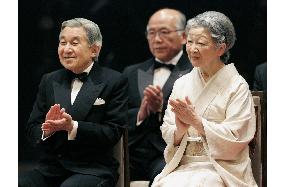
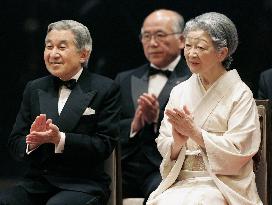
TOKYO, Japan - Japanese Emperor Akihito and Empress Michiko attend an award ceremony for the Japan Prize in Tokyo on April 19. Three scientists -- Peter Ashton of Britain, Albert Fert of France and Peter Grunberg of Germany -- received the prize from the Science and Technology Foundation of Japan.

  •  
Japan's M5 rocket lifts off, puts into orbit astronomical satellite

Japan's M5 rocket lifts off, puts into orbit astronomical satellite

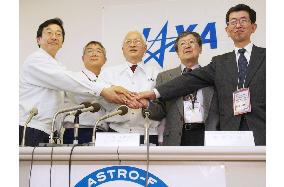
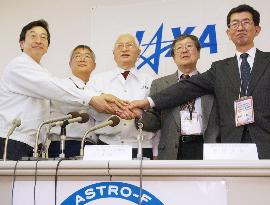
KOMOTSUKI, Japan - Scientists and officials of the Japan Aerospace Exploration Agency pose for photos at a press conference after the Japanese-developed M5 rocket, launched from the Uchinoura Space Center in Kimotsuki, Kagoshima Prefecture in southwestern Japan on Feb. 22, successfully put into orbit the infrared ray astronomical satellite Astro-F.

  •  
Int'l team of researchers completes rice genome decoding

Int'l team of researchers completes rice genome decoding

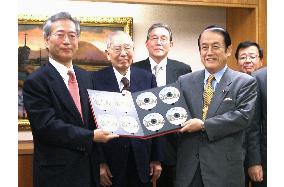
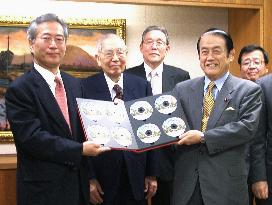
TOKYO, Japan - An international team of scientists has completed the sequencing of the rice genome, an accomplishment that should lead to the development of new varieties of rice to meet different needs. Researcher Takuji Sasaki (L) hands a CD set containing the research results to Japanese agriculture minister Yoshinobu Shimamura (R in front) in Tokyo on Dec. 13.

  •  
Japan, U.S. beef experts end 2-day talks

Japan, U.S. beef experts end 2-day talks

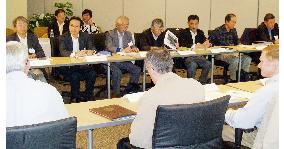
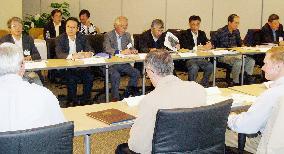
FORT COLLINS, United States - Japanese and U.S. scientists are seated for their second-day talks in Fort Collins, Colorado, on Oct. 5 aimed at discussing ways to lift Japan's import ban on American beef. The talks were intended to devise scientific measures to verify cows' ages, which may lead Japan to remove its ban on U.S. beef imports.

  •  
Japanese scientists create heaviest ever element

Japanese scientists create heaviest ever element

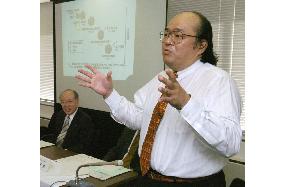
TOKYO, Japan - Kosuke Morita, a researcher at Riken, an independent administrative corporation formerly known as the Institute of Physical and Chemical Research, briefs reporters on the heaviest-ever new element, created by his team in Tokyo on Sept. 28. Riken President Ryoji Noyori, a 2001 Nobel Prize laureate in chemistry, sits at left.

  •  
Scientists observe total solar eclipse in Antarctica

Scientists observe total solar eclipse in Antarctica

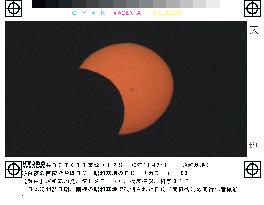
SHOWA BASE, Antaractica - The sun begins to disappear around 1:14 a.m. on Nov. 24 during a rare total solar eclipse observed in Antarctica. This pool photo was taken by a Japanese reporter at Japan's Showa Base.

  •  
Scientists begin drilling Mt. Unzen volcano for magma

Scientists begin drilling Mt. Unzen volcano for magma

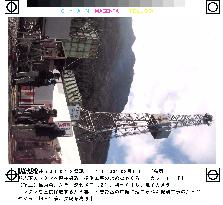
SHIMABARA, Japan - Researchers gather Feb. 13 at a tower that has been set up near the lava dome of Fugen, the main peak of Mt. Unzen in Nagasaki Prefecture. Japanese and foreign researchers began the world's first volcano-drilling experiment on the day to extract magma samples in an effort to clarify the mechanism of volcanic eruption.

  •  
(1)Nobel laureate Koshiba relishes honor

(1)Nobel laureate Koshiba relishes honor

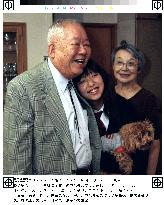
TOKYO, Japan - Japanese physicist Masatoshi Koshiba, who won the 2002 Nobel Prize in Physics with two American scientists, smiles as he gets words of congratulations from his wife Kyoko (R) and granddaughter Ami Fujii (C) at his residence in Tokyo late at night Oct. 8. ''My wife, daughter, granddaughter became formal all of a sudden and said, 'Congratulations.' I just said to them, 'Yeah,''' Koshiba said, smiling.

  •  
(5) Japanese emperor, empress in Hungary

(5) Japanese emperor, empress in Hungary

BUDAPEST, Hungary - Japanese Emperor Akihito (3rd from R), and Empress Michiko (2nd from R) are greeted by scientists from a Hungarian science academy in Budapest on July 19 before a luncheon with them. (pool photo)

  •  
Noyori heads to Stockholm for Nobel Prize ceremony

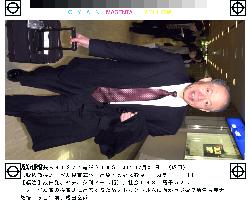
Noyori heads to Stockholm for Nobel Prize ceremony

NARITA, Japan - Japanese chemist Ryoji Noyori, who won the 2001 Nobel Prize in Chemistry along with two other scientists, prepares to leave Narita airport, east of Tokyo, on Dec. 5 to attend an award ceremony in Stockholm on Dec. 10.

  •  
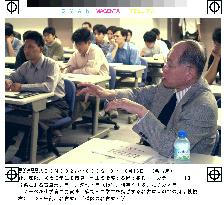
Noyori with students for 1st time since winning Nobel prize

Noyori with students for 1st time since winning Nobel prize

NAGOYA, Japan - Japanese chemist Ryoji Noyori, who along with two other scientists won the 2001 Nobel Prize in Chemistry, makes his first public appearance before students Oct. 13 at a Nagoya University academic venue, since being proclaimed a winner of the coveted prize. During the session, Noyori, 63, listened to students read their research papers.

  •  
Japanese scientist Shirakawa wins Nobel Prize in Chemistry

Japanese scientist Shirakawa wins Nobel Prize in Chemistry

STOCKHOLM, Sweden - File photo shows Hideki Shirakawa, one of three scientists who won the 2000 Nobel Prize in Chemistry. The Royal Swedish Academy of Sciences said Oct. 10 the three won the award for the discovery and development of conductive polymers. Shirakawa, an honorary professor with the University of Tsukuba, northeast of Tokyo, is the ninth Japanese to win a Nobel prize and the country's second person to be awarded the Nobel Prize in Chemistry after Kenichi Fukui in 1981.

  •  
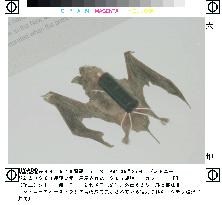
Replica of U.S. kamikaze bat on display

Replica of U.S. kamikaze bat on display

SYDNEY, Australia - A replica of a bat with a small napalm bomb strapped to its chest, which was devised during World War II by U.S. military scientists for attacking Japanese cities. The replica, reconstructed by Richard Scott-Child of the Australian Museum in Sydney, is currently on display at the museum. Plans called for hundreds of the bats to be used, but the project was canceled due to embarrassing setbacks during tests.

  •  
Japan Prize laureates meet with PM Kishida

Japan Prize laureates meet with PM Kishida

Japanese Prime Minister Fumio Kishida (C) poses for a photo with Japan Prize laureates, including Katalin Kariko (3rd from R), senior vice president at BioNTech SE, at his office in Tokyo on April 15, 2022. The Japan Prize is awarded annually to scientists and engineers from around the world who have made significant contributions to the advancement of science and technology.

  •  
Japan Prize laureates meet with PM Kishida

Japan Prize laureates meet with PM Kishida

Japanese Prime Minister Fumio Kishida (far L) meets with Japan Prize laureates, including Katalin Kariko (2nd from R), senior vice president at BioNTech SE, at his office in Tokyo on April 15, 2022. The Japan Prize is awarded annually to scientists and engineers from around the world who have made significant contributions to the advancement of science and technology.

  •  
Noyori heads to Stockholm for Nobel Prize ceremony

Noyori heads to Stockholm for Nobel Prize ceremony

NARITA, Japan - Japanese chemist Ryoji Noyori, who won the 2001 Nobel Prize in Chemistry along with two other scientists, prepares to leave Narita airport, east of Tokyo, on Dec. 5 to attend an award ceremony in Stockholm on Dec. 10.

  •  
Japanese scientists create heaviest ever element

Japanese scientists create heaviest ever element

TOKYO, Japan - Kosuke Morita, a researcher at Riken, an independent administrative corporation formerly known as the Institute of Physical and Chemical Research, briefs reporters on the heaviest-ever new element, created by his team in Tokyo on Sept. 28. Riken President Ryoji Noyori, a 2001 Nobel Prize laureate in chemistry, sits at left. (Kyodo)

  •  
Japan, U.S. beef experts end 2-day talks

Japan, U.S. beef experts end 2-day talks

FORT COLLINS, United States - Japanese and U.S. scientists are seated for their second-day talks in Fort Collins, Colorado, on Oct. 5 aimed at discussing ways to lift Japan's import ban on American beef. The talks were intended to devise scientific measures to verify cows' ages, which may lead Japan to remove its ban on U.S. beef imports. (Kyodo)

  •  
Int'l team of researchers completes rice genome decoding

Int'l team of researchers completes rice genome decoding

TOKYO, Japan - An international team of scientists has completed the sequencing of the rice genome, an accomplishment that should lead to the development of new varieties of rice to meet different needs. Researcher Takuji Sasaki (L) hands a CD set containing the research results to Japanese agriculture minister Yoshinobu Shimamura (R in front) in Tokyo on Dec. 13.

  •  
Japan's M5 rocket lifts off, puts into orbit astronomical satell

Japan's M5 rocket lifts off, puts into orbit astronomical satell

KOMOTSUKI, Japan - Scientists and officials of the Japan Aerospace Exploration Agency pose for photos at a press conference after the Japanese-developed M5 rocket, launched from the Uchinoura Space Center in Kimotsuki, Kagoshima Prefecture in southwestern Japan on Feb. 22, successfully put into orbit the infrared ray astronomical satellite Astro-F. (Kyodo)

  •  
3 European scientists receive Japan science awards

3 European scientists receive Japan science awards

TOKYO, Japan - Japanese Emperor Akihito and Empress Michiko attend an award ceremony for the Japan Prize in Tokyo on April 19. Three scientists -- Peter Ashton of Britain, Albert Fert of France and Peter Grunberg of Germany -- received the prize from the Science and Technology Foundation of Japan. (Kyodo)

  •  
Nobel award ceremony takes place, 3 Japanese scientists honored

Nobel award ceremony takes place, 3 Japanese scientists honored

STOCKHOLM, Sweden - (From left) Makoto Kobayashi, professor emeritus at the High Energy Accelerator Research Organization, Toshihide Masukawa, professor emeritus at Kyoto University, and Osamu Shimomura, professor emeritus at Boston University, show their Nobel Prize medals after receiving them from Sweden's King Carl XVI Gustaf at the Stockholm Concert Hall on Dec. 10. (Pool photo by Kyodo) (Kyodo)

  •  
Nobel award ceremony takes place, 3 Japanese scientists honored

Nobel award ceremony takes place, 3 Japanese scientists honored

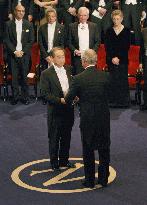
STOCKHOLM, Sweden - Makoto Kobayashi, professor emeritus at the High Energy Accelerator Research Organization, receives his medal and diploma from Sweden's King Carl XVI Gustaf at the Stockholm Concert Hall on Dec. 10. Kobayashi won the Nobel Prize in physics along with Toshihide Masukawa, professor emeritus at Kyoto University and Yoichiro Nambu, a Tokyo-born U.S. scientist and professor emeritus at the University of Chicago. (Pool photo by Kyodo) (Kyodo)

  •  
Nobel award ceremony takes place, 3 Japanese scientists honored

Nobel award ceremony takes place, 3 Japanese scientists honored

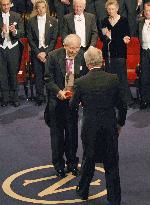
STOCKHOLM, Sweden - Osamu Shimomura, professor emeritus at Boston University, receives his medal and diploma from Sweden's King Carl XVI Gustaf at the Stockholm Concert Hall on Dec. 10. Shimomura shared the prize in chemistry with two other scientists -- Martin Chalfie, a professor at Columbia University, and Roger Tsien, a professor at the University of California in San Diego. (Pool photo by Kyodo) (Kyodo)

  • Main
  • Top
  • Editorial
  • Creative
  • About Us
  • About ILG
  • Terms of use
  • Company
  • BEHIND
  • Price List
  • Single Plan
  • Monthly Plan
  • Services
  • Shooting
  • Rights Clearance
  • Support
  • FAQ
  • How To Buy
  • Contact Us
  • Become a Partner

© KYODO NEWS IMAGES INC

All Rights Reserved.

  • Editorial
  • Olympics
  • News
  • Sports
  • Japan
  • Tech
  • Royal
  • Disaster
  • NorthKorea
  • Old Japan
  • SNS
  • Creative
  • Food
  • Japan
  • Landscape
  • Animal
  • Popular
  • #Ukraine
  • #Russia
  • #coronavirus
  • #N. Korea
  • #China
  • #Thailand
  • #Ukraine
  • #Russia
  • #coronavirus
  • #N. Korea
  • #China
  • #Thailand
  • Food
  • Japan
  • Landscape
  • Animal
  • Olympics
  • News
  • Sports
  • Japan
  • Tech
  • Royal
  • Disaster
  • NorthKorea
  • Old Japan
  • SNS