•  
Guardian deity carved out of tsunami-hit cherry trees

Guardian deity carved out of tsunami-hit cherry trees

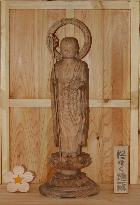
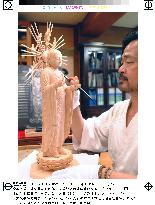
SENDAI, Japan - A 60-centimeter-tall Jizo, a guardian deity of children, made of wood from two cherry trees that temporarily survived the March 2011 massive tsunami in the town of Onagawa, Miyagi Prefecture in northeastern Japan, is pictured on March 12, 2014. A consecration ceremony was held in the town the same day.

  •  
Guardian deity carved out of tsunami-hit cherry trees

Guardian deity carved out of tsunami-hit cherry trees

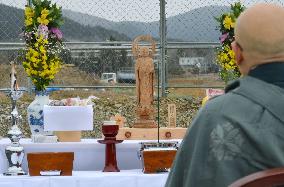
SENDAI, Japan - A consecration ceremony is held on March 12, 2014, in the town of Onagawa, Miyagi Prefecture in northeastern Japan, for a 60-centimeter-tall Jizo, a guardian deity of children, carved out of wood from two cherry trees that temporarily survived the March 2011 massive tsunami in the town.

  •  
Buddhist monk with jizo deity statue

Buddhist monk with jizo deity statue

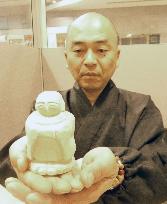
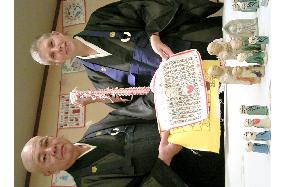
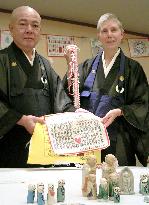
SENDAI, Japan - Toshiaki Uda, the head priest of Buddhist temple Seiunji in Koshu, Yamanashi Prefecture, shows a palm-sized wooden jizo deity in Sendai, Miyagi Prefecture, on Jan. 12, 2012. Monks and a Buddhist icon craftsman have launched a project to deliver 1,000 compact jizo deity statues to areas affected by the March 2011 earthquake and tsunami.

  •  
Disaster-hit Ishinomaki in March and June

Disaster-hit Ishinomaki in March and June

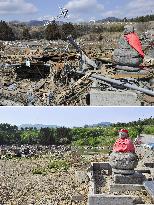
ISHINOMAKI, Japan - Combined photo shows an area ravaged by the March 11 earthquake and tsunami in Ishinomaki, Miyagi Prefecture, on March 24, 2011 (top frame), nearly two weeks after the disaster, and the same spot on June 4, 2011 (bottom frame). The debris has been cleared away and a stone statue of a Buddhist deity called Jizo wears a hood in the bottom picture.

  •  
Buddhist deity statue in rubble

Buddhist deity statue in rubble

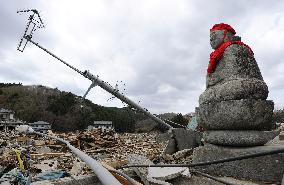
ISHINOMAKI, Japan - A stone statue of the Buddhist deity called Jizo sits among debris in the quake and tsunami-hit Ishinomaki, Miyagi Prefecture, on April 21, 2011.

  •  
Japan film on Hiroshima A-bomb 'Face of Jizo' premieres in U.S.

Japan film on Hiroshima A-bomb 'Face of Jizo' premieres in U.S.

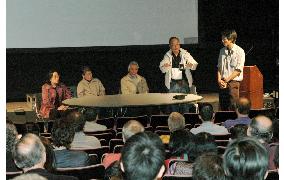
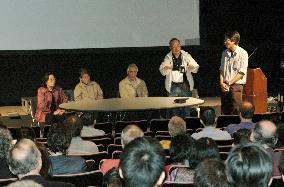
BOSTON, United States - A Japanese film depicting the struggles of a Japanese woman, who survives the Aug. 6, 1945 atomic bombing of Hiroshima, premiered in the United States on April 21 at a Massachusetts Institute of Technology theater as part of the Global Hibakusha (A-bomb survivors) Film Festival being held in Boston on April 14-24. Photo shows A-bomb survivors responding to questions from the film audience after the show.

  •  
American Zen priest promotes Jizo project for Hiroshima, Nagasaki

American Zen priest promotes Jizo project for Hiroshima, Nagasaki

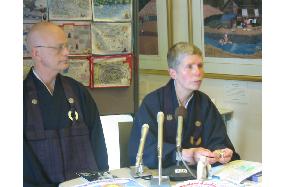
KYOTO, Japan - Jan Chozen Bays (R), an American Zen master, speaks with reporters at a Kyoto hotel on Aug. 4. She called for people to join a project to make some 270,000 statues and written images of Jizo Bodhisattva to represent the victims of the atomic bombing of Hiroshima and Nagasaki and promote world peace. Bays said she came up with the idea when she visited Hiroshima and Nagasaki two years ago. Jizo Bodhisattva is the guardian of deceased children, expectant mothers, firemen, travelers, and pilgrims.

  •  
U.S. Zen priest calls to prepare 300,000 Jizos for A-bomb victims

U.S. Zen priest calls to prepare 300,000 Jizos for A-bomb victims

NAGASAKI, Japan - Jan Chozen Bays (R) an American Zen priest, speaks at a news conference in Nagasaki on May 13. Bays is seeking to gather about 300,000 handmade images and statues of Jizo, one of the most beloved divinities in Japan, by summer 2005 in memory of every victim of the 1945 atomic bombings of Hiroshima and Nagasaki.

  •  
New 'Jizo Bosatsu' statue almost completed

New 'Jizo Bosatsu' statue almost completed

KYOTO, Japan - A new 'Jizo Bosatsu,' (an image of a Buddhist saint), is almost complete. The original centuries-old wooden statue was destroyed in a suspected arson attack at the main hall of the Jakko-in Temple in Kyoto on May 9. The 2.6-meter wooden statue, housed in the main hall, had been designated by the state as an important cultural treasure. The new statue is 42 centimeters tall.

  •  
Japan film on Hiroshima A-bomb 'Face of Jizo' premieres in U.S.

Japan film on Hiroshima A-bomb 'Face of Jizo' premieres in U.S.

BOSTON, United States - A Japanese film depicting the struggles of a Japanese woman, who survives the Aug. 6, 1945 atomic bombing of Hiroshima, premiered in the United States on April 21 at a Massachusetts Institute of Technology theater as part of the Global Hibakusha (A-bomb survivors) Film Festival being held in Boston on April 14-24. Photo shows A-bomb survivors responding to questions from the film audience after the show. (Kyodo)

  •  
American Zen priest promotes Jizo project for Hiroshima, Nagasak

American Zen priest promotes Jizo project for Hiroshima, Nagasak

KYOTO, Japan - Jan Chozen Bays (R), an American Zen master, speaks with reporters at a Kyoto hotel on Aug. 4. She called for people to join a project to make some 270,000 statues and written images of Jizo Bodhisattva to represent the victims of the atomic bombing of Hiroshima and Nagasaki and promote world peace. Bays said she came up with the idea when she visited Hiroshima and Nagasaki two years ago. Jizo Bodhisattva is the guardian of deceased children, expectant mothers, firemen, travelers, and pilgrims. (Kyodo)

  •  
Shed built to house tsunami-swept stone deity statue in north Japan

Shed built to house tsunami-swept stone deity statue in north Japan

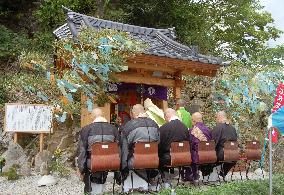
Buddhist monks pray during a service in Kesennuma, Miyagi Prefecture, on July 24, 2015, to celebrate the completion of a shed housing a "Jizo" stone guardian deity statue that was swept away in the 2011 earthquake and tsunami disaster but later found from wreckage in the northeastern Japan city. (Kyodo) ==Kyodo

  •  
Visitors pray in Zenizuka Jizo-do at Sensoji

Visitors pray in Zenizuka Jizo-do at Sensoji

Visitors pray in front the Kankan Jizo deity at Zenizuka Jizo-do hall on the premises of Asakusa's Sensoji Temple in Tokyo on Jan. 17, 2015. If you tap the Kankan Jizo with a stone in front, it is said to give you good luck. (Kyodo) ==Kyodo

  •  
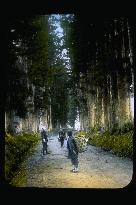
A row of Japanese cedar trees along the Nikko Road

A row of Japanese cedar trees along the Nikko Road

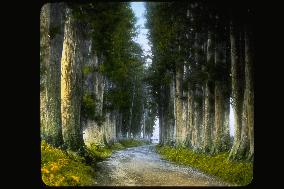
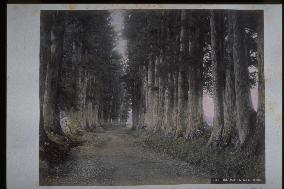
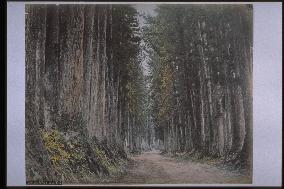
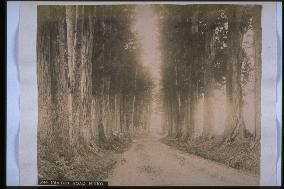
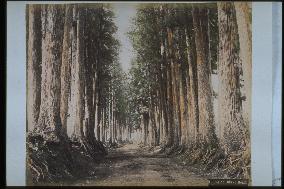
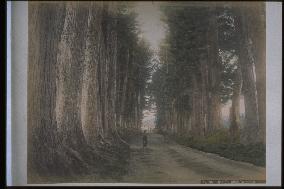
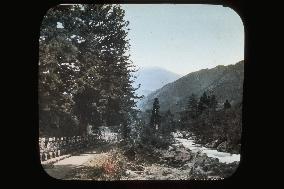
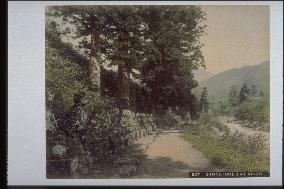
The cedars along Nikko Highway were donated by Matsudaira Masatsuna on the 33rd anniversary of the death of Shogun Tokugawa Ieyasu. The building visible in the background probably stands near Oiwake Jizo. This area was beautiful at the time. The sky is visible between the trees. It is said that people could walk here by the light of the moon and stars.==Date:unknown, Place:Nikko, Photo:unknown, (Credit:Nagasaki University Library/Kyodo News Images) [Cabinet Number98‐38‐0]

  •  
Rokumichijizo Statues,Hakone

Rokumichijizo Statues,Hakone

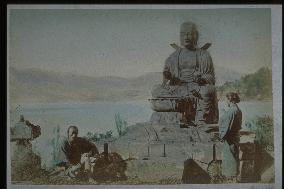
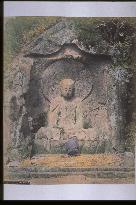
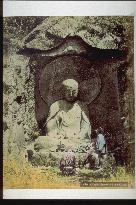
This is 3.2m magaibotoke (the largest in Kanto region during the Kamakura Period) carved into over seven meter high pyrozene andesite rock for jizo worship during Middle Ages. Although there is only one jizo here, this is called Rokudo (Six Way) Jizo because this is one of the group of stone buddhas around Shojingaike Pond which was regarded as the crossroad of Rokudo (lit. Six Road: Buddhist terminology meaning transmigration in the six paths of life). As there is no shack-like cover over the jizo, this photo was taken after 1878.==Date:unknown, Place:Hakone, Photo:unknown, (Credit:Nagasaki University Library/Kyodo News Images) [Cabinet Number98‐27‐0]

  •  
A row of Japanese cedar trees along the Nikko Road

A row of Japanese cedar trees along the Nikko Road

The cedars along Nikko Highway were donated by Matsudaira Masatsuna on the 33rd anniversary of the death of Shogun Tokugawa Ieyasu. The building visible in the background probably stands near Oiwake Jizo. This area was beautiful at the time. The sky is visible between the trees. It is said that people could walk here by the light of the moon and stars.==Date:1904, Place:Nikko, Photo:unknown, (Credit:Nagasaki University Library/Kyodo News Images) [Cabinet Number98‐7‐0]

  •  
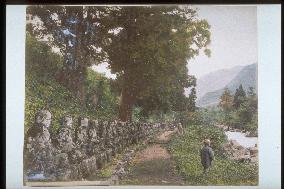
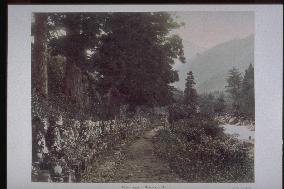
The Hundred Stone Statues of Jizo at Ganmangahara,Nikko

The Hundred Stone Statues of Jizo at Ganmangahara,Nikko

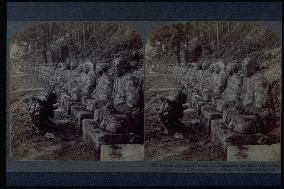
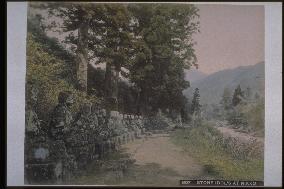
This famous sight on Daiya River is known by names such as Narabi-jizo, Bake-jizo, and Hyaku-jizo. It is also known as Kanman-ga-fuchi or Ganman-ga-fuchi. Many of Narabi-jizo were either lost or destroyed by the flood of 1902.==Date:1904, Place:Nikko, Photo:Underwood, (Credit:Nagasaki University Library/Kyodo News Images) [Cabinet Number97‐59‐0]

  •  
Carrying a Jizo

Carrying a Jizo

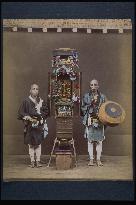
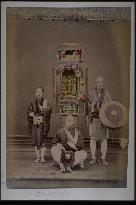
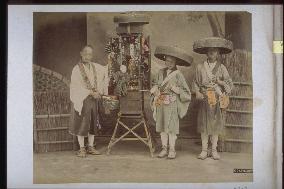
People in pilgrim's garb carry a portable Buddhist altar. They chant a Buddhist prayer while striking a metal gong. The style of the altar suggests that they are members of the Pure Land Sect. They may be a son and his parents.==Date:unknown, Place:unknown, Photo:unknown, (Credit:Nagasaki University Library/Kyodo News Images) [Cabinet Number96‐87‐0]

  •  
A row of Japanese cedar trees along the Nikko Road

A row of Japanese cedar trees along the Nikko Road

The cedars along Nikko Highway were donated by Matsudaira Masatsuna on the 33rd anniversary of the death of Shogun Tokugawa Ieyasu. The building visible in the background probably stands near Oiwake Jizo. This area was beautiful at the time. The sky is visible between the trees. It is said that people could walk here by the light of the moon and stars.==Date:unknown, Place:Nikko, Photo:unknown, (Credit:Nagasaki University Library/Kyodo News Images) [Cabinet Number93‐16‐0]

  •  
Carrying a Jizo

Carrying a Jizo

People in pilgrim's garb carry a portable Buddhist altar. They chant a Buddhist prayer while striking a metal gong. The style of the altar suggests that they are members of the Pure Land Sect. They may be a son and his parents.==Date:unknown, Place:unknown, Photo:unknown, (Credit:Nagasaki University Library/Kyodo News Images) [Cabinet Number92‐36‐0]

  •  
Dainichi-do Temple,Nikko

Dainichi-do Temple,Nikko

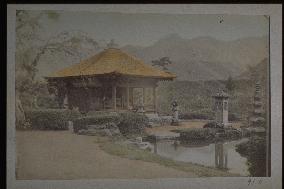
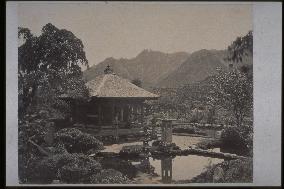
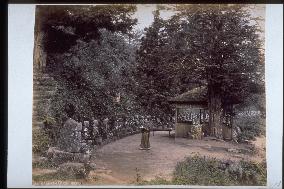
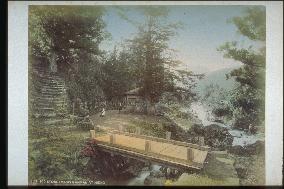
This famous sight on the Chuzenji Road running beside Daiya River was a popular stopover for tourists visiting Nikko, Kanmanga-fuchi and Urami Falls. The garden, including Dainichi Hall, was destroyed by the flood of 1902, and the remaining Jizo Hall was washed away by another flood in 1919. These severe natural disasters changes the topography of the area.==Date:unknown, Place:Nikko, Photo:unknown, (Credit:Nagasaki University Library/Kyodo News Images) [Cabinet Number91‐6‐0]

  •  
Statues of Enmeijizo (giving a long-life) by Lake Ashi

Statues of Enmeijizo (giving a long-life) by Lake Ashi

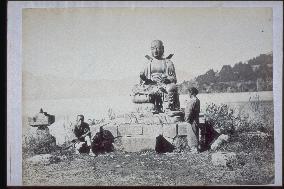
This is Enmei Jizo in autumn, 1871 after Haibutsukishaku (anti-Buddhist movement at the beginning of the Meiji era). Compared with the image in catalogue #5365, the figure's halo is broken, the accompanying jizo figures on the side are gone, and the stone lanterns have been destroyed. There were many stone Buddhas and stone towers as well as this Enmei Jizo in Tokaido Hakon Sanchuzu, documented by a ukiyoe print made by Sadahide Goun during Edo era. It is reported that many were thrown into the lake.==Date:unknown, Place:Hakone, Photo:unknown, (Credit:Nagasaki University Library/Kyodo News Images) [Cabinet Number90‐45‐0]

  •  
The Hundred Stone Statues of Jizo at Ganmangahara,Nikko

The Hundred Stone Statues of Jizo at Ganmangahara,Nikko

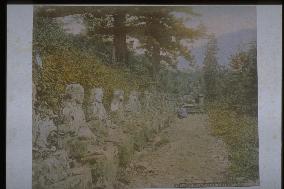
This famous sight on Daiya River is known by names such as Narabi-jizo, Bake-jizo, and Hyaku-jizo. It is also known as Kanman-ga-fuchi or Ganman-ga-fuchi. Oya-jizo, the head of which was washed away by the flood of 1902, is visible at the end of the road.==Date:unknown, Place:Nikko, Photo:unknown, (Credit:Nagasaki University Library/Kyodo News Images) [Cabinet Number88‐14‐0]

  •  
A row of Japanese cedar trees along the Nikko Road

A row of Japanese cedar trees along the Nikko Road

Cedar trees line a street near present-day Imaichi City. This is similar to the road from Oiwake-jizo, at the crossroads of Nikko Highway in Imaichi City and Reiheishi Highway leading to Morimoto Village.==Date:unknown, Place:Nikko, Photo:A. Farsari, (Credit:Nagasaki University Library/Kyodo News Images) [Cabinet Number82‐32‐0]

  •  
Rokumichijizo Statues,Hakone

Rokumichijizo Statues,Hakone

This is Hakone Rokudo Jizo. The photo taken by French captain Louis Kreitmann who traveled Japan between February, 1876 and May 1878 shows the shack-like frame around the jizo. However, it is not visible on this photo. Thus, this must have been taken after that period. This jizo, carved in 1300, was the biggest magaibutsu (a Buddhist image carved into the surface of natural rock) in Kanto region during the Kamakura Period.==Date:unknown, Place:Hakone, Photo:A. Farsari, (Credit:Nagasaki University Library/Kyodo News Images) [Cabinet Number82‐28‐0]

  •  
The Hundred Stone Statues of Jizo at Ganmangahara,Nikko

The Hundred Stone Statues of Jizo at Ganmangahara,Nikko

This famous sight on Daiya River is known by names such as Narabi-jizo, Bake-jizo, and Hyaku-jizo. It is also known as Kanman-ga-fuchi or Ganman-ga-fuchi. Oya-jizo, the head of which was washed away by the flood of 1902, is visible at the end of the road.==Date:unknown, Place:Nikko, Photo:Tamamura Kozaburo, (Credit:Nagasaki University Library/Kyodo News Images) [Cabinet Number80‐49‐0]

  •  
Dainichi-do Temple,Nikko

Dainichi-do Temple,Nikko

This famous sight on the Chuzenji Road running beside Daiya River was a popular stopover for tourists visiting Nikko, Kanmanga-fuchi and Urami Falls. The garden, including Dainichi Hall, was destroyed by the flood of 1902, and the remaining Jizo Hall was washed away by another flood in 1919. These severe natural disasters changes the topography of the area.==Date:unknown, Place:Nikko, Photo:Ogawa Kazumasa, (Credit:Nagasaki University Library/Kyodo News Images) [Cabinet Number67‐34‐2]

  •  
A row of Japanese cedar trees along the Nikko Road

A row of Japanese cedar trees along the Nikko Road

The cedars along Nikko Highway were donated by Matsudaira Masatsuna on the 33rd anniversary of the death of Shogun Tokugawa Ieyasu. The building visible in the background probably stands near Oiwake Jizo. This area was beautiful at the time. The sky is visible between the trees. It is said that people could walk here by the light of the moon and stars.==Date:unknown, Place:Imaichi, Photo:unknown, (Credit:Nagasaki University Library/Kyodo News Images) [Cabinet Number61‐5‐0]

  •  
Mt. Fuji seen from Suzukawa

Mt. Fuji seen from Suzukawa

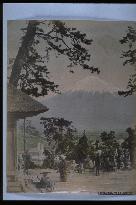
Northern view of Mt. Fuji from Jizo-do on the sand dune of Suzukawa in Fuji City. Stone jizo statues line a path in the temple grounds, and the Jizo-do temple is partially visible. The four people are obviously posing for the photograph. The train tracks of Tokaido Line and Kawai Bridge are visible in the background, indicating that the photograph was taken after 1890.==Date:unknown, Place:Shizuoka, Photo:unknown, (Credit:Nagasaki University Library/Kyodo News Images) [Cabinet Number59‐47‐0]

  •  
The Hundred Stone Statues of Jizo at Ganmangahara,Nikko

The Hundred Stone Statues of Jizo at Ganmangahara,Nikko

This famous sight on Daiya River is known by names such as Narabi-jizo, Bake-jizo, and Hyaku-jizo. It is also known as Kanman-ga-fuchi or Ganman-ga-fuchi. Oya-jizo, the head of which was washed away by the flood of 1902, is visible at the end of the road.==Date:unknown, Place:Nikko, Photo:unknown, (Credit:Nagasaki University Library/Kyodo News Images) [Cabinet Number54‐48‐0]

  •  
A row of Japanese cedar trees along the Nikko Road

A row of Japanese cedar trees along the Nikko Road

The cedars along Nikko Highway were donated by Matsudaira Masatsuna on the 33rd anniversary of the death of Shogun Tokugawa Ieyasu. The building visible in the background probably stands near Oiwake Jizo. This area was beautiful at the time. The sky is visible between the trees. It is said that people could walk here by the light of the moon and stars.==Date:unknown, Place:Imaichi, Photo:unknown, (Credit:Nagasaki University Library/Kyodo News Images) [Cabinet Number54‐43‐0]

  •  
A row of Japanese cedar trees along the Nikko Road

A row of Japanese cedar trees along the Nikko Road

Cedar trees line a street near present-day Imaichi City. This is similar to the road from Oiwake-jizo, at the crossroads of Nikko Highway in Imaichi City and Reiheishi Highway leading to Morimoto Village.==Date:unknown, Place:Imaichi, Photo:unknown, (Credit:Nagasaki University Library/Kyodo News Images) [Cabinet Number54‐34‐0]

  •  
Dainichi-do Temple,Nikko

Dainichi-do Temple,Nikko

This famous sight on the Chuzenji Road running beside Daiya River was a popular stopover for tourists visiting Nikko, Kanmanga-fuchi and Urami Falls. The garden, including Dainichi Hall, was destroyed by the flood of 1902, and the remaining Jizo Hall was washed away by another flood in 1919. These severe natural disasters changes the topography of the area.==Date:unknown, Place:Nikko, Photo:unknown, (Credit:Nagasaki University Library/Kyodo News Images) [Cabinet Number54‐29‐0]

  •  
A row of Japanese cedar trees along the Nikko Road

A row of Japanese cedar trees along the Nikko Road

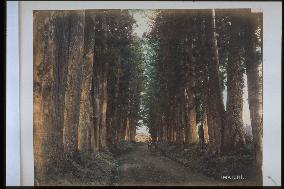
The cedars along Nikko Highway were donated by Matsudaira Masatsuna on the 33rd anniversary of the death of Shogun Tokugawa Ieyasu. The building visible in the background probably stands near Oiwake Jizo. This area was beautiful at the time. The sky is visible between the trees.==Date:unknown, Place:Imaichi, Photo:unknown, (Credit:Nagasaki University Library/Kyodo News Images) [Cabinet Number54‐18‐0]

  •  
The Six Statues of Jizo

The Six Statues of Jizo

A different photograph of the Rokujizo figures was carried in the October 16, 1871 (September 3 on the lunar calendar) issue of The Far East (photograph #1082). In photographs of Kamakura taken in the early Meiji Period, however, the structure in which the jizo statues are housed and the atmosphere of the surroundings are different. This casts some doubt on whether the jizo depicted here are those in Kamakura. The exact date of the photograph is unknown.==Date:unknown, Place:Kamakura, Photo:unknown, (Credit:Nagasaki University Library/Kyodo News Images) [Cabinet Number51‐48‐0]

  •  
The Hundred Stone Statues of Jizo at Ganmangahara,Nikko

The Hundred Stone Statues of Jizo at Ganmangahara,Nikko

This famous sight on Daiya River is known by names such as Narabi-jizo, Bake-jizo, and Hyaku-jizo. It is also known as Kanman-ga-fuchi or Ganman-ga-fuchi. Oya-jizo, the head of which was washed away by the flood of 1902, is visible at the end of the road.==Date:unknown, Place:Nikko, Photo:unknown, (Credit:Nagasaki University Library/Kyodo News Images) [Cabinet Number47‐28‐0]

  •  
Carrying a stone statue of the guardian deity,Jizo

Carrying a stone statue of the guardian deity,Jizo

There are many photos of pilgrims traveling around Japan at the end of the Edo era. The two in this photo carries this Jizo on their backs, and ring bells to collect donations on the way.==Date:unknown, Place:unknown, Photo:Ogawa Kazumasa, (Credit:Nagasaki University Library/Kyodo News Images) [Cabinet Number44‐14‐0]

  •  
Carrying a stone statue of the guardian deity,Jizo

Carrying a stone statue of the guardian deity,Jizo

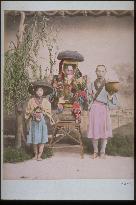
There are many photos of pilgrims in temples and spiritual sites all over Japan among the old photos at the end of the Edo era. These photos are taken after the mid-Meiji era after that. The three form a group, and they carry Jizo on their backs, and ring bells as they go to collect donations.==Date:Middle Meiji, Place:unknown, Photo:unknown, (Credit:Nagasaki University Library/Kyodo News Images) [Cabinet Number43‐7‐0]

  •  
Myogi Shinto Shrine

Myogi Shinto Shrine

Myogi Shrine at the eastern foot of Hakuunzan of Omote Myogi, surrounded by old cedar trees. The building of the shrine was built from the Hoei years to the second year of Horeki (1752). The Gods worshipped are the Nihon Buson, Hojutaishin, and Sugawara Michizane. It possesses the national cultural asset of Jizo Bosatsu Reigenki. A priest is seen in front of the shrine building.==Date:unknown, Place:Gunma, Photo:Kusakabe Kinbei, (Credit:Nagasaki University Library/Kyodo News Images) [Cabinet Number38‐64‐0]

  •  
The Hundred Stone Statues of Jizo at Ganmangahara,Nikko

The Hundred Stone Statues of Jizo at Ganmangahara,Nikko

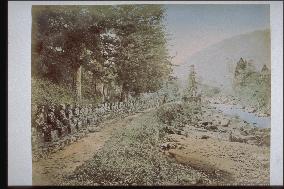
Kanganmabuchi of Nikko is a gorge in the Nantaisan range, carving the rocks by the sharp flow of Daiya River. The hundred Jizo stand here. Most of them are standing today, and the head Jizo is also in the picture. Many of the head Jizo and lined Jizo were destroyed in the flood of 1902.==Date:unknown, Place:Nikko, Photo:unknown, (Credit:Nagasaki University Library/Kyodo News Images) [Cabinet Number31‐57‐0]

  •  
The Six Statues of Jizo

The Six Statues of Jizo

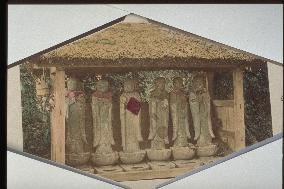
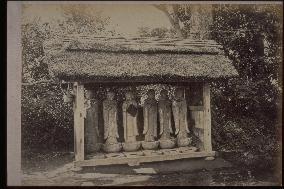
A small thatched-roof hut with six jizo statues. The third Jizo from the left wears an apron. A small pail hangs from the roof to the left.==Date:unknown, Place:Kamakura, Photo:unknown, (Credit:Nagasaki University Library/Kyodo News Images) [Cabinet Number24‐34‐0]

  •  
Statues of Enmeijizo (giving a long-life) by Lake Ashi

Statues of Enmeijizo (giving a long-life) by Lake Ashi

In Hakone, a movement to destroy Buddhist statues was seen after the official separation of Shinto and Buddhist rituals in 1868, and the Buddhist images by Ashino Lake were also damaged. In the picture, a tragic scene with a broken halo and the stone lantern torn down can be seen. This jizo still exists at Tokujoin in Odawara.==Date:unknown, Place:Hakone, Photo:unknown, (Credit:Nagasaki University Library/Kyodo News Images) [Cabinet Number24‐23‐0]

  •  
The Hundred Stone Statues of Jizo at Ganmangahara,Nikko

The Hundred Stone Statues of Jizo at Ganmangahara,Nikko

Almost all of the 100 Jizo of Kanmangafuchi of Nikko stand erect, and in the rear centre is the Oya Jizo. A white monument to Hayashi Razan stands between the river bank and gigantic trees. In the flood of 1902, some of the hundred Jizo and the monument to Hayashi Razan were lost.==Date:Before 35th year of Meiji, Place:Nikko, Photo:Tamamura Kozaburo, (Credit:Nagasaki University Library/Kyodo News Images) [Cabinet Number11‐16‐0]

  •  
Gamangafuchi deep water at daiyagawa river

Gamangafuchi deep water at daiyagawa river

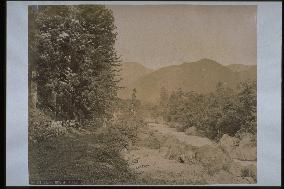
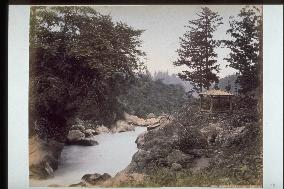
Kanmangafuchi is a gorge water created by the erosion of granite from Mt. Nantai by the rapid waters of Daiya River. Hyaku Jizo (Hundred Jizos) stand here. A Jizo stands above the observation post. The site is famous for its rapids and swirling waters.==Date:unknown, Place:Nikko, Photo:Ogawa Kazumasa, (Credit:Nagasaki University Library/Kyodo News Images) [Cabinet Number9‐18‐0]

  •  
The Hundred Stone Statues of Jizo at Ganmangahara,Nikko

The Hundred Stone Statues of Jizo at Ganmangahara,Nikko

Kanmangafuchi is a gorge created by the erosion of granite at Mt. Nantai by the rapid waters of Daiya River. Hyaku Jizo (Hundred Jizos) stand here. The tea house which stood at the foot of the swirling waters was lost along with some of the Narabi Jizo and Oya Jizo in the flood of 1902. People of the tea house bring tea.==Date:Before 35th year of Meiji, Place:Nikko, Photo:Ogawa Kazumasa, (Credit:Nagasaki University Library/Kyodo News Images) [Cabinet Number9‐19‐0]

  •  
100 stone statues of jizo,the guardian deity,at nikko gamangafuchi deep water

100 stone statues of jizo,the guardian deity,at nikko gamangafuchi deep water

The Kanman Gorge in Nikko was created by erosion of the rocks of Mt. Nantai by the rapid stream of the Daiya River. Hundred Jizo stand here. Most of the Narabi Jizo still exist, and the Oya Jizo standing at the head is also seen in the photo. A monument to Hayashi Razan stands near the big trees along the river. Many of the Narabi Jizo and Oya Jizo as well as the monument were destroyed in the flood of 1902.==Date:unknown, Place:Nikko, Photo:Ogawa Kazumasa, (Credit:Nagasaki University Library/Kyodo News Images) [Cabinet Number8‐6‐0]

  •  
Rokudo jizo,stone statue of the guardian deity

Rokudo jizo,stone statue of the guardian deity

The Rokudo Jizo are typical examples of stone Buddhist statues in Hakone together with the Magai botoke of Nijugobosatsu. It was carved on a rock facing Shojin Lake at the foot of the Mt. Kamifutagoyama, and has a height of over 4 meters. It was completed in 1300, and the Buddhist ceremony to consecrate a newly made image was conducted by Ryokan Boninjo. It is a national historic site.==Date:unknown, Place:Hakone, Photo:Ogawa Kazumasa, (Credit:Nagasaki University Library/Kyodo News Images) [Cabinet Number7‐21‐0]

  •  
The Hundred Stone Statues of Jizo at Ganmangahara,Nikko

The Hundred Stone Statues of Jizo at Ganmangahara,Nikko

Kanmangafuchi in Nikko is a gorge created by erosion of Mt.Natai by the steep flow of Daiya River. The Hyakujizo are located here. The tea house at the foot of the sharp flow was destroyed together with some of the Jizo in the area (Narabi Jizo) and the Oya Jizo in 1902. In the photo, people are worshiping the Narabi Jizo.==Date:Before 35th year of Meiji, Place:Nikko, Photo:Ogawa Kazumasa, (Credit:Nagasaki University Library/Kyodo News Images) [Cabinet Number7‐11‐0]

  •  
Shrine along the road

Shrine along the road

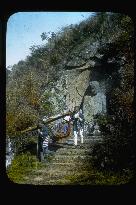
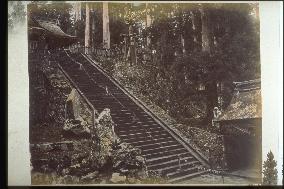
These may be the steps leading to the main building of Jokomyoji Temple. The main Buddha is the Yahiroi Jizo which is said to be the Nenji Buddha (Buddha for daily worship) of Ashikaga Naoyoshi. According to legend, when Ashikaga Naoyoshi had used up all of his arrows, a young priest stepped forward holding one of his used arrows. Naoyoshi was puzzled, and when he looked at the Jizo it was holding an arrow along with its cane.==Date:unknown, Place:Kamakura, Photo:Ogawa Kazumasa, (Credit:Nagasaki University Library/Kyodo News Images) [Cabinet Number5‐32‐0]

  •  
The Hundred Stone Statues of Jizo at Ganmangahara,Nikko

The Hundred Stone Statues of Jizo at Ganmangahara,Nikko

Nikko Kanmangafuchi is a deep gorge created by the erosion of the lava of Mt. Nantai by the rough flow of Daiya River. Hundred Jizo (guardian deity of children) stand at this site. Most of the Jizo are intact, and the main Jizo faces the front as portrayed in the photo. Many of the Jizo were destroyed in the flood of 1902.==Date:Before 35th year of Meiji, Place:Nikko, Photo:Kusakabe Kinbei, (Credit:Nagasaki University Library/Kyodo News Images) [Cabinet Number2‐40‐0]

  • Main
  • Top
  • Editorial
  • Creative
  • About Us
  • About ILG
  • Terms of use
  • Company
  • BEHIND
  • Price List
  • Single Plan
  • Monthly Plan
  • Services
  • Shooting
  • Rights Clearance
  • Support
  • FAQ
  • How To Buy
  • Contact Us
  • Become a Partner

© KYODO NEWS IMAGES INC

All Rights Reserved.

  • Editorial
  • Olympics
  • News
  • Sports
  • Japan
  • Tech
  • Royal
  • Disaster
  • NorthKorea
  • Old Japan
  • SNS
  • Creative
  • Food
  • Japan
  • Landscape
  • Animal
  • Popular
  • #Ukraine
  • #Thailand
  • #coronavirus
  • #N. Korea
  • #Russia
  • #China
  • #Ukraine
  • #Thailand
  • #coronavirus
  • #N. Korea
  • #Russia
  • #China
  • Food
  • Japan
  • Landscape
  • Animal
  • Olympics
  • News
  • Sports
  • Japan
  • Tech
  • Royal
  • Disaster
  • NorthKorea
  • Old Japan
  • SNS