•  
Slap Fighting Championship - Las Vegas

Slap Fighting Championship - Las Vegas

Juicy Finau and Zak “The White Hulk” Lansing meet on the mat for a 3-round Super Heavyweight match at Fontainebleau Las Vegas for PowerSlap 15 on October 3, 2025 in Las Vegas, NV, United States. Photo by Louis Grasse/PXimages/ABACAPRESS.COM

  •  
Slap Fighting Championship - Las Vegas

Slap Fighting Championship - Las Vegas

Juicy Finau and Zak “The White Hulk” Lansing meet on the mat for a 3-round Super Heavyweight match at Fontainebleau Las Vegas for PowerSlap 15 on October 3, 2025 in Las Vegas, NV, United States. Photo by Louis Grasse/PXimages/ABACAPRESS.COM

  •  
Slap Fighting Championship - Las Vegas

Slap Fighting Championship - Las Vegas

Juicy Finau and Zak “The White Hulk” Lansing meet on the mat for a 3-round Super Heavyweight match at Fontainebleau Las Vegas for PowerSlap 15 on October 3, 2025 in Las Vegas, NV, United States. Photo by Louis Grasse/PXimages/ABACAPRESS.COM

  •  
Slap Fighting Championship - Las Vegas

Slap Fighting Championship - Las Vegas

Juicy Finau and Zak “The White Hulk” Lansing meet on the mat for a 3-round Super Heavyweight match at Fontainebleau Las Vegas for PowerSlap 15 on October 3, 2025 in Las Vegas, NV, United States. Photo by Louis Grasse/PXimages/ABACAPRESS.COM

  •  
Slap Fighting Championship - Las Vegas

Slap Fighting Championship - Las Vegas

Juicy Finau and Zak “The White Hulk” Lansing meet on the mat for a 3-round Super Heavyweight match at Fontainebleau Las Vegas for PowerSlap 15 on October 3, 2025 in Las Vegas, NV, United States. Photo by Louis Grasse/PXimages/ABACAPRESS.COM

  •  
Slap Fighting Championship - Las Vegas

Slap Fighting Championship - Las Vegas

Juicy Finau and Zak “The White Hulk” Lansing meet on the mat for a 3-round Super Heavyweight match at Fontainebleau Las Vegas for PowerSlap 15 on October 3, 2025 in Las Vegas, NV, United States. Photo by Louis Grasse/PXimages/ABACAPRESS.COM

  •  
Watermelon Farm - China

Watermelon Farm - China

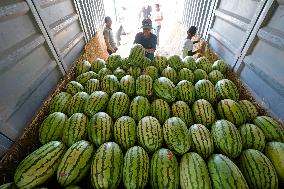
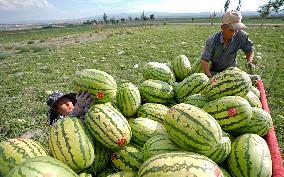
Retailers load Xisha watermelons onto a truck in Xingren Town of Shapotou District, Zhongwei City, northwest China's Ningxia Hui Autonomous Region, July 20, 2025. The Xisha watermelon is a watermelon variety cultivated on calcareous soil covered with stone gravels. It is known for its large size, crisp and juicy flesh, as well as rich sweetness. The fruit is often hailed as the "green gem of the Gobi Desert" owing to its great economic value. Zhongwei City, a major producer of Xisha watermelons, has recorded a planting area of 469,500 mu (31,300 hectares) this year, with an expected output of 1.15 million tonnes. Photo by Wang Peng/Xinhua/ABACAPRESS.COM

  •  
Watermelon Farm - China

Watermelon Farm - China

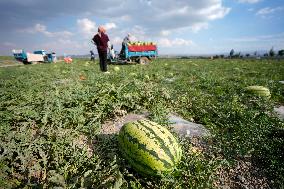
Farmers pick Xisha watermelons in Xingren Town of Shapotou District, Zhongwei City, northwest China's Ningxia Hui Autonomous Region, July 20, 2025. The Xisha watermelon is a watermelon variety cultivated on calcareous soil covered with stone gravels. It is known for its large size, crisp and juicy flesh, as well as rich sweetness. The fruit is often hailed as the "green gem of the Gobi Desert" owing to its great economic value. Zhongwei City, a major producer of Xisha watermelons, has recorded a planting area of 469,500 mu (31,300 hectares) this year, with an expected output of 1.15 million tonnes. Photo by Wang Peng/Xinhua/ABACAPRESS.COM

  •  
Watermelon Farm - China

Watermelon Farm - China

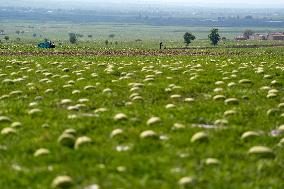
Farmers work in a Xisha watermelon field in Xiangshan Village of Shapotou District, Zhongwei City, northwest China's Ningxia Hui Autonomous Region, July 20, 2025. The Xisha watermelon is a watermelon variety cultivated on calcareous soil covered with stone gravels. It is known for its large size, crisp and juicy flesh, as well as rich sweetness. The fruit is often hailed as the "green gem of the Gobi Desert" owing to its great economic value. Zhongwei City, a major producer of Xisha watermelons, has recorded a planting area of 469,500 mu (31,300 hectares) this year, with an expected output of 1.15 million tonnes. Photo by Wang Peng/Xinhua/ABACAPRESS.COM

  •  
Watermelon Farm - China

Watermelon Farm - China

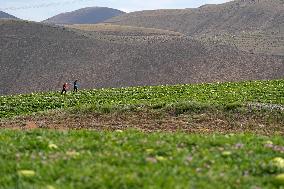
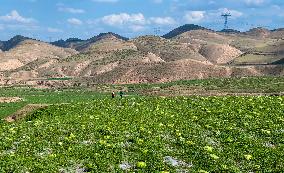
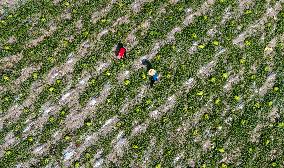
A drone photo taken on July 20, 2025 shows farmers working in a Xisha watermelon field in Xiangshan Township of Shapotou District, Zhongwei City, northwest China's Ningxia Hui Autonomous Region. The Xisha watermelon is a watermelon variety cultivated on calcareous soil covered with stone gravels. It is known for its large size, crisp and juicy flesh, as well as rich sweetness. The fruit is often hailed as the "green gem of the Gobi Desert" owing to its great economic value. Zhongwei City, a major producer of Xisha watermelons, has recorded a planting area of 469,500 mu (31,300 hectares) this year, with an expected output of 1.15 million tonnes. Photo by Wang Peng/Xinhua/ABACAPRESS.COM

  •  
Watermelon Farm - China

Watermelon Farm - China

An aerial drone photo taken on July 20, 2025 shows farmers working in a Xisha watermelon field in Xiangshan Township of Shapotou District, Zhongwei City, northwest China's Ningxia Hui Autonomous Region. The Xisha watermelon is a watermelon variety cultivated on calcareous soil covered with stone gravels. It is known for its large size, crisp and juicy flesh, as well as rich sweetness. The fruit is often hailed as the "green gem of the Gobi Desert" owing to its great economic value. Zhongwei City, a major producer of Xisha watermelons, has recorded a planting area of 469,500 mu (31,300 hectares) this year, with an expected output of 1.15 million tonnes. Photo by Wang Peng/Xinhua/ABACAPRESS.COM

  •  
Watermelon Farm - China

Watermelon Farm - China

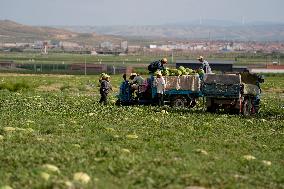
Farmers pick and transport Xisha watermelons in Xingren Town of Shapotou District, Zhongwei City, northwest China's Ningxia Hui Autonomous Region, July 20, 2025. The Xisha watermelon is a watermelon variety cultivated on calcareous soil covered with stone gravels. It is known for its large size, crisp and juicy flesh, as well as rich sweetness. The fruit is often hailed as the "green gem of the Gobi Desert" owing to its great economic value. Zhongwei City, a major producer of Xisha watermelons, has recorded a planting area of 469,500 mu (31,300 hectares) this year, with an expected output of 1.15 million tonnes. Photo by Wang Peng/Xinhua/ABACAPRESS.COM

  •  
Watermelon Farm - China

Watermelon Farm - China

Farmers pick and transport Xisha watermelons in Xingren Town of Shapotou District, Zhongwei City, northwest China's Ningxia Hui Autonomous Region, July 20, 2025. The Xisha watermelon is a watermelon variety cultivated on calcareous soil covered with stone gravels. It is known for its large size, crisp and juicy flesh, as well as rich sweetness. The fruit is often hailed as the "green gem of the Gobi Desert" owing to its great economic value. Zhongwei City, a major producer of Xisha watermelons, has recorded a planting area of 469,500 mu (31,300 hectares) this year, with an expected output of 1.15 million tonnes. Photo by Wang Peng/Xinhua/ABACAPRESS.COM

  •  
Watermelon Farm - China

Watermelon Farm - China

Farmers pick and transport Xisha watermelons in Xingren Town of Shapotou District, Zhongwei City, northwest China's Ningxia Hui Autonomous Region, July 20, 2025. The Xisha watermelon is a watermelon variety cultivated on calcareous soil covered with stone gravels. It is known for its large size, crisp and juicy flesh, as well as rich sweetness. The fruit is often hailed as the "green gem of the Gobi Desert" owing to its great economic value. Zhongwei City, a major producer of Xisha watermelons, has recorded a planting area of 469,500 mu (31,300 hectares) this year, with an expected output of 1.15 million tonnes. Photo by Wang Peng/Xinhua/ABACAPRESS.COM

  •  
Watermelon Farm - China

Watermelon Farm - China

Farmers work in a Xisha watermelon field in Xingren Township of Shapotou District, Zhongwei City, northwest China's Ningxia Hui Autonomous Region, July 20, 2025. The Xisha watermelon is a watermelon variety cultivated on calcareous soil covered with stone gravels. It is known for its large size, crisp and juicy flesh, as well as rich sweetness. The fruit is often hailed as the "green gem of the Gobi Desert" owing to its great economic value. Zhongwei City, a major producer of Xisha watermelons, has recorded a planting area of 469,500 mu (31,300 hectares) this year, with an expected output of 1.15 million tonnes. Photo by Wang Peng/Xinhua/ABACAPRESS.COM

  •  
Preserving Tradition And Innovating Duck Culture - Bejing

Preserving Tradition And Innovating Duck Culture - Bejing

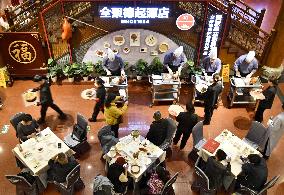
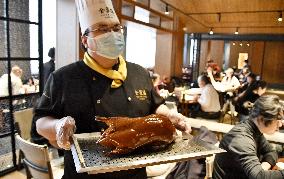
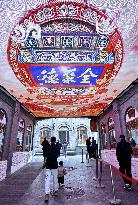
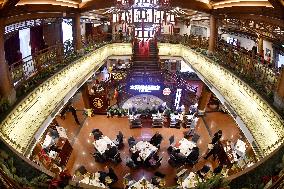
B Customers have meals at the first-ever store of Quanjude on the Qianmen Street in Beijing, capital of China, March 25, 2025. Peking Duck, a representative cuisine of Beijing, has won popularity across the world for its golden, crispy skin and juicy, flavorful meat. Set up by Yang Quanren in 1864 in Beijing, "Quanjude", a time-honored brand for Peking duck, has become a must-go for visitors from both home and abroad. In 2008, Quanjude's craft of making Peking Duck was listed in the second batch of national intangible cultural heritages. The cooking craft of Peking Duck, which has been passed down for seven generations in Quanjude, is mainly used in two steps, preparation and roasting. To ensure the quality of its duck, Quanjude only chooses a type of local ducks which are fed and raised in a special way so that the proportion of the fat in the duck meat is strictly under control. During the roasting procedure, Quanjude uses wood from hard fruit trees and open fire to get a better taste. Meanwhile, the chef w

  •  
Preserving Tradition And Innovating Duck Culture - Bejing

Preserving Tradition And Innovating Duck Culture - Bejing

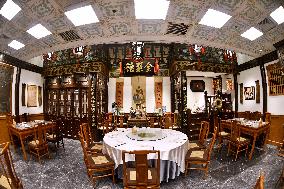
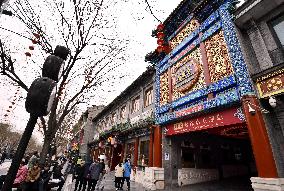
B This photo taken on March 25, 2025 shows the replica of an old Quanjude store at its first-ever store on the Qianmen Street in Beijing, capital of China, March 25, 2025. Peking Duck, a representative cuisine of Beijing, has won popularity across the world for its golden, crispy skin and juicy, flavorful meat. Set up by Yang Quanren in 1864 in Beijing, "Quanjude", a time-honored brand for Peking duck, has become a must-go for visitors from both home and abroad. In 2008, Quanjude's craft of making Peking Duck was listed in the second batch of national intangible cultural heritages. The cooking craft of Peking Duck, which has been passed down for seven generations in Quanjude, is mainly used in two steps, preparation and roasting. To ensure the quality of its duck, Quanjude only chooses a type of local ducks which are fed and raised in a special way so that the proportion of the fat in the duck meat is strictly under control. During the roasting procedure, Quanjude uses wood from hard fruit trees and open fire

  •  
Preserving Tradition And Innovating Duck Culture - Bejing

Preserving Tradition And Innovating Duck Culture - Bejing

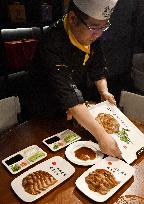
B A chef learns the dish presentation at the Hepingmen store of Quanjude in Beijing, capital of China, March 13, 2025. Peking Duck, a representative cuisine of Beijing, has won popularity across the world for its golden, crispy skin and juicy, flavorful meat. Set up by Yang Quanren in 1864 in Beijing, "Quanjude", a time-honored brand for Peking duck, has become a must-go for visitors from both home and abroad. In 2008, Quanjude's craft of making Peking Duck was listed in the second batch of national intangible cultural heritages. The cooking craft of Peking Duck, which has been passed down for seven generations in Quanjude, is mainly used in two steps, preparation and roasting. To ensure the quality of its duck, Quanjude only chooses a type of local ducks which are fed and raised in a special way so that the proportion of the fat in the duck meat is strictly under control. During the roasting procedure, Quanjude uses wood from hard fruit trees and open fire to get a better taste. Meanwhile, the chef will also

  •  
Preserving Tradition And Innovating Duck Culture - Bejing

Preserving Tradition And Innovating Duck Culture - Bejing

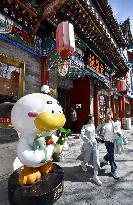
B A mascot of Quanjude is displayed at the entrance of an experience store of Quanjude on the Qianmen Street in Beijing, capital of China, March 25, 2025. Peking Duck, a representative cuisine of Beijing, has won popularity across the world for its golden, crispy skin and juicy, flavorful meat. Set up by Yang Quanren in 1864 in Beijing, "Quanjude", a time-honored brand for Peking duck, has become a must-go for visitors from both home and abroad. In 2008, Quanjude's craft of making Peking Duck was listed in the second batch of national intangible cultural heritages. The cooking craft of Peking Duck, which has been passed down for seven generations in Quanjude, is mainly used in two steps, preparation and roasting. To ensure the quality of its duck, Quanjude only chooses a type of local ducks which are fed and raised in a special way so that the proportion of the fat in the duck meat is strictly under control. During the roasting procedure, Quanjude uses wood from hard fruit trees and open fire to get a better

  •  
Preserving Tradition And Innovating Duck Culture - Bejing

Preserving Tradition And Innovating Duck Culture - Bejing

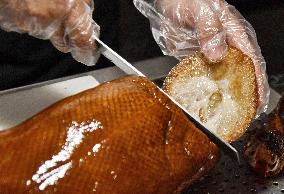
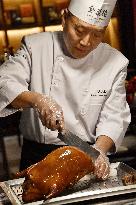
B A chef prepares to slice Peking Duck for customers at the Hepingmen store of Quanjude in Beijing, capital of China, March 13, 2025. Peking Duck, a representative cuisine of Beijing, has won popularity across the world for its golden, crispy skin and juicy, flavorful meat. Set up by Yang Quanren in 1864 in Beijing, "Quanjude", a time-honored brand for Peking duck, has become a must-go for visitors from both home and abroad. In 2008, Quanjude's craft of making Peking Duck was listed in the second batch of national intangible cultural heritages. The cooking craft of Peking Duck, which has been passed down for seven generations in Quanjude, is mainly used in two steps, preparation and roasting. To ensure the quality of its duck, Quanjude only chooses a type of local ducks which are fed and raised in a special way so that the proportion of the fat in the duck meat is strictly under control. During the roasting procedure, Quanjude uses wood from hard fruit trees and open fire to get a better taste. Meanwhile, the

  •  
Preserving Tradition And Innovating Duck Culture - Bejing

Preserving Tradition And Innovating Duck Culture - Bejing

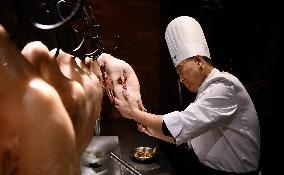
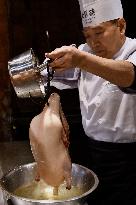
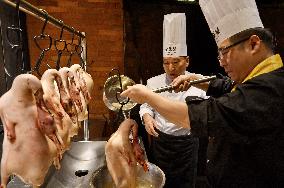
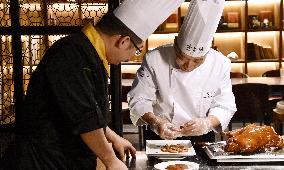
B Wu Yubo prepares the duck at the Hepingmen store of Quanjude in Beijing, capital of China, March 13, 2025. Peking Duck, a representative cuisine of Beijing, has won popularity across the world for its golden, crispy skin and juicy, flavorful meat. Set up by Yang Quanren in 1864 in Beijing, "Quanjude", a time-honored brand for Peking duck, has become a must-go for visitors from both home and abroad. In 2008, Quanjude's craft of making Peking Duck was listed in the second batch of national intangible cultural heritages. The cooking craft of Peking Duck, which has been passed down for seven generations in Quanjude, is mainly used in two steps, preparation and roasting. To ensure the quality of its duck, Quanjude only chooses a type of local ducks which are fed and raised in a special way so that the proportion of the fat in the duck meat is strictly under control. During the roasting procedure, Quanjude uses wood from hard fruit trees and open fire to get a better taste. Meanwhile, the chef will also use a lon

  •  
Preserving Tradition And Innovating Duck Culture - Bejing

Preserving Tradition And Innovating Duck Culture - Bejing

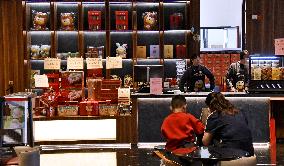
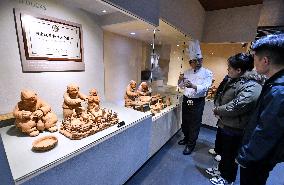
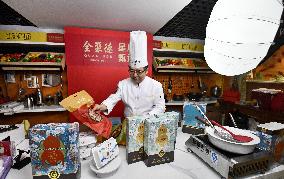
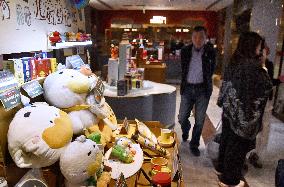
B Cultural creative products are displayed at the Hepingmen store of Quanjude in Beijing, capital of China, March 13, 2025. Peking Duck, a representative cuisine of Beijing, has won popularity across the world for its golden, crispy skin and juicy, flavorful meat. Set up by Yang Quanren in 1864 in Beijing, "Quanjude", a time-honored brand for Peking duck, has become a must-go for visitors from both home and abroad. In 2008, Quanjude's craft of making Peking Duck was listed in the second batch of national intangible cultural heritages. The cooking craft of Peking Duck, which has been passed down for seven generations in Quanjude, is mainly used in two steps, preparation and roasting. To ensure the quality of its duck, Quanjude only chooses a type of local ducks which are fed and raised in a special way so that the proportion of the fat in the duck meat is strictly under control. During the roasting procedure, Quanjude uses wood from hard fruit trees and open fire to get a better taste. Meanwhile, the chef will

  •  
Preserving Tradition And Innovating Duck Culture - Bejing

Preserving Tradition And Innovating Duck Culture - Bejing

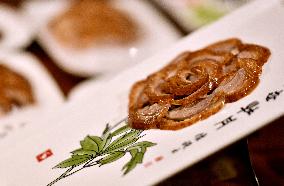
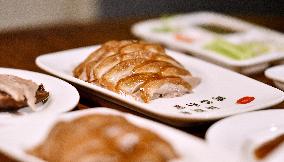
B A plate of sliced Peking Duck is displayed at the Hepingmen store of Quanjude in Beijing, capital of China, March 13, 2025. Peking Duck, a representative cuisine of Beijing, has won popularity across the world for its golden, crispy skin and juicy, flavorful meat. Set up by Yang Quanren in 1864 in Beijing, "Quanjude", a time-honored brand for Peking duck, has become a must-go for visitors from both home and abroad. In 2008, Quanjude's craft of making Peking Duck was listed in the second batch of national intangible cultural heritages. The cooking craft of Peking Duck, which has been passed down for seven generations in Quanjude, is mainly used in two steps, preparation and roasting. To ensure the quality of its duck, Quanjude only chooses a type of local ducks which are fed and raised in a special way so that the proportion of the fat in the duck meat is strictly under control. During the roasting procedure, Quanjude uses wood from hard fruit trees and open fire to get a better taste. Meanwhile, the chef wi

  •  
Preserving Tradition And Innovating Duck Culture - Bejing

Preserving Tradition And Innovating Duck Culture - Bejing

B People walk to the first-ever store of Quanjude on the Qianmen Street in Beijing, capital of China, March 14, 2025. Peking Duck, a representative cuisine of Beijing, has won popularity across the world for its golden, crispy skin and juicy, flavorful meat. Set up by Yang Quanren in 1864 in Beijing, "Quanjude", a time-honored brand for Peking duck, has become a must-go for visitors from both home and abroad. In 2008, Quanjude's craft of making Peking Duck was listed in the second batch of national intangible cultural heritages. The cooking craft of Peking Duck, which has been passed down for seven generations in Quanjude, is mainly used in two steps, preparation and roasting. To ensure the quality of its duck, Quanjude only chooses a type of local ducks which are fed and raised in a special way so that the proportion of the fat in the duck meat is strictly under control. During the roasting procedure, Quanjude uses wood from hard fruit trees and open fire to get a better taste. Meanwhile, the chef will also

  •  
Preserving Tradition And Innovating Duck Culture - Bejing

Preserving Tradition And Innovating Duck Culture - Bejing

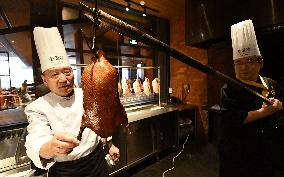
B Wu Yubo shows the skills of roasting ducks at the Hepingmen store of Quanjude in Beijing, capital of China, March 13, 2025. Peking Duck, a representative cuisine of Beijing, has won popularity across the world for its golden, crispy skin and juicy, flavorful meat. Set up by Yang Quanren in 1864 in Beijing, "Quanjude", a time-honored brand for Peking duck, has become a must-go for visitors from both home and abroad. In 2008, Quanjude's craft of making Peking Duck was listed in the second batch of national intangible cultural heritages. The cooking craft of Peking Duck, which has been passed down for seven generations in Quanjude, is mainly used in two steps, preparation and roasting. To ensure the quality of its duck, Quanjude only chooses a type of local ducks which are fed and raised in a special way so that the proportion of the fat in the duck meat is strictly under control. During the roasting procedure, Quanjude uses wood from hard fruit trees and open fire to get a better taste. Meanwhile, the chef wi

  •  
Preserving Tradition And Innovating Duck Culture - Bejing

Preserving Tradition And Innovating Duck Culture - Bejing

B People visit a museum of Quanjude at the Hepingmen store of Quanjude in Beijing, capital of China, March 13, 2025. Peking Duck, a representative cuisine of Beijing, has won popularity across the world for its golden, crispy skin and juicy, flavorful meat. Set up by Yang Quanren in 1864 in Beijing, "Quanjude", a time-honored brand for Peking duck, has become a must-go for visitors from both home and abroad. In 2008, Quanjude's craft of making Peking Duck was listed in the second batch of national intangible cultural heritages. The cooking craft of Peking Duck, which has been passed down for seven generations in Quanjude, is mainly used in two steps, preparation and roasting. To ensure the quality of its duck, Quanjude only chooses a type of local ducks which are fed and raised in a special way so that the proportion of the fat in the duck meat is strictly under control. During the roasting procedure, Quanjude uses wood from hard fruit trees and open fire to get a better taste. Meanwhile, the chef will also u

  •  
Preserving Tradition And Innovating Duck Culture - Bejing

Preserving Tradition And Innovating Duck Culture - Bejing

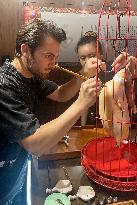
B Wu Yubo prepares a duck at the Hepingmen store of Quanjude in Beijing, capital of China, March 13, 2025. Peking Duck, a representative cuisine of Beijing, has won popularity across the world for its golden, crispy skin and juicy, flavorful meat. Set up by Yang Quanren in 1864 in Beijing, "Quanjude", a time-honored brand for Peking duck, has become a must-go for visitors from both home and abroad. In 2008, Quanjude's craft of making Peking Duck was listed in the second batch of national intangible cultural heritages. The cooking craft of Peking Duck, which has been passed down for seven generations in Quanjude, is mainly used in two steps, preparation and roasting. To ensure the quality of its duck, Quanjude only chooses a type of local ducks which are fed and raised in a special way so that the proportion of the fat in the duck meat is strictly under control. During the roasting procedure, Quanjude uses wood from hard fruit trees and open fire to get a better taste. Meanwhile, the chef will also use a long

  •  
Preserving Tradition And Innovating Duck Culture - Bejing

Preserving Tradition And Innovating Duck Culture - Bejing

B The first-ever store of Quanjude is seen on the Qianmen Street in Beijing, capital of China, March 14, 2025. Peking Duck, a representative cuisine of Beijing, has won popularity across the world for its golden, crispy skin and juicy, flavorful meat. Set up by Yang Quanren in 1864 in Beijing, "Quanjude", a time-honored brand for Peking duck, has become a must-go for visitors from both home and abroad. In 2008, Quanjude's craft of making Peking Duck was listed in the second batch of national intangible cultural heritages. The cooking craft of Peking Duck, which has been passed down for seven generations in Quanjude, is mainly used in two steps, preparation and roasting. To ensure the quality of its duck, Quanjude only chooses a type of local ducks which are fed and raised in a special way so that the proportion of the fat in the duck meat is strictly under control. During the roasting procedure, Quanjude uses wood from hard fruit trees and open fire to get a better taste. Meanwhile, the chef will also use a l

  •  
Preserving Tradition And Innovating Duck Culture - Bejing

Preserving Tradition And Innovating Duck Culture - Bejing

B Wu Yubo (L) teaches his apprentice to prepare ducks at the Hepingmen store of Quanjude in Beijing, capital of China, March 13, 2025. Peking Duck, a representative cuisine of Beijing, has won popularity across the world for its golden, crispy skin and juicy, flavorful meat. Set up by Yang Quanren in 1864 in Beijing, "Quanjude", a time-honored brand for Peking duck, has become a must-go for visitors from both home and abroad. In 2008, Quanjude's craft of making Peking Duck was listed in the second batch of national intangible cultural heritages. The cooking craft of Peking Duck, which has been passed down for seven generations in Quanjude, is mainly used in two steps, preparation and roasting. To ensure the quality of its duck, Quanjude only chooses a type of local ducks which are fed and raised in a special way so that the proportion of the fat in the duck meat is strictly under control. During the roasting procedure, Quanjude uses wood from hard fruit trees and open fire to get a better taste. Meanwhile, th

  •  
Preserving Tradition And Innovating Duck Culture - Bejing

Preserving Tradition And Innovating Duck Culture - Bejing

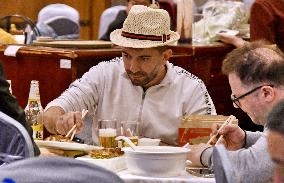
B A foreign guest eats Peking Duck at the first-ever store of Quanjude on the Qianmen Street in Beijing, capital of China, March 25, 2025. Peking Duck, a representative cuisine of Beijing, has won popularity across the world for its golden, crispy skin and juicy, flavorful meat. Set up by Yang Quanren in 1864 in Beijing, "Quanjude", a time-honored brand for Peking duck, has become a must-go for visitors from both home and abroad. In 2008, Quanjude's craft of making Peking Duck was listed in the second batch of national intangible cultural heritages. The cooking craft of Peking Duck, which has been passed down for seven generations in Quanjude, is mainly used in two steps, preparation and roasting. To ensure the quality of its duck, Quanjude only chooses a type of local ducks which are fed and raised in a special way so that the proportion of the fat in the duck meat is strictly under control. During the roasting procedure, Quanjude uses wood from hard fruit trees and open fire to get a better taste. Meanwhile

  •  
Preserving Tradition And Innovating Duck Culture - Bejing

Preserving Tradition And Innovating Duck Culture - Bejing

B Wu Yubo shows how to slice a duck at the Hepingmen store of Quanjude in Beijing, capital of China, March 13, 2025. Peking Duck, a representative cuisine of Beijing, has won popularity across the world for its golden, crispy skin and juicy, flavorful meat. Set up by Yang Quanren in 1864 in Beijing, "Quanjude", a time-honored brand for Peking duck, has become a must-go for visitors from both home and abroad. In 2008, Quanjude's craft of making Peking Duck was listed in the second batch of national intangible cultural heritages. The cooking craft of Peking Duck, which has been passed down for seven generations in Quanjude, is mainly used in two steps, preparation and roasting. To ensure the quality of its duck, Quanjude only chooses a type of local ducks which are fed and raised in a special way so that the proportion of the fat in the duck meat is strictly under control. During the roasting procedure, Quanjude uses wood from hard fruit trees and open fire to get a better taste. Meanwhile, the chef will also u

  •  
Preserving Tradition And Innovating Duck Culture - Bejing

Preserving Tradition And Innovating Duck Culture - Bejing

B Wu Yubo teaches his apprentice to arrange a plate at the Hepingmen store of Quanjude in Beijing, capital of China, March 13, 2025. Peking Duck, a representative cuisine of Beijing, has won popularity across the world for its golden, crispy skin and juicy, flavorful meat. Set up by Yang Quanren in 1864 in Beijing, "Quanjude", a time-honored brand for Peking duck, has become a must-go for visitors from both home and abroad. In 2008, Quanjude's craft of making Peking Duck was listed in the second batch of national intangible cultural heritages. The cooking craft of Peking Duck, which has been passed down for seven generations in Quanjude, is mainly used in two steps, preparation and roasting. To ensure the quality of its duck, Quanjude only chooses a type of local ducks which are fed and raised in a special way so that the proportion of the fat in the duck meat is strictly under control. During the roasting procedure, Quanjude uses wood from hard fruit trees and open fire to get a better taste. Meanwhile, the

  •  
Preserving Tradition And Innovating Duck Culture - Bejing

Preserving Tradition And Innovating Duck Culture - Bejing

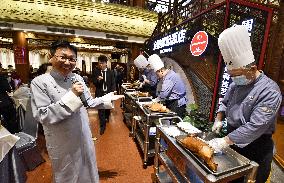
B A chef prepares to promote Peking Duck through online streaming at the Hepingmen store of Quanjude in Beijing, capital of China, March 13, 2025. Peking Duck, a representative cuisine of Beijing, has won popularity across the world for its golden, crispy skin and juicy, flavorful meat. Set up by Yang Quanren in 1864 in Beijing, "Quanjude", a time-honored brand for Peking duck, has become a must-go for visitors from both home and abroad. In 2008, Quanjude's craft of making Peking Duck was listed in the second batch of national intangible cultural heritages. The cooking craft of Peking Duck, which has been passed down for seven generations in Quanjude, is mainly used in two steps, preparation and roasting. To ensure the quality of its duck, Quanjude only chooses a type of local ducks which are fed and raised in a special way so that the proportion of the fat in the duck meat is strictly under control. During the roasting procedure, Quanjude uses wood from hard fruit trees and open fire to get a better taste. M

  •  
Preserving Tradition And Innovating Duck Culture - Bejing

Preserving Tradition And Innovating Duck Culture - Bejing

B Customers taste Peking Ducks at the first-ever store of Quanjude on the Qianmen Street in Beijing, capital of China, March 25, 2025. Peking Duck, a representative cuisine of Beijing, has won popularity across the world for its golden, crispy skin and juicy, flavorful meat. Set up by Yang Quanren in 1864 in Beijing, "Quanjude", a time-honored brand for Peking duck, has become a must-go for visitors from both home and abroad. In 2008, Quanjude's craft of making Peking Duck was listed in the second batch of national intangible cultural heritages. The cooking craft of Peking Duck, which has been passed down for seven generations in Quanjude, is mainly used in two steps, preparation and roasting. To ensure the quality of its duck, Quanjude only chooses a type of local ducks which are fed and raised in a special way so that the proportion of the fat in the duck meat is strictly under control. During the roasting procedure, Quanjude uses wood from hard fruit trees and open fire to get a better taste. Meanwhile, th

  •  
Preserving Tradition And Innovating Duck Culture - Bejing

Preserving Tradition And Innovating Duck Culture - Bejing

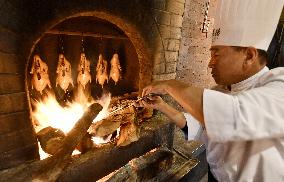
B Wu Yubo takes roasted ducks out of an oven at the Hepingmen store of Quanjude in Beijing, capital of China, March 13, 2025. Peking Duck, a representative cuisine of Beijing, has won popularity across the world for its golden, crispy skin and juicy, flavorful meat. Set up by Yang Quanren in 1864 in Beijing, "Quanjude", a time-honored brand for Peking duck, has become a must-go for visitors from both home and abroad. In 2008, Quanjude's craft of making Peking Duck was listed in the second batch of national intangible cultural heritages. The cooking craft of Peking Duck, which has been passed down for seven generations in Quanjude, is mainly used in two steps, preparation and roasting. To ensure the quality of its duck, Quanjude only chooses a type of local ducks which are fed and raised in a special way so that the proportion of the fat in the duck meat is strictly under control. During the roasting procedure, Quanjude uses wood from hard fruit trees and open fire to get a better taste. Meanwhile, the chef wi

  •  
Preserving Tradition And Innovating Duck Culture - Bejing

Preserving Tradition And Innovating Duck Culture - Bejing

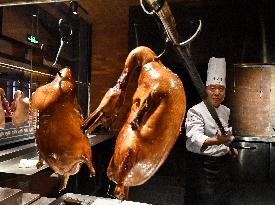
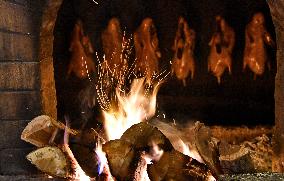
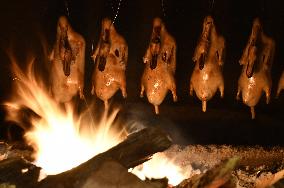
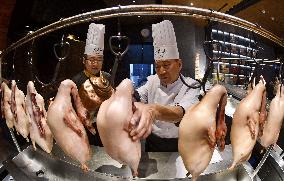
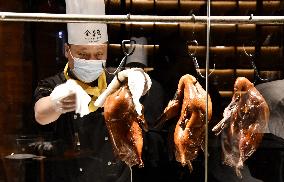
B Ducks are being roasted in an oven at the Hepingmen store of Quanjude in Beijing, capital of China, March 13, 2025. Peking Duck, a representative cuisine of Beijing, has won popularity across the world for its golden, crispy skin and juicy, flavorful meat. Set up by Yang Quanren in 1864 in Beijing, "Quanjude", a time-honored brand for Peking duck, has become a must-go for visitors from both home and abroad. In 2008, Quanjude's craft of making Peking Duck was listed in the second batch of national intangible cultural heritages. The cooking craft of Peking Duck, which has been passed down for seven generations in Quanjude, is mainly used in two steps, preparation and roasting. To ensure the quality of its duck, Quanjude only chooses a type of local ducks which are fed and raised in a special way so that the proportion of the fat in the duck meat is strictly under control. During the roasting procedure, Quanjude uses wood from hard fruit trees and open fire to get a better taste. Meanwhile, the chef will also

  •  
Preserving Tradition And Innovating Duck Culture - Bejing

Preserving Tradition And Innovating Duck Culture - Bejing

B A chef prepares to slice a roasted duck at the Hepingmen store of Quanjude in Beijing, capital of China, March 13, 2025. Peking Duck, a representative cuisine of Beijing, has won popularity across the world for its golden, crispy skin and juicy, flavorful meat. Set up by Yang Quanren in 1864 in Beijing, "Quanjude", a time-honored brand for Peking duck, has become a must-go for visitors from both home and abroad. In 2008, Quanjude's craft of making Peking Duck was listed in the second batch of national intangible cultural heritages. The cooking craft of Peking Duck, which has been passed down for seven generations in Quanjude, is mainly used in two steps, preparation and roasting. To ensure the quality of its duck, Quanjude only chooses a type of local ducks which are fed and raised in a special way so that the proportion of the fat in the duck meat is strictly under control. During the roasting procedure, Quanjude uses wood from hard fruit trees and open fire to get a better taste. Meanwhile, the chef will

  •  
Preserving Tradition And Innovating Duck Culture - Bejing

Preserving Tradition And Innovating Duck Culture - Bejing

B Ducks are being roasted in an oven at the Hepingmen store of Quanjude in Beijing, capital of China, March 13, 2025. Peking Duck, a representative cuisine of Beijing, has won popularity across the world for its golden, crispy skin and juicy, flavorful meat. Set up by Yang Quanren in 1864 in Beijing, "Quanjude", a time-honored brand for Peking duck, has become a must-go for visitors from both home and abroad. In 2008, Quanjude's craft of making Peking Duck was listed in the second batch of national intangible cultural heritages. The cooking craft of Peking Duck, which has been passed down for seven generations in Quanjude, is mainly used in two steps, preparation and roasting. To ensure the quality of its duck, Quanjude only chooses a type of local ducks which are fed and raised in a special way so that the proportion of the fat in the duck meat is strictly under control. During the roasting procedure, Quanjude uses wood from hard fruit trees and open fire to get a better taste. Meanwhile, the chef will also

  •  
Preserving Tradition And Innovating Duck Culture - Bejing

Preserving Tradition And Innovating Duck Culture - Bejing

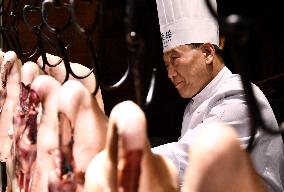
B Wu Yubo checks the prepared duck at the Hepingmen store of Quanjude in Beijing, capital of China, March 13, 2025. Peking Duck, a representative cuisine of Beijing, has won popularity across the world for its golden, crispy skin and juicy, flavorful meat. Set up by Yang Quanren in 1864 in Beijing, "Quanjude", a time-honored brand for Peking duck, has become a must-go for visitors from both home and abroad. In 2008, Quanjude's craft of making Peking Duck was listed in the second batch of national intangible cultural heritages. The cooking craft of Peking Duck, which has been passed down for seven generations in Quanjude, is mainly used in two steps, preparation and roasting. To ensure the quality of its duck, Quanjude only chooses a type of local ducks which are fed and raised in a special way so that the proportion of the fat in the duck meat is strictly under control. During the roasting procedure, Quanjude uses wood from hard fruit trees and open fire to get a better taste. Meanwhile, the chef will also us

  •  
Preserving Tradition And Innovating Duck Culture - Bejing

Preserving Tradition And Innovating Duck Culture - Bejing

B Customers look at cultural creative products of Quanjude at one of its experience stores on the Qianmen Street in Beijing, capital of China, March 25, 2025. Peking Duck, a representative cuisine of Beijing, has won popularity across the world for its golden, crispy skin and juicy, flavorful meat. Set up by Yang Quanren in 1864 in Beijing, "Quanjude", a time-honored brand for Peking duck, has become a must-go for visitors from both home and abroad. In 2008, Quanjude's craft of making Peking Duck was listed in the second batch of national intangible cultural heritages. The cooking craft of Peking Duck, which has been passed down for seven generations in Quanjude, is mainly used in two steps, preparation and roasting. To ensure the quality of its duck, Quanjude only chooses a type of local ducks which are fed and raised in a special way so that the proportion of the fat in the duck meat is strictly under control. During the roasting procedure, Quanjude uses wood from hard fruit trees and open fire to get a bet

  •  
Preserving Tradition And Innovating Duck Culture - Bejing

Preserving Tradition And Innovating Duck Culture - Bejing

B Wu Yubo shows how to slice a duck at the Hepingmen store of Quanjude in Beijing, capital of China, March 13, 2025. Peking Duck, a representative cuisine of Beijing, has won popularity across the world for its golden, crispy skin and juicy, flavorful meat. Set up by Yang Quanren in 1864 in Beijing, "Quanjude", a time-honored brand for Peking duck, has become a must-go for visitors from both home and abroad. In 2008, Quanjude's craft of making Peking Duck was listed in the second batch of national intangible cultural heritages. The cooking craft of Peking Duck, which has been passed down for seven generations in Quanjude, is mainly used in two steps, preparation and roasting. To ensure the quality of its duck, Quanjude only chooses a type of local ducks which are fed and raised in a special way so that the proportion of the fat in the duck meat is strictly under control. During the roasting procedure, Quanjude uses wood from hard fruit trees and open fire to get a better taste. Meanwhile, the chef will also u

  •  
Preserving Tradition And Innovating Duck Culture - Bejing

Preserving Tradition And Innovating Duck Culture - Bejing

B This undated file photo shows a foreign tourist experiencing the making of Peking Duck at the Hepingmen store of Quanjude in Beijing, capital of China. Peking Duck, a representative cuisine of Beijing, has won popularity across the world for its golden, crispy skin and juicy, flavorful meat. Set up by Yang Quanren in 1864 in Beijing, "Quanjude", a time-honored brand for Peking duck, has become a must-go for visitors from both home and abroad. In 2008, Quanjude's craft of making Peking Duck was listed in the second batch of national intangible cultural heritages. The cooking craft of Peking Duck, which has been passed down for seven generations in Quanjude, is mainly used in two steps, preparation and roasting. To ensure the quality of its duck, Quanjude only chooses a type of local ducks which are fed and raised in a special way so that the proportion of the fat in the duck meat is strictly under control. During the roasting procedure, Quanjude uses wood from hard fruit trees and open fire to get a better t

  •  
Preserving Tradition And Innovating Duck Culture - Bejing

Preserving Tradition And Innovating Duck Culture - Bejing

B A staff member introduces the history of Quanjude to customers at its first-ever store on the Qianmen Street in Beijing, capital of China, March 25, 2025. Peking Duck, a representative cuisine of Beijing, has won popularity across the world for its golden, crispy skin and juicy, flavorful meat. Set up by Yang Quanren in 1864 in Beijing, "Quanjude", a time-honored brand for Peking duck, has become a must-go for visitors from both home and abroad. In 2008, Quanjude's craft of making Peking Duck was listed in the second batch of national intangible cultural heritages. The cooking craft of Peking Duck, which has been passed down for seven generations in Quanjude, is mainly used in two steps, preparation and roasting. To ensure the quality of its duck, Quanjude only chooses a type of local ducks which are fed and raised in a special way so that the proportion of the fat in the duck meat is strictly under control. During the roasting procedure, Quanjude uses wood from hard fruit trees and open fire to get a bette

  •  
Preserving Tradition And Innovating Duck Culture - Bejing

Preserving Tradition And Innovating Duck Culture - Bejing

B Wu Yubo checks a roasted duck at the Hepingmen store of Quanjude in Beijing, capital of China, March 13, 2025. Peking Duck, a representative cuisine of Beijing, has won popularity across the world for its golden, crispy skin and juicy, flavorful meat. Set up by Yang Quanren in 1864 in Beijing, "Quanjude", a time-honored brand for Peking duck, has become a must-go for visitors from both home and abroad. In 2008, Quanjude's craft of making Peking Duck was listed in the second batch of national intangible cultural heritages. The cooking craft of Peking Duck, which has been passed down for seven generations in Quanjude, is mainly used in two steps, preparation and roasting. To ensure the quality of its duck, Quanjude only chooses a type of local ducks which are fed and raised in a special way so that the proportion of the fat in the duck meat is strictly under control. During the roasting procedure, Quanjude uses wood from hard fruit trees and open fire to get a better taste. Meanwhile, the chef will also use a

  •  
Preserving Tradition And Innovating Duck Culture - Bejing

Preserving Tradition And Innovating Duck Culture - Bejing

B A plate of sliced Peking Duck is displayed at the Hepingmen store of Quanjude in Beijing, capital of China, March 13, 2025. Peking Duck, a representative cuisine of Beijing, has won popularity across the world for its golden, crispy skin and juicy, flavorful meat. Set up by Yang Quanren in 1864 in Beijing, "Quanjude", a time-honored brand for Peking duck, has become a must-go for visitors from both home and abroad. In 2008, Quanjude's craft of making Peking Duck was listed in the second batch of national intangible cultural heritages. The cooking craft of Peking Duck, which has been passed down for seven generations in Quanjude, is mainly used in two steps, preparation and roasting. To ensure the quality of its duck, Quanjude only chooses a type of local ducks which are fed and raised in a special way so that the proportion of the fat in the duck meat is strictly under control. During the roasting procedure, Quanjude uses wood from hard fruit trees and open fire to get a better taste. Meanwhile, the chef wi

  •  
Preserving Tradition And Innovating Duck Culture - Bejing

Preserving Tradition And Innovating Duck Culture - Bejing

B Wu Yubo (R) teaches his apprentice at the Hepingmen store of Quanjude in Beijing, capital of China, March 13, 2025. Peking Duck, a representative cuisine of Beijing, has won popularity across the world for its golden, crispy skin and juicy, flavorful meat. Set up by Yang Quanren in 1864 in Beijing, "Quanjude", a time-honored brand for Peking duck, has become a must-go for visitors from both home and abroad. In 2008, Quanjude's craft of making Peking Duck was listed in the second batch of national intangible cultural heritages. The cooking craft of Peking Duck, which has been passed down for seven generations in Quanjude, is mainly used in two steps, preparation and roasting. To ensure the quality of its duck, Quanjude only chooses a type of local ducks which are fed and raised in a special way so that the proportion of the fat in the duck meat is strictly under control. During the roasting procedure, Quanjude uses wood from hard fruit trees and open fire to get a better taste. Meanwhile, the chef will also

  •  
Preserving Tradition And Innovating Duck Culture - Bejing

Preserving Tradition And Innovating Duck Culture - Bejing

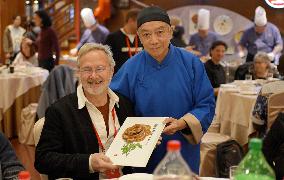
B This undated file photo shows a foreign tourist posing for photos with a waiter in traditional costumes at the first-ever store of Quanjude on the Qianmen Street in Beijing, capital of China. Peking Duck, a representative cuisine of Beijing, has won popularity across the world for its golden, crispy skin and juicy, flavorful meat. Set up by Yang Quanren in 1864 in Beijing, "Quanjude", a time-honored brand for Peking duck, has become a must-go for visitors from both home and abroad. In 2008, Quanjude's craft of making Peking Duck was listed in the second batch of national intangible cultural heritages. The cooking craft of Peking Duck, which has been passed down for seven generations in Quanjude, is mainly used in two steps, preparation and roasting. To ensure the quality of its duck, Quanjude only chooses a type of local ducks which are fed and raised in a special way so that the proportion of the fat in the duck meat is strictly under control. During the roasting procedure, Quanjude uses wood from hard fru

  •  
Tomato Harvest - Bangladesh

Tomato Harvest - Bangladesh

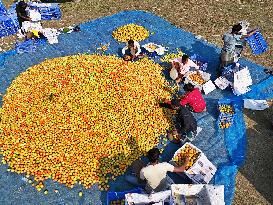
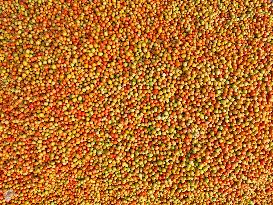
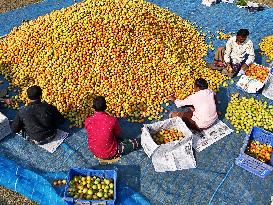
Workers are surrounded by heaps of vibrant red tomatoes, carefully sorting and boxing the produce for distribution. Farmers from nearby villages arrive with freshly harvested tomatoes, washed and organized for sale at the busy winter wholesale market. Juicy red tomatoes ripen under the Bangladesh sun as workers pick out the best fruits for sale. Then, the tomatoes are transported nationwide and often processed into ketchup and tomato paste. Workers meticulously package the fruit into crates, though each 25 kg batch sells for only about 10 USD, reflecting seasonal price dips. This market provides essential income for farmers, helping them cover summer planting costs and sustain their livelihoods. Bogura, Bangladesh, January 06, 2025. Photo by Habibur Rahman/ABACAPRESS.COM

  •  
Tomato Harvest - Bangladesh

Tomato Harvest - Bangladesh

Workers are surrounded by heaps of vibrant red tomatoes, carefully sorting and boxing the produce for distribution. Farmers from nearby villages arrive with freshly harvested tomatoes, washed and organized for sale at the busy winter wholesale market. Juicy red tomatoes ripen under the Bangladesh sun as workers pick out the best fruits for sale. Then, the tomatoes are transported nationwide and often processed into ketchup and tomato paste. Workers meticulously package the fruit into crates, though each 25 kg batch sells for only about 10 USD, reflecting seasonal price dips. This market provides essential income for farmers, helping them cover summer planting costs and sustain their livelihoods. Bogura, Bangladesh, January 06, 2025. Photo by Habibur Rahman/ABACAPRESS.COM

  •  
Tomato Harvest - Bangladesh

Tomato Harvest - Bangladesh

Workers are surrounded by heaps of vibrant red tomatoes, carefully sorting and boxing the produce for distribution. Farmers from nearby villages arrive with freshly harvested tomatoes, washed and organized for sale at the busy winter wholesale market. Juicy red tomatoes ripen under the Bangladesh sun as workers pick out the best fruits for sale. Then, the tomatoes are transported nationwide and often processed into ketchup and tomato paste. Workers meticulously package the fruit into crates, though each 25 kg batch sells for only about 10 USD, reflecting seasonal price dips. This market provides essential income for farmers, helping them cover summer planting costs and sustain their livelihoods. Bogura, Bangladesh, January 06, 2025. Photo by Habibur Rahman/ABACAPRESS.COM

  • Main
  • Top
  • Editorial
  • Creative
  • About Us
  • About ILG
  • Terms of use
  • Company
  • BEHIND
  • Price List
  • Single Plan
  • Monthly Plan
  • Services
  • Shooting
  • Rights Clearance
  • Support
  • FAQ
  • How To Buy
  • Contact Us
  • Become a Partner

© KYODO NEWS IMAGES INC

All Rights Reserved.

  • Editorial
  • Olympics
  • News
  • Sports
  • Japan
  • Tech
  • Royal
  • Disaster
  • NorthKorea
  • Old Japan
  • SNS
  • Creative
  • Food
  • Japan
  • Landscape
  • Animal
  • Popular
  • #Ukraine
  • #Thailand
  • #coronavirus
  • #N. Korea
  • #Russia
  • #China
  • #Ukraine
  • #Thailand
  • #coronavirus
  • #N. Korea
  • #Russia
  • #China
  • Food
  • Japan
  • Landscape
  • Animal
  • Olympics
  • News
  • Sports
  • Japan
  • Tech
  • Royal
  • Disaster
  • NorthKorea
  • Old Japan
  • SNS