•  
Hyper-Kamiokande neutrino observatory

Hyper-Kamiokande neutrino observatory

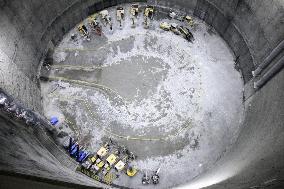
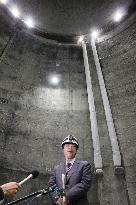
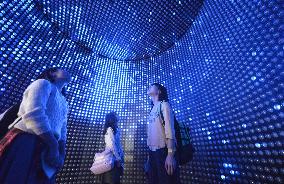
The University of Tokyo's Institute for Cosmic Ray Research unveils to the media on June 28, 2025, a huge cavity excavated in the mountains of Hida in Gifu Prefecture, central Japan, for the installation of the Hyper-Kamiokande neutrino observatory.

  •  
Hyper-Kamiokande neutrino observatory

Hyper-Kamiokande neutrino observatory

The University of Tokyo's Institute for Cosmic Ray Research unveils to the media on June 28, 2025, a huge cavity excavated in the mountains of Hida in Gifu Prefecture, central Japan, for the installation of the Hyper-Kamiokande neutrino observatory.

  •  

UNDERGROUND SPACE OBSERVATORY

UNDERGROUND SPACE OBSERVATORY,Concerts, pianos, Super-Kamiokande, neutrinos, elementary particles, research facilities 1000 meters below Kamioka=Date:1994, Place:Kamioka Mine, Hida City, Gifu Prefecture,JAPAN

  •  
Residents invited to tunnel for housing huge telescope

Residents invited to tunnel for housing huge telescope

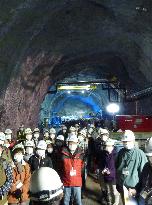
GIFU, Japan - Invited residents in Hida, Gifu Prefecture, central Japan, walk about 1.5 kilometers along a 6-kilometer L-shaped tunnel intended to house the large-scale cryogenic gravitational wave telescope "KAGRA" some 200 meters below the surface of the Kamioka mining area near the Super-Kamiokande neutrino observatory on Oct. 26, 2014.

  •  
Repair on damaged neutrino detector to be completed in mid-April

Repair on damaged neutrino detector to be completed in mid-April

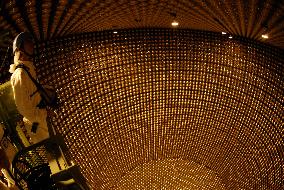
GIFU, Japan - A large neutrino detector operated by the University of Tokyo's Institute for Cosmic Ray Research was shown off to media organizations on April 7 before the completion of its repair work in mid-April following severe damage sustained in an accident in November 2001. The institute will partially resume experiments with the ''Super-Kamiokande'' detector immediately after the completion of the reconstruction work before its full resumption in around late June, the institute said.

  •  
Emperor, empress visit Super-Kamiokande

Emperor, empress visit Super-Kamiokande

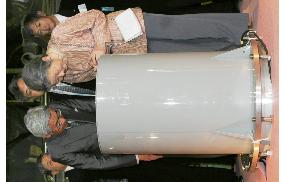
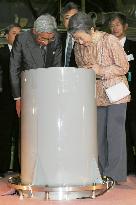
HIDA, Japan - Emperor Akihito and Empress Michiko looks at a device during their visit to Super-Kamiokande, a large detector for cosmic particles located in Kamioka, Gifu Prefecture, on July 13. (Pool photo)

  •  
Koizumi visits Kamiokande

Koizumi visits Kamiokande

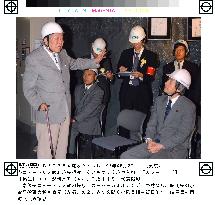
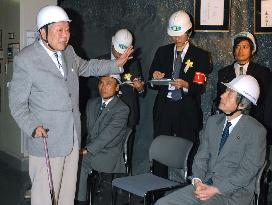
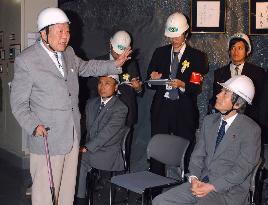
TOKYO, Japan - Prime Minister Junichiro Koizumi (seated) is briefed by Masatoshi Koshiba (L), a professor emeritus at the University of Tokyo, during a visit to the Kamiokande cosmic neutrino detector, located 1 kilometer underground in a mine in Kamioka, Gifu Prefecture, on Aug. 27.(Pool photo)

  •  
(1) Koshiba, Tanaka receive Nobel prizes at awards ceremony

(1) Koshiba, Tanaka receive Nobel prizes at awards ceremony

STOCKHOLM, Sweden - Japan's Masatoshi Koshiba, co-winner of the 2002 Nobel Prize in Physics, receives his Nobel medal from King Carl XVI Gustaf at a ceremony in Stockholm on Dec. 10. Koshiba, 76, professor emeritus at the University of Tokyo, was honored for his contribution to confirming the existence of cosmic neutrinos by developing and using a gigantic underground detector called Kamiokande in Kamioka, Gifu Prefecture.

  •  
Damaged neutrino detector 'Super Kamiokande' restored

Damaged neutrino detector 'Super Kamiokande' restored

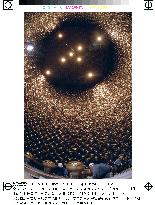
GIFU, Japan - A large neutrino detector operated by the University of Tokyo's Institute for Cosmic Ray Research (ICRR) in Gifu Prefecture is shown off to the media Sept. 24 after it was repaired following severe damage sustained in an accident in November 2001. About 7,000 or 60% of the 11,000 photomultiplier tubes (PMTs) attached to the neutrino detector in the town of Kamioka in the central Japanese prefecture were found broken last Nov. 12 due to a chain reaction, but it is now repaired to a level that experiments can resume, ICRR officials said.

  •  
Repair on damaged neutrino detector to be completed in mid-April

Repair on damaged neutrino detector to be completed in mid-April

GIFU, Japan - A large neutrino detector operated by the University of Tokyo's Institute for Cosmic Ray Research was shown off to media organizations on April 7 before the completion of its repair work in mid-April following severe damage sustained in an accident in November 2001. The institute will partially resume experiments with the ''Super-Kamiokande'' detector immediately after the completion of the reconstruction work before its full resumption in around late June, the institute said. (Kyodo)

  •  
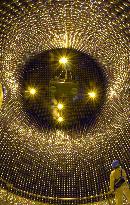
Super-Kamiokande neutrino observatory in Japan

Super-Kamiokande neutrino observatory in Japan

File photo taken in April 2006 shows the Super-Kamiokande neutrino observatory 1,000 meters underground in Gifu Prefecture, central Japan. University of Tokyo professor Takaaki Kajita won the 2015 Nobel Prize in Physics along with Canada's Arthur McDonald for their discovery of neutrino oscillations demonstrating that neutrinos have mass. (Kyodo) ==Kyodo

  •  
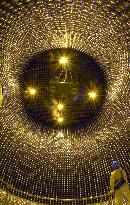
Super-Kamiokande neutrino observatory in Japan

Super-Kamiokande neutrino observatory in Japan

File photo taken in April 2006 shows the Super-Kamiokande neutrino observatory 1,000 meters underground in the central Japan prefecture of Gifu. Takaaki Kajita, a professor at the University of Tokyo, won the 2015 Nobel Prize in Physics along with Canada's Arthur McDonald for their discovery of neutrino oscillations demonstrating that neutrinos have mass. (Kyodo) ==Kyodo

  •  
Nobel laureate Kajita thanks community back home for support

Nobel laureate Kajita thanks community back home for support

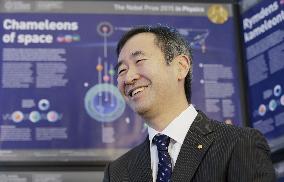
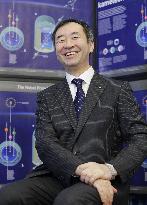
Japanese scientist Takaaki Kajita, who shared the 2015 Nobel Prize in Physics with Canada's Arthur McDonald, gives an interview with the media in Stockholm on Dec. 7, 2015. Kajita expressed gratitude for support from people in Kamioka, the Japanese community that hosts the Super-Kamiokande neutrino observatory. (Kyodo) ==Kyodo

  •  
Nobel laureate Kajita thanks community back home for support

Nobel laureate Kajita thanks community back home for support

Japanese scientist Takaaki Kajita, who shared the 2015 Nobel Prize in Physics with Canada's Arthur McDonald, gives an interview with the media in Stockholm on Dec. 7, 2015. Kajita expressed gratitude for support from people in Kamioka, the Japanese community that hosts the Super-Kamiokande neutrino observatory. (Kyodo) ==Kyodo

  •  
Kajita donates neutrino detector

Kajita donates neutrino detector

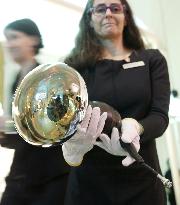
Photo taken Dec. 6, 2015, shows a neutrino detector donated by Takaaki Kajita, the Japanese scientist jointly awarded the Nobel Prize in physics for the discovery of neutrino oscillations, to the Nobel Museum in Stockholm. The same detectors are installed at the Super-Kamiokande neutrino observatory in Japan. (Kyodo) ==Kyodo

  •  
Kajita donates neutrino detector

Kajita donates neutrino detector

Photo taken Dec. 6, 2015, shows a neutrino detector (front) donated by Takaaki Kajita, the Japanese scientist jointly awarded the Nobel Prize in physics for the discovery of neutrino oscillations, to the Nobel Museum in Stockholm. The same detectors are installed at the Super-Kamiokande neutrino observatory in Japan. The detector seen in the back was donated by another Japanese Nobel laureate and Kajita's teacher, Masatoshi Koshiba, in 2002. (Kyodo) ==Kyodo

  •  
High school students study about Super-Kamiokande

High school students study about Super-Kamiokande

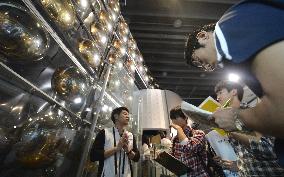
High school students take notes in front of a model of Nobel Physics Prize winner Takaaki Kajita's Super-Kamiokande detector at the National Museum of Emerging Science and Innovation (Miraikan) in Tokyo on Oct. 10, 2015. Kajita won the prize for the discovery of neutrino oscillations. (Kyodo) ==Kyodo

  •  
High school students look at Super-Kamiokande model

High school students look at Super-Kamiokande model

High school students observe a model of the Super-Kamiokande neutrino detector at the National Museum of Emerging Science and Innovation (Miraikan) in Tokyo on Oct. 10, 2015, after Japanese scientist Takaaki Kajita won the 2015 Nobel Prize in Physics for the discovery of neutrino oscillations. (Kyodo) ==Kyodo

  •  
Expert explains work at facility linked to Nobel physics prize

Expert explains work at facility linked to Nobel physics prize

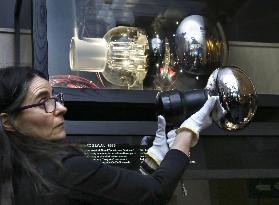
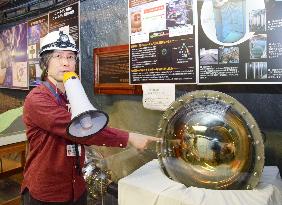
Yoshinari Hayato, associate professor at the University of Tokyo's Institute for Cosmic Ray Research, shows one of the photomultiplier tubes at Super-Kamiokande, the world's largest underground neutrino detector facility, in Hida, Gifu Prefecture, central Japan, on Oct. 9, 2015. The detector was instrumental in research by Japanese scientist Takaaki Kajita, who was named a co-recipient of the Nobel Prize in Physics on Oct. 6 "for the discovery of neutrino oscillations, which shows that neutrinos have mass." (Kyodo) ==Kyodo

  •  
Expert explains work at facility linked to Nobel physics prize

Expert explains work at facility linked to Nobel physics prize

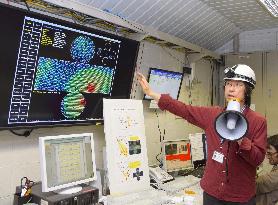
Yoshinari Hayato, associate professor at the University of Tokyo's Institute for Cosmic Ray Research, explains work in the control room at Super-Kamiokande, the world's largest underground neutrino detector facility, in Hida, Gifu Prefecture, central Japan, on Oct. 9, 2015. The detector was instrumental in research by Japanese scientist Takaaki Kajita, who was named a co-recipient of the Nobel Prize in Physics on Oct. 6 "for the discovery of neutrino oscillations, which shows that neutrinos have mass." (Kyodo) ==Kyodo

  •  
Japanese scientist Masatoshi Koshiba

Japanese scientist Masatoshi Koshiba

Photo taken in August 2003 shows Japanese scientist Masatoshi Koshiba (L), a co-winner of the 2002 Nobel Prize in physics, and Japanese Prime Minister Junichiro Koizumi (front R) at the Super-Kamiokande neutrino observatory in Gifu Prefecture. Koshiba died on Nov. 12, 2020, at age 94.

  •  
Emperor, empress visit Super-Kamiokande

Emperor, empress visit Super-Kamiokande

HIDA, Japan - Emperor Akihito and Empress Michiko looks at a device during their visit to Super-Kamiokande, a large detector for cosmic particles located in Kamioka, Gifu Prefecture, on July 13. (Pool photo) (Kyodo)

  •  
Koizumi visits Kamiokande

Koizumi visits Kamiokande

TOKYO, Japan - Prime Minister Junichiro Koizumi (seated) is briefed by Masatoshi Koshiba (L), a professor emeritus at the University of Tokyo, during a visit to the Kamiokande cosmic neutrino detector, located 1 kilometer underground in a mine in Kamioka, Gifu Prefecture, on Aug. 27.(Pool photo)(Kyodo)

  •  
(1) Koshiba, Tanaka receive Nobel prizes at awards ceremony

(1) Koshiba, Tanaka receive Nobel prizes at awards ceremony

STOCKHOLM, Sweden - Japan's Masatoshi Koshiba, co-winner of the 2002 Nobel Prize in Physics, receives his Nobel medal from King Carl XVI Gustaf at a ceremony in Stockholm on Dec. 10. Koshiba, 76, professor emeritus at the University of Tokyo, was honored for his contribution to confirming the existence of cosmic neutrinos by developing and using a gigantic underground detector called Kamiokande in Kamioka, Gifu Prefecture. (Kyodo)

  •  
Damaged neutrino detector 'Super Kamiokande' restored

Damaged neutrino detector 'Super Kamiokande' restored

GIFU, Japan - A large neutrino detector operated by the University of Tokyo's Institute for Cosmic Ray Research (ICRR) in Gifu Prefecture is shown off to the media Sept. 24 after it was repaired following severe damage sustained in an accident in November 2001. About 7,000 or 60% of the 11,000 photomultiplier tubes (PMTs) attached to the neutrino detector in the town of Kamioka in the central Japanese prefecture were found broken last Nov. 12 due to a chain reaction, but it is now repaired to a level that experiments can resume, ICRR officials said. (Kyodo)

  •  
Japanese, U.S. physicists to share Israel's Wolf Prize

Japanese, U.S. physicists to share Israel's Wolf Prize

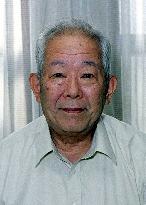
TOKYO, Japan - Masatoshi Koshiba, professor emeritus at the University of Tokyo who will share the 2000 Wolf Prize in physics with a U.S. scientist, is shown in a file photo. The Israel-based Wolf Foundation said on Jan. 18 Koshiba, 73, and Raymond Davis Jr., 85, a professor at the University of Pennsylvania, will share the 100,000 dollar prize, to be presented in Jerusalem in May. Koshiba has led a series of experiments on neutrinos, using the Kamiokande and Super-Kamiokande detectors in the town of Kamioka, Gifu Prefecture, to study the subatomic particles emitted by supernovas.

  •  
Scientists detect neutrino beam traversing 250 km

Scientists detect neutrino beam traversing 250 km

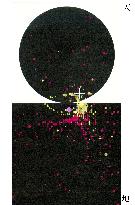
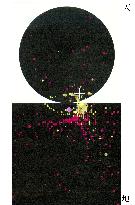
The photo shows a neutrino beam traversing 250 kilometers between the High Energy Accelerator Research Organization facility in Tsukuba, Ibaraki Prefecture, and the Super-Kamiokande detector in the town of Kamioka, Gifu Prefecture. An international team of scientists announced June 28 the detection of the beam's passage. The photos were provided by the University of Tokyo's Institute for Cosmic Ray Research, which led the experiment.

  •  
Scientists detect neutrino beam traversing 250 km

Scientists detect neutrino beam traversing 250 km

The photo shows a neutrino beam traversing 250 kilometers between the High Energy Accelerator Research Organization facility in Tsukuba, Ibaraki Prefecture, and the Super-Kamiokande detector in the town of Kamioka, Gifu Prefecture. An international team of scientists announced June 28 the detection of the beam's passage. The photos were provided by the University of Tokyo's Institute for Cosmic Ray Research, which led the experiment.

  •  
Study shows neutrinos possess m

Study shows neutrinos possess m

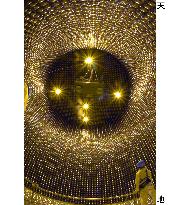
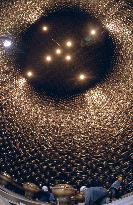
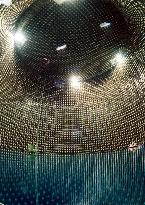
A team of Japanese and U.S. scientists have found evidence showing for the first time that neutrinos -- tiny, electrically neutral, subatomic particles -- possess mass, contradicting the standard theory of particle physics. The Super-Kamiokande group made the finding by using a 50,000-ton tank (in the photo) of highly purified water located about 1,000 meters underground in the Kamioka Mine in Gifu Prefecture, central Japan. ==Kyodo

  • Main
  • Top
  • Editorial
  • Creative
  • About Us
  • About ILG
  • Terms of use
  • Company
  • BEHIND
  • Price List
  • Single Plan
  • Monthly Plan
  • Services
  • Shooting
  • Rights Clearance
  • Support
  • FAQ
  • How To Buy
  • Contact Us
  • Become a Partner

© KYODO NEWS IMAGES INC

All Rights Reserved.

  • Editorial
  • Olympics
  • News
  • Sports
  • Japan
  • Tech
  • Royal
  • Disaster
  • NorthKorea
  • Old Japan
  • SNS
  • Creative
  • Food
  • Japan
  • Landscape
  • Animal
  • Popular
  • #Ukraine
  • #Russia
  • #coronavirus
  • #N. Korea
  • #Thailand
  • #China
  • #Ukraine
  • #Russia
  • #coronavirus
  • #N. Korea
  • #Thailand
  • #China
  • Food
  • Japan
  • Landscape
  • Animal
  • Olympics
  • News
  • Sports
  • Japan
  • Tech
  • Royal
  • Disaster
  • NorthKorea
  • Old Japan
  • SNS