•  
Illustration - Surtourisme

Illustration - Surtourisme

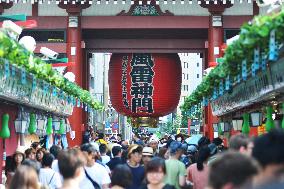
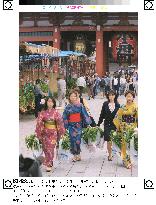
JAPAN. TOKYO. JAPAN. TOKYO. ASAKUSA. CROWD AT THE ENTRANCE OF THE SENSO-JI TEMPLE DEDICATED TO THE GODDESS KANNON. Photo by Antoine Lorgnier/Only World/ABACAPRESS.COM

  •  
Wind chime festival at western Japan temple

Wind chime festival at western Japan temple

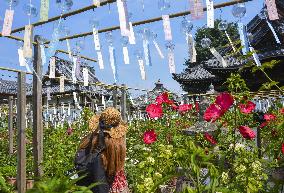
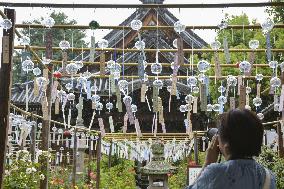
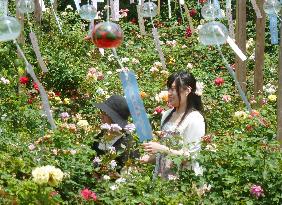
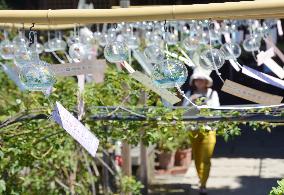
Wind chimes blow in the wind at Ofusa Kannon temple in Kashihara in Nara Prefecture, western Japan, on July 1, 2025, as about 3,000 wind chimes are hung for the annual three-month wind chime festival that began the same day.

  •  
Wind chime festival at western Japan temple

Wind chime festival at western Japan temple

Wind chimes blow in the wind at Ofusa Kannon temple in Kashihara in Nara Prefecture, western Japan, on July 1, 2025, as about 3,000 wind chimes are hung for the annual three-month wind chime festival that began the same day.

  •  

Stolen Buddhist statue returned to Japan

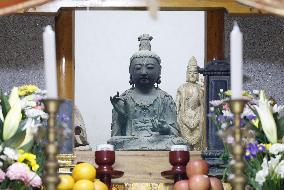
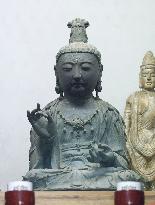
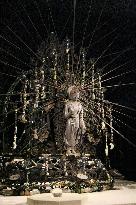
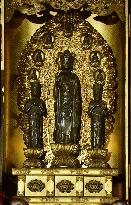
TSUSHIMA, Japan, May 12 Kyodo - A 14th-century Buddhist statue of the Avalokitesvara Bodhisattva sits at Kannon Temple on Tsushima Island in Nagasaki Prefecture, southwestern Japan, on May 12, 2025. The statue, stolen in October 2012 and taken to South Korea, was returned to the temple the same day. (Kyodo)

  •  

[Breaking News]Stolen Buddhist statue returned to Japan

TSUSHIMA, Japan, May 12 Kyodo - A 14th-century Buddhist statue of the Avalokitesvara Bodhisattva sits at Kannon Temple on Tsushima Island in Nagasaki Prefecture, southwestern Japan, on May 12, 2025. The statue, stolen in October 2012 and taken to South Korea, was returned to the temple the same day. (Kyodo)

  •  
Stolen Buddhist statue returned to Japan

Stolen Buddhist statue returned to Japan

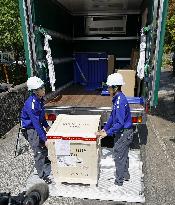
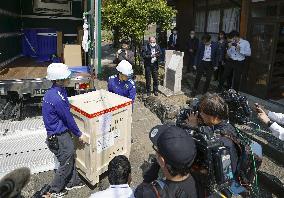
A box containing the statue of the Avalokitesvara Bodhisattva, a 14th-century Buddhist statue, is unloaded from a truck as it arrives at Kannon Temple on Tsushima Island in Nagasaki Prefecture, southwestern Japan, on May 12, 2025. The statue, stolen in October 2012 and taken to South Korea, was returned to the temple.

  •  
Stolen Buddhist statue returned to Japan

Stolen Buddhist statue returned to Japan

A box containing the statue of the Avalokitesvara Bodhisattva, a 14th-century Buddhist statue, is carried into Kannon Temple on Tsushima Island in Nagasaki Prefecture, southwestern Japan, on May 12, 2025. The statue, stolen in October 2012 and taken to South Korea, was returned to the temple.

  •  
Stolen Buddhist statue returned to Japan

Stolen Buddhist statue returned to Japan

A truck carries a 14th-century Buddhist statue of the Avalokitesvara Bodhisattva upon its arrival on Tsushima Island in Nagasaki Prefecture, southwestern Japan, in the early hours of May 12, 2025. The statue, stolen in October 2012 and taken to South Korea, was being returned to Kannon Temple on Tsushima.

  •  
Stolen Buddhist statue returned to Japan

Stolen Buddhist statue returned to Japan

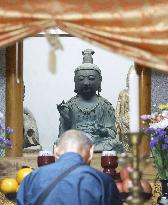
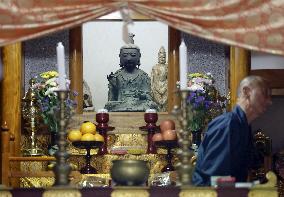
A 14th-century Buddhist statue of the Avalokitesvara Bodhisattva sits at Kannon Temple on Tsushima Island in Nagasaki Prefecture, southwestern Japan, on May 12, 2025. The statue, stolen in October 2012 and taken to South Korea, was returned to the temple the same day.

  •  
Stolen Buddhist statue returned to Japan

Stolen Buddhist statue returned to Japan

A 14th-century Buddhist statue of the Avalokitesvara Bodhisattva sits at Kannon Temple on Tsushima Island in Nagasaki Prefecture, southwestern Japan, on May 12, 2025. The statue, stolen in October 2012 and taken to South Korea, was returned to the temple the same day.

  •  
Stolen Buddhist statue returned to Japan

Stolen Buddhist statue returned to Japan

A 14th-century Buddhist statue of the Avalokitesvara Bodhisattva sits at Kannon Temple on Tsushima Island in Nagasaki Prefecture, southwestern Japan, on May 12, 2025. The statue, stolen in October 2012 and taken to South Korea, was returned to the temple the same day.

  •  
Stolen Buddhist statue returned to Japan

Stolen Buddhist statue returned to Japan

A 14th-century Buddhist statue of the Avalokitesvara Bodhisattva sits at Kannon Temple on Tsushima Island in Nagasaki Prefecture, southwestern Japan, on May 12, 2025. The statue, stolen in October 2012 and taken to South Korea, was returned to the temple the same day.

  •  
Cosplay parade in Nagoya

Cosplay parade in Nagoya

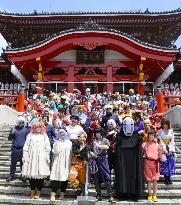
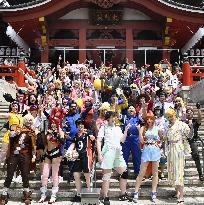
Cosplayers pose for photos at Osu Kannon temple in Nagoya, Aichi prefecture, central Japan, on Aug. 4, 2024, before a parade at the nearby Osu shopping street held in part of the World Cosplay Summit.

  •  
Wind chime festival at western Japan temple

Wind chime festival at western Japan temple

Wind chimes are on display at Ofusa Kannon temple in Kashihara in Nara Prefecture, western Japan, on July 1, 2024, as the annual wind chime festival begins.

  •  
Wind chime festival at western Japan temple

Wind chime festival at western Japan temple

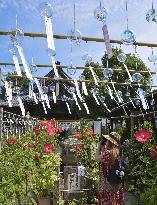
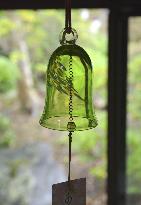
A wind chime is on display in a teahouse at Ofusa Kannon temple in Kashihara in Nara Prefecture, western Japan, on July 1, 2024, as the annual wind chime festival begins.

  •  
World Cosplay Summit in Nagoya

World Cosplay Summit in Nagoya

Cosplayers pose for a photo at the Osu Kannon temple in Nagoya, central Japan, on the final day of the annual World Cosplay Summit on Aug. 6, 2023.

  •  
Wind chime festival starts in Nara Pref. temple

Wind chime festival starts in Nara Pref. temple

TONDABAYASHI, Japan - The wind chime festival begins at Ofusa Kannon, known as the temple of roses and wind chimes in Kashihara, Nara Prefecture, on July 1, 2014.

  •  
Buddhist temples joining matchmaking boom

Buddhist temples joining matchmaking boom

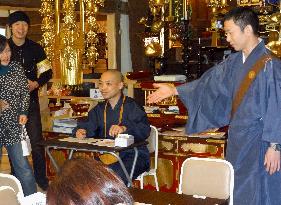
WAKAYAMA, Japan - Shunko Yoshino (R), chief priest of Anrakuji, a Buddhist temple of the Nichiren sect in the city of Wakayama, and Ryushin Yasutake (C), chief priest of Dorakuji, a Buddhist temple of the Kuze Kannon sect in the town of Katsuragi, Wakayama Prefecture, accept participants in a spouse-finding hunting event in front of an altar in the main hall of Anrakuji on Feb. 11, 2013.

  •  
Buddhist treasure repaired

Buddhist treasure repaired

NARA, Japan - The crown for a statue of Fuku Kenjaku Kannon, a form of the bodhisattva Avalokitesvara, is shown to reporters after repairs in Nara, western Japan, on April 2, 2012. The eighth-century crown with a statue of Buddha attached to it will be exhibited from April 3, 2012, at Todai temple museum in Nara.

  •  
World Cosplay Summit in Nagoya

World Cosplay Summit in Nagoya

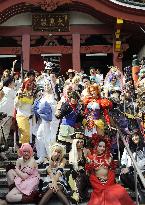
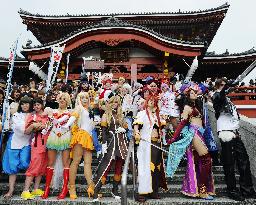
NAGOYA, Japan - Participants of the World Cosplay Summit 2011 strike poses at the Osu Kannon temple in Nagoya, central Japan, on Aug. 6, 2011. Around 500 cosplayers from Japan and 16 other countries are taking part in the three-day event that began the same day.

  •  
World Cosplay Summit in Nagoya

World Cosplay Summit in Nagoya

NAGOYA, Japan - Participants of the World Cosplay Summit 2011 strike poses at the Osu Kannon temple in Nagoya, central Japan, on Aug. 6, 2011. Around 500 cosplayers from Japan and 16 other countries are taking part in the three-day event that began the same day.

  •  
Int'l 'cosplayers' take to Nagoya streets

Int'l 'cosplayers' take to Nagoya streets

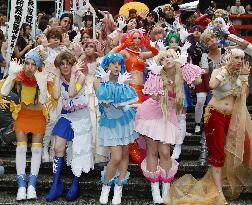
NAGOYA, Japan - Costume role players from abroad pose during a photo opportunity at Osu Kannon temple in Nagoya's Naka Ward on July 31, 2010, as the World Cosplay Summit 2010 commenced the same day.

  •  
Int'l 'cosplayers' take to Nagoya streets for summit parade

Int'l 'cosplayers' take to Nagoya streets for summit parade

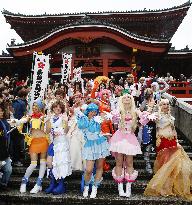
NAGOYA, Japan - ''Cosplay'' costume role players from abroad pose during a photo opportunity at Osu Kannon temple in Nagoya's Naka Ward following a parade on Aug. 1. The ''cosplayers'' are taking part in the three-day World Cosplay Summit, which started the same day in the city.

  •  
Int'l 'cosplayers' take to Nagoya streets for summit parade

Int'l 'cosplayers' take to Nagoya streets for summit parade

NAGOYA, Japan - ''Cosplay'' costume role players from abroad pose during a photo opportunity at Osu Kannon temple in Nagoya's Naka Ward following a parade on Aug. 1. The ''cosplayers'' are taking part in the three-day World Cosplay Summit, which started the same day in the city.

  •  
Int'l 'cosplayers' take to Nagoya streets for summit parade

Int'l 'cosplayers' take to Nagoya streets for summit parade

NAGOYA, Japan - ''Cosplay'' costume role players from abroad pose during a photo opportunity at Osu Kannon temple in Nagoya's Naka Ward following a parade on Aug. 1. The ''cosplayers'' are taking part in the three-day World Cosplay Summit, which started the same day in the city.

  •  
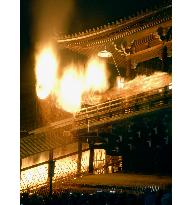
Big Pine torches ablaze at Todaiji as herald to spring

Big Pine torches ablaze at Todaiji as herald to spring

NARA, Japan - Big Pine torches are ablaze outside the Nigatsu-do of Todaiji temple in Nara on March 1, the start of the Omizutori (taking sacred water) ceremony heralding the arrival of spring in Japan's ancient capital. Shuni-e, or ceremony of the second month, as Omizutori is formally known, has been performed without interruption since 752 A.D., the year when the Great Buddha in Todaiji was built. Nigatsu-do is home to the eleven-headed Kannon, the symbol for the nation's prosperity and world peace.

  •  
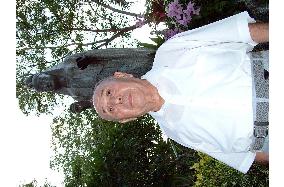
(1)Veterans, survivors commemorate WWII Leyte landings

(1)Veterans, survivors commemorate WWII Leyte landings

TACLOBAN, Philippines - Yoshikazu Sakamoto stands in front of the statute of kannon erected in Leyte in memory of Japanese war dead on Oct. 19 on the eve of ceremonies marking the 60th anniversary on Oct. 20 of the landing of U.S.-led forces on the shores of Leyte in the eastern Philippines, which led to the end of Japan's occupation of the Philippines. Sakamoto said after the mass that he lost his brother-in-law during the war, but added that other people may have suffered more.

  •  
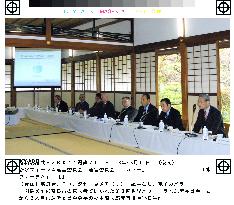
Int'l water forum to start Sun. in Kyoto

Int'l water forum to start Sun. in Kyoto

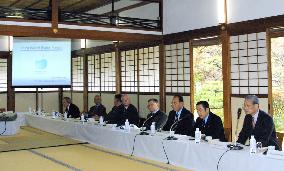
NARA, Japan - Members of the World Water Council and the National Steering Committee for the third World Water Forum hold a joint session at Todaiji Temple in Nara on March 15, the eve of the opening of the forum in Kyoto. Todaiji was chosen as the venue for the meeting because a popular ceremony known as Omizutori (literally, ''water-drawing'') involving a water offering to the Eleven Headed Kannon has been held annually in March at the temple for over 1,250 years.

  •  
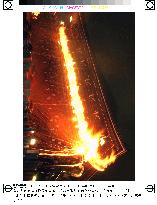
'Omizutori' rite heralds arrival of spring

'Omizutori' rite heralds arrival of spring

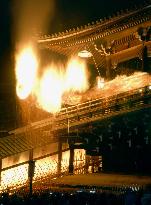
NARA, Japan - Monks wave large torches from a verandah at Todaiji Temple in Nara on March 1, scattering sparks over the crowd below in the annual ''Omizutori'' (water-drawing) rite at the temple. The monks later drew water from a nearby well and offered it to the image of the 11-faced Kannon in the Nigatsudo Hall. In the event, the monks prayed for happiness and peace.

  •  
'Omizutori' rite heralds the arrival of spring

'Omizutori' rite heralds the arrival of spring

NARA, Japan - Monks wave a large torch from the verandah, sprinkling sparks over the crow below in the annual ''Omizutori (water-drawing)'' rite at the Nigatsudo Hall at Todaiji Temple in Nara on March 1. The monks come down afterwards to draw water from a nearby well and offer it to the image of the 11-faced Kannon at the Hall. Said to date from AD 752, the rite symbolizes the arrival of spring.

  •  
Annual 'hozuki' plant fair opens in Tokyo's Asakusa

Annual 'hozuki' plant fair opens in Tokyo's Asakusa

TOKYO, Japan - A fair at which ''hozuki,'' or Chinese lantern plants, are sold opens at Tokyo's Sensoji Temple, or more popularly known as the Asakusa Kannon Temple, on July 9. The two-day fair, which marks the coming of summer, is expected to draw some 400,000 visitors.

  •  

Android Kannon at Kyoto temple

KYOTO, Japan Feb23:The Android Kannon Mindar gives a speech in tune with projected images and sound, in a dimly lit hall of Kyoto's Kodaiji temple, on Feb. 23, 2019. The robot, developed to explain the teachings of Buddha in plain terms, will begin preaching to the general public in early March.

  •  
Wind chime festival at Ofusa Kannon Temple in Nara Pref.

Wind chime festival at Ofusa Kannon Temple in Nara Pref.

Some 2,500 wind chimes are blown in the wind at Ofusa Kannon Temple in Kashihara, Nara Prefecture, western Japan, during an annual wind chime festival on July 14, 2015. (Kyodo) ==Kyodo

  •  
Gokaicho event starts at Zenko-ji Temple in Nagano

Gokaicho event starts at Zenko-ji Temple in Nagano

Replicas of the Amida-Nyorai, Kannon-Bosatsu and Seishi-Bosatsu statues, which are kept in absolute secrecy, are shown to the public at the main hall of Zenko-ji Temple in Nagano, central Japan, on April 5, the start of the temple's Maedachi Honzon Gokaicho event. The statues were brought into Japan when Buddhism was first introduced in the 6th century. The event, which is held only once in seven years, will run through May 31. (Kyodo) ==Kyodo

  •  
Gokaicho event starts at Zenko-ji Temple in Nagano

Gokaicho event starts at Zenko-ji Temple in Nagano

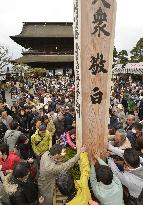
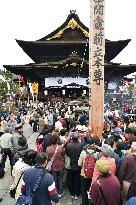
Worshippers touch the sacred pillar called Eko-bashira, in front of the main hall of Zenko-ji Temple, one of the most magnificent Buddhist temples in Japan, in Nagano, central Japan, on April 5, 2015, the start of the temple's Maedachi Honzon Gokaicho event. During the event held only once every seven years, replicas of the Amida-Nyorai, Kannon-Bosatsu and Seishi-Bosatsu statues, which are normally kept in absolute secrecy, are shown to the public. The statues were brought into Japan when Buddhism was first introduced in the 6th century. The event will run through May 31. (Kyodo) ==Kyodo

  •  
Gokaicho event starts at Zenko-ji Temple in Nagano

Gokaicho event starts at Zenko-ji Temple in Nagano

Worshippers touch the sacred pillar called Eko-bashira, in front of the main hall of Zenko-ji Temple, one of the most magnificent Buddhist temples in Japan, in Nagano, central Japan, on April 5, 2015, the start of the temple's Maedachi Honzon Gokaicho event. During the event held only once every seven years, replicas of the Amida-Nyorai, Kannon-Bosatsu and Seishi-Bosatsu statues, which are normally kept in absolute secrecy, are shown to the public. The statues were brought into Japan when Buddhism was first introduced in the 6th century. The event will run through May 31. (Kyodo) ==Kyodo

  •  
Steam rises as men vie to grab lucky wooden bars at Okayama festival

Steam rises as men vie to grab lucky wooden bars at Okayama festival

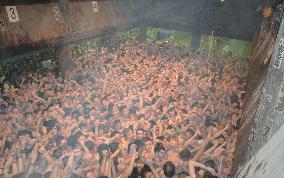
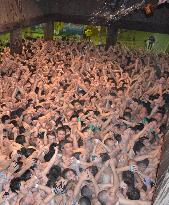
Steam rises as some 9,000 men jostle in the main hall of the Saidaiji Kannon-in temple in Okayama, western Japan, in a bid to grab two lucky wooden bars during a traditional festival on Feb. 21, 2015. (Kyodo) ==Kyodo

  •  
Men vie to grab lucky wooden bars at festival in Okayama, west Japan

Men vie to grab lucky wooden bars at festival in Okayama, west Japan

Some 9,000 men jostle in the main hall of the Saidaiji Kannon-in temple in Okayama, western Japan, in a bid to grab two lucky wooden bars during a traditional festival on Feb. 21, 2015. (Kyodo) ==Kyodo

  •  
Big Pine torches ablaze at Todaiji as herald to spring

Big Pine torches ablaze at Todaiji as herald to spring

NARA, Japan - Big Pine torches are ablaze outside the Nigatsu-do of Todaiji temple in Nara on March 1, the start of the Omizutori (taking sacred water) ceremony heralding the arrival of spring in Japan's ancient capital. Shuni-e, or ceremony of the second month, as Omizutori is formally known, has been performed without interruption since 752 A.D., the year when the Great Buddha in Todaiji was built. Nigatsu-do is home to the eleven-headed Kannon, the symbol for the nation's prosperity and world peace. (Kyodo)

  •  
(1)Veterans, survivors commemorate WWII Leyte landings

(1)Veterans, survivors commemorate WWII Leyte landings

TACLOBAN, Philippines - Yoshikazu Sakamoto stands in front of the statute of kannon erected in Leyte in memory of Japanese war dead on Oct. 19 on the eve of ceremonies marking the 60th anniversary on Oct. 20 of the landing of U.S.-led forces on the shores of Leyte in the eastern Philippines, which led to the end of Japan's occupation of the Philippines. Sakamoto said after the mass that he lost his brother-in-law during the war, but added that other people may have suffered more. (Kyodo)

  •  
Int'l water forum to start Sun. in Kyoto

Int'l water forum to start Sun. in Kyoto

NARA, Japan - Members of the World Water Council and the National Steering Committee for the third World Water Forum hold a joint session at Todaiji Temple in Nara on March 15, the eve of the opening of the forum in Kyoto. Todaiji was chosen as the venue for the meeting because a popular ceremony known as Omizutori (literally, ''water-drawing'') involving a water offering to the Eleven Headed Kannon has been held annually in March at the temple for over 1,250 years. (Kyodo)

  •  
The thousand Kannon images in Sanjusangendo Temple

The thousand Kannon images in Sanjusangendo Temple

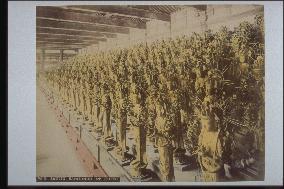
The same as the photo numbered 1-24, taken from a slightly lower angle looking up.==Date:unknown, Place:Kyoto, Photo:Tamamura Kozaburo, (Credit:Nagasaki University Library/Kyodo News Images) [Cabinet Number11‐36‐0]

  •  
Sensoji Temple

Sensoji Temple

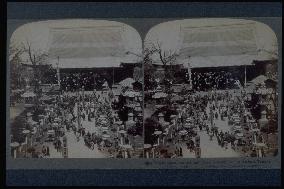
This Kannon-do was rebuilt by the third shogun Tokugawa Iemitsu in 1649. The style of construction is koran mitesaki-zukuri. The photograph captures a flock of pigeons flying from Niomon (gate). The building burned down in an air raid on March 10, 1945. The present-day Kannon-do was erected on October 17, 1958. Taken by Herbert George Ponting. Stereograph published in 1904.==Date:1904, Place:Tokyo, Photo:Underwood, (Credit:Nagasaki University Library/Kyodo News Images) [Cabinet Number97‐69‐0]

  •  
Lake Biwa seen from Miidera Temple

Lake Biwa seen from Miidera Temple

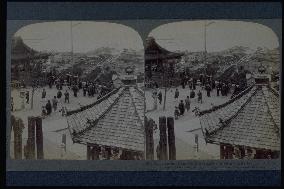
View of Otsu from Kannondo at Miidera Temple (official name: Enjoji Temple). The canal in the centre is the Lake Biwa Waterway built in 1890 to supply drinking water to Kyoto, generate electricity, and facilitate transportation. Miidera, the 14th temple in the circuit of 33 Holy Kannon Temples of Western Japan, commanded a panoramic view of Lake Biwa and bustled with worshippers.==Date:1904, Place:Otsu, Photo:Underwood, (Credit:Nagasaki University Library/Kyodo News Images) [Cabinet Number97‐47‐0]

  •  
Manganji Temple,Nikko

Manganji Temple,Nikko

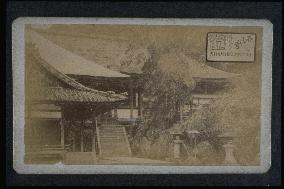
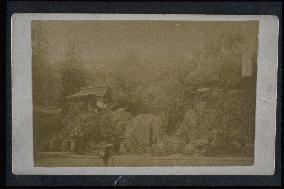
Sanbutsu-do, the main hall of Rinoji Temple, was formerly part of Nikko Futarasan Shinto Shrine. In response to the official separation of Buddhism and Shintoism in 1871, it was dissembled and rebuilt on its present site in 1881. It enshrines three Buddhist deities: Senju-kannon (1,000-hand deity of mercy), Amida-nyorai and Bato-kannon.==Date:unknown, Place:Nikko, Photo:unknown, (Credit:Nagasaki University Library/Kyodo News Images) [Cabinet Number96‐40‐0]

  •  
Osu Kannon Temple and the five-story pagoda

Osu Kannon Temple and the five-story pagoda

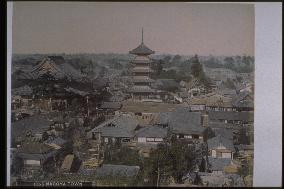
Osu Kannon Temple and the five-story pagoda==Date:unknown, Place:Nagoya, Photo:Tamamura Kozaburo, (Credit:Nagasaki University Library/Kyodo News Images)

  •  
Lake Biwa seen from Miidera Temple

Lake Biwa seen from Miidera Temple

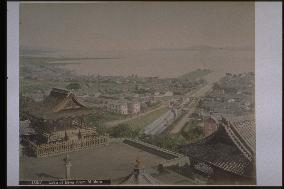
View of Otsu from Kannondo at Miidera Temple (official name: Enjoji Temple). Enjoji is the 14th temple in the circuit of 33 Holy Kannon Temples of Western Japan. The canal in the centre is the Lake Biwa Waterway built in 1890 to supply drinking water, generate electricity, and facilitate transportation. The state of the surroundings suggests that this photograph was taken soon after the completion of the waterway.==Date:unknown, Place:Otsu, Photo:Tamamura Kozaburo, (Credit:Nagasaki University Library/Kyodo News Images) [Cabinet Number80‐12‐0]

  •  
Lake Biwa seen from Miidera Temple

Lake Biwa seen from Miidera Temple

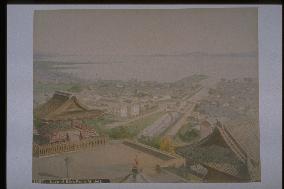
View of Otsu from Kannondo at Miidera Temple (official name: Enjoji Temple). Enjoji is the 14th temple in the circuit of 33 Holy Kannon Temples of Western Japan. The canal in the centre is the Lake Biwa Waterway built in 1890 to supply drinking water, generate electricity, and facilitate transportation. The state of the surroundings suggests that this photograph was taken soon after the completion of the waterway.==Date:unknown, Place:Otsu, Photo:Tamamura Kozaburo, (Credit:Nagasaki University Library/Kyodo News Images) [Cabinet Number79‐13‐0]

  •  
Ishiyamadera Temple

Ishiyamadera Temple

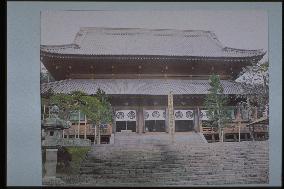
The precincts of Ishiyamadera Temple seen from the front of the Main Hall . During the Heian Period, aristocratic women worshipped at the temple, and in later years it attracted many commoners as the 13th temple in the circuit of the 33 Holy Kannon temple of Western Japan. The Main Hall, just behind the tile-roofed Rennyodo, burned to the ground in 1096 and was later rebuilt.==Date:unknown, Place:Shiga, Photo:unknown, (Credit:Nagasaki University Library/Kyodo News Images) [Cabinet Number71‐42‐0]

  •  
Ishiyamadera Temple

Ishiyamadera Temple

The precincts of Ishiyamadera Temple. During the Heian Period (794-1192), the temple was popular among ladies of the aristocracy. It was designated later as the 13th temple in the circuit of 33 Holy Kannon Temples of Western Japan and gained popularity among commoners. The photograph emphasizes the jagged wollastonite rocks after which the temple is named ( Ishiyama means stone mountain ).==Date:unknown, Place:Shiga, Photo:unknown, (Credit:Nagasaki University Library/Kyodo News Images) [Cabinet Number71‐35‐0]

  • Main
  • Top
  • Editorial
  • Creative
  • About Us
  • About ILG
  • Terms of use
  • Company
  • BEHIND
  • Price List
  • Single Plan
  • Monthly Plan
  • Services
  • Shooting
  • Rights Clearance
  • Support
  • FAQ
  • How To Buy
  • Contact Us
  • Become a Partner

© KYODO NEWS IMAGES INC

All Rights Reserved.

  • Editorial
  • Olympics
  • News
  • Sports
  • Japan
  • Tech
  • Royal
  • Disaster
  • NorthKorea
  • Old Japan
  • SNS
  • Creative
  • Food
  • Japan
  • Landscape
  • Animal
  • Popular
  • #Ukraine
  • #Thailand
  • #coronavirus
  • #N. Korea
  • #Russia
  • #China
  • #Ukraine
  • #Thailand
  • #coronavirus
  • #N. Korea
  • #Russia
  • #China
  • Food
  • Japan
  • Landscape
  • Animal
  • Olympics
  • News
  • Sports
  • Japan
  • Tech
  • Royal
  • Disaster
  • NorthKorea
  • Old Japan
  • SNS