•  
Poet from Hiroshima

Poet from Hiroshima

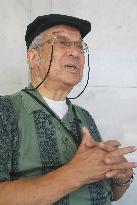
HIROSHIMA, Japan - Kozaburo Nagatsu, a poet from Hiroshima Prefecture, is interviewed by Kyodo News on July 9, 2013 in Hiroshima, Hiroshima Prefecture. Nagatsu has been writing poems for years as he wants people to know the sorrow of tens of thousands of people who died instantly in the 1945 atomic bombing on Hiroshima.

  •  
Kozaburo Hirai, composer of 'Tombo no Megane,' dies at 92

Kozaburo Hirai, composer of 'Tombo no Megane,' dies at 92

TOKYO, Japan - Kozaburo Hirai (file photo), a pioneer of Japanese choral music and who composed a number of popular children's songs, including ''Tombo no megane'' (the dragonfly's glasses) and ''Ski,'' died of pneumonia at a Tokyo hospital Nov. 30, his family said. He was 92.

  •  
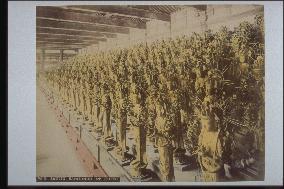
The thousand Kannon images in Sanjusangendo Temple

The thousand Kannon images in Sanjusangendo Temple

The same as the photo numbered 1-24, taken from a slightly lower angle looking up.==Date:unknown, Place:Kyoto, Photo:Tamamura Kozaburo, (Credit:Nagasaki University Library/Kyodo News Images) [Cabinet Number11‐36‐0]

  •  
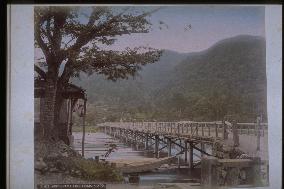
The Togetsukyo Bridge,Arashiyama

The Togetsukyo Bridge,Arashiyama

Togetsu Bridge at Arashiyama is viewed from the northern end, facing south. Horinji Temple is visible on the hillside. A sign at the northern end of the bridge informs people that cows and horses are not allowed to cross the bridge. A teahouse with hanging lanterns stands under a cherry tree. A maruko boat is docked nearby. The bridge was destroyed by a flood in 1892. The stone bridge to the right, Kinmonkyo, was later moved to Kurumazaki Shrine. Taken by Tamamura Kozaburo.==Date:unknown, Place:Kyoto, Photo:unknown, (Credit:Nagasaki University Library/Kyodo News Images) [Cabinet Number88‐6‐0]

  •  
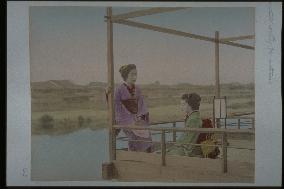
Enjoying a cool evening on yuka platforms along the Kamo River

Enjoying a cool evening on yuka platforms along the Kamo River

A geisha and maiko relax on a terrace at Shijo Ohashi, looking over Kamogawa River. One stares across the river, while the other sits on the railing looking toward the interior. Houses are reflected on the river in the background. This photograph may have been used in picture postcards for tourists. It was taken by Tamamura Kozaburo.==Date:unknown, Place:Kyoto, Photo:Tamamura Kozaburo, (Credit:Nagasaki University Library/Kyodo News Images) [Cabinet Number83‐18‐0]

  •  
The Nitenmon Gate,Taiyuin Shrine,Nikko

The Nitenmon Gate,Taiyuin Shrine,Nikko

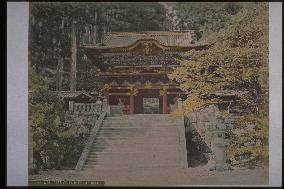
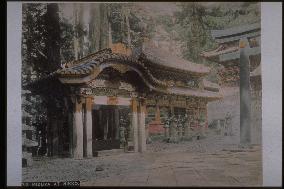
Nitenmon is located beyond Niomon in the precincts of Taiyuin, the mausoleum of third shogun Tokugawa Iemitsu. A plaque inscribed with the word Taiyuin by Emperor Gomizunoo is affixed to the upper part of the gate. Two of the four celestial guardians, Jikokuten and Komokuten, are enshrined at the front part of the gate while the other two, Fujin and Raijin, were placed on the back . This is the largest gate at Nikko-Sannai.==Date:unknown, Place:Nikko, Photo:Tamamura Kozaburo, (Credit:Nagasaki University Library/Kyodo News Images) [Cabinet Number80‐47‐0]

  •  
The god of wind at Niomon Gate,Taiyuin Shrine,Nikko

The god of wind at Niomon Gate,Taiyuin Shrine,Nikko

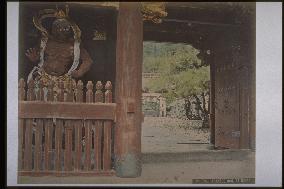
Naraen-Kongo is one of the two Nio (guardian deities) at Niomon, the entrance gate to Taiyuin. Taiyuin is both the posthumous name give to third shogun Tokugawa Iemitsu by Emperor Gokomyo and the name of his mausoleum. The other Nio statue is Mitsushaku-Kongo.==Date:unknown, Place:Nikko, Photo:Tamamura Kozaburo, (Credit:Nagasaki University Library/Kyodo News Images) [Cabinet Number80‐46‐0]

  •  
The Hundred Stone Statues of Jizo at Ganmangahara,Nikko

The Hundred Stone Statues of Jizo at Ganmangahara,Nikko

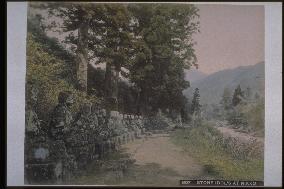
This famous sight on Daiya River is known by names such as Narabi-jizo, Bake-jizo, and Hyaku-jizo. It is also known as Kanman-ga-fuchi or Ganman-ga-fuchi. Oya-jizo, the head of which was washed away by the flood of 1902, is visible at the end of the road.==Date:unknown, Place:Nikko, Photo:Tamamura Kozaburo, (Credit:Nagasaki University Library/Kyodo News Images) [Cabinet Number80‐49‐0]

  •  
The Karamon Gate,Toshogu Shrine,Nikko

The Karamon Gate,Toshogu Shrine,Nikko

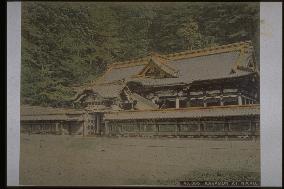
This is the main gate at Toshogu Shinto Shrine. Only high ranking government officials and feudal lords, who were allowed to meet the shogun directly, could use this gate during the Edo Period. The inscription on the upper portion reads Shuntei Choken-no-gi (Emperor Shun's Morning Greetings). On both sides of the gate, surrounding the main shrine, is a 160m-long carved sukibei (transparent wall).==Date:unknown, Place:Nikko, Photo:Tamamura Kozaburo, (Credit:Nagasaki University Library/Kyodo News Images) [Cabinet Number80‐44‐0]

  •  
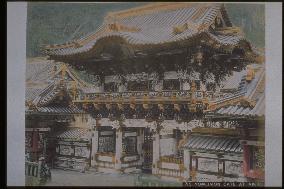
The Yomeimon Gate,Toshogu Shrine,Nikko

The Yomeimon Gate,Toshogu Shrine,Nikko

This is the front side of Yomeimon Gate. The symbol of Nikko Toshogu, this gate displays a collection of the craftsmanship and decorative techniques representative of the beginning of the Edo Period. The carvings on the gate total 508 and include people, animals -real and imaginary-, flowers, birds, patterns, and so on. Because the viewers will not get tired of admiring the beauty of the gate until twilight, it is also called the Higurashimon (the Evening Gate).==Date:unknown, Place:Nikko, Photo:Tamamura Kozaburo, (Credit:Nagasaki University Library/Kyodo News Images) [Cabinet Number80‐43‐0]

  •  
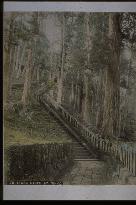
Stone steps on the approach to the Okusha,Toshogu Shrine,Nikko

Stone steps on the approach to the Okusha,Toshogu Shrine,Nikko

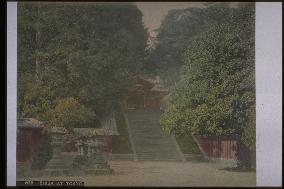
Visitors reach these steps after passing under the famous Nemurineko (sleeping cat) carving in the east corridor of the main hall at Nikko Toshogu and going through Sakashita Gate. At the top the stairs is the Okusha (inner shrine) containing the tomb of Tokugawa Ieyasu. Each step is made from a solid slab of stone. The Okusha is visible in the upper part of the photograph.==Date:unknown, Place:Nikko, Photo:Tamamura Kozaburo, (Credit:Nagasaki University Library/Kyodo News Images) [Cabinet Number80‐45‐0]

  •  
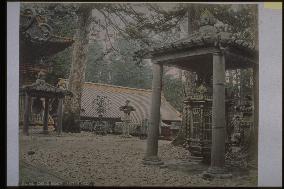
The Dutch Lantern,Toshogu Shrine,Nikko

The Dutch Lantern,Toshogu Shrine,Nikko

This photograph contains the octagonal revolving lantern given to Japan by the Dutch Republic. It is visible on the right, in front of the Yomeimon Gate of the Nikko Toshogu Shinto Shrine. A lotus lantern is standing in the centre back. The building on the left is the Bell Tower. The Korean Bell, which should be hanging in the roofed structure supported by the four pillars, is not visible here. The roof of Kamijinko is visible behind.==Date:unknown, Place:Nikko, Photo:Tamamura Kozaburo, (Credit:Nagasaki University Library/Kyodo News Images) [Cabinet Number80‐41‐0]

  •  
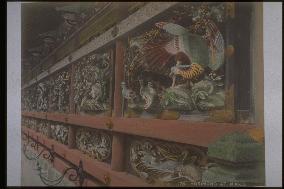
Carvings at the cliosters of the Yomeimon Gate,Toshogu Shrine,Nikko

Carvings at the cliosters of the Yomeimon Gate,Toshogu Shrine,Nikko

This is the south side of the 220m corridor that stretches east to west from the sodebei wall of Yomeimon at Nikko Toshogu. The south side is decorated with 25 different carvings. A candlestick is attached to each carving to light the corridor.==Date:unknown, Place:Nikko, Photo:Tamamura Kozaburo, (Credit:Nagasaki University Library/Kyodo News Images) [Cabinet Number80‐42‐0]

  •  
The Suibansha (sacred fountain),Toshogu Shrine,Nikko

The Suibansha (sacred fountain),Toshogu Shrine,Nikko

The white building in the centre is the Omizuya, with a granite water basin donated by the Nabeshima Clan in 1618. This is said to be the first structure in a shrine washing place using a water basin rather than a naturally occurring stream or spring for cleansing hands. The Rinzo (Kyozo), where the sutras are stored, is to the right.==Date:unknown, Place:Nikko, Photo:Tamamura Kozaburo, (Credit:Nagasaki University Library/Kyodo News Images) [Cabinet Number80‐38‐0]

  •  
The torii,Taiyuin Shrine,Nikko

The torii,Taiyuin Shrine,Nikko

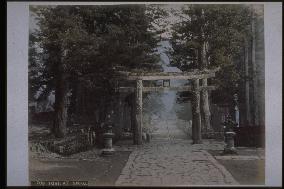
This is a view of the stone torii gate and Omote-sando approach to Toshogu Shinto Shrine. The torii was donated by Kuroda Echizennokami Nagamasa in 1618. Nine meters high, it is the largest stone torii gate built during the Edo Period. A waterway, non-existent at present, is visible in the centre.==Date:unknown, Place:Nikko, Photo:Tamamura Kozaburo, (Credit:Nagasaki University Library/Kyodo News Images) [Cabinet Number80‐37‐0]

  •  
A row of Japanese cedar trees along the Nikko Road

A row of Japanese cedar trees along the Nikko Road

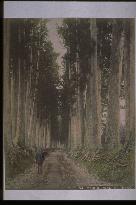
Cedar trees line a street near present-day Imaichi City. Three cedar-lined highways led to Nikko: Onari (Nikko) Highway, Reiheishi Highway, and Aizu-nishi Highway. A total distance of about 37km, most of the former roads are now in Imaichi City. The one shown here may be Reiheishi Highway, because it is particularly narrow.==Date:unknown, Place:Nikko, Photo:Tamamura Kozaburo, (Credit:Nagasaki University Library/Kyodo News Images) [Cabinet Number80‐35‐0]

  •  
The middle gate to Haiden (sanctuary) of the Okuno-in of Bunsho-in,Zojoji Temple,Shiba

The middle gate to Haiden (sanctuary) of the Okuno-in of Bunsho-in,Zojoji Temple,Shiba

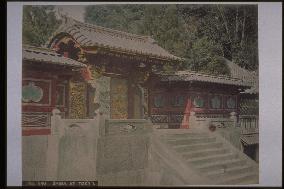
The stone stairs and Karamon Gate leading to the inner shrine of Yushoin Mausoleum are viewed from just inside Shikiri Gate (#4162). After that, a visitor sees the Hall of Worship, then the stairs and bronze lanterns visible in #2641, and then the pagoda in the interior.==Date:unknown, Place:Tokyo, Photo:Tamamura Kozaburo, (Credit:Nagasaki University Library/Kyodo News Images) [Cabinet Number80‐32‐0]

  •  
The curtain gate to the tomb in Bunsho-in,Zojoji Temple,Shiba

The curtain gate to the tomb in Bunsho-in,Zojoji Temple,Shiba

The Shikiri Gate dividing the Hall of Worship and the inner shrine at Bunshoin Mausoleum is seen from the Hall of Worship. The inner shrine was designed in a straight line from this gate all the way up to the pagoda in the deepest part of the mausoleum. Later, the tombs of the 12th Shogun Ieyoshi and 14th Shogun Iemochi were added, but the location of the inner shrine remained the same.==Date:unknown, Place:Tokyo, Photo:Tamamura Kozaburo, (Credit:Nagasaki University Library/Kyodo News Images) [Cabinet Number80‐30‐0]

  •  
The General's tomb,Zojoji Temple,Shiba

The General's tomb,Zojoji Temple,Shiba

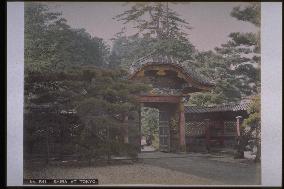
This is the gate in front of the pagoda of the 9th Shogun Tokugawa Ieshige (Shunshinin). No new mausoleums were constructed after the 8th Shogun Yoshimune, so the okuin (inner shrine) of Shunshinin was attached to that of Yushouin. This is the northernmost mausoleum at Zojoji Temple built for the Tokugawa shoguns.==Date:unknown, Place:Tokyo, Photo:Tamamura Kozaburo, (Credit:Nagasaki University Library/Kyodo News Images) [Cabinet Number80‐33‐0]

  •  
A five-story pagoda at Tennoji Temple,Ueno

A five-story pagoda at Tennoji Temple,Ueno

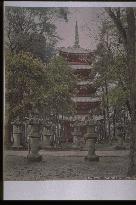
This five-story pagoda was built by Doi Toshikatsu, feudal lord of Furukawa Castle, in 1639. The stone lanterns in the foreground line the approach of Toshogu Shrine. The main hall is to the left. The pagoda originally belonged to the shrine, but after the separation of Shintoism and Buddhism in the Meiji Period, it transferred to Kaneiji Temple. At present, it belongs to the Tokyo Metropolitan Government and is located within the Ueno Zoo grounds.==Date:unknown, Place:Ueno, Photo:Tamamura Kozaburo, (Credit:Nagasaki University Library/Kyodo News Images) [Cabinet Number80‐28‐0]

  •  
The approach to Toshogu Shrine,Ueno

The approach to Toshogu Shrine,Ueno

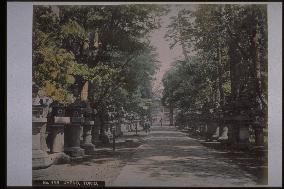
The entrance to the main hall of Toshogu Shrine is seen from the direction of the approach. A total of 195 large stone lanterns donated by feudal lords stand along it. The enormous size of the lanterns and the torii gate can be judged by comparing them with the people walking along the approach. The torii gate depicted in #2202 is visible behind the torii gate in the centre.==Date:unknown, Place:Ueno, Photo:Tamamura Kozaburo, (Credit:Nagasaki University Library/Kyodo News Images) [Cabinet Number80‐29‐0]

  •  
Teahouses at Ueno Park

Teahouses at Ueno Park

Shinobugaoka, a hill at Ueno, is viewed from the racetrack at Shinobazu Pond. The Western-style building on the right is Ueno Seiyoken Restaurant, which opened in 1876 as a branch of Kyobashi Seiyoken. It was a hotel and a restaurant frequented daily by many people.==Date:unknown, Place:Ueno, Photo:Tamamura Kozaburo, (Credit:Nagasaki University Library/Kyodo News Images) [Cabinet Number80‐24‐0]

  •  
Miyanoshita Spa

Miyanoshita Spa

Miyanoshita and Dogashima viewed from Mukoyama. The Fujiya and Naraya hotels are visible at Miyanoshita. Thus, this was taken after the completion of the main building of Fujiya Hotel in 1891, after the big fire of Miyanoshita in 1883. Godan Ryokan (inn) is also visible on the way to Dogashima. At both sides of the inn the falls of Shirabenotaki and Shirasaginotaki cascade. Hiramatsu villa stands under Godan Ryokan.==Date:unknown, Place:Hakone, Photo:Tamamura Kozaburo, (Credit:Nagasaki University Library/Kyodo News Images) [Cabinet Number80‐16‐0]

  •  
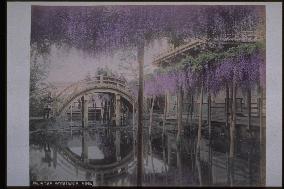
A wisteria trellis at Kameido Shrine

A wisteria trellis at Kameido Shrine

This is the smaller Taiko-bashi (Sori-bashi) located in front of the Romon (Sakura Gate) on the right. The Wisteria Festival of Kameido Tenjin Shrine held from mid-April to mid-May every year is a harbinger of summer. There are many other events held at the shrine. The parents of young children release carp into Shinji Pond during the Shichi-Go-San Festival on November 15 to pray for the healthy growth of their children. Masaoka shiki wrote the haiku poem: Sori-bashi, the wisteria are purple and carp red.==Date:unknown, Place:Tokyo, Photo:Tamamura Kozaburo, (Credit:Nagasaki University Library/Kyodo News Images) [Cabinet Number80‐25‐0]

  •  
Honmoku Point seen from the Fudozaka slope

Honmoku Point seen from the Fudozaka slope

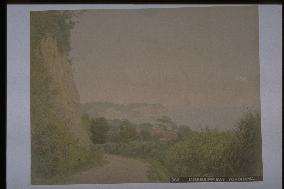
Negishi Village is at the foot of the hill, and Honmoku Peninsula is visible in the background, with (from the left) the Ichinotani, Ninotani, and Sannotani Valleys. Negishi Bay was known to foreigners as Mississippi Bay after the nickname given to it by Commodore Perry. Part of the new road built for foreigners, Fudo Slope was praised by them as one of the most beautiful scenes in the world.==Date:unknown, Place:Yokohama, Photo:Tamamura Kozaburo, (Credit:Nagasaki University Library/Kyodo News Images) [Cabinet Number80‐22‐0]

  •  
The hundred steps of Motomachi,Yokohama

The hundred steps of Motomachi,Yokohama

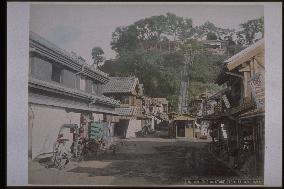
The hundred steps of Motomachi,Yokohama==Date:unknown, Place:Yokohama, Photo:Tamamura Kozaburo, (Credit:Nagasaki University Library/Kyodo News Images)

  •  
A garden in Tokyo

A garden in Tokyo

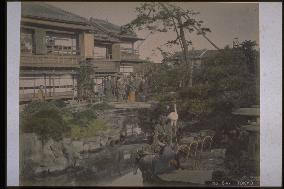
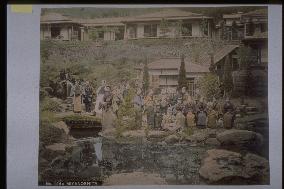
The people outside are all wearing jackets with cotton lining and the people upstairs are holding something like hand towels. This is probably a spa, not a teahouse. The garden seems to be built in chisenkaiyushiki style with a splendid stone assembly around the pond. A tropical tree, probably a palm, is visible in the background. The location is unknown.==Date:unknown, Place:Tokyo, Photo:Tamamura Kozaburo, (Credit:Nagasaki University Library/Kyodo News Images) [Cabinet Number80‐23‐0]

  •  
Daibutsu (the Great Buddha) of Kamakura

Daibutsu (the Great Buddha) of Kamakura

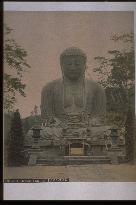
The photograph is labeled No.534 DAIBUTSU AT KAMAKURA. The exact date is unknown. People are standing in the cupped hands of the statue and other spots. The palm of the statue is large, possibly about 3.8 square meters. The Great Buddha is an object of worship and climbing upon it is prohibited today.==Date:unknown, Place:Kamakura, Photo:Tamamura Kozaburo, (Credit:Nagasaki University Library/Kyodo News Images) [Cabinet Number80‐18‐0]

  •  
Lake Ashi

Lake Ashi

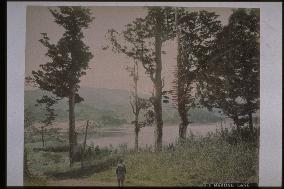
This is the post town of Hakone, with Lake Ashinoko, as seen from what was once Hakone barrier station. As the power lines installed in 1873 from Tokyo to Nagasaki are visible, this photo must have been taken after that. The thatched roofs of honjin are seen. The round, wooded mountain is Mt. Hatabiki. Behind it is Mt. Kurakake which is a part of the outer mountain range of Hakone. A child is looking at the lake.==Date:unknown, Place:Hakone, Photo:Tamamura Kozaburo, (Credit:Nagasaki University Library/Kyodo News Images) [Cabinet Number80‐17‐0]

  •  
Osu Kannon Temple and the five-story pagoda

Osu Kannon Temple and the five-story pagoda

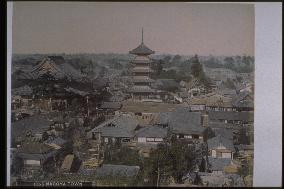
Osu Kannon Temple and the five-story pagoda==Date:unknown, Place:Nagoya, Photo:Tamamura Kozaburo, (Credit:Nagasaki University Library/Kyodo News Images)

  •  
Mt. Fuji seen from Lake Ashi

Mt. Fuji seen from Lake Ashi

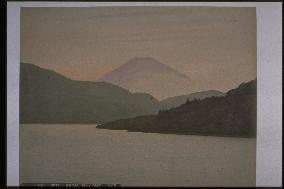
This photo has almost the same composition as that of catalogue #5080. It captures Mt. Fuji viewed from Motohakone on Lake Ashinoko. It gives the impression of the mountain emerging from the sunset. The compositon with the lake in the foreground, the forest of Hakone Shrine on the right, the foot of Mt. Mikuni on the left, and the cone-shaped Mt. Fuji is known as a scene representative of Hakone.==Date:unknown, Place:Hakone, Photo:Tamamura Kozaburo, (Credit:Nagasaki University Library/Kyodo News Images) [Cabinet Number80‐15‐0]

  •  
Lake Biwa seen from Miidera Temple

Lake Biwa seen from Miidera Temple

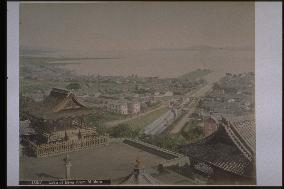
View of Otsu from Kannondo at Miidera Temple (official name: Enjoji Temple). Enjoji is the 14th temple in the circuit of 33 Holy Kannon Temples of Western Japan. The canal in the centre is the Lake Biwa Waterway built in 1890 to supply drinking water, generate electricity, and facilitate transportation. The state of the surroundings suggests that this photograph was taken soon after the completion of the waterway.==Date:unknown, Place:Otsu, Photo:Tamamura Kozaburo, (Credit:Nagasaki University Library/Kyodo News Images) [Cabinet Number80‐12‐0]

  •  
Kinkakuji Temple

Kinkakuji Temple

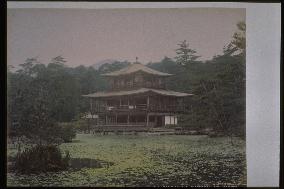
The Golden Pavilion at Rokuon-ji Temple seen from the eastern edge of Kyoko Pond, facing west-northwest. The shrubbery on the left is Hosokawa Rock and Ashihara Island is visible behind. The temple was built in 1398 but destroyed by arson in 1950. Unlike the reconstructed building of today, the original roof was supported by many columns at each level. Water weeds fill the surface of the pond. Pine forest surrounds the pond, and Mt. Momoyama rises behind.==Date:unknown, Place:Kyoto, Photo:Tamamura Kozaburo, (Credit:Nagasaki University Library/Kyodo News Images) [Cabinet Number80‐8‐0]

  •  
Sarusawa Pond and the five-story pagoda

Sarusawa Pond and the five-story pagoda

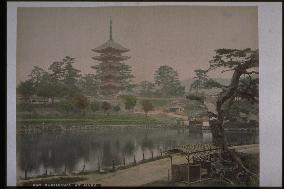
This photo captures Sarusawa Pond in the foreground and the five-storied pagoda of Kofukuji Temple when facing southwest. This composition which is also seen in the following, catalog #2934, 3182, and 3693, was probably thought of as the typical Nara photo. Some inns are seen around the temple.==Date:unknown, Place:Nara, Photo:Tamamura Kozaburo, (Credit:Nagasaki University Library/Kyodo News Images) [Cabinet Number80‐11‐0]

  •  
Maruyama Yaami Hotel

Maruyama Yaami Hotel

Distant view of the Maruyama Yaami Hotel from the top of the Sanmon Gate at Chion-in Temple, facing southeast. Long stone stairs, the stone bridge over the pond, and abundant nature with tall pines and maple trees are visible in the foreground. Several buildings of the Yaami Hotel stand on the Maruyama hillside, as well as a terrace built on the west side to enjoy the view.==Date:unknown, Place:Kyoto, Photo:Tamamura Kozaburo, (Credit:Nagasaki University Library/Kyodo News Images) [Cabinet Number80‐4‐0]

  •  
The Hozu River

The Hozu River

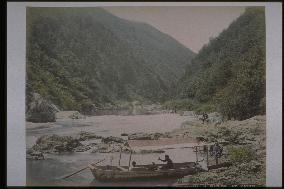
A yakata boat is docked at Hozu River Gorge. The people on the boat are enjoying drinking sake. Boatmen are resting on the bow of the boat and on the rock. People took the approximately 16km boat ride from Hozu Town in Kameoka to Togetsu Bridge in Arashiyama. The river boats that carried lumber and goods from Tanba Kameoka to Kyoto were converted to leisure boats at the end of the Meiji Period when the Kyoto Railway was established.==Date:unknown, Place:Kyoto, Photo:Tamamura Kozaburo, (Credit:Nagasaki University Library/Kyodo News Images) [Cabinet Number80‐9‐0]

  •  
Deer on the approach to Kasuga Shrine

Deer on the approach to Kasuga Shrine

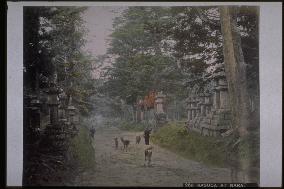
This photo captures four deer and two men as well as a man and a deer afar. The four deer in the foreground could be three female and one fawn. The point of the shot is about 350m west of Nino-torii Gate by Umadome Bridge when facing west.==Date:unknown, Place:Nara, Photo:Tamamura Kozaburo, (Credit:Nagasaki University Library/Kyodo News Images) [Cabinet Number80‐10‐0]

  •  
Images of Buddha in the inner sanctuary at Chion-in Temple

Images of Buddha in the inner sanctuary at Chion-in Temple

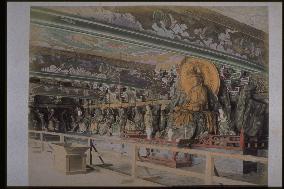
Buddhist statues on the Sanmon Gate of Chion-in Temple. The Buddha is seated in the middle, flanked by Zenzai-doji, Shudatsu-choja, and the 16 Buddhist Saints. Unryu (dragons in clouds) and other motifs are painted on the ceiling. Taken by Tamamura Kozaburo.==Date:unknown, Place:Kyoto, Photo:unknown, (Credit:Nagasaki University Library/Kyodo News Images) [Cabinet Number80‐7‐0]

  •  
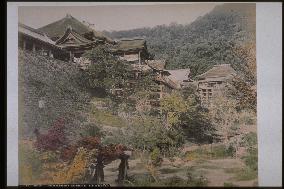
Kiyomizudera Temple,Kyoto

Kiyomizudera Temple,Kyoto

View (from the left) of Okuno-in, Amitabha Hall, and the main hall of Kiyomizu Temple, looking from the south garden. Mt. Otowa is visible in the background. A number of trees had been planted, but the South Garden was not as yet complete. The cherry trees and maple trees stand at irregular intervals, and the temple approach has not yet been made. This photo is thought to have been taken before 1898 when regular temple maintenance procedures were established.==Date:unknown, Place:Kyoto, Photo:Tamamura Kozaburo, (Credit:Nagasaki University Library/Kyodo News Images) [Cabinet Number80‐6‐0]

  •  
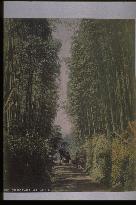
Bamboo groove at Gojozaka Slope

Bamboo groove at Gojozaka Slope

A man pulling a rickshaw and a woman with goods to be sold, carried in baskets suspended from a yoke, stand at Gojo-zaka slope which is surrounded by bamboo brush. Bamboo grass grows thickly on both sides of the road. The broken bamboo on both sides in the foreground was probably cut to prevent the bamboo grass from spreading to the road. The path is narrow and rickshaws can barely pass each other. Taken prior to 1909 when the slope was expanded to a width of 7.2 meters.==Date:unknown, Place:Kyoto, Photo:Tamamura Kozaburo, (Credit:Nagasaki University Library/Kyodo News Images) [Cabinet Number80‐5‐0]

  •  
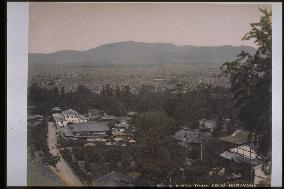
The city of Kyoto seen from Maruyama

The city of Kyoto seen from Maruyama

Western view of the northern part of Kyoto from the Yoshimizu Hot Spring building. The road stretching from the centre of the photo to the left corner is the approach to Yasaka Shinto Shrine. Although the site would later become Maruyama Park, no work has been done yet, and a few restaurants stand in the area. A two-story Western-style building of yosemune-zukuri style stands on the northeast side of the street where cherry blossoms would later become a tourist attraction. The Nishiyama Mountain Range is faintly visible in the background.==Date:unknown, Place:Kyoto, Photo:Tamamura Kozaburo, (Credit:Nagasaki University Library/Kyodo News Images) [Cabinet Number80‐3‐0]

  •  
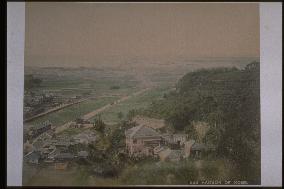
A panoramic view of Kobe

A panoramic view of Kobe

A panoramic view of Kobe==Date:unknown, Place:Kobe, Photo:Tamamura Kozaburo, (Credit:Nagasaki University Library/Kyodo News Images)

  •  
Takahoko Island

Takahoko Island

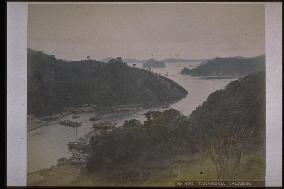
This is a view of the mouth of Nagasaki Harbour taken from the hillside behind Tomachi. Takahoko Island is visible in the centre. The tip of the peninsula on the right is Kanzakibana, and the area protruding on the left is Megami. Takahoko was known as the site of Christian martyrdom in the 17th century and a landmark for foreign ships entering Nagasaki Harbour.==Date:unknown, Place:Nagasaki, Photo:Tamamura Kozaburo, (Credit:Nagasaki University Library/Kyodo News Images) [Cabinet Number80‐1‐0]

  •  
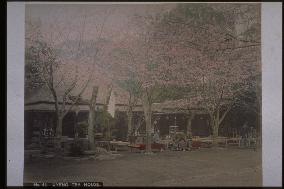
Cherry trees at Nogeyama Park,Yokohama

Cherry trees at Nogeyama Park,Yokohama

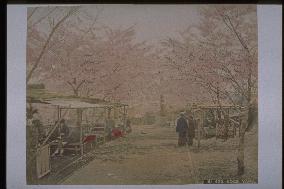
The Iseyama Kotaijingu precincts. This shrine was established after the relocation of a small shrine in Tobe-machi to Mt. Noge in 1870. After the opening of the new shrine, Mt. Noge was renamed Iseyama (Mt. Ise) and many people visited the area in the cherry blossom season.==Date:unknown, Place:Yokohama, Photo:Tamamura Kozaburo, (Credit:Nagasaki University Library/Kyodo News Images) [Cabinet Number79‐28‐0]

  •  
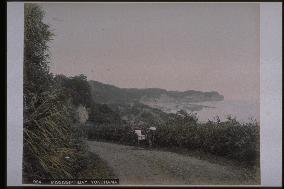
Honmoku Point seen from the Fudozaka slope

Honmoku Point seen from the Fudozaka slope

Negishi Village is at the foot of the hill, and Honmoku Peninsula is visible in the background, with (from the left) the Ichinotani, Ninotani, and Sannotani Valleys. Negishi Bay was known to foreigners as Mississippi Bay after the nickname given to it by Commodore Perry. Part of the new road built for foreigners, Fudo Slope was praised by them as one of the most beautiful scenes in the world.==Date:unknown, Place:Yokohama, Photo:Tamamura Kozaburo, (Credit:Nagasaki University Library/Kyodo News Images) [Cabinet Number79‐27‐0]

  •  
Yokohama Station and a bridge

Yokohama Station and a bridge

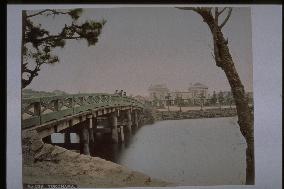
The building by Oe Bridge is the first Yokohama Railroad Station designed by R. P. Bridgens and built in 1871. The arch-shaped corridor connecting the second floors of the two station buildings was added in 1873 but destroyed by a typhoon in 1884.==Date:unknown, Place:Yokohama, Photo:Tamamura Kozaburo, (Credit:Nagasaki University Library/Kyodo News Images) [Cabinet Number79‐24‐0]

  •  
A garden of a hotel,Miyanoshita Spa

A garden of a hotel,Miyanoshita Spa

This photo depicts the Japanese-style structure of the Fujiya Hotel (completed in 1885), with people in the garden, after the large fire of Miyanoshita in 1883. The man seated centre with a hat is a foreign guest, and it appears men and women around him are hotel employees. Women are wearing kimono with aprons and the men appear to be a cook, a gardener, and so on.==Date:unknown, Place:Hakone, Photo:Tamamura Kozaburo, (Credit:Nagasaki University Library/Kyodo News Images) [Cabinet Number79‐23‐0]

  •  
The Miyanoshita Road

The Miyanoshita Road

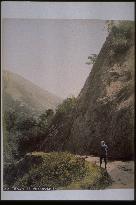
This road for the cars opened between Tonosawa and Miyanoshita in July, 1887 with the aid of Sennosuke Yamaguchi, the president of Fujiya Hotel, among others. This location appears around a place higher up toward Miyanoshita from Deyama. This road, present National Route 1, contributed greatly to the tourist industry in Hakone.==Date:unknown, Place:Hakone, Photo:Tamamura Kozaburo, (Credit:Nagasaki University Library/Kyodo News Images) [Cabinet Number79‐18‐0]

  •  
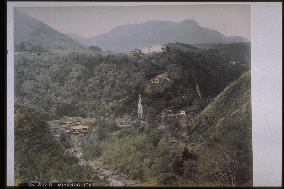
The Hozu River

The Hozu River

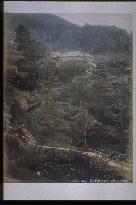
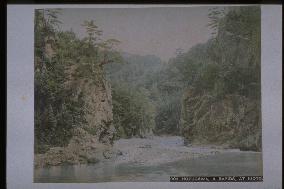
Kiyotaki River is viewed from a boat going down Hozu River. Hozu Gorge, also called Arashi Gorge, is a 13km stretch from around Hozu Bridge in Kameoka to Togetsu Bridge in Arashiyama. This is a scenic point where rapids and unusual rock formations can be enjoyed. Tributaries such as Kiyotaki River flow into the V-shaped gorge at an altitude of 400 meters between Mt. Atago and Oisaka.==Date:unknown, Place:Kyoto, Photo:Tamamura Kozaburo, (Credit:Nagasaki University Library/Kyodo News Images) [Cabinet Number79‐15‐0]

  •  
Mt. Fuji seen from the Fuji River

Mt. Fuji seen from the Fuji River

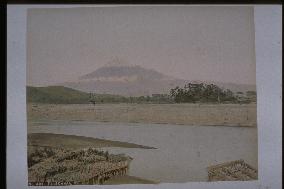
Northeastern view of Mt. Fuji from the bank of Fuji River at Iwabuchi in Fujigawa-machi. The ferry port of Iwabuchi is in the foreground, and Matsuoka Sui Shinto Shrine of Fuji City is visible in the forest on the other side. The bridge between the shrine and Iwabuchi is not visible in this photograph, perhaps because it had been recently washed away, which often happened due to the rapid flow of Fuji River. The mountain on the left is Mt. Iwamoto, and pine trees line the other side of the river.==Date:unknown, Place:Shizuoka, Photo:Tamamura Kozaburo, (Credit:Nagasaki University Library/Kyodo News Images) [Cabinet Number79‐16‐0]

  • Main
  • Top
  • Editorial
  • Creative
  • About Us
  • About ILG
  • Terms of use
  • Company
  • BEHIND
  • Price List
  • Single Plan
  • Monthly Plan
  • Services
  • Shooting
  • Rights Clearance
  • Support
  • FAQ
  • How To Buy
  • Contact Us
  • Become a Partner

© KYODO NEWS IMAGES INC

All Rights Reserved.

  • Editorial
  • Olympics
  • News
  • Sports
  • Japan
  • Tech
  • Royal
  • Disaster
  • NorthKorea
  • Old Japan
  • SNS
  • Creative
  • Food
  • Japan
  • Landscape
  • Animal
  • Popular
  • #Ukraine
  • #China
  • #coronavirus
  • #N. Korea
  • #Russia
  • #Thailand
  • #Ukraine
  • #China
  • #coronavirus
  • #N. Korea
  • #Russia
  • #Thailand
  • Food
  • Japan
  • Landscape
  • Animal
  • Olympics
  • News
  • Sports
  • Japan
  • Tech
  • Royal
  • Disaster
  • NorthKorea
  • Old Japan
  • SNS