•  

Canada: Severe Thunderstorms Batter Southeastern Saskatchewan, Causing Widespread Damage

A series of severe thunderstorms struck southeastern Saskatchewan on June 6-7, bringing heavy rainfall, winds exceeding 100 kilometers per hour, and widespread damage. The footage shows damage to a gas station in Carlyle.

  •  
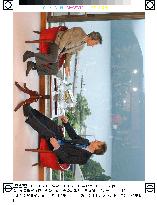
(3)Blair holds talks with Koizumi

(3)Blair holds talks with Koizumi

HAKONE, Japan - British Prime Minister Tony Blair (R) is in talks with Japanese Prime Minister Junichiro Koizumi in a hotel room overlooking Lake Ashi in Hakone, southwest of Tokyo, on July 19. (Pool photo)

  •  
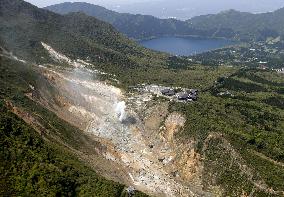
Volcanic alert raised for Mt. Hakone

Volcanic alert raised for Mt. Hakone

Photo taken from a Kyodo News helicopter shows steam bursts in the Owakudani hot spring district (foreground) of Mt. Hakone, a popular tourist spot southwest of Tokyo, on May 6, 2015. Lake Ashi is seen in the background. Japanese authorities raised the volcanic alert for the mountain the same day, anticipating a possible small steam eruption. (Kyodo) ==Kyodo

  •  
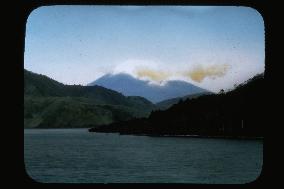
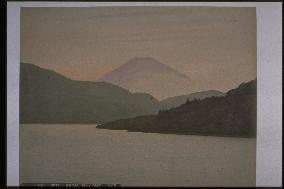
Mt. Fuji in the morning seen from Lake Ashi

Mt. Fuji in the morning seen from Lake Ashi

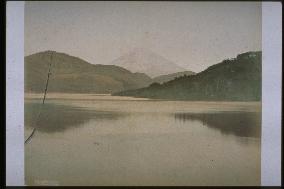
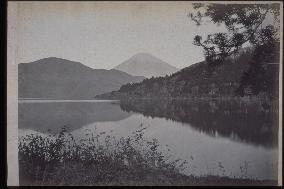
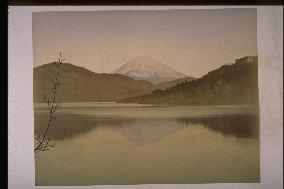
This is Mt. Fuji as veiwed from Moto-Hakone by Lake Ashinoko. The dark forest on the right is Hakone Shrine precincts. This site was called Hakone Gongen before the Japanese government instituted a policy in 1868 separating Buddhism and Shinto. The name Hakone Gongen appears in many ancient tales such as the Tale of The Soga written in the Kamakura Period. The mountain on the left is the foot of Mt. Mikuni, one of the outer moutain range of Hakone. This scene of Mt. Fuji behind the lake and the mountains is famous.==Date:unknown, Place:Hakone, Photo:unknown, (Credit:Nagasaki University Library/Kyodo News Images) [Cabinet Number98‐44‐0]

  •  
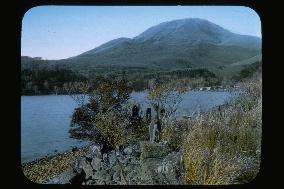
Lake Ashi

Lake Ashi

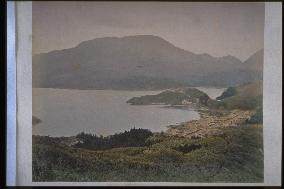
This photo captures the old town of Motohakone, with Mt. Komagadake viewed from Sainogahara by Lake Ashinoko. It is known that Sainogahara had many stone towers and stone Buddhas druing the Edo Period according to Tokaido Hakone Sanchu-zu (Ukiyoe; Color woodblock print of Hakone's everyday life in Edo period by Gountei Sadahide, 1863). This photo was taken after 1868 when Haibutsukishaku (anti-Buddhist movement at the beginning of the Meiji era) took place and many stones were destroyed or broken .==Date:unknown, Place:Hakone, Photo:unknown, (Credit:Nagasaki University Library/Kyodo News Images) [Cabinet Number98‐32‐0]

  •  
The shore of Lake Ashi

The shore of Lake Ashi

This is not Lake Ashinoko, but Gora Park opened in August, 1914 as viewed from its fountain pond. The park was built as the central development project of the Gora area by Odawara Electric Railway (present day Hakone Tozan Railway). The park was designed by Shichigoro Ishhiki and is known as the first rock garden in the French style. The mountain behind the forest is Mt. Sounzan.==Date:unknown, Place:Hakone, Photo:unknown, (Credit:Nagasaki University Library/Kyodo News Images) [Cabinet Number96‐9‐0]

  •  
Lake Ashi

Lake Ashi

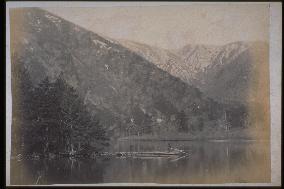
This is a photograph of Yunoko Lake and the houses of the spa at Oku-Nikko. The land to the right is Usagi Island. The mountain visible in the back is Onsengadake. Passing over Konsei Pass, the road leads to Numata in Gunma Prefecture. Yumoto Spa is said to date back to 778 when it was found and named Yakushi-yu.==Date:unknown, Place:Nikko, Photo:unknown, (Credit:Nagasaki University Library/Kyodo News Images) [Cabinet Number93‐18‐0]

  •  
Lake Ashi

Lake Ashi

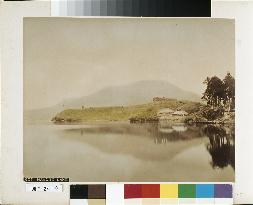
Lake Ashi==Date:unknown, Place:Hakone, Photo:unknown, (Credit:Nagasaki University Library/Kyodo News Images)

  •  
Statues of Enmeijizo (giving a long-life) by Lake Ashi

Statues of Enmeijizo (giving a long-life) by Lake Ashi

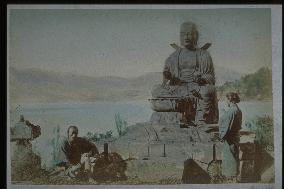
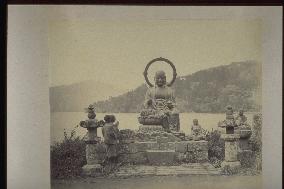
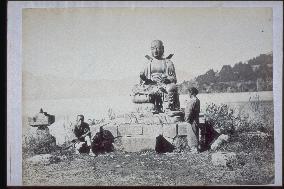
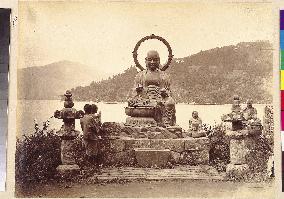
This is Enmei Jizo in autumn, 1871 after Haibutsukishaku (anti-Buddhist movement at the beginning of the Meiji era). Compared with the image in catalogue #5365, the figure's halo is broken, the accompanying jizo figures on the side are gone, and the stone lanterns have been destroyed. There were many stone Buddhas and stone towers as well as this Enmei Jizo in Tokaido Hakon Sanchuzu, documented by a ukiyoe print made by Sadahide Goun during Edo era. It is reported that many were thrown into the lake.==Date:unknown, Place:Hakone, Photo:unknown, (Credit:Nagasaki University Library/Kyodo News Images) [Cabinet Number90‐45‐0]

  •  
Lake Ashi

Lake Ashi

The Hakone Imperial Villa is visible on top of the hill of Dogashima. It was built in 1886 as a villa for Emperor Meiji. This site had been called Dogashima (Dogashima- the island of tower) because there was a tower at the Hakone Gongen Shrine in the ancient times. The imperial villa was built because this is the best location to see the inverted reflection of Fuji on the furface of Lake Ashinoko. Also, this site is close enough to Tokyo to avoid the summer heat. This site is now named Onshi Hakone Park.==Date:unknown, Place:Hakone, Photo:unknown, (Credit:Nagasaki University Library/Kyodo News Images) [Cabinet Number89‐6‐0]

  •  
Lake Ashi

Lake Ashi

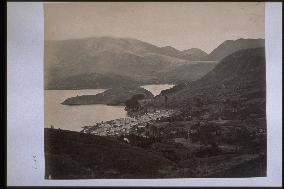
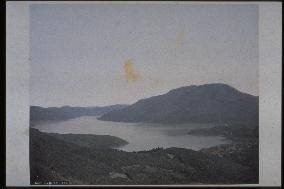
Viewing northwest from Mt. Kurakake. This photo was taken after 1886, as Hakone Imperial Villa is visible on top of the mountain of Dogashima Island. It appears the date of the photo is later than mid-Meiji, as more houses are seen in Hakone than in catalogue #2972. The mountains at the back right are Momagadake and Kamiyama. The peninsula on the left is Mt. Hatabiki.==Date:unknown, Place:Hakone, Photo:A. Farsari, (Credit:Nagasaki University Library/Kyodo News Images) [Cabinet Number82‐26‐0]

  •  
Lake Ashi

Lake Ashi

This is the post town of Hakone, with Lake Ashinoko, as seen from what was once Hakone barrier station. As the power lines installed in 1873 from Tokyo to Nagasaki are visible, this photo must have been taken after that. The thatched roofs of honjin are seen. The round, wooded mountain is Mt. Hatabiki. Behind it is Mt. Kurakake which is a part of the outer mountain range of Hakone. A child is looking at the lake.==Date:unknown, Place:Hakone, Photo:Tamamura Kozaburo, (Credit:Nagasaki University Library/Kyodo News Images) [Cabinet Number80‐17‐0]

  •  
Mt. Fuji seen from Lake Ashi

Mt. Fuji seen from Lake Ashi

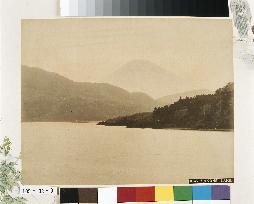
This photo has almost the same composition as that of catalogue #5080. It captures Mt. Fuji viewed from Motohakone on Lake Ashinoko. It gives the impression of the mountain emerging from the sunset. The compositon with the lake in the foreground, the forest of Hakone Shrine on the right, the foot of Mt. Mikuni on the left, and the cone-shaped Mt. Fuji is known as a scene representative of Hakone.==Date:unknown, Place:Hakone, Photo:Tamamura Kozaburo, (Credit:Nagasaki University Library/Kyodo News Images) [Cabinet Number80‐15‐0]

  •  
Lake Ashi and a post town in Hakone

Lake Ashi and a post town in Hakone

Lake Ashi and a post town in Hakone==Date:unknown, Place:Hakone, Photo:R. Stillfried, (Credit:Nagasaki University Library/Kyodo News Images)

  •  
Lake Ashi

Lake Ashi

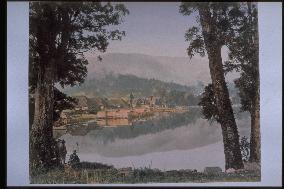
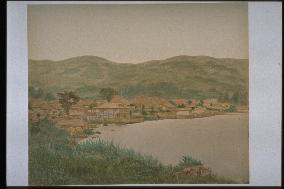
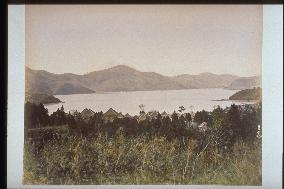
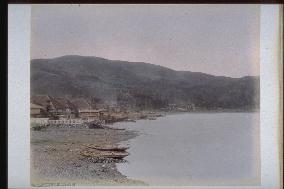
This is the post town of Hakone as seen from what was once the Hakone barrier station. The buildings on the banks of Lake Ashinoko are part of the thatched roofed building complex, the honjin. The large structures with thatched roofs to the right are officially appointed inns (Honjin). Feudal lords stayed or rested here during the Sankinkoutai (A bi-annual period of madatory alternate residence in Edo for feudal lords, known as Daimyo). The mountain in the background is Mt. Kurakake. There appear to be craftsmen looking at the lake in the foreground.==Date:unknown, Place:Hakone, Photo:R. Stillfried, (Credit:Nagasaki University Library/Kyodo News Images) [Cabinet Number77‐17‐0]

  •  
Lake Ashi

Lake Ashi

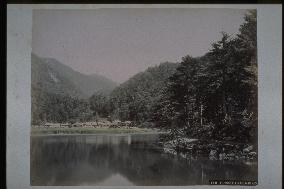
Lake Ashi==Date:unknown, Place:Hakone, Photo:Ogawa Kazumasa, (Credit:Nagasaki University Library/Kyodo News Images)

  •  
Mt. Fuji seen from Lake Ashi

Mt. Fuji seen from Lake Ashi

The compositon of the photo is almost the same as that of catalogue #5080 and #4147. It captures Mt. Fuji viewed from Motohakone by Lake Ashinoko. The compositon with the lake in the foreground, the forest of Hakone Shrine on the right, the foot of Mt. Mikuni on the left, and the cone-shaped Mt. Fuji is known as a scene representative of Hakone. One difference from the other photos is that here Mt. Fuji is reflected on the surface of the lake.==Date:unknown, Place:Hakone, Photo:unknown, (Credit:Nagasaki University Library/Kyodo News Images) [Cabinet Number64‐47‐0]

  •  
Lake Ashi seen from Hakone Shrine

Lake Ashi seen from Hakone Shrine

This is a byobu torii gate located at a crossing at present-day National route 1 after going down Gongen Slope after going up the Old Hakone Highway from the post town of Hata. This is a scenic point where Lake Ashinoko and the village of Moto-Hakone can be seen as well as the traffic hub. There seemed to have been teahouses and there are many photos taken at this location. One of the reasons for that is because the photography equipment was quite heavy those days and many photos were taken at the resting spots.==Date:unknown, Place:Hakone, Photo:unknown, (Credit:Nagasaki University Library/Kyodo News Images) [Cabinet Number59‐64‐0]

  •  
Lake Ashi

Lake Ashi

This photo depicts the Dogashima area of Hakone post town in the north of Mt. Kurakake. Since Hakone Imperial Villa is visible on top of the mountain of Dogashima, this photo was taken after 1886. Buildings, such as honjins, still remain. The post town keeps the same atmosphere as at the end of the Edo Peiod. The mountain on the right is Komagadake, and Mt. Kamiyama, the highest mountain in Hakone, is behind it.==Date:unknown, Place:Hakone, Photo:unknown, (Credit:Nagasaki University Library/Kyodo News Images) [Cabinet Number59‐59‐0]

  •  
Lake Ashi

Lake Ashi

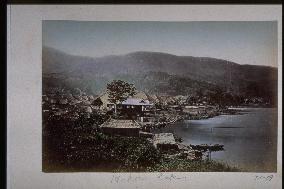
This is the post town of Hakone as seen from what was once the Hakone barrier station. The two-storied building projecting into Lake Ashinoko is the Hafuya Inn (present day Hakone Hotel). The large structures with thatched roofs to its right are officially appointed inns (Honjin) for the feudal lords (Daimyo) and other noblemen. They are from the left, Kawada Honjin, Koma Honjin, Ishiuchi Honjin, and Amano Heizaemon Honjin. The mountain on the left is Mt. Kurakake, and Hakone Pass is located to the right.==Date:unknown, Place:Hakone, Photo:unknown, (Credit:Nagasaki University Library/Kyodo News Images) [Cabinet Number59‐34‐2]

  •  
Lake Ashi

Lake Ashi

Viewing northwest from Mt. Kurakake. This photo was taken after 1886, as Hakone Imperial Villa is visible on top of the mountain of Dogashima Island. It appears the date of the photo is later than mid-Meiji, as more houses are seen in Hakone than in catalogue #2972. The mountains at the back right are Momagadake and Kamiyama. The peninsula on the left is Mt. Hatabiki.==Date:unknown, Place:Hakone, Photo:unknown, (Credit:Nagasaki University Library/Kyodo News Images) [Cabinet Number59‐10‐2]

  •  
Lake Ashi

Lake Ashi

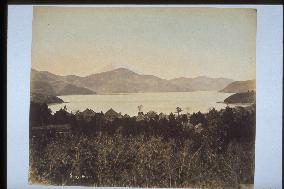
This photo captures Lake Ashinoko, Dogashima, and Mt. Fuji viewed from Tomi-bansho (lookout station) of Hakone barrier station. If the Imperial Villa on the peninsula projecting in the lake on the right side of the photo can be seen, it was taken after 1886. However, it is outside of the photo, and therefore, cannot be verified. The triangular mountain before Mt. Fuji is Mt. Mikuni (alt. 1,102m), one of the outer mountain range of Hakone.==Date:unknown, Place:Hakone, Photo:unknown, (Credit:Nagasaki University Library/Kyodo News Images) [Cabinet Number47‐19‐0]

  •  
Lake Ashi

Lake Ashi

The same negative as the photo numbered 26-6. Not known which is older. In the center of the photo is the former Hakone juku, but the building with a flat roof is the Hafuya hotel, which later became the Hakone Hotel. To the right corner of the houses, was the feared sekisho (guardhouse) of Hakone.==Date:unknown, Place:Hakone, Photo:Suzuki Shin-ichi, (Credit:Nagasaki University Library/Kyodo News Images) [Cabinet Number41‐8‐0]

  •  
Lake Ashi

Lake Ashi

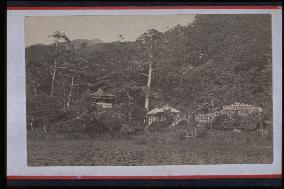
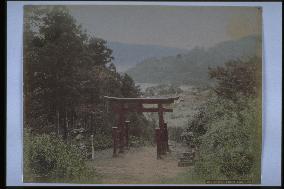
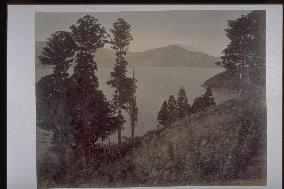
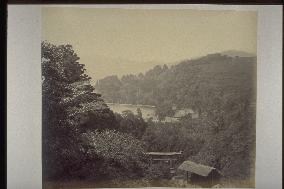
The screen torii on the way down with a view of Ashino Lake looking towards Hakone Shrine. At present, only the monument is left standing next to a gasoline station. Many pictures use this angle, but the hut to the right of the torii indicates that this photo was taken in the early Meiji Era.==Date:unknown, Place:Hakone, Photo:F. Beato, (Credit:Nagasaki University Library/Kyodo News Images) [Cabinet Number36‐11‐0]

  •  
Lake Ashi

Lake Ashi

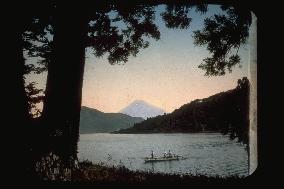
Ashino Lake and Mt. Fuji from the shore near the present Hakone Elementary School. To the right at the foot of the mountains is Hakone Shrine. It is a typical photo introducing Hakone. Three people are seen rowing a boat, but their position is rather unnatural and was probably assumed for the picture.==Date:unknown, Place:Hakone, Photo:unknown, (Credit:Nagasaki University Library/Kyodo News Images) [Cabinet Number31‐76‐0]

  •  
Statues of Enmeijizo (giving a long-life) by Lake Ashi

Statues of Enmeijizo (giving a long-life) by Lake Ashi

This photo was taken before the Buddha destruction movement, and there were many large and small Buddhist statues around the banks of Ashino Lake. This one in the centre was described by Kaempfer and other early writers.==Date:unknown, Place:Hakone, Photo:F. Beato, (Credit:Nagasaki University Library/Kyodo News Images) [Cabinet Number36‐7‐0]

  •  
Lake Ashi

Lake Ashi

The same as the photo numbered 31-26. Which is older is unknown, but the range of the photo is wider in 31-26, so maybe it is older. In these photos, people wearing hanten appear frequently. These may be carriers who also served as models.==Date:unknown, Place:Hakone, Photo:unknown, (Credit:Nagasaki University Library/Kyodo News Images) [Cabinet Number31‐75‐0]

  •  
Lake Ashi

Lake Ashi

Lake Ashino and the Sekisho of Hakone can be seen to the left. The Sekisho of Hakone was famous as a place to guard the Tokaido, together with the Sekisho of Arai. It was established with a double fence built in the lake. To the distance is the Honjin where the warrior lords stayed during trips back and forth to Edo.==Date:unknown, Place:Hakone, Photo:unknown, (Credit:Nagasaki University Library/Kyodo News Images) [Cabinet Number31‐73‐0]

  •  
Lake Ashi

Lake Ashi

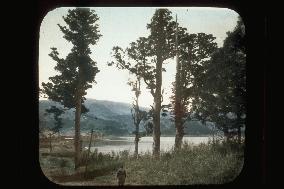
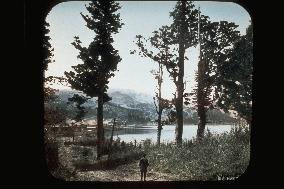
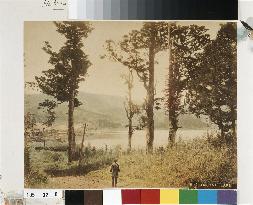
A photo of a person wearing a hanten and standing backwards on the cedar boulevard by the shores of Lake Ashino. From the telegraph pole, we know this picture was taken after 1881 when telegraphy started around Lake Ashino. The building to the left is the so-called Honjin of the Hakonejuku. This was taken from very near the ruins of the Sekisho.==Date:unknown, Place:Hakone, Photo:unknown, (Credit:Nagasaki University Library/Kyodo News Images) [Cabinet Number31‐26‐0]

  •  
The Hakone post town

The Hakone post town

With Mt. Fuji in the background, this is a picture of Lake Ashi and Hakone city. The pyramid-shaped roofs to the left are the Honjin, or lodgings of feudal lords during the Sankin Kotai of the Edo Era. From the right, they may be Matahara, Kawada, Koma and Ishiuchi, but this is not certain.==Date:unknown, Place:Hakone, Photo:unknown, (Credit:Nagasaki University Library/Kyodo News Images) [Cabinet Number26‐6‐0]

  •  
Statues of Enmeijizo (giving a long-life) by Lake Ashi

Statues of Enmeijizo (giving a long-life) by Lake Ashi

In Hakone, a movement to destroy Buddhist statues was seen after the official separation of Shinto and Buddhist rituals in 1868, and the Buddhist images by Ashino Lake were also damaged. In the picture, a tragic scene with a broken halo and the stone lantern torn down can be seen. This jizo still exists at Tokujoin in Odawara.==Date:unknown, Place:Hakone, Photo:unknown, (Credit:Nagasaki University Library/Kyodo News Images) [Cabinet Number24‐23‐0]

  •  
Mt. Fuji seen from Lake Ashi

Mt. Fuji seen from Lake Ashi

This is a photo of the so-called Sakasa Fuji (upside-down Fuji) . It is monochrome, but the shadows can be seen clearly. To the right in the mountains is Hakone Shinto Shrine. The same as the photo in The Far East Vol. 2-20.==Date:unknown, Place:Hakone, Photo:unknown, (Credit:Nagasaki University Library/Kyodo News Images) [Cabinet Number19‐48‐0]

  •  
Lake Ashi

Lake Ashi

The white pole shows the remains of the sekisho (check point).In the left corner is the Hafuya Hotel, and to the right are remains of the honjin (officially appointed inns) of the lords Kawada Kakuemon, Komasa Goemon, Ishiuchi Tarozaemon and Amano Hirazaemon. The photo portrays the area which at present is a pier for tourist boats on Ashino Lake.==Date:unknown, Place:Hakone, Photo:Ogawa Kazumasa, (Credit:Nagasaki University Library/Kyodo News Images) [Cabinet Number6‐11‐0]

  •  
Mt. Fuji seen from Lake Ashi

Mt. Fuji seen from Lake Ashi

Ashino Lake and Mt.Fuji seen from the forefront of Hakone Elementary School. It is a view of the so-called Sakasa Fuji (Mt.Fuji upside down). In the mountain to the right of the lake is the Hakone Gongen. The famous red torii of the shrine was built in 1960 to commemorate the official investiture of the Crown Prince and so is not in the photo.==Date:Middle Meiji, Place:Hakone, Photo:Kusakabe Kinbei, (Credit:Nagasaki University Library/Kyodo News Images) [Cabinet Number3‐42‐0]

  •  
Statues of Enmeijizo (giving a long-life) by Lake Ashi

Statues of Enmeijizo (giving a long-life) by Lake Ashi

This is Enmei Jizo around 1867 before Haibutsukishaku (anti-Buddhist movement at the beginning of the Meiji era). Compared with the figure in catalogue #4603 taken after Haibutsukishaku, the intact halo, flanking jizo figures, and the stone lanterns are extant. According to Tokaido Hakone Sanchuzu printed in 1867 by Sadahide Gountei, there once existed many stone Buddhas and towers at Sainogahara on the shore of Lake Ashinoko.==Date:unknown, Place:Hakone, Photo:F. Beato, (Credit:Nagasaki University Library/Kyodo News Images) [Cabinet Number104‐2‐0]

  •  
Mt. Fuji seen from Lake Ashi

Mt. Fuji seen from Lake Ashi

Mt. Fuji seen from Lake Ashi ==Date:unknown, Place:Hakone, Photo:unknown, (Credit:Nagasaki University Library/Kyodo News Images)

  •  
Lake Ashi

Lake Ashi

Lake Ashi==Date:unknown, Place:Hakone, Photo:Tamamura Kozaburo, (Credit:Nagasaki University Library/Kyodo News Images)

  •  
Mt. Fuji seen from Lake Ashi

Mt. Fuji seen from Lake Ashi

Mt. Fuji seen from Lake Ashi==Date:unknown, Place:Hakone, Photo:unknown, (Credit:Nagasaki University Library/Kyodo News Images)

  •  
Lake Ashi

Lake Ashi

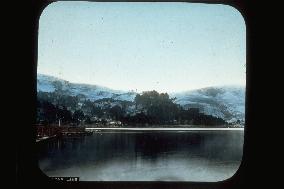
Lake Ashi==Date:unknown, Place:Hakone, Photo:unknown, (Credit:Nagasaki University Library/Kyodo News Images)

  •  
Azaleas in full bloom in Hakone

Azaleas in full bloom in Hakone

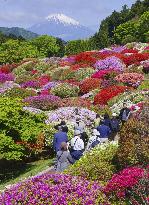
Visitors stroll through a park with azalea flowers in full bloom near Lake Ashi in Hakone, Kanagawa Prefecture, near Tokyo, on May 11, 2018. (Kyodo) ==Kyodo

  •  
(3)Blair holds talks with Koizumi

(3)Blair holds talks with Koizumi

HAKONE, Japan - British Prime Minister Tony Blair (R) is in talks with Japanese Prime Minister Junichiro Koizumi in a hotel room overlooking Lake Ashi in Hakone, southwest of Tokyo, on July 19. (Pool photo) (Kyodo)

  • Main
  • Top
  • Editorial
  • Creative
  • About Us
  • About ILG
  • Terms of use
  • Company
  • BEHIND
  • Price List
  • Single Plan
  • Monthly Plan
  • Services
  • Shooting
  • Rights Clearance
  • Support
  • FAQ
  • How To Buy
  • Contact Us
  • Become a Partner

© KYODO NEWS IMAGES INC

All Rights Reserved.

  • Editorial
  • Olympics
  • News
  • Sports
  • Japan
  • Tech
  • Royal
  • Disaster
  • NorthKorea
  • Old Japan
  • SNS
  • Creative
  • Food
  • Japan
  • Landscape
  • Animal
  • Popular
  • #Ukraine
  • #China
  • #coronavirus
  • #N. Korea
  • #Russia
  • #Thailand
  • #Ukraine
  • #China
  • #coronavirus
  • #N. Korea
  • #Russia
  • #Thailand
  • Food
  • Japan
  • Landscape
  • Animal
  • Olympics
  • News
  • Sports
  • Japan
  • Tech
  • Royal
  • Disaster
  • NorthKorea
  • Old Japan
  • SNS