•  
Underground Neutrino Observatory Operation - Chin

Underground Neutrino Observatory Operation - Chin

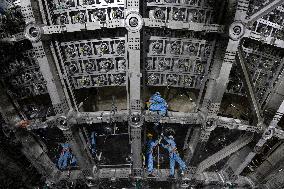
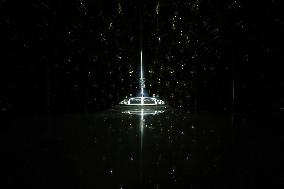
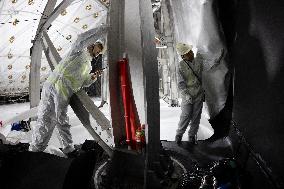
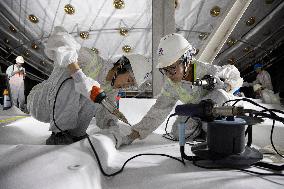
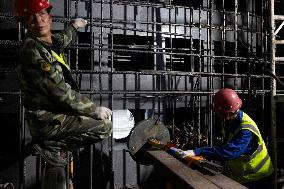
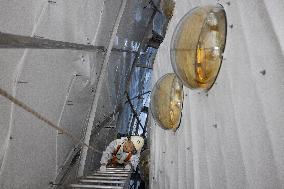
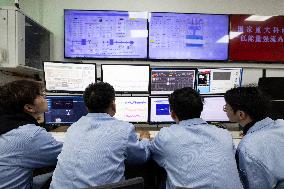
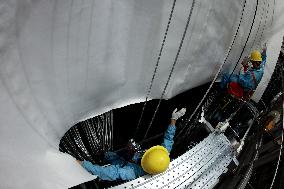
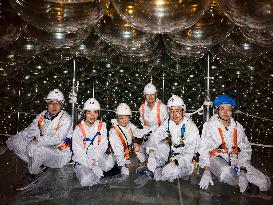
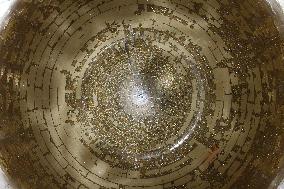
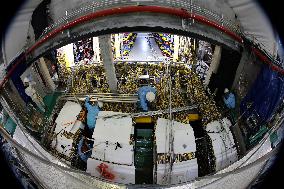
File photo dated on October 10, 2025 shows staff members working on a stainless steel truss of the central detector of the Jiangmen Underground Neutrino Observatory (JUNO) in Jiangmen, south China's Guangdong Province. The world's largest transparent spherical detector began operation in China on Tuesday, making it the world's first operational ultra-large scientific facility dedicated to neutrino research with ultra-high precision. Having completed the filling of its 20,000-tonne liquid scintillator detector, JUNO in Guangdong began taking data after more than a decade of preparation and construction, on August 26, 2025 in Beijing, China. Photo by Jin Liwang Xinhua/ABACAPRESS.COM

  •  
Underground Neutrino Observatory Operation - Chin

Underground Neutrino Observatory Operation - Chin

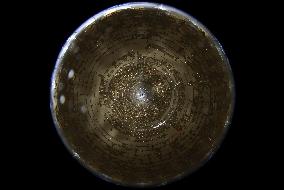
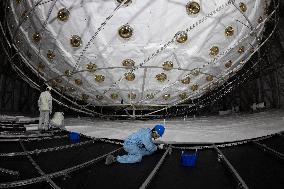
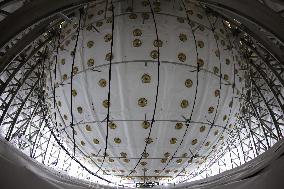
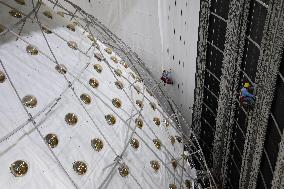
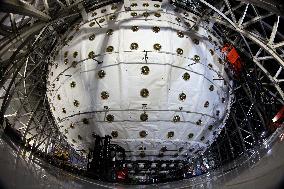
File photo taken on Nov. 22, 2024 shows the acrylic sphere of the central detector of the Jiangmen Underground Neutrino Observatory (JUNO) in Jiangmen, south China's Guangdong Province. The world's largest transparent spherical detector began operation in China on Tuesday, making it the world's first operational ultra-large scientific facility dedicated to neutrino research with ultra-high precision. Having completed the filling of its 20,000-tonne liquid scintillator detector, JUNO in Guangdong began taking data after more than a decade of preparation and construction, on August 26, 2025 in Beijing, China. Photo by Jin Liwang Xinhua/ABACAPRESS.COM

  •  
Underground Neutrino Observatory Operation - Chin

Underground Neutrino Observatory Operation - Chin

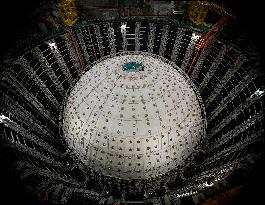
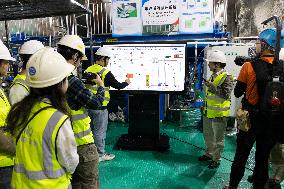
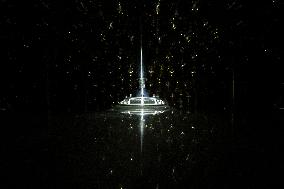
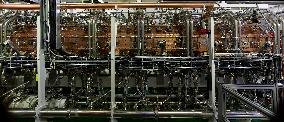
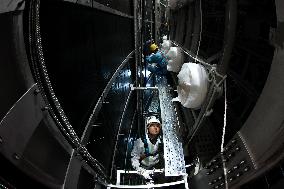
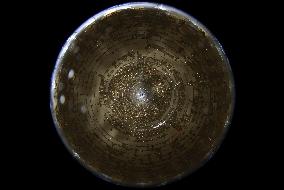
This stitched photo shows the central detector of the Jiangmen Underground Neutrino Observatory (JUNO) under construction in Jiangmen, south China's Guangdong Province, Oct. 9, 2024. The world's largest transparent spherical detector began operation in China on Tuesday, making it the world's first operational ultra-large scientific facility dedicated to neutrino research with ultra-high precision. Having completed the filling of its 20,000-tonne liquid scintillator detector, JUNO in Guangdong began taking data after more than a decade of preparation and construction, on August 26, 2025 in Beijing, China. Photo by Jin Liwang Xinhua/ABACAPRESS.COM

  •  
Underground Neutrino Observatory Operation - Chin

Underground Neutrino Observatory Operation - Chin

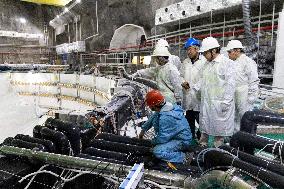
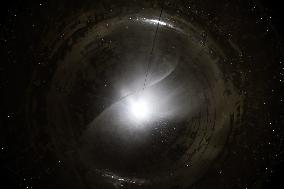
File photo taken on Dec. 16, 2024 shows the central detector of the Jiangmen Underground Neutrino Observatory (JUNO) in Jiangmen, south China's Guangdong Province. The world's largest transparent spherical detector began operation in China on Tuesday, making it the world's first operational ultra-large scientific facility dedicated to neutrino research with ultra-high precision. Having completed the filling of its 20,000-tonne liquid scintillator detector, JUNO in Guangdong began taking data after more than a decade of preparation and construction, on August 26, 2025 in Beijing, China. Photo by Jin Liwang Xinhua/ABACAPRESS.COM

  •  
Underground Neutrino Observatory Operation - Chin

Underground Neutrino Observatory Operation - Chin

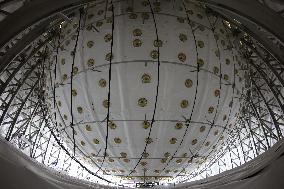
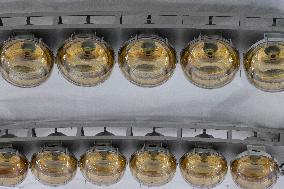
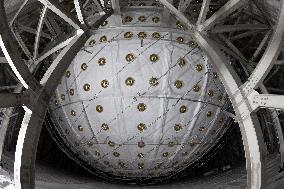
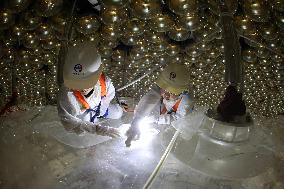
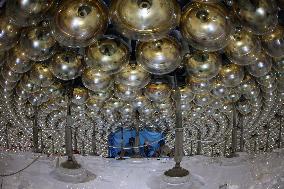
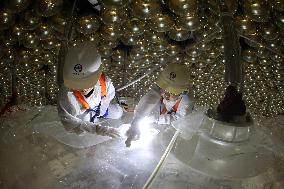
File photo taken on Dec. 17, 2024 shows photo-multiplier tubes seen from top of the acrylic sphere of the liquid-scintillator detector in Jiangmen Underground Neutrino Observatory (JUNO) in Jiangmen, south China's Guangdong Province. The world's largest transparent spherical detector began operation in China on Tuesday, making it the world's first operational ultra-large scientific facility dedicated to neutrino research with ultra-high precision. Having completed the filling of its 20,000-tonne liquid scintillator detector, JUNO in Guangdong began taking data after more than a decade of preparation and construction, on August 26, 2025 in Beijing, China. Photo by Jin Liwang Xinhua/ABACAPRESS.COM

  •  
China World Robot Conference - Beijing

China World Robot Conference - Beijing

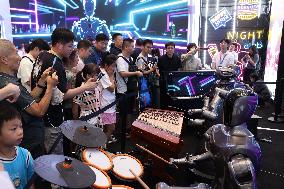
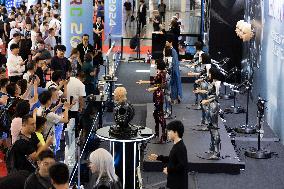
Visitors watch a performance by a robot band at the 2025 World Robot Conference (WRC) in Beijing, capital of China, Aug. 8, 2025. The 2025 WRC that kicked off on Friday in Beijing unveiled future development trends of embodied intelligent robots, focusing on fields such as cognition, decision-making and safety. Co-hosted by the Chinese Institute of Electronics and the World Robot Cooperation Organization, the five-day event features forums, exhibitions, competitions and networking events, with over 200 robotics companies from around the world presenting their latest innovations. Photo by Jin Liwang/Xinhua/ABACAPRESS.COM

  •  
China World Robot Conference - Beijing

China World Robot Conference - Beijing

Visitors watch a dancing robot at the 2025 World Robot Conference (WRC) in Beijing, capital of China, Aug. 8, 2025. The 2025 WRC that kicked off on Friday in Beijing unveiled future development trends of embodied intelligent robots, focusing on fields such as cognition, decision-making and safety. Co-hosted by the Chinese Institute of Electronics and the World Robot Cooperation Organization, the five-day event features forums, exhibitions, competitions and networking events, with over 200 robotics companies from around the world presenting their latest innovations. Photo by Jin Liwang/Xinhua/ABACAPRESS.COM

  •  
China World Robot Conference - Beijing

China World Robot Conference - Beijing

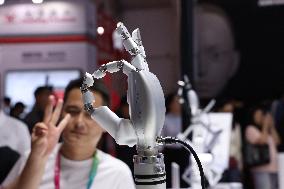
Visitors look at a robot hand at the 2025 World Robot Conference (WRC) in Beijing, capital of China, Aug. 8, 2025. The 2025 WRC that kicked off on Friday in Beijing unveiled future development trends of embodied intelligent robots, focusing on fields such as cognition, decision-making and safety. Co-hosted by the Chinese Institute of Electronics and the World Robot Cooperation Organization, the five-day event features forums, exhibitions, competitions and networking events, with over 200 robotics companies from around the world presenting their latest innovations. Photo by Jin Liwang/Xinhua/ABACAPRESS.COM

  •  
China World Robot Conference - Beijing

China World Robot Conference - Beijing

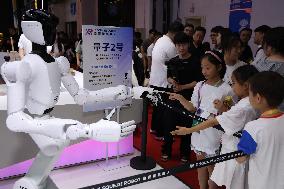
Visitors interact with a Quanta X2 robot from X Square Robot at the 2025 World Robot Conference (WRC) in Beijing, capital of China, Aug. 8, 2025. The 2025 WRC that kicked off on Friday in Beijing unveiled future development trends of embodied intelligent robots, focusing on fields such as cognition, decision-making and safety. Co-hosted by the Chinese Institute of Electronics and the World Robot Cooperation Organization, the five-day event features forums, exhibitions, competitions and networking events, with over 200 robotics companies from around the world presenting their latest innovations. Photo by Jin Liwang/Xinhua/ABACAPRESS.COM

  •  
China World Robot Conference - Beijing

China World Robot Conference - Beijing

A robot of Unitree Robotics gives a combat performance at the 2025 World Robot Conference (WRC) in Beijing, capital of China, Aug. 8, 2025. The 2025 WRC that kicked off on Friday in Beijing unveiled future development trends of embodied intelligent robots, focusing on fields such as cognition, decision-making and safety. Co-hosted by the Chinese Institute of Electronics and the World Robot Cooperation Organization, the five-day event features forums, exhibitions, competitions and networking events, with over 200 robotics companies from around the world presenting their latest innovations. Photo by Jin Liwang/Xinhua/ABACAPRESS.COM

  •  
Liquid Filling At Neutrino Observatory - China

Liquid Filling At Neutrino Observatory - China

A researcher adjusts displacement sensors at the top of the central detector of the Jiangmen Underground Neutrino Observatory (JUNO) in Jiangmen, south China's Guangdong Province, December 17, 2024. The liquid filling of the central detector of JUNO started on Wednesday. As one of the world's most powerful experiments to uncover neutrino mystery, JUNO is expected to operate for at least 30 years. Photo by Jin Liwang/Xinhua/ABACAPRESS.COM

  •  
Liquid Filling At Neutrino Observatory - China

Liquid Filling At Neutrino Observatory - China

Wang Yifang (L), chief scientist of the Jiangmen Underground Neutrino Observatory (JUNO), and Ma Xiaoyan, chief engineer of the JUNO, inspect the construction site at the bottom of a water tank of JUNO in Jiangmen, south China's Guangdong Province, December 16, 2024. The liquid filling of the central detector of JUNO started on Wednesday. As one of the world's most powerful experiments to uncover neutrino mystery, JUNO is expected to operate for at least 30 years. Photo by Jin Liwang/Xinhua/ABACAPRESS.COM

  •  
Liquid Filling At Neutrino Observatory - China

Liquid Filling At Neutrino Observatory - China

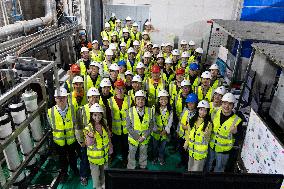
Researchers pose for a group photo to mark the start of liquid filling at the Jiangmen Underground Neutrino Observatory (JUNO) in Jiangmen, south China's Guangdong Province, December 18, 2024. The liquid filling of the central detector of JUNO started on Wednesday. As one of the world's most powerful experiments to uncover neutrino mystery, JUNO is expected to operate for at least 30 years. Photo by Jin Liwang/Xinhua/ABACAPRESS.COM

  •  
Liquid Filling At Neutrino Observatory - China

Liquid Filling At Neutrino Observatory - China

Ma Xiaoyan, chief engineer of the Jiangmen Underground Neutrino Observatory (JUNO), checks the bottom of a water tank of the JUNO in Jiangmen, south China's Guangdong Province, December 16, 2024. The liquid filling of the central detector of JUNO started on Wednesday. As one of the world's most powerful experiments to uncover neutrino mystery, JUNO is expected to operate for at least 30 years. Photo by Jin Liwang/Xinhua/ABACAPRESS.COM

  •  
Liquid Filling At Neutrino Observatory - China

Liquid Filling At Neutrino Observatory - China

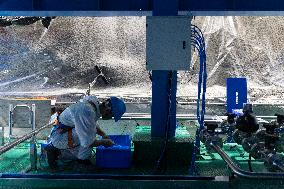
Staff members seal the bottom of a water tank with Tyvek material at the construction site of the Jiangmen Underground Neutrino Observatory (JUNO) in Jiangmen, south China's Guangdong Province, December 16, 2024. The liquid filling of the central detector of JUNO started on Wednesday. As one of the world's most powerful experiments to uncover neutrino mystery, JUNO is expected to operate for at least 30 years. Photo by Jin Liwang/Xinhua/ABACAPRESS.COM

  •  
Liquid Filling At Neutrino Observatory - China

Liquid Filling At Neutrino Observatory - China

Staff members cover the last hole in the water tank of the Jiangmen Underground Neutrino Observatory (JUNO) in Jiangmen, south China's Guangdong Province, December 17, 2024. The liquid filling of the central detector of JUNO started on Wednesday. As one of the world's most powerful experiments to uncover neutrino mystery, JUNO is expected to operate for at least 30 years. Photo by Jin Liwang/Xinhua/ABACAPRESS.COM

  •  
Liquid Filling At Neutrino Observatory - China

Liquid Filling At Neutrino Observatory - China

Staff members seal the bottom of a water tank with Tyvek material at the construction site of the Jiangmen Underground Neutrino Observatory (JUNO) in Jiangmen, south China's Guangdong Province, December 16, 2024. The liquid filling of the central detector of JUNO started on Wednesday. As one of the world's most powerful experiments to uncover neutrino mystery, JUNO is expected to operate for at least 30 years. Photo by Jin Liwang/Xinhua/ABACAPRESS.COM

  •  
Liquid Filling At Neutrino Observatory - China

Liquid Filling At Neutrino Observatory - China

Wang Yifang (2nd R), chief scientist of the Jiangmen Underground Neutrino Observatory (JUNO), together with other researchers, starts the liquid filling of JUNO in Jiangmen, south China's Guangdong Province, December 18, 2024. The liquid filling of the central detector of JUNO started on Wednesday. As one of the world's most powerful experiments to uncover neutrino mystery, JUNO is expected to operate for at least 30 years. Photo by Jin Liwang/Xinhua/ABACAPRESS.COM

  •  
Liquid Filling At Neutrino Observatory - China

Liquid Filling At Neutrino Observatory - China

Wang Yifang (2nd R), chief scientist of the Jiangmen Underground Neutrino Observatory (JUNO), and Ma Xiaoyan (4th R), chief engineer of the JUNO, check the status of liquid filling of JUNO in Jiangmen, south China's Guangdong Province, December 18, 2024. The liquid filling of the central detector of JUNO started on Wednesday. As one of the world's most powerful experiments to uncover neutrino mystery, JUNO is expected to operate for at least 30 years. Photo by Jin Liwang/Xinhua/ABACAPRESS.COM

  •  
Liquid Filling At Neutrino Observatory - China

Liquid Filling At Neutrino Observatory - China

Ma Xiaoyan, chief engineer of the Jiangmen Underground Neutrino Observatory (JUNO), inspects the construction site of JUNO in Jiangmen, south China's Guangdong Province, December 17, 2024. The liquid filling of the central detector of JUNO started on Wednesday. As one of the world's most powerful experiments to uncover neutrino mystery, JUNO is expected to operate for at least 30 years. Photo by Jin Liwang/Xinhua/ABACAPRESS.COM

  •  
Liquid Filling At Neutrino Observatory - China

Liquid Filling At Neutrino Observatory - China

This photo taken on December 16, 2024 shows the central detector of the Jiangmen Underground Neutrino Observatory (JUNO) in Jiangmen, south China's Guangdong Province. The liquid filling of the central detector of JUNO started on Wednesday. As one of the world's most powerful experiments to uncover neutrino mystery, JUNO is expected to operate for at least 30 years. Photo by Jin Liwang/Xinhua/ABACAPRESS.COM

  •  
Liquid Filling At Neutrino Observatory - China

Liquid Filling At Neutrino Observatory - China

This photo taken on December 17, 2024 shows photo-multiplier tubes seen from the top of the acrylic sphere of the Jiangmen Underground Neutrino Observatory (JUNO) in Jiangmen, south China's Guangdong Province. The liquid filling of the central detector of JUNO started on Wednesday. As one of the world's most powerful experiments to uncover neutrino mystery, JUNO is expected to operate for at least 30 years. Photo by Jin Liwang/Xinhua/ABACAPRESS.COM

  •  
Liquid Filling At Neutrino Observatory - China

Liquid Filling At Neutrino Observatory - China

This photo taken on December 17, 2024 shows photo-multiplier tubes inside the acrylic sphere of the Jiangmen Underground Neutrino Observatory (JUNO) in Jiangmen, south China's Guangdong Province. The liquid filling of the central detector of JUNO started on Wednesday. As one of the world's most powerful experiments to uncover neutrino mystery, JUNO is expected to operate for at least 30 years. Photo by Jin Liwang/Xinhua/ABACAPRESS.COM

  •  
Liquid Filling At Neutrino Observatory - China

Liquid Filling At Neutrino Observatory - China

This photo taken on December 17, 2024 shows the central detector of the Jiangmen Underground Neutrino Observatory (JUNO) in Jiangmen, south China's Guangdong Province. The liquid filling of the central detector of JUNO started on Wednesday. As one of the world's most powerful experiments to uncover neutrino mystery, JUNO is expected to operate for at least 30 years. Photo by Jin Liwang/Xinhua/ABACAPRESS.COM

  •  
Low-Energy High-Intensity Heavy-Ion Accelerator Facility - China

Low-Energy High-Intensity Heavy-Ion Accelerator Facility - China

Sun Liangting, a researcher with the Institute of Modern Physics of the Chinese Academy of Sciences, checks equipment on December 10, 2024. The world's first stand-alone low-energy high-intensity heavy-ion accelerator facility (LEAF), developed by the Institute of Modern Physics of the Chinese Academy of Sciences, recently passed the expert panel acceptance inspection organized by the National Natural Science Foundation of China. The LEAF can provide intense heavy-ion beams and mixed ion beams of various charge states from light to heavy elements, offering advantages such as high beam intensity, high charge state, diverse ion species, and a wide range of energy variations. With the upgrading of ion accelerators and the evolution of accelerator technologies, frontier research in ion beam physics has continuously deepened human understanding of the world, and related application technologies have been widely adopted in various fields. Photo by Jin Liwang/Xinhua/ABACAPRESS.COM

  •  
Low-Energy High-Intensity Heavy-Ion Accelerator Facility - China

Low-Energy High-Intensity Heavy-Ion Accelerator Facility - China

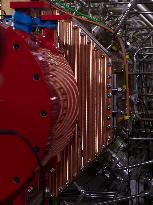
This photo taken on December 10, 2024 shows part of the low-energy high-intensity heavy-ion accelerator facility (LEAF). The world's first stand-alone low-energy high-intensity heavy-ion accelerator facility (LEAF), developed by the Institute of Modern Physics of the Chinese Academy of Sciences, recently passed the expert panel acceptance inspection organized by the National Natural Science Foundation of China. The LEAF can provide intense heavy-ion beams and mixed ion beams of various charge states from light to heavy elements, offering advantages such as high beam intensity, high charge state, diverse ion species, and a wide range of energy variations. With the upgrading of ion accelerators and the evolution of accelerator technologies, frontier research in ion beam physics has continuously deepened human understanding of the world, and related application technologies have been widely adopted in various fields. Photo by Jin Liwang/Xinhua/ABACAPRESS.COM

  •  
Low-Energy High-Intensity Heavy-Ion Accelerator Facility - China

Low-Energy High-Intensity Heavy-Ion Accelerator Facility - China

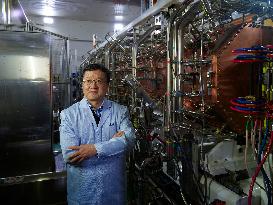
Zhao Hongwei, an academician of the Chinese Academy of Sciences (CAS), poses for a photo in front of the low-energy high-intensity heavy-ion accelerator facility (LEAF) on December 10, 2024. The world's first stand-alone low-energy high-intensity heavy-ion accelerator facility (LEAF), developed by the Institute of Modern Physics of the Chinese Academy of Sciences, recently passed the expert panel acceptance inspection organized by the National Natural Science Foundation of China. The LEAF can provide intense heavy-ion beams and mixed ion beams of various charge states from light to heavy elements, offering advantages such as high beam intensity, high charge state, diverse ion species, and a wide range of energy variations. With the upgrading of ion accelerators and the evolution of accelerator technologies, frontier research in ion beam physics has continuously deepened human understanding of the world, and related application technologies have been widely adopted in various fields. Photo by Jin Liwang/Xinhua

  •  
Low-Energy High-Intensity Heavy-Ion Accelerator Facility - China

Low-Energy High-Intensity Heavy-Ion Accelerator Facility - China

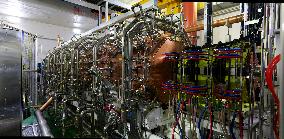
This stitched photo taken on December 10, 2024 shows part of the low-energy high-intensity heavy-ion accelerator facility (LEAF). The world's first stand-alone low-energy high-intensity heavy-ion accelerator facility (LEAF), developed by the Institute of Modern Physics of the Chinese Academy of Sciences, recently passed the expert panel acceptance inspection organized by the National Natural Science Foundation of China. The LEAF can provide intense heavy-ion beams and mixed ion beams of various charge states from light to heavy elements, offering advantages such as high beam intensity, high charge state, diverse ion species, and a wide range of energy variations. With the upgrading of ion accelerators and the evolution of accelerator technologies, frontier research in ion beam physics has continuously deepened human understanding of the world, and related application technologies have been widely adopted in various fields. Photo by Jin Liwang/Xinhua/ABACAPRESS.COM

  •  
Low-Energy High-Intensity Heavy-Ion Accelerator Facility - China

Low-Energy High-Intensity Heavy-Ion Accelerator Facility - China

Researchers observe experiment progress at the control room of the low-energy high-intensity heavy-ion accelerator facility (LEAF) on December 10, 2024. The world's first stand-alone low-energy high-intensity heavy-ion accelerator facility (LEAF), developed by the Institute of Modern Physics of the Chinese Academy of Sciences, recently passed the expert panel acceptance inspection organized by the National Natural Science Foundation of China. The LEAF can provide intense heavy-ion beams and mixed ion beams of various charge states from light to heavy elements, offering advantages such as high beam intensity, high charge state, diverse ion species, and a wide range of energy variations. With the upgrading of ion accelerators and the evolution of accelerator technologies, frontier research in ion beam physics has continuously deepened human understanding of the world, and related application technologies have been widely adopted in various fields. Photo by Jin Liwang/Xinhua/ABACAPRESS.COM

  •  
Low-Energy High-Intensity Heavy-Ion Accelerator Facility - China

Low-Energy High-Intensity Heavy-Ion Accelerator Facility - China

Researchers analyze experimental data at the control room of the low-energy high-intensity heavy-ion accelerator facility (LEAF) on December 10, 2024. The world's first stand-alone low-energy high-intensity heavy-ion accelerator facility (LEAF), developed by the Institute of Modern Physics of the Chinese Academy of Sciences, recently passed the expert panel acceptance inspection organized by the National Natural Science Foundation of China. The LEAF can provide intense heavy-ion beams and mixed ion beams of various charge states from light to heavy elements, offering advantages such as high beam intensity, high charge state, diverse ion species, and a wide range of energy variations. With the upgrading of ion accelerators and the evolution of accelerator technologies, frontier research in ion beam physics has continuously deepened human understanding of the world, and related application technologies have been widely adopted in various fields. Photo by Jin Liwang/Xinhua/ABACAPRESS.COM

  •  
Low-Energy High-Intensity Heavy-Ion Accelerator Facility - China

Low-Energy High-Intensity Heavy-Ion Accelerator Facility - China

This stitched photo taken on December 10, 2024 shows part of the low-energy high-intensity heavy-ion accelerator facility (LEAF). The world's first stand-alone low-energy high-intensity heavy-ion accelerator facility (LEAF), developed by the Institute of Modern Physics of the Chinese Academy of Sciences, recently passed the expert panel acceptance inspection organized by the National Natural Science Foundation of China. The LEAF can provide intense heavy-ion beams and mixed ion beams of various charge states from light to heavy elements, offering advantages such as high beam intensity, high charge state, diverse ion species, and a wide range of energy variations. With the upgrading of ion accelerators and the evolution of accelerator technologies, frontier research in ion beam physics has continuously deepened human understanding of the world, and related application technologies have been widely adopted in various fields. Photo by Jin Liwang/Xinhua/ABACAPRESS.COM

  •  
Jiangmen Underground Neutrino Observatory - China

Jiangmen Underground Neutrino Observatory - China

Researchers Ma Xiaoyan (R) and Zhao Jie check the acrylic sphere of the central detector of the Jiangmen Underground Neutrino Observatory (JUNO) in Jiangmen, south China's Guangdong Province, November 23, 2024. The main part of the central detector has been constructed recently. As one of the world's most powerful experiments to uncover neutrino mystery, JUNO is expected to operate for at least 30 years. Photo by Jin Liwang/Xinhua/ABACAPRESS.COM

  •  
Underground Neutrino Observatory JUNO - China

Underground Neutrino Observatory JUNO - China

Staff members work at the construction site of the Jiangmen Underground Neutrino Observatory (JUNO) in Jiangmen, south China's Guangdong Province, Nov. 22, 2024. The main part of the central detector has been constructed recently. As one of the world's most powerful experiments to uncover neutrino mystery, JUNO is expected to operate for at least 30 years. Photo by Jin Liwang/Xinhua/ABACAPRESS.COM

  •  
Underground Neutrino Observatory JUNO - China

Underground Neutrino Observatory JUNO - China

Staff members rest at the construction site of the Jiangmen Underground Neutrino Observatory (JUNO) in Jiangmen, south China's Guangdong Province, Nov. 23, 2024. The main part of the central detector has been constructed recently. As one of the world's most powerful experiments to uncover neutrino mystery, JUNO is expected to operate for at least 30 years. Photo by Jin Liwang/Xinhua/ABACAPRESS.COM

  •  
Underground Neutrino Observatory JUNO - China

Underground Neutrino Observatory JUNO - China

Staff members work at the construction site of the Jiangmen Underground Neutrino Observatory (JUNO) in Jiangmen, south China's Guangdong Province, Nov. 22, 2024. The main part of the central detector has been constructed recently. As one of the world's most powerful experiments to uncover neutrino mystery, JUNO is expected to operate for at least 30 years. Photo by Jin Liwang/Xinhua/ABACAPRESS.COM

  •  
Underground Neutrino Observatory JUNO - China

Underground Neutrino Observatory JUNO - China

Staff members work at the construction site of the Jiangmen Underground Neutrino Observatory (JUNO) in Jiangmen, south China's Guangdong Province, Nov. 23, 2024. The main part of the central detector has been constructed recently. As one of the world's most powerful experiments to uncover neutrino mystery, JUNO is expected to operate for at least 30 years. Photo by Jin Liwang/Xinhua/ABACAPRESS.COM

  •  
Underground Neutrino Observatory JUNO - China

Underground Neutrino Observatory JUNO - China

Staff members check the installation of the central detector of the Jiangmen Underground Neutrino Observatory (JUNO) in Jiangmen, south China's Guangdong Province, Nov. 22, 2024. The main part of the central detector has been constructed recently. As one of the world's most powerful experiments to uncover neutrino mystery, JUNO is expected to operate for at least 30 years. Photo by Jin Liwang/Xinhua/ABACAPRESS.COM

  •  
Underground Neutrino Observatory JUNO - China

Underground Neutrino Observatory JUNO - China

This photo taken on Nov. 23, 2024 shows the acrylic sphere of the central detector of the Jiangmen Underground Neutrino Observatory (JUNO) being cleaned in Jiangmen, south China's Guangdong Province. The main part of the central detector has been constructed recently. As one of the world's most powerful experiments to uncover neutrino mystery, JUNO is expected to operate for at least 30 years. Photo by Jin Liwang/Xinhua/ABACAPRESS.COM

  •  
Underground Neutrino Observatory JUNO - China

Underground Neutrino Observatory JUNO - China

Staff members pose for a group photo at the construction site of the Jiangmen Underground Neutrino Observatory (JUNO) in Jiangmen, south China's Guangdong Province, Nov. 23, 2024. The main part of the central detector has been constructed recently. As one of the world's most powerful experiments to uncover neutrino mystery, JUNO is expected to operate for at least 30 years. Photo by Jin Liwang/Xinhua/ABACAPRESS.COM

  •  
Underground Neutrino Observatory JUNO - China

Underground Neutrino Observatory JUNO - China

This photo shows the central detector of the Jiangmen Underground Neutrino Observatory (JUNO) under construction in Jiangmen, south China's Guangdong Province, Nov. 22, 2024. The main part of the central detector has been constructed recently. As one of the world's most powerful experiments to uncover neutrino mystery, JUNO is expected to operate for at least 30 years. Photo by Jin Liwang/Xinhua/ABACAPRESS.COM

  •  
Underground Neutrino Observatory JUNO - China

Underground Neutrino Observatory JUNO - China

This photo taken on Nov. 22, 2024 shows the acrylic sphere of the central detector of the Jiangmen Underground Neutrino Observatory (JUNO) in Jiangmen, south China's Guangdong Province. The main part of the central detector has been constructed recently. As one of the world's most powerful experiments to uncover neutrino mystery, JUNO is expected to operate for at least 30 years. Photo by Jin Liwang/Xinhua/ABACAPRESS.COM

  •  
Underground Neutrino Observatory JUNO - China

Underground Neutrino Observatory JUNO - China

Researchers Ma Xiaoyan (R) and Zhao Jie check the acrylic sphere of the central detector of the Jiangmen Underground Neutrino Observatory (JUNO) in Jiangmen, south China's Guangdong Province, Nov. 23, 2024. The main part of the central detector has been constructed recently. As one of the world's most powerful experiments to uncover neutrino mystery, JUNO is expected to operate for at least 30 years. Photo by Jin Liwang/Xinhua/ABACAPRESS.COM

  •  
Underground Neutrino Observatory JUNO - China

Underground Neutrino Observatory JUNO - China

This photo taken on Nov. 22, 2024 shows the acrylic sphere of the central detector of the Jiangmen Underground Neutrino Observatory (JUNO) in Jiangmen, south China's Guangdong Province. The main part of the central detector has been constructed recently. As one of the world's most powerful experiments to uncover neutrino mystery, JUNO is expected to operate for at least 30 years. Photo by Jin Liwang/Xinhua/ABACAPRESS.COM

  •  
World Robot Conference - Beijing

World Robot Conference - Beijing

Humanoid robots are pictured during the World Robot Conference 2024 in Beijing, capital of China, Aug. 21, 2024. The World Robot Conference 2024 opened here on Wednesday. Photo by Xinhua/Jin Liwang/ABACAPRESS.COM

  •  
World Robot Conference - Beijing

World Robot Conference - Beijing

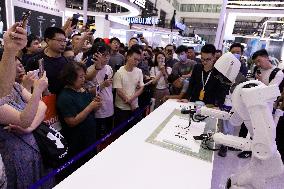
Visitors watch as a robot writes Chinese calligraphy during the World Robot Conference 2024 in Beijing, capital of China, Aug. 21, 2024. The World Robot Conference 2024 opened here on Wednesday. Photo by Xinhua/Jin Liwang/ABACAPRESS.COM

  •  
World Robot Conference - Beijing

World Robot Conference - Beijing

Robots greet each other during the World Robot Conference 2024 in Beijing, capital of China, Aug. 21, 2024. The World Robot Conference 2024 opened here on Wednesday. Photo by Xinhua/Jin Liwang/ABACAPRESS.COM

  •  
World Robot Conference - Beijing

World Robot Conference - Beijing

A humanoid robot is pictured during the World Robot Conference 2024 in Beijing, capital of China, August 21, 2024. The World Robot Conference 2024 opened here on Wednesday. (Xinhua/Jin Liwang)

  •  
World Robot Conference - Beijing

World Robot Conference - Beijing

Humanoid robots of the "Q Family" are pictured during the World Robot Conference 2024 in Beijing, capital of China, August 21, 2024. The World Robot Conference 2024 opened here on Wednesday. (Xinhua/Jin Liwang)

  •  
CHINA-BEIJING-SYMPOSIUM-UNDERSTANDING-CPC PLENUM (CN)

CHINA-BEIJING-SYMPOSIUM-UNDERSTANDING-CPC PLENUM (CN)

(240806) -- BEIJING, Aug. 6, 2024 Photo by Xinhua/ABACAPRESS.COM) -- A guest reads a think tank report unveiled at a symposium themed on understanding the third plenum of the 20th Communist Party of China (CPC) Central Committee in Beijing, capital of China, Aug. 6, 2024. The symposium was attended by more than 200 diplomats, think tank experts and journalists from over 60 countries for exchanges and discussions on Tuesday in Beijing. A think tank report on the achievements and global contributions of China's reform endeavors in the new era was unveiled at the symposium. Titled "Deepening Reform Comprehensively to Advance Chinese Modernization: Major Achievements and Global Contributions," the report was jointly issued in Chinese and English by the think tanks under the Institute of Party History and Literature of the CPC Central Committee and Xinhua News Agency. Photo by Xinhua/ABACAPRESS.COM/Jin Liwang)

  •  
CHINA-CPC CENTRAL COMMITTEE-PRESS CONFERENCE (CN)

CHINA-CPC CENTRAL COMMITTEE-PRESS CONFERENCE (CN)

(240719) -- BEIJING, July 19, 2024 Photo by Xinhua/ABACAPRESS.COM) -- The Central Committee of the Communist Party of China (CPC) holds a press conference on the guiding principles from the third plenary session of the 20th CPC Central Committee on July 19, 2024. Photo by Xinhua/ABACAPRESS.COM/Jin Liwang)

  • Main
  • Top
  • Editorial
  • Creative
  • About Us
  • About ILG
  • Terms of use
  • Company
  • BEHIND
  • Price List
  • Single Plan
  • Monthly Plan
  • Services
  • Shooting
  • Rights Clearance
  • Support
  • FAQ
  • How To Buy
  • Contact Us
  • Become a Partner

© KYODO NEWS IMAGES INC

All Rights Reserved.

  • Editorial
  • Olympics
  • News
  • Sports
  • Japan
  • Tech
  • Royal
  • Disaster
  • NorthKorea
  • Old Japan
  • SNS
  • Creative
  • Food
  • Japan
  • Landscape
  • Animal
  • Popular
  • #Ukraine
  • #China
  • #coronavirus
  • #N. Korea
  • #Thailand
  • #Russia
  • #Ukraine
  • #China
  • #coronavirus
  • #N. Korea
  • #Thailand
  • #Russia
  • Food
  • Japan
  • Landscape
  • Animal
  • Olympics
  • News
  • Sports
  • Japan
  • Tech
  • Royal
  • Disaster
  • NorthKorea
  • Old Japan
  • SNS