•  
Tsunami-damaged piano returns to elementary school

Tsunami-damaged piano returns to elementary school

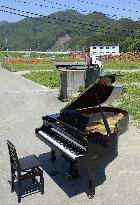
KAMAISHI, Japan - A grand piano, washed away from Toni Elementary School in Kamaishi, Iwate Prefecture, northeastern Japan, by the devastating tsunami of March 11, 2011, is displayed in the vacated yard of the school after repair on June 2, 2014.

  •  
Takahashi, Asada at quake charity event in Kobe

Takahashi, Asada at quake charity event in Kobe

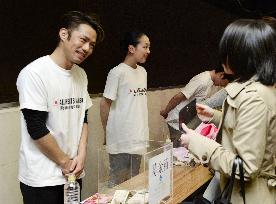
KOBE, Japan - Japanese figure skater Daisuke Takahashi (L) and Mao Asada (2nd from L) ask visitors for donations to support reconstruction from the March 11, 2011, disaster after their performances at a charity event held in Kobe on April 2, 2014.

  •  
Crown prince, princess visit disaster-hit Iwate

Crown prince, princess visit disaster-hit Iwate

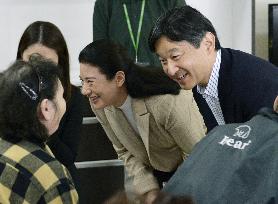
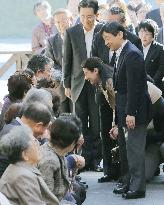
KAMAISHI, Japan - Crown Prince Naruhito (R) and Crown Princess Masako (C) converse with evacuees from the March 2011 earthquake and tsunami at a temporary housing in Kamaishi, Iwate Prefecture, on Nov. 2, 2013.

  •  
Crown prince, princess visit disaster-hit Iwate

Crown prince, princess visit disaster-hit Iwate

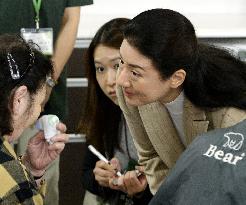
KAMAISHI, Japan - Crown Princess Masako (R) listens to a crying woman, an evacuee from the March 2011 earthquake and tsunami, at a temporary housing in Kamaishi, Iwate Prefecture, on Nov. 2, 2013.

  •  
Crown prince, princess visit disaster-hit Iwate

Crown prince, princess visit disaster-hit Iwate

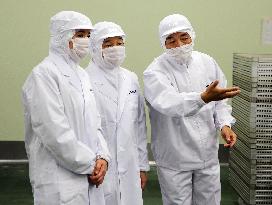
KAMAISHI, Japan - Crown Prince Naruhito (C) and Crown Princess Masako (L) visit Ono Foods Co., a seafood processing company, in Kamaishi, Iwate Prefecture, on Nov. 2, 2013. The company's operation was affected by the March 2011 earthquake and tsunami. (Pool photo)

  •  
Crown prince, princess visit disaster-hit Iwate

Crown prince, princess visit disaster-hit Iwate

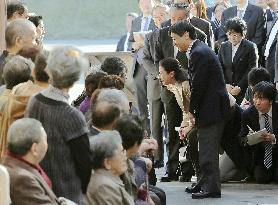
KAMAISHI, Japan - Crown Prince Naruhito (R front) and Crown Princess Masako (next to him) converse with evacuees from the March 2011 earthquake and tsunami at a temporary housing in Kamaishi, Iwate Prefecture, on Nov. 2, 2013. (Pool photo)

  •  
Crown prince, princess visit disaster-hit Iwate

Crown prince, princess visit disaster-hit Iwate

KAMAISHI, Japan - Crown Prince Naruhito (R front) and Crown Princess Masako (next to him) converse with evacuees from the March 2011 earthquake and tsunami at a temporary housing in Kamaishi, Iwate Prefecture, on Nov. 2, 2013. (Pool photo)

  •  
Replica moai for disaster area displayed in Osaka

Replica moai for disaster area displayed in Osaka

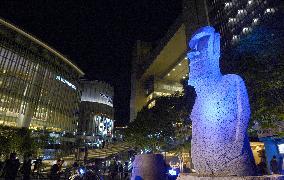
OSAKA, Japan - A replica moai statue from Chile goes on display at the Grand Front Osaka commercial facility in Osaka on May 2, 2013. The newly made statue is a present given as a token of support by the Chilean government to the town of Minamisanriku, Miyagi Prefecture, hit by the March 2011 earthquake and tsunami. It will be displayed through May 9 before being transported to Minamisanriku.

  •  
2 years after quake

2 years after quake

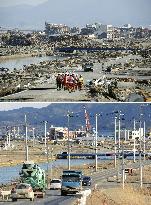
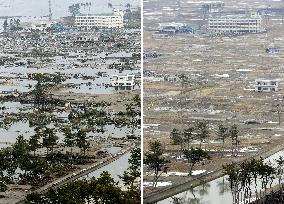
MINAMISANRIKU, Japan - Photos show an area in the town of Minamisanriku, Miyagi Prefecture, on March 13, 2011 (top), two days after the massive earthquake and tsunami in northeastern Japan, and the same location on March 2, 2013, with cars running on a restored national road.

  •  
2 years after quake

2 years after quake

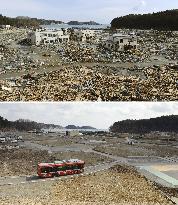
MINAMISANRIKU, Japan - Photos show an area in the town of Minamisanriku, Miyagi Prefecture, on March 18, 2011 (top), after the March 11 earthquake and tsunami, and the same location on March 2, 2013, with a bus running to Yanaizu Station in the city of Tome in the prefecture.

  •  
2 years after quake

2 years after quake

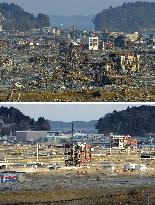
MINAMISANRIKU, Japan - Photos show an area in the town of Minamisanriku, Miyagi Prefecture, on March 13, 2011 (top), two days after the massive earthquake and tsunami in northeastern Japan, and the same location on March 2, 2013, with the frame of the town's antidisaster office visible.

  •  
Young volunteers stay to support victims of March 2011 disaster

Young volunteers stay to support victims of March 2011 disaster

FUKUSHIMA, Japan - Volunteer Yusuke Kato (L), holding a dosimeter, explains to a tour participant about a checkpoint set up 10 kilometers north of Tokyo Electric Power Co.'s Fukushima Daiichi nuclear power plant crippled by the March 2011 disaster. Photo was taken Feb. 2, 2013, in Minamisoma, Fukushima Prefecture.

  •  
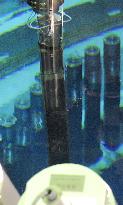
TEPCO starts removing fuel from Fukushima Daini reactor

TEPCO starts removing fuel from Fukushima Daini reactor

TOMIOKA, Japan - Fuel assemblies are removed from the No. 4 reactor at Tokyo Electric Power Co.'s Fukushima Daini plant in Tomioka, Fukushima Prefecture, on Oct. 2, 2012. TEPCO showed to the media its work to remove fuel from the reactor to the spent fuel pool located next to it, the first time it has done so since a huge earthquake and tsunami hit the complex and crippled the Fukushima Daiichi plant in March 2011.

  •  
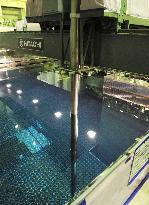
TEPCO starts removing fuel from Fukushima Daini reactor

TEPCO starts removing fuel from Fukushima Daini reactor

TOMIOKA, Japan - Fuel assemblies (underwater, C) are carried into the spent fuel pool after being removed from the No. 4 reactor at Tokyo Electric Power Co.'s Fukushima Daini plant in Tomioka, Fukushima Prefecture, on Oct. 2, 2012. TEPCO showed to the media its work to remove fuel from the reactor to the spent fuel pool located next to it, the first time it has done so since a huge earthquake and tsunami hit the complex and crippled the Fukushima Daiichi plant in March 2011.

  •  
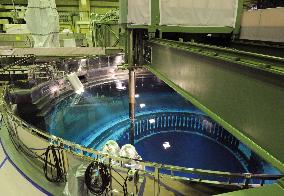
TEPCO starts removing fuel from Fukushima Daini reactor

TEPCO starts removing fuel from Fukushima Daini reactor

TOMIOKA, Japan - Fuel assemblies (underwater, C) are removed from the No. 4 reactor at Tokyo Electric Power Co.'s Fukushima Daini plant in Tomioka, Fukushima Prefecture on Oct. 2, 2012. TEPCO showed to the media its work to remove fuel from the reactor to the spent fuel pool located next to it, the first time it has done so since a huge earthquake and tsunami hit the complex and crippled the Fukushima Daiichi plant in March 2011.

  •  
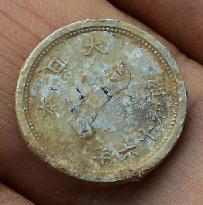
Japanese coin found at burial site in N. Korea

Japanese coin found at burial site in N. Korea

HAMHUNG, North Korea - Photo taken Sept. 2, 2012, shows what appears to be a Japanese coin that North Korea said was discovered in a survey in March 2011 of a site in Bupyong, believed to contain the remains of Japanese nationals who died around the end of World War II, outside Hamhung in the south of Hamgyong Province in eastern North Korea. A bag containing the coin was excavated there on Sept. 2, 2012. Characters such as "Dai-Nippon," loosely translated as great Japan, "Showa 16 nen," referring to a Japanese era and year equivalent to the year 1941, and "Issen," a small currency unit, are inscribed on the coin.

  •  
Japan's power-saving period begins

Japan's power-saving period begins

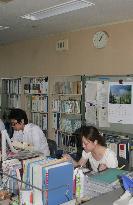
FUKUOKA, Japan - Employees of the Fukuoka prefectural government have their lunch in an office where electricity has been turned off as part of power-saving efforts, on July 2, 2012. A government-requested power-saving period began in Japan the same day to cope with power supply constraints caused by the prolonged halt of nuclear reactors following the March 2011 Fukushima nuclear disaster.

  •  
Japan's power-saving period begins

Japan's power-saving period begins

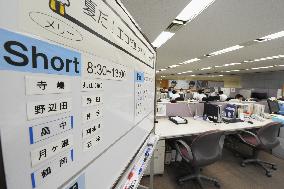
TOKYO, Japan - A board in the head office of Nippon Telegraph and Telephone East Corp. (NTT East) in Tokyo on July 2, 2012, shows the work schedules of employees, including those working only between 8:30 a.m. and 1 p.m. for two days per week under a "short" working hour system introduced as part of power-saving efforts. A government-requested power-saving period began in Japan the same day to cope with power supply constraints caused by the prolonged halt of nuclear reactors following the March 2011 Fukushima nuclear disaster.

  •  
Japan's power-saving period begins

Japan's power-saving period begins

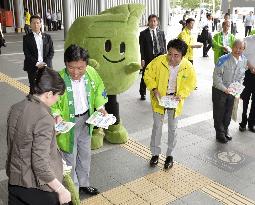
FUKUOKA, Japan - (from L) Fukuoka Gov. Hiroshi Ogawa, Fukuoka Mayor Soichiro Takashima and Kyushu Electric Power Co. President Michiaki Uriu distribute handouts calling for electricity saving near JR Hakata Station in Fukuoka City on July 2, 2012. A government-requested power-saving period began in Japan that day to cope with power supply constraints caused by the prolonged halt of nuclear reactors following the March 2011 Fukushima nuclear accident.

  •  
Minamisanriku soon after quake, now

Minamisanriku soon after quake, now

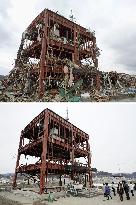
TOKYO, Japan - Photos show a town government building in Minamisanriku, Miyagi Prefecture, on March 26, 2011 (top), shortly after the area was devastated by the March 11 earthquake and tsunami, and the same location on March 2, 2012 (bottom). Dozens of municipal employees died at the building in the tsunami as it was designated as a facility to deal with disasters.

  •  
Ishinomaki soon after quake, now

Ishinomaki soon after quake, now

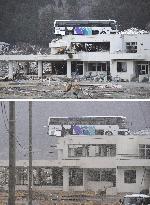
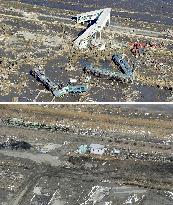
TOKYO, Japan - Photos show a building in the town of Ogatsu, part of the city of Ishinomaki in Miyagi Prefecture, on April 1, 2011 (top), shortly after the area was devastated by the March 11 earthquake and tsunami, and the same location on March 2, 2012 (bottom), in which a bus swept by the tsunami still remains on the building.

  •  
Minamisanriku soon after quake, now

Minamisanriku soon after quake, now

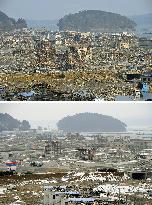
TOKYO, Japan - Photos show an area in the town of Minamisanriku, Miyagi Prefecture, on March 13, 2011 (top), shortly after the area was devastated by the March 11 earthquake and tsunami, and the same location on March 2, 2012 (bottom). Still much work seemed necessary to reconstruct the heavily damaged area.

  •  
Watari soon after quake, now

Watari soon after quake, now

TOKYO, Japan - Photos taken from a Kyodo News helicopter show the town of Watari, Miyagi Prefecture, on March 12, 2011 (top), shortly after the area was devastated by the March 11 earthquake and tsunami, and the same town on March 2, 2012 (bottom).

  •  
Sendai airport soon after quake, now

Sendai airport soon after quake, now

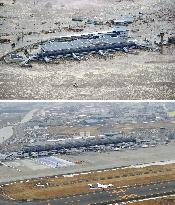
TOKYO, Japan - Photos taken from a Kyodo News helicopter show Sendai airport in Miyagi Prefecture on March 11, 2011 (top), shortly after the area was devastated by the March 11 earthquake and tsunami, and the same airport on March 2, 2012 (bottom).

  •  
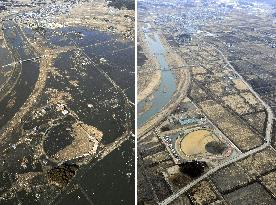
Sendai soon after quake, now

Sendai soon after quake, now

TOKYO, Japan - Photos taken from a Kyodo News helicopter show an area in Sendai, Miyagi Prefecture, on March 12, 2011 (L), shortly after the area was devastated by the March 11 earthquake and tsunami, and the same location on March 2, 2012 (R).

  •  
Iwanuma being hit by tsunami, now

Iwanuma being hit by tsunami, now

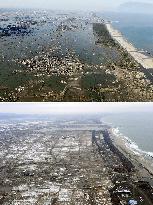
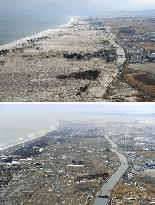
TOKYO, Japan - Photos taken from a Kyodo News helicopter show the coast of the city of Iwanuma, Miyagi Prefecture on March 11, 2011 (top), when the area was being hit by massive tsunami following a magnitude 9.0 earthquake, and the same location on March 2, 2012 (bottom).

  •  
Railway station soon after quake, now

Railway station soon after quake, now

TOKYO, Japan - Photos taken from a Kyodo News helicopter show JR Shinchi railway station in the town of Shinchi, Fukushima Prefecture on March 12, 2011 (top), shortly after the area was devastated by the March 11 earthquake and tsunami, and the same location on March 2, 2012 (bottom). The station is to be rebuilt in an inland area.

  •  
Fishing port soon after quake, now

Fishing port soon after quake, now

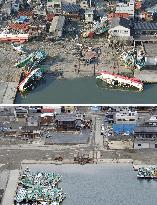
SOMA, Japan - Photos taken from a Kyodo News helicopter show Matsukawaura fishing port in the city of Soma, Fukushima Prefecture, on March 13, 2011 (top), shortly after the area was devastated by the March 11 earthquake and tsunami, and the same port on March 2, 2012 (bottom).

  •  
Baseball field soon after quake, now

Baseball field soon after quake, now

TOKYO, Japan - Photos taken from a Kyodo News helicopter show a baseball field in the city of Minamisoma, Fukushima Prefecture on March 12, 2011 (L), shortly after the area was devastated by the March 11 earthquake and tsunami, and the same field on March 2, 2012 (R).

  •  
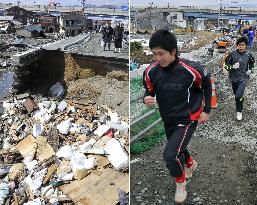
Miyako soon after quake, now

Miyako soon after quake, now

TOKYO, Japan - Photos show a road in the city of Miyako, Iwate Prefecture, on March 12, 2011 (L), shortly after the area was devastated by the March 11 earthquake and tsunami, and the same road on March 2, 2012 (R), when high school students were running there.

  •  
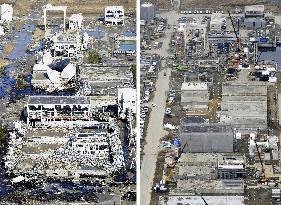
Minamisoma soon after quake, now

Minamisoma soon after quake, now

TOKYO, Japan - Photos taken from a Kyodo News helicopter show the Haramachi thermal power plant in the city of Minamisoma, Fukushima Prefecture, on March 12, 2011 (L), shortly after the area was devastated by the March 11 earthquake and tsunami, and the same plant on March 2, 2012 (R).

  •  
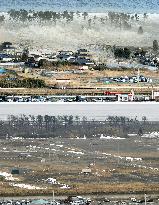
Natori being hit by tsunami, now

Natori being hit by tsunami, now

TOKYO, Japan - Photos taken from a Kyodo News helicopter show a coastal area in the city of Natori, Miyagi Prefecture, on March 11, 2011 (top), when the area was being hit by massive tsunami following a magnitude 9.0 earthquake, and the same location on March 2, 2012 (bottom).

  •  
Fukushima no-entry zone

Fukushima no-entry zone

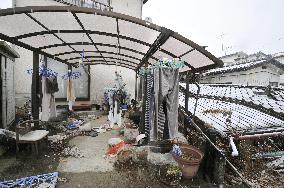
HIRONO, Japan - Laundry is left hanging at a home in the town of Futaba, Fukushima Prefecture, on March 2, 2012, as the area falls in the no-entry zone within 20 kilometers from the troubled Fukushima Daiichi Nuclear Power Station. Part of the no-entry zone, set due to the nuclear crisis resulting from the March 11, 2011, quake and tsunami, was shown to reporters.

  •  
Fukushima no-entry zone

Fukushima no-entry zone

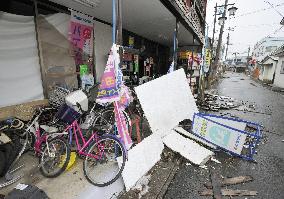
HIRONO, Japan - A bike shop is left damaged in the town of Okuma, Fukushima Prefecture, on March 2, 2012, as the area falls in the no-entry zone within 20 kilometers from the troubled Fukushima Daiichi Nuclear Power Station. Part of the no-entry zone, set due to the nuclear crisis resulting from the March 11, 2011, quake and tsunami, was shown to reporters.

  •  
Fukushima no-entry zone

Fukushima no-entry zone

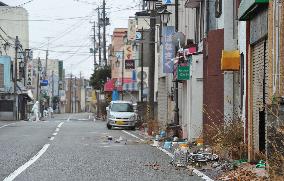
HIRONO, Japan - No people are seen in a shopping area in the town of Okuma, Fukushima Prefecture, on March 2, 2012, as the area falls in the no-entry zone within 20 kilometers from the troubled Fukushima Daiichi Nuclear Power Station. Part of the no-entry zone, set due to the nuclear crisis resulting from the March 11, 2011, quake and tsunami, was shown to reporters.

  •  
Fukushima no-entry zone

Fukushima no-entry zone

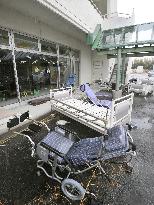
HIRONO, Japan - A wheelchair and a bed are left outside a hospital in the town of Futaba, Fukushima Prefecture, on March 2, 2012, as the area falls in the no-entry zone within 20 kilometers from the troubled Fukushima Daiichi Nuclear Power Station. Part of the no-entry zone, set due to the nuclear crisis resulting from the March 11, 2011, quake and tsunami, was shown to reporters.

  •  
Fukushima no-entry zone

Fukushima no-entry zone

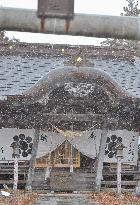
HIRONO, Japan - A Shinto shrine is left leaning in the town of Futaba, Fukushima Prefecture, on March 2, 2012, as the area falls in the no-entry zone within 20 kilometers from the troubled Fukushima Daiichi Nuclear Power Station. Part of the no-entry zone, set due to the nuclear crisis resulting from the March 11, 2011, quake and tsunami, was shown to reporters.

  •  
Fukushima no-entry zone

Fukushima no-entry zone

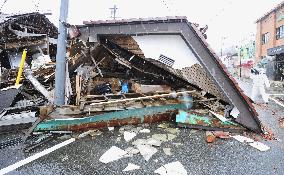
HIRONO, Japan - A house is left collapsed in the town of Futaba, Fukushima Prefecture, on March 2, 2012, as the area falls in the no-entry zone within 20 kilometers from the troubled Fukushima Daiichi Nuclear Power Station. Part of the no-entry zone, set due to the nuclear crisis resulting from the March 11, 2011, quake and tsunami, was shown to reporters.

  •  
Fukushima no-entry zone

Fukushima no-entry zone

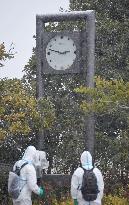
HIRONO, Japan - A clock in front of the town hall of Futaba, Fukushima Prefecture, on March 2, 2012, shows around 2:46, apparently because the devastating quake occurred at 2:46 p.m. on March 11, 2011. Part of areas in the no-entry zone within 20 kilometers from the troubled Fukushima Daiichi Nuclear Power Station, set due to the nuclear crisis resulting from the March 11, 2011, quake and tsunami, was shown to reporters.

  •  
Fukushima no-entry zone

Fukushima no-entry zone

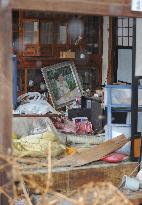
HIRONO, Japan - A home is left messy in the town of Futaba, Fukushima Prefecture, on March 2, 2012, as the area falls in the no-entry zone within 20 kilometers from the troubled Fukushima Daiichi Nuclear Power Station. Part of the no-entry zone, set due to the nuclear crisis resulting from the March 11, 2011, quake and tsunami, was shown to reporters.

  •  
Fukushima no-entry zone

Fukushima no-entry zone

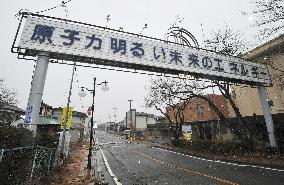
HIRONO, Japan - No people are seen in a shopping area in the town of Futaba, Fukushima Prefecture, on March 2, 2012, as the area falls in the no-entry zone within 20 kilometers from the troubled Fukushima Daiichi Nuclear Power Station. The signboard reads, ''Nuclear power: energy for a bright future.'' Part of the no-entry zone, set due to the nuclear crisis resulting from the March 11, 2011, quake and tsunami, was shown to reporters.

  •  
Christchurch cathedral

Christchurch cathedral

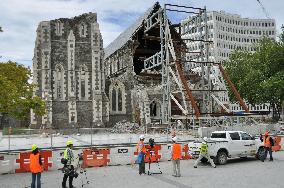
CHRISTCHURCH, New Zealand - Photo taken in February 2012 shows the cathedral damaged by the February 2011 earthquake in Christchurch, New Zealand. Bishop Victoria Matthews said on March 2, 2012, the cathedral will be demolished.

  •  
Bringing fire to Tohoku

Bringing fire to Tohoku

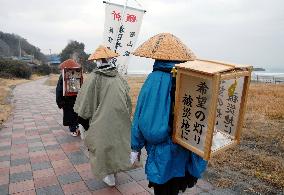
IWAKI, Japan - Buddhist monks walk along Nakoso Beach in Iwaki, Fukushima Prefecture, on March 2, 2012, as they brought fire taken from a monument in Hyogo Prefecture to commemorate the 1995 Great Hanshin Earthquake to the northeastern Japanese city hit by the March 11, 2011, quake and tsunami. The fire will be used for events to mark the first anniversary of the disaster.

  •  
Bringing fire to Tohoku

Bringing fire to Tohoku

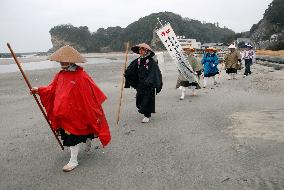
IWAKI, Japan - Buddhist monks walk along Nakoso Beach in Iwaki, Fukushima Prefecture, on March 2, 2012, as they brought fire taken from a monument in Hyogo Prefecture to commemorate the 1995 Great Hanshin Earthquake to the northeastern Japanese city hit by the March 11, 2011, quake and tsunami. The fire will be used for events to mark the first anniversary of the disaster.

  •  
Abandoned emergency center

Abandoned emergency center

OKUMA, Japan - The Japanese government's nuclear accident task force shows the press its emergency office in Okuma, Fukushima Prefecture, on March 2, 2012, which was on March 15, 2011, following the accident at the Fukushima Daiichi nuclear power plant. The whiteboard displays notes on radiation levels. On the left is a terminal of the System for Prediction of Environmental Emergency Dose Information, or SPEEDI.

  •  
Tokyo accepts debris from Onagawa

Tokyo accepts debris from Onagawa

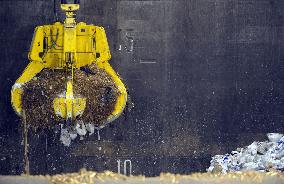
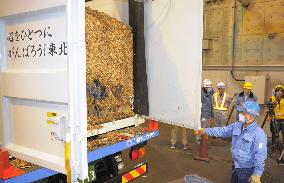
TOKYO, Japan - Photo taken March 2, 2012, shows debris (L) created by the March 2011 earthquake and tsunami in Onagawa, Miyagi Prefecture, which has been delivered to a garbage incineration plant in Tokyo's Chuo Ward, with the Japanese capital's regular garbage seen at the right bottom. The Tokyo metropolitan government the same day started accepting debris from the town severely hit by the disaster.

  •  
Abandoned emergency center

Abandoned emergency center

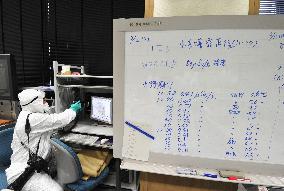
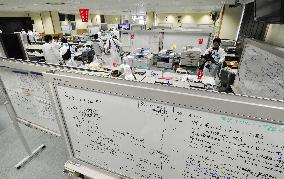
OKUMA, Japan - The Japanese government's nuclear accident task force shows the press its emergency office in Okuma, Fukushima Prefecture, on March 2, 2012. The office had been abandoned on March 15, 2011, following the accident at the Fukushima Daiichi nuclear power plant. Notes left on the whiteboards, including the word ''explosion,'' show the crisis environment at the time the facility was abandoned.

  •  
Abandoned emergency center

Abandoned emergency center

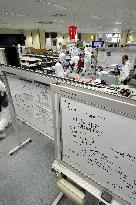
OKUMA, Japan - The Japanese government's nuclear accident task force shows the press its emergency office in Okuma, Fukushima Prefecture, on March 2, 2012. The office had been abandoned on March 15, 2011, following the accident at the Fukushima Daiichi nuclear power plant. Notes left on the whiteboards, including the word ''explosion,'' show the crisis environment at the time the facility was abandoned.

  •  
Tokyo accepts debris from Onagawa

Tokyo accepts debris from Onagawa

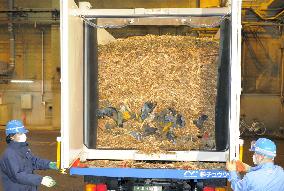
TOKYO, Japan - Debris created by the March 2011 earthquake and tsunami in Onagawa, Miyagi Prefecture, arrives at a garbage incineration plant in Tokyo's Chuo Ward on March 2, 2012. The Tokyo metropolitan government the same day started accepting debris from the town severely hit by the disaster.

  •  
Tokyo accepts debris from Onagawa

Tokyo accepts debris from Onagawa

TOKYO, Japan - Debris created by the March 2011 earthquake and tsunami in Onagawa, Miyagi Prefecture, arrives at a garbage incineration plant in Tokyo's Chuo Ward on March 2, 2012. The Tokyo metropolitan government the same day started accepting debris from the town severely hit by the disaster.

  • Main
  • Top
  • Editorial
  • Creative
  • About Us
  • About ILG
  • Terms of use
  • Company
  • BEHIND
  • Price List
  • Single Plan
  • Monthly Plan
  • Services
  • Shooting
  • Rights Clearance
  • Support
  • FAQ
  • How To Buy
  • Contact Us
  • Become a Partner

© KYODO NEWS IMAGES INC

All Rights Reserved.

  • Editorial
  • Olympics
  • News
  • Sports
  • Japan
  • Tech
  • Royal
  • Disaster
  • NorthKorea
  • Old Japan
  • SNS
  • Creative
  • Food
  • Japan
  • Landscape
  • Animal
  • Popular
  • #Ukraine
  • #Russia
  • #coronavirus
  • #N. Korea
  • #China
  • #Thailand
  • #Ukraine
  • #Russia
  • #coronavirus
  • #N. Korea
  • #China
  • #Thailand
  • Food
  • Japan
  • Landscape
  • Animal
  • Olympics
  • News
  • Sports
  • Japan
  • Tech
  • Royal
  • Disaster
  • NorthKorea
  • Old Japan
  • SNS