•  
Typhoon Co-May Makes Landfall in Eastern China

Typhoon Co-May Makes Landfall in Eastern China

Rescuers work to drain water from a flooded road in Ningbo, east China's Zhejiang Province, July 30, 2025. Co-May, the eighth typhoon of this year, made landfall for the second time in east China's Shanghai Municipality on Wednesday afternoon after it made landfall in Zhejiang Province in early Wednesday morning, according to the Shanghai central meteorological observatory. Zhejiang and Jiangsu provinces have taken actions to step up hazard inspection and disaster prevention efforts while evacuating residents from dangerous places. (Photo by Hu Xuejun/Xinhua/ABACAPRESS.COM

  •  
Typhoon Co-May Makes Landfall in Eastern China

Typhoon Co-May Makes Landfall in Eastern China

Staff members verify the stability of rooftop railings at Shanghai Railway Station in Shanghai, east China, July 30, 2025. Co-May, the eighth typhoon of this year, made landfall for the second time in east China's Shanghai Municipality on Wednesday afternoon after it made landfall in Zhejiang Province in early Wednesday morning, according to the Shanghai central meteorological observatory. The center of Typhoon Co-May (tropical storm level) made second landfall on the coast of Fengxian District, Shanghai around 4: 40 p.m. At the time of landfall, the maximum wind speed near the center was 23 meters per second, accompanied by a central minimum pressure of 978 hectopascals. Photo by Xinhua/Wang Xiang/ABACAPRESS.COM

  •  
Typhoon Co-May Makes Landfall in Eastern China

Typhoon Co-May Makes Landfall in Eastern China

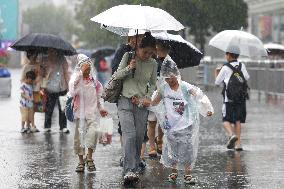
Travellers walk in the rain near Shanghai Railway Station in Shanghai, east China, July 30, 2025. Co-May, the eighth typhoon of this year, made landfall for the second time in east China's Shanghai Municipality on Wednesday afternoon after it made landfall in Zhejiang Province in early Wednesday morning, according to the Shanghai central meteorological observatory. The center of Typhoon Co-May (tropical storm level) made second landfall on the coast of Fengxian District, Shanghai around 4: 40 p.m. At the time of landfall, the maximum wind speed near the center was 23 meters per second, accompanied by a central minimum pressure of 978 hectopascals. Photo by Xinhua/Wang Xiang/ABACAPRESS.COM

  •  
Typhoon Co-May Makes Landfall in Eastern China

Typhoon Co-May Makes Landfall in Eastern China

Staff members check flood control facilities along the railway in Shanghai, east China, July 30, 2025. Co-May, the eighth typhoon of this year, made landfall for the second time in east China's Shanghai Municipality on Wednesday afternoon after it made landfall in Zhejiang Province in early Wednesday morning, according to the Shanghai central meteorological observatory. The center of Typhoon Co-May (tropical storm level) made second landfall on the coast of Fengxian District, Shanghai around 4: 40 p.m. At the time of landfall, the maximum wind speed near the center was 23 meters per second, accompanied by a central minimum pressure of 978 hectopascals. (Xinhua/ABACAPRESS.COM

  •  
Typhoon Co-May Makes Landfall in Eastern China

Typhoon Co-May Makes Landfall in Eastern China

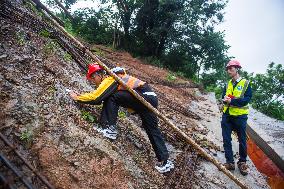
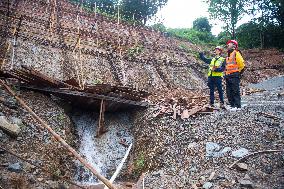
Staff members partrol at an area with high risk of geological disasters in Zhoushan City, east China's Zhejiang Province, July 30, 2025. Co-May, the eighth typhoon of this year, made landfall in east China's Zhejiang Province at about 4:30 a.m. Wednesday, according to the provincial meteorological observatory. The typhoon, with the maximum wind force near its center reaching 23 meters per second, churned ashore at Zhoushan City of Zhejiang. Photo by Xinhua/Jiang Han/ABACAPRESS.COM

  •  
Typhoon Co-May Makes Landfall in Eastern China

Typhoon Co-May Makes Landfall in Eastern China

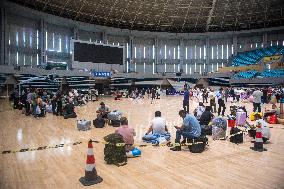
Locals take shelter at a stadium-turned relocation site in Zhoushan City, east China's Zhejiang Province, July 30, 2025. Co-May, the eighth typhoon of this year, made landfall in east China's Zhejiang Province at about 4:30 a.m. Wednesday, according to the provincial meteorological observatory. The typhoon, with the maximum wind force near its center reaching 23 meters per second, churned ashore at Zhoushan City of Zhejiang. Photo by Xinhua/Jiang Han/ABACAPRESS.COM

  •  
Typhoon Co-May Makes Landfall in Eastern China

Typhoon Co-May Makes Landfall in Eastern China

Staff members partrol at an area with high risk of geological disasters in Zhoushan City, east China's Zhejiang Province, July 30, 2025. Co-May, the eighth typhoon of this year, made landfall in east China's Zhejiang Province at about 4:30 a.m. Wednesday, according to the provincial meteorological observatory. The typhoon, with the maximum wind force near its center reaching 23 meters per second, churned ashore at Zhoushan City of Zhejiang. Photo by Xinhua/Jiang Han/ABACAPRESS.COM

  •  
Nomadic Life in Inner Mongolia's Horqin Grassland - China

Nomadic Life in Inner Mongolia's Horqin Grassland - China

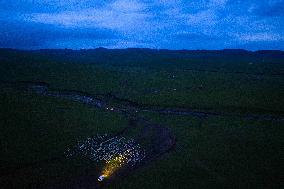
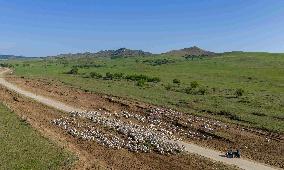
An aerial drone photo taken on June 14, 2025 shows herdsmen driving the livestock at night on the way to the summer campsite on Ar Horqin Grassland, Chifeng City of north China's Inner Mongolia Autonomous Region. Saintsogt, 55, a herdsman in Bayin-undur of Ar Horqin Banner, north China's Inner Mongolia Autonomous Region, is busy with the annual summer migration covering a distance of about 100 kilometers. For the past four decades, he has completed the migration every year. Saintsogt's pasture is a part of the Ar Horqin Grassland Nomadic System, which was listed as one of the Globally Important Agricultural Heritage Systems (GIAHS) sites by the United Nations Food and Agriculture Organization (FAO) on May 20, 2022. Herders here still keep the traditional nomadic customs today. "The travel time has been shortened to three days from eight," Saintsogt said. "The rain makes pasture grow better, and the livestock have enough forage." This year, herders from more than 1,200 households and 128,000 livestock in Bayin

  •  
Nomadic Life in Inner Mongolia's Horqin Grassland - China

Nomadic Life in Inner Mongolia's Horqin Grassland - China

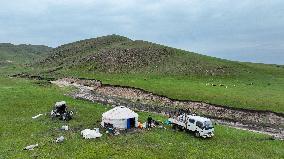
An aerial drone photo taken on June 15, 2025 shows a Mongolian yurt of Saintsogt at his summer campsite on Ar Horqin Grassland, Chifeng City of north China's Inner Mongolia Autonomous Region. Saintsogt, 55, a herdsman in Bayin-undur of Ar Horqin Banner, north China's Inner Mongolia Autonomous Region, is busy with the annual summer migration covering a distance of about 100 kilometers. For the past four decades, he has completed the migration every year. Saintsogt's pasture is a part of the Ar Horqin Grassland Nomadic System, which was listed as one of the Globally Important Agricultural Heritage Systems (GIAHS) sites by the United Nations Food and Agriculture Organization (FAO) on May 20, 2022. Herders here still keep the traditional nomadic customs today. "The travel time has been shortened to three days from eight," Saintsogt said. "The rain makes pasture grow better, and the livestock have enough forage." This year, herders from more than 1,200 households and 128,000 livestock in Bayin-undur joined the mig

  •  
Nomadic Life in Inner Mongolia's Horqin Grassland - China

Nomadic Life in Inner Mongolia's Horqin Grassland - China

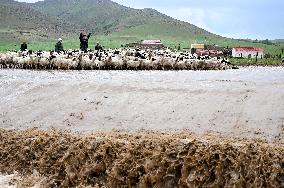
Saintsogt's son (2nd R) drives sheep in rain on his way to the summer campsite on Ar Horqin Grassland, Chifeng City of north China's Inner Mongolia Autonomous Region, June 13, 2025. Saintsogt, 55, a herdsman in Bayin-undur of Ar Horqin Banner, north China's Inner Mongolia Autonomous Region, is busy with the annual summer migration covering a distance of about 100 kilometers. For the past four decades, he has completed the migration every year. Saintsogt's pasture is a part of the Ar Horqin Grassland Nomadic System, which was listed as one of the Globally Important Agricultural Heritage Systems (GIAHS) sites by the United Nations Food and Agriculture Organization (FAO) on May 20, 2022. Herders here still keep the traditional nomadic customs today. "The travel time has been shortened to three days from eight," Saintsogt said. "The rain makes pasture grow better, and the livestock have enough forage." This year, herders from more than 1,200 households and 128,000 livestock in Bayin-undur joined the migration. Ph

  •  
Nomadic Life in Inner Mongolia's Horqin Grassland - China

Nomadic Life in Inner Mongolia's Horqin Grassland - China

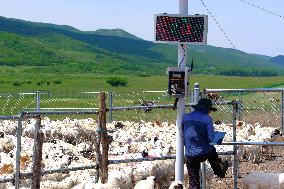
A staff member of Gogodtai Han Ul national nature reserve counts the livestock entering the nature reserve in north China's Inner Mongolia Autonomous Region, June 14, 2025. Saintsogt, 55, a herdsman in Bayin-undur of Ar Horqin Banner, north China's Inner Mongolia Autonomous Region, is busy with the annual summer migration covering a distance of about 100 kilometers. For the past four decades, he has completed the migration every year. Saintsogt's pasture is a part of the Ar Horqin Grassland Nomadic System, which was listed as one of the Globally Important Agricultural Heritage Systems (GIAHS) sites by the United Nations Food and Agriculture Organization (FAO) on May 20, 2022. Herders here still keep the traditional nomadic customs today. "The travel time has been shortened to three days from eight," Saintsogt said. "The rain makes pasture grow better, and the livestock have enough forage." This year, herders from more than 1,200 households and 128,000 livestock in Bayin-undur joined the migration. Photo by Ma

  •  
Nomadic Life in Inner Mongolia's Horqin Grassland - China

Nomadic Life in Inner Mongolia's Horqin Grassland - China

Saintsogt's son seeks for a sick sheep after arriving at the summer campsite on Ar Horqin Grassland, Chifeng City of north China's Inner Mongolia Autonomous Region, June 15, 2025. Saintsogt, 55, a herdsman in Bayin-undur of Ar Horqin Banner, north China's Inner Mongolia Autonomous Region, is busy with the annual summer migration covering a distance of about 100 kilometers. For the past four decades, he has completed the migration every year. Saintsogt's pasture is a part of the Ar Horqin Grassland Nomadic System, which was listed as one of the Globally Important Agricultural Heritage Systems (GIAHS) sites by the United Nations Food and Agriculture Organization (FAO) on May 20, 2022. Herders here still keep the traditional nomadic customs today. "The travel time has been shortened to three days from eight," Saintsogt said. "The rain makes pasture grow better, and the livestock have enough forage." This year, herders from more than 1,200 households and 128,000 livestock in Bayin-undur joined the migration. Phot

  •  
Nomadic Life in Inner Mongolia's Horqin Grassland - China

Nomadic Life in Inner Mongolia's Horqin Grassland - China

Saintsogt's wife arranges bedding at home before departing for the summer campsite on Ar Horqin Grassland, Chifeng City of north China's Inner Mongolia Autonomous Region, June 13, 2025. Saintsogt, 55, a herdsman in Bayin-undur of Ar Horqin Banner, north China's Inner Mongolia Autonomous Region, is busy with the annual summer migration covering a distance of about 100 kilometers. For the past four decades, he has completed the migration every year. Saintsogt's pasture is a part of the Ar Horqin Grassland Nomadic System, which was listed as one of the Globally Important Agricultural Heritage Systems (GIAHS) sites by the United Nations Food and Agriculture Organization (FAO) on May 20, 2022. Herders here still keep the traditional nomadic customs today. "The travel time has been shortened to three days from eight," Saintsogt said. "The rain makes pasture grow better, and the livestock have enough forage." This year, herders from more than 1,200 households and 128,000 livestock in Bayin-undur joined the migration

  •  
Nomadic Life in Inner Mongolia's Horqin Grassland - China

Nomadic Life in Inner Mongolia's Horqin Grassland - China

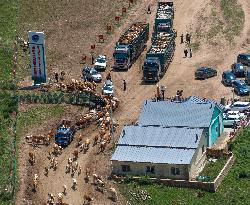
An aerial drone photo taken on June 14, 2025 shows herders waiting for entering the Gogodtai Han Ul national nature reserve in north China's Inner Mongolia Autonomous Region. Saintsogt, 55, a herdsman in Bayin-undur of Ar Horqin Banner, north China's Inner Mongolia Autonomous Region, is busy with the annual summer migration covering a distance of about 100 kilometers. For the past four decades, he has completed the migration every year. Saintsogt's pasture is a part of the Ar Horqin Grassland Nomadic System, which was listed as one of the Globally Important Agricultural Heritage Systems (GIAHS) sites by the United Nations Food and Agriculture Organization (FAO) on May 20, 2022. Herders here still keep the traditional nomadic customs today. "The travel time has been shortened to three days from eight," Saintsogt said. "The rain makes pasture grow better, and the livestock have enough forage." This year, herders from more than 1,200 households and 128,000 livestock in Bayin-undur joined the migration. Photo by

  •  
Nomadic Life in Inner Mongolia's Horqin Grassland - China

Nomadic Life in Inner Mongolia's Horqin Grassland - China

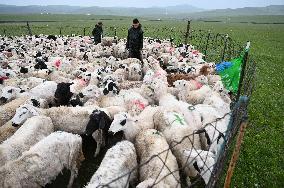
Saintsogt gathers the livestock at the winter campsite before departing for the summer campsite on Ar Horqin Grassland, Chifeng City of north China's Inner Mongolia Autonomous Region, June 13, 2025. Saintsogt, 55, a herdsman in Bayin-undur of Ar Horqin Banner, north China's Inner Mongolia Autonomous Region, is busy with the annual summer migration covering a distance of about 100 kilometers. For the past four decades, he has completed the migration every year. Saintsogt's pasture is a part of the Ar Horqin Grassland Nomadic System, which was listed as one of the Globally Important Agricultural Heritage Systems (GIAHS) sites by the United Nations Food and Agriculture Organization (FAO) on May 20, 2022. Herders here still keep the traditional nomadic customs today. "The travel time has been shortened to three days from eight," Saintsogt said. "The rain makes pasture grow better, and the livestock have enough forage." This year, herders from more than 1,200 households and 128,000 livestock in Bayin-undur joined

  •  
Nomadic Life in Inner Mongolia's Horqin Grassland - China

Nomadic Life in Inner Mongolia's Horqin Grassland - China

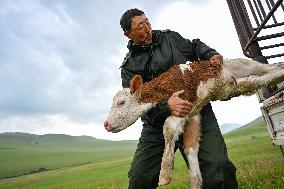
Saintsogt takes a newly born calf off the truck after arriving at the summer campsite on Ar Horqin Grassland, Chifeng City of north China's Inner Mongolia Autonomous Region, June 15, 2025. Saintsogt, 55, a herdsman in Bayin-undur of Ar Horqin Banner, north China's Inner Mongolia Autonomous Region, is busy with the annual summer migration covering a distance of about 100 kilometers. For the past four decades, he has completed the migration every year. Saintsogt's pasture is a part of the Ar Horqin Grassland Nomadic System, which was listed as one of the Globally Important Agricultural Heritage Systems (GIAHS) sites by the United Nations Food and Agriculture Organization (FAO) on May 20, 2022. Herders here still keep the traditional nomadic customs today. "The travel time has been shortened to three days from eight," Saintsogt said. "The rain makes pasture grow better, and the livestock have enough forage." This year, herders from more than 1,200 households and 128,000 livestock in Bayin-undur joined the migrat

  •  
Nomadic Life in Inner Mongolia's Horqin Grassland - China

Nomadic Life in Inner Mongolia's Horqin Grassland - China

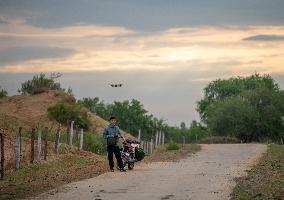
Saintsogt's son operates a drone to check the number of the livestock on Ar Horqin Grassland, Chifeng City of north China's Inner Mongolia Autonomous Region, June 13, 2025. Saintsogt, 55, a herdsman in Bayin-undur of Ar Horqin Banner, north China's Inner Mongolia Autonomous Region, is busy with the annual summer migration covering a distance of about 100 kilometers. For the past four decades, he has completed the migration every year. Saintsogt's pasture is a part of the Ar Horqin Grassland Nomadic System, which was listed as one of the Globally Important Agricultural Heritage Systems (GIAHS) sites by the United Nations Food and Agriculture Organization (FAO) on May 20, 2022. Herders here still keep the traditional nomadic customs today. "The travel time has been shortened to three days from eight," Saintsogt said. "The rain makes pasture grow better, and the livestock have enough forage." This year, herders from more than 1,200 households and 128,000 livestock in Bayin-undur joined the migration. Photo by Ma

  •  
Nomadic Life in Inner Mongolia's Horqin Grassland - China

Nomadic Life in Inner Mongolia's Horqin Grassland - China

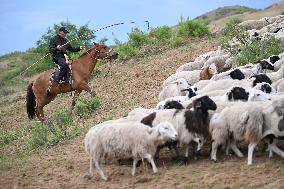
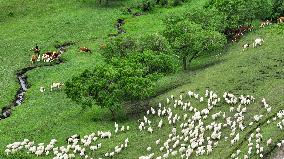
An aerial drone photo taken on June 14, 2025 shows Saintsogt driving the livestock on his way to the summer campsite on Ar Horqin Grassland, Chifeng City of north China's Inner Mongolia Autonomous Region. Saintsogt, 55, a herdsman in Bayin-undur of Ar Horqin Banner, north China's Inner Mongolia Autonomous Region, is busy with the annual summer migration covering a distance of about 100 kilometers. For the past four decades, he has completed the migration every year. Saintsogt's pasture is a part of the Ar Horqin Grassland Nomadic System, which was listed as one of the Globally Important Agricultural Heritage Systems (GIAHS) sites by the United Nations Food and Agriculture Organization (FAO) on May 20, 2022. Herders here still keep the traditional nomadic customs today. "The travel time has been shortened to three days from eight," Saintsogt said. "The rain makes pasture grow better, and the livestock have enough forage." This year, herders from more than 1,200 households and 128,000 livestock in Bayin-undur j

  •  
Nomadic Life in Inner Mongolia's Horqin Grassland - China

Nomadic Life in Inner Mongolia's Horqin Grassland - China

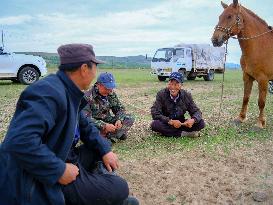
Saintsogt (R) talks with other herdsmen on their way to the summer campsite on Ar Horqin Grassland, Chifeng City of north China's Inner Mongolia Autonomous Region, June 13, 2025. Saintsogt, 55, a herdsman in Bayin-undur of Ar Horqin Banner, north China's Inner Mongolia Autonomous Region, is busy with the annual summer migration covering a distance of about 100 kilometers. For the past four decades, he has completed the migration every year. Saintsogt's pasture is a part of the Ar Horqin Grassland Nomadic System, which was listed as one of the Globally Important Agricultural Heritage Systems (GIAHS) sites by the United Nations Food and Agriculture Organization (FAO) on May 20, 2022. Herders here still keep the traditional nomadic customs today. "The travel time has been shortened to three days from eight," Saintsogt said. "The rain makes pasture grow better, and the livestock have enough forage." This year, herders from more than 1,200 households and 128,000 livestock in Bayin-undur joined the migration. Photo

  •  
Nomadic Life in Inner Mongolia's Horqin Grassland - China

Nomadic Life in Inner Mongolia's Horqin Grassland - China

Saintsogt gathers the livestock at their winter campsite before departing for the summer campsite on Ar Horqin Grassland, Chifeng City of north China's Inner Mongolia Autonomous Region, June 13, 2025. Saintsogt, 55, a herdsman in Bayin-undur of Ar Horqin Banner, north China's Inner Mongolia Autonomous Region, is busy with the annual summer migration covering a distance of about 100 kilometers. For the past four decades, he has completed the migration every year. Saintsogt's pasture is a part of the Ar Horqin Grassland Nomadic System, which was listed as one of the Globally Important Agricultural Heritage Systems (GIAHS) sites by the United Nations Food and Agriculture Organization (FAO) on May 20, 2022. Herders here still keep the traditional nomadic customs today. "The travel time has been shortened to three days from eight," Saintsogt said. "The rain makes pasture grow better, and the livestock have enough forage." This year, herders from more than 1,200 households and 128,000 livestock in Bayin-undur joine

  •  
Nomadic Life in Inner Mongolia's Horqin Grassland - China

Nomadic Life in Inner Mongolia's Horqin Grassland - China

An aerial drone photo shows Saintsogt's son (L) riding a motorcycle to drive the livestock on his way to the summer campsite on Ar Horqin Grassland, Chifeng City of north China's Inner Mongolia Autonomous Region, June 14, 2025. Saintsogt, 55, a herdsman in Bayin-undur of Ar Horqin Banner, north China's Inner Mongolia Autonomous Region, is busy with the annual summer migration covering a distance of about 100 kilometers. For the past four decades, he has completed the migration every year. Saintsogt's pasture is a part of the Ar Horqin Grassland Nomadic System, which was listed as one of the Globally Important Agricultural Heritage Systems (GIAHS) sites by the United Nations Food and Agriculture Organization (FAO) on May 20, 2022. Herders here still keep the traditional nomadic customs today. "The travel time has been shortened to three days from eight," Saintsogt said. "The rain makes pasture grow better, and the livestock have enough forage." This year, herders from more than 1,200 households and 128,000 liv

  •  
Nomadic Life in Inner Mongolia's Horqin Grassland - China

Nomadic Life in Inner Mongolia's Horqin Grassland - China

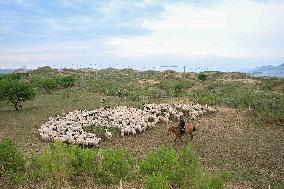
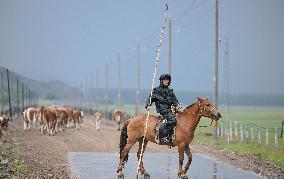
Saintsogt drives cattle in the rain on his way to the summer campsite on Ar Horqin Grassland, Chifeng City of north China's Inner Mongolia Autonomous Region, June 13, 2025. Saintsogt, 55, a herdsman in Bayin-undur of Ar Horqin Banner, north China's Inner Mongolia Autonomous Region, is busy with the annual summer migration covering a distance of about 100 kilometers. For the past four decades, he has completed the migration every year. Saintsogt's pasture is a part of the Ar Horqin Grassland Nomadic System, which was listed as one of the Globally Important Agricultural Heritage Systems (GIAHS) sites by the United Nations Food and Agriculture Organization (FAO) on May 20, 2022. Herders here still keep the traditional nomadic customs today. "The travel time has been shortened to three days from eight," Saintsogt said. "The rain makes pasture grow better, and the livestock have enough forage." This year, herders from more than 1,200 households and 128,000 livestock in Bayin-undur joined the migration. Photo by Be

  •  
Nomadic Life in Inner Mongolia's Horqin Grassland - China

Nomadic Life in Inner Mongolia's Horqin Grassland - China

Saintsogt hugs a newly born calf on his way to the summer campsite on Ar Horqin Grassland, Chifeng City of north China's Inner Mongolia Autonomous Region, June 14, 2025. Saintsogt, 55, a herdsman in Bayin-undur of Ar Horqin Banner, north China's Inner Mongolia Autonomous Region, is busy with the annual summer migration covering a distance of about 100 kilometers. For the past four decades, he has completed the migration every year. Saintsogt's pasture is a part of the Ar Horqin Grassland Nomadic System, which was listed as one of the Globally Important Agricultural Heritage Systems (GIAHS) sites by the United Nations Food and Agriculture Organization (FAO) on May 20, 2022. Herders here still keep the traditional nomadic customs today. "The travel time has been shortened to three days from eight," Saintsogt said. "The rain makes pasture grow better, and the livestock have enough forage." This year, herders from more than 1,200 households and 128,000 livestock in Bayin-undur joined the migration. Photo by Bei H

  •  
Nomadic Life in Inner Mongolia's Horqin Grassland - China

Nomadic Life in Inner Mongolia's Horqin Grassland - China

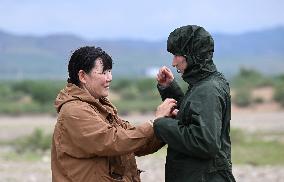
Saintsogt's wife (L) helps her son to wear a raincoat on their way to the summer campsite on Ar Horqin Grassland, Chifeng City of north China's Inner Mongolia Autonomous Region, June 13, 2025. Saintsogt, 55, a herdsman in Bayin-undur of Ar Horqin Banner, north China's Inner Mongolia Autonomous Region, is busy with the annual summer migration covering a distance of about 100 kilometers. For the past four decades, he has completed the migration every year. Saintsogt's pasture is a part of the Ar Horqin Grassland Nomadic System, which was listed as one of the Globally Important Agricultural Heritage Systems (GIAHS) sites by the United Nations Food and Agriculture Organization (FAO) on May 20, 2022. Herders here still keep the traditional nomadic customs today. "The travel time has been shortened to three days from eight," Saintsogt said. "The rain makes pasture grow better, and the livestock have enough forage." This year, herders from more than 1,200 households and 128,000 livestock in Bayin-undur joined the mi

  •  
Nomadic Life in Inner Mongolia's Horqin Grassland - China

Nomadic Life in Inner Mongolia's Horqin Grassland - China

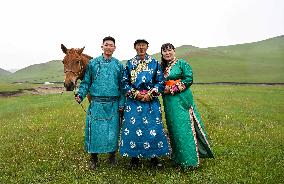
Saintsogt (C), his wife (R) and son pose for a group photo at their summer campsite on Ar Horqin Grassland, Chifeng City of north China's Inner Mongolia Autonomous Region, June 15, 2025. Saintsogt, 55, a herdsman in Bayin-undur of Ar Horqin Banner, north China's Inner Mongolia Autonomous Region, is busy with the annual summer migration covering a distance of about 100 kilometers. For the past four decades, he has completed the migration every year. Saintsogt's pasture is a part of the Ar Horqin Grassland Nomadic System, which was listed as one of the Globally Important Agricultural Heritage Systems (GIAHS) sites by the United Nations Food and Agriculture Organization (FAO) on May 20, 2022. Herders here still keep the traditional nomadic customs today. "The travel time has been shortened to three days from eight," Saintsogt said. "The rain makes pasture grow better, and the livestock have enough forage." This year, herders from more than 1,200 households and 128,000 livestock in Bayin-undur joined the migratio

  •  

US: SpaceX Launches Starship on Ninth Test Mission From Texas 3

Elon Musk’s Starship rocket launched for its 9th test flight from Texas on Tuesday, May 27, but lost control mid-flight due to a leak, making a safe landing unlikely, according to SpaceX. The Super Heavy booster carried Starship toward space, where it flew for under an hour before issues arose. A payload door also failed to open, preventing the release of dummy satellites. The flight followed previous high-altitude failures earlier this year.

  •  
Dragon Boat Festival Across China

Dragon Boat Festival Across China

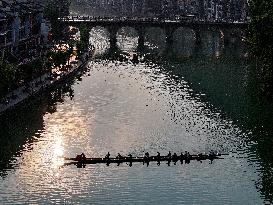
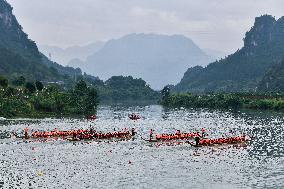
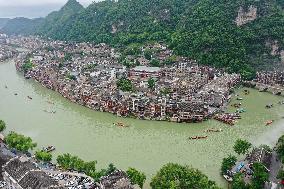
Locals row a dragon boat in Zhenyuan ancient town in Qiandongnan Miao and Dong Autonomous Prefecture in southwest China's Guizhou Province, May 20, 2025. Zhenyuan boasts a 22-century-long tradition of dragon boat races, and the county is also well noted for the large sizes and intricate decorations of its dragon boats. The dragon boat racing in Zhenyuan was inscribed in the third batch of China's national intangible cultural heritage list in 2011. Dragon Boat Festival, also known as Duanwu Festival, falls on the fifth day of the fifth month in the Chinese lunar calendar. It is celebrated on May 31 this year. Photo by Ou Dongqu/Xinhua/ABACAPRESS.COM

  •  
Dragon Boat Festival Across China

Dragon Boat Festival Across China

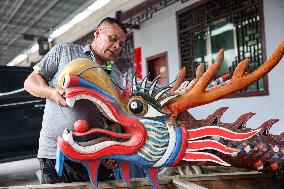
Craftsman Li Qifa checks the newly assembled dragon head for a dragon boat in Zhenyuan ancient town in Qiandongnan Miao and Dong Autonomous Prefecture in southwest China's Guizhou Province, May 20, 2025. Zhenyuan boasts a 22-century-long tradition of dragon boat races, and the county is also well noted for the large sizes and intricate decorations of its dragon boats. The dragon boat racing in Zhenyuan was inscribed in the third batch of China's national intangible cultural heritage list in 2011. Dragon Boat Festival, also known as Duanwu Festival, falls on the fifth day of the fifth month in the Chinese lunar calendar. It is celebrated on May 31 this year. Photo by Ou Dongqu/Xinhua/ABACAPRESS.COM

  •  
Dragon Boat Festival Across China

Dragon Boat Festival Across China

Craftsman Li Qifa carves the dragon tail for a dragon boat in Zhenyuan ancient town in Qiandongnan Miao and Dong Autonomous Prefecture in southwest China's Guizhou Province, May 20, 2025. Zhenyuan boasts a 22-century-long tradition of dragon boat races, and the county is also well noted for the large sizes and intricate decorations of its dragon boats. The dragon boat racing in Zhenyuan was inscribed in the third batch of China's national intangible cultural heritage list in 2011. Dragon Boat Festival, also known as Duanwu Festival, falls on the fifth day of the fifth month in the Chinese lunar calendar. It is celebrated on May 31 this year. Photo by Ou Dongqu/Xinhua/ABACAPRESS.COM

  •  
Dragon Boat Festival Across China

Dragon Boat Festival Across China

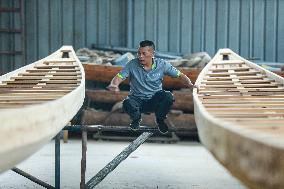
Craftsman Li Qifa checks partially assembled dragon boats in Zhenyuan ancient town in Qiandongnan Miao and Dong Autonomous Prefecture in southwest China's Guizhou Province, May 20, 2025. Zhenyuan boasts a 22-century-long tradition of dragon boat races, and the county is also well noted for the large sizes and intricate decorations of its dragon boats. The dragon boat racing in Zhenyuan was inscribed in the third batch of China's national intangible cultural heritage list in 2011. Dragon Boat Festival, also known as Duanwu Festival, falls on the fifth day of the fifth month in the Chinese lunar calendar. It is celebrated on May 31 this year. Photo by Ou Dongqu/Xinhua/ABACAPRESS.COM

  •  
Dragon Boat Festival Across China

Dragon Boat Festival Across China

An aerial drone photo shows locals rowing a dragon boat in Zhenyuan ancient town in Qiandongnan Miao and Dong Autonomous Prefecture in southwest China's Guizhou Province, May 20, 2025. Zhenyuan boasts a 22-century-long tradition of dragon boat races, and the county is also well noted for the large sizes and intricate decorations of its dragon boats. The dragon boat racing in Zhenyuan was inscribed in the third batch of China's national intangible cultural heritage list in 2011. Dragon Boat Festival, also known as Duanwu Festival, falls on the fifth day of the fifth month in the Chinese lunar calendar. It is celebrated on May 31 this year. Photo by Ou Dongqu/Xinhua/ABACAPRESS.COM

  •  
Dragon Boat Festival Across China

Dragon Boat Festival Across China

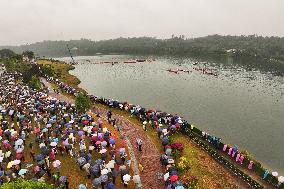
Teams from Beijing-based colleges compete in a dragon boat race on a lake at Yuanmingyuan Park in Beijing, capital of China, on May 31, 2025. The Dragon Boat Festival, also known as Duanwu Festival, is a traditional Chinese holiday to commemorate ancient Chinese poet Qu Yuan from the Warring States Period 475-221 B.C.). Celebrated on the fifth day of the fifth month of the Chinese lunar calendar, the festival falls on May 31 this year. Photo by Luo Xiaoguang/Xinhua/ABACAPRESS.COM

  •  
Dragon Boat Festival Across China

Dragon Boat Festival Across China

Teams compete in a dragon boat race on waters of a park in Lhasa, southwest China's Xizang Autonomous Region, on May 31, 2025. The Dragon Boat Festival, also known as Duanwu Festival, is a traditional Chinese holiday to commemorate ancient Chinese poet Qu Yuan from the Warring States Period 475-221 B.C.). Celebrated on the fifth day of the fifth month of the Chinese lunar calendar, the festival falls on May 31 this year. Photo by Jigme Dorge/Xinhua/ABACAPRESS.COM

  •  
Dragon Boat Festival Across China

Dragon Boat Festival Across China

An aerial drone photo taken on May 31, 2025 shows teams compete in a dragon boat race on the Songhua River in Harbin, northeast China's Heilongjiang Province. The Dragon Boat Festival, also known as Duanwu Festival, is a traditional Chinese holiday to commemorate ancient Chinese poet Qu Yuan from the Warring States Period 475-221 B.C.). Celebrated on the fifth day of the fifth month of the Chinese lunar calendar, the festival falls on May 31 this year. Photo by Zhang Tao/Xinhua/ABACAPRESS.COM

  •  
Dragon Boat Festival Across China

Dragon Boat Festival Across China

An aerial drone photo shows locals rowing a dragon boat in Zhenyuan ancient town in Qiandongnan Miao and Dong Autonomous Prefecture in southwest China's Guizhou Province, May 20, 2025. Zhenyuan boasts a 22-century-long tradition of dragon boat races, and the county is also well noted for the large sizes and intricate decorations of its dragon boats. The dragon boat racing in Zhenyuan was inscribed in the third batch of China's national intangible cultural heritage list in 2011. Dragon Boat Festival, also known as Duanwu Festival, falls on the fifth day of the fifth month in the Chinese lunar calendar. It is celebrated on May 31 this year. Photo by Ou Dongqu/Xinhua/ABACAPRESS.COM

  •  
Dragon Boat Festival Across China

Dragon Boat Festival Across China

Teams compete in a dragon boat race on the Jinjiang River in Bijiang District of Tongren city, southwest China's Guizhou Province, on May 31, 2025. The Dragon Boat Festival, also known as Duanwu Festival, is a traditional Chinese holiday to commemorate ancient Chinese poet Qu Yuan from the Warring States Period 475-221 B.C.). Celebrated on the fifth day of the fifth month of the Chinese lunar calendar, the festival falls on May 31 this year. Photo by Yang Wenbin/Xinhua/ABACAPRESS.COM

  •  
Dragon Boat Festival Across China

Dragon Boat Festival Across China

Teams from Beijing-based colleges compete in a dragon boat race on a lake at Yuanmingyuan Park in Beijing, capital of China, on May 31, 2025. The Dragon Boat Festival, also known as Duanwu Festival, is a traditional Chinese holiday to commemorate ancient Chinese poet Qu Yuan from the Warring States Period 475-221 B.C.). Celebrated on the fifth day of the fifth month of the Chinese lunar calendar, the festival falls on May 31 this year. Photo by Luo Xiaoguang/Xinhua/ABACAPRESS.COM

  •  
Dragon Boat Festival Across China

Dragon Boat Festival Across China

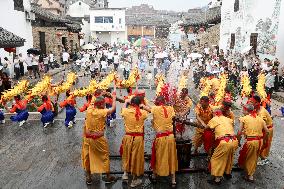
Villagers stage a traditional folk performance for tourists during a celebration of the Dragon Boat Festival in Tonglu County of Hangzhou City, east China's Zhejiang Province, on May 31, 2025. The Dragon Boat Festival, also known as Duanwu Festival, is a traditional Chinese holiday to commemorate ancient Chinese poet Qu Yuan from the Warring States Period 475-221 B.C.). Celebrated on the fifth day of the fifth month of the Chinese lunar calendar, the festival falls on May 31 this year. Photo by Xu Junyong/Xinhua/ABACAPRESS.COM

  •  
Dragon Boat Festival Across China

Dragon Boat Festival Across China

Teams compete in a dragon boat race on the Jinjiang River in Bijiang District of Tongren city, southwest China's Guizhou Province, on May 31, 2025. The Dragon Boat Festival, also known as Duanwu Festival, is a traditional Chinese holiday to commemorate ancient Chinese poet Qu Yuan from the Warring States Period 475-221 B.C.). Celebrated on the fifth day of the fifth month of the Chinese lunar calendar, the festival falls on May 31 this year. Photo by Yang Wenbin/Xinhua/ABACAPRESS.COM

  •  
Dragon Boat Festival Across China

Dragon Boat Festival Across China

An aerial drone photo taken on May 31, 2025 shows teams competing in a dragon boat race at Longnv Lake by Jialing River in Wusheng County, Guang'an City, southwest China's Sichuan Province. The Dragon Boat Festival, also known as Duanwu Festival, is a traditional Chinese holiday to commemorate ancient Chinese poet Qu Yuan from the Warring States Period 475-221 B.C.). Celebrated on the fifth day of the fifth month of the Chinese lunar calendar, the festival falls on May 31 this year. Photo by Xia Junlin/Xinhua/ABACAPRESS.COM

  •  
Dragon Boat Festival Across China

Dragon Boat Festival Across China

Teams compete in a dragon boat race on the Jinjiang River in Bijiang District of Tongren city, southwest China's Guizhou Province, on May 31, 2025. The Dragon Boat Festival, also known as Duanwu Festival, is a traditional Chinese holiday to commemorate ancient Chinese poet Qu Yuan from the Warring States Period 475-221 B.C.). Celebrated on the fifth day of the fifth month of the Chinese lunar calendar, the festival falls on May 31 this year. Photo by Yang Wenbin/Xinhua/ABACAPRESS.COM

  •  
Dragon Boat Festival Across China

Dragon Boat Festival Across China

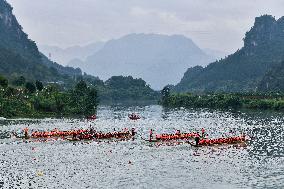
An aerial drone photo taken on May 31, 2025 shows dragon boat teams rallied on the Wuyang River in Zhenyuan County of Qiandongnan Miao and Dong Autonomous Prefecture, southwest China's Guizhou Province. The Dragon Boat Festival, also known as Duanwu Festival, is a traditional Chinese holiday to commemorate ancient Chinese poet Qu Yuan from the Warring States Period 475-221 B.C.). Celebrated on the fifth day of the fifth month of the Chinese lunar calendar, the festival falls on May 31 this year. Photo by Yuan Fuhong/Xinhua/ABACAPRESS.COM

  •  
Dragon Boat Festival Across China

Dragon Boat Festival Across China

A boy shows an artwork with a dragon boat pattern on it in Tancheng County, Linyi City, east China's Shandong Province, on May 31, 2025. The Dragon Boat Festival, also known as Duanwu Festival, is a traditional Chinese holiday to commemorate ancient Chinese poet Qu Yuan from the Warring States Period 475-221 B.C.). Celebrated on the fifth day of the fifth month of the Chinese lunar calendar, the festival falls on May 31 this year. Photo by Zhang Chunlei/Xinhua/ABACAPRESS.COM

  •  
Dragon Boat Festival Across China

Dragon Boat Festival Across China

This photo taken on May 31, 2025 shows a scene during Haihe Dragon Boat Race, held in north China's Tianjin. The Dragon Boat Festival, also known as Duanwu Festival, is a traditional Chinese holiday to commemorate ancient Chinese poet Qu Yuan from the Warring States Period 475-221 B.C.). Celebrated on the fifth day of the fifth month of the Chinese lunar calendar, the festival falls on May 31 this year. Photo by Du Penghui/Xinhua/ABACAPRESS.COM

  •  
Dragon Boat Festival Across China

Dragon Boat Festival Across China

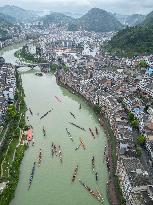
An aerial drone photo shows locals rowing dragon boats in Zhenyuan ancient town in Qiandongnan Miao and Dong Autonomous Prefecture in southwest China's Guizhou Province, May 31, 2025. Zhenyuan boasts a 22-century-long tradition of dragon boat races, and the county is also well noted for the large sizes and intricate decorations of its dragon boats. The dragon boat racing in Zhenyuan was inscribed in the third batch of China's national intangible cultural heritage list in 2011. Dragon Boat Festival, also known as Duanwu Festival, falls on the fifth day of the fifth month in the Chinese lunar calendar. It is celebrated on May 31 this year. Photo by Yu Tianying/Xinhua/ABACAPRESS.COM

  •  
Dragon Boat Festival Across China

Dragon Boat Festival Across China

Children learn to make zongzi, a traditional Chinese food to mark the Dragon Boat Festival, under the guidance of their teacher at a kindergarten in Xiamen City, southeast China's Fujian Province, on May 30, 2025. The Dragon Boat Festival, also known as Duanwu Festival, is a traditional Chinese holiday to commemorate ancient Chinese poet Qu Yuan from the Warring States Period 475-221 B.C.). Celebrated on the fifth day of the fifth month of the Chinese lunar calendar, the festival falls on May 31 this year. Photo by Zeng Demeng/Xinhua/ABACAPRESS.COM

  •  
Dragon Boat Festival Across China

Dragon Boat Festival Across China

Locals row a dragon boat in Zhenyuan ancient town in Qiandongnan Miao and Dong Autonomous Prefecture in southwest China's Guizhou Province, May 20, 2025. Zhenyuan boasts a 22-century-long tradition of dragon boat races, and the county is also well noted for the large sizes and intricate decorations of its dragon boats. The dragon boat racing in Zhenyuan was inscribed in the third batch of China's national intangible cultural heritage list in 2011. Dragon Boat Festival, also known as Duanwu Festival, falls on the fifth day of the fifth month in the Chinese lunar calendar. It is celebrated on May 31 this year. Photo by Ou Dongqu/Xinhua/ABACAPRESS.COM

  •  
Dragon Boat Festival Across China

Dragon Boat Festival Across China

Locals row dragon boats in Zhenyuan ancient town in Qiandongnan Miao and Dong Autonomous Prefecture in southwest China's Guizhou Province, May 31, 2025. Zhenyuan boasts a 22-century-long tradition of dragon boat races, and the county is also well noted for the large sizes and intricate decorations of its dragon boats. The dragon boat racing in Zhenyuan was inscribed in the third batch of China's national intangible cultural heritage list in 2011. Dragon Boat Festival, also known as Duanwu Festival, falls on the fifth day of the fifth month in the Chinese lunar calendar. It is celebrated on May 31 this year. Photo by Yuan Hongfu/Xinhua/ABACAPRESS.COM

  •  
Dragon Boat Festival Across China

Dragon Boat Festival Across China

An aerial drone photo shows local people rowing a dragon boat in Zhenyuan ancient town in Qiandongnan Miao and Dong Autonomous Prefecture in southwest China's Guizhou Province, May 20, 2025. Zhenyuan boasts a 22-century-long tradition of dragon boat races, and the county is also well noted for the large sizes and intricate decorations of its dragon boats. The dragon boat racing in Zhenyuan was inscribed in the third batch of China's national intangible cultural heritage list in 2011. Dragon Boat Festival, also known as Duanwu Festival, falls on the fifth day of the fifth month in the Chinese lunar calendar. It is celebrated on May 31 this year. Photo by Ou Dongqu/Xinhua/ABACAPRESS.COM

  •  
Dragon Boat Festival Across China

Dragon Boat Festival Across China

An aerial drone photo shows locals rowing dragon boats in Zhenyuan ancient town in Qiandongnan Miao and Dong Autonomous Prefecture in southwest China's Guizhou Province, May 31, 2025. Zhenyuan boasts a 22-century-long tradition of dragon boat races, and the county is also well noted for the large sizes and intricate decorations of its dragon boats. The dragon boat racing in Zhenyuan was inscribed in the third batch of China's national intangible cultural heritage list in 2011. Dragon Boat Festival, also known as Duanwu Festival, falls on the fifth day of the fifth month in the Chinese lunar calendar. It is celebrated on May 31 this year. Photo by Yuan Fuhong/Xinhua/ABACAPRESS.COM

  • Main
  • Top
  • Editorial
  • Creative
  • About Us
  • About ILG
  • Terms of use
  • Company
  • BEHIND
  • Price List
  • Single Plan
  • Monthly Plan
  • Services
  • Shooting
  • Rights Clearance
  • Support
  • FAQ
  • How To Buy
  • Contact Us
  • Become a Partner

© KYODO NEWS IMAGES INC

All Rights Reserved.

  • Editorial
  • Olympics
  • News
  • Sports
  • Japan
  • Tech
  • Royal
  • Disaster
  • NorthKorea
  • Old Japan
  • SNS

  • Creative
  • Food
  • Japan
  • Landscape
  • Animal
  • Popular
  • #Ukraine
  • #Russia
  • #coronavirus
  • #N. Korea
  • #China
  • #Thailand
  • #Ukraine
  • #Russia
  • #coronavirus
  • #N. Korea
  • #China
  • #Thailand
  • Food
  • Japan
  • Landscape
  • Animal
  • Olympics
  • News
  • Sports
  • Japan
  • Tech
  • Royal
  • Disaster
  • NorthKorea
  • Old Japan
  • SNS