•  

Japan to start ocean discharge of Fukushima nuke wastewater Thursday

STORY: Japan to start ocean discharge of Fukushima nuke wastewater Thursday DATELINE: Aug. 22, 2023 LENGTH: 00:00:51 LOCATION: Tokyo CATEGORY: ENVIRONMENT/SOCIETY SHOTLIST: 1. various of Fukushima Daiichi nuclear power plant 2. various of people opposing 3. various of Fukushima Daiichi nuclear power plant and local fishermen STORYLINE: The Japanese government announced Tuesday it has decided to start releasing nuclear-contaminated wastewater from the crippled Fukushima Daiichi Nuclear Power Plant into the ocean on Thursday. The decision was made amid strong opposition from neighboring and Pacific island countries, as well as local fishermen over the irreversible impacts on the marine environment and public health. The Fukushima Daiichi nuclear power plant, hit by a magnitude-9.0 earthquake and an ensuing tsunami on March 11, 2011, suffered core meltdowns that released radiation. In April 2021, the Japanese government announced its controversial plan to release nuclear-contaminated water from the facilit

  •  

Japanese rally against ocean discharge of nuclear-contaminated wastewater

STORY: Japanese rally against ocean discharge of nuclear-contaminated wastewater DATELINE: Aug. 19, 2023 LENGTH: 0:01:52 LOCATION: Tokyo CATEGORY: ENVIRONMENT/SOCIETY SHOTLIST: 1 various of the rally 2 various of the crippled Fukushima Daiichi Nuclear Power Plant STORYLINE: As the Japanese government approaches a decision on the specific date for the discharge of nuclear-contaminated water from the crippled Fukushima Daiichi Nuclear Power Plant into the ocean, hundreds of Japanese gathered in central Tokyo on Friday to rally against the discharge plan. Despite scorching temperatures exceeding 35 degrees Celsius, people from various parts of Japan braved the heat to gather in front of the Japanese prime minister's official residence, urging the government to uphold its promise of "no disposal without the understanding of relevant parties." Hit by a magnitude-9.0 earthquake and an ensuing tsunami on March 11, 2011, the Fukushima Daiichi nuclear power plant suffered core meltdowns that released radiation, r

  •  
(FOCUS)JAPAN-FUKUSHIMA-NUCLEAR-CONTAMINATED WASTEWATER

(FOCUS)JAPAN-FUKUSHIMA-NUCLEAR-CONTAMINATED WASTEWATER

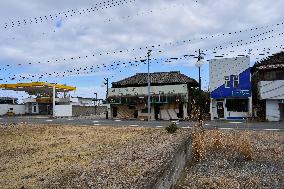
(230313) -- FUKUSHIMA, March 13, 2023 (Xinhua) -- This photo taken on March 6, 2023 shows abandoned houses in Futabacho, Futabagun of Fukushima Prefecture in Japan. Struck by a magnitude-9.0 earthquake and ensuing tsunami that hit Japan's northeast on March 11, 2011, the power plant suffered core meltdowns, resulting in a level-7 nuclear accident, the highest on the International Nuclear and Radiological Event Scale. Twelve years after the 2011 accident traumatized Fukushima's fishing industry, local fishermen are still struggling for recovery. As Japan pushes ahead with dumping tons of contaminated nuclear wastewater from the wrecked Fukushima Daiichi nuclear power plant into the Pacific Ocean in spring or summer, local residents, especially those in the fishing industry, believe their livelihoods would again be devastated. (Xinhua/Zhang Xiaoyu)

  •  
(FOCUS)JAPAN-FUKUSHIMA-NUCLEAR-CONTAMINATED WASTEWATER

(FOCUS)JAPAN-FUKUSHIMA-NUCLEAR-CONTAMINATED WASTEWATER

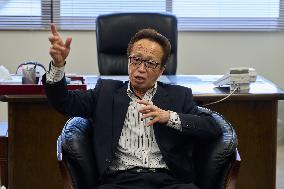
(230313) -- FUKUSHIMA, March 13, 2023 (Xinhua) -- Toshimitsu Konno, head of Fukushima prefecture's Soma Futaba Fisheries Cooperative Association, gives an interview in Soma City, Fukushima Prefecture, Japan, March 8, 2023. Struck by a magnitude-9.0 earthquake and ensuing tsunami that hit Japan's northeast on March 11, 2011, the power plant suffered core meltdowns, resulting in a level-7 nuclear accident, the highest on the International Nuclear and Radiological Event Scale. Twelve years after the 2011 accident traumatized Fukushima's fishing industry, local fishermen are still struggling for recovery. As Japan pushes ahead with dumping tons of contaminated nuclear wastewater from the wrecked Fukushima Daiichi nuclear power plant into the Pacific Ocean in spring or summer, local residents, especially those in the fishing industry, believe their livelihoods would again be devastated. (Xinhua/Zhang Xiaoyu)

  •  
(FOCUS)JAPAN-FUKUSHIMA-NUCLEAR-CONTAMINATED WASTEWATER

(FOCUS)JAPAN-FUKUSHIMA-NUCLEAR-CONTAMINATED WASTEWATER

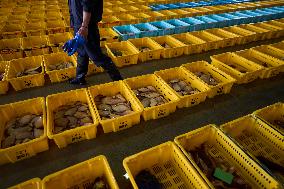
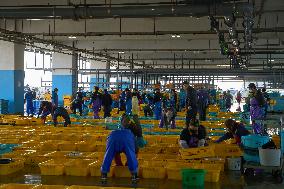
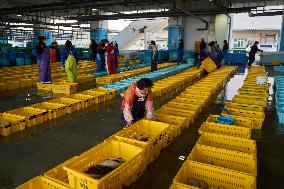
(230313) -- FUKUSHIMA, March 13, 2023 (Xinhua) -- This photo taken on March 8, 2023 shows freshly caught fish at a fish market in Soma City, Fukushima Prefecture, Japan. Struck by a magnitude-9.0 earthquake and ensuing tsunami that hit Japan's northeast on March 11, 2011, the power plant suffered core meltdowns, resulting in a level-7 nuclear accident, the highest on the International Nuclear and Radiological Event Scale. Twelve years after the 2011 accident traumatized Fukushima's fishing industry, local fishermen are still struggling for recovery. As Japan pushes ahead with dumping tons of contaminated nuclear wastewater from the wrecked Fukushima Daiichi nuclear power plant into the Pacific Ocean in spring or summer, local residents, especially those in the fishing industry, believe their livelihoods would again be devastated. (Xinhua/Zhang Xiaoyu)

  •  
(FOCUS)JAPAN-FUKUSHIMA-NUCLEAR-CONTAMINATED WASTEWATER

(FOCUS)JAPAN-FUKUSHIMA-NUCLEAR-CONTAMINATED WASTEWATER

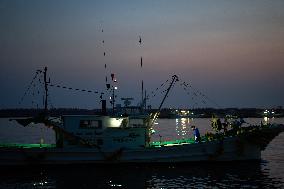
(230313) -- FUKUSHIMA, March 13, 2023 (Xinhua) -- Fishing boats are pictured approaching the shore in Soma City, Fukushima Prefecture, Japan, March 8, 2023. Struck by a magnitude-9.0 earthquake and ensuing tsunami that hit Japan's northeast on March 11, 2011, the power plant suffered core meltdowns, resulting in a level-7 nuclear accident, the highest on the International Nuclear and Radiological Event Scale. Twelve years after the 2011 accident traumatized Fukushima's fishing industry, local fishermen are still struggling for recovery. As Japan pushes ahead with dumping tons of contaminated nuclear wastewater from the wrecked Fukushima Daiichi nuclear power plant into the Pacific Ocean in spring or summer, local residents, especially those in the fishing industry, believe their livelihoods would again be devastated. (Xinhua/Zhang Xiaoyu)

  •  
(FOCUS)JAPAN-FUKUSHIMA-NUCLEAR-CONTAMINATED WASTEWATER

(FOCUS)JAPAN-FUKUSHIMA-NUCLEAR-CONTAMINATED WASTEWATER

(230313) -- FUKUSHIMA, March 13, 2023 (Xinhua) -- This photo taken on March 8, 2023 shows a fish market in Soma City, Fukushima Prefecture, Japan. Struck by a magnitude-9.0 earthquake and ensuing tsunami that hit Japan's northeast on March 11, 2011, the power plant suffered core meltdowns, resulting in a level-7 nuclear accident, the highest on the International Nuclear and Radiological Event Scale. Twelve years after the 2011 accident traumatized Fukushima's fishing industry, local fishermen are still struggling for recovery. As Japan pushes ahead with dumping tons of contaminated nuclear wastewater from the wrecked Fukushima Daiichi nuclear power plant into the Pacific Ocean in spring or summer, local residents, especially those in the fishing industry, believe their livelihoods would again be devastated. (Xinhua/Zhang Xiaoyu)

  •  
(FOCUS)JAPAN-FUKUSHIMA-NUCLEAR-CONTAMINATED WASTEWATER

(FOCUS)JAPAN-FUKUSHIMA-NUCLEAR-CONTAMINATED WASTEWATER

(230313) -- FUKUSHIMA, March 13, 2023 (Xinhua) -- This photo taken on March 8, 2023 shows a fish market in Soma City, Fukushima Prefecture, Japan. Struck by a magnitude-9.0 earthquake and ensuing tsunami that hit Japan's northeast on March 11, 2011, the power plant suffered core meltdowns, resulting in a level-7 nuclear accident, the highest on the International Nuclear and Radiological Event Scale. Twelve years after the 2011 accident traumatized Fukushima's fishing industry, local fishermen are still struggling for recovery. As Japan pushes ahead with dumping tons of contaminated nuclear wastewater from the wrecked Fukushima Daiichi nuclear power plant into the Pacific Ocean in spring or summer, local residents, especially those in the fishing industry, believe their livelihoods would again be devastated. (Xinhua/Zhang Xiaoyu)

  •  
(FOCUS)JAPAN-FUKUSHIMA-NUCLEAR-CONTAMINATED WASTEWATER

(FOCUS)JAPAN-FUKUSHIMA-NUCLEAR-CONTAMINATED WASTEWATER

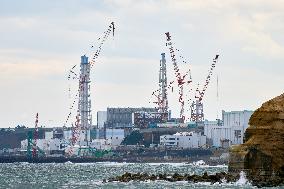
(230313) -- FUKUSHIMA, March 13, 2023 (Xinhua) -- This photo taken on March 6, 2023 shows the Fukushima Daiichi nuclear power plant in Futabacho, Futabagun of Fukushima Prefecture, Japan. Struck by a magnitude-9.0 earthquake and ensuing tsunami that hit Japan's northeast on March 11, 2011, the power plant suffered core meltdowns, resulting in a level-7 nuclear accident, the highest on the International Nuclear and Radiological Event Scale. Twelve years after the 2011 accident traumatized Fukushima's fishing industry, local fishermen are still struggling for recovery. As Japan pushes ahead with dumping tons of contaminated nuclear wastewater from the wrecked Fukushima Daiichi nuclear power plant into the Pacific Ocean in spring or summer, local residents, especially those in the fishing industry, believe their livelihoods would again be devastated. (Xinhua/Zhang Xiaoyu)

  •  
(FOCUS)JAPAN-FUKUSHIMA-NUCLEAR-CONTAMINATED WASTEWATER

(FOCUS)JAPAN-FUKUSHIMA-NUCLEAR-CONTAMINATED WASTEWATER

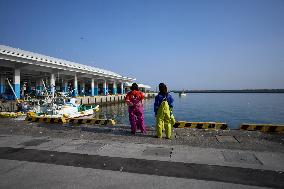
(230313) -- FUKUSHIMA, March 13, 2023 (Xinhua) -- Fishermen wait for fishing boats on a bank in Soma City, Fukushima Prefecture, Japan, March 8, 2023. Struck by a magnitude-9.0 earthquake and ensuing tsunami that hit Japan's northeast on March 11, 2011, the power plant suffered core meltdowns, resulting in a level-7 nuclear accident, the highest on the International Nuclear and Radiological Event Scale. Twelve years after the 2011 accident traumatized Fukushima's fishing industry, local fishermen are still struggling for recovery. As Japan pushes ahead with dumping tons of contaminated nuclear wastewater from the wrecked Fukushima Daiichi nuclear power plant into the Pacific Ocean in spring or summer, local residents, especially those in the fishing industry, believe their livelihoods would again be devastated. (Xinhua/Zhang Xiaoyu)

  •  
JAPAN-TOKYO-PROTEST-NUCLEAR-CONTAMINATED WASTEWATER

JAPAN-TOKYO-PROTEST-NUCLEAR-CONTAMINATED WASTEWATER

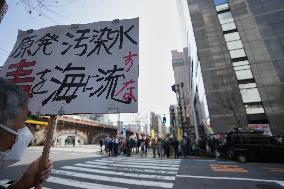
(230312) -- TOKYO, March 12, 2023 (Xinhua) -- A sign that reads "do not dump contaminated wastewater into the sea" is pictured during a protest near the headquarters of Tokyo Electric Power Company (TEPCO) in Tokyo, Japan, March 11, 2023. Saturday marks the 12th year after a 9.0-magnitude earthquake hit northeast Japan, which is also known in the country as the Great East Japan Earthquake. On March 11, 2011, an ensuing tsunami also led to core meltdowns at the Fukushima power plant operated by TEPCO, resulting in a level-7 nuclear accident. The Japanese government said in January that starting in this spring or summer, over 1 million tons of radioactive wastewater from the wrecked Fukushima nuclear power plant will be released into the Pacific. In front of the TEPCO headquarters in Tokyo, a large number of people gathered early Saturday to express their strong opposition to the discharge plan by holding various banners and signs, or handing out leaflets. TO GO WITH "Feature: 12 years after Fukushima quake, Ja

  •  

12 years after Fukushima quake, Japanese public opposes dumping nuke wastewater into sea

STORY: 12 years after Fukushima quake, Japanese public opposes dumping nuke wastewater into sea DATELINE: March 12, 2023 LENGTH: 00:02:08 LOCATION: Tokyo CATEGORY: SOCIETY\ENVIRONMENT SHOTLIST: 1. various of people gathering early Saturday to express their strong opposition to the discharge plan 2. SOUNDBITE 1 (Japanese): MAKOTO YANAGIDA, Japanese environmental organization Tanpoposya 3. SOUNDBITE 2 (Japanese): JONNY H. (pseudonym), Guitarist 4. SOUNDBITE 3 (Japanese): MUKAI, Sanya Labor Center member 5. SOUNDBITE 4 (Japanese): TOSHIKO OKADA, Member of a citizens' group STORYLINE: As Japan moves to push ahead with dumping nuclear-contaminated wastewater from the wrecked Fukushima Daiichi nuclear power plant into the Pacific Ocean, local residents are expressing their anger and opposition. Saturday marked the 12th year after a 9.0-magnitude earthquake hit northeast Japan. An ensuing tsunami also led to core meltdowns at the Fukushima power plant operated by Tokyo Electric Power Company (TEPCO), resultin

  •  
TEPCO decides on permanent shutdown of 2 Fukushima reactors

TEPCO decides on permanent shutdown of 2 Fukushima reactors

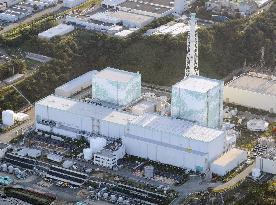
TOKYO, Japan - File photo taken in September 2013 shows the No. 5 reactor (L) and No. 6 reactor at Tokyo Electric Power Co.'s Fukushima Daiichi power plant in Fukushima Prefecture. The company decided at its board meeting on Dec. 18, 2013, to permanently shut down the two reactors that avoided meltdowns in the 2011 nuclear disaster.

  •  
Rubble removal starts in Futaba, host of Fukushima Daiichi

Rubble removal starts in Futaba, host of Fukushima Daiichi

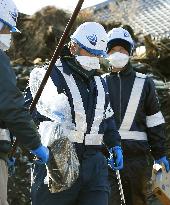
FUTABA, Japan - A worker holds a school bag which was found on Dec. 17, 2014, in rubble generated by the March 2011 earthquake and tsunami in the northeastern Japan town of Futaba, which hosts the crippled Fukushima Daiichi complex. The government began the removal work the same day, after it was postponed due to the meltdowns at the power plant.

  •  
Rubble removal starts in Futaba, host of Fukushima Daiichi

Rubble removal starts in Futaba, host of Fukushima Daiichi

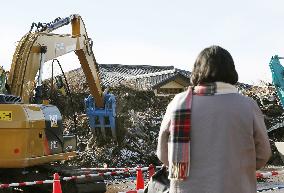
FUTABA, Japan - A local resident watches the first removal work of rubble generated by the March 2011 earthquake and tsunami in the northeastern Japan town of Futaba, which hosts the crippled Fukushima Daiichi complex, on Dec. 17, 2014. The removal work was postponed due to the meltdowns at the power plant.

  •  
2 Takahama plant reactors to clear major safety hurdle

2 Takahama plant reactors to clear major safety hurdle

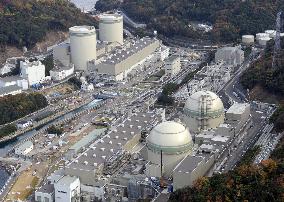
TOKYO, Japan - File photo taken in November 2014 shows Kansai Electric Power Co.'s Takahama nuclear plant, located on the Sea of Japan coast. The idled Nos. 3 and 4 reactors at the plant are set to clear the initial hurdle on Dec. 17 to being brought back online, possibly next year, despite persisting public concerns over nuclear safety in the face of the Fukushima meltdowns.

  •  
Fukushima Gov. Sato leaves office

Fukushima Gov. Sato leaves office

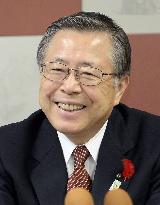
FUKUSHIMA, Japan - Yuhei Sato, governor of the northeastern Japan prefecture of Fukushima, attends a press conference on Nov. 11, 2014, when he retired at the expiration of his term of office. During his eight-year tenure, Sato faced the 2011 triple disaster of earthquake, tsunami and nuclear reactor meltdowns.

  •  
Kansai Electric likely to be in red in FY 2014

Kansai Electric likely to be in red in FY 2014

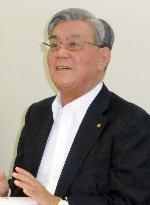
OSAKA, Japan - Kansai Electric Power Co. President Makoto Yagi attends a press conference in Osaka, Japan, on Oct. 29, 2014. He said the utility may post its fourth straight group net loss in fiscal 2014 unless its idled nuclear reactors come back online, amid surging costs for fossil fuels in the absence of nuclear power following the 2011 Fukushima meltdowns.

  •  
Ex-PM Koizumi raps Abe's aim to revive nuclear power

Ex-PM Koizumi raps Abe's aim to revive nuclear power

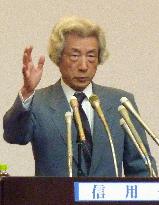
TOKYO, Japan - Former Prime Minister Junichiro Koizumi speaks at a symposium in Tokyo on Oct. 22, 2014. Known as a firm opponent to nuclear power following the 2011 Fukushima meltdowns, Koizumi criticized current Japanese leader Shinzo Abe's policy to revive the country's nuclear power generation.

  •  
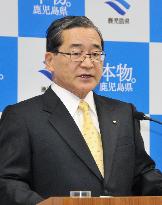
Kagoshima Gov. Ito at press conference

Kagoshima Gov. Ito at press conference

KAGOSHIMA, Japan - Kagoshima Gov. Yuichiro Ito gives a press conference in Kagoshima on Oct. 17, 2014, about a town meeting aimed at winning local residents' support for bringing Kyushu Electric Power Co.'s Sendai nuclear power plant back online after it cleared the government's new, tighter safety regulations adopted after the Fukushima meltdowns.

  •  
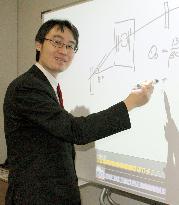
Project under way to see inside reactors with "muons"

Project under way to see inside reactors with "muons"

TOKYO, Japan - Photo taken Jan. 31, 2014 in Kawasaki, Kanagawa Prefecture, shows Haruo Miyadera, a Toshiba Corp. researcher who is engaged in a project to see into the interior of reactors at the Fukushima Daiichi nuclear power plant which suffered meltdowns due to the earthquake and tsunami in March 2011 using elementary particles called "muons."

  •  
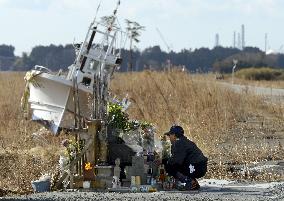
3 years since quake-tsunami disaster

3 years since quake-tsunami disaster

NAMIE, Japan - A man prays before a cenotaph in an evacuation zone in Namie, Fukushima Prefecture, on March 11, 2014, three years after the March 11, 2011, earthquake and tsunami disaster that triggered meltdowns at the Fukushima Daiichi nuclear power plant. The plant's exhaust pipes are seen in the background, to the right.

  •  
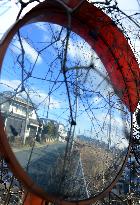
No-go zones in Fukushima

No-go zones in Fukushima

FUKUSHIMA, Japan - A roadside mirror is covered in vines in a no-go zone in Namie, Fukushima Prefecture, in January 2014, almost three years after the March 11, 2011, earthquake and tsunami disaster that triggered meltdowns at the Fukushima Daiichi nuclear power plant.

  •  
No-go zones in Fukushima

No-go zones in Fukushima

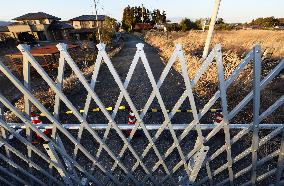
FUKUSHIMA, Japan - A barricade blocks a road in a no-go zone in Namie, Fukushima Prefecture, in January 2014, almost three years after the March 11, 2011, earthquake and tsunami disaster that triggered meltdowns at the Fukushima Daiichi nuclear power plant.

  •  
No-go zones in Fukushima

No-go zones in Fukushima

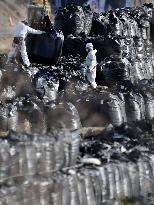
FUKUSHIMA, Japan - Hundreds of bags containing waste resulting from decontamination work in the aftermath of meltdowns at the Fukushima Daiichi nuclear power plant are piled up at a temporary storage site in a no-go zone in Okuma, Fukushima Prefecture, in January 2014, almost three years after the March 11, 2011, earthquake and tsunami disaster that triggered the nuclear crisis.

  •  
Fukushima Daiichi nuclear plant

Fukushima Daiichi nuclear plant

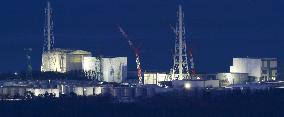
FUKUSHIMA, Japan - Photo taken in January 2014 from mountains in Tomioka, Fukushima Prefecture, shows (from left) the Nos. 1 to 4 reactors of the Fukushima Daiichi nuclear power plant, almost three years after the March 11, 2011, earthquake and tsunami disaster that triggered meltdowns at the plant.

  •  
No-go zones in Fukushima

No-go zones in Fukushima

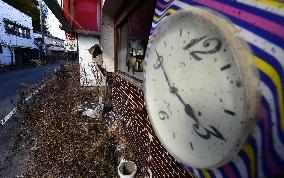
FUKUSHIMA, Japan - The hands of a clock on the outside of a hair salon in a no-go zone in Tomioka, Fukushima Prefecture, in January 2014 remain frozen at 2:46 p.m., the time that a magnitude 9.0 earthquake struck northeastern Japan on March 11, 2011. The quake and a subsequent massive tsunami triggered meltdowns at the Fukushima Daiichi nuclear power plant.

  •  
No-go zones in Fukushima

No-go zones in Fukushima

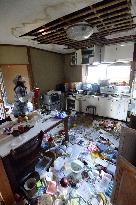
FUKUSHIMA, Japan - The kitchen of a house in a no-go zone in Tomioka, Fukushima Prefecture, remains littered with utensils in the aftermath of a magnitude 9.0 earthquake that struck northeastern Japan on March 11, 2011, in this photo taken in November 2013, about two and a half years after the disaster. The ceiling appears to have been damaged by a roof leak and there is evidence that rats have been in the kitchen. The quake and a subsequent massive tsunami triggered meltdowns at the Fukushima Daiichi nuclear power plant.

  •  
No-go zones in Fukushima

No-go zones in Fukushima

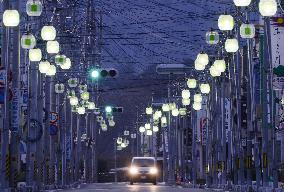
FUKUSHIMA, Japan - Photo shows an empty shopping street in a no-go zone in Minamisoma, Fukushima Prefecture, in January 2014, almost three years after the March 11, 2011, earthquake and tsunami disaster that triggered meltdowns at the Fukushima Daiichi nuclear power plant.

  •  
Fukushima Daiichi plant

Fukushima Daiichi plant

TOKYO, Japan - A September 2013 file photo shows the No. 5 (L) and No. 6 reactor units of the Fukushima Daiichi Nuclear Power Station in Fukushima Prefecture. Tokyo Electric Power Co. plans to permanently shut down the two reactors that avoided meltdowns during the 2011 accident, company sources said on Nov. 20, 2013.

  •  
Abe visits Fukushima Daiichi plant

Abe visits Fukushima Daiichi plant

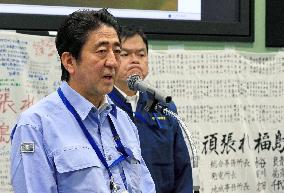
OKUMA, Japan - Prime Minister Shinzo Abe speaks to workers at Tokyo Electric Power Co.'s Fukushima Daiichi Nuclear Power Station in Fukushima Prefecture on Sept. 19, 2013. Abe urged TEPCO to scrap the Nos. 5 and 6 reactors at the crippled plant that avoided meltdowns during the 2011 nuclear crisis. (Pool photo)

  •  
Abe visits Fukushima Daiichi plant

Abe visits Fukushima Daiichi plant

OKUMA, Japan - Prime Minister Shinzo Abe (C) speaks to reporters at Tokyo Electric Power Co.'s Fukushima Daiichi Nuclear Power Station in Fukushima Prefecture on Sept. 19, 2013. Abe urged TEPCO to scrap the Nos. 5 and 6 reactors at the crippled plant that avoided meltdowns during the 2011 nuclear crisis. (Pool photo)

  •  
Abe visits Fukushima Daiichi plant

Abe visits Fukushima Daiichi plant

OKUMA, Japan - Prime Minister Shinzo Abe (L) sees off workers going to check tanks containing radioactive wastewater at Tokyo Electric Power Co.'s Fukushima Daiichi Nuclear Power Station in Fukushima Prefecture on Sept. 19, 2013. Abe urged TEPCO to scrap the Nos. 5 and 6 reactors at the crippled plant that avoided meltdowns during the 2011 nuclear crisis. (Pool photo)

  •  
Fukushima Daiichi plant

Fukushima Daiichi plant

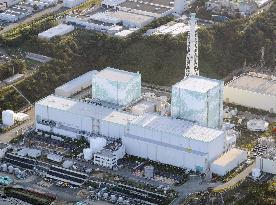
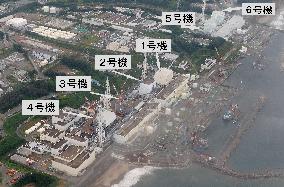
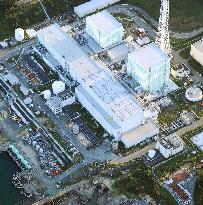
TOKYO, Japan - File photo taken in August 2013 shows (from L bottom) the Nos. 4, 3, 2, 1, 5 and 6 reactor buildings at Tokyo Electric Power Co.'s Fukushima Daiichi Nuclear Power Station in Fukushima Prefecture. Prime Minister Shinzo Abe visited the plant on Sept. 19 and urged TEPCO to scrap the Nos. 5 and 6 reactors at the crippled plant that avoided meltdowns during the 2011 nuclear crisis. The utility is moving ahead with decommissioning of the Nos. 1 to 4 units.

  •  
Fukushima Daiichi plant

Fukushima Daiichi plant

TOKYO, Japan - File photo taken in August 2013 shows (from L bottom) the Nos. 4, 3, 2, 1, 5 and 6 reactor buildings at Tokyo Electric Power Co.'s Fukushima Daiichi Nuclear Power Station in Fukushima Prefecture. Prime Minister Shinzo Abe visited the plant on Sept. 19 and urged TEPCO to scrap the Nos. 5 and 6 reactors at the crippled plant that avoided meltdowns during the 2011 nuclear crisis. The utility is moving ahead with decommissioning of the Nos. 1 to 4 units.

  •  
Fukushima Daiichi plant

Fukushima Daiichi plant

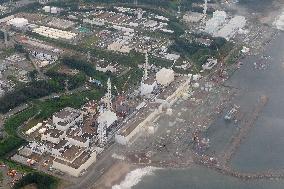
TOKYO, Japan - Photo taken from a Kyodo News helicopter over the town of Futaba, Fukushima Prefecture, on Sept. 18, 2013, shows the Nos. 5 (back) and 6 reactor buildings at Tokyo Electric Power Co.'s Fukushima Daiichi Nuclear Power Station. Prime Minister Shinzo Abe visited the plant on Sept. 19 and urged TEPCO to scrap the Nos. 5 and 6 reactors at the crippled plant that avoided meltdowns during the 2011 nuclear crisis.

  •  
Abe visits Fukushima Daiichi plant

Abe visits Fukushima Daiichi plant

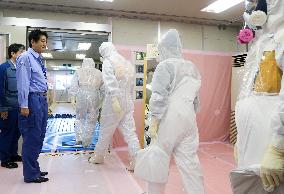
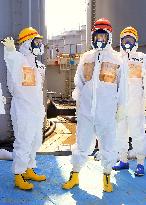
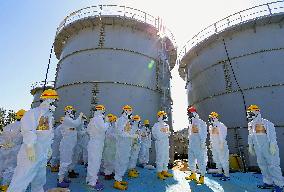
OKUMA, Japan - Prime Minister Shinzo Abe (C), wearing a protective suit, inspects the area near a storage tank from which radioactive water was found to have leaked at Tokyo Electric Power Co.'s Fukushima Daiichi Nuclear Power Station in Fukushima Prefecture on Sept. 19, 2013. Abe urged TEPCO to scrap the Nos. 5 and 6 reactors at the crippled plant that avoided meltdowns during the 2011 nuclear crisis. (Pool photo)

  •  
Abe visits Fukushima Daiichi plant

Abe visits Fukushima Daiichi plant

OKUMA, Japan - Prime Minister Shinzo Abe (3rd from R) inspects the area near a storage tank from which radioactive water was found to have leaked at Tokyo Electric Power Co.'s Fukushima Daiichi Nuclear Power Station in Fukushima Prefecture on Sept. 19, 2013. Abe urged TEPCO to scrap the Nos. 5 and 6 reactors at the crippled plant that avoided meltdowns during the 2011 nuclear crisis. (Pool photo)

  •  
Tanks holding toxic water at Fukushima plant

Tanks holding toxic water at Fukushima plant

FUKUSHIMA, Japan - A worker dismantles a tank at the Fukushima Daiichi nuclear power plant on Sept. 13, 2013. Tokyo Electric Power Co., the plant operator, is storing in hundreds of huge tanks toxic water accumulating as a result of continuing water injections into the three reactors that suffered meltdowns. But water recently leaked from one of the tanks, seen second from left. (Pool photo)

  •  
Leakage of highly radioactive water at Fukushima plant

Leakage of highly radioactive water at Fukushima plant

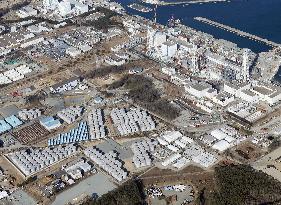
TOKYO, Japan - File photo taken in March 2013 shows the crippled Fukushima Daiichi nuclear power plant (R top) and numerous tanks (L bottom) containing radioactive water that has accumulated as a result of continuing water injections into the three reactors that suffered meltdowns. Tokyo Electric Power Co., the plant operator, said Aug. 20, 2013, that an estimated 300 tons of highly radioactive water have leaked from one of the water storage tanks at the Fukushima plant, making it the worst leakage incident from such containers.

  •  
Abandoned animals in Fukushima

Abandoned animals in Fukushima

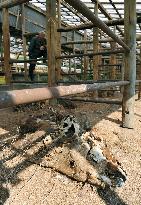
TOKYO, Japan - In this photo taken in the town of Tomioka, Fukushima Prefecture, on May 19, 2012, a cattle beast lies starved to death after its owner abandoned it in a barn. The town remains nearly deserted as the government in April 2011 designated it and other municipalities within a 20-kilometer ring around the crippled Fukushima Daiichi nuclear power plant as a no-go zone. The plant's reactors suffered meltdowns after being struck by the March 11, 2011, earthquake and tsunami, spewing massive amounts of radioactive materials into the air and sea.

  •  
Abandoned animals in Fukushima

Abandoned animals in Fukushima

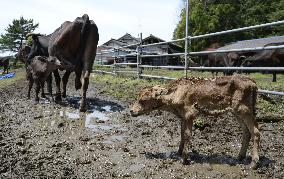
TOKYO, Japan - In this photo taken in the town of Tomioka, Fukushima Prefecture, on June 23, 2012, a calf (front) looks almost skeletal because its mother is too weak to breastfeed it. The town remains nearly deserted as the government in April 2011 designated it and other municipalities within a 20-kilometer ring around the crippled Fukushima Daiichi nuclear power plant as a no-go zone. The plant's reactors suffered meltdowns after being struck by the March 11, 2011, earthquake and tsunami, spewing massive amounts of radioactive materials into the air and sea.

  •  
Man caring for abandoned cattle in Fukushima

Man caring for abandoned cattle in Fukushima

TOKYO, Japan - In this photo taken in the town of Tomioka, Fukushima Prefecture, on June 23, 2012, Naoto Matsumura, who cares for cattle abandoned by their owners, relaxes at his home after finishing his day's work of tending to pets and livestock. Without electricity, he relies on candles to light his room. The town remains nearly deserted as the government in April 2011 designated it and other municipalities within a 20-kilometer ring around the crippled Fukushima Daiichi nuclear power plant as a no-go zone. The plant's reactors suffered meltdowns after being struck by the March 11, 2011, earthquake and tsunami, spewing massive amounts of radioactive materials into the air and sea.

  •  
Abandoned animals in Fukushima

Abandoned animals in Fukushima

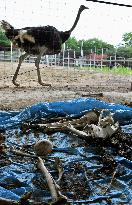
TOKYO, Japan - In this photo taken in the town of Okuma, Fukushima Prefecture, on May 20, 2012, an ostrich walks by the remains of another that starved to death after they were left abandoned at a breeding facility. In April 2011, the government designated Okuma and other municipalities within a 20-kilometer ring around the crippled Fukushima Daiichi nuclear power plant as a no-go zone. The plant's reactors suffered meltdowns after being struck by the March 11, 2011, earthquake and tsunami, spewing massive amounts of radioactive materials into the air and sea.

  •  
Abandoned animals in Fukushima

Abandoned animals in Fukushima

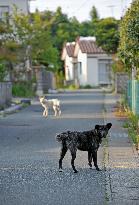
TOKYO, Japan - Photo taken in the town of Tomioka, Fukushima Prefecture, on May 21, 2012, shows dogs that have been abandoned by their owners. The town remains nearly deserted as the government in April 2011 designated it and other municipalities within a 20-kilometer ring around the crippled Fukushima Daiichi nuclear power plant as a no-go zone. The plant's reactors suffered meltdowns after being struck by the March 11, 2011, earthquake and tsunami, spewing massive amounts of radioactive materials into the air and sea.

  •  
Man caring for abandoned cattle in Fukushima

Man caring for abandoned cattle in Fukushima

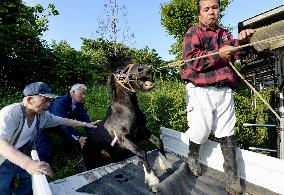
TOKYO, Japan - In this photo taken in the town of Tomioka, Fukushima Prefecture, on June 22, 2012, Naoto Matsumura (C) and his friend Kazuo Endo (R) help a pony onto a truck so he can take it home and care for it, doing so at the request of a resident (L) who has returned home temporarily. The town remains nearly deserted as the government in April 2011 designated it and other municipalities within a 20-kilometer ring around the crippled Fukushima Daiichi nuclear power plant as a no-go zone. The plant's reactors suffered meltdowns after being struck by the March 11, 2011, earthquake and tsunami, spewing massive amounts of radioactive materials into the air and sea.

  •  
Man caring for abandoned cattle in Fukushima

Man caring for abandoned cattle in Fukushima

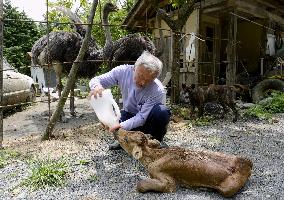
TOKYO, Japan - In this photo taken in the town of Tomioka, Fukushima Prefecture, on June 23, 2012, Naoto Matsumura, who cares for cattle abandoned by their owners, gives milk to a weakened calf via a feeding bottle. Behind him are the ostriches and the dog he keeps after their owners abandoned them. The town remains nearly deserted as the government in April 2011 designated it and other municipalities within a 20-kilometer ring around the crippled Fukushima Daiichi nuclear power plant as a no-go zone. The plant's reactors suffered meltdowns after being struck by the March 11, 2011, earthquake and tsunami, spewing massive amounts of radioactive materials into the air and sea.

  •  
Hosono regrets not having admitted nuclear meltdowns immediately

Hosono regrets not having admitted nuclear meltdowns immediately

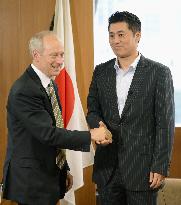
TOKYO, Japan - Japan's nuclear disaster minister Goshi Hosono (R) and Michael Sandel, a professor of political philosophy at Harvard University, shake hands after their discussion in Tokyo on May 29, 2012. Hosono said he regrets that the Japanese government did not admit the possibility of nuclear meltdowns at the crisis-hit Fukushima Daiichi plant shortly after the disaster was triggered by the earthquake and tsunami in March 2011.

  •  

Fukushima Plant Still Posing Risks 4 Years After Meltdowns: regulator

FUKUSHIMA, JAPAN - MAR. 11: The situation still remains risky at the crippled Fukushima Daiichi power plant four years after nuclear meltdowns occurred in 2011, the chairman of Japan's nuclear regulator said Wednesday, vowing utmost efforts to avoid further trouble there. "There have been quite a few accidents and problems at the Fukushima plant in the past year, and we need to face the reality that they are causing anxiety and anger among people in Fukushima," Shunichi Tanaka told personnel at the Nuclear Regulation Authority on the fourth anniversary of the nuclear disaster. Mishaps still occur regularly at the radiation-leaking complex in Fukushima Prefecture, where decommissioning

  •  

11th anniversary of 2011 Great East Japan Earthquakes

Japan on Friday marked the 11th anniversary of the earthquake, tsunami and nuclear disaster that devastated its northeastern region in 2011 and left more than 15,000 dead in the worst natural calamity in the country's postwar history. Infrastructure in the hard-hit areas has largely been rebuilt, but some 38,000 people remain displaced more than a decade after the magnitude-9.0 earthquake and ensuring tsunamis caused widespread damage and triggered meltdowns at the Fukushima Daiichi nuclear complex.

  • Main
  • Top
  • Editorial
  • Creative
  • About Us
  • About ILG
  • Terms of use
  • Company
  • BEHIND
  • Price List
  • Single Plan
  • Monthly Plan
  • Services
  • Shooting
  • Rights Clearance
  • Support
  • FAQ
  • How To Buy
  • Contact Us
  • Become a Partner

© KYODO NEWS IMAGES INC

All Rights Reserved.

  • Editorial
  • Olympics
  • News
  • Sports
  • Japan
  • Tech
  • Royal
  • Disaster
  • NorthKorea
  • Old Japan
  • SNS
  • Creative
  • Food
  • Japan
  • Landscape
  • Animal
  • Popular
  • #Ukraine
  • #China
  • #coronavirus
  • #N. Korea
  • #Russia
  • #Thailand
  • #Ukraine
  • #China
  • #coronavirus
  • #N. Korea
  • #Russia
  • #Thailand
  • Food
  • Japan
  • Landscape
  • Animal
  • Olympics
  • News
  • Sports
  • Japan
  • Tech
  • Royal
  • Disaster
  • NorthKorea
  • Old Japan
  • SNS