•  
Red Spider Nebula

Red Spider Nebula

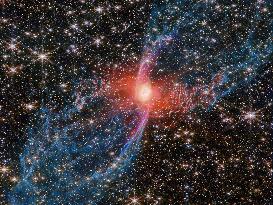
Handout photo dated on October 26, 2025 shows Red Spider Nebula. Using its Near-InfraRed Camera (NIRCam), NASA’s James Webb Space Telescope captured never-before-seen details of the Red Spider Nebula, a planetary nebula, in this image released on Oct. 26, 2025. NIRCam is Webb’s primary near-infrared imager, providing high-resolution imaging and spectroscopy for a wide variety of investigations. Webb’s new view of the Red Spider Nebula reveals for the first time the full extent of the nebula’s outstretched lobes, which form the ‘legs’ of the spider. These lobes, shown in blue, are traced by light emitted from H2 molecules, which contain two hydrogen atoms bonded together. Stretching over the entirety of NIRCam’s field of view, these lobes are shown to be closed, bubble-like structures that each extend about 3 light-years. Outflowing gas from the center of the nebula has inflated these massive bubbles over thousands of years. Photo by ESA/Webb, NASA & CSA, J. H. Kastner (Rochester Institute of Technolo via ABAC

  •  
James Webb Telescope Finds Most Distant Known Galaxy

James Webb Telescope Finds Most Distant Known Galaxy

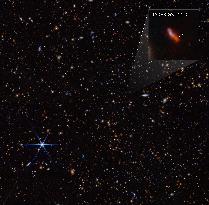
Handout infrared image from NASA’s James Webb Space Telescope (also called Webb or JWST) was taken by the NIRCam (Near-Infrared Camera) for the JWST Advanced Deep Extragalactic Survey, or JADES, program. The NIRCam data was used to determine which galaxies to study further with spectroscopic observations. One such galaxy, JADES-GS-z14-0 (shown in the pullout), was determined to be at a redshift of 14.32 (+0.08/-0.20), making it the current record-holder for the most distant known galaxy. This corresponds to a time less than 300 million years after the big bang. In the background image, blue represents light at 0.9, 1.15, and 1.5 microns (filters F090W + F115W + F150W), green is 2.0 and 2.77 microns (F200W + F277W), and red is 3.56, 4.1, and 4.44 microns (F356W + F410M + F444W). The pullout image shows light at 0.9 and 1.15 microns (F090W + F115W) as blue, 1.5 and 2.0 microns (F150W + F200W) as green, and 2.77 microns (F277W) as red. Photo by Nasa via ABACAPRESS.COM

  •  
NASA's Webb Reveals New Features in Heart of Milky Way

NASA's Webb Reveals New Features in Heart of Milky Way

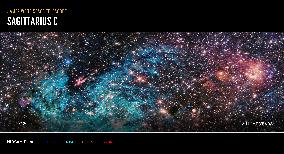
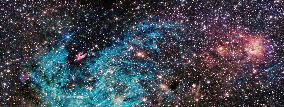
Handout photo - The latest image from NASA's James Webb Space Telescope shows a portion of the dense center of our galaxy in unprecedented detail, including never-before-seen features astronomers have yet to explain. The star-forming region, named Sagittarius C (Sgr C), is about 300 light-years from the Milky Way's central supermassive black hole, Sagittarius A. The NIRCam (Near-Infrared Camera) instrument on NASA's James Webb Space Telescope's reveals a portion of the Milky Way’s dense core in a new light. An estimated 500,000 stars shine in this image of the Sagittarius C (Sgr C) region, along with some as-yet unidentified features. A large region of ionized hydrogen, shown in cyan, contains intriguing needle-like structures that lack any uniform orientation. The James Webb Space Telescope is the world’s premier space science observatory. Webb is solving mysteries in our solar system, looking beyond to distant worlds around other stars, and probing the mysterious structures and origins of our universe and o

  •  
NASA's Webb Reveals New Features in Heart of Milky Way

NASA's Webb Reveals New Features in Heart of Milky Way

Handout photo - The latest image from NASA's James Webb Space Telescope shows a portion of the dense center of our galaxy in unprecedented detail, including never-before-seen features astronomers have yet to explain. The star-forming region, named Sagittarius C (Sgr C), is about 300 light-years from the Milky Way's central supermassive black hole, Sagittarius A. The NIRCam (Near-Infrared Camera) instrument on NASA's James Webb Space Telescope's reveals a portion of the Milky Way’s dense core in a new light. An estimated 500,000 stars shine in this image of the Sagittarius C (Sgr C) region, along with some as-yet unidentified features. A large region of ionized hydrogen, shown in cyan, contains intriguing needle-like structures that lack any uniform orientation. The James Webb Space Telescope is the world’s premier space science observatory. Webb is solving mysteries in our solar system, looking beyond to distant worlds around other stars, and probing the mysterious structures and origins of our universe and o

  •  
Webb Reveals New Structures Within Iconic Supernova

Webb Reveals New Structures Within Iconic Supernova

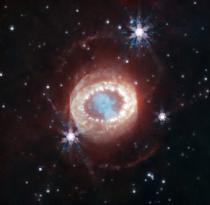
Handout - Webb’s NIRCam (Near-Infrared Camera) captured this detailed image of SN 1987A (Supernova 1987A). At the center, material ejected from the supernova forms a keyhole shape. Just to its left and right are faint crescents newly discovered by Webb. Beyond them an equatorial ring, formed from material ejected tens of thousands of years before the supernova explosion, contains bright hot spots. Exterior to that is diffuse emission and two faint outer rings. This image reveals a central structure like a keyhole. This center is packed with clumpy gas and dust ejected by the supernova explosion. The dust is so dense that even near-infrared light that Webb detects can’t penetrate it, shaping the dark “hole” in the keyhole. Despite the decades of study since the supernova’s initial discovery, there are several mysteries that remain, particularly surrounding the neutron star that should have been formed in the aftermath of the supernova explosion. August 31, 2023. Photo by NASA, ESA, CSA, M. Matsuura (Cardiff Un

  •  
James Webb View Of The Ring Nebula

James Webb View Of The Ring Nebula

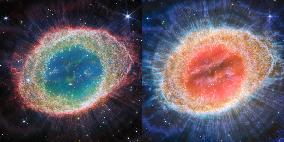
New images from NASA’s James Webb Space Telescope of the well-known Ring Nebula provide unprecedented spatial resolution and spectral sensitivity. In the NIRCam (Near-Infrared Camera) image on the left, the intricate details of the filament structure of the inner ring are particularly visible in this dataset. On the right, the MIRI (Mid-InfraRed Instrument) image reveals particular details in the concentric features in the outer regions of the nebulae’s ring. Photo by ESA/Webb, NASA, CSA, M. Barlow, N. Cox, R. Wesson via CNP/ABACAPRESS.COM

  •  
Saturn Captured By James Webb Space Telescope

Saturn Captured By James Webb Space Telescope

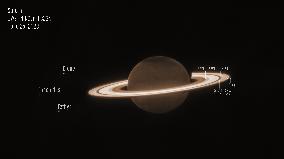
This image shows Saturn and some of its moons, captured by the James Webb Space Telescope’s (JWST) NIRCam instrument on June 25, 2023. In this monochrome image, NIRCam filter F323N (3.23 microns) was color mapped with an orange hue. JWST turned to the ringed world Saturn in June 2023 to conduct a deep search for new ring structure and faint moons. Saturn itself appears to extremely dark at the infrared wavelengths sensed by JWST’s Near-Infrared Camera (NIRCam), as methane gas absorbs almost all of the sunlight falling on the atmosphere. However, the icy rings stay relatively bright, leading to the unusual appearance of Saturn in the JWST image. Several very deep Saturn exposures taken together with this image were designed to test JWST’s capacity to detect faint moons around the planet and its bright rings. Any newly discovered moons would be important dynamical tracers of the current Saturn system as well as its past history. This context image clearly shows details within the ring system, along with many of

  •  
Saturn Captured By James Webb Space Telescope

Saturn Captured By James Webb Space Telescope

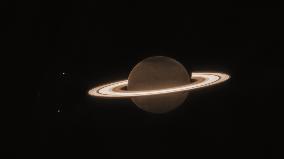
This image shows Saturn and some of its moons, captured by the James Webb Space Telescope’s (JWST) NIRCam instrument on June 25, 2023. In this monochrome image, NIRCam filter F323N (3.23 microns) was color mapped with an orange hue. JWST turned to the ringed world Saturn in June 2023 to conduct a deep search for new ring structure and faint moons. Saturn itself appears to extremely dark at the infrared wavelengths sensed by JWST’s Near-Infrared Camera (NIRCam), as methane gas absorbs almost all of the sunlight falling on the atmosphere. However, the icy rings stay relatively bright, leading to the unusual appearance of Saturn in the JWST image. Several very deep Saturn exposures taken together with this image were designed to test JWST’s capacity to detect faint moons around the planet and its bright rings. Any newly discovered moons would be important dynamical tracers of the current Saturn system as well as its past history. This context image clearly shows details within the ring system, along with many of

  •  
View Of Comet Helps Solve Mystery Of Earth's Abundant Water

View Of Comet Helps Solve Mystery Of Earth's Abundant Water

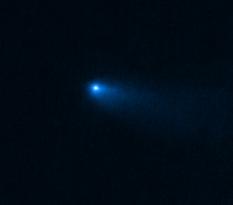
Handout - This image of Comet 238P/Read was captured by the NIRCam (Near-Infrared Camera) instrument on NASA’s James Webb Space Telescope on September 8, 2022. It displays the hazy halo, called the coma, and tail that are characteristic of comets, as opposed to asteroids. The dusty coma and tail result from the vaporization of ices as the Sun warms the main body of the comet. NASA's James Webb Space Telescope has enabled another long-sought scientific breakthrough, this time for solar system scientists studying the origins of Earth's abundant water. Using Webb's NIRSpec (Near-Infrared Spectrograph) instrument, astronomers have confirmed gas – specifically water vapor – around a comet in the main asteroid belt for the first time, indicating that water ice from the primordial solar system can be preserved in that region. Comet Read is a main belt comet – an object that resides in the main asteroid belt but which periodically displays a halo, or coma, and tail like a comet. Main belt comets themselves are a fair

  •  
U.S.-GREENBELT-JAMES WEBB SPACE TELESCOPE-UNIVERSE-FIRST FULL-COLOR IMAGES

U.S.-GREENBELT-JAMES WEBB SPACE TELESCOPE-UNIVERSE-FIRST FULL-COLOR IMAGES

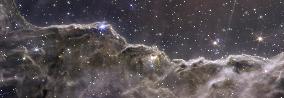
(220712) -- GREENBELT (U.S.), July 12, 2022 (Xinhua) -- Image released by NASA on July 12, 2022 shows a composite image of the Cosmic Cliffs in the Carina Nebula, created with James Webb Space Telescope's NIRCam and MIRI. NASA released James Webb Space Telescope's first full-color images of the universe and their spectroscopic data on Tuesday, revealing the unprecedented and detailed views of the universe. (NASA, ESA, CSA, STScI/Handout via Xinhua)

  •  
NASA Delays The James Webb Space Telescope Launch Again

NASA Delays The James Webb Space Telescope Launch Again

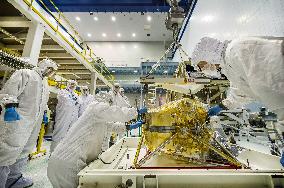
★Handout photo dated July 27, 2013 of the optics module of the James Webb Space Telescope's primary imager, the Near Infrared Camera, arrived at NASA's Goddard Space Flight Center in Greenbelt, Md. In this photo, Lockheed Martin engineers attach a lift sling to the NIRCam instrument. Last summer, NASA and the European Space Agency (ESA) set an October 31, 2021, launch date for the $ 10 billion James Webb Space Telescope, but it's having to delay the science observatory's trip into space once again. Thankfully, the launch might take place just a few weeks later, in November or early December. A rescheduled date is unlikely to be confirmed until later this summer or perhaps in the fall. The instrument, successor to NASA's Hubble Space Telescope, which is the largest science observatory ever placed into space, will launch on a European Ariane 5 rocket from a spaceport in French Guiana. Photo

  • Main
  • Top
  • Editorial
  • Creative
  • About Us
  • About ILG
  • Terms of use
  • Company
  • BEHIND
  • Price List
  • Single Plan
  • Monthly Plan
  • Services
  • Shooting
  • Rights Clearance
  • Support
  • FAQ
  • How To Buy
  • Contact Us
  • Become a Partner

© KYODO NEWS IMAGES INC

All Rights Reserved.

  • Editorial
  • Olympics
  • News
  • Sports
  • Japan
  • Tech
  • Royal
  • Disaster
  • NorthKorea
  • Old Japan
  • SNS
  • Creative
  • Food
  • Japan
  • Landscape
  • Animal
  • Popular
  • #Ukraine
  • #Thailand
  • #coronavirus
  • #N. Korea
  • #Russia
  • #China
  • #Ukraine
  • #Thailand
  • #coronavirus
  • #N. Korea
  • #Russia
  • #China
  • Food
  • Japan
  • Landscape
  • Animal
  • Olympics
  • News
  • Sports
  • Japan
  • Tech
  • Royal
  • Disaster
  • NorthKorea
  • Old Japan
  • SNS