•  
Red Spider Nebula

Red Spider Nebula

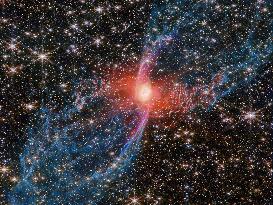
Handout photo dated on October 26, 2025 shows Red Spider Nebula. Using its Near-InfraRed Camera (NIRCam), NASA’s James Webb Space Telescope captured never-before-seen details of the Red Spider Nebula, a planetary nebula, in this image released on Oct. 26, 2025. NIRCam is Webb’s primary near-infrared imager, providing high-resolution imaging and spectroscopy for a wide variety of investigations. Webb’s new view of the Red Spider Nebula reveals for the first time the full extent of the nebula’s outstretched lobes, which form the ‘legs’ of the spider. These lobes, shown in blue, are traced by light emitted from H2 molecules, which contain two hydrogen atoms bonded together. Stretching over the entirety of NIRCam’s field of view, these lobes are shown to be closed, bubble-like structures that each extend about 3 light-years. Outflowing gas from the center of the nebula has inflated these massive bubbles over thousands of years. Photo by ESA/Webb, NASA & CSA, J. H. Kastner (Rochester Institute of Technolo via ABAC

  •  
Pillars of Creation Star in New Visualization from NASA's Hubble and Webb Telescopes

Pillars of Creation Star in New Visualization from NASA's Hubble and Webb Telescopes

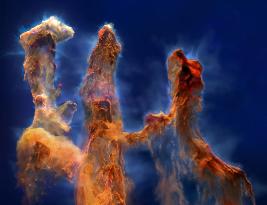
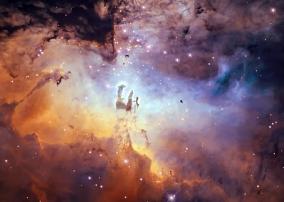
HANDOUT - The Pillars of Creation are one of the most iconic and beautiful sights in deep space - and now NASA has released a 3D visualisation allowing us to really see inside the most stunning part of the Eagle Nebula. Made famous in 1995 by NASA's Hubble Space Telescope, the Pillars of Creation are giant clouds where stars are born. Using data from NASA's Hubble and James Webb space telescopes, astronomers have created a comprehensive and detailed multiwavelength look at these towering celestial structures. By flying past and amongst the pillars, viewers experience their three-dimensional structure and see how they look different in the Hubble visible-light view versus the Webb infrared-light view," explained principal visualization scientist Frank Summers of the Space Telescope Science Institute (STScI) in Baltimore, who led the movie development team for NASA's Universe of Learning. The four Pillars of Creation, made primarily of cool molecular hydrogen and dust, are being eroded by the fierce winds and p

  •  
Pillars of Creation Star in New Visualization from NASA's Hubble and Webb Telescopes

Pillars of Creation Star in New Visualization from NASA's Hubble and Webb Telescopes

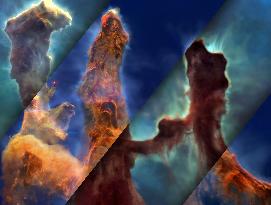
HANDOUT - The Pillars of Creation are one of the most iconic and beautiful sights in deep space - and now NASA has released a 3D visualisation allowing us to really see inside the most stunning part of the Eagle Nebula. Made famous in 1995 by NASA's Hubble Space Telescope, the Pillars of Creation are giant clouds where stars are born. Using data from NASA's Hubble and James Webb space telescopes, astronomers have created a comprehensive and detailed multiwavelength look at these towering celestial structures. By flying past and amongst the pillars, viewers experience their three-dimensional structure and see how they look different in the Hubble visible-light view versus the Webb infrared-light view," explained principal visualization scientist Frank Summers of the Space Telescope Science Institute (STScI) in Baltimore, who led the movie development team for NASA's Universe of Learning. The four Pillars of Creation, made primarily of cool molecular hydrogen and dust, are being eroded by the fierce winds and p

  •  
Pillars of Creation Star in New Visualization from NASA's Hubble and Webb Telescopes

Pillars of Creation Star in New Visualization from NASA's Hubble and Webb Telescopes

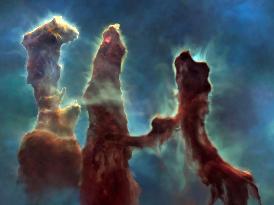
HANDOUT - The Pillars of Creation are one of the most iconic and beautiful sights in deep space - and now NASA has released a 3D visualisation allowing us to really see inside the most stunning part of the Eagle Nebula. Made famous in 1995 by NASA's Hubble Space Telescope, the Pillars of Creation are giant clouds where stars are born. Using data from NASA's Hubble and James Webb space telescopes, astronomers have created a comprehensive and detailed multiwavelength look at these towering celestial structures. By flying past and amongst the pillars, viewers experience their three-dimensional structure and see how they look different in the Hubble visible-light view versus the Webb infrared-light view," explained principal visualization scientist Frank Summers of the Space Telescope Science Institute (STScI) in Baltimore, who led the movie development team for NASA's Universe of Learning. The four Pillars of Creation, made primarily of cool molecular hydrogen and dust, are being eroded by the fierce winds and p

  •  
Pillars of Creation Star in New Visualization from NASA's Hubble and Webb Telescopes

Pillars of Creation Star in New Visualization from NASA's Hubble and Webb Telescopes

HANDOUT - The Pillars of Creation are one of the most iconic and beautiful sights in deep space - and now NASA has released a 3D visualisation allowing us to really see inside the most stunning part of the Eagle Nebula. Made famous in 1995 by NASA's Hubble Space Telescope, the Pillars of Creation are giant clouds where stars are born. Using data from NASA's Hubble and James Webb space telescopes, astronomers have created a comprehensive and detailed multiwavelength look at these towering celestial structures. By flying past and amongst the pillars, viewers experience their three-dimensional structure and see how they look different in the Hubble visible-light view versus the Webb infrared-light view," explained principal visualization scientist Frank Summers of the Space Telescope Science Institute (STScI) in Baltimore, who led the movie development team for NASA's Universe of Learning. The four Pillars of Creation, made primarily of cool molecular hydrogen and dust, are being eroded by the fierce winds and p

  •  
Hubble Spots the Little Dumbbell Nebula

Hubble Spots the Little Dumbbell Nebula

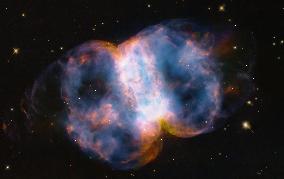
Handout - In celebration of the 34th anniversary of the launch of NASA’s Hubble Space Telescope, astronomers took a snapshot of the Little Dumbbell Nebula, also known as Messier 76, or M76, located 3,400 light-years away in the northern circumpolar constellation Perseus. The name ‘Little Dumbbell’ comes from its shape that is a two-lobed structure of colorful, mottled, glowing gases resembling a balloon that’s been pinched around a middle waist. Like an inflating balloon, the lobes are expanding into space from a dying star seen as a white dot in the center. Blistering ultraviolet radiation from the super-hot star is causing the gases to glow. The red color is from nitrogen, and blue is from oxygen. Photo by NASA, ESA, STScI via ABACAPRESS.COM

  •  
CHINA-FUJIAN-PRIVATE ENTERPRISES-IMPORT & EXPORT (CN)

CHINA-FUJIAN-PRIVATE ENTERPRISES-IMPORT & EXPORT (CN)

(240321) -- FUZHOU, March 21, 2024 (Xinhua) -- Workers work at Contemporary Nebula Technology Energy Co., Ltd. in Fuzhou, southeast China's Fujian Province, March 13, 2024. In recent years, private enterprises in Fujian have been focusing on the new demands of the international market, continuously increasing technological innovation and expanding overseas markets and sales channels. Customs data showed that from January to February this year, the import and export value of private enterprises in Fujian Province reached 207.35 billion yuan (about 28.79 billion U.S. dollars), an increase of 21.9 percent over the same period last year. (Xinhua/Lin Shanchuan)

  •  
CHINA-FUJIAN-PRIVATE ENTERPRISES-IMPORT & EXPORT (CN)

CHINA-FUJIAN-PRIVATE ENTERPRISES-IMPORT & EXPORT (CN)

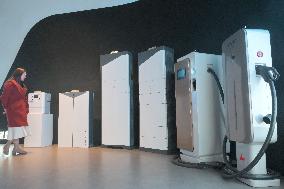
(240321) -- FUZHOU, March 21, 2024 (Xinhua) -- Products of Contemporary Nebula Technology Energy Co., Ltd. are on display at an exhibition hall of the company in Fuzhou, southeast China's Fujian Province, March 13, 2024. In recent years, private enterprises in Fujian have been focusing on the new demands of the international market, continuously increasing technological innovation and expanding overseas markets and sales channels. Customs data showed that from January to February this year, the import and export value of private enterprises in Fujian Province reached 207.35 billion yuan (about 28.79 billion U.S. dollars), an increase of 21.9 percent over the same period last year. (Xinhua/Lin Shanchuan)

  •  
EUROPEAN SPACE AGENCY-EUCLID-TELESCOPE-IMAGES

EUROPEAN SPACE AGENCY-EUCLID-TELESCOPE-IMAGES

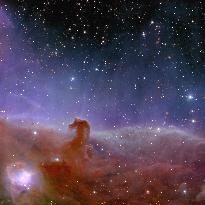
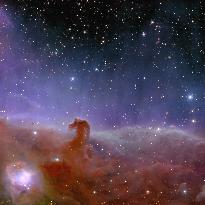
(231108) -- PARIS, Nov. 8, 2023 (Xinhua) -- This image provided by the European Space Agency on Nov. 7, 2023 shows the space telescope Euclid's view of the Horsehead Nebula. The European Space Agency released Euclid's first photos on Tuesday. (European Space Agency hand out via Xinhua)(ESA/Euclid/Euclid Consortium/NASA, image processing by J.-C. Cuillandre (CEA Paris-Saclay), G. Anselmi, CC BY-SA 3.0 IGO)

  •  
Stunning First Full-Colour Images From Euclid Telescope

Stunning First Full-Colour Images From Euclid Telescope

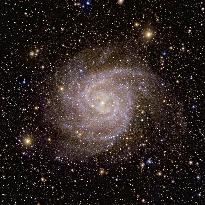
HANDOUT - Spiral galaxy IC 342. The European Space Agency's (ESA) Euclid space mission unveiled its first five full-colour images of the cosmos on Tuesday, November 7, 2023. Launched in July, Euclid is a cutting-edge telescope tasked with mapping a third of the extragalactic sky, shedding light on how dark matter and dark energy shape our universe. This ambitious mission is unique in its ability to capture razor-sharp astronomical images across a vast expanse of the sky, offering unprecedented insights into the far reaches of the universe. The initial set of images serves as a testament to Euclid's unparalleled capability to construct the most extensive 3D map of the universe to date. Among the images, the most captivating is a panoramic view of the Horsehead Nebula, also known as Barnard 33, situated in the Orion constellation approximately 1,375 light-years away. The nebula, with its striking equine shape, stands as the nearest giant star-forming region to Earth. Positioned just south of the prominent star

  •  
Stunning First Full-Colour Images From Euclid Telescope

Stunning First Full-Colour Images From Euclid Telescope

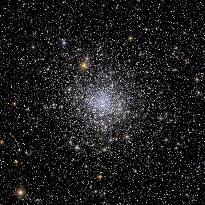
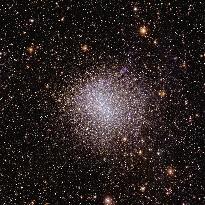
HANDOUT - his image shows: Globular cluster NGC 6397. The European Space Agency's (ESA) Euclid space mission unveiled its first five full-colour images of the cosmos on Tuesday, November 7, 2023. Launched in July, Euclid is a cutting-edge telescope tasked with mapping a third of the extragalactic sky, shedding light on how dark matter and dark energy shape our universe. This ambitious mission is unique in its ability to capture razor-sharp astronomical images across a vast expanse of the sky, offering unprecedented insights into the far reaches of the universe. The initial set of images serves as a testament to Euclid's unparalleled capability to construct the most extensive 3D map of the universe to date. Among the images, the most captivating is a panoramic view of the Horsehead Nebula, also known as Barnard 33, situated in the Orion constellation approximately 1,375 light-years away. The nebula, with its striking equine shape, stands as the nearest giant star-forming region to Earth. Positioned just south

  •  
Stunning First Full-Colour Images From Euclid Telescope

Stunning First Full-Colour Images From Euclid Telescope

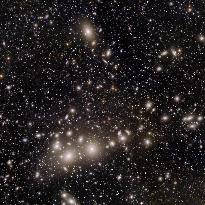
HANDOUT - The Perseus Cluster of galaxies. The European Space Agency's (ESA) Euclid space mission unveiled its first five full-colour images of the cosmos on Tuesday, November 7, 2023. Launched in July, Euclid is a cutting-edge telescope tasked with mapping a third of the extragalactic sky, shedding light on how dark matter and dark energy shape our universe. This ambitious mission is unique in its ability to capture razor-sharp astronomical images across a vast expanse of the sky, offering unprecedented insights into the far reaches of the universe. The initial set of images serves as a testament to Euclid's unparalleled capability to construct the most extensive 3D map of the universe to date. Among the images, the most captivating is a panoramic view of the Horsehead Nebula, also known as Barnard 33, situated in the Orion constellation approximately 1,375 light-years away. The nebula, with its striking equine shape, stands as the nearest giant star-forming region to Earth. Positioned just south of the prom

  •  
Stunning First Full-Colour Images From Euclid Telescope

Stunning First Full-Colour Images From Euclid Telescope

HANDOUT - The Horse's Head Nebula. The European Space Agency's (ESA) Euclid space mission unveiled its first five full-colour images of the cosmos on Tuesday, November 7, 2023. Launched in July, Euclid is a cutting-edge telescope tasked with mapping a third of the extragalactic sky, shedding light on how dark matter and dark energy shape our universe. This ambitious mission is unique in its ability to capture razor-sharp astronomical images across a vast expanse of the sky, offering unprecedented insights into the far reaches of the universe. The initial set of images serves as a testament to Euclid's unparalleled capability to construct the most extensive 3D map of the universe to date. Among the images, the most captivating is a panoramic view of the Horsehead Nebula, also known as Barnard 33, situated in the Orion constellation approximately 1,375 light-years away. The nebula, with its striking equine shape, stands as the nearest giant star-forming region to Earth. Positioned just south of the prominent st

  •  
Stunning First Full-Colour Images From Euclid Telescope

Stunning First Full-Colour Images From Euclid Telescope

HANDOUT - Irregular galaxy NGC 6822. The European Space Agency's (ESA) Euclid space mission unveiled its first five full-colour images of the cosmos on Tuesday, November 7, 2023. Launched in July, Euclid is a cutting-edge telescope tasked with mapping a third of the extragalactic sky, shedding light on how dark matter and dark energy shape our universe. This ambitious mission is unique in its ability to capture razor-sharp astronomical images across a vast expanse of the sky, offering unprecedented insights into the far reaches of the universe. The initial set of images serves as a testament to Euclid's unparalleled capability to construct the most extensive 3D map of the universe to date. Among the images, the most captivating is a panoramic view of the Horsehead Nebula, also known as Barnard 33, situated in the Orion constellation approximately 1,375 light-years away. The nebula, with its striking equine shape, stands as the nearest giant star-forming region to Earth. Positioned just south of the prominent

  •  
NASA X-ray Telescopes Reveal the 'Bones' of a Ghostly Cosmic Hand

NASA X-ray Telescopes Reveal the 'Bones' of a Ghostly Cosmic Hand

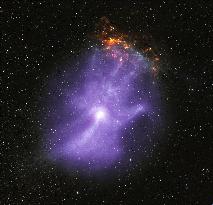
Handout - New composite image showing pulsar wind nebula (referred to as MSH 15-52) resembling a human hand, combining Chandra telescope data (seen in orange (low-energy X-rays), green, and blue (higher-energy X-rays)), while the diffuse purple represents the IXPE X-ray telescope observations. Scientists say they have revealed the "bones" of a ghostly cosmic hand. Two of NASA’s X-ray space telescopes have combined their imaging powers to unveil the magnetic field “bones” of a remarkable hand-shaped structure in space. The space agency says that together these telescopes reveal the behaviour of a dead collapsed star that lives on through plumes of particles of energised matter and antimatter. In 2001, NASA’s Chandra X-ray Observatory first observed the pulsar PSR B1509-58 and revealed that its pulsar wind nebula (referred to as MSH 15-52) resembles a human hand. The pulsar is located at the base of the “palm” of the nebula, while MSH 15-52 is located 16,000 light-years from Earth. Now, NASA’s newest X-ray tele

  •  
NASA X-ray Telescopes Reveal the 'Bones' of a Ghostly Cosmic Hand

NASA X-ray Telescopes Reveal the 'Bones' of a Ghostly Cosmic Hand

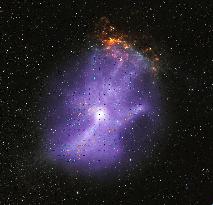
Handout - New composite image showing pulsar wind nebula (referred to as MSH 15-52) resembling a human hand, combining Chandra telescope data (seen in orange (low-energy X-rays), green, and blue (higher-energy X-rays)), while the diffuse purple represents the IXPE X-ray telescope observations. This image shows vectors that represent the magnetic field “bones” revealed by the two X-ray space telescopes. Scientists say they have revealed the "bones" of a ghostly cosmic hand. Two of NASA’s X-ray space telescopes have combined their imaging powers to unveil the magnetic field “bones” of a remarkable hand-shaped structure in space. The space agency says that together these telescopes reveal the behaviour of a dead collapsed star that lives on through plumes of particles of energised matter and antimatter. In 2001, NASA’s Chandra X-ray Observatory first observed the pulsar PSR B1509-58 and revealed that its pulsar wind nebula (referred to as MSH 15-52) resembles a human hand. The pulsar is located at the base of th

  •  
NASA X-ray Telescopes Reveal the 'Bones' of a Ghostly Cosmic Hand

NASA X-ray Telescopes Reveal the 'Bones' of a Ghostly Cosmic Hand

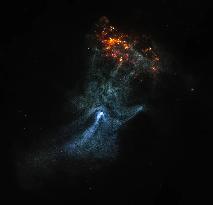
Handout - In 2001, NASA’s Chandra X-ray Observatory first observed the pulsar PSR B1509-58 and revealed that its pulsar wind nebula (referred to as MSH 15-52) resembles a human hand. Scientists say they have revealed the "bones" of a ghostly cosmic hand. Two of NASA’s X-ray space telescopes have combined their imaging powers to unveil the magnetic field “bones” of a remarkable hand-shaped structure in space. The space agency says that together these telescopes reveal the behaviour of a dead collapsed star that lives on through plumes of particles of energised matter and antimatter. In 2001, NASA’s Chandra X-ray Observatory first observed the pulsar PSR B1509-58 and revealed that its pulsar wind nebula (referred to as MSH 15-52) resembles a human hand. The pulsar is located at the base of the “palm” of the nebula, while MSH 15-52 is located 16,000 light-years from Earth. Now, NASA’s newest X-ray telescope, the Imaging X-ray Polarimetry Explorer (IXPE), has observed MSH 15-52 for about 17 days, the longest it h

  •  
James Webb View Of The Ring Nebula

James Webb View Of The Ring Nebula

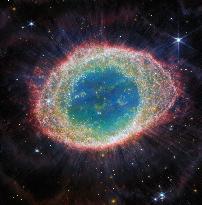
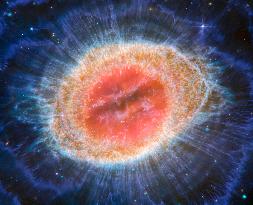
The NASA/ESA/CSA James Webb Space Telescope has observed the well-known Ring Nebula with unprecedented detail. Formed by a star throwing off its outer layers as it runs out of fuel, the Ring Nebula is an archetypal planetary nebula. Also known as M57 and NGC 6720, it is both relatively close to Earth at roughly 2,500 light-years away. This new image provides unprecedented spatial resolution and spectral sensitivity. For example, the intricate details of the filament structure of the inner ring are particularly visible in this dataset. There are some 20,000 dense globules in the nebula, which are rich in molecular hydrogen. In contrast, the inner region shows very hot gas. The main shell contains a thin ring of enhanced emission fromcarbon-based molecules known as polycyclic aromatic hydrocarbons (PAHs). Roughly ten concentric arcs are located just beyond the outer edge of the main ring. The arcs are thought to originate from the interaction of the central star with a low-mass companion orbiting at a distance

  •  
James Webb View Of The Ring Nebula

James Webb View Of The Ring Nebula

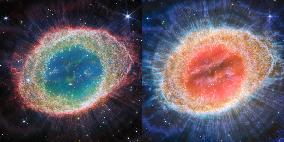
The NASA/ESA/CSA James Webb Space Telescope has observed the well-known Ring Nebula with unprecedented detail. Formed by a star throwing off its outer layers as it runs out of fuel, the Ring Nebula is an archetypal planetary nebula. Also known as M57 and NGC 6720, it is both relatively close to Earth at roughly 2,500 light-years away. This new image provides unprecedented spatial resolution and spectral sensitivity. In particular, Webb’s MIRI (Mid-InfraRed Instrument) reveals particular details in the concentric features in the outer regions of the nebulae’s ring (right). There are some 20,000 dense globules in the nebula, which are rich in molecular hydrogen. In contrast, the inner region shows very hot gas. The main shell contains a thin ring of enhanced emission fromcarbon-based molecules known as polycyclic aromatic hydrocarbons (PAHs). Roughly ten concentric arcs located just beyond the outer edge of the main ring. The arcs are thought to originate from the interaction of the central star with a low-mass

  •  
James Webb View Of The Ring Nebula

James Webb View Of The Ring Nebula

New images from NASA’s James Webb Space Telescope of the well-known Ring Nebula provide unprecedented spatial resolution and spectral sensitivity. In the NIRCam (Near-Infrared Camera) image on the left, the intricate details of the filament structure of the inner ring are particularly visible in this dataset. On the right, the MIRI (Mid-InfraRed Instrument) image reveals particular details in the concentric features in the outer regions of the nebulae’s ring. Photo by ESA/Webb, NASA, CSA, M. Barlow, N. Cox, R. Wesson via CNP/ABACAPRESS.COM

  •  
CHINA-SICHUAN-SCIENCE FICTION-AWARDS (CN)

CHINA-SICHUAN-SCIENCE FICTION-AWARDS (CN)

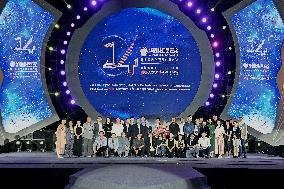
(230514) -- GUANGHAN, May 14, 2023 (Xinhua) -- This photo taken on May 13, 2023 shows the awarding ceremony of the 14th Xingyun (Nebula) Awards for Chinese Science Fiction in Guanghan, southwest China's Sichuan Province. The winners of the 14th Xingyun (Nebula) Awards for Chinese Science Fiction were announced on Saturday in southwest China's Sichuan Province. (Xinhua)

  •  

Exploring new trends of driverless vehicles in Hefei, China

STORY: Exploring new trends of driverless vehicles in Hefei, China DATELINE: Dec. 6, 2022 LENGTH: 00:02:18 LOCATION: HEFEI, China CATEGORY: SOCIETY/TECHNOLOGY SHOTLIST: 1. STANDUP 1 (English): LIU FANGQIANG, Xinhua correspondent 2. various of driverless vehicles 3. SOUNDBITE 1 (Chinese): HE JIJUN, Senior R&D engineer, Beijing Nebula Link Technology Co., Ltd. 4. various of driverless vehicles 5. SOUNDBITE 2 (Chinese): SONG ZHIWEI, President of Singpilot (Anhui) Co., Ltd. 6. SOUNDBITE 3 (Chinese): HU CHANGCHUN, Deputy general manager, Hefei Zhongguancun Intelligent Connected Vehicle Park STORYLINE: STANDUP 1 (English): LIU FANGQIANG, Xinhua correspondent "Autonomous driving has been widely used in China's society today and I tried some of its applications a few days ago, such as the autonomous driving tour bus, autonomous driving delivery vehicle. What else can this technology do in the future? Today, I've come to an autonomous driving technology innovation park in Hefei city, capital of east China's Anhui P

  •  

Journey toward Chinese modernization Ep 4: Harmony between humanity and nature

STORY: Journey toward Chinese modernization Ep 4: Harmony between humanity and nature DATELINE: Nov. 6, 2022 LENGTH: 00:05:11 LOCATION: Beijing CATEGORY: ENVIRONMENT/SOCIETY SHOTLIST: 1. STANDUP 1 (English): ZHANG LI, Xinhua correspondent 2. SOUNDBITE 1 (Chinese): LIU ZUOBIN, CEO of Fujian Nebula Software Technology Co., Ltd. 3. SOUNDBITE 2 (Chinese): Mr LIN, Customer 4. SOUNDBITE 3 (Chinese): Ms LIU, Customer 5. STANDUP 2 (English): ZHANG LI, Xinhua correspondent 6. SOUNDBITE 4 (Chinese): LI CHUNZHAO, Official of water resources bureau in Tianhe District, Guangzhou 7. STANDUP 3 (English): ZHANG LI, Xinhua correspondent 8. SOUNDBITE 5 (Tibetan): CHERE, Herdsman in Golog, Qinghai 9. SOUNDBITE 6 (Chinese): SAMDROP, Herdsman-turned-ranger 10. STANDUP 4 (English): ZHANG LI, Xinhua correspondent 11. SOUNDBITE 7 (Chinese): FENG ZHIHUI, Engineer of the panda-shaped photovoltaic power station STORYLINE: STANDUP 1 (English): ZHANG LI, Xinhua correspondent "Lucid waters and lush mountains are invaluable assets -- th

  •  
U.S.-GREENBELT-JAMES WEBB SPACE TELESCOPE-UNIVERSE-FIRST FULL-COLOR IMAGES

U.S.-GREENBELT-JAMES WEBB SPACE TELESCOPE-UNIVERSE-FIRST FULL-COLOR IMAGES

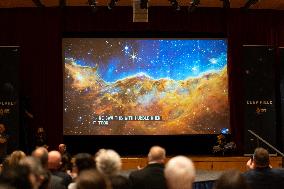
(220712) -- GREENBELT (U.S.), July 12, 2022 (Xinhua) -- The image captured by NASA's James Webb Space Telescope of the star-forming region called NGC 3324 in the Carina Nebula is seen on a screen at NASA's Goddard Space Flight Center in Greenbelt, Maryland, the Untied States, on July 12, 2022. NASA released James Webb Space Telescope's first full-color images of the universe and their spectroscopic data on Tuesday, revealing the unprecedented and detailed views of the universe. (NASA/Taylor Mickal/Handout via Xinhua)

  •  
U.S.-GREENBELT-JAMES WEBB SPACE TELESCOPE-UNIVERSE-FIRST FULL-COLOR IMAGES

U.S.-GREENBELT-JAMES WEBB SPACE TELESCOPE-UNIVERSE-FIRST FULL-COLOR IMAGES

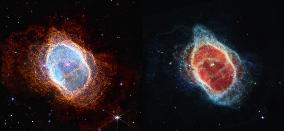
(220712) -- GREENBELT (U.S.), July 12, 2022 (Xinhua) -- Image released by NASA on July 12, 2022 shows a side-by-side comparison of the Southern Ring Nebula in near-infrared light (L) and mid-infrared light (R) from NASA's James Webb Space Telescope. NASA released James Webb Space Telescope's first full-color images of the universe and their spectroscopic data on Tuesday, revealing the unprecedented and detailed views of the universe. (NASA, ESA, CSA, STScI/Handout via Xinhua)

  •  
U.S.-GREENBELT-JAMES WEBB SPACE TELESCOPE-UNIVERSE-FIRST FULL-COLOR IMAGES

U.S.-GREENBELT-JAMES WEBB SPACE TELESCOPE-UNIVERSE-FIRST FULL-COLOR IMAGES

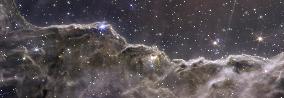
(220712) -- GREENBELT (U.S.), July 12, 2022 (Xinhua) -- Image released by NASA on July 12, 2022 shows a composite image of the Cosmic Cliffs in the Carina Nebula, created with James Webb Space Telescope's NIRCam and MIRI. NASA released James Webb Space Telescope's first full-color images of the universe and their spectroscopic data on Tuesday, revealing the unprecedented and detailed views of the universe. (NASA, ESA, CSA, STScI/Handout via Xinhua)

  •  
U.S.-GREENBELT-JAMES WEBB SPACE TELESCOPE-UNIVERSE-FIRST FULL-COLOR IMAGES

U.S.-GREENBELT-JAMES WEBB SPACE TELESCOPE-UNIVERSE-FIRST FULL-COLOR IMAGES

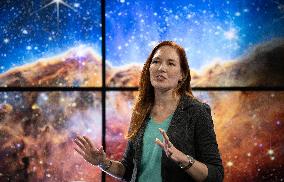
(220712) -- GREENBELT (U.S.), July 12, 2022 (Xinhua) -- NASA James Webb Space Telescope Deputy Project Scientist for Communications Amber Straughn speaks about the infrared image of the star-forming region called NGC 3324 in the Carina Nebula as it is shown on a screen during a broadcast releasing the telescope's first full-color images at NASA's Goddard Space Flight Center in Greenbelt, Maryland, the Untied States, on July 12, 2022. NASA released James Webb Space Telescope's first full-color images of the universe and their spectroscopic data on Tuesday, revealing the unprecedented and detailed views of the universe. (NASA/Bill Ingalls/Handout via Xinhua)

  •  
U.S.-GREENBELT-JAMES WEBB SPACE TELESCOPE-UNIVERSE-FIRST FULL-COLOR IMAGES

U.S.-GREENBELT-JAMES WEBB SPACE TELESCOPE-UNIVERSE-FIRST FULL-COLOR IMAGES

(220712) -- GREENBELT (U.S.), July 12, 2022 (Xinhua) -- Image released by NASA on July 12, 2022 shows the edge of a nearby, young, star-forming region called NGC 3324 in the Carina Nebula. Captured in infrared light by NASA's James Webb Space Telescope, the image reveals for the first time previously invisible areas of star birth. NASA released James Webb Space Telescope's first full-color images of the universe and their spectroscopic data on Tuesday, revealing the unprecedented and detailed views of the universe. (NASA, ESA, CSA, STScI/Handout via Xinhua)

  •  
First light images taken by Japan's 'Subaru' telescope

First light images taken by Japan's 'Subaru' telescope

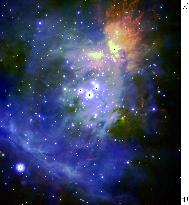
This handout photo of the Orion nebula, released by the National Astronomical Observatory of Japan (NAOJ) on Jan. 29, has been taken using 'Subaru,' one of the world's largest optical-infrared telescopes located in Hawaii. It shows sharp images of four bright stars called Trapezium, which are normally concealed behind gas clouds. The Subaru Telescope, named after the Japanese word for Pleiades, made verifiable observations of objects 5 billion light years away in the Milky Way Galaxy in two hours, compared with the seven hours it took the orbiting Hubble Telescope, NAOJ officials said. ==Kyodo

  •  
Zenon: The Zequel (2001)

Zenon: The Zequel (2001)

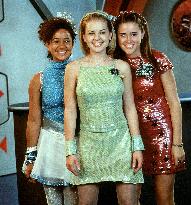
Shadia Simmons, Kirsten Storms, Lauren Maltby Characters: Nebula Wade,Zenon Kar,Margie Hammond Film: Zenon: The Zequel (2001) Director: Manny Coto 12 January 2001 Date: 12 January 2001

  •  
Zenon: The Zequel (2001)

Zenon: The Zequel (2001)

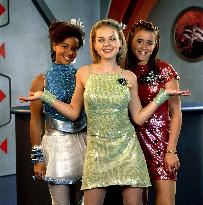
Shadia Simmons, Kirsten Storms & Lauren Maltby Characters: Nebula Wade,Zenon Kar & Margie Hammond Film: Zenon: The Zequel (2001) Director: Manny Coto 12 January 2001 Date: 12 January 2001

  •  
Subaru telescope captures 'halo' of nebula M57

Subaru telescope captures 'halo' of nebula M57

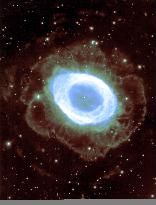
TOKYO, Japan - The National Astronomical Observatory of Japan (NAOJ) released Sept. 17 a picture showing a faint ''halo'' around nebula M57, or the Ring Nebula, some 1,600 light years away from Earth. The Subaru telescope at the summit of Mauna Kea in Hawaii is the first one to successfully capture the halo surrounding the nebula's clear, white outer ring, NAOJ said.

  •  
M42 Orion Nebula

M42 Orion Nebula

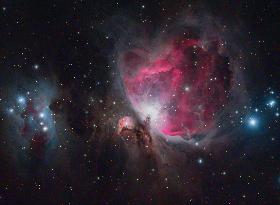
A view of M42 Orion Nebula, Shangri la, Yunnan, China, February 13, 2021.

  •  
Orion Nebula

Orion Nebula

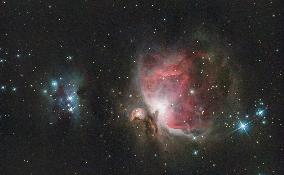
Photo taken on Jan 9, 2021 shows the Orion Nebula in the winter sky above Yangcheng Lake in Suzhou, east China's Jiangsu Province, using a reflecting telescope.

  •  
The Starry Sky

The Starry Sky

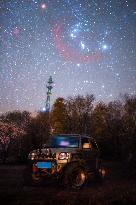
Emission nebula Barnard ring rises with Orion, Anshun City, Guizhou Province, China, October 19, 2020.

  •  
Nagoya Univ. group photographs dark nebula

Nagoya Univ. group photographs dark nebula

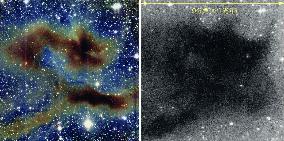
NAGOYA, Japan - A set of two photographs show a dark nebula in the constellation of Lupus. A Nagoya University group said Feb. 8 that it photographed the dark nebula by attaching a near-infrared camera to a telescope at a South African observatory in June 2001. (Photo provided by Nagoya University and National Astronomical Observatory of Japan) (Kyodo)

  •  
Subaru telescope photographs protostars' jets

Subaru telescope photographs protostars' jets

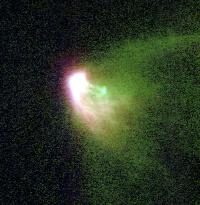
TOKYO, Japan - The National Astronomical Observatory of Japan released Aug. 24 this image of two parallel jets being emitted from a nebula which is 450 light years from Earth and believed to contain two protostars. The image was captured by the Subaru, one of the world's largest optical-infrared telescopes which is located at the summit of the Mt. Mauna Kea in Hawaii.

  • Main
  • Top
  • Editorial
  • Creative
  • About Us
  • About ILG
  • Terms of use
  • Company
  • BEHIND
  • Price List
  • Single Plan
  • Monthly Plan
  • Services
  • Shooting
  • Rights Clearance
  • Support
  • FAQ
  • How To Buy
  • Contact Us
  • Become a Partner

© KYODO NEWS IMAGES INC

All Rights Reserved.

  • Editorial
  • Olympics
  • News
  • Sports
  • Japan
  • Tech
  • Royal
  • Disaster
  • NorthKorea
  • Old Japan
  • SNS
  • Creative
  • Food
  • Japan
  • Landscape
  • Animal
  • Popular
  • #Ukraine
  • #Thailand
  • #coronavirus
  • #N. Korea
  • #China
  • #Russia
  • #Ukraine
  • #Thailand
  • #coronavirus
  • #N. Korea
  • #China
  • #Russia
  • Food
  • Japan
  • Landscape
  • Animal
  • Olympics
  • News
  • Sports
  • Japan
  • Tech
  • Royal
  • Disaster
  • NorthKorea
  • Old Japan
  • SNS