•  
Princess Sayako heads to Imperial Hotel for wedding

Princess Sayako heads to Imperial Hotel for wedding

TOKYO, Japan - A car carrying Princess Sayako crosses the Niju-bashi, or Double Bridge, in the Imperial Palace Nov. 15 on its way to the Imperial Hotel for the wedding of the princess to Tokyo metropolitan government employee Yoshiki Kuroda.

  •  
Imperial Palace tours becoming popular

Imperial Palace tours becoming popular

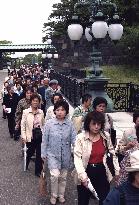
TOKYO, Japan - Visitors cross Niju-bashi, or the Double Bridge, the main gateway to the Imperial Palace in central Tokyo. Tours of the palace are becoming popular this year, the 400th anniversary of the establishment of the Tokugawa shogunate in Edo, the old name for Tokyo. Edo Castle, the seat of the Tokugawa shoguns, stood on the grounds of the palace.

  •  
Princess Sayako heads to Imperial Hotel for wedding

Princess Sayako heads to Imperial Hotel for wedding

TOKYO, Japan - A car carrying Princess Sayako crosses the Niju-bashi, or Double Bridge, in the Imperial Palace Nov. 15 on its way to the Imperial Hotel for the wedding of the princess to Tokyo metropolitan government employee Yoshiki Kuroda. (Kyodo)

  •  
Princess Sayako heads to Imperial Hotel for wedding

Princess Sayako heads to Imperial Hotel for wedding

TOKYO, Japan - A car carrying Princess Sayako crosses the Niju-bashi, or Double Bridge, in the Imperial Palace Nov. 15 on its way to the Imperial Hotel for the wedding of the princess to Tokyo metropolitan government employee Yoshiki Kuroda. (Kyodo)

  •  
Niju-bashi Bridge,the Imperial Palace

Niju-bashi Bridge,the Imperial Palace

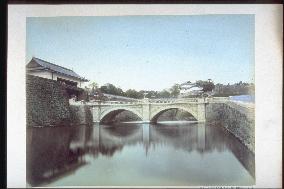
Kakumon Bridge spanning the inner moat (Nijubashi Moat) is said to have been built during the Kansei Period (1789-1801). During the Edo and Meiji Periods, the bridge in the foreground was called Nishinomaru Ote-bashi and the one behind it Nishinomaru Shimojo-bashi. The names currently used by the Imperial House Agency are Imperial Palace Main Gate Stone Bridge and Imperial Palace Main Gate Iron Bridge, respectively. Since 1948, commoners have been allowed to cross these bridges on January 2 and on the Emperor's birthday. Mid-Meiji Period.==Date:unknown, Place:Tokyo, Photo:unknown, (Credit:Nagasaki University Library/Kyodo News Images) [Cabinet Number88‐36‐0]

  •  
Niju-bashi Bridge,the Imperial Palace

Niju-bashi Bridge,the Imperial Palace

Kakumon Bridge spanning the inner moat (Nijubashi Moat) is said to have been built during the Kansei Period (1789-1801). During the Edo and Meiji Periods, the bridge in the foreground was called Nishinomaru Ote-bashi and the one behind it Nishinomaru Shimojo-bashi. The names currently used by the Imperial House Agency are Imperial Palace Main Gate Stone Bridge and Imperial Palace Main Gate Iron Bridge, respectively. Since 1948, commoners have been allowed to cross these bridges on January 2 and on the Emperor's birthday. Mid-Meiji Period.==Date:unknown, Place:Tokyo, Photo:unknown, (Credit:Nagasaki University Library/Kyodo News Images) [Cabinet Number87‐1‐0]

  •  
Niju-bashi Bridge,the Imperial Palace

Niju-bashi Bridge,the Imperial Palace

The gate on the left, called Nishinomaru Ote-mon during the Edo Period, became the main gate of the Imperial Palace in 1889 after the construction of the new palace the previous year. The first gate, Korai-mon, in front of the main gate was later removed and only the Watari Yagura-mon exists today. Mid-Meiji Period.==Date:unknown, Place:Tokyo, Photo:A. Farsari, (Credit:Nagasaki University Library/Kyodo News Images) [Cabinet Number81‐17‐0]

  •  
Niju-bashi Bridge,Edo Castle

Niju-bashi Bridge,Edo Castle

Niju-bashi Bridge,Edo Castle==Date:unknown, Place:Tokyo, Photo:R. Stillfried, (Credit:Nagasaki University Library/Kyodo News Images)

  •  
The Imperial Palace

The Imperial Palace

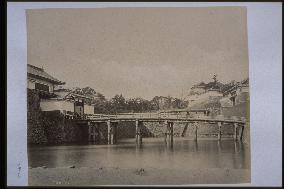
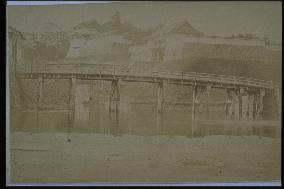
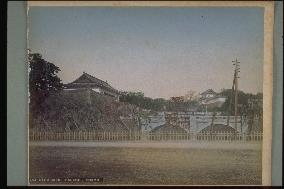
Nishinomaru Ote Bridge and Nishinomaru Shimojo Bridge seen from Nishinomaru Shita (present-day Imperial Palace Outer Garden). Nishinomaru Shimojo Bridge featured rare two-stage girders because of a deep moat. Thus, it was called Niju-bashi (double level bridge). The gate on the left is Nishinomaru Ote-mon. The gate on the right is Nishinomaru Shoinmae-mon. Next to it are Jurokken Tamon and Fushimi watchtower. Taken at the beginning of the Meiji Period.==Date:unknown, Place:Tokyo, Photo:unknown, (Credit:Nagasaki University Library/Kyodo News Images) [Cabinet Number69‐74‐2]

  •  
Niju-bashi Bridge,the Imperial Palace

Niju-bashi Bridge,the Imperial Palace

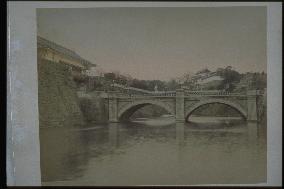
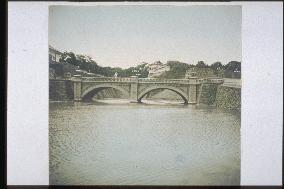
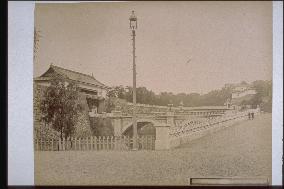
Ote Bridge of Nishinomaru (foreground) was replaced with an arched stone bridge in 1887. Although it is hidden behind the stone bridge, Nishinomaru Shimojo-bashi was replaced with an iron bridge in October 1888 at the time of the construction of new palace buildings. Ornamental lamps were installed for the first time here. (One of these is preserved at the Meiji Village theme park). The present-day Nishinomaru Shimojo-bashi Bridge was rebuilt in a similar design in 1964. The watchtower on the right was transferred from Fushimi Castle in Kyoto and re-named Fushimi Yagura. Mid-Meiji Period.==Date:unknown, Place:Tokyo, Photo:unknown, (Credit:Nagasaki University Library/Kyodo News Images) [Cabinet Number53‐41‐0]

  •  
Niju-bashi Bridge,the Imperial Palace

Niju-bashi Bridge,the Imperial Palace

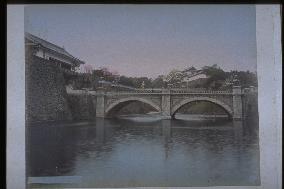
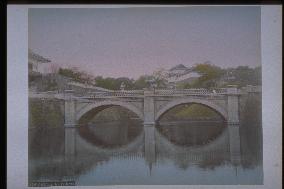
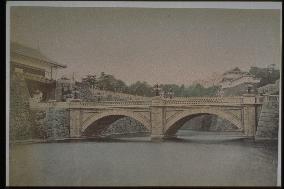
The double arch stone bridge at the front gate of the Imperial Palace, popularly known as the spectacles Megane bridge. Fushimi turret can be seen over the bridge. The so-called double arched bridge is not this stone bridge but the steel bridge of the front gate located at the Fushimi turret.==Date:unknown, Place:Tokyo, Photo:unknown, (Credit:Nagasaki University Library/Kyodo News Images) [Cabinet Number46‐147‐0]

  •  
Niju-bashi Bridge,the Imperial Palace

Niju-bashi Bridge,the Imperial Palace

The double arched bridge of the front gate of the Imperial Palace, popularly known as the Megane bridge (bridge shaped in spectacles). Over the bridge is seen the Fushimi turret. The so-called Niju bridge is not this bridge, but the steel bridge over the Fushimi turret at the front entrance.==Date:unknown, Place:Tokyo, Photo:Kusakabe Kinbei, (Credit:Nagasaki University Library/Kyodo News Images) [Cabinet Number40‐3‐0]

  •  
Niju-bashi Bridge,the Imperial Palace

Niju-bashi Bridge,the Imperial Palace

The stone bridge of the Imperial Palace popularly called Meganebashi (spectacles bridge ). Over the bridge can be seen the Fushimi turret. The so-called Nijubashi is not this bridge but the steel bridge at the front gate where the Fushimi turret stands. The water surface of the moat is hidden by the fenced grounds to the fore.==Date:unknown, Place:Tokyo, Photo:Ogawa Kazumasa, (Credit:Nagasaki University Library/Kyodo News Images) [Cabinet Number25‐50‐0]

  •  
Niju-bashi Bridge,the Imperial Palace

Niju-bashi Bridge,the Imperial Palace

This stone bridge was built after the imperial palace was built. The former bridge was built in the 1614 and was called Nijubashi because the bridge girders were doubled.==Date:unknown, Place:Tokyo, Photo:Ogawa Kazumasa, (Credit:Nagasaki University Library/Kyodo News Images) [Cabinet Number8‐16‐0]

  •  
Niju-bashi Bridge, the Imperial Palace

Niju-bashi Bridge, the Imperial Palace

Niju-bashi Bridge, the Imperial Palace ==Date:Early Meiji, Place:Tokyo, Photo:unknown, (Credit:Nagasaki University Library/Kyodo News Images)

  •  
Imperial Palace tours becoming popular

Imperial Palace tours becoming popular

TOKYO, Japan - Visitors cross Niju-bashi, or the Double Bridge, the main gateway to the Imperial Palace in central Tokyo. Tours of the palace are becoming popular this year, the 400th anniversary of the establishment of the Tokugawa shogunate in Edo, the old name for Tokyo. Edo Castle, the seat of the Tokugawa shoguns, stood on the grounds of the palace. (Kyodo)

  • Main
  • Top
  • Editorial
  • Creative
  • About Us
  • About ILG
  • Terms of use
  • Company
  • BEHIND
  • Price List
  • Single Plan
  • Monthly Plan
  • Services
  • Shooting
  • Rights Clearance
  • Support
  • FAQ
  • How To Buy
  • Contact Us
  • Become a Partner

© KYODO NEWS IMAGES INC

All Rights Reserved.

  • Editorial
  • Olympics
  • News
  • Sports
  • Japan
  • Tech
  • Royal
  • Disaster
  • NorthKorea
  • Old Japan
  • SNS
  • Creative
  • Food
  • Japan
  • Landscape
  • Animal
  • Popular
  • #Ukraine
  • #China
  • #coronavirus
  • #N. Korea
  • #Thailand
  • #Russia
  • #Ukraine
  • #China
  • #coronavirus
  • #N. Korea
  • #Thailand
  • #Russia
  • Food
  • Japan
  • Landscape
  • Animal
  • Olympics
  • News
  • Sports
  • Japan
  • Tech
  • Royal
  • Disaster
  • NorthKorea
  • Old Japan
  • SNS