•  
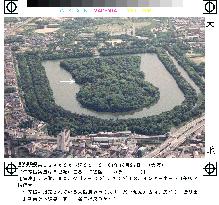
Nintoku tomb built around mid-5th century

Nintoku tomb built around mid-5th century

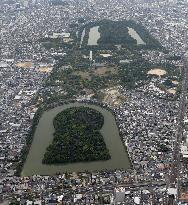
OSAKA, Japan - Fragments of a large jar dating from around the mid-5th century have been found around Japan's largest mound tomb (site shown with arrow), located in Sakai, Osaka Prefecture, that the Imperial Household Agency identifies as the grave of Emperor Nintoku, Kyodo News learned Oct. 27. The mouth of the jar indicates it was made around A.D. 450 at a nearby site called Suemura, according to archaeologists.

  •  
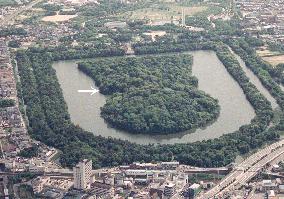
Nintoku tomb built around mid-5th century

Nintoku tomb built around mid-5th century

OSAKA, Japan - Fragments of a large jar dating from around the mid-5th century have been found around Japan's largest mound tomb (site shown with arrow), located in Sakai, Osaka Prefecture, that the Imperial Household Agency identifies as the grave of Emperor Nintoku, Kyodo News learned Oct. 27. The mouth of the jar indicates it was made around A.D. 450 at a nearby site called Suemura, according to archaeologists.

  •  
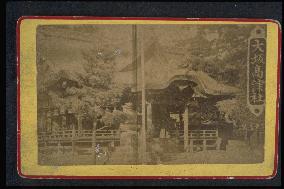
Kozu-sha,Osaka

Kozu-sha,Osaka

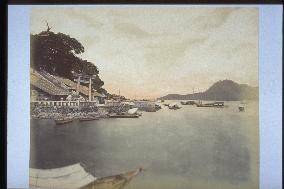
Legend has it that Emperor Nintoku, now enshrined at Takatsu Shinto Shrine, canceled all taxation for a period of three years after noting from the top of this hill that no smoke was coming out of the chimneys of houses below. The shrine is located on the cliff at Ue-machi and commands a panoramic view of the city of Osaka. Probably taken in the second decade of the Meiji Period (1877-1887).==Date:unknown, Place:Osaka, Photo:unknown, (Credit:Nagasaki University Library/Kyodo News Images) [Cabinet Number71‐12‐0]

  •  
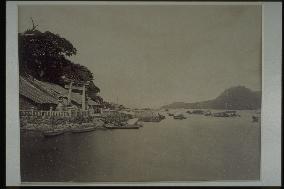
Shimonoseki

Shimonoseki

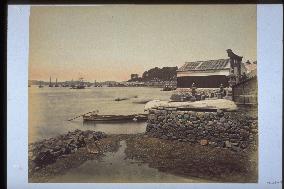
The Kanmon Straits and Kameyama Hachimangu Shrine. Kameyama Hachimangu is dedicated to Emperor Ojin, Emperor Chuai, Empress Jingu and Emperor Nintoku. This was taken by Uchida Kuichi when the photographer accompanied Emperor Meiji on his trip around western Japan in 1872.==Date:1872\r\n, Place:Shimonoseki, Photo:Uchida Kuichi, (Credit:Nagasaki University Library/Kyodo News Images) [Cabinet Number66‐1‐0]

  •  
Shimonoseki

Shimonoseki

The Kanmon Straits and Kameyama Hachimangu Shrine. Kameyama Hachimangu is dedicated to Emperor Ojin, Emperor Chuai, Empress Jingu and Emperor Nintoku. This was taken by Uchida Kuichi when the photographer accompanied Emperor Meiji on his trip around western Japan in 1872.==Date:1872, Place:Shimonoseki, Photo:Uchida Kuichi, (Credit:Nagasaki University Library/Kyodo News Images) [Cabinet Number26‐7‐0]

  •  
Shimonoseki

Shimonoseki

The Kanmon Straits and Kameyama Hachimangu Shrine. Kameyama Hachimangu is dedicated to Emperor Ojin, Emperor Chuai, Empress Jingu and Emperor Nintoku. This was taken by Uchida Kuichi when the photographer accompanied Emperor Meiji on his trip around western Japan in 1872.==Date:1872, Place:Shimonoseki, Photo:Uchida Kuichi, (Credit:Nagasaki University Library/Kyodo News Images) [Cabinet Number26‐10‐0]

  •  
Japan's ancient tombs to become world heritage site

Japan's ancient tombs to become world heritage site

Photo taken April 17, 2019, shows the Emperor Nintoku mausoleum (back), Japan's largest ancient mound, officially called Daisen Kofun, one of the sites collectively called the Mozu-Furuichi tumulus clusters in Osaka Prefecture. UNESCO decided on July 6, 2019, to add the tumulus clusters to the World Heritage list. (Kyodo) ==Kyodo

  •  
Ancient Japanese tombs added to UNESCO World Heritage list

Ancient Japanese tombs added to UNESCO World Heritage list

Osaka Gov. Hirofumi Yoshimura meets the press in Baku, Azerbaijan, on July 6, 2019, after UNESCO decided earlier in the day there to add two tumulus clusters in Osaka Prefecture to the World Heritage list, including the country's largest keyhole-shaped mound named after Emperor Nintoku. (Kyodo) ==Kyodo

  •  
Ancient Japanese tombs added to UNESCO World Heritage list

Ancient Japanese tombs added to UNESCO World Heritage list

Osaka Gov. Hirofumi Yoshimura (C) celebrates in Baku, Azerbaijan, on July 6, 2019, after UNESCO decided earlier in the day there to add two tumulus clusters in Osaka Prefecture to the World Heritage list, including the country's largest keyhole-shaped mound named after Emperor Nintoku. (Kyodo) ==Kyodo

  •  
Ancient Japanese tombs added to UNESCO World Heritage list

Ancient Japanese tombs added to UNESCO World Heritage list

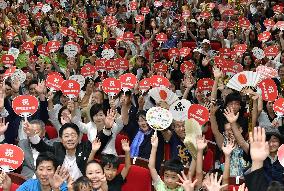
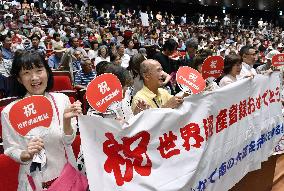
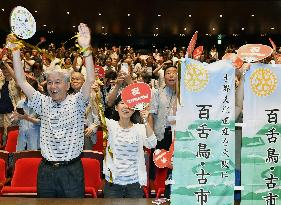
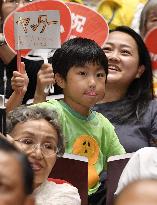
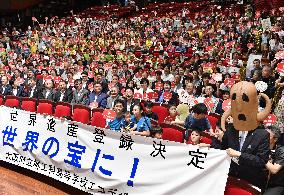
People in the western Japan city of Sakai celebrate on July 6, 2019, after UNESCO decided earlier in the day to add two local tumulus clusters to the World Heritage list, including the country's largest keyhole-shaped mound named after Emperor Nintoku. (Kyodo) ==Kyodo

  •  
Ancient Japanese tombs added to UNESCO World Heritage list

Ancient Japanese tombs added to UNESCO World Heritage list

People in the western Japan city of Sakai celebrate on July 6, 2019, after UNESCO decided earlier in the day to add two local tumulus clusters to the World Heritage list, including the country's largest keyhole-shaped mound named after Emperor Nintoku. (Kyodo) ==Kyodo

  •  
Ancient Japanese tombs added to UNESCO World Heritage list

Ancient Japanese tombs added to UNESCO World Heritage list

People in the western Japan city of Sakai celebrate on July 6, 2019, after UNESCO decided earlier in the day to add two local tumulus clusters to the World Heritage list, including the country's largest keyhole-shaped mound named after Emperor Nintoku. (Kyodo) ==Kyodo

  •  
Ancient Japanese tombs added to UNESCO World Heritage list

Ancient Japanese tombs added to UNESCO World Heritage list

People in the western Japan city of Sakai celebrate on July 6, 2019, after UNESCO decided earlier in the day to add two local tumulus clusters to the World Heritage list, including the country's largest keyhole-shaped mound named after Emperor Nintoku. (Kyodo) ==Kyodo

  •  
Ancient Japanese tombs added to UNESCO World Heritage list

Ancient Japanese tombs added to UNESCO World Heritage list

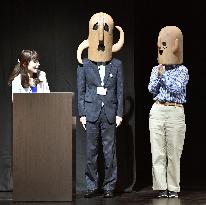
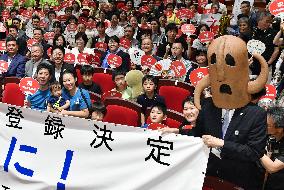
A Sakai city official (C) wearing a "haniwa" -- a clay figure produced during Japan's Kofun period in the 3rd to 6th centuries to decorate tombs for ritual use -- celebrates in the western Japan city on July 6, 2019, after UNESCO decided earlier in the day to add two local tumulus clusters to the World Heritage list, including the country's largest keyhole-shaped mound named after Emperor Nintoku. (Kyodo) ==Kyodo

  •  
Ancient Japanese tombs added to UNESCO World Heritage list

Ancient Japanese tombs added to UNESCO World Heritage list

A Sakai city official wearing a "haniwa" -- a clay figure produced during Japan's Kofun period in the 3rd to 6th centuries to decorate tombs for ritual use -- and people in the western Japan city celebrate on July 6, 2019, after UNESCO decided earlier in the day to add two local tumulus clusters to the World Heritage list, including the country's largest keyhole-shaped mound named after Emperor Nintoku. (Kyodo) ==Kyodo

  •  
Ancient Japanese tombs added to UNESCO World Heritage list

Ancient Japanese tombs added to UNESCO World Heritage list

A Sakai city official wearing a "haniwa" -- a clay figure produced during Japan's Kofun period in the 3rd to 6th centuries to decorate tombs for ritual use -- and people in the western Japan city celebrate on July 6, 2019, after UNESCO decided earlier in the day to add two local tumulus clusters to the World Heritage list, including the country's largest keyhole-shaped mound named after Emperor Nintoku. (Kyodo) ==Kyodo

  •  
Ancient burial mound in Osaka

Ancient burial mound in Osaka

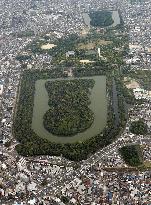
File photo taken May 14, 2019, shows what is said to be Emperor Nintoku's mausoleum in Sakai, Osaka Prefecture, western Japan. A UNESCO advisory panel recommended the previous day adding two clusters of ancient burial mounds in the prefecture, including the grave pictured that is officially called Daisen Kofun, to the World Culture Heritage list, as one of the Mozu-Furuichi tumulus clusters. (Kyodo) ==Kyodo

  •  
Japan's ancient tombs eyed to become world heritage site

Japan's ancient tombs eyed to become world heritage site

Photo taken May 14, 2019, from a Kyodo News helicopter shows the Emperor Nintoku mausoleum, Japan's largest ancient mound, officially called Daisen Kofun, one of the sites collectively called the Mozu-Furuichi tumulus clusters in Osaka Prefecture. Japan's Cultural Affairs Agency said the same day that the tumulus clusters have been recommended for addition to the World Cultural Heritage list by an advisory panel of the U.N. Educational, Scientific and Cultural Organization. (Kyodo) ==Kyodo

  •  
Japan's ancient tombs eyed to become world heritage site

Japan's ancient tombs eyed to become world heritage site

Photo taken May 14, 2019, from a Kyodo News helicopter shows the Emperor Nintoku mausoleum (back), Japan's largest ancient mound, officially called Daisen Kofun, one of the sites collectively called the Mozu-Furuichi tumulus clusters in Osaka Prefecture. Japan's Cultural Affairs Agency said the same day that the tumulus clusters, including Emperor Richu's mausoleum (front), have been recommended for addition to the World Cultural Heritage list by an advisory panel of the U.N. Educational, Scientific and Cultural Organization. (Kyodo) ==Kyodo

  •  
Japan's ancient tombs eyed to become world heritage site

Japan's ancient tombs eyed to become world heritage site

Photo taken May 14, 2019, from a Kyodo News helicopter shows the Emperor Nintoku mausoleum (C), Japan's largest ancient mound, officially called Daisen Kofun, one of the sites collectively called the Mozu-Furuichi tumulus clusters in Osaka Prefecture. Japan's Cultural Affairs Agency said the same day that the tumulus clusters have been recommended for addition to the World Cultural Heritage list by an advisory panel of the U.N. Educational, Scientific and Cultural Organization. (Kyodo) ==Kyodo

  •  
Ancient Japanese mounded tomb

Ancient Japanese mounded tomb

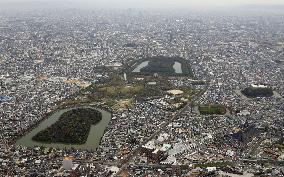
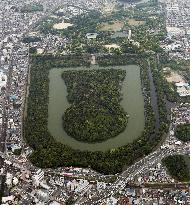
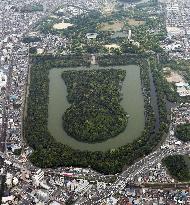
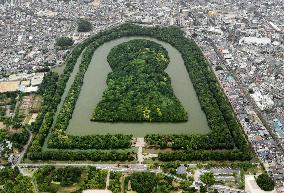
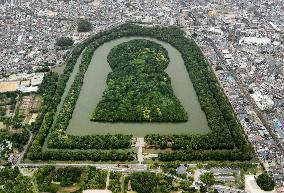
Photo taken in June 2017 shows Daisen Kofun, Japan's largest ancient mounded tomb, built in the fifth century, in Sakai, Osaka Prefecture. It is officially designated as the tomb of Emperor Nintoku. (Kyodo) ==Kyodo

  •  
Japan's largest tomb mound

Japan's largest tomb mound

Photo taken in June 2017 shows Daisen Kofun, Japan's largest ancient mound, in Sakai in Osaka Prefecture, western Japan. The tomb, officially designated as that of Emperor Nintoku and one of the three largest in the world, together with the Mausoleum of the First Qin Emperor in China and the Great Pyramid of Giza in Egypt, was at least 40 meters larger when it was first constructed in the fifth century, the Imperial Household Agency said on April 12, 2018. (Kyodo) ==Kyodo

  • Main
  • Top
  • Editorial
  • Creative
  • About Us
  • About ILG
  • Terms of use
  • Company
  • BEHIND
  • Price List
  • Single Plan
  • Monthly Plan
  • Services
  • Shooting
  • Rights Clearance
  • Support
  • FAQ
  • How To Buy
  • Contact Us
  • Become a Partner

© KYODO NEWS IMAGES INC

All Rights Reserved.

  • Editorial
  • Olympics
  • News
  • Sports
  • Japan
  • Tech
  • Royal
  • Disaster
  • NorthKorea
  • Old Japan
  • SNS
  • Creative
  • Food
  • Japan
  • Landscape
  • Animal
  • Popular
  • #Ukraine
  • #China
  • #coronavirus
  • #N. Korea
  • #Thailand
  • #Russia
  • #Ukraine
  • #China
  • #coronavirus
  • #N. Korea
  • #Thailand
  • #Russia
  • Food
  • Japan
  • Landscape
  • Animal
  • Olympics
  • News
  • Sports
  • Japan
  • Tech
  • Royal
  • Disaster
  • NorthKorea
  • Old Japan
  • SNS