•  
Nishi Otani (Otani Honbyo Mausoleum of Honganji Temple)

Nishi Otani (Otani Honbyo Mausoleum of Honganji Temple)

Nishi Otani (Otani Honbyo Mausoleum of Honganji Temple)==Date:c. 1880, Place:Kyoto, Photo:unknown ,Credit:Nagasaki University Library/Kyodo News Images [Institution Catalog Number:6883]

  •  
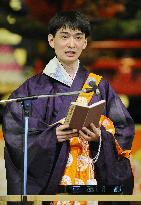
New leader of 'Jodo Shinshu' Buddhist sect gives speech

New leader of 'Jodo Shinshu' Buddhist sect gives speech

KYOTO, Japan - New "Monshu" or leader Kojun Otani of the Honganji-ha sect of the "Jodo Shinshu" (True Pure Land) Buddhist school delivers a speech during a leadership change rite at its Nishi Honganji head temple in Kyoto, western Japan, on June 6, 2014.

  •  
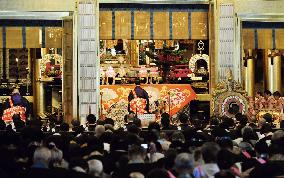
'Jodo Shinshu' Buddhist sect holds rite to have new leader

'Jodo Shinshu' Buddhist sect holds rite to have new leader

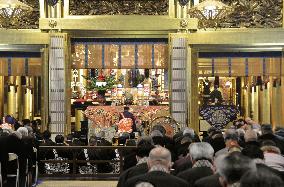
KYOTO, Japan - The Honganji-ha sect of the "Jodo Shinshu" (True Pure Land) Buddhist school holds a ceremony to usher in its new "Monshu" or leader at its Nishi Honganji head temple in Kyoto, western Japan, on June 6, 2014, with new Monshu Kojun Otani sitting in the middle of a chancel in front of an altar.

  •  
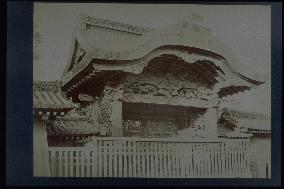
The Tomon Gate of Nishi Honganji Temple

The Tomon Gate of Nishi Honganji Temple

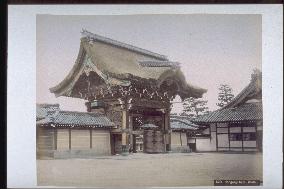
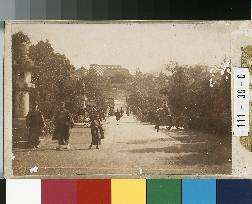
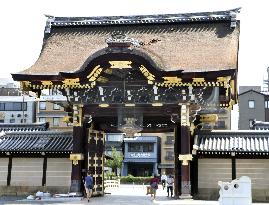
The Karamon Gate of Nishihonganji Temple is seen from the southeast, facing northeast. The four-legged gate facing Kitakoji Street is said to have been moved from Fushimi Castle in the Momoyama Period. The shingled roof is built in karahafu style front and back and in irimoya style left and right. The gate features paneled entrance doors, lintels and frog-leg struts. Carvings of a lion and peony, peacock and pine, kirin and clouds, and dragon and clouds decorate beams. The gate is also called Higuremon and Chokushimon.==Date:unknown, Place:Kyoto, Photo:unknown, (Credit:Nagasaki University Library/Kyodo News Images) [Cabinet Number96‐93‐0]

  •  
Nishi Honganji Temple

Nishi Honganji Temple

The Amida-do (Main Hall) of Nishi Honganji Temple, looking from the north side of the mizubuki gingko tree facing west. The Amida-do was built in 1760 with an east-west width of 38 meters, a north-south width of 42 meters, and a height of 24 meters. The branches of the mizubuki gingko tree are visible. Taken by Felix Beato.==Date:unknown, Place:Kyoto, Photo:F. Beato, (Credit:Nagasaki University Library/Kyodo News Images) [Cabinet Number62‐23‐0]

  •  
Nishi Otani (Otani Honbyo Mausoleum of Honganji Temple)

Nishi Otani (Otani Honbyo Mausoleum of Honganji Temple)

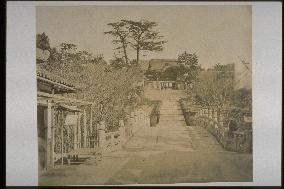
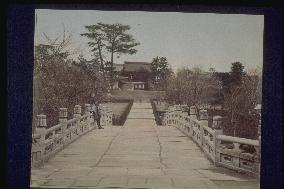
The approach to Nishi-Otani Temple is viewed from the western edge of Entsu Bridge, facing east. There are two giant pine trees by the sanmon gate in the back. This stone bridge was built in 1865. It was referred to as a spectacles bridge because of its shape. It was famous for its red and white lotus flowers in the mid-19th century. There are teahouses with benches on the northwestern edge of the bridge. Taken by F. Beato.==Date:unknown, Place:Kyoto, Photo:F. Beato, (Credit:Nagasaki University Library/Kyodo News Images) [Cabinet Number62‐19‐0]

  •  
Nishi Honganji Temple

Nishi Honganji Temple

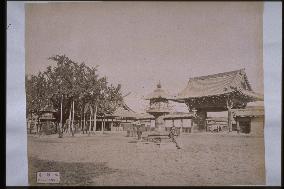
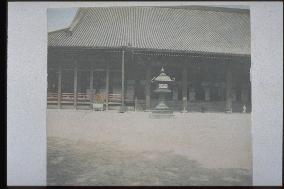
The grounds of Nishi Honganji Temple, looking from the southeastern side of the Goei-do facing northeast. The gate of the Goei-do and a mizubuki gingko tree are depicted on the right and left. A man is leaning against the bronze lantern in the centre. Other people are also present on the temple grounds. The Goei-do is in irimoya style with roof tiles and was built in 1645. The rails of a bridge over Horikawa River are visible beyond the Goei-do gate.==Date:unknown, Place:Kyoto, Photo:unknown, (Credit:Nagasaki University Library/Kyodo News Images) [Cabinet Number52‐28‐0]

  •  
A view of the city from the Otani Main Tomb,Nishi Honganji Temple

A view of the city from the Otani Main Tomb,Nishi Honganji Temple

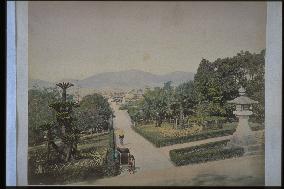
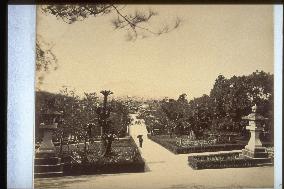
The temple approach is seen from the sanmon gate of Nishi-Otani Temple, facing west. The city of Kyoto and the Nishiyama Mountain Range are visible in the background. A stone lantern stands in front of the gate. The garden is well maintained and has cycad trees. A driver, his rickshaw and a person with an umbrella are visible at the gate. Tall trees are visible to the north.==Date:unknown, Place:Kyoto, Photo:unknown, (Credit:Nagasaki University Library/Kyodo News Images) [Cabinet Number52‐23‐0]

  •  
Nishi Honganji Temple

Nishi Honganji Temple

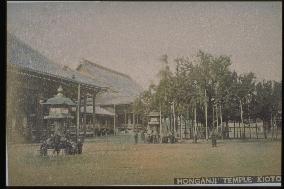
The grounds of Nishi Honganji Temple, looking from the southeastern side of Goei-do facing north-northwest. The buildings are (from the left) the Goei-do (Taishi-do) and Amida-do (Main Hall). A mizubuki gingko tree is visible. The Goei-do was built in 1636 and the Amida-do in 1760. These two buildings are connected by an arcade. Many people, including children, are gathered around the bronze lanterns.==Date:unknown, Place:Kyoto, Photo:unknown, (Credit:Nagasaki University Library/Kyodo News Images) [Cabinet Number52‐9‐0]

  •  
Nishi Honganji Temple

Nishi Honganji Temple

Goei-do of Nishi Honganji Temple, looking from the east side facing west. A bronze lantern is installed at the centre. People can be seen praying in front of the stairs. The Goei-do is also called the Taishi-do and was built in 1636. It is an irimoya-zukuri style building with roof tiles and an east-west width of 45 meters, a north-south length of 57 meters, and a height of 27 meters.==Date:unknown, Place:Kyoto, Photo:unknown, (Credit:Nagasaki University Library/Kyodo News Images) [Cabinet Number46‐111‐0]

  •  
Hiunkaku at Nishi-Honganji Temple

Hiunkaku at Nishi-Honganji Temple

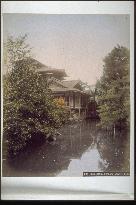
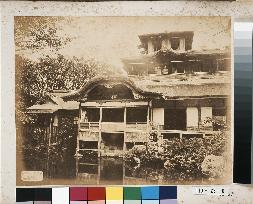
The northwestern part of Hiunkaku at Nishihonganji Temple is viewed from the north side of the pond in Tekisui Garden. Hiunkaku is said to be a part of a mansion built in the Momoyama Period. It is a three-story, cypress-shingle roofed, palace-style building. The north and south sides are about 25.8m long, the east side about 11.8m and the west side about 12.5m. The first story is built in undulating bargeboard style on the left side, and irimoya style on the right.==Date:unknown, Place:Kyoto, Photo:unknown, (Credit:Nagasaki University Library/Kyodo News Images) [Cabinet Number42‐16‐0]

  •  
Gate of Amida-do at Nishi Honganji Temple

Gate of Amida-do at Nishi Honganji Temple

Gate of Amida-do at Nishi Honganji Temple==Date:unknown, Place:Kyoto, Photo:unknown, (Credit:Nagasaki University Library/Kyodo News Images)

  •  
Nishi Otani (Otani Honbyo Mausoleum of Honganji Temple)

Nishi Otani (Otani Honbyo Mausoleum of Honganji Temple)

The compounds of a fairly large shrine. The name of the shrine is unknown. A stone bridge is built over the pond, and beyond that is the main building. A person stands leaning on the girders of the stone bridge, but other than that people are nowhere to be seen. The tranquil nature of the shrine can be felt.==Date:unknown, Place:Kyoto, Photo:unknown, (Credit:Nagasaki University Library/Kyodo News Images) [Cabinet Number37‐9‐0]

  •  
Nishi Otani (Otani Honbyo Mausoleum of Honganji Temple)

Nishi Otani (Otani Honbyo Mausoleum of Honganji Temple)

The tomb of Shinran, founder of Shin Sect, east of Gojo Bridge in the Higashiyama district of Kyoto city. The principal image of the temple is the statue of Shinran. It belongs to Honganji Temple of the Jodoshin Sect, and is called Nishiotani. On both sides of the wide path, there are many tombs in plots with tree fences. A person holds an umbrella on the central path.==Date:unknown, Place:Kyoto, Photo:unknown, (Credit:Nagasaki University Library/Kyodo News Images) [Cabinet Number19‐9‐0]

  •  
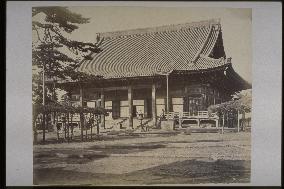
Mido (honarable hall), Nishi Honganji Temple

Mido (honarable hall), Nishi Honganji Temple

Mido (honarable hall), Nishi Honganji Temple==Date:Early Meiji, Place:kyoto, Photo:unknown, (Credit:Nagasaki University Library/Kyodo News Images)

  •  
Nishi Otani (Otani Honbyo Mausoleum of Honganji Temple)

Nishi Otani (Otani Honbyo Mausoleum of Honganji Temple)

Nishi Otani (Otani Honbyo Mausoleum of Honganji Temple)==Date:unknown, Place:Kyoto, Photo:unknown, (Credit:Nagasaki University Library/Kyodo News Images)

  •  
Hiunkaku at Nishi-Honganji Temple

Hiunkaku at Nishi-Honganji Temple

Hiunkaku at Nishi-Honganji Temple==Date:unknown, Place:Kyoto, Photo:unknown, (Credit:Nagasaki University Library/Kyodo News Images)

  •  
Apprentice geiko visit Kyoto temple

Apprentice geiko visit Kyoto temple

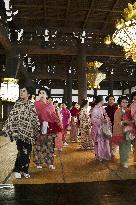
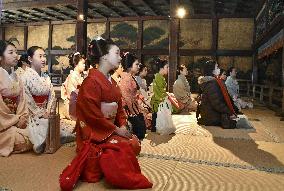
Maiko, or apprentice geiko, visit Nishi Honganji Temple in Kyoto on Feb. 5, 2019, to learn about Kyoto's history and culture. (Kyodo) ==Kyodo

  •  
Apprentice geiko visit Kyoto temple

Apprentice geiko visit Kyoto temple

Maiko, or apprentice geiko, visit Nishi Honganji Temple in Kyoto on Feb. 5, 2019, to learn about Kyoto's history and culture. (Kyodo) ==Kyodo

  •  
Amida statue relocation at Nishi Honganji temple

Amida statue relocation at Nishi Honganji temple

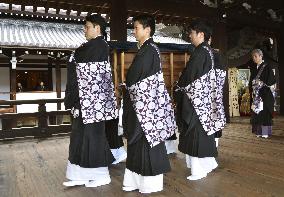
Buddhist monks at Nishi Honganji temple in Kyoto hold a ceremony on Dec. 17, 2018 after a wooden chest containing the Amida statue serving as the temple's principal deity was moved for temporary relocation with the Amidado hall housing the chest, a national treasure, undergoing full-fledged repair. (Kyodo) ==Kyodo

  •  
Amida statue relocation at Nishi Honganji temple

Amida statue relocation at Nishi Honganji temple

Buddhist monks at Nishi Honganji temple in Kyoto on Dec. 17, 2018, carry a wooden chest containing the Amida statue serving as the temple's principal deity for temporary relocation, as the Amidado hall housing the chest, a national treasure, undergoes full-fledged repair. (Kyodo) ==Kyodo

  •  
Powerful typhoon aftermath

Powerful typhoon aftermath

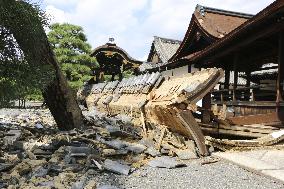
Photo shows the roof of Amidado gate, a Japanese important cultural property, at UNESCO World Heritage-listed Nishi Honganji Temple in Kyoto on Sept. 5, 2018, damaged by powerful Typhoon Jebi that hit western Japan the previous day. (Kyodo) ==Kyodo

  •  
Powerful typhoon aftermath

Powerful typhoon aftermath

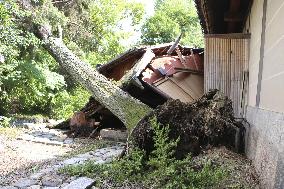
Photo shows a collapsed wall on the southern side of the south Noh stage, a Japanese important cultural property, at UNESCO World Heritage-listed Nishi Honganji Temple in Kyoto on Sept. 5, 2018, a day after powerful Typhoon Jebi hit western Japan. (Kyodo) ==Kyodo

  •  
Powerful typhoon aftermath

Powerful typhoon aftermath

Photo shows a collapsed facility in Tekisuien Garden at UNESCO World Heritage-listed Nishi Honganji Temple in Kyoto on Sept. 5, 2018, a day after powerful Typhoon Jebi hit western Japan. (Kyodo) ==Kyodo

  •  
Silent music festival

Silent music festival

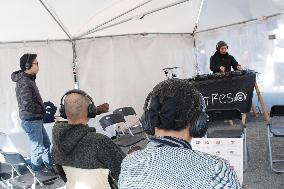
Photo taken in December 2017 shows people at "silent festival," a music event using wireless headphones to make no noise, at the Nishi Honganji temple in Kyoto, western Japan. (Kyodo) ==Kyodo

  •  
National treasure Karamon gate opens for 1st time in 34 years

National treasure Karamon gate opens for 1st time in 34 years

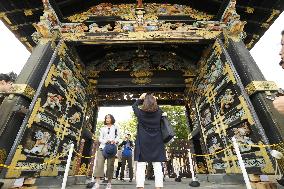
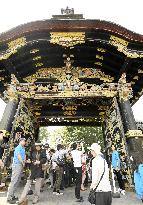
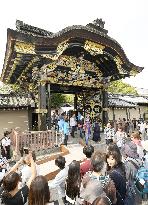
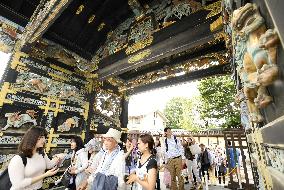
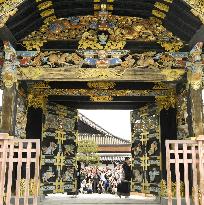
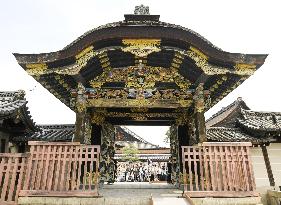
The Karamon, a gate with decorative carvings designated as a national treasure, is opened for the first time since 1983 at the Nishi Honganji temple in Kyoto on May 21, 2017, in a special one-day event. The Karamon, literally meaning "Chinese gate," stands 8.7 meters tall and was built in the late 16th century, according to the temple. (Kyodo) ==Kyodo

  •  
National treasure Karamon gate opens for 1st time in 34 years

National treasure Karamon gate opens for 1st time in 34 years

The Karamon, a gate with decorative carvings designated as a national treasure, is opened for the first time since 1983 at the Nishi Honganji temple in Kyoto on May 21, 2017, in a special one-day event. The Karamon, literally meaning "Chinese gate," stands 8.7 meters tall and was built in the late 16th century, according to the temple. (Kyodo) ==Kyodo

  •  
National treasure Karamon gate opens for 1st time in 34 years

National treasure Karamon gate opens for 1st time in 34 years

The Karamon, a gate with decorative carvings designated as a national treasure, is opened for the first time since 1983 at the Nishi Honganji temple in Kyoto on May 21, 2017, in a special one-day event. The Karamon, literally meaning "Chinese gate," stands 8.7 meters tall and was built in the late 16th century, according to the temple. (Kyodo) ==Kyodo

  •  
National treasure Karamon gate opens for 1st time in 34 years

National treasure Karamon gate opens for 1st time in 34 years

The Karamon, a gate with decorative carvings designated as a national treasure, is opened for the first time since 1983 at the Nishi Honganji temple in Kyoto on May 21, 2017, in a special one-day event. The Karamon, literally meaning "Chinese gate," stands 8.7 meters tall and was built in the late 16th century, according to the temple. (Kyodo) ==Kyodo

  •  
National treasure Karamon gate opens for 1st time in 34 years

National treasure Karamon gate opens for 1st time in 34 years

The Karamon, a gate with decorative carvings designated as a national treasure, is opened for the first time since 1983 at the Nishi Honganji temple in Kyoto on May 21, 2017, in a special one-day event. The Karamon, literally meaning "Chinese gate," stands 8.7 meters tall and was built in the late 16th century, according to the temple. (Kyodo) ==Kyodo

  •  
National treasure Karamon gate opens for 1st time in 34 years

National treasure Karamon gate opens for 1st time in 34 years

The Karamon, a gate with decorative carvings designated as a national treasure, is opened for the first time since 1983 at the Nishi Honganji temple in Kyoto on May 21, 2017, in a special one-day event. The Karamon, literally meaning "Chinese gate," stands 8.7 meters tall and was built in the late 16th century, according to the temple. (Kyodo) ==Kyodo

  •  
National treasures lit up at Kyoto temple

National treasures lit up at Kyoto temple

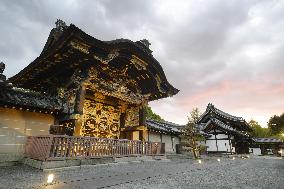
Karamon, a gate designated as a national treasure in the Nishi Honganji temple complex in Kyoto, is lit up on April 24, 2017, in preparation for night opening hours for visitors from the following day. (Kyodo) ==Kyodo

  •  
National treasures lit up at Kyoto temple

National treasures lit up at Kyoto temple

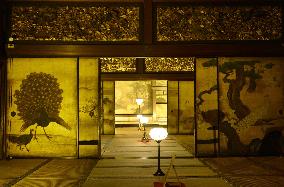
Shoin, a room designated as a national treasure in the Nishi Honganji temple complex in Kyoto, is lit up on April 24, 2017, in preparation for night opening hours for visitors from the following day. (Kyodo) ==Kyodo

  •  
National treasures lit up at Kyoto temple

National treasures lit up at Kyoto temple

Shoin, a room designated as a national treasure in the Nishi Honganji temple complex in Kyoto, is lit up on April 24, 2017, in preparation for night opening hours for visitors from the following day. (Kyodo) ==Kyodo

  •  
National treasures lit up at Kyoto temple

National treasures lit up at Kyoto temple

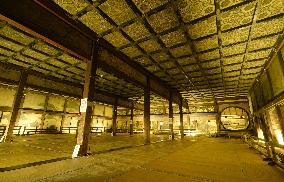
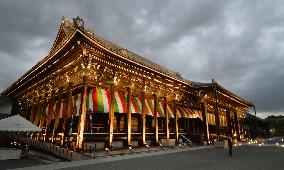
Goeido, a hall designated as a national treasure in the Nishi Honganji temple complex in Kyoto, is lit up on April 24, 2017, in preparation for night opening hours for visitors from the following day. (Kyodo) ==Kyodo

  • Main
  • Top
  • Editorial
  • Creative
  • About Us
  • About ILG
  • Terms of use
  • Company
  • BEHIND
  • Price List
  • Single Plan
  • Monthly Plan
  • Services
  • Shooting
  • Rights Clearance
  • Support
  • FAQ
  • How To Buy
  • Contact Us
  • Become a Partner

© KYODO NEWS IMAGES INC

All Rights Reserved.

  • Editorial
  • Olympics
  • News
  • Sports
  • Japan
  • Tech
  • Royal
  • Disaster
  • NorthKorea
  • Old Japan
  • SNS
  • Creative
  • Food
  • Japan
  • Landscape
  • Animal
  • Popular
  • #Ukraine
  • #China
  • #coronavirus
  • #N. Korea
  • #Thailand
  • #Russia
  • #Ukraine
  • #China
  • #coronavirus
  • #N. Korea
  • #Thailand
  • #Russia
  • Food
  • Japan
  • Landscape
  • Animal
  • Olympics
  • News
  • Sports
  • Japan
  • Tech
  • Royal
  • Disaster
  • NorthKorea
  • Old Japan
  • SNS