•  
Nobi Great Earthquake

Nobi Great Earthquake

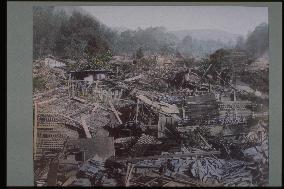
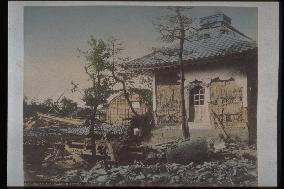
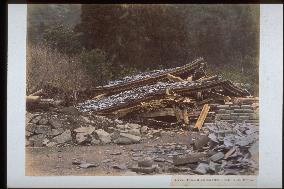
An 8.4 magnitude earthquake struck Japan in 1891. The epicentre was in the Nobi region. The most severe on land in Japan and one of the worst in world history, the earthquake served as a starting point for modern seismology in Japan. A major fault (Neodani Fault) was formed. This photograph depicts the damage caused to a temple in Gifu Prefecture.==Date:unknown, Place:Gifu, Photo:unknown, (Credit:Nagasaki University Library/Kyodo News Images) [Cabinet Number96‐43‐0]

  •  
Nagoya Castle

Nagoya Castle

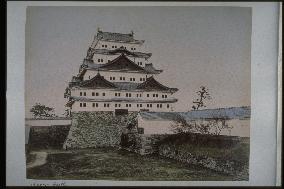
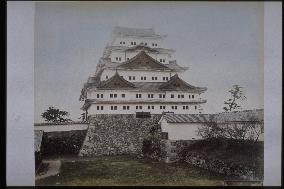
The east side of the dungeon of Nagoya Castle seen from around Higashi Ichi-no-mon (gate). The wall on the left side of the castle tower stretches to a small tower. The building slightly visible on the left is the kitchen of the Honmaru (main donjon) palace. Since the tamon wall to the right was destroyed by the Nobi Earthquake in 1891, this photograph was taken after the golden shachi (mythical carp) were returned to the castle tower top in 1878 but before the earthquake.==Date:unknown, Place:Nagoya, Photo:unknown, (Credit:Nagasaki University Library/Kyodo News Images) [Cabinet Number87‐33‐0]

  •  
Nagoya Castle

Nagoya Castle

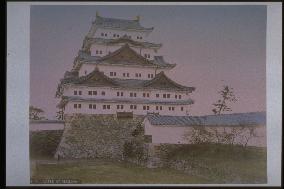
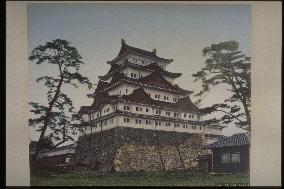
The east side of the dungeon of Nagoya Castle seen from around Higashi Ichi-no-mon (gate). The wall on the left side of the castle tower stretches to a small tower. The building slightly visible on the left is the kitchen of the Honmaru (main donjon) palace. Since the tamon wall to the right was destroyed by the Nobi Earthquake in 1891, this photograph was taken after the golden shachi (mythical carp) were returned to the castle tower top in 1878 but before the earthquake.==Date:unknown, Place:Nagoya, Photo:unknown, (Credit:Nagasaki University Library/Kyodo News Images) [Cabinet Number86‐11‐0]

  •  
Nagoya Castle

Nagoya Castle

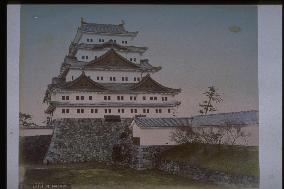
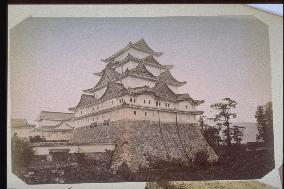
The east side of the dungeon of Nagoya Castle seen from around Higashi Ichi-no-mon (gate). The wall on the left side of the castle tower stretches to a small tower. The building slightly visible on the left is the kitchen of the Honmaru (main donjon) palace. Since the tamon wall to the right was destroyed by the Nobi Earthquake in 1891, this photograph was taken after the golden shachi (mythical carp) were returned to the castle tower top in 1878 but before the earthquake.==Date:unknown, Place:Nagoya, Photo:A. Farsari, (Credit:Nagasaki University Library/Kyodo News Images) [Cabinet Number81‐18‐0]

  •  
Nagoya Castle

Nagoya Castle

The east side of the dungeon of Nagoya Castle seen from around Higashi Ichi-no-mon (gate). The wall on the left side of the castle tower stretches to a small tower. The building slightly visible on the left is the kitchen of the Honmaru (main donjon) palace. Since the tamon wall to the right was destroyed by the Nobi Earthquake in 1891, this photograph was taken after the golden shachi (mythical carp) were returned to the castle tower top in 1878 but before the earthquake.==Date:unknown, Place:Nagoya, Photo:unknown, (Credit:Nagasaki University Library/Kyodo News Images) [Cabinet Number61‐2‐0]

  •  
Nobi Great Earthquake

Nobi Great Earthquake

Nobi Great Earthquake==Date:unknown, Place:Gifu, Photo:unknown, (Credit:Nagasaki University Library/Kyodo News Images)

  •  
Nagoya Castle

Nagoya Castle

The north-northeastern part of the dungeon of Nagoya Castle seen from Ofukemaru. The castle tower is in the centre. Part of the Fumyo Gate and tamon wall are to the left. A small tower is visible in the rear to the right. The building in front stands in Ofukemaru. This photograph was probably taken after 1878, when the golden shachi (mythical carp) were returned to the tower top but before the Nobi Earthquake of 1891.==Date:unknown, Place:Nagoya, Photo:unknown, (Credit:Nagasaki University Library/Kyodo News Images) [Cabinet Number56‐21‐2]

  •  
Nagoya Castle

Nagoya Castle

The northern part of the dungeon of Nagoya Castle seen from Ofukemaru. In the centre is the castle tower. The gate on the left is Fumyo-mon. A small tower is visible in the rear of the castle tower. The partially-visible roof could be the tamon-bei (a long, roofed, timber-frame structure built on a stone faced embankment, running between the corners and turrets of a castle). This photograph was probably taken after 1878, when the golden shachi (mythical carp) were returned to the tower top, but before the Nobi Earthquake of 1891.==Date:unknown, Place:Nagoya, Photo:unknown, (Credit:Nagasaki University Library/Kyodo News Images) [Cabinet Number51‐46‐0]

  •  
Great Nobi Earthquake (rescue station at Okumura)

Great Nobi Earthquake (rescue station at Okumura)

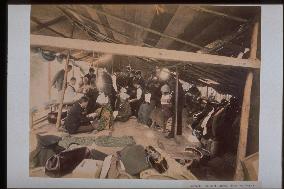
The wounded in the earthquake are treated in the tent. Most of the wounded seem to be women. This is probably immediately after the earthquake.==Date:unknown, Place:Aichi, Photo:Kusakabe Kinbei, (Credit:Nagasaki University Library/Kyodo News Images) [Cabinet Number39‐24‐0]

  •  
Great Nobi Earthquake (destroyed temple at Neomura Midoridani)

Great Nobi Earthquake (destroyed temple at Neomura Midoridani)

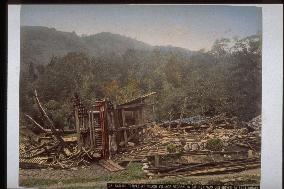
A collapsed temple located in Midori of Neoya village which was the seismic center of the Nobi earthquake. The size of the earthquake was magnitude 8.0 (according to the scientific tables).The collapse was instantaneous.==Date:unknown, Place:Gifu, Photo:Kusakabe Kinbei, (Credit:Nagasaki University Library/Kyodo News Images) [Cabinet Number39‐19‐0]

  •  
Great Nobi Earthquake (exposed strata at Neomura Midoridani)

Great Nobi Earthquake (exposed strata at Neomura Midoridani)

Nobi earthquake took place at 6:37 on October 28, 1891, with the area near Midori of Neo village of Gifu prefecture as the seismic center. It was an enormous earthquake with a magnitude of 8. An approximately 3 meter high dislocation was formed for about 100km at Neoya. This dislocation was designated as a precious natural product in 1952.==Date:unknown, Place:Gifu, Photo:Kusakabe Kinbei, (Credit:Nagasaki University Library/Kyodo News Images) [Cabinet Number39‐18‐0]

  •  
Great Nobi Earthquake (corpses)

Great Nobi Earthquake (corpses)

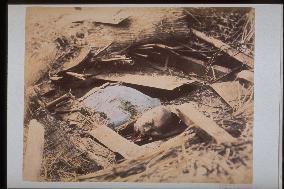
A person dead under the collapsed house. Of the 7,273 deaths in the Nobi earthquake, 4,889 died in Mino, and 2,331 in Owari.==Date:unknown, Place:Gifu, Photo:Kusakabe Kinbei, (Credit:Nagasaki University Library/Kyodo News Images) [Cabinet Number39‐22‐0]

  •  
Great Nobi Earthquake (landslide at Neodani)

Great Nobi Earthquake (landslide at Neodani)

There were more than 10,000 mountains collapsing in the Nobi earthquake disaster. In Neoya village, roads were stopped, and transportation was cut. Prices for daily commodities shot up, and the price of a hyo (straw bag)of salt was 80 sen. (reported in the Gifu Hibi dated November 5).==Date:unknown, Place:Gifu, Photo:Kusakabe Kinbei, (Credit:Nagasaki University Library/Kyodo News Images) [Cabinet Number39‐17‐0]

  •  
Great Nobi Earthquake (rescue station at Okumura)

Great Nobi Earthquake (rescue station at Okumura)

Victims of the Nobi earthquake which took place early in the morning of October 28, 1891. Rice and water etc. are provided at a square.==Date:unknown, Place:Aichi, Photo:Kusakabe Kinbei, (Credit:Nagasaki University Library/Kyodo News Images) [Cabinet Number39‐23‐0]

  •  
Great Nobi Earthquake (new lake at Neomura Midoridani)

Great Nobi Earthquake (new lake at Neomura Midoridani)

Rivers were stopped by mountains collapsing and the ground sinking in many places forming lakes like in this picture, by the Nobi earthquake. So flooding occurred in Neoya, and the inhabitants escaped to higher places.==Date:unknown, Place:Gifu, Photo:Kusakabe Kinbei, (Credit:Nagasaki University Library/Kyodo News Images) [Cabinet Number39‐20‐0]

  •  
Great Nobi Earthquake (inundation of Tenjindo Shrine at Neomura)

Great Nobi Earthquake (inundation of Tenjindo Shrine at Neomura)

Tenjindo is about 5 km upper stream from Midori. According to the caption in the photo, it sunk 30 feet from the usual level. Collapsed houses and families watching them. This sort of scene was seen everywhere. The disaster in Neoya was 675 houses destroyed out of 715, and 142 dead from a population of 3,346, and 290 wounded.==Date:unknown, Place:Gifu, Photo:Kusakabe Kinbei, (Credit:Nagasaki University Library/Kyodo News Images) [Cabinet Number39‐21‐0]

  •  
Great Nobi Earthquake (Kasamatsu Village)

Great Nobi Earthquake (Kasamatsu Village)

Kasamatsu village is the present Kasamatsu-cho of Hashima-gun of Gifu prefecture. There was great disaster here, and the newspaper coverage reports the gravity of the disaster. According to the Jiji dated November 6, there were 555 totally destroyed houses, 29 half destroyed houses, 205 deaths, 382 wounded and 547 fires.==Date:unknown, Place:Gifu, Photo:Kusakabe Kinbei, (Credit:Nagasaki University Library/Kyodo News Images) [Cabinet Number39‐12‐0]

  •  
Great Nobi Earthquake (Enshoji Temple in ruins at Neodani Kinbara)

Great Nobi Earthquake (Enshoji Temple in ruins at Neodani Kinbara)

A collapsed temple located in Kanehara of Neoya village which was the seismic center of the Nobi earthquake. The size of the earthquake was magnitude 8.0 (according to the scientific tables). The tremors could be felt south of Sendai, all over Japan.==Date:unknown, Place:Gifu, Photo:Kusakabe Kinbei, (Credit:Nagasaki University Library/Kyodo News Images) [Cabinet Number39‐15‐0]

  •  
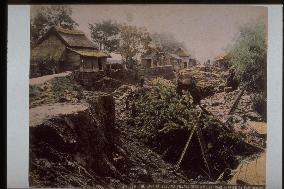
Great Nobi Earthquake (exposed strata at Neodani Kinbara)

Great Nobi Earthquake (exposed strata at Neodani Kinbara)

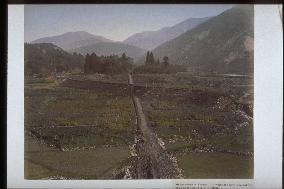
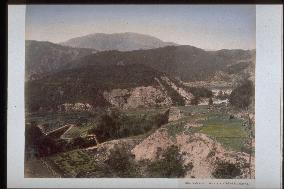
The slope of the mountain on the opposite side has collapsed, and the paddy field before harvest has been gouged. The Gifu Hibi dated November 5 reports that The paddy fields have either sunk or have been ripped open, so with the ground uneven, water cannot be kept, without hope for next years rice crops.==Date:unknown, Place:Gifu, Photo:Kusakabe Kinbei, (Credit:Nagasaki University Library/Kyodo News Images) [Cabinet Number39‐16‐0]

  •  
Great Nobi Earthquake (Kitagata)

Great Nobi Earthquake (Kitagata)

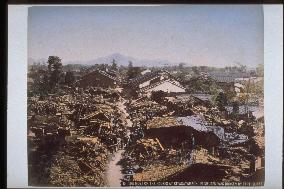
The tragic state of the Kitagata cho of Motosugun of Gifu prefecture which was near the seismic center. According to the Gifu Hibi (Gifu Daily), In Motosugun, several thousand houses were destroyed, Naka aza Nakamachi of Kitagata-cho has been totally destroyed, and there are no cities without houses destroyed, and several hundred are dead. The photo is a view of the east from the west (in the direction of Gifu).==Date:unknown, Place:Gifu, Photo:Kusakabe Kinbei, (Credit:Nagasaki University Library/Kyodo News Images) [Cabinet Number39‐13‐0]

  •  
Great Nobi Earthquake (devastated village)

Great Nobi Earthquake (devastated village)

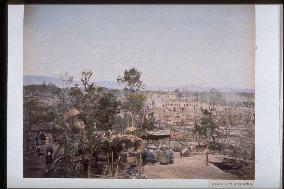
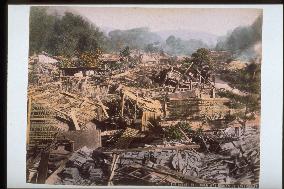
The disaster of the Nobi earthquake reached 142,177 fully destroyed houses, 18,184 half destroyed houses, and 7,273 deaths. The disaster ranged in the 6 prefectures of Gifu, Aichi, Fukui, Ishikawa, Shiga and Mie. By this earthquake, study of seismology began in Japan.==Date:unknown, Place:Gifu, Photo:Kusakabe Kinbei, (Credit:Nagasaki University Library/Kyodo News Images) [Cabinet Number39‐11‐0]

  •  
Great Nobi Earthquake (house fallen into Ogaki River)

Great Nobi Earthquake (house fallen into Ogaki River)

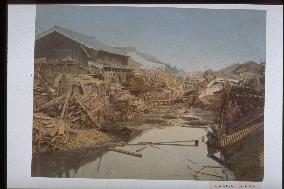
A collapsed house in the river (Suimon River, perhaps) flowing through the city of Ogaki. A great fire broke out in Ogaki after the earthquake, which burnt 70% of the city. Many wounded who were crying for help under the collapsed houses died in the fire.==Date:unknown, Place:Gifu, Photo:Kusakabe Kinbei, (Credit:Nagasaki University Library/Kyodo News Images) [Cabinet Number39‐14‐0]

  •  
Great Nobi Earthquake (Ogaki Wakamori Village)

Great Nobi Earthquake (Ogaki Wakamori Village)

According to the Gifu Hibi (Gifu Daily), in Ogaki, 90% of the houses were destroyed, with 70% burnt by catching fire from all directions, and the whole city seems to have been destroyed. The disaster in Ogaki is reported to be 3,356 fully destroyed houses, 962 half-destroyed houses, 789 dead, 1,270 wounded, and 1,473 fires. In the Jiji dated November 6.==Date:unknown, Place:Gifu, Photo:Kusakabe Kinbei, (Credit:Nagasaki University Library/Kyodo News Images) [Cabinet Number39‐7‐0]

  •  
Great Nobi Earthquake (Kuroda Village)

Great Nobi Earthquake (Kuroda Village)

The tragic aftermath of the Nobi earthquake which took place on October 28, 1891. Pillars tumble by the strong shakes, and the thatched roof squashes the whole house. Mother and child stand at a loss having survived the earthquake.==Date:unknown, Place:Aichi, Photo:Kusakabe Kinbei, (Credit:Nagasaki University Library/Kyodo News Images) [Cabinet Number39‐9‐0]

  •  
Great Nobi Earthquake (embankment of Nagara River)

Great Nobi Earthquake (embankment of Nagara River)

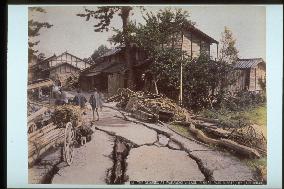
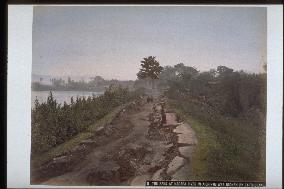
The Nobi earthquake of 1891 had a magnitude 8.4, of the greatest size. The ground shook and was ripped open for 150km from Nagoya to Fukui. The Nagara River embankment had a long crevice as seen in this picture.==Date:unknown, Place:Aichi, Photo:Kusakabe Kinbei, (Credit:Nagasaki University Library/Kyodo News Images) [Cabinet Number39‐10‐0]

  •  
Great Nobi Earthquake (Ichinomiya Village)

Great Nobi Earthquake (Ichinomiya Village)

A father and child keep themselves from rain and wind in a simple hut built in front of their destroyed house in the Nobi earthquake. In front of them are cups, water pails and kettles. This may be a scene several days after the earthquake.==Date:unknown, Place:Aichi, Photo:Kusakabe Kinbei, (Credit:Nagasaki University Library/Kyodo News Images) [Cabinet Number39‐8‐0]

  •  
Great Nobi Earthquake (Ichinomiya Village)

Great Nobi Earthquake (Ichinomiya Village)

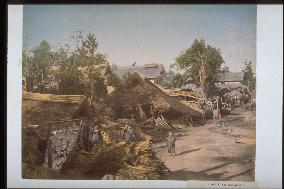
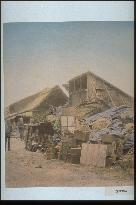
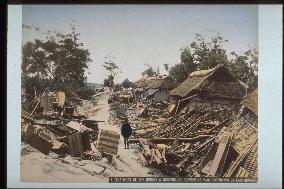
The houses and grounds in the Ichinomiya district (to the west of Nobi Plains)that were destroyed in the Nobi earthquake of 1891. A person stands at a loss in the center. This earthquake was the biggest in magnitude in the inner region of Japan, and many roads, embankment and mountains collapsed.==Date:unknown, Place:Aichi, Photo:Kusakabe Kinbei, (Credit:Nagasaki University Library/Kyodo News Images) [Cabinet Number39‐6‐0]

  •  
Great Nobi Earthquake (Biwajima Bridge)

Great Nobi Earthquake (Biwajima Bridge)

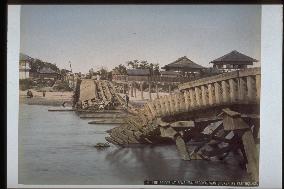
The bridge in Biwajima of Nagoya city that collapsed in the Nobi earthquake of 1891. Biwajima was a market place for fresh vegetables from the time when the town at the foot of the Nagoya castle was established, and many commodities were sold there.==Date:unknown, Place:Nagoya, Photo:Kusakabe Kinbei, (Credit:Nagasaki University Library/Kyodo News Images) [Cabinet Number39‐4‐0]

  •  
Great Nobi Earthquake (embankment at Ebijima Village)

Great Nobi Earthquake (embankment at Ebijima Village)

The embankment in the village (the caption Ebijima is nowhere to be found) near Nagoya city that collapsed in the Nobi earthquake of 1891. The disaster of this earthquake was immense, with 85,848 houses destroyed, and 7,469 dead.==Date:unknown, Place:Nagoya, Photo:Kusakabe Kinbei, (Credit:Nagasaki University Library/Kyodo News Images) [Cabinet Number39‐5‐0]

  •  
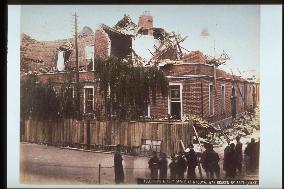
Great Nobi Earthquake (post office)

Great Nobi Earthquake (post office)

The telecommunications office in Nagoya that collapsed in the Nobi earthquake of 1891, and people watching it. The tragic state of the building tells us the terrible extent of earthquake at magnitude 8.4.==Date:unknown, Place:Nagoya, Photo:Kusakabe Kinbei, (Credit:Nagasaki University Library/Kyodo News Images) [Cabinet Number39‐3‐0]

  •  
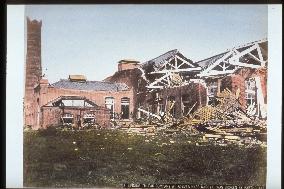
Great Nobi Earthquake (spinning factory near Atsuda)

Great Nobi Earthquake (spinning factory near Atsuda)

The textile factory in Atsuta-ku of Nagoya City that collapsed in the Nobi earthquake of 1891. In this area, modern factories were built, and this Owari Textiles (established in 1887) and vehicle and weapon factories were bustling.==Date:unknown, Place:Nagoya, Photo:Kusakabe Kinbei, (Credit:Nagasaki University Library/Kyodo News Images) [Cabinet Number39‐2‐0]

  •  
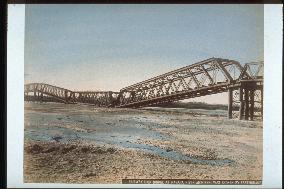
Great Nobi Earthquake (iron bridge over Nagara River on Tokaido Main Line)

Great Nobi Earthquake (iron bridge over Nagara River on Tokaido Main Line)

The Nagara River Steel bridge destroyed in the Nobi earthquake. Three spans out of five collapsed. This steel bridge was designed by the Englishman C.A.W. Pownall, and was completed in January of 1888. It was the biggest in size among the bridges for the railway in Japan at the time.==Date:unknown, Place:Gifu, Photo:Kusakabe Kinbei, (Credit:Nagasaki University Library/Kyodo News Images) [Cabinet Number39‐1‐0]

  •  
Fujiko F. Fujio Museum in Japan's Kawasaki

Fujiko F. Fujio Museum in Japan's Kawasaki

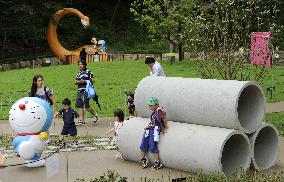
Children play on the rooftop of the Fujiko F. Fujio Museum in the suburbs of Kawasaki near Tokyo on its opening day Sept. 3, 2011. Fujiko F. Fujio is known as the creator of the popular "Doraemon" manga series about a robotic cat from the 22nd century who travels back in time to help a boy named Nobita Nobi. The museum has on its rooftop a replica of the "open ground" that often appears in the manga series as a place for Doraemon characters to gather. (Kyodo) ==Kyodo

  •  
Fujiko F. Fujio Museum in Japan's Kawasaki

Fujiko F. Fujio Museum in Japan's Kawasaki

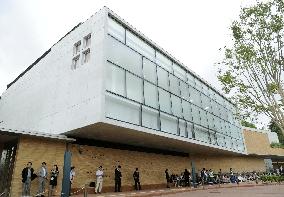
The Fujiko F. Fujio Museum opens in the suburbs of Kawasaki near Tokyo on Sept. 3, 2011. Fujiko F. Fujio is the creator of many popular manga series, including "Doraemon," a robotic cat from the 22nd century who travels back in time to help a boy named Nobita Nobi. (Kyodo) ==Kyodo

  • Main
  • Top
  • Editorial
  • Creative
  • About Us
  • About ILG
  • Terms of use
  • Company
  • BEHIND
  • Price List
  • Single Plan
  • Monthly Plan
  • Services
  • Shooting
  • Rights Clearance
  • Support
  • FAQ
  • How To Buy
  • Contact Us
  • Become a Partner

© KYODO NEWS IMAGES INC

All Rights Reserved.

  • Editorial
  • Olympics
  • News
  • Sports
  • Japan
  • Tech
  • Royal
  • Disaster
  • NorthKorea
  • Old Japan
  • SNS
  • Creative
  • Food
  • Japan
  • Landscape
  • Animal
  • Popular
  • #Ukraine
  • #Thailand
  • #coronavirus
  • #N. Korea
  • #Russia
  • #China
  • #Ukraine
  • #Thailand
  • #coronavirus
  • #N. Korea
  • #Russia
  • #China
  • Food
  • Japan
  • Landscape
  • Animal
  • Olympics
  • News
  • Sports
  • Japan
  • Tech
  • Royal
  • Disaster
  • NorthKorea
  • Old Japan
  • SNS