•  
Japan mulled possessing nuke weapons in 1958

Japan mulled possessing nuke weapons in 1958

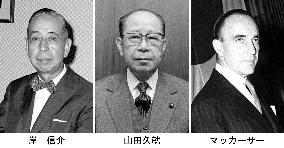
TOKYO, Japan - Photo shows (from L) former Japanese Prime Minister Nobusuke Kishi, former Japanese Vice Foreign Minister Hisanari Yamada and former U.S. Ambassador to Japan Douglas MacArthur II. Japanese officials in 1958 discussed an option for the country to possess ''defensive'' nuclear weapons as protection against the Soviet Union during the Cold War, and conveyed those talks to the United States, declassified U.S. archives showed March 16, 2013. That year, MacArthur told a meeting with U.S. defense and state department officials that then Japanese Prime Minister Kishi believed it was ''essential'' for Japan to have nuclear arsenals and Yamada, then Japan's vice foreign minister, told the envoy that Japanese Foreign Ministry officials discussed whether Tokyo should study and reach a decision on acquiring defensive nuclear weapons.

  •  
Abe acknowledges responsibility of Kishi, other wartime leaders

Abe acknowledges responsibility of Kishi, other wartime leaders

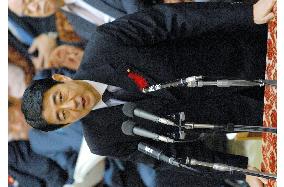
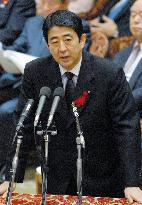
TOKYO, Japan - Prime Minister Shinzo Abe speaks during a House of Representatives Budget Committee session at the Diet in Tokyo on Oct. 5. During the session, Abe acknowledged the war responsibility of his grandfather, the late former Prime Minister Nobusuke Kishi, and Japan's other wartime leaders.

  •  
Prime Minister Koizumi watches Japan Derby

Prime Minister Koizumi watches Japan Derby

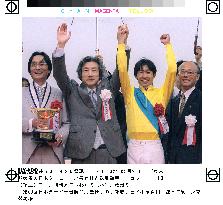
TOKYO, Japan - Prime Minister Junichiro Koizumi raises his hands with Yutaka Take, the winning jockey of the Japan Derby, at the Tokyo Racecourse on May 26. Koizumi was the second prime minister to watch the Japan Derby following the late Prime Minister Nobusuke Kishi.

  •  
Nobusuke Kishi

Nobusuke Kishi

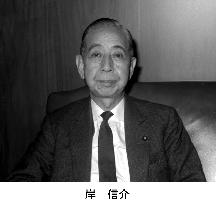
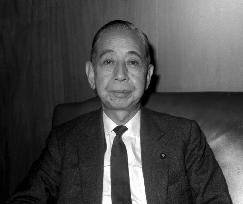
Born Nov. 13, 1896 in Yamaguchi Prefecture and deceased on Aug. 7, 1987. Kishi was a bureaucrat-turned politician who served as prime minister between 1957 and 1960. As a member of the cabinet of Hideki Tojo from 1941 to 1944, Kishi was in charge of Japan's economic mobilization in the war against the U.S. Though imprisoned by the occupation authorities as a class-A war criminal, he was released in 1948. As prime minister, Kishi signed the revised Japan-U.S. Security Treaty in 1960. Kishi had great influence in Japan's conservative political community until he died at the age of 90. His younger brother Eisaku Sato also served as prime minister. (Photo was taken on Dec. 23, 1964)

  •  
Funeral for ex-Japan PM Kishi+

Funeral for ex-Japan PM Kishi+

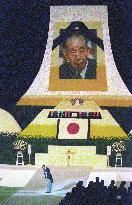
TOKYO, Japan, Nov. 17 Kyodo - Japanese Prime Minister Yasuhiro Nakasone bows after giving a memorial address for former Prime Minister Nobusuke Kishi at his funeral sponsored jointly by the ruling Liberal Democratic Party and the Cabinet at the Nippon Budokan hall in Tokyo on Sept. 17, 1987.

  •  
Abe acknowledges responsibility of Kishi, other wartime leaders

Abe acknowledges responsibility of Kishi, other wartime leaders

TOKYO, Japan - Prime Minister Shinzo Abe speaks during a House of Representatives Budget Committee session at the Diet in Tokyo on Oct. 5. During the session, Abe acknowledged the war responsibility of his grandfather, the late former Prime Minister Nobusuke Kishi, and Japan's other wartime leaders. (Kyodo)

  •  

1958 News Highlights

The Middle East crisis, the Nautilus submarine successfully dives into the North Pole, the Antarctic research expedition, the damage caused by Typhoon No. 22, the Nankai Maru and All Nippon Airways disasters, the bloody scandals over work reviews, the Bolshoi Circus, Paul Anka visits Japan, and the rockabilly whirlwind. The Bolshoi Circus, Paul Anka, and a whirlwind of rockabilly. Shooting date unknown, release date: December 26, 1958.

  •  

The Second Report of Typhoon Ise Bay

Typhoon Ise Bay left behind unprecedented damage, with over 5,000 dead and 100 billion yen in damage. People living in houses submerged in water Evacuees calling for mass evacuation People boarding helicopters People boarding boats Crowded evacuation centers People praying People praying People eating at evacuation centers People infected with contagious diseases Wandering people Women searching for the bodies of their relatives Relief supplies being transported Prime Minister Kishi receiving a petition His Imperial Highness the Crown Prince visiting his wife The levee destroyed by the storm surge, footage of an experiment to verify the strength of the storm surge in a V-shaped bay, and a person rowing a boat.

  •  

Prime Minister Kishi returns

Prime Minister Kishi returns to Haneda Airport after his visit to Southeast Asia. Date of shooting unknown, release date: December 13, 1957.

  •  

History in Japan

In 1960, the Kishi Cabinet forced a vote on the new Security Treaty, causing the public to lose faith in politics. Prime Minister Sato, who criticized the Ikeda cabinet for doubling income, also recorded the lowest approval rating. Prime Minister Tanaka's remodeling of the Japanese archipelago caused land prices to soar. The film shows a burnt-out field after the end of the war in August 1945, scenes of postwar trains and ships, the outbreak of the Korean War in June 1950, a woman crying while clinging to a corpse, soldiers marching, Nobusuke Kishi signing the new Japan-U.S. Security Treaty, the confusion in the Diet after a forced vote, clashes between police and protesters against the Security Treaty, a commemorative photo shoot for the inauguration of the Ikeda Cabinet, people seeking jobs, young people, and the outbreak of the Korean War.. shooting date unknown, release date: March 16, 1973.

  •  

Launch of the Self-Defense Forces

Inauguration of the Self-Defense Forces      Shigeru Yoshida riding in a car, the National Police Reserve, a confused Diet, the inauguration of the Self-Defense Forces, Prime Minister Kishi  *Filming date unknown, Release date: July 1, 1954.

  •  

Ikeda's new cabinet is born.

Hayato Ikeda wins the election for the presidency with a low profile, and announces the list of ministers in a short time. The new Ikeda cabinet is inaugurated, including Mr. Hayato Ikeda, who wins the runoff election, Mr. Nobusuke Kishi, who is attacked by thugs, and Chief Cabinet Secretary Ohira, who announces the ministerial list..

  •  

Eight Days of Turbulence: The Natural Approval of the New Security Treaty

A wave of 300,000 people demonstrate at the National Diet; the treaty is naturally enacted on June 19;  a general strike by the General Council of Trade Unions on June 22. The LDP tries to open the meeting and the Socialist Party blocks it; 300,000 demonstrators fill the area around the Diet; Prime Minister Nobusuke Kishi returns home exhausted when the new security treaty is naturally passed; the streets are littered with scraps of paper; Ike welcomes the South Koreans; the LDP secretly holds a meeting of the House of Councillors and the security treaty is passed in a few minutes; the 19th round of united action and all urban traffic is stopped. The film's shooting date is unknown, release date: June 17, 1960.

  •  

Last Stand: The New Security Treaty

Parliamentary turmoil. A procession of 120,000 opposition petitions to the National Diet. Zengakuren clashes with police. The opposition parties make noise in the Diet, Chairman Ozawa tries to take the chair, the Socialist Party declares a state of emergency and calls for a halt to the revision of the Security Treaty, the LDP tries to bring the issue to a vote, but the anti-mainstream faction opposes it, Chairman Kiyose presents a mediation plan in collaboration with the Democratic Socialist Party, questions and answers in the Diet, a long line of people with petitions in their hands in the Diet, students of the All-Japan Federation of Student Associations rush into the Diet. Students of the All-Japan Federation of Student Self-Government Associations (ZENKAKU RENGO) trying to raid the Diet. They climb over the barricades of armored vehicles and clash with police forces. The film's shooting date is unknown, release date: April 29, 1960.

  •  

Kishi's Cabinet in a Tight situation

LDP forces through new security treaty with cops, protesters rush to the official residence. Prime Minister Kishi is cornered by mainstream protesters and anti-mainstream protesters demanding his resignation. Prime Minister Nobusuke Kishi is cornered by vague mainstream factions and anti-mainstream factions demanding his resignation, and Chairman Asanuma Inetsujiro demands the resignation and dissolution of the Cabinet. The Prime Minister Kishi is cornered by the vague mainstream faction and the anti-mainstream faction demanding his resignation.

  •  

Stepping stone holiday

Suruga Road is a scent of flowers and tea. The thundering people of Hakone. May Day is all about opposition to the National Security Treaty (NISA). 46 years ago, during the Golden Week holidays, we recorded topics from all over Japan. It seems that even though times have changed, the people's love for events has not changed. In this video, we see a scene of tea picking in Shizuoka Prefecture, gifts from various places to the areas affected by Typhoon Vera (Isewan Typhoon), the Thunder People and the Drive People in Hakone, a carnival of pointy hats in Tomakomai, Hokkaido, 600,000 people participate in the Central May Day, portable shrines are carried out in a protest march, and the Diet is held even on consecutive holidays to revise the Security Treaty. The date of shooting is unknown, the date of release: May 6, 1960.

  •  

People on Security

Japan-U.S. Security Treaty revised, Socialist Party split, 100-billion-yen fighter jet.  Prime Minister Kishi on a PR mission before the extraordinary Diet session, the UN Day parade, Kono's farewell party to the U.S., the Diet members' meeting, the Socialist Party's split into the Nishio faction and its own parliamentary activities, the debate over whether to use Lockheed or Grumman fighter jets, local people  clapping their hands at reconstruction work in areas hit by the Self-Defense Forces disaster, the big autumn exercise in Miyagi Prefecture, Asanuma's speech at the extraordinary Diet session. Date of shooting unknown, release date: October 30, 1959.

  •  

The signing of the New Security Treaty before the National Assembly's ratification

After the signing of the new security treaty, 12,000 people are mobilized to welcome Prime Minister Suehiro Nishio at Haneda Airport, and the new Nishio Party is established as the Democratic Socialist Party.   Prime Minister Nobusuke Kishi and his plenipotentiaries emerge from the plane, Prime Minister Kishi holds a press conference, the Democratic Socialist Party is born, and Prime Minister Kishi promotes the new security treaty at the LDP convention.

  •  

The Back Road to the Signing

The All-Japan Federation of Student Self-Defense Forces (Zengakuren) barricades itself in the airport to prevent Prime Minister kishi Nobusuke from signing the new security treaty. The All-Japan Federation of Student Organizations (AJF) barricades itself in the airport, students are arrested by the police, wooden swords, eye-blinkers, and Japanese swords are seized from a right-wing truck. From the Prime Minister's official residence, a plenipotentiary of Prime Minister Kishi's delegation, surrounded by security guards, traveled to Haneda Airport through back streets, directly onto the runway, and then to Washington. The film was shot on an unknown date, and was released on January 22, 1960.

  •  

Pros and Cons of the Security Treaty Amendment

An active movement is now underway over the pros and cons of revising the Security Treaty. The film features a meeting of the Liberal Democratic Party, a street preaching session by Mr. Inejiro Asanuma of the Socialist Party, a trip to Germany by Prime Minister Nobusuke Kishi, a study meeting of the Kono Faction on the Security Treaty, a meeting of a right-wing group, and a demonstration. Date of shooting unknown, Release date: July 31, 1959.

  •  
(1)Nobusuke Kishi

(1)Nobusuke Kishi

TOKYO, Japan - Nobusuke Kishi (L) takes a smoke at the official residence of his brother Eisaku Sato, the chief cabinet secretary, after he was released from Sugamo Prison. The photo was taken in December 1948. (Kyodo)

  •  
(2)Nobusuke Kishi

(2)Nobusuke Kishi

TOKYO, Japan - Nobusuke Kishi, with former Prime Minister Ichiro Hatoyama at Hatoyama's residence. The photo was taken on Nov. 9, 1958. (Kyodo)

  •  
Kameido Shrine

Kameido Shrine

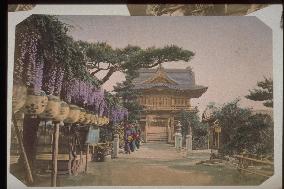
Kameido Tenmangu Shrine (present-day Kameido Tenjinsha) is one of the three main shrines dedicated to Sugawara Michizane. The other two are Dazaifu Tenmangu Shrine in Fukuoka and Kitano Tenmangu Shrine in Kyoto. The shrine is said to go back to the year 1661when the Shinto priest of Dazaifu, Sugawara Otorii Nobusuke, carved a holy image from the wood of the tobiume (plum tree) and enshrined it in the eastern part of Honjo. In 1662, the fourth Shogun Ietsuna donated the land to the shrine, and shrine buildings including the Romon Gate, Shinji Pond, and Taiko Bridge were later built in imitation of the Dazaifu Tenmangu Shrine.==Date:unknown, Place:Tokyo, Photo:unknown, (Credit:Nagasaki University Library/Kyodo News Images) [Cabinet Number51‐39‐0]

  •  
Sukarno's visit to Japan

Sukarno's visit to Japan

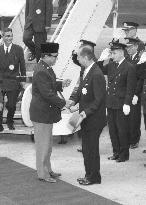
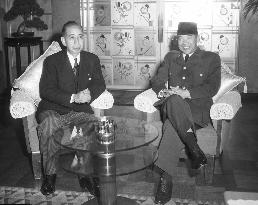
Photo taken on May 24, 1960, shows Indonesia's first president, Sukarno (L), greeted by Japanese Prime Minister Nobusuke Kishi upon his arrival at Haneda airport in Tokyo. (Kyodo) ==Kyodo

  •  
Sukarno's visit to Japan

Sukarno's visit to Japan

Photo taken on Jan. 30, 1958, shows Indonesia's first president, Sukarno (R), and Japanese Prime Minister Nobusuke Kishi posing for photos during their talks in Tokyo. (Kyodo) ==Kyodo

  •  
60th anniv. of signing of Japan-U.S. security treaty

60th anniv. of signing of Japan-U.S. security treaty

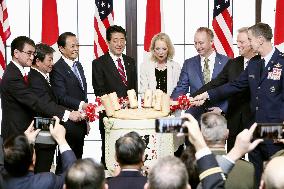
Japanese Prime Minister Shinzo Abe (C, L) and Mary Eisenhower (C, R), granddaughter of former U.S. President Dwight Eisenhower, open a barrel of sake during a ceremony marking the 60th anniversary of the signing of the Japan-U.S. security treaty in Tokyo on Jan. 19, 2020. The treaty was signed in 1960 by the governments of Prime Minister Nobusuke Kishi -- Abe's grandfather -- and President Eisenhower. (Pool photo)(Kyodo) ==Kyodo

  •  
60th anniv. of signing of Japan-U.S. security treaty

60th anniv. of signing of Japan-U.S. security treaty

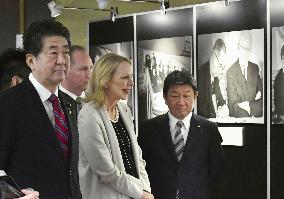
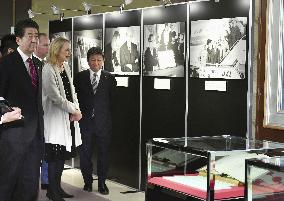
Japanese Prime Minister Shinzo Abe (L) and Mary Eisenhower (C), granddaughter of former U.S. President Dwight Eisenhower, are pictured before attending a ceremony to mark the 60th anniversary of the signing of the Japan-U.S. security treaty in Tokyo on Jan. 19, 2020. The treaty was signed in 1960 by the governments of Prime Minister Nobusuke Kishi -- Abe's grandfather -- and President Eisenhower. (Kyodo) ==Kyodo

  •  
60th anniv. of signing of Japan-U.S. security treaty

60th anniv. of signing of Japan-U.S. security treaty

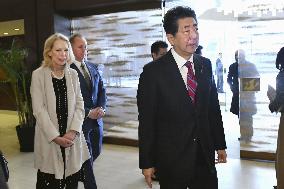
Japanese Prime Minister Shinzo Abe and Mary Eisenhower, granddaughter of former U.S. President Dwight Eisenhower, are pictured before attending a ceremony to mark the 60th anniversary of the signing of the Japan-U.S. security treaty in Tokyo on Jan. 19, 2020. The treaty was signed in 1960 by the governments of Prime Minister Nobusuke Kishi -- Abe's grandfather -- and President Eisenhower. (Pool photo)(Kyodo) ==Kyodo

  •  
60th anniv. of signing of Japan-U.S. security treaty

60th anniv. of signing of Japan-U.S. security treaty

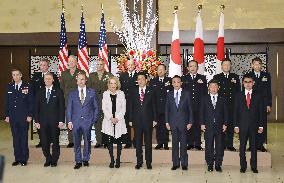
Japanese Prime Minister Shinzo Abe (5th from L in front row), Mary Eisenhower (4th from L), granddaughter of former U.S. President Dwight Eisenhower, and others pose for a photo before attending a ceremony in Tokyo on Jan. 19, 2020, to mark the 60th anniversary of the signing of the Japan-U.S. security treaty. The treaty was signed in 1960 by the governments of Prime Minister Nobusuke Kishi -- Abe's grandfather -- and President Eisenhower. (Kyodo) ==Kyodo

  •  
60th anniv. of signing of Japan-U.S. security treaty

60th anniv. of signing of Japan-U.S. security treaty

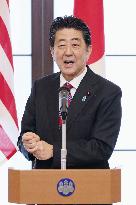
Japanese Prime Minister Shinzo Abe addresses a ceremony marking the 60th anniversary of the signing of the Japan-U.S. security treaty in Tokyo on Jan. 19, 2020. The treaty was signed in 1960 by the governments of Prime Minister Nobusuke Kishi -- Abe's grandfather -- and President Eisenhower. (Pool photo) (Kyodo) ==Kyodo

  •  
60th anniv. of signing of Japan-U.S. security treaty

60th anniv. of signing of Japan-U.S. security treaty

Japanese Prime Minister Shinzo Abe (far L) and Mary Eisenhower, granddaughter of former U.S. President Dwight Eisenhower, are pictured before attending a ceremony to mark the 60th anniversary of the signing of the Japan-U.S. security treaty in Tokyo on Jan. 19, 2020. The treaty was signed in 1960 by the governments of Prime Minister Nobusuke Kishi -- Abe's grandfather -- and President Eisenhower. (Pool photo)(Kyodo) ==Kyodo

  •  
PM Abe visits grandfather Kishi's grave in Yamaguchi Pref.

PM Abe visits grandfather Kishi's grave in Yamaguchi Pref.

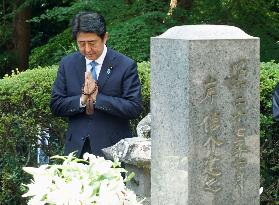
Japanese Prime Minister Shinzo Abe pays his respects at the grave of his grandfather Nobusuke Kishi, who served as prime minister from 1957 to 1960, in the town of Tabuse, Yamaguchi Prefecture, western Japan, on Aug. 14, 2016. (Kyodo) ==Kyodo

  •  
Nobusuke Kishi

Nobusuke Kishi

Born Nov. 13, 1896 in Yamaguchi Prefecture and deceased on Aug. 7, 1987. Kishi was a bureaucrat-turned politician who served as prime minister between 1957 and 1960. As a member of the cabinet of Hideki Tojo from 1941 to 1944, Kishi was in charge of Japan's economic mobilization in the war against the U.S. Though imprisoned by the occupation authorities as a class-A war criminal, he was released in 1948. As prime minister, Kishi signed the revised Japan-U.S. Security Treaty in 1960. Kishi had great influence in Japan's conservative political community until he died at the age of 90. His younger brother Eisaku Sato also served as prime minister. (Photo was taken on Dec. 23, 1964)

  • Main
  • Top
  • Editorial
  • Creative
  • About Us
  • About ILG
  • Terms of use
  • Company
  • BEHIND
  • Price List
  • Single Plan
  • Monthly Plan
  • Services
  • Shooting
  • Rights Clearance
  • Support
  • FAQ
  • How To Buy
  • Contact Us
  • Become a Partner

© KYODO NEWS IMAGES INC

All Rights Reserved.

  • Editorial
  • Olympics
  • News
  • Sports
  • Japan
  • Tech
  • Royal
  • Disaster
  • NorthKorea
  • Old Japan
  • SNS
  • Creative
  • Food
  • Japan
  • Landscape
  • Animal
  • Popular
  • #Ukraine
  • #Thailand
  • #coronavirus
  • #N. Korea
  • #Russia
  • #China
  • #Ukraine
  • #Thailand
  • #coronavirus
  • #N. Korea
  • #Russia
  • #China
  • Food
  • Japan
  • Landscape
  • Animal
  • Olympics
  • News
  • Sports
  • Japan
  • Tech
  • Royal
  • Disaster
  • NorthKorea
  • Old Japan
  • SNS